Best AI Code Review Tools in 2026 - Expert Picks
16 AI code review tools tested on TypeScript, Python, Go, and Java codebases. Features, pricing, detection quality, and false positive rates compared.
Published:
Last Updated:
Direct answer
Of the 16 AI code review tools we installed on the same four production repositories, CodeRabbit is the best general-purpose pick at $24 per developer per month on its Essentials tier, Ito is the only one that executes the change instead of reading it, and Greptile is the pick for cross-file bugs at $30 per seat. Only 3 of the 51 vendors we track publish an enterprise rate card. No party without a commercial stake has published a false-positive rate for any shipping commercial AI code reviewer. Verified 2026-10-19.
Why AI code review tools matter in 2026
Code review is one of the biggest bottlenecks in modern software development. Studies from Google and Microsoft show that developers spend 6-12 hours per week reviewing pull requests, and the average PR waits 24-48 hours for its first human review. That delay slows down shipping, frustrates developers, and creates merge conflicts that waste even more time.
AI code review tools address this bottleneck by providing near-instant automated feedback the moment a pull request is opened. The best ones go far beyond what traditional linters can do - they understand code context across files, catch logic errors, identify security vulnerabilities, and even suggest concrete fixes.
But the market has exploded. There are now dozens of tools claiming to “catch bugs before production,” and the difference between the best and worst tools is enormous. Some genuinely reduce review cycles by 30-60%. Others generate so much noise that developers disable them within a week.
We tested 16 AI code review tools on real production codebases to separate the signal from the noise. This guide covers the tools that are actually worth your team’s time - with honest assessments of what each one does well and where it falls short.
Disclosure: Gitar is our AI code review category partner and is marked as such below. Partners get a guaranteed entry in relevant lists; they do not get a rating, a rank, or the removal of a criticism. Gitar’s position here matches its 4.6 rating, and its limitations are listed in full. See our sponsorship policy.
Our testing methodology
We did not rely on marketing claims or cherry-picked demos. Every tool in this guide was installed on the same set of four production-grade repositories and evaluated against the same criteria.
Test repositories
We used four real-world repositories representing the most common production environments:
- TypeScript monorepo - A Next.js application with a shared component library, API routes, and Prisma ORM, totaling approximately 85,000 lines of code
- Python ML pipeline - A data processing and model training pipeline using pandas, scikit-learn, and FastAPI, totaling approximately 42,000 lines of code
- Go microservice - An event-driven service with gRPC endpoints, PostgreSQL, and Redis, totaling approximately 28,000 lines of code
- Java enterprise app - A Spring Boot application with multi-module Maven setup, totaling approximately 120,000 lines of code
Evaluation process
For each tool, we followed the same protocol:
- Installation and setup - Measured time from sign-up to first working review
- Planted-issue PRs - Opened 10 pull requests per repository containing intentionally introduced issues across categories: null safety, race conditions, security vulnerabilities, performance regressions, error handling gaps, and API contract violations
- Detection rate - Percentage of planted issues the tool identified correctly
- False positive rate - Percentage of comments that flagged non-issues or stylistic preferences incorrectly labeled as bugs
- Review latency - Time from PR open to first comment appearing
- Fix quality - Whether suggested fixes were correct, applicable, and did not introduce new issues
- Context awareness - Ability to understand cross-file dependencies and project-wide patterns
Here is an example of a test PR containing three common issue types:
// Intentionally buggy code for testing
async function getUserOrders(userId: string) {
  const user = await db.users.findOne({ id: userId });
  // Bug: no null check on user
  const orders = await db.orders.find({ userId: user.id });

  // Bug: race condition - orders could change between queries
  const total = orders.reduce((sum, o) => sum + o.amount, 0);

  // Security: no input validation on userId
  return { user, orders, total };
}
The strongest tools caught all three issues and provided fix suggestions. The weakest caught none and instead left comments about variable naming conventions or import ordering.
One tool evaluated on a different basis
Ito is the exception to the protocol above, and it is worth being explicit about why. The planted-issue methodology measures how well a tool reads a diff, and Ito does not read diffs - it builds and runs the application. Scoring it on detection rate against planted static issues would measure the wrong thing entirely. We evaluated it separately on a runtime-verification basis, covering what it does to a pull request, what evidence it returns, setup cost, run time, and pricing behaviour under realistic retry volume. That work is written up in full in our hands-on Ito review. Its placement here reflects that separate evaluation, not a detection-rate figure from the four test repositories. Where we cite Ito’s own published statistics, we label them as vendor-reported.
What we did not test
We focused specifically on code review quality and developer experience. We did not evaluate compliance reporting depth, RBAC granularity, or enterprise deployment options beyond noting whether they exist. For tools with enterprise tiers, we tested the highest self-service plan available.
Which AI code review tool should I use in 2026?
Direct answer: CodeRabbit for general-purpose AI review at $24 per developer per month on Essentials, Greptile at $30 per seat when your bugs are cross-file, Ito when the risk is a broken user flow rather than a bad line, and PR-Agent self-hosted and MIT-licensed when code cannot leave your network. SonarQube remains the only tool here with real quality-gate enforcement. Verified 2026-10-19.
Quick comparison: all tools at a glance
All prices below are per developer per month on the cheapest annual plan unless noted, and all were read off the vendor’s own published pricing page (verified 2026-10-19).
| Tool | Category | Free Tier | Price (per user/mo) | Best For | Languages | Platforms |
|---|---|---|---|---|---|---|
| CodeRabbit | AI PR review | Public repos only | $24 (Essentials) | Overall AI review | 30+ | GitHub, GitLab, Azure, Bitbucket |
| Ito | Agentic QA / runtime | Yes (OSS) | $40 | Bugs static review cannot see | Web + API | GitHub |
| Gitar (partner) | AI review + fixes | Trial + free OSS | $20 | Validating AI-generated code | 10+ | GitHub, GitLab, CircleCI, Buildkite, Jenkins |
| Greptile | AI PR review | Starter: 1 active dev, 50 credits/mo | $30 | Context-aware reviews | 12+ | GitHub, GitLab, Bitbucket, Bitbucket DC, Gitea, Perforce |
| SonarQube | Static analysis | Yes (Community) | ~$13/mo (billed yearly) | Enterprise rule depth | 35+ | GitHub, GitLab, Azure, Bitbucket |
| Snyk Code | Security SAST | Yes (limited) | $25 | Security-first teams | 19+ | GitHub, GitLab, Azure, Bitbucket |
| Codacy | Code quality | Developer tier, free forever (IDE) | $18 (Team, yearly) | All-in-one for small teams | 40+ | GitHub, GitLab, Bitbucket |
| DeepSource (Harness, Sept 2026) | Code quality + AI | Public repos | ~$24 + AI billed per use | Low false positives | 16 | GitHub, GitLab, Bitbucket |
| Semgrep | Security scanning | Yes (10 contributors / 10 private repos) | $30 (Code module) | Custom security rules | 30+ | GitHub, GitLab, Bitbucket |
| Sourcery | AI code quality | Yes (OSS) | $12 (Pro, annual) | Python-heavy teams | 4 | GitHub, GitLab |
| Qodo (ex-CodiumAI) | AI review + tests | Trial only, no permanent free tier | ~$30/mo flat up to 30 users | Test generation | 10+ | GitHub, GitLab, VS Code, JetBrains |
| PR-Agent | AI PR review (OSS) | Yes (self-hosted) | $30 (hosted) | Self-hosted AI review | 20+ | GitHub, GitLab, Bitbucket, Azure |
| CodeScene | Behavioral analysis | Yes (OSS) | EUR 18 | Tech debt prioritization | 20+ | GitHub, GitLab, Bitbucket, Azure |
| Pixee | Auto-remediation | Yes (public repos) | Contact sales | Fixing scanner backlogs | 5 | GitHub, GitLab |
| Panto | AI code review + security | Yes (open source) | $15 | All-in-one review + SAST + secrets | 30+ | GitHub, GitLab, Bitbucket, Azure DevOps |
How much do AI code review tools cost?
Direct answer: The self-serve band is $12 to $48 per developer per month. Sourcery Pro is the cheapest at $12 annually, CodeRabbit Essentials is $24, Greptile and cubic Team are $30, and CodeRabbit Team is $48. Usage-only pricing undercuts all of them for low PR volume: Macroscope charges $0.05 per KB reviewed with a $0.50 floor and no seat fee. Verified 2026-10-19.
Pricing comparison
Pricing transparency matters. Here is what each tool actually costs for different team sizes, based on each vendor’s publicly listed pricing (verified 2026-10-19). Prices moved materially since our previous pass in March 2026, so treat any older version of this table as stale.
| Tool | Free Tier | 5 devs/month | 20 devs/month | 50 devs/month | Billing Model |
|---|---|---|---|---|---|
| CodeRabbit (Essentials) | Public repos only | $120 | $480 | $1,200 | Per seat, 1 linked repo |
| CodeRabbit (Team) | Public repos only | $240 | $960 | $2,400 | Per seat, 5 linked repos |
| Ito (Pro) | Qualified OSS only | $200 | $800 | $2,000 | Per seat + $3 per review over allowance |
| Gitar (Core) | 14-day trial, free for OSS | $100 | $400 | Enterprise (50-user cap) | Per seat |
| Gitar (Pro) | 14-day trial, free for OSS | $200 | $800 | Enterprise (50-user cap) | Per seat |
| Greptile | Starter: 1 active dev | $150 | $600 | $1,500 | Per dev who received a review; credits do not pool |
| SonarQube Cloud | Community Build (free) | ~$65 | ~$260 | ~$650 | LOC-based (starts ~$150/yr) |
| Snyk Code | 1 user, limited scans | $125 | $500 | $1,250+ | Per dev (Enterprise pricing varies) |
| Codacy | Developer tier free forever | $90 | $360 | Business, quote-only (Team caps at 30 devs) | Per seat, yearly |
| DeepSource (Harness) | Public repos | $120 + AI usage | $480 + AI usage | $1,200 + AI usage | Per committer, AI review billed separately at $8-$15 per 10K LOC |
| Semgrep (Code) | 10 contributors / 10 private repos | $150 | $600 | $1,500 | Per contributor, per module |
| Sourcery | OSS only | $60 | $240 | $600 | Per seat, annual |
| Qodo | Trial only | ~$30 flat | ~$30 flat | Quote-only above 30 users | Flat team fee + credits at $0.012, no rollover |
| PR-Agent (self-hosted) | Free, MIT licence | $0 + LLM spend | $0 + LLM spend | $0 + LLM spend | Your own API keys |
| CodeScene | OSS only | EUR 90 | EUR 360 | EUR 900 | Per author |
| Pixee | Public repos | Contact sales | Contact sales | Contact sales | Enterprise |
| Panto | Free for open source | $75 | $300 | $750 | Per developer |
Note: Ito’s seat price is not the number to model. It includes 20 reviews per seat per month and charges $3 for each one after that, and every re-run on a failing PR counts. A PR that takes three attempts to go green consumes four runs, so a team using Ito as a merge gate will clear the allowance faster than raw PR count suggests. The figures above are the subscription floor, not the expected bill.
Note: SonarQube’s pricing model is LOC-based rather than per-seat, which means costs scale with codebase size rather than team size. The figures above are estimates based on typical repository sizes. Actual costs may be lower for small codebases or significantly higher for large monorepos.
Detailed tool reviews
1. CodeRabbit - Best overall AI code review
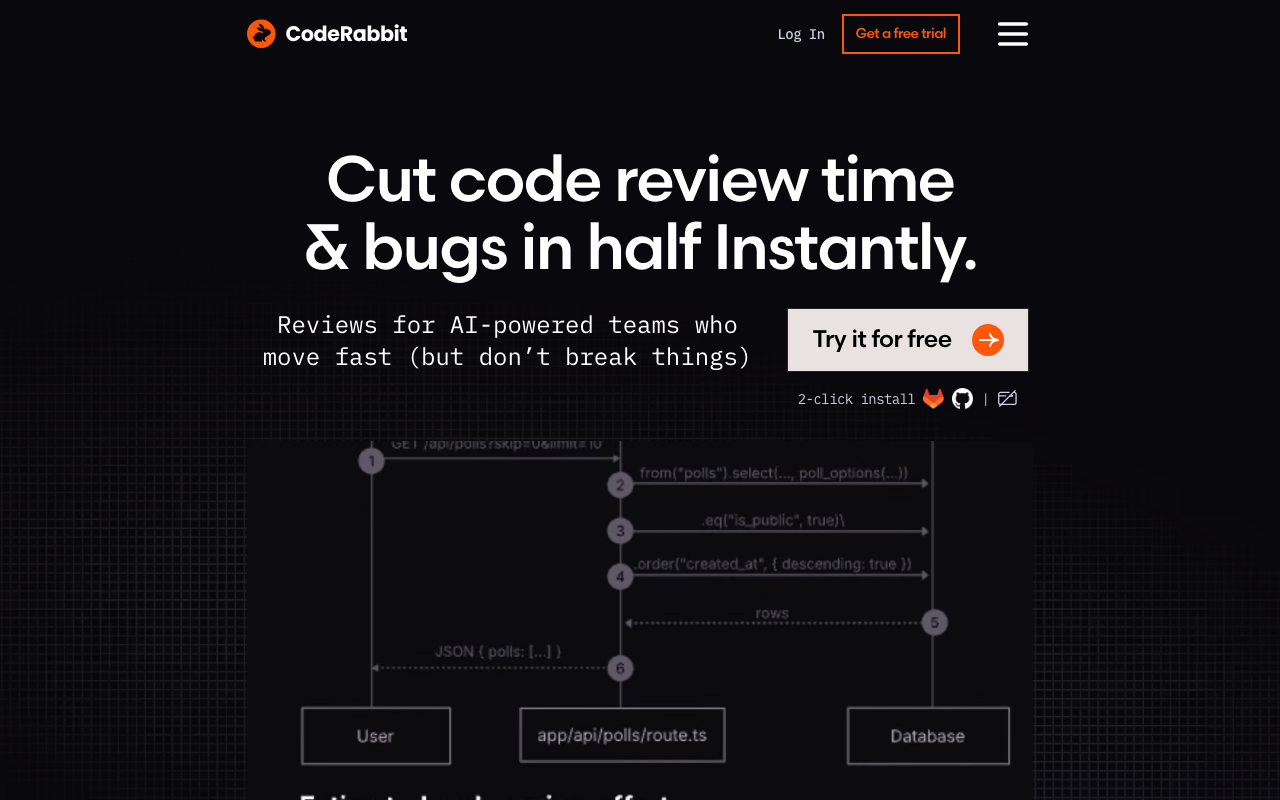
Rating: 4.7/5 | Free on public repos / $24 per user/month (Essentials, annual)
CodeRabbit is the most widely installed AI code review app on GitHub, with over 2 million repositories connected and 13 million pull requests reviewed. In our testing, it consistently produced the most useful feedback with the least noise across all four test repositories.
What CodeRabbit does best: CodeRabbit uses LLMs to understand code semantics rather than matching against fixed rules. It generates a structured summary of every PR (a walkthrough describing what changed and why), then leaves inline comments on specific lines where it finds issues. It caught null safety bugs, race conditions, and missing error handling in our test PRs - and its suggested fixes were applicable without modification in the majority of cases.
The natural language instruction system is what separates it from competitors. Instead of writing YAML rules or learning a domain-specific language, you describe what you want in plain English:
# .coderabbit.yaml
reviews:
  instructions:
    - "Always check for null/undefined before accessing properties"
    - "Flag any database query without error handling"
    - "Warn about functions longer than 40 lines"
    - "Enforce that all API endpoints validate input with Zod"
This makes configuration accessible to every developer on the team, not just the senior engineers who understand static analysis rule syntax.
Key features:
- PR walkthrough generation - Automatic summary of changes with file-by-file breakdown
- Inline code suggestions - Context-aware fix suggestions that can be applied with one click
- 40+ built-in linters - Complements AI analysis with deterministic rules for formatting and style
- Natural language rules - Configure review behavior in plain English via
.coderabbit.yaml - Multi-platform - GitHub, GitLab, Azure DevOps, and Bitbucket support
Pricing (verified 2026-10-19): The free tier covers public repositories only. CodeRabbit’s pricing page now reads “free reviews forever for public repositories”; private repos are not included, and a free account gets 1 summary-only private PR review per hour plus 3 IDE and 3 CLI reviews per hour. Paid tiers were renamed in September 2026: Pro became Essentials at $24/dev/mo annual ($30 monthly), Pro Plus became Team at $48 ($60), and a new Advanced tier sits at $72. Prices did not change, only the names. Lite and Pro Legacy were retired on 8 June 2026. Overage is $0.25 per reviewed file. Self-hosting is available to organisations with 500+ seats. If you see “CodeRabbit Pro” quoted anywhere, including in an older version of this page, it is stale.
Who it is for: Any team that wants AI-powered PR review without a heavy setup process, and that can live inside the linked-repository cap.
Honest limitations: CodeRabbit does not replace deterministic static analysis. It does not track technical debt over time, enforce quality gates, or provide coverage metrics. For compliance-heavy environments, you still need a tool like SonarQube or Codacy alongside it. Review quality can also vary on highly domain-specific code where the LLM lacks training data.
The constraint most comparisons omit is the linked-repository cap: Essentials covers exactly 1 repository, Team 5, Advanced 10 and Enterprise 20 (verified 2026-10-19). For a small team with six services that single-repo limit, not the seat price, is what decides your tier. File caps matter too: 150 files per review on Free and Essentials, 300 on Team and above, with a hard stop above 300 files on usage-priced on-demand reviews. The 5 / 8 / 10 / 12 hourly review limits degrade to 1 per hour under fair-usage enforcement, which for Essentials kicks in at 30 and 60 reviews per rolling 7 days.
One more thing worth knowing, because it is unusually candid for a vendor default: CodeRabbit reads its competitors’ instruction files. The knowledge_base.code_guidelines.filePatterns defaults include **/REVIEW.md, **/CLAUDE.md, **/AGENTS.md, **/.cursorrules, .github/copilot-instructions.md, **/GEMINI.md and **/.windsurfrules (verified 2026-10-19). If you already wrote review rules for another tool, CodeRabbit will pick them up with no extra configuration.
2. Ito - Best for catching bugs static review cannot see
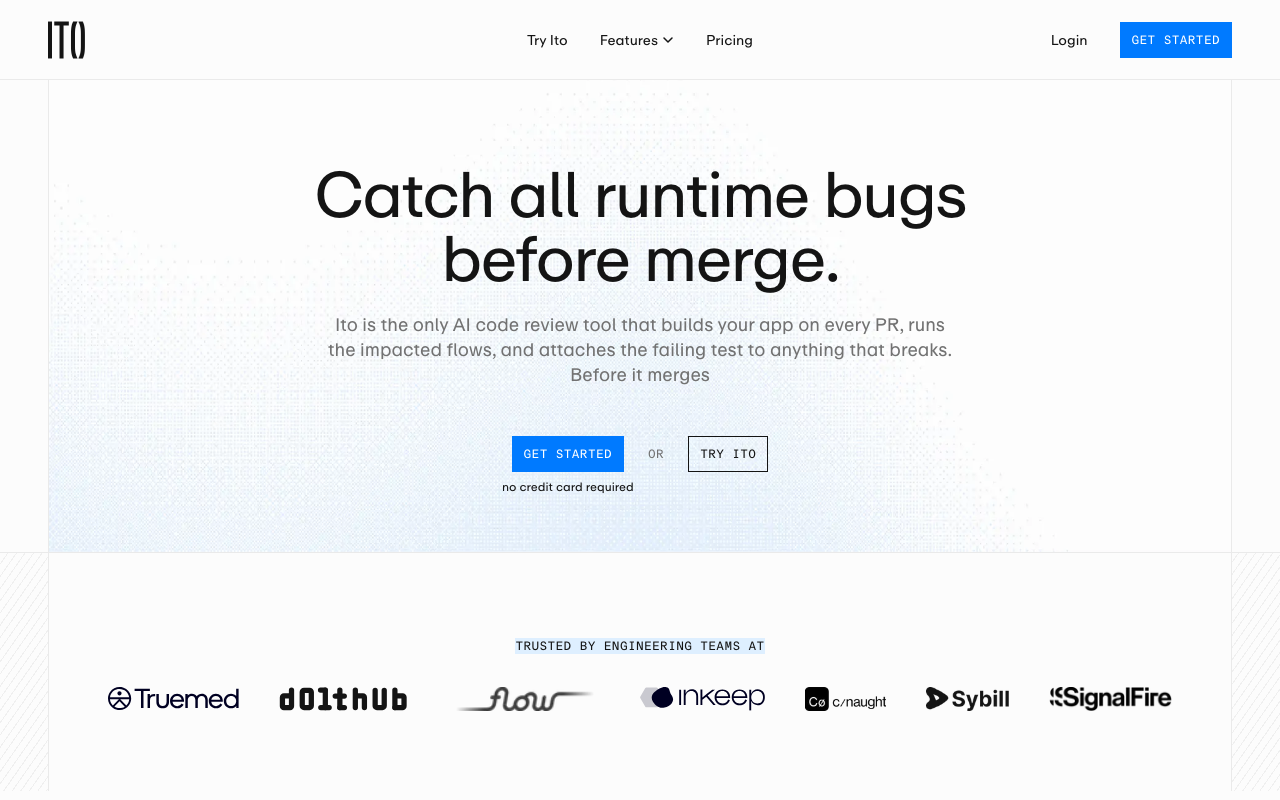
Rating: 4.8/5 | Free (OSS) / $40 per seat/month
Every other tool on this list reads your pull request. Ito runs it. That is not a marketing distinction, it is a category one, and it is why the youngest product here takes the second slot.
The gap it addresses is straightforward once stated. A linter, a static analyzer, an LLM reviewer, and a human reviewer are all inspecting the same artifact: the text of a change. None of them execute it. In teams where an agent writes a meaningful share of the diff and nobody reads every line anymore, the first thing that actually runs the code is production. Ito moves that first execution to before the merge.
What Ito does best: It builds a disposable copy of your application from source in a containerized sandbox, infers from the diff and the PR description which user flows the change could affect, then drives those flows in a real browser the way a user would. It validates outcomes rather than patterns. Did checkout complete? Did the form submit? Does the flow that worked last week still work?
The evidence it posts back is the part that earns the rating. Each failure arrives with a video replay of the run, the lines of code it holds responsible, reproduction steps, and a severity rating. That is the best failure reporting of any tool in this guide, and it is not close. The cost of a red end-to-end run is almost never the fix, it is the twenty minutes spent reproducing the failure locally before you can start. Watching the failure happen removes most of that. Push a fix and the run retriggers automatically.
It is also the rare tool here that needs no test framework, no browser drivers, and no CI pipeline changes. Setup is a GitHub app install, and Ito puts time-to-first-tested-PR at about 60 minutes - the lowest adoption cost on this list for the largest jump in what gets caught.
Key features:
- Runtime execution - Builds and drives your actual application rather than analysing the diff
- Inferred test plans - Derives coverage from the change itself, so there are no scripts to write and nothing to maintain when a CSS class gets renamed
- Video replay - Every run attaches a recording of what happened
- Reproduction steps and responsible lines - Failures arrive triaged, not just reported
- Severity ratings - Prioritises what to fix before merge
- Automatic re-run - Re-validates as soon as you push a fix
Pricing: Free for qualified non-commercial MIT and Apache open source projects, with unlimited public repos and full video. Pro is $40/seat/month including 20 reviews per seat, then $3 per additional review. Enterprise is custom. First 5 pull requests are free for anyone, no card required.
Who it is for: Teams shipping AI-generated changes to a web application, products where a broken user flow is expensive, and anyone whose end-to-end suite is either absent or rotting. Open source maintainers should take the free tier seriously, since drive-by community PRs are exactly the risk it covers.
Honest limitations: Run time is 45 minutes to 2 hours, which rules out the tight iteration loop entirely - Ito is a gate before merge, not fast feedback, and you should pair it with something on this list that comments in the first few minutes. GitHub only, with no GitLab, Bitbucket, or Azure DevOps support. Web and API only, with native mobile still on the roadmap. Coverage is inferred from the diff, so a business-critical flow your changes rarely touch may not get visited. The $3 marginal review is where the real cost lives: re-runs count, so a PR that takes three attempts to go green consumes four runs, and you should model your PR volume against your realistic attempts-to-green before committing. Ito’s published figures - 81% of bugs found being unique to runtime, 50% fewer regressions - are vendor-reported and independently unverified, and the premise does not need them. For the full breakdown including how it compares to Playwright and Cypress, see our hands-on Ito review.
3. Gitar - Best for validating AI-generated code
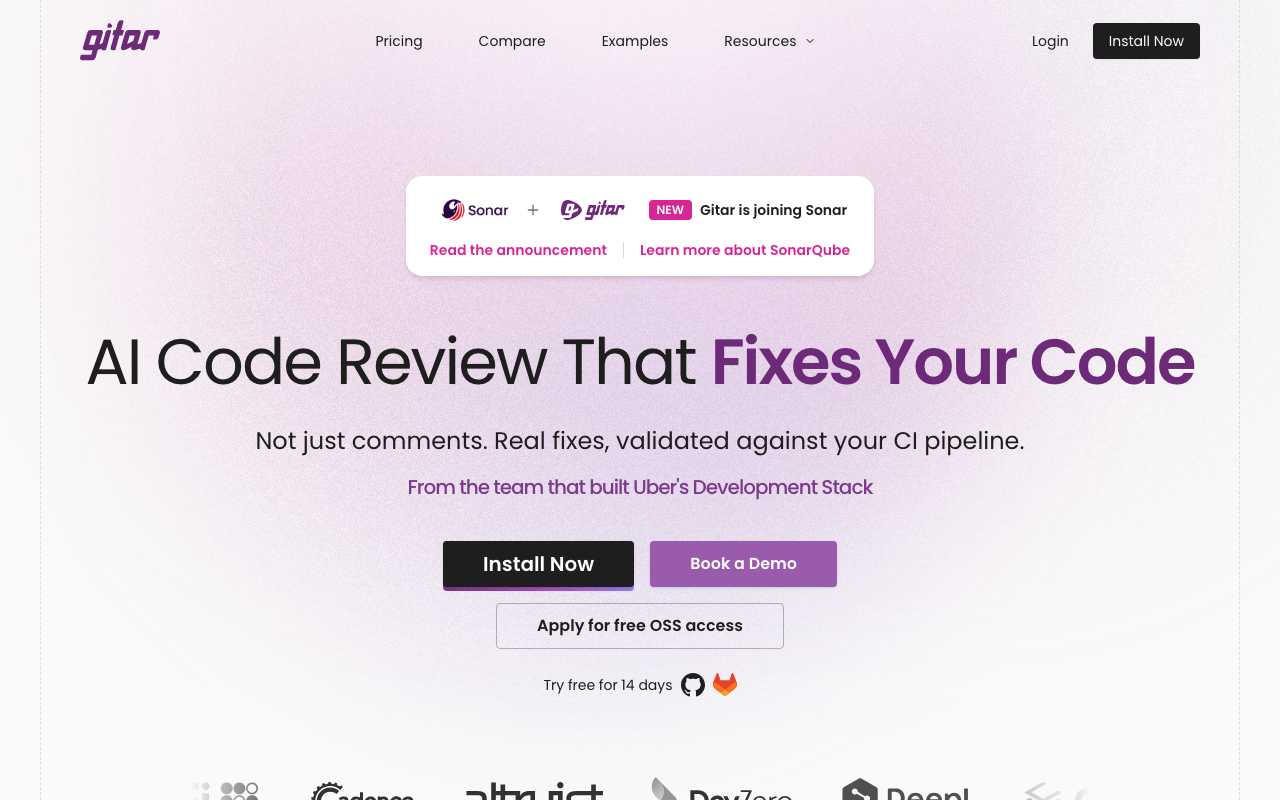
Rating: 4.6/5 | $20 per user/month (Core), $40 (Pro) | Category partner - see disclosure
Gitar is the one tool on this list that is not really trying to write better review comments. It is trying to make the comment unnecessary. When it finds a problem it has high confidence in, it commits the fix, runs your CI against it, and only escalates to a human if the validation fails. The founding team built the internal tooling behind Uber’s development stack, where the same approach generated 4,881 pull requests in six months across Thrift-to-gRPC and feature flag cleanup migrations. Sonar acquired the company in May 2026, five weeks after it exited stealth.
What Gitar does best: Closing the loop. Every other tool in this guide ends its work at a suggestion a human has to act on. Gitar is the only one that applies the change, runs CI against it, and reports back. That difference compounds when the PR queue is full of agent-written code nobody has the appetite to read line by line.
The hybrid architecture is the other differentiator. Gitar runs a deterministic static analysis pass before invoking the LLM and uses the static results to constrain what the model is allowed to assert. That is a structurally sounder answer to hallucinated findings than prompt tuning, and it is the reason the tool is quieter on stylistic issues than the pure-LLM reviewers here.
Key features:
- Fixes, not just comments - Applies the change as a commit and validates it against CI
- CI failure triage - Deduplicates repeated build failures and retries flaky tests instead of surfacing them as review noise
- Migration automation - Framework upgrades, API deprecations, and language shifts across many repos (Enterprise)
- Agent-agnostic validation - Built to check output from Claude Code, Cursor, Codex, Devin, and Copilot
- Natural language CI agents - Define policy and workflow checks in plain English
Pricing: Core $20/user/month, Pro $40/user/month, Enterprise custom. 14-day trial, no card. OSI-licensed public repos get Pro free. Note that auto-applying fixes is a Pro feature - budget at $40 if the fix workflow is why you are here.
Head-to-head comparisons: Gitar vs CodeRabbit, Gitar vs Qodo, and Gitar vs Greptile.
Who it is for: Teams whose PR volume is now dominated by AI-generated code, and organizations with a real migration project on the roadmap.
Honest limitations: No permanent free tier for private repos. Both self-serve plans cap at 50 users, so growth pushes you into an Enterprise contract. The product is mid-integration into Sonar’s platform, and buyers making a multi-year commitment should expect the positioning to move. Language coverage (10+) is narrower than CodeRabbit’s 30+, and there is less public benchmark data than the incumbents have.
4. Greptile - Best for context-aware reviews
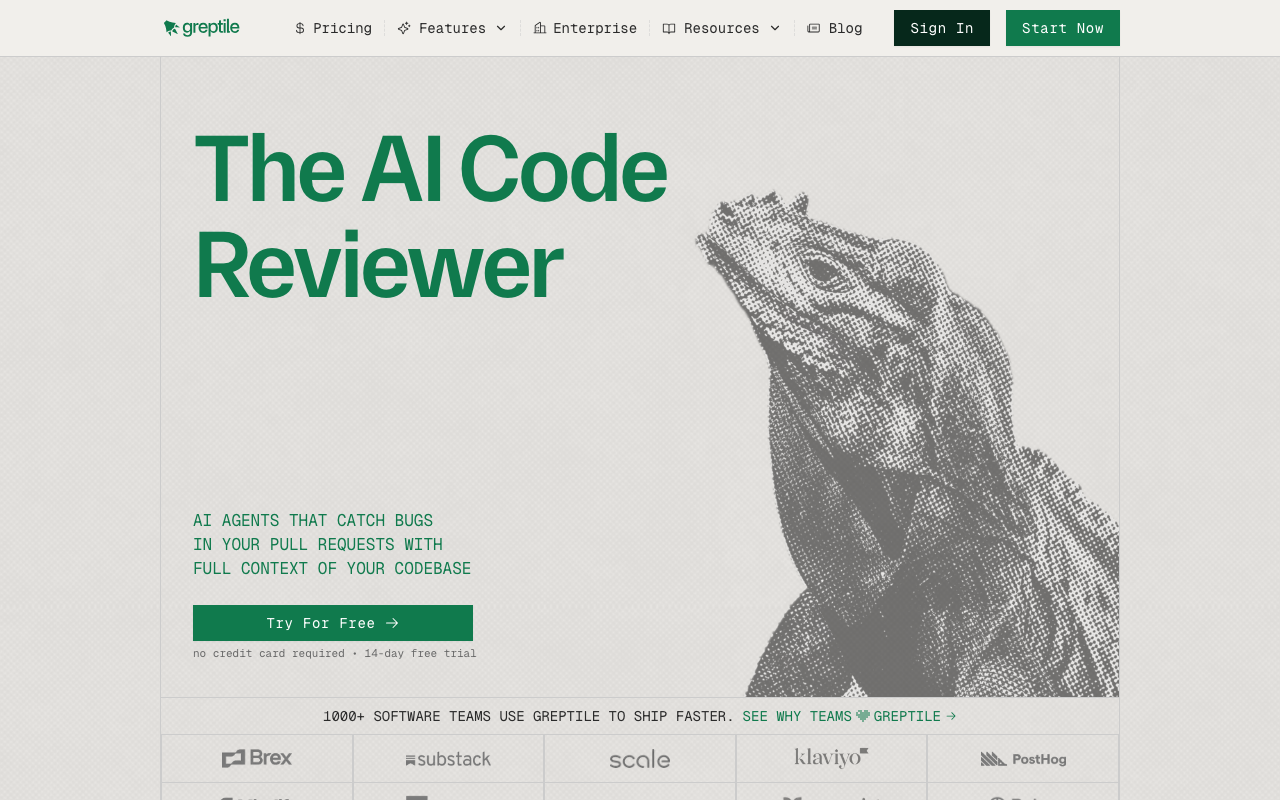
Rating: 4.5/5 | $30 per dev/month
Greptile takes a fundamentally different approach to AI code review. Before reviewing any pull request, it indexes your entire codebase to build a semantic understanding of how all the pieces fit together. This means it catches issues that require cross-file or cross-package context - the kind of bugs that neither rule-based tools nor context-limited AI tools can detect.
What Greptile does best: In our Go microservice tests, Greptile found a bug that every other tool missed. A recent refactor had changed a function signature in one package, but a caller in a different package was still passing the old argument type. The code compiled because Go interfaces made the types compatible, but the runtime behavior was incorrect. Greptile flagged it because it understood the intent of both functions across the codebase.
Greptile also excels at understanding project conventions. After indexing, it learns your team’s patterns - how you name variables, structure error handling, organize modules - and flags deviations. This is especially valuable for onboarding new team members whose code might be functionally correct but stylistically inconsistent.
Key features:
- Full-codebase indexing - Builds a semantic map of your entire repository before reviewing
- Cross-file context - Detects issues spanning multiple files and packages
- Convention learning - Learns and enforces your team’s coding patterns
- Natural language Q&A - Ask questions about your codebase in Slack or your IDE
- API access - Build custom workflows on top of Greptile’s codebase understanding
Pricing (verified 2026-10-19): A Starter tier is free for 1 active developer with 50 credits a month. Pro is $30/seat/month with 50 credits included and $1 per extra credit. A “seat” is any developer who received a review, not anyone you add to the org, and credits are per author and do not pool - which is the single most common billing surprise on this tool. Apex depth costs 10 credits per review. Greptile publishes startup terms: 50% off pre-Series A under $2M revenue, plus one month free and special pricing for YC companies. Greptile raised a $25M Series A led by Benchmark in September 2025 at roughly a $180M valuation; some 2026 coverage misdates that round to 2026.
Who it is for: Teams with large, interconnected codebases where cross-file bugs are a real problem. Particularly strong for monorepo setups and teams doing frequent refactoring.
Honest limitations: The initial indexing process can take significant time on large repos. Review latency is higher than lighter tools because the analysis is deeper. Language support (12+ languages) is narrower than CodeRabbit’s 30+, and Greptile’s own documented claim of “all languages supported” is unfalsifiable. Its published 82% benchmark score is Greptile scoring Greptile on an internal 50-PR, 5-repo evaluation. Augment Code re-ran the same repositories and scored Greptile at 45% - as an F-score, not a catch rate - after expanding and correcting the golden comments by reviewing each PR manually. So the 82-versus-45 gap is partly a different answer key rather than purely self-dealing, and neither number is independent. Note also that Augment’s code-review assets were acquired by Harness on 8 October 2026 (verified 2026-10-19), so that re-run now sits inside a company that sells DeepSource.
5. SonarQube - Best for enterprise rule depth
Rating: 4.5/5 | Free (Community) / ~$150/year (Developer)
SonarQube is not primarily an AI tool, but it belongs on this list because it remains the deepest rule-based analysis platform available, and its recent AI CodeFix feature adds machine learning-powered fix suggestions. With 6,500+ rules across 35+ languages, SonarQube catches classes of issues that AI-only tools miss entirely - subtle concurrency bugs, resource leaks, and compliance violations.
What SonarQube does best: Quality gates. SonarQube lets you define pass/fail criteria for every pull request and block merges that do not meet your standards. No other tool on this list offers the same depth of enforcement. If you need to maintain coverage thresholds, limit code duplication percentages, and ensure zero critical security findings before any code ships, SonarQube is the only serious option.
The compliance reporting is equally strong. SonarQube maps findings to OWASP Top 10, CWE, SANS Top 25, and PCI DSS requirements out of the box. For teams in regulated industries, this audit trail is not optional - it is a hard requirement.
Key features:
- 6,500+ analysis rules across 35+ languages
- Quality gate enforcement - Block merges that fail defined thresholds
- AI CodeFix - ML-powered fix suggestions for detected issues
- Compliance reporting - OWASP, CWE, SANS, PCI DSS mapping
- Technical debt tracking - Quantifies and trends remediation effort over time
Pricing: The Community Build is free but lacks branch analysis and PR decoration. SonarQube Cloud starts at approximately $150/year for small projects (LOC-based pricing). The Developer Edition for self-hosted starts at approximately $2,500/year. Enterprise pricing starts at $20,000+/year.
Who it is for: Enterprise teams with compliance requirements, teams that need quality gate enforcement, and organizations that want to track technical debt trends over months and years.
Honest limitations: Self-hosting requires DevOps overhead (PostgreSQL, JVM tuning, upgrade management). The Community Build’s lack of PR decoration makes it impractical for teams using pull request workflows. AI CodeFix suggestions are functional but template-like compared to LLM-powered alternatives. The UI feels dated compared to newer tools. LOC-based pricing can create cost surprises as codebases grow.
6. Snyk Code - Best for security-focused teams
Rating: 4.5/5 | Free (limited) / $25 per dev/month
Snyk Code is the SAST component of the Snyk platform, which was recognized as a Gartner Magic Quadrant Leader for Application Security Testing in 2025. While it is primarily a security tool, its real-time code analysis and AI-powered fix suggestions make it a strong AI code review option for security-conscious teams.
What Snyk Code does best: Snyk’s DeepCode AI engine performs interfile dataflow analysis that traces vulnerability paths across multiple function calls and files. In our JavaScript tests, it found a prototype pollution vulnerability by following user input through three intermediate functions to a point where it was used unsafely. No general-purpose AI review tool caught that. It also found a SQL injection path in our Java tests that went through a service layer, a repository layer, and a custom query builder before reaching a raw query execution.
The platform’s breadth is its other major strength. Beyond SAST, Snyk provides SCA (dependency vulnerability scanning), container image scanning, IaC security for Terraform and CloudFormation, and cloud security posture management. If your security team wants a single pane of glass, Snyk is the closest thing available.
Key features:
- DeepCode AI engine - Interfile dataflow analysis with semantic understanding
- AI-powered auto-fix - Remediation suggestions trained on human-curated fix patterns
- Five security domains - SAST, SCA, container, IaC, and cloud security in one platform
- Reachability analysis - Filters SCA noise by identifying whether vulnerable code paths are actually reachable
- IDE integration - Real-time scanning in VS Code, JetBrains, and Visual Studio
Pricing: Free tier supports 1 user with limited scans. The Team plan starts at $25/dev/month. Enterprise pricing scales to $67K-$90K+/year for 100-developer teams, which includes the full platform.
Who it is for: Security-first teams and organizations that need comprehensive application security testing. Particularly strong for teams that want SAST and SCA in one tool rather than managing separate vendors.
Honest limitations: Snyk Code is not a code quality tool. It does not detect code smells, track complexity metrics, measure duplication, or enforce style rules. SAST language support (19+ languages) is narrower than SonarQube’s 35+. At scale, Snyk’s enterprise pricing is substantial. The platform is security-focused, so teams looking for general code review feedback need to pair it with another tool.
7. Codacy - Best all-in-one for small to mid-size teams
Rating: 4.3/5 | Free / $15 per user/month
Codacy is the closest thing to a “one tool for everything” option on this list. It bundles code quality analysis, security scanning (SAST, SCA, DAST, secrets detection), coverage tracking, and AI-powered review into a single platform. For teams that do not want to manage three or four separate tools, Codacy offers a compelling alternative at a reasonable price point.
What Codacy does best: Breadth and simplicity. You connect your GitHub, GitLab, or Bitbucket repo, and scanning starts in minutes with zero pipeline configuration. It supports 49 languages out of the box, which is more than any other tool on this list. Pricing is predictable at $15/user/month with unlimited scans and no LOC-based surprises. The AI Guardrails IDE extension (free for all developers) scans AI-generated code in real time in VS Code, Cursor, and Windsurf.
Codacy was named a G2 Leader for Static Code Analysis in 2025, and its per-user pricing model makes it particularly attractive for growing teams. A 20-person team pays $300/month for comprehensive analysis - roughly what some competitors charge for 5-10 users.
Key features:
- 49-language support - Broadest language coverage of any all-in-one platform
- SAST + SCA + DAST - Security scanning powered by multiple engines including ZAP
- Coverage tracking - Integrates with existing test coverage reporters
- AI Guardrails - Free IDE extension for scanning AI-generated code
- Secrets detection - Identifies leaked credentials and API keys in code
Pricing: Free tier covers up to 5 repositories with limited features. Pro plan at $15/user/month. Business plan with self-hosted options at approximately $37.50/user/month.
Who it is for: Small to mid-size teams (5-50 developers) that want code quality, security, and coverage in one subscription without the overhead of managing multiple tools.
Honest limitations: Rule depth is narrower than SonarQube’s 6,500+ rules. AI review features are less advanced than dedicated AI-first tools like CodeRabbit or Greptile. Self-hosted deployment is only available on the Business plan. Custom rule creation is more limited than Semgrep’s pattern-based approach.
8. DeepSource - Best for low false positive analysis
Rating: 4.3/5 | Public repos free / ~$24 per user/month plus usage-billed AI review
Ownership change: Harness acquired DeepSource on 9 September 2026 (verified 2026-10-19). DeepSource is now a Harness product, and Harness has made 15 acquisitions in total including Codecov, ShiftLeft and, on 8 October 2026, Augment Code’s Cosmos, Auggie CLI and Code Context Engine. DeepSource had 6,000+ customers at acquisition. If you are signing a multi-year deal, price in the fact that the roadmap now belongs to a platform vendor.
DeepSource has built its entire brand around signal quality. If your team has started ignoring automated review comments because of noise, DeepSource is specifically designed to solve that problem. Its sub-5% false positive rate is a DeepSource marketing figure, not a measured independent result - treat it accordingly. DeepSource also scored itself at 84.51% F1 while scoring CodeRabbit at 36.19%, and then published a blog post titled to the effect that every AI code review vendor benchmarks itself and wins, listing six vendors while omitting its own 84.51%.
What DeepSource does best: The five-dimension PR report card evaluates every pull request across Security, Reliability, Complexity, Hygiene, and Coverage. This structured feedback helps developers understand not just what to fix but what category the issue falls into. The Autofix AI feature generates context-aware fixes for the majority of detected issues, reducing manual refactoring workload significantly.
DeepSource’s 5,000+ analysis rules provide comparable depth to SonarQube, and the committer-based billing model means you only pay for developers who actively contribute code - not for reviewers or occasional contributors who read but rarely push.
Key features:
- Sub-5% false positive rate - vendor-claimed, never independently replicated
- 5,000+ analysis rules - deterministic static analysis runs before the AI agent sees the code, across 30+ languages
- Autofix AI - One-click fixes for detected issues
- Five-dimension PR reports - Security, Reliability, Complexity, Hygiene, Coverage
- Committer-based billing - Only pay for active code contributors
Pricing (verified 2026-10-19): Public repositories are analysed free. The Team seat is roughly $24/dev/month, but AI review is billed separately from the seat at $8 per 10,000 processed lines on Standard and $15 per 10,000 on Advanced, offset by a $100 annual AI credit per user. That changes the real cost of the seat materially, and it is the number most comparison tables miss.
Who it is for: Teams that have been burned by noisy tools and want high-confidence findings they can trust. Particularly strong for Python and JavaScript teams where DeepSource’s analysis is deepest.
Honest limitations: Language support covers 16 languages at GA, narrower than Codacy or SonarQube. Some languages like C/C++, Swift, and Kotlin remain in beta. The separately-billed AI review means your invoice scales with diff volume rather than headcount, which is harder to forecast than a flat seat. No DAST or container scanning. And the signal-quality pitch rests on a number DeepSource published about itself.
9. Semgrep - Best for custom security rules
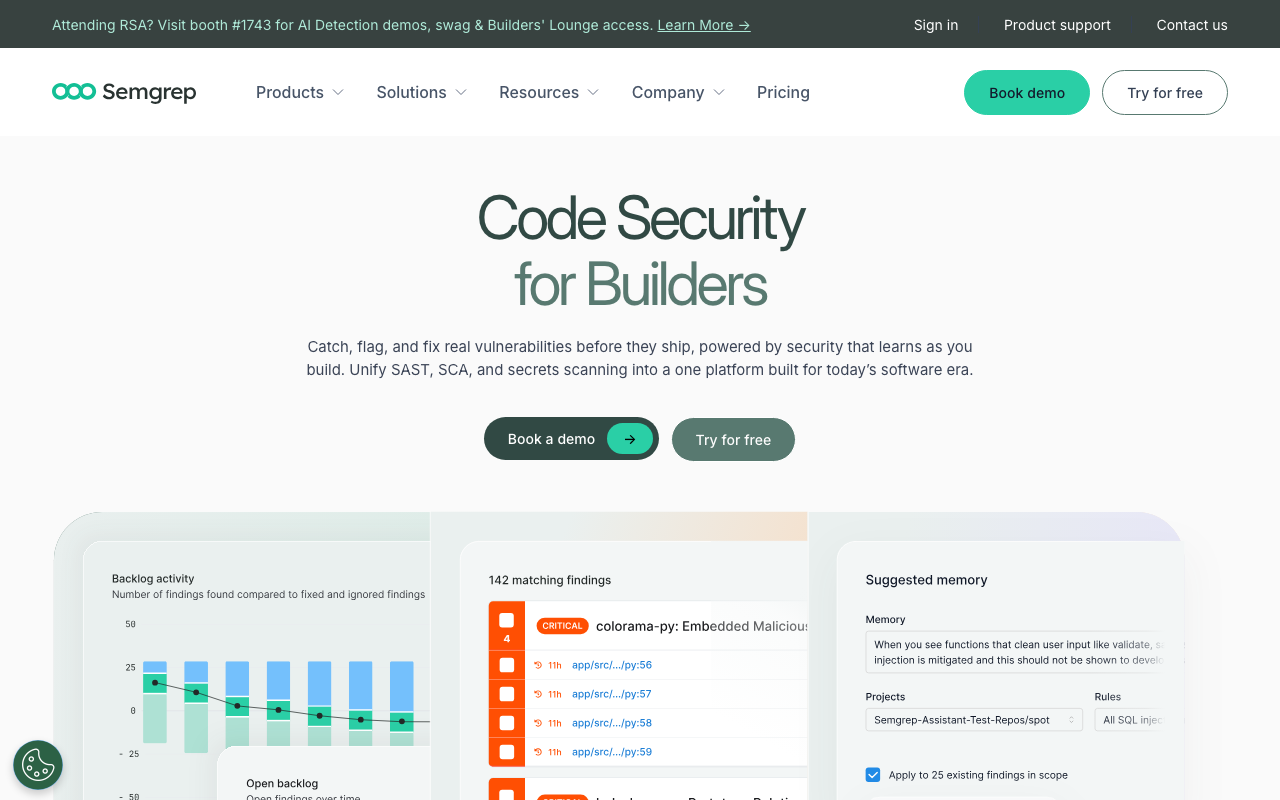
Rating: 4.4/5 | Free (10 contributors) / $35 per contributor/month
Semgrep takes a fundamentally different approach to code analysis. Instead of writing rules in a proprietary DSL or configuring XML patterns, you write Semgrep rules using syntax that looks like the source code being analyzed. Rules that would take days to implement in SonarQube’s Java-based custom rules engine can be written in 15-20 minutes with Semgrep.
What Semgrep does best: Speed and customizability. Semgrep scans at a median of 10 seconds in CI pipelines - 20-100x faster than SonarQube. The rule syntax is intuitive enough that application developers (not just security engineers) can write organization-specific rules. The Pro engine adds cross-file and cross-function taint analysis, which is essential for catching injection vulnerabilities that span multiple functions.
The Semgrep Assistant (AI-powered triage) reduces false positives by 20-40% on day one by automatically analyzing whether flagged issues are exploitable in context. The library of 20,000+ Pro rules provides out-of-the-box coverage for OWASP Top 10 and common vulnerability patterns.
Key features:
- Code-like rule syntax - Write rules using familiar source code patterns
- 20,000+ Pro rules - Comprehensive OWASP and CWE coverage
- Cross-file analysis - Pro engine traces taint across function and file boundaries
- Semgrep Assistant - AI-powered false positive triage
- 10-second median scan time - Fastest SAST tool in our testing
Pricing: Free for up to 10 contributors with the full platform. Team plan at $35/contributor/month. Enterprise pricing is custom.
Who it is for: Security-conscious teams that want to write and enforce custom rules specific to their application. DevSecOps teams that need fast CI/CD integration without slowing down pipelines.
Honest limitations: Primarily a security tool. No code quality metrics, coverage tracking, technical debt management, or code smell detection. Custom rule authoring has a learning curve for non-security engineers despite the intuitive syntax. At $35/contributor/month, costs add up quickly for larger teams.
10. Sourcery - Best for Python-heavy teams
Rating: 4.2/5 | Free (OSS) / $29 per seat/month
Sourcery focuses on code quality improvement through AI-powered refactoring suggestions. Rather than just finding bugs, it identifies code that works but could be written more cleanly - simplifying complex conditionals, replacing loops with comprehensions, extracting repeated logic into functions.
What Sourcery does best: Sourcery excels at incremental code quality improvement. Its review comments include before/after code snippets showing exactly how to simplify a piece of code. For Python especially, the suggestions reflect deep understanding of Pythonic idioms and modern best practices. The IDE integration provides real-time suggestions as you type, catching quality issues before they even make it into a PR.
Sourcery also generates PR descriptions and review summaries, saving time on documentation.
Key features:
- Refactoring suggestions - AI-powered code simplification with before/after examples
- IDE integration - Real-time suggestions in VS Code, JetBrains, and Sublime Text
- PR summaries - Automatic description generation for pull requests
- Custom rules - Define team-specific quality standards
- Quality metrics - Track code quality trends over time
Pricing: Free for open-source projects. Pro plan at $10/user/month. Team plan at $24/user/month. Enterprise pricing is custom.
Who it is for: Python-focused teams that care about code quality and readability. Teams where the problem is not bugs per se but code that is correct yet unnecessarily complex or un-idiomatic.
Honest limitations: Language support is limited to Python, JavaScript, TypeScript, and Go. Security scanning is minimal. Detection depth is narrower than dedicated SAST tools. Not a replacement for tools that enforce quality gates or track coverage. The free tier is restricted to open-source projects.
11. Qodo (formerly CodiumAI) - Best for AI-powered test generation
Rating: 4.2/5 | Free tier / $19 per seat/month
Qodo, previously known as CodiumAI, combines AI code review with automated test generation. While most tools on this list focus on finding issues in existing code, Qodo uniquely helps ensure that new code is tested from the start. Its test generation engine analyzes function behavior and edge cases to produce meaningful test suites automatically.
What Qodo does best: The AI test generation is Qodo’s standout feature. Point it at a function, and it generates a comprehensive test suite covering happy paths, edge cases, error conditions, and boundary values. The generated tests are not trivial assertions - they reflect genuine understanding of what the function is supposed to do and how it might fail.
The code review side of Qodo is solid if not exceptional. It catches common bugs and suggests improvements, with a focus on explaining the reasoning behind each suggestion. The “Qodo Chat” feature lets developers have a conversation about code quality and architecture within their IDE.
Key features:
- AI test generation - Automatic test creation covering edge cases and error conditions
- PR review - Inline code review comments with explanations
- IDE integration - VS Code and JetBrains plugins for real-time analysis
- Qodo Chat - Conversational interface for code quality discussions
- Multi-language - Supports 10+ languages for review, with deepest test generation for Python, JavaScript, and TypeScript
Pricing: Free tier with limited features. Pro plan at $19/seat/month. Enterprise pricing available.
Who it is for: Teams that struggle with test coverage and want AI help writing meaningful tests alongside code review. Particularly useful during major feature development where writing tests from scratch is time-consuming.
Honest limitations: Test generation quality varies significantly by language - excellent for Python and TypeScript, inconsistent for Java and Go. Code review depth is not as strong as dedicated review tools like CodeRabbit or Greptile. The dual focus (review + testing) means neither capability is as deep as single-focus competitors.
12. PR-Agent (Qodo Merge) - Best self-hosted AI review
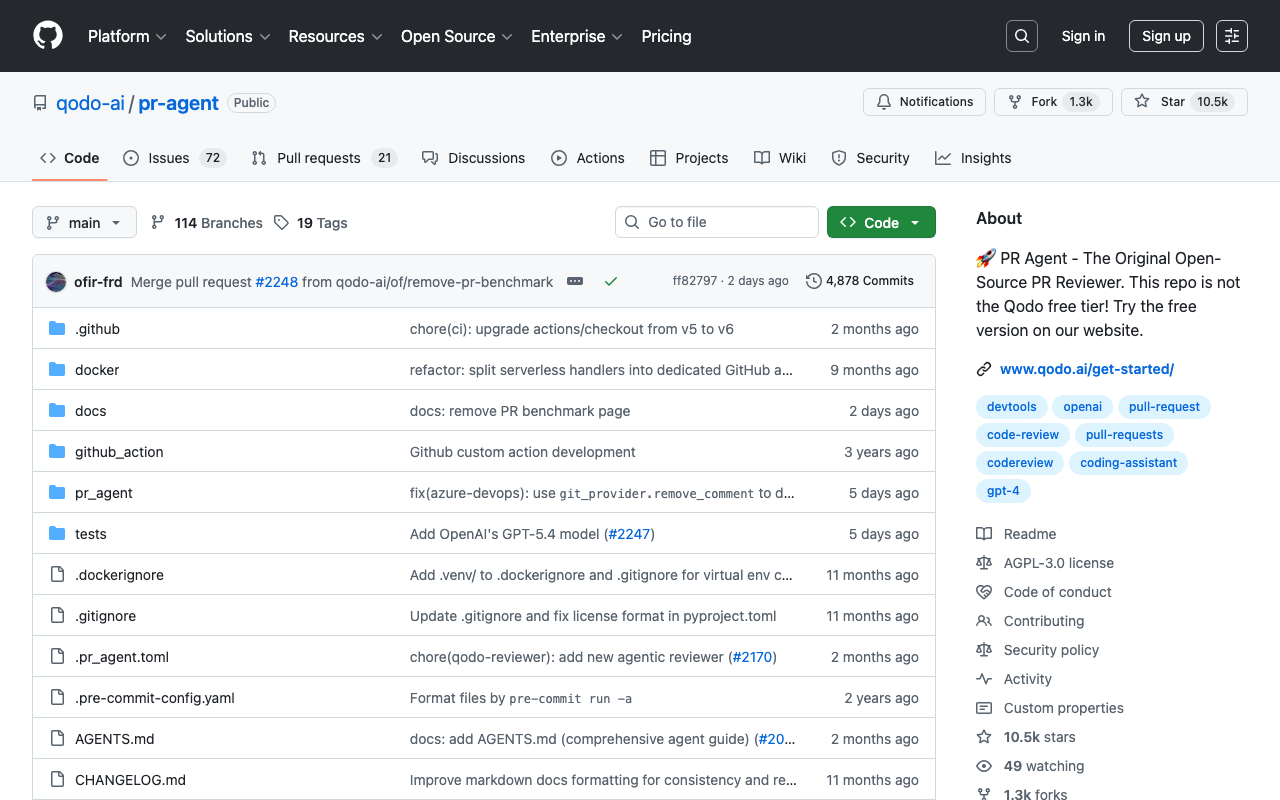
Rating: 4.1/5 | Free (self-hosted) / $19 per seat/month (hosted)
PR-Agent is an open-source AI code review tool by Qodo (the same company behind Qodo/CodiumAI). It can be self-hosted on your own infrastructure, which makes it the best option for teams with strict data sovereignty requirements who cannot send code to third-party services.
What PR-Agent does best: Flexibility and control. The self-hosted option means your code never leaves your infrastructure. The tool generates PR descriptions, review comments, code suggestions, and can even update changelogs automatically. Its modular architecture lets you enable or disable specific review capabilities. The /improve, /review, and /describe commands give developers on-demand control over what analysis runs.
As a hosted service (branded as Qodo Merge), it provides the same functionality without self-hosting overhead at $30/month flat for up to 30 users.
Key features:
- Open-source core - Full source code available, self-host with your own LLM API keys
- Modular commands -
/review,/improve,/describe,/askfor on-demand analysis - PR description generation - Automatic summaries with change type labels
- Custom prompts - Tailor review behavior through prompt engineering
- Multi-platform - GitHub, GitLab, Bitbucket, and Azure DevOps
Pricing: Self-hosted is free (you pay for your own LLM API usage). Hosted (Qodo Merge) at $30/month flat for up to 30 users. Enterprise pricing is custom.
Who it is for: Teams with data sovereignty requirements, organizations that cannot use cloud-hosted code review services, and developers who want full control over their AI review stack.
Honest limitations: Self-hosting requires maintaining infrastructure and managing LLM API costs. LLM API costs can be unpredictable depending on PR volume and size. The self-hosted version requires more setup and maintenance than turnkey solutions. Review quality depends on the underlying LLM you configure, which means results vary based on your API provider and model choice.
13. CodeScene - Best for technical debt prioritization
Rating: 4.2/5 | Free (OSS) / EUR 18 per author/month
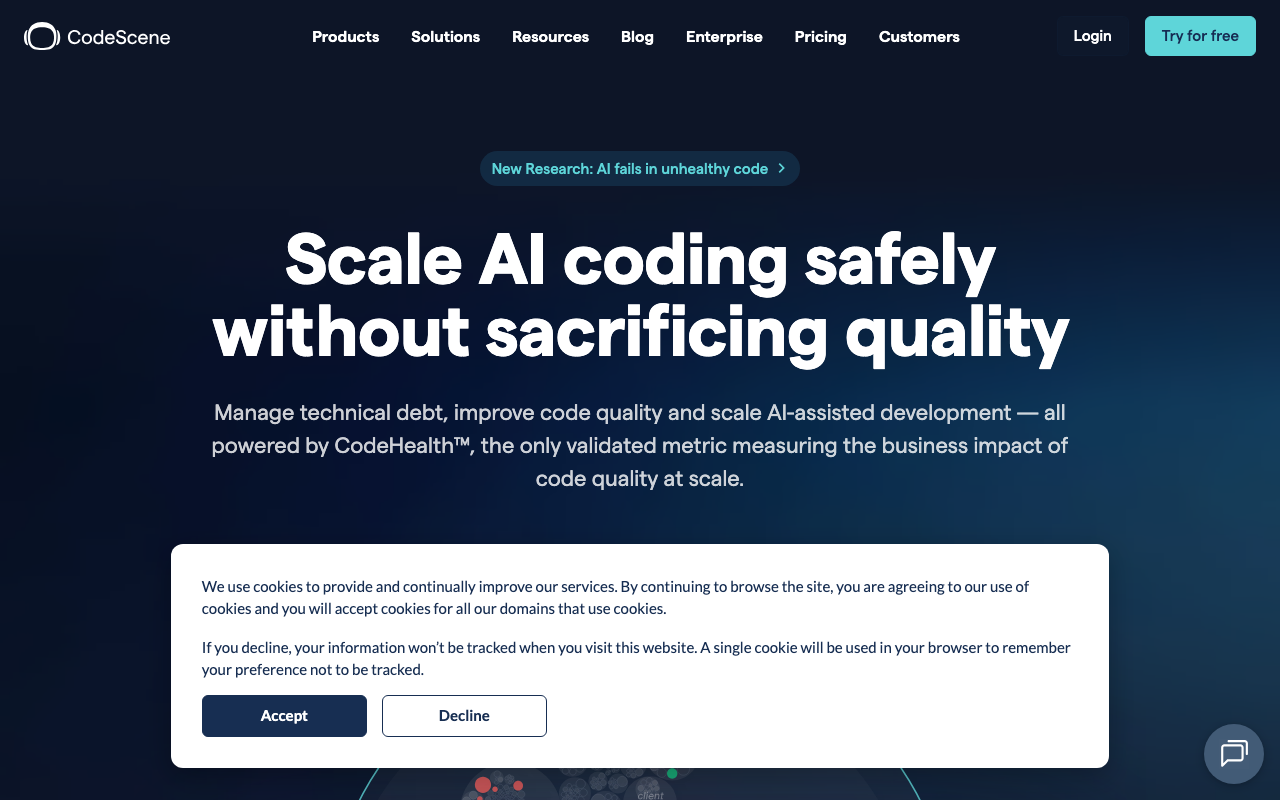
CodeScene is unique on this list because it combines traditional code analysis with behavioral analysis of how your team actually works with the code. By analyzing Git history, it identifies hotspots - complex code that changes frequently - and prioritizes technical debt remediation where it will have the most impact.
What CodeScene does best: CodeScene’s hotspot detection reveals that 80% of bugs typically concentrate in 20% of files. By identifying which complex files change most frequently, it focuses refactoring effort on the code with the highest ROI. The CodeHealth metric (1-10 scale based on 25+ research-backed factors) provides a more nuanced view of code quality than simple pass/fail gates.
The knowledge distribution analysis maps which developers understand which parts of the codebase, revealing bus-factor risks before they become emergencies. The AI refactoring agent (ACE) can automatically improve CodeHealth scores by refactoring complex code.
Key features:
- Hotspot analysis - Identifies high-change, high-complexity code
- CodeHealth metric - 1-10 scale based on 25+ code quality factors
- Knowledge mapping - Identifies bus-factor risks and knowledge silos
- AI refactoring (ACE) - Automated CodeHealth improvement
- PR risk assessment - Predicts defect probability based on change patterns
Pricing: Free for open-source projects. Team plan at EUR 18/author/month. Enterprise pricing is custom.
Who it is for: Engineering leaders and tech leads who need to make strategic decisions about where to invest refactoring effort. Teams that want data-driven arguments for addressing technical debt.
Honest limitations: Steeper learning curve than traditional static analysis tools. Not a replacement for security scanning. The AI refactoring agent (ACE) supports only 6 languages. Behavioral analysis requires meaningful Git history to produce useful results, making it less useful for new repositories. Developers may find the focus on organizational patterns less immediately actionable than concrete bug reports.
14. Pixee - Best for automated remediation
Rating: 4.1/5 | Free (public repos) / Contact sales
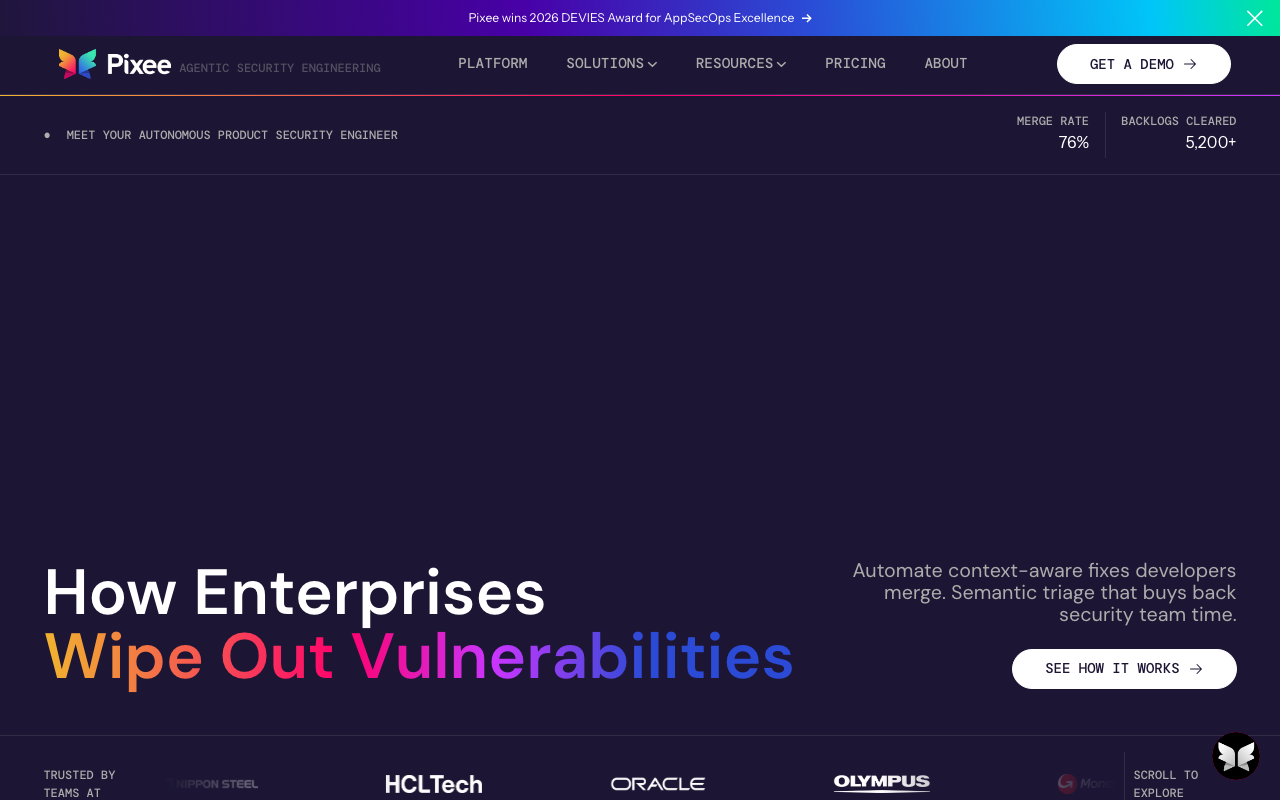
Pixee takes a different angle entirely. Rather than finding more issues, it fixes the ones your existing scanners have already found. It ingests findings from SonarQube, Snyk, Semgrep, Checkmarx, or other tools, triages false positives, and automatically generates pull requests with production-ready fixes.
What Pixee does best: If you already have a scanner generating hundreds or thousands of findings that sit in a backlog because no one has time to fix them, Pixee is the solution. It reports an 80% reduction in false positive triage and a 76% developer merge rate on its automated fix PRs. The fixes are context-aware - they respect your code style, import conventions, and error handling patterns.
The open-source codemodder framework makes it extensible, and the fixes it generates are deterministic rather than AI-hallucinated, meaning you can trust them in safety-critical codebases.
Key features:
- Scanner integration - Ingests findings from SonarQube, Snyk, Semgrep, Checkmarx, and more
- Automated fix PRs - Generates mergeable pull requests with production-ready code changes
- False positive triage - Eliminates approximately 80% of false positives before generating fixes
- Context-aware fixes - Respects existing code style and conventions
- Open-source framework - Extensible through the codemodder project
Pricing: Free for public repositories. Enterprise pricing requires sales engagement.
Who it is for: Teams that already run security or quality scanners but cannot keep up with the remediation backlog. Particularly valuable for organizations with compliance requirements that mandate timely resolution of findings.
Honest limitations: Language support is limited to Java, Python, JavaScript/TypeScript, C#, and Go. Not a standalone scanner - it requires input from other tools. Pro and Enterprise pricing is not publicly listed. Effectiveness depends entirely on the quality of findings from your upstream scanner.
15. Panto - Best all-in-one AI code review and security platform
Panto combines AI-powered PR reviews, static analysis, SAST security scanning, secret detection, and IaC scanning into a single tool. While most AI code review tools focus exclusively on PR-level feedback, Panto bundles the security layer alongside its review capabilities, which makes it one of the more consolidated single-platform options here.
What sets it apart. Panto’s core differentiator is breadth at a low price. One subscription replaces what would otherwise require separate tools for code review, static analysis, SAST, secrets detection, and IaC scanning. It supports 30+ languages and integrates with all four major git platforms - GitHub, GitLab, Bitbucket, and Azure DevOps - which is rare in the AI code review space.
Review quality. The AI engine provides inline PR feedback with fix recommendations and generates PR summaries that explain changes in plain language. PR Chat lets developers reply to findings and ask follow-up questions inside the pull request. Panto also pulls context from Jira and Confluence, so a review can reference the ticket behind a change rather than judging the diff in isolation.
Security scanning. Panto runs more than 30,000 static analysis checks per pull request alongside the AI pass. SAST covers common vulnerability classes across 30+ languages, secret detection catches accidentally committed API keys and tokens, and IaC and open-source license scanning run on the same trigger.
Pricing. Free for open-source projects with full feature access. The Teams plan is $15 per developer/month and covers unlimited private repositories, security scanning, and the Jira and Confluence integrations. Enterprise adds self-hosted deployment, SSO, and compliance-ready reporting for SOC 2, ISO, and PCI-DSS.
Strengths:
- Bundles code review, static analysis, SAST, secrets, and IaC scanning in one platform
- Supports all four major git platforms including Azure DevOps
- Aggressive pricing at $15/developer/month, free for open source
- Jira and Confluence context gives reviews awareness of intent, not just the diff
- Self-hosted deployment available for regulated environments
Weaknesses:
- Newer platform with a smaller user base than established tools
- Documentation and community resources still growing
- Less battle-tested review depth than CodeRabbit on complex, domain-specific code
Bottom line: Panto is a strong choice for teams that want a consolidated code health platform without stitching together multiple vendors. If you need review, static analysis, and security scanning in one tool on a tight budget, it covers a lot of ground for the price - just pilot it on a couple of repositories first, since it is the youngest and least proven product here.
The hidden costs of AI code review tools
Price per seat only tells part of the story. Here are the costs most teams do not consider until after they have committed:
LLM API costs for self-hosted tools. Tools like PR-Agent that let you bring your own LLM API key can generate significant API costs. A team processing 50 PRs/day with an average of 500 changed lines per PR could spend $200-$500/month on OpenAI API calls alone, depending on the model used.
False positive tax. Every false positive comment costs developer time to review and dismiss. A tool with a 20% false positive rate on a team processing 30 PRs/day generates 6+ unnecessary review interactions daily. Over a month, that adds up to hours of wasted developer attention - the most expensive resource in any engineering organization.
Integration and maintenance overhead. Self-hosted tools require infrastructure, upgrades, and monitoring. Even cloud tools need configuration, custom rules, and ongoing tuning to stay useful. Budget 2-4 hours per month for tool maintenance on top of subscription costs.
Switching costs. Once your team builds custom rules, tunes ignore patterns, and integrates a tool into their workflow, switching to a competitor is not trivial. Choose carefully upfront and start with a genuine two-week evaluation period before committing.
How to choose the right AI code review tool
The “best” tool depends on your team’s specific situation. Here is a decision framework based on common scenarios:
By team size and budget
Solo developer or open-source maintainer: Start with CodeRabbit (free, unlimited repos) or Sourcery (free for OSS). Both provide meaningful value at zero cost.
Small team (2-10 developers) on a budget: Codacy at $15/user/month gives you the most features per dollar - code quality, security scanning, coverage tracking, and AI review in one subscription. Qodo at $30/month flat for up to 30 users is a strong alternative if test generation is important.
Mid-size team (10-50 developers): CodeRabbit at $24/user/month for AI review, potentially combined with Semgrep (free for up to 10 contributors) for security scanning.
Enterprise (50+ developers): Layer SonarQube for deterministic analysis and quality gates with CodeRabbit or Greptile for AI review and Snyk Code for security.
By primary concern
“We want AI-powered code review with minimal setup”: CodeRabbit. Install in 5 minutes, get useful reviews on the next PR.
“We need to catch security vulnerabilities”: Snyk Code for comprehensive security or Semgrep for custom security rules. Both offer interfile taint analysis that general-purpose tools cannot match.
“We have a large codebase with lots of cross-file dependencies”: Greptile. Its full-codebase indexing catches issues that per-file analysis tools miss.
“AI writes a lot of our diffs and nobody reads every line anymore”: Ito. It is the only tool here that executes the change instead of reading it, so it catches broken user flows and runtime regressions that every diff-reader on this list structurally cannot. GitHub and web apps only.
“We need compliance and quality gates”: SonarQube. No other tool offers the same depth of rule-based analysis, quality gate enforcement, and compliance reporting.
“We need to reduce our scanner finding backlog”: Pixee. It integrates with your existing scanners and automatically generates fix PRs for detected issues.
“We cannot send code to third-party services”: PR-Agent. Self-host with your own LLM API keys on your own infrastructure.
“We want data-driven technical debt prioritization”: CodeScene. Its behavioral analysis identifies where refactoring effort will have the highest ROI.
The layered approach
Most teams get the best results by combining two or three tools from different categories:
- AI review layer - CodeRabbit, Greptile, or Sourcery for semantic code understanding
- Deterministic analysis layer - SonarQube, Codacy, or DeepSource for rule-based detection and quality gates
- Security layer (if needed) - Snyk Code or Semgrep for deep vulnerability detection
- Runtime layer (if you ship a web app) - Ito as a pre-merge gate that actually executes the change
This layered approach catches the widest range of issues: AI tools find logic errors and contextual problems, rule-based tools catch known vulnerability patterns and enforce standards, security tools perform deep taint analysis for injection and data flow vulnerabilities, and a runtime tool catches the flows that break even when every line of the diff looks correct. Note that layers 1 through 3 all read the same artifact, so their coverage overlaps more than you would expect. Layer 4 overlaps with none of them, which is why adding it tends to produce the biggest jump in what gets caught.
Common mistakes when adopting AI code review tools
Enabling everything at once. Start with a tool’s default configuration and gradually add custom rules based on what your team actually needs. Turning on every available check on day one creates overwhelming noise that leads to developers ignoring the tool entirely.
Treating AI suggestions as infallible. AI code review tools produce false positives and occasionally suggest fixes that introduce new problems. Establish a team culture where AI suggestions are treated as recommendations, not mandates - especially during the first month of adoption.
Not configuring ignore patterns. Every codebase has generated files, vendored dependencies, test fixtures, and other code that should not be reviewed. Spend 15 minutes setting up ignore patterns during initial setup. It will save hours of noise over the following months.
Choosing based on feature count alone. A tool with 50 features your team does not use is worth less than a tool with 5 features your team uses every day. Prioritize the capabilities that address your team’s actual pain points.
Skipping the evaluation period. Most tools offer free tiers or trials. Use them. Install the tool, run it for two weeks on real PRs, and measure whether developers find the feedback useful. If the merge-time reduction or bug-catch rate does not justify the cost, move on to the next option.
How we verified this
What we checked, and when. Pricing, plan names, platform support and free-tier terms were checked against each vendor’s own pricing and documentation pages on 2026-10-19. Where a vendor renders prices client-side and a fetch returned nothing, we say so below rather than quoting a third-party aggregator as if it were the source.
Benchmark figures are attributed to whoever paid for them. This matters more here than anywhere else on the site, because almost every number circulating in this category was produced by a company selling a reviewer:
- Greptile’s 82% is Greptile scoring Greptile on 50 pull requests across 5 repositories, not independently validated. Augment’s re-run on the same repositories scored Greptile at 45% - and that is an F-score, with Augment having rebuilt the answer key rather than reusing Greptile’s. Harness acquired Augment’s Cosmos, Auggie CLI and Code Context Engine on 8 October 2026.
- Martian Code Review Bench scored CodeRabbit at 51.2% F1 / 49.2% precision across roughly 300,000 PRs. Martian sells model routing rather than a reviewer, which makes it the least conflicted leaderboard available - and four separate vendors have each declared themselves #1 on it.
- DeepSource’s 84.51% F1 is DeepSource scoring DeepSource. Entelligence places itself first in its own benchmark. CodeAnt’s 300K-PR benchmark recommends CodeAnt.
- c-CRAB (arXiv 2603.23448) found review agents collectively identify only 41.5% of issues across 184 pull requests, 67 repositories and 234 validated review comments. One disclosure, because we hold other publishers to it: five of its six authors are academic, but one lists SonarSource, and Sonar acquired Gitar, which is a paid sponsor of this site. SonarQube is not among the four tools c-CRAB evaluates, which blunts the conflict - but we are not going to call out vendor-funded benchmarks elsewhere and stay quiet about this one.
The claim we keep making, stated precisely: no party without a commercial stake has published a false-positive rate, precision figure or noise measurement for any shipping commercial AI code reviewer. SWE-PRBench and CR-Bench do publish false-positive data, but for bare models in fixed harnesses rather than products you can buy.
What we could not verify.
- Any independent false-positive rate for any tool on this page. This is the central gap in the category. We are closing it ourselves - the method is pre-registered at the ACR Noise Index methodology before any results exist, specifically so it cannot be tuned to a conclusion.
- CodeRabbit’s max-files-per-review limits and the fair-usage hourly floor. Not on the pricing page, and the documentation path we tried returned 404.
- Tabnine’s pricing. Tricentis acquired Tabnine on 30 July 2026 and its pricing page now redirects to a Tricentis contact form, so no per-seat figure is quotable.
- Gemini Code Assist’s free individual tier. Sources conflict on whether it still serves requests, so it is excluded from comparisons rather than guessed at.
- GitHub Actions minutes consumed per Copilot review. GitHub publishes no figure, so the cost is not modellable from documentation. You measure it on your own repositories.
- Per-language precision or recall for any tool. No vendor publishes it, and none of the four academic benchmarks break results out by language.
Our position. aicodereview.cc sells no code review tool. Gitar is a paid category partner; partners get a guaranteed entry in relevant lists, never a rating, a rank, or the removal of a criticism. Gitar has no published third-party review-quality benchmark, and its own platform matrix lists GitHub Enterprise Server as unsupported. Both facts stay on the page.
Conclusion
The AI code review market in 2026 is significantly more mature than even two years ago. The best tools now genuinely understand code context, catch real bugs that human reviewers miss, and reduce review cycles measurably. But the gap between the best and worst tools is enormous, and choosing the wrong one can cost your team more in wasted attention than it saves in caught bugs.
For most teams, the recommendation is straightforward: start with CodeRabbit’s free tier for AI-powered review. If you need deeper security scanning, add Semgrep or Snyk Code. If you need quality gates and compliance, add SonarQube or Codacy. Evaluate for two weeks before committing to any paid plan.
The tools that scored highest in our testing - CodeRabbit, Greptile, and DeepSource - share a common trait: they focus on signal quality over feature count. A tool that leaves five high-quality comments is worth more than one that leaves fifty mediocre ones. Choose accordingly.
Further Reading
- Best Code Review Tools for Python in 2026 - Linters, SAST, and AI
- 12 Best Free Code Review Tools in 2026 - Open Source and Free Tiers
- Will AI Replace Code Reviewers? What the Data Actually Shows
- 13 Best Code Quality Tools in 2026 - Platforms, Linters, and Metrics
- Best Code Review Tools for JavaScript and TypeScript in 2026
- 34 Automated Code Review Tools Compared (2026)
- Azure DevOps Code Review: Tools and Setup Guide (2026)
 Gitar
GitarComments are not enough
Gitar applies the fix, validates it in CI, and clears the queue.
See it on your repo Read our independent Gitar reviewFrequently Asked Questions
Are AI code review tools worth the cost?
For most teams, yes. AI code review tools typically pay for themselves by reducing review cycle time by 30-60% and catching bugs that would otherwise reach production. A single prevented production bug can save thousands in incident response costs, which far exceeds the $15-35/month per developer that most tools charge. Many tools also offer generous free tiers for open source and small teams.
Can AI code review tools replace human reviewers?
No. AI code review tools are best used as a complement to human review, not a replacement. They excel at catching mechanical issues like null pointer dereferences, security vulnerabilities, and style violations, but they cannot evaluate architecture decisions, business logic correctness, or whether code meets product requirements. The best workflow is to let the AI handle the first pass so human reviewers can focus on higher-level concerns.
What is the difference between AI code review and static analysis?
Static analysis tools like SonarQube and Semgrep use predefined rules to detect known patterns of bugs and vulnerabilities. AI code review tools like CodeRabbit and Greptile use large language models to understand code semantics, catching logic errors and suggesting improvements that rule-based tools miss. Many modern platforms combine both approaches for broader coverage.
Which AI code review tool has the lowest false positive rate?
Nobody honestly knows, and that is the most important fact on this page. No party without a commercial stake has published a false-positive rate, precision figure or noise measurement for any shipping commercial AI code reviewer (verified 2026-10-19). Every published figure is a vendor scoring itself: DeepSource markets a sub-5% false positive rate and scored itself at 84.51% F1, Greptile scored Greptile at 82%, and Anthropic claims under 1% false positives on PRs over 1,000 lines. The closest thing to a neutral number is the Martian Code Review Bench, which put CodeRabbit at 51.2% F1 and 49.2% precision on roughly 300,000 PRs in March 2026. In our own testing CodeRabbit and DeepSource produced the least noise, but that is our judgement, not a measured rate.
Do AI code review tools work with private repositories?
Yes, every major AI code review tool supports private repositories on a paid plan, but the free tiers have narrowed. CodeRabbit's free tier no longer covers private repos at all - as of its current pricing page it says free reviews forever for public repositories, and free accounts get only 1 summary-only private PR review per hour (verified 2026-10-19). Codacy's Developer tier is free forever but IDE-focused. Greptile Starter is free for 1 active developer with 50 credits a month. cubic has no free tier at all now. Enterprise tools like Snyk Code and Checkmarx carry SOC 2 reports and documented data-handling policies suitable for sensitive codebases, but verify them against the vendor trust centre rather than a comparison table.
How long does an AI code review take?
Most AI code review tools complete their review within 1-5 minutes of a pull request being opened. Lightweight tools like Sourcery and CodeRabbit typically finish in under 3 minutes. Tools that perform deeper analysis, such as Greptile with its full-codebase indexing or Snyk Code with its cross-file dataflow analysis, may take 3-10 minutes depending on the size of the change.
What is the best free AI code review tool?
PR-Agent is the strongest genuinely free option. It was relicensed to MIT on 23 April 2026 and moved to independent community governance under The-PR-Agent org, so you can self-host it at any team size and pay only your own LLM bill (verified 2026-10-19). Kodus is AGPLv3 and free to self-host at any size. CodeRabbit used to hold this slot and no longer does: its free tier now covers public repositories only, with 1 summary-only private PR review per hour. Korbit Max is free for all open source. Codacy's Developer tier is free forever but focused on the IDE rather than pull requests. Qodo has no permanent free tier, only a 14-day trial.
How do AI code review tools handle security vulnerabilities?
AI code review tools detect security vulnerabilities using a combination of pattern matching and LLM-based semantic analysis. Tools like Snyk Code and Semgrep specialize in security with deep taint analysis and CVE database matching. CodeRabbit and Greptile catch security issues as part of broader code review, flagging common vulnerabilities like SQL injection, XSS, and hardcoded secrets alongside logic and quality issues.
Do AI code review tools support monorepos?
Yes, most AI code review tools support monorepos, though performance varies. CodeRabbit and Greptile handle monorepos well because they analyze cross-file dependencies. SonarQube and Codacy support monorepo configurations but may require additional setup for project boundaries. For very large monorepos with 500,000+ lines of code, tools like Greptile and Sourcegraph Cody are best suited due to their full-codebase indexing.
Can AI code review tools integrate with GitHub, GitLab, and Bitbucket?
Most AI code review tools support GitHub, GitLab, and Bitbucket. CodeRabbit supports all three plus Azure DevOps. SonarQube, Codacy, and Semgrep also support all major platforms. Some tools like Sourcery only support GitHub and GitLab. Before choosing a tool, verify it supports your specific platform and any self-hosted or on-premises version you may be running.
What languages do AI code review tools support?
Language support varies significantly across tools. CodeRabbit supports 30+ languages including TypeScript, Python, Go, Java, C++, and Rust. SonarQube covers 35+ languages with especially deep rules for Java and C#. Sourcery is limited to Python, JavaScript, TypeScript, and Go. Codacy supports the widest range at 49 languages. Always check that your primary languages are fully supported, not just listed as beta.
How do I set up an AI code review tool for my team?
Most AI code review tools can be set up in under 10 minutes. You typically install a GitHub or GitLab app, grant repository access, and the tool starts reviewing PRs automatically. Tools like CodeRabbit and Codacy require no server infrastructure. Self-hosted options like PR-Agent and SonarQube require more setup but give you full control over data and configuration.
What is the difference between CodeRabbit and GitHub Copilot for code review?
CodeRabbit is a dedicated AI code review tool that analyzes entire pull requests with cross-file context, security scanning, and natural language configuration. GitHub Copilot is primarily a code generation tool with basic PR review as a secondary feature. CodeRabbit provides deeper, more actionable review comments and learns from your team's patterns, while Copilot's review stays at the line level without full codebase awareness.
Are AI code review tools safe to use with proprietary code?
Reputable AI code review tools implement strong data security practices. CodeRabbit, Codacy, and Snyk Code are SOC 2 compliant and do not store your source code after analysis. Self-hosted options like PR-Agent and SonarQube keep all data on your infrastructure. Always review a tool's data handling policy, especially regarding whether code is sent to third-party LLM providers, before connecting proprietary repositories.
How accurate are AI code review tools compared to human reviewers?
AI code review tools catch 30-70% of the issues that experienced human reviewers would find, depending on the tool and issue type. They excel at mechanical issues like null safety, error handling gaps, and security vulnerabilities, often catching these faster and more consistently than humans. However, they miss architectural concerns, business logic errors, and design decisions that require domain expertise. The best results come from combining AI review with human review.
Explore More
Tool Reviews
 Panto Review
 CodeRabbit Review
 Ito Review
 SonarQube Review
 Codacy Review
 Greptile Review
 Snyk Code Review
 Semgrep Review
 DeepSource Review
 Sourcery Review
 Qodo Review
 PR-Agent Review
 CodeScene Review
 Pixee Review
Free Newsletter
Stay ahead with AI dev tools
Weekly insights on AI code review, static analysis, and developer productivity. No spam, unsubscribe anytime.
Join developers getting weekly AI tool insights.
Related Articles
34 Automated Code Review Tools Compared (2026)
34 automated code review tools compared across AI PR reviewers, static analysis, linters, security scanners, and code quality platforms with pricing.
February 10, 2026
best-of28 Best AI Developer Productivity Tools (2026)
28 AI developer productivity tools across code generation, review, testing, documentation, project management, and DevOps with pricing comparison.
February 11, 2026
best-ofBest AI Tools for Developers in 2026
15+ AI developer tools tested across code review, generation, debugging, and security. Comparison of GitHub Copilot, Claude Code, CodeRabbit, and more.
February 11, 2026