CodeRabbit vs Greptile: Which AI Reviewer Catches More Bugs?
CodeRabbit vs Greptile - we compare bug catch rates, pricing, codebase indexing, and review accuracy. Data-backed analysis to help you choose.
Published:
Last Updated:
Quick verdict
CodeRabbit and Greptile take fundamentally different approaches to AI code review, and the performance gap between them is significant. In third-party benchmarks, CodeRabbit catches roughly 82% of bugs while Greptile catches around 44%. CodeRabbit offers a free tier, costs $24/user/month on paid plans, and supports GitHub, GitLab, Bitbucket, and Azure DevOps. Greptile costs $30/user/month with no free tier and focuses primarily on GitHub.
For the majority of engineering teams, CodeRabbit is the stronger choice. It catches nearly twice as many bugs, costs less, sets up faster, and works on more platforms. Greptile’s core differentiator is its full-codebase indexing, which powers a codebase Q&A feature that has real value for onboarding and exploration. But if your primary goal is catching bugs before they reach production, CodeRabbit delivers substantially better results.
The rest of this comparison breaks down exactly how these two tools differ across review quality, pricing, platform support, configuration, developer experience, and specific use cases so you can make an informed decision for your team.
At-a-glance comparison
| Feature | CodeRabbit | Greptile |
|---|---|---|
| Primary approach | Diff analysis + contextual file awareness | Full codebase indexing + vector search |
| Bug catch rate | ~82% (third-party benchmarks) | ~44% (third-party benchmarks) |
| False positive rate | ~15% | ~22% |
| Security issue detection | ~79% | ~40% |
| Review latency (median) | ~90 seconds | ~3-5 minutes |
| Actionable fix suggestions | ~85% of comments | ~60% of comments |
| Free tier | Yes - unlimited public repos | No |
| Pro pricing | $24/user/month | $30/user/month |
| Enterprise pricing | Custom (self-hosted available) | Custom (self-hosted available) |
| GitHub support | Full | Full |
| GitLab support | Full | Limited |
| Bitbucket support | Full | No |
| Azure DevOps support | Full | No |
| Natural language config | Yes - .coderabbit.yaml | No |
| Confidence scores | No - binary review comments | Yes - per-comment confidence |
| Codebase Q&A | No | Yes - chat with your codebase |
| Auto-fix suggestions | Yes - one-click commit | Limited |
| Self-hosted option | Yes (Enterprise) | Yes (Enterprise) |
| API access | Yes | Yes |
| Setup time | ~5 minutes | ~15-30 minutes (indexing required) |
| IDE extension | No (PR-focused) | No |
| SOC 2 compliance | Yes | Yes |
What is CodeRabbit?
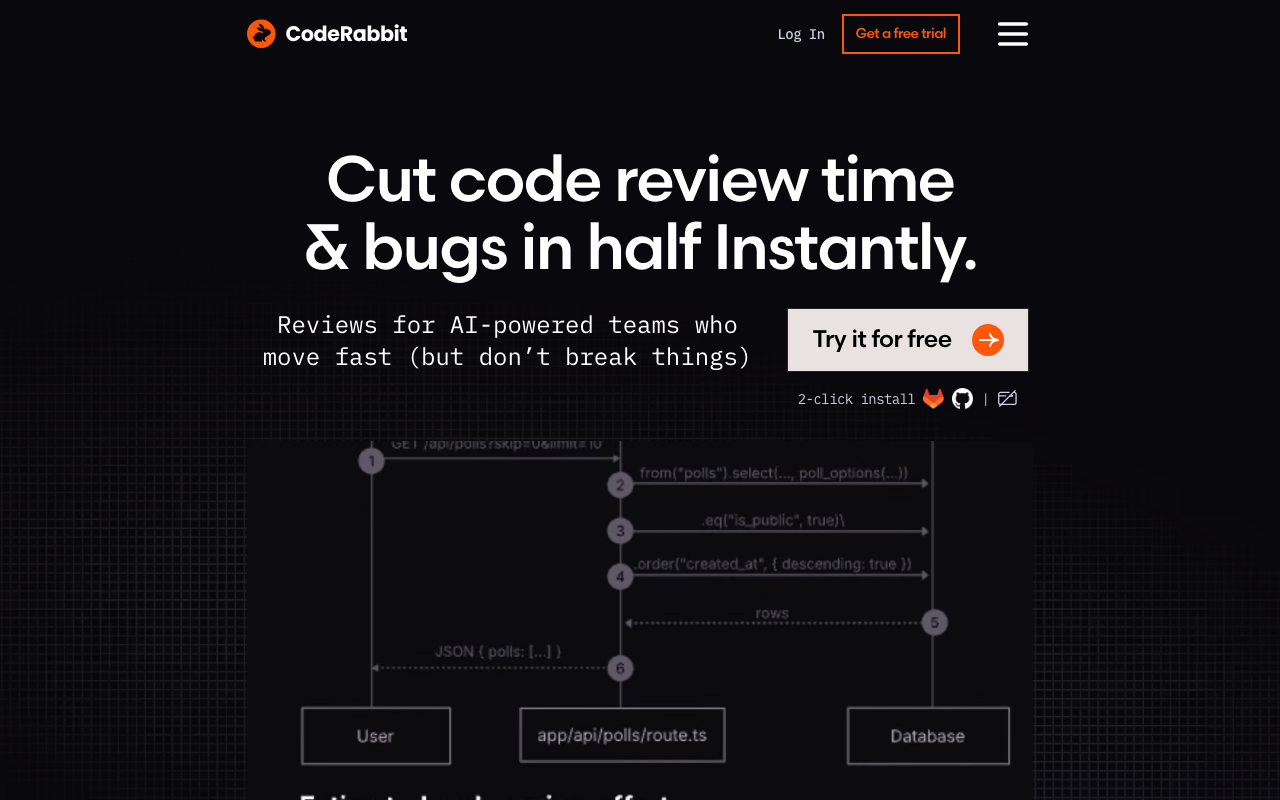
CodeRabbit is a dedicated AI code review tool that analyzes pull request diffs with deep contextual awareness. When a PR opens, CodeRabbit reads the changed files, then pulls in related files - callers, callees, shared types, configuration files, and test files - to understand the full impact of the change. It posts line-by-line review comments with specific fix suggestions that developers can commit with a single click.
The architecture is surgical and focused. Rather than trying to understand an entire codebase upfront, CodeRabbit identifies the files most relevant to the current change and analyzes them deeply. This targeted approach is what drives its high bug catch rate. CodeRabbit does not need to know about every file in your repository - it needs to know about the files that could be affected by the current PR.
CodeRabbit supports GitHub, GitLab, Bitbucket, and Azure DevOps as first-class integrations. Setup takes about five minutes: install the app on your platform, optionally configure a .coderabbit.yaml file with your review preferences, and open a PR. Reviews start immediately with no indexing step required.
Key strengths of CodeRabbit include:
- High bug catch rate. The ~82% detection rate in third-party benchmarks places it at or near the top of the AI code review category.
- Fast feedback loop. Median review latency of about 90 seconds means developers get feedback before they context-switch to other tasks.
- Natural language configuration. Teams can write review instructions in plain English, making the tool accessible to engineers of all experience levels.
- One-click fix suggestions. When CodeRabbit identifies a problem, it often provides a specific code fix that can be committed directly from the PR interface.
- Broad platform support. Four major platforms covered means CodeRabbit works regardless of where your team hosts code.
- Generous free tier. Unlimited access on public repositories with full features, making it the default choice for open source projects.
Limitations to be aware of:
- No codebase Q&A. CodeRabbit does not offer a way to ask questions about your codebase in natural language. Its focus is exclusively on PR review.
- No confidence scores. Comments are presented as review findings without an attached probability or confidence level.
- PR-focused only. There is no IDE extension or pre-commit analysis. CodeRabbit operates exclusively at the pull request stage.
What is Greptile?
Greptile indexes your entire codebase and uses that index to review changes and answer questions. Before it can review a single PR, Greptile builds a vector embedding of your repository - every file, every function, every comment. When a PR arrives, Greptile queries this index to find relevant code across the codebase. The idea is that full-codebase understanding leads to better reviews.
The indexing-first architecture is Greptile’s defining characteristic. It treats code review as a search problem: given a set of changes, what else in the codebase might be affected? By building a comprehensive index, Greptile can answer this question by querying embeddings rather than analyzing individual files on the fly.
Greptile primarily supports GitHub, with limited GitLab support. There is no Bitbucket or Azure DevOps support. The initial setup involves connecting your repository and waiting for the indexing step to complete, which can take anywhere from 10 minutes to several hours depending on codebase size.
Key strengths of Greptile include:
- Codebase Q&A. Developers can ask questions about their codebase in natural language - “Where is the authentication middleware?” or “How does the payment flow work?” This is genuinely useful for onboarding and exploration.
- Confidence scores. Each review comment includes a percentage indicating Greptile’s confidence in the finding, providing a triage signal.
- Full-codebase awareness. Because the entire repository is indexed, Greptile can sometimes identify connections between distant parts of the codebase that a diff-focused tool might miss.
- API access. Greptile offers an API that lets teams integrate codebase intelligence into their own tools and workflows.
Limitations to be aware of:
- Lower bug catch rate. The ~44% detection rate in third-party benchmarks means Greptile misses more than half of planted issues.
- Higher false positive rate. At ~22%, roughly one in five comments flags something that is not actually a problem.
- No free tier. All usage requires a paid plan starting at $30/user/month.
- Indexing overhead. The initial index build can take minutes to hours, and ongoing index updates add latency and compute costs.
- Limited platform support. Primarily GitHub-focused with limited GitLab and no Bitbucket or Azure DevOps support.
- Slower reviews. Median latency of 3-5 minutes is noticeably longer than competitors.
Feature-by-feature deep dive
Review depth and accuracy
This is where the biggest performance gap exists between the two tools. Independent benchmarks using repositories with intentionally planted bugs, security vulnerabilities, and architectural issues show CodeRabbit catching roughly 82% of issues versus Greptile’s 44%. That is not a marginal difference - CodeRabbit catches nearly twice as many bugs.
The gap extends beyond raw detection rates. When we look at the quality of review comments, CodeRabbit’s feedback tends to be more specific and actionable. About 85% of CodeRabbit’s comments include a concrete suggestion for how to fix the identified issue, compared to about 60% for Greptile. This matters because a comment that says “there might be a null pointer issue here” is less useful than one that says “this variable can be null when the upstream API returns a 404 - add a null check on line 47 before accessing .data.”
CodeRabbit’s contextual analysis explains much of this performance advantage. When reviewing a PR, CodeRabbit does not just look at the changed lines. It identifies related files - the callers of modified functions, the implementations of interfaces that changed, the configuration files that affect the behavior of modified code - and analyzes them together. This gives it the context needed to catch issues like broken call chains, mismatched types across file boundaries, and missing error handling for edge cases that only become visible when you see the broader picture.
Greptile’s full-codebase index theoretically provides similar cross-file awareness, but querying a vector embedding is fundamentally different from analyzing specific file relationships. The index captures semantic similarity rather than structural dependencies, which means Greptile can find code that “looks similar” to what changed but may miss code that is structurally dependent on the change. This distinction helps explain why broader context does not automatically translate to better bug detection.
The false positive comparison reinforces the accuracy story. CodeRabbit’s ~15% false positive rate means about one in seven comments is a non-issue. Greptile’s ~22% rate means about one in five. Over time, higher false positive rates erode developer trust. When a tool cries wolf too often, engineers start dismissing its comments reflexively, and real issues get ignored alongside false alarms. Lower noise is not just a convenience - it is essential to long-term adoption.
Language and framework support
Both tools support all major programming languages, including JavaScript/TypeScript, Python, Java, Go, Rust, C/C++, Ruby, PHP, C#, Swift, and Kotlin. Neither tool has significant language coverage gaps for mainstream development.
Where they differ is in the depth of framework-specific analysis. CodeRabbit’s review engine includes awareness of common frameworks like React, Next.js, Django, Spring Boot, and Rails. When reviewing a React component, for example, CodeRabbit understands hook rules, component lifecycle patterns, and common performance pitfalls like unnecessary re-renders. Greptile’s framework awareness depends on what its codebase index has captured, which can vary based on how well the framework patterns are represented in the indexed codebase.
For teams using less common languages or frameworks, both tools fall back on general-purpose code analysis. Neither has a meaningful advantage for niche technology stacks.
Platform support
CodeRabbit’s platform coverage is substantially broader. It supports GitHub, GitLab, Bitbucket, and Azure DevOps as first-class integrations. Each platform gets full feature parity - line-by-line PR comments, fix suggestions, natural language configuration, and all review capabilities work identically regardless of the hosting platform.
Greptile is primarily a GitHub tool. Its GitHub integration is mature and well-documented. GitLab support exists but is limited in scope - some features available on GitHub may not work on GitLab. There is no Bitbucket or Azure DevOps support at all.
This is a dealbreaker for specific organizations. Enterprise teams on Azure DevOps, which is common in companies that are heavily invested in the Microsoft ecosystem, cannot use Greptile at all. Teams using Bitbucket, which remains popular among Atlassian-centric organizations, are in the same position. For these teams, the comparison is moot - CodeRabbit is the only option.
For teams that are exclusively on GitHub, platform support is not a differentiator. But for organizations with mixed platform environments or plans to migrate between platforms, CodeRabbit’s broader support provides future-proofing that Greptile cannot match.
CI/CD integration
Both tools integrate into pull request workflows, but they take different approaches to CI/CD pipelines. CodeRabbit posts review comments directly on PRs and can be configured to act as a required reviewer, effectively blocking merges when critical issues are found. This integrates naturally with branch protection rules on any supported platform.
CodeRabbit also integrates with project management tools like Jira and Linear. When a PR references a ticket, CodeRabbit reads the ticket description and validates the implementation against the stated requirements. This cross-tool context enriches the review beyond just code analysis.
Greptile’s CI/CD integration is more focused on its API capabilities. Teams can use the Greptile API to build custom integrations that query the codebase index as part of their pipeline - for example, running a codebase-aware check before deployment. This is powerful for teams that want to build custom tooling, but it requires more engineering effort than CodeRabbit’s out-of-the-box integrations.
For teams that want a plug-and-play solution, CodeRabbit’s native platform integrations are simpler to set up and maintain. For teams that want to build custom codebase intelligence into their pipeline, Greptile’s API offers flexibility that CodeRabbit does not prioritize.
Security analysis
CodeRabbit detects security issues at a significantly higher rate. In benchmark testing, CodeRabbit identified approximately 79% of planted security vulnerabilities, compared to Greptile’s approximately 40%. This includes common vulnerability categories like SQL injection, cross-site scripting (XSS), authentication bypasses, insecure deserialization, and hardcoded credentials.
CodeRabbit’s security analysis benefits from the same contextual approach that drives its general bug detection. It traces data flow across files, identifies inputs that reach sensitive operations without validation, and flags authentication and authorization patterns that deviate from the codebase’s established conventions.
Greptile’s security analysis relies on its codebase index to identify security-relevant code patterns. While it can catch some common vulnerabilities, the lower overall detection rate suggests that the indexing approach is less effective for security analysis, where understanding specific data flow paths is more important than broad codebase similarity.
Neither tool replaces a dedicated security scanner like Snyk Code or SonarQube. Both CodeRabbit and Greptile should be viewed as an additional layer of security review, not a primary security analysis tool. Teams with strict security requirements should use dedicated SAST tools in addition to AI code review.
Pricing comparison
CodeRabbit costs less at every tier and offers a free plan that Greptile does not match. Here is the full pricing breakdown:
| Plan | CodeRabbit | Greptile |
|---|---|---|
| Free tier | Unlimited public repos, full features | None |
| Pro/Paid plan | $24/user/month | $30/user/month |
| Annual billing | Discount available | Discount available |
| Enterprise | Custom pricing, self-hosted option | Custom pricing, self-hosted option |
The cost difference scales with team size. Here is what each tool costs at different team sizes:
| Team size | CodeRabbit monthly | CodeRabbit annual | Greptile monthly | Greptile annual | Annual savings with CodeRabbit |
|---|---|---|---|---|---|
| 5 engineers | $120 | $1,440 | $150 | $1,800 | $360 |
| 10 engineers | $240 | $2,880 | $300 | $3,600 | $720 |
| 25 engineers | $600 | $7,200 | $750 | $9,000 | $1,800 |
| 50 engineers | $1,200 | $14,400 | $1,500 | $18,000 | $3,600 |
| 100 engineers | $2,400 | $28,800 | $3,000 | $36,000 | $7,200 |
For a 50-person engineering team, CodeRabbit saves $3,600 per year while providing higher bug detection rates, faster reviews, and broader platform support. The savings compound as team size grows.
The free tier difference deserves emphasis. CodeRabbit provides unlimited, unrestricted access on public repositories - the same AI model, the same review depth, the same configuration options. This makes it the default choice for open source projects, and it means any team can evaluate CodeRabbit’s review quality on real PRs before committing to a paid plan. Greptile requires a paid subscription from day one, which creates a meaningful barrier to evaluation.
For startups and early-stage teams with limited budgets, CodeRabbit’s free tier on public repos and lower per-user price on private repos make it the more accessible option. Greptile’s pricing assumes teams are ready to pay $30/user/month before seeing any results, which is a harder sell during a trial period.
Developer experience
CodeRabbit prioritizes a frictionless developer experience. The setup process takes about five minutes: install the GitHub App (or equivalent for your platform), optionally configure a .coderabbit.yaml file, and open a PR. Reviews start immediately on the next PR. There is no waiting period, no indexing step, and no configuration required to get useful feedback.
The review comments appear directly on the PR as inline comments, exactly where a human reviewer would leave them. Developers can respond to CodeRabbit’s comments in natural language - asking for clarification, requesting a different approach, or dismissing a finding. CodeRabbit remembers these interactions and calibrates its future reviews accordingly.
One-click fix suggestions are a significant developer experience advantage. When CodeRabbit identifies a problem and knows how to fix it, the fix appears as a suggestion that can be committed directly from the PR interface. No copy-pasting, no manual editing - just click “commit suggestion” and the fix is applied. This reduces the friction between identifying an issue and resolving it to a single click.
Greptile’s setup experience is slower due to the required indexing step. Before Greptile can review a single PR, it needs to build a vector index of your repository. For medium-sized codebases (50K-100K lines), this takes 15-30 minutes. For large monorepos, it can take hours. The index must be kept up to date as the codebase evolves, which adds ongoing overhead.
Once indexing is complete, Greptile’s review experience is competent but less polished than CodeRabbit’s. Reviews take longer to appear (3-5 minutes versus ~90 seconds), and the comments, while accompanied by confidence scores, tend to be less specific in their fix suggestions.
Greptile’s codebase Q&A feature is where its developer experience shines. Being able to ask “Where is the payment processing logic?” or “How does user authentication work in this project?” and get an accurate answer is genuinely valuable, especially for new team members. This is a capability that CodeRabbit does not offer, and it justifies Greptile’s value for teams where codebase exploration and knowledge sharing are priorities.
Customization and review rules
CodeRabbit’s natural language configuration system is one of the most developer-friendly in the AI code review category. Teams write review instructions in plain English in a .coderabbit.yaml file that lives alongside their code:
# .coderabbit.yaml
reviews:
  instructions:
    - "Flag any function longer than 50 lines"
    - "Require error handling around all external API calls"
    - "Warn when sensitive data is logged"
    - "Enforce that all public API endpoints validate input"
    - "Check that database queries use parameterized statements"
    - "Flag any TODO or FIXME comments that lack a tracking ticket"
These instructions are version-controlled, self-documenting, and accessible to engineers of all experience levels. A junior developer can read the .coderabbit.yaml file and immediately understand the team’s coding standards. Non-senior engineers can contribute new rules without learning a DSL or regex syntax.
CodeRabbit also learns from developer interactions. When a developer dismisses a comment or asks CodeRabbit to adjust its feedback through a reply, the tool remembers. Over weeks of use, CodeRabbit calibrates to the team’s preferences - it learns which patterns the team considers acceptable and which ones should always be flagged. This learning loop means the tool gets better over time without requiring manual configuration updates.
Greptile does not offer a comparable natural language configuration system. Its review behavior is determined by its codebase index and default AI analysis parameters. Teams have limited control over what Greptile focuses on or how it frames its feedback. For teams with specific coding standards, internal conventions, or domain-specific requirements, this lack of customization is a meaningful limitation.
Codebase indexing: Greptile’s differentiator examined
Greptile’s full-codebase indexing is the technical foundation that sets it apart from every other AI code review tool, and it is worth examining in detail. The approach works like this: Greptile reads every file in your repository, breaks the code into semantic chunks, generates vector embeddings for each chunk, and stores them in a searchable index. When a PR arrives, Greptile queries this index to find code across the repository that is semantically related to the changes.
The promise is powerful. Full-codebase awareness should theoretically enable reviews that understand distant dependencies, architectural patterns, and historical context. And in some cases, Greptile delivers on this promise. It can identify that a function being modified has a sibling implementation in another service that might also need updating. It can surface coding patterns used elsewhere in the codebase that the current PR deviates from.
But the benchmark results tell a different story about effectiveness. Despite having access to the entire codebase, Greptile catches fewer bugs than CodeRabbit, which uses a more targeted approach. CodeRabbit identifies the specific files relevant to the current PR - callers, callees, shared types, configuration - and analyzes them deeply, rather than querying a broad index. This focused analysis produces more relevant, actionable feedback because it prioritizes structural relationships over semantic similarity.
The indexing approach also introduces practical overhead. The initial index build takes meaningful time, and the index must be kept up to date. Every push to the repository triggers an index update, adding latency and compute costs. For teams with large monorepos or high commit frequency, this overhead is not trivial.
Where codebase indexing genuinely excels is Q&A and exploration. The ability to ask “How does the user authentication flow work?” and get an answer grounded in your actual codebase is valuable. This is the primary use case where Greptile’s approach outperforms alternatives. But Q&A is a different product from code review, and excelling at one does not guarantee excellence at the other.
Confidence scores: useful signal or false comfort?
Greptile attaches confidence scores to its review comments, which is a feature worth evaluating honestly. Each comment includes a percentage - for example, 92% or 67% - indicating how confident Greptile is that the finding represents a real issue. In theory, this helps developers triage AI feedback: focus on high-confidence findings first, and treat low-confidence ones as suggestions to consider.
In practice, confidence calibration is imperfect. During testing, some high-confidence comments (85%+) turned out to be false positives, while some low-confidence comments (50-60%) flagged genuine bugs. The scores provide a rough directional signal, but they are not reliable enough to use as a hard filter. A team that configures its workflow to ignore everything below 80% confidence will miss real issues.
CodeRabbit does not use confidence scores. Instead, it manages signal-to-noise through its natural language configuration and learning system. The philosophy is different: rather than telling developers “we are 73% sure this is a problem,” CodeRabbit aims to only surface findings it considers worth reviewing. The result is fewer total comments but a higher percentage of valuable ones.
For teams that want explicit confidence metadata on review comments, Greptile’s approach has appeal. But the lower overall catch rate means you are getting confidence scores on a smaller pool of findings - many real issues never appear in Greptile’s output at all, regardless of what confidence score they would have received.
Setup and onboarding compared
The setup experience differs dramatically between the two tools. CodeRabbit is designed for instant productivity. The process is:
- Install the CodeRabbit app on your platform (GitHub, GitLab, Bitbucket, or Azure DevOps)
- Authorize access to the repositories you want reviewed
- Optionally create a
.coderabbit.yamlfile with your review preferences - Open a PR - reviews begin immediately
Total time from signup to first review: approximately five minutes.
Greptile requires an indexing step that adds meaningful delay. The process is:
- Connect your GitHub account to Greptile
- Select repositories to index
- Wait for the indexing process to complete (15-30 minutes for medium repositories, potentially hours for large ones)
- Once indexing is complete, reviews begin on new PRs
Total time from signup to first review: 20 minutes to several hours, depending on codebase size.
For teams evaluating multiple AI review tools, this setup difference matters. CodeRabbit can be tested on the next PR with zero friction. Greptile requires a time investment before delivering any value. When an engineering lead is comparing three or four tools, the one that produces results in five minutes has a significant evaluation advantage over the one that needs an hour of indexing.
The onboarding difference extends to new team members. When a new engineer joins a team that uses CodeRabbit, they open their first PR and reviews appear automatically. No additional setup, no personal indexing step, no configuration required. With Greptile, the repository is already indexed, so new team members can start using the Q&A feature immediately - which is actually a strong onboarding benefit for Greptile.
When to choose CodeRabbit
Choose CodeRabbit if:
- Bug detection accuracy is your top priority. The ~82% catch rate versus ~44% means CodeRabbit catches nearly twice as many issues before they reach production.
- You want fast feedback loops. At ~90 seconds median latency, CodeRabbit reviews arrive before developers context-switch to other tasks.
- Budget matters. $24/user/month versus $30/user/month, with a generous free tier that Greptile does not offer.
- You need multi-platform support. GitHub, GitLab, Bitbucket, and Azure DevOps are all fully supported.
- Natural language configuration fits your team. Writing review rules in plain English is more accessible than any alternative configuration approach.
- Quick setup matters. Five minutes to first review, no indexing step required.
- You want one-click fix suggestions. CodeRabbit’s auto-fix capability reduces the friction between identifying and resolving issues.
- You are an open source project. CodeRabbit’s free tier on public repos is unmatched.
When to choose Greptile
Choose Greptile if:
- Codebase Q&A is a primary use case. If your team needs to ask natural language questions about your codebase for onboarding, exploration, or architectural understanding, Greptile offers a capability CodeRabbit does not have.
- Confidence scores matter to your workflow. If your team wants explicit probability indicators on review comments to help with triage, Greptile provides this feature.
- Full-codebase indexing aligns with your review philosophy. Some teams prefer the idea of AI that “knows” the entire codebase, even if the benchmark numbers suggest it does not translate to higher bug detection.
- You are on GitHub exclusively. Greptile’s GitHub integration is mature and well-supported. If you do not need other platforms, this limitation does not affect you.
- You are building custom tooling. Greptile’s API lets you integrate codebase intelligence into your own tools, which appeals to teams with strong internal platform engineering practices.
When to use both together
Some teams find value in running CodeRabbit and Greptile simultaneously. The use case looks like this:
- CodeRabbit handles all PR review. It posts line-by-line comments, provides fix suggestions, and serves as the primary quality gate on pull requests.
- Greptile serves as a codebase knowledge base. New team members use it to explore the codebase, ask architectural questions, and ramp up faster. Existing engineers use it to understand unfamiliar parts of a large codebase.
The combined cost is $54/user/month ($24 for CodeRabbit + $30 for Greptile), which is meaningful. This setup makes the most sense for larger teams (25+ engineers) where onboarding speed and codebase knowledge sharing justify the additional expense. For smaller teams, CodeRabbit alone typically covers the review needs, and codebase knowledge is managed through documentation and direct communication.
Use case comparison matrix
| Use case | Better tool | Why |
|---|---|---|
| Catching bugs in PRs | CodeRabbit | ~82% vs ~44% detection rate |
| Security vulnerability detection | CodeRabbit | ~79% vs ~40% detection rate |
| Open source projects | CodeRabbit | Free tier with full features on public repos |
| Onboarding new engineers | Greptile | Codebase Q&A helps new hires explore the codebase |
| Fast feedback loops | CodeRabbit | ~90 seconds vs ~3-5 minutes |
| Enterprise/multi-platform | CodeRabbit | Supports GitHub, GitLab, Bitbucket, Azure DevOps |
| Cost-sensitive teams | CodeRabbit | $24/user/month vs $30/user/month, plus free tier |
| Custom review standards | CodeRabbit | Natural language configuration via .coderabbit.yaml |
| Codebase exploration | Greptile | Natural language Q&A over indexed codebase |
| Triage-heavy workflows | Greptile | Confidence scores provide triage signal |
| Quick evaluation/POC | CodeRabbit | No indexing, free tier, instant setup |
| Large monorepos | CodeRabbit | No indexing overhead, faster per-review latency |
Migration considerations
If you are currently using Greptile and considering a switch to CodeRabbit, the migration is straightforward. CodeRabbit does not require any data migration - install it on your platform, configure your .coderabbit.yaml file, and it starts reviewing PRs immediately. You can run both tools in parallel during a transition period to compare results on the same PRs.
If you are currently using CodeRabbit and considering Greptile, be aware that you will need to wait for the initial codebase indexing to complete before seeing any results. Plan for a transition period where both tools run side by side, and give Greptile’s index time to build and stabilize before making a final evaluation.
For teams new to AI code review, starting with CodeRabbit’s free tier is the lowest-risk approach. You can evaluate the tool’s review quality on real PRs without any financial commitment, and if it meets your needs, upgrade to the Pro plan. If you decide you also want codebase Q&A capabilities, you can add Greptile later without disrupting your review workflow.
Bottom line
CodeRabbit outperforms Greptile on the metrics that matter most for AI code review: bug detection, pricing, platform support, and speed. The ~82% versus ~44% catch rate gap is not a rounding error - it represents a fundamental difference in review effectiveness. CodeRabbit costs less, supports more platforms, sets up faster, generates fewer false positives, and catches nearly twice as many issues.
Greptile’s full-codebase indexing is an architecturally interesting approach, and its codebase Q&A feature has genuine value for onboarding and exploration. Teams that prioritize codebase knowledge sharing alongside code review may find Greptile’s indexing-based approach appealing. But the core promise of AI code review is catching bugs before they reach production, and on that metric, CodeRabbit is the clear winner.
For teams evaluating both tools, CodeRabbit’s free tier makes the decision low-risk: install it on a public repo, open a few PRs, and see the results. No indexing wait, no credit card required. Compare those results to Greptile’s output on the same PRs, and let the data guide your decision.
Related Articles
CodeRabbit vs Codacy: Which Code Review Tool Wins in 2026?
CodeRabbit vs Codacy compared on features, pricing, and use cases. Find out which code review tool fits your team's workflow in this detailed breakdown.
March 12, 2026
comparisonCodeRabbit vs DeepSource: AI Code Review Tools Compared
CodeRabbit vs DeepSource compared for AI code review. 40+ linters vs 5,000+ rules, pricing, auto-fix, platform support, and which tool fits your team.
March 12, 2026
comparisonCodeRabbit vs GitHub Copilot for Code Review (2026)
CodeRabbit vs GitHub Copilot compared head-to-head for AI code review. See pricing, review depth, platform support, and which tool fits your team.
March 12, 2026