Veracode Pricing: Costs, Plans, and Quotes
Veracode pricing in 2026 - SAST, DAST, and SCA costs, per-application estimates, bundle pricing, and negotiation tips to lower your contract.
Published:
Last Updated:
Why Veracode pricing is so hard to pin down
If you have ever tried to figure out what Veracode actually costs, you know the frustration. There is no pricing page on veracode.com. No calculator. No transparent per-seat or per-scan rate card. Instead, you get a “Request a Demo” button that leads to a sales conversation where pricing depends on variables that Veracode controls - your application count, scan volume, contract length, and how aggressively their sales team is pursuing your deal.
This is not accidental. Veracode uses an enterprise sales model where every contract is custom-quoted based on the buyer’s specific environment. The rationale, from Veracode’s perspective, is that application security needs vary dramatically between a 5-application startup and a 500-application Fortune 500 company, so fixed pricing would either overprice small customers or underprice large ones. The practical effect for buyers is that you cannot compare Veracode’s cost to alternatives without going through a multi-week sales process, which gives Veracode significant information asymmetry in the negotiation.
This guide breaks through that opacity. Drawing on publicly available data from procurement platforms like Vendr and Slintel, user reports on G2 and TrustRadius, industry analyst estimates, and documented contract data points, this is the most complete picture of Veracode pricing available outside of a direct sales quote. Every number here is an estimate - your actual quote will vary - but these figures will give you a realistic baseline for budgeting and negotiation.
Veracode pricing model explained
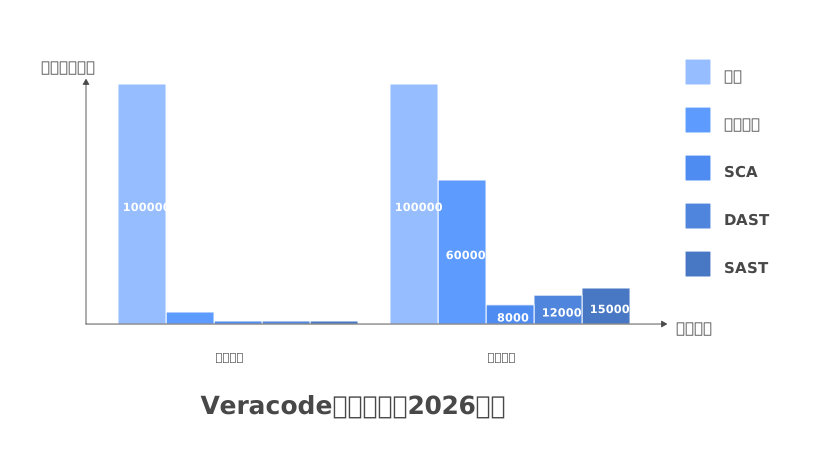
Veracode’s pricing is structured around three primary dimensions: the products you license, the number of applications you scan, and the contract terms you negotiate. Understanding how each dimension works is essential before you engage with sales.
Product-based pricing
Veracode sells its capabilities as distinct product modules that can be purchased individually or bundled. Each module carries its own price, and the total cost is additive.
Static Application Security Testing (SAST) is the core product and the most common entry point. Veracode SAST includes binary analysis (the flagship scanning engine that analyzes compiled artifacts), Pipeline Scan (a lighter-weight scanner designed for CI/CD integration), IDE plugins for real-time developer feedback, and Veracode Fix (the AI-powered remediation engine). SAST is priced primarily by application count.
Software Composition Analysis (SCA) covers open-source vulnerability scanning, license compliance checking, SBOM generation in SPDX and CycloneDX formats, and - following the January 2025 Phylum acquisition - behavioral analysis for detecting malicious packages. SCA is typically priced by the number of repositories or projects scanned.
Dynamic Application Security Testing (DAST) tests running web applications and APIs for runtime vulnerabilities. It includes authenticated and unauthenticated scanning, API security testing, and the AI-assisted authentication feature that handles complex login flows. DAST is priced by the number of target applications and scan frequency.
Enterprise Platform bundles all of the above plus container scanning, Infrastructure as Code (IaC) security, policy-based compliance management, Security Labs developer training, penetration testing as a service, and application security consulting. This is the full platform and carries the highest price, but also the deepest discounting potential because of the larger deal size.
Application-based pricing
Within each product module, the primary pricing unit is the application. Veracode defines an “application” as a distinct codebase or deployable unit that is scanned as a single entity. This has important implications for modern architectures.
A monolithic Java application counts as one application. A microservices architecture with 20 independently deployed services could count as 20 applications, which multiplies your cost proportionally. Veracode does offer “application profile” management to help organizations group related codebases, but the per-application pricing model can become expensive quickly for teams with many repositories or microservices.
The per-application cost is not fixed - it decreases with volume. An organization scanning 10 applications pays a higher per-app rate than one scanning 100 applications. This volume discount structure incentivizes larger commitments but creates a barrier for teams that want to start small and expand gradually.
Contract-based pricing
The third pricing dimension is the contract structure itself. Veracode offers annual and multi-year contracts, with significant discounts for longer commitments.
Annual contracts represent the baseline pricing. Multi-year contracts (2 or 3 years) can reduce annual costs by 10-25%, but they lock you into the platform for the contract duration. Contract renewals often come with price increases unless you negotiate caps upfront. Early termination is typically not available or comes with substantial penalties.
Estimated Veracode costs by product
Based on publicly available data points, here is what organizations can expect to pay for each Veracode product in 2026. These are estimates - your actual quote will depend on your specific situation.
SAST pricing
| Application Count | Estimated Annual Cost | Per-App Cost |
|---|---|---|
| 1-5 applications | $15,000 - $25,000 | $3,000 - $5,000/app |
| 6-25 applications | $25,000 - $60,000 | $1,500 - $2,500/app |
| 26-50 applications | $50,000 - $100,000 | $1,000 - $2,000/app |
| 51-100 applications | $80,000 - $150,000 | $800 - $1,500/app |
| 100+ applications | $120,000 - $300,000+ | $500 - $1,200/app |
The starting price of approximately $15,000/year for SAST reflects a small portfolio of 1-5 applications. This floor price means that even if you only need to scan a single application, you are paying $15,000 for it - making Veracode one of the most expensive options for teams with limited scanning needs.
Pipeline Scan is included in the SAST license at no additional cost. Veracode Fix, the AI-powered remediation engine, is also bundled with SAST as of 2026 and does not carry a separate fee. This is worth noting because some competitors charge extra for AI remediation features.
SCA pricing
| Repository Count | Estimated Annual Cost |
|---|---|
| 1-10 repositories | $12,000 - $18,000 |
| 11-50 repositories | $18,000 - $40,000 |
| 51-100 repositories | $35,000 - $60,000 |
| 100+ repositories | $50,000 - $100,000+ |
SCA pricing starts around $12,000/year and scales with repository count and scan frequency. The Phylum-powered behavioral analysis for malicious package detection is included in the standard SCA license, though some early reports suggest that the Package Firewall capability may be positioned as a premium add-on for certain contract structures.
DAST pricing
| Target Applications | Estimated Annual Cost |
|---|---|
| 1-5 targets | $20,000 - $30,000 |
| 6-15 targets | $30,000 - $50,000 |
| 16-30 targets | $45,000 - $75,000 |
| 30+ targets | $60,000 - $120,000+ |
DAST is the most expensive individual module on a per-target basis. The cost reflects the complexity of dynamic scanning - Veracode must crawl and test running applications, handle authentication, and process potentially millions of requests per scan. The AI-assisted authentication feature is included in all DAST plans.
Enterprise platform pricing
| Organization Size | Estimated Annual Cost |
|---|---|
| Small (10-25 apps, 50 devs) | $60,000 - $120,000 |
| Mid-market (25-100 apps, 100-250 devs) | $100,000 - $250,000 |
| Large enterprise (100-500 apps, 500+ devs) | $200,000 - $500,000+ |
| Fortune 500 (500+ apps) | $500,000 - $1,000,000+ |
The enterprise platform bundle typically offers 15-30% savings compared to purchasing SAST, SCA, and DAST individually. For organizations that need all three scanning modalities, the bundle is almost always the more cost-effective path.
Several Vendr data points corroborate these ranges. Enterprise contracts in the $100,000-$300,000 annual range are common for mid-market companies, while Fortune 500 deployments regularly exceed $500,000 per year. The highest reported contract values approach or exceed $1 million annually for the largest global deployments.
The per-application pricing deep dive
Veracode’s per-application pricing model is the single most important factor in determining your total cost. Understanding how Veracode defines and counts applications - and how to optimize your application portfolio structure - can save tens of thousands of dollars annually.
How Veracode defines an application
An application in Veracode’s context is a distinct scannable unit. For SAST, this means a compiled binary or set of binaries that are uploaded and analyzed together. For SCA, it means a project or repository with dependencies. For DAST, it means a target URL or API endpoint.
The practical challenge arises with modern architectures. Consider a typical microservices deployment:
- Monolith: A single Java application deployed as one WAR file = 1 Veracode application
- Microservices: 15 independently deployed services, each with its own repository = potentially 15 Veracode applications
- Monorepo with multiple deployables: A single repository producing 8 deployable artifacts = potentially 8 Veracode applications
The cost implications are significant. If your per-app rate is $1,500/year, the monolith costs $1,500 while the equivalent microservices architecture costs $22,500 for the same business functionality. This is one of the most common sources of sticker shock when teams moving to microservices get their Veracode renewal quote.
Strategies to reduce application count
Consolidate related services into single application profiles. Veracode allows you to group multiple scan targets under a single application profile. If you have microservices that are always deployed together and share a security policy, discuss with your Veracode account team whether they can be grouped. This does not always work - Veracode has rules about what constitutes a legitimate grouping - but it is worth exploring.
Prioritize which applications need Veracode. Not every application in your portfolio needs the depth of Veracode’s enterprise-grade scanning. Consider using Veracode only for your highest-risk, compliance-critical applications and covering lower-risk internal tools with cheaper alternatives like Semgrep or SonarQube.
Negotiate application tiers. Some Veracode contracts differentiate between “full-scan” applications (with complete SAST, policy evaluation, and compliance reporting) and “Pipeline Scan only” applications (with lighter scanning and no policy evaluation). Pipeline Scan-only applications typically cost less per app than full-scan applications.
Per-application cost benchmarks
Based on aggregated data, here are realistic per-application cost ranges for SAST:
| Contract Size | Per-App SAST Cost | Notes |
|---|---|---|
| 1-5 apps | $3,000 - $5,000/app/year | Highest per-app rate, minimum contract floor applies |
| 6-25 apps | $1,500 - $2,500/app/year | Volume discount begins |
| 26-50 apps | $1,000 - $2,000/app/year | Meaningful volume discount |
| 51-100 apps | $800 - $1,500/app/year | Significant volume discount |
| 100+ apps | $500 - $1,200/app/year | Best available rates, heavily negotiated |
These per-app costs are for SAST only. Adding SCA and DAST increases the per-application cost, though bundled platform pricing provides better per-app economics than purchasing modules individually.
SAST + DAST + SCA bundle economics
For organizations that need comprehensive application security testing, Veracode’s platform bundle combining SAST, DAST, and SCA is the standard procurement path. Understanding the bundle economics helps you evaluate whether the platform approach makes sense versus purchasing modules individually or using separate tools for each testing modality.
Individual vs. bundled pricing
| Approach | 25 Apps, Annual Cost | Effective Per-App Cost |
|---|---|---|
| SAST only | $40,000 - $60,000 | $1,600 - $2,400 |
| SCA only | $20,000 - $35,000 | $800 - $1,400 |
| DAST only | $35,000 - $55,000 | $1,400 - $2,200 |
| Individual total | $95,000 - $150,000 | $3,800 - $6,000 |
| Platform bundle | $70,000 - $120,000 | $2,800 - $4,800 |
| Bundle savings | 20-30% | $1,000 - $1,200/app |
The bundle discount typically ranges from 15-30% off the combined individual module pricing. The exact discount depends on your negotiation leverage, contract length, and the size of the deal. Larger deals command larger discounts.
What the bundle includes
The full enterprise platform bundle in 2026 typically includes:
- SAST with binary analysis and Pipeline Scan
- Veracode Fix AI-powered remediation
- SCA with Phylum behavioral analysis and Package Firewall
- DAST with AI-assisted authentication
- Container security scanning
- IaC security scanning
- Policy-based compliance management
- Security Labs enterprise training
- Standard support (phone, email, knowledge base)
- Veracode Platform dashboard with portfolio analytics
Items that may carry additional costs even within the bundle:
- Premium support tiers (dedicated TAM, 24/7 support)
- Professional services (implementation, policy configuration, custom integrations)
- Penetration testing as a service
- Application security consulting engagements
- Veracode Verified attestation program participation
- Overage charges for exceeding contracted application or scan limits
When the bundle makes sense
The platform bundle delivers the best ROI for organizations that genuinely need all three testing modalities. If you are buying SAST and SCA already, adding DAST for the marginal bundle cost is usually cheaper than purchasing a standalone DAST tool from another vendor. The integration benefits - unified policy management, correlated findings across scan types, single pane of glass reporting - also reduce operational overhead.
The bundle does not make sense if you only need one or two capabilities. Purchasing SAST alone and using a separate tool for SCA (like Snyk’s free tier) is often more cost-effective than buying the full bundle. Similarly, if your DAST needs are limited, standalone tools like OWASP ZAP (free) or Burp Suite can fill the gap at a fraction of Veracode DAST’s cost.
Veracode Fix pricing
Veracode Fix is the AI-powered remediation engine that generates code fixes for detected vulnerabilities. Launched with a patented approach in 2025, it is one of Veracode’s most compelling features and a key differentiator in the enterprise AppSec market.
What Veracode Fix costs
As of 2026, Veracode Fix is included in all SAST subscriptions at no additional cost. This is a significant value-add because AI-powered remediation is an emerging capability that some competitors charge extra for. The minimum cost to access Veracode Fix is the SAST starting price of approximately $15,000/year.
What Veracode Fix delivers
According to Veracode’s published data, Fix covers over 70% of detected flaws and reduces mean time to remediate by up to 92%. It generates code fixes in 11 supported languages, integrates directly into IDEs and pull request workflows, and does not use customer code to train its AI models - addressing a common enterprise concern about intellectual property protection.
How Fix compares to alternatives
| Tool | AI Remediation | Included in Base Price | Coverage |
|---|---|---|---|
| Veracode Fix | Yes | Yes (with SAST) | 70%+ of findings, 11 languages |
| Snyk DeepCode AI Fix | Yes | Yes (with SAST) | Varies by language |
| Semgrep Assistant | AI triage + suggestions | Yes (Team+) | 60% auto-triage, 95% accuracy |
| Checkmarx AI | Limited | Varies | Newer, less mature |
| Corgea Agent | Yes | Yes | Full auto-fix with PRs |
| SonarQube AI Fix | AI suggestions | SonarQube Cloud only | Limited languages |
Veracode Fix is competitive but not unique in this space. Corgea takes the most aggressive approach with fully automated fix PRs, while Semgrep’s Assistant focuses on AI-powered triage rather than direct code generation. The key advantage of Veracode Fix is that it is tightly integrated with the binary analysis engine, so fixes are generated with context about how the vulnerability manifests in the compiled artifact.
Cost comparison with major competitors
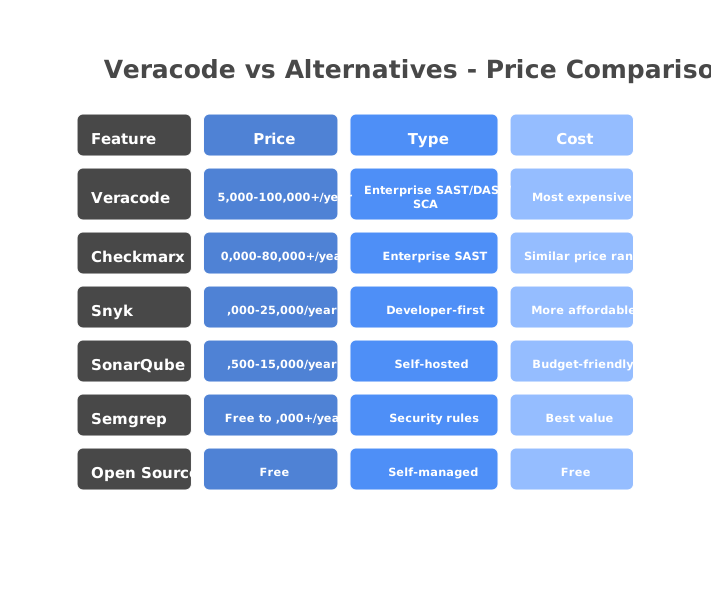
Understanding Veracode’s pricing in isolation is only half the picture. The real question for most buyers is how Veracode compares to alternatives on cost. Here is a detailed comparison across multiple team sizes and capability requirements.
SAST-only comparison
| Tool | 10 Developers | 25 Developers | 50 Developers | 100 Developers |
|---|---|---|---|---|
| Veracode SAST | ~$15,000/yr | ~$25,000/yr | ~$50,000/yr | ~$90,000/yr |
| Checkmarx One | ~$59,000/yr | ~$100,000/yr | ~$200,000/yr | ~$500,000/yr |
| Snyk Code (Team) | $3,000/yr | $7,500/yr | $15,000/yr | $67,000-$90,000/yr |
| Semgrep (Team) | $4,200/yr | $10,500/yr | $21,000/yr | $42,000/yr |
| SonarQube Developer | $2,500/yr | $2,500/yr | $2,500/yr | $10,000/yr |
| DeepSource (Business) | $2,400/yr | $6,000/yr | $12,000/yr | $24,000/yr |
At the SAST-only level, Veracode sits in the middle of the enterprise pricing spectrum - more expensive than developer-first tools like Semgrep, Snyk, and DeepSource, but less expensive than Checkmarx’s full platform pricing. The interesting crossover point is at 100+ developers, where Snyk’s per-developer pricing starts approaching Veracode’s per-application pricing.
Full platform comparison (SAST + SCA + DAST)
| Tool | 25 Apps / 50 Devs | 100 Apps / 200 Devs | 500 Apps / 1000 Devs |
|---|---|---|---|
| Veracode Enterprise | ~$100,000/yr | ~$250,000/yr | ~$500,000+/yr |
| Checkmarx One | ~$150,000/yr | ~$350,000/yr | ~$750,000+/yr |
| Snyk Enterprise | ~$50,000/yr | ~$150,000/yr | Custom |
| Semgrep + ZAP | ~$25,000/yr | ~$75,000/yr | ~$200,000/yr |
| Aikido Security | ~$15,000/yr | ~$50,000/yr | Custom |
For full-platform comparisons, Veracode is generally less expensive than Checkmarx and more expensive than everything else. The key differentiator is that Veracode and Checkmarx are the only options in this list that include enterprise-grade DAST, compliance reporting, and application portfolio governance in a single platform.
Cost per developer analysis
Another way to frame the comparison is cost per developer, which normalizes across different pricing models:
| Tool | Cost Per Developer (50-dev team) | Includes |
|---|---|---|
| Veracode SAST only | ~$1,000/dev/yr | SAST, Pipeline Scan, Fix |
| Veracode Full Platform | ~$2,000/dev/yr | SAST, DAST, SCA, containers, compliance |
| Checkmarx One | ~$4,000/dev/yr | SAST, SCA, DAST, API security |
| Snyk Team | $300/dev/yr | SAST, SCA, containers, IaC |
| Semgrep Team | $420/dev/yr | SAST, SCA, secrets |
| DeepSource Business | $240/dev/yr | SAST, code quality, autofix |
| SonarQube Developer | $50/dev/yr | SAST, code quality |
| Aikido Security | ~$350/dev/yr | SAST, SCA, DAST, containers, CSPM |
This per-developer view makes the cost differential stark. Veracode’s full platform costs 4-8x more per developer than Snyk or Semgrep, and up to 40x more than SonarQube. The question is whether the additional capabilities - binary analysis, enterprise DAST, compliance reporting, and governance - justify the premium for your specific organization.
Total cost of ownership analysis
The subscription price is only one component of what Veracode actually costs your organization. A realistic total cost of ownership (TCO) analysis must account for implementation, operational, and opportunity costs that do not appear on the invoice.
Implementation costs
Professional services: Veracode offers implementation services to help organizations configure the platform, set up policies, integrate CI/CD pipelines, and train teams. These services are optional but strongly recommended by Veracode’s customer success team, and their cost can be substantial.
| Service | Estimated Cost | Duration |
|---|---|---|
| Basic implementation | $10,000 - $25,000 | 2-4 weeks |
| Enterprise onboarding | $25,000 - $75,000 | 4-8 weeks |
| Custom integration development | $15,000 - $50,000 | Varies |
| Policy configuration and tuning | $5,000 - $15,000 | 1-3 weeks |
Internal engineering time: Even with professional services, your team will spend significant time on integration. Expect 2-4 weeks of a DevOps engineer’s time to integrate Veracode into CI/CD pipelines across your application portfolio, configure build processes to produce the compiled artifacts Veracode requires, and validate that scan results flow correctly into developer workflows.
Developer training: While Veracode provides Security Labs for vulnerability-specific training, developers still need to learn how to interpret Veracode results, use the platform dashboard, apply Veracode Fix suggestions, and handle false positives. Budget 4-8 hours per developer for initial platform familiarization.
Operational costs
Ongoing tuning and maintenance: Veracode requires continuous tuning to maintain an acceptable signal-to-noise ratio. False positives that are not suppressed or triaged create “finding fatigue” that causes developers to ignore legitimate vulnerabilities. Budget 4-8 hours per month of a security engineer’s time for finding management across a medium-sized application portfolio.
Build process overhead: Veracode’s binary SAST requires compiled artifacts, which means your CI/CD pipeline must include a build step before scanning. For languages that compile quickly (Go, Rust), this adds minutes. For large Java or .NET applications, build times can add 10-30 minutes to the pipeline. Over hundreds of scans per month, this pipeline time has a real cost in developer wait time and CI/CD compute resources.
Platform administration: Someone in your organization needs to manage application profiles, user access, policy configurations, and integration maintenance. For small deployments, this is a fraction of one person’s time. For large enterprise deployments with hundreds of applications, it can justify a half-time or full-time platform administrator.
TCO estimate by organization size
| Cost Category | Small (10 apps) | Mid-market (50 apps) | Enterprise (200 apps) |
|---|---|---|---|
| Annual subscription | $40,000 | $150,000 | $400,000 |
| Implementation (Year 1) | $15,000 | $40,000 | $75,000 |
| Professional services | $5,000 | $15,000 | $35,000 |
| Internal engineering (integration) | $10,000 | $25,000 | $50,000 |
| Developer training | $3,000 | $8,000 | $20,000 |
| Ongoing tuning (annual) | $6,000 | $15,000 | $40,000 |
| Platform administration (annual) | $3,000 | $10,000 | $30,000 |
| Year 1 total | $82,000 | $263,000 | $650,000 |
| Year 2+ annual | $49,000 | $175,000 | $470,000 |
Year 1 TCO is typically 1.5-2x the subscription price due to implementation costs. Year 2+ TCO stabilizes at 1.2-1.3x the subscription price, reflecting ongoing operational overhead.
TCO comparison with alternatives
| Approach | 50 Apps, Year 1 TCO | 50 Apps, Year 2+ TCO |
|---|---|---|
| Veracode Full Platform | ~$263,000 | ~$175,000 |
| Checkmarx One | ~$320,000 | ~$230,000 |
| Snyk Enterprise | ~$100,000 | ~$75,000 |
| Semgrep Team + SonarQube | ~$40,000 | ~$30,000 |
| Aikido Security Pro | ~$35,000 | ~$25,000 |
The TCO gap between enterprise platforms (Veracode, Checkmarx) and developer-first tools (Snyk, Semgrep, Aikido) is even wider than the subscription price gap suggests, because enterprise platforms require more implementation effort, more ongoing tuning, and more administrative overhead.
ROI framework for Veracode
Justifying Veracode’s cost requires a concrete return-on-investment framework that maps the platform’s capabilities to measurable business outcomes. Here is how to build the business case.
Vulnerability remediation cost avoidance
The primary ROI driver for application security tools is the cost of finding and fixing vulnerabilities at different stages of the SDLC. Industry benchmarks consistently show that vulnerabilities caught later in the lifecycle cost exponentially more to fix.
| Stage | Average Cost to Fix | Veracode Impact |
|---|---|---|
| Development (IDE/PR) | $50 - $500 | Pipeline Scan + Fix catches early |
| Testing/Staging | $500 - $5,000 | Full SAST + DAST catches before release |
| Production | $5,000 - $50,000 | Runtime vulnerabilities avoided |
| Post-breach | $100,000 - $10,000,000+ | Compliance + detection reduces breach risk |
If Veracode catches 50 vulnerabilities per year that would otherwise reach production, and the average production fix cost is $10,000, the tool prevents $500,000 in remediation costs. Against a $150,000 annual subscription, that is a 3.3x ROI from remediation savings alone.
Compliance and audit cost reduction
For organizations subject to regulatory requirements, Veracode’s built-in compliance templates and audit-ready reporting can significantly reduce the cost of compliance activities.
- PCI DSS compliance audits typically cost $50,000-$200,000 annually. Veracode’s automated compliance reporting reduces the application security portion of audit preparation by 60-80%, saving $30,000-$100,000 in audit-related labor.
- SOC 2 certification requires demonstrating security controls over application development. Veracode’s policy engine and reporting provide documentary evidence that reduces SOC 2 preparation effort by 40-60%.
- HIPAA security assessments require evidence of vulnerability management processes. Veracode’s portfolio dashboards and remediation tracking provide this evidence out of the box.
Developer productivity impact
This is where the ROI calculation gets nuanced. Veracode’s binary analysis approach adds pipeline time (negative productivity impact), but Veracode Fix’s AI remediation reduces fix time (positive productivity impact).
Negative impact: If binary scanning adds 15 minutes to each CI/CD pipeline run, and your team runs 500 scans per month, that is 125 hours of pipeline wait time per month. At a loaded developer cost of $100/hour, that represents $12,500/month in waiting costs.
Positive impact: Veracode claims Fix reduces remediation time by 92%. If developers spend an average of 4 hours per vulnerability on manual remediation and Fix reduces that to 20 minutes, the savings are 3.67 hours per vulnerability. At 50 vulnerabilities per year and $100/hour, that saves $18,350/year.
The net developer productivity impact depends heavily on your scanning frequency, codebase size, and vulnerability volume. For most organizations, the positive impact of AI remediation outweighs the negative impact of binary scanning overhead, but the margin is often thin.
Building the business case
A complete Veracode ROI calculation should include:
- Vulnerability cost avoidance: (Number of vulnerabilities caught) x (Average cost if found later) - (Cost of earlier remediation)
- Compliance cost reduction: (Current audit costs) x (Percentage reduced by automated reporting)
- Breach risk reduction: (Annual breach probability) x (Average breach cost) x (Risk reduction percentage)
- Developer productivity net impact: (Fix time savings) - (Pipeline time added)
- Tool consolidation savings: (Cost of replaced tools) - (Veracode cost)
For most mid-market and enterprise organizations, the ROI breaks even when Veracode prevents 20-30 vulnerabilities per year from reaching production and reduces compliance preparation effort by 40% or more. The business case is strongest for organizations in regulated industries where compliance costs are high and breach consequences are severe.
Budget-friendly alternatives to Veracode
If Veracode’s pricing exceeds your budget, these alternatives provide strong application security coverage at significantly lower cost. The right choice depends on which Veracode capabilities you actually need versus which ones are nice-to-have.
Free and open-source options
Semgrep (Free tier) - The most capable free SAST option available. Free for up to 10 contributors with the full platform including cross-file analysis, SCA with reachability, secrets detection, and AI-powered triage. For teams under 10 developers, this is functionally equivalent to Veracode’s SAST at zero cost. The Pro engine with 20,000+ rules provides detection depth that approaches enterprise tools.
SonarQube Community Build - Free self-hosted static analysis with 6,500+ rules across 35+ languages. Stronger on code quality than security, but covers common vulnerability patterns like SQL injection, XSS, and hardcoded credentials. Requires self-hosting but runs on modest infrastructure. Lacks branch analysis and PR decoration - those require the Developer Edition at $2,500/year.
OWASP ZAP - Free, open-source DAST that covers many of the same web application vulnerability categories as Veracode DAST. Lacks Veracode’s AI-assisted authentication and enterprise reporting, but provides solid basic dynamic scanning at zero cost. Often used as a Veracode DAST replacement by cost-conscious teams.
Trivy - Free, open-source vulnerability scanner for containers, IaC, and dependencies. Covers Veracode’s container scanning and IaC scanning capabilities at zero cost. Widely adopted in the Kubernetes ecosystem and actively maintained by Aqua Security.
Low-cost commercial options
Semgrep Team ($35/contributor/month) - For teams larger than 10 contributors, Semgrep Team provides the full platform with cross-file SAST, SCA, secrets detection, and the AI-powered Semgrep Assistant. At $420/developer/year, it costs roughly one-third of Veracode SAST on a per-developer basis and scans in seconds rather than minutes.
DeepSource Business ($20/user/month) - DeepSource offers SAST and code quality analysis with AI-powered autofix at one of the lowest price points in the market. At $240/developer/year, it costs a fraction of Veracode. DeepSource focuses on code quality alongside security and supports 15+ languages with over 1,000 analyzers. It lacks DAST and SCA, but for teams primarily interested in SAST and code quality, it is exceptional value.
SonarQube Developer Edition ($2,500/year) - Adds branch analysis, PR decoration, and taint analysis to the Community Build’s free foundation. At $2,500/year regardless of team size (up to a threshold), it is dramatically cheaper than Veracode for teams that need basic SAST with developer workflow integration.
Aikido Security ($300/month for 10 users) - The broadest security coverage at the lowest price point. Bundles SAST, SCA, DAST, container scanning, IaC scanning, secrets detection, and CSPM for less than Veracode’s SAST-only minimum. The tradeoff is less maturity, less compliance depth, and less industry recognition.
The combination approach
Many teams replacing Veracode find the best value in combining two complementary tools rather than paying for a single comprehensive platform. The most cost-effective combinations:
Semgrep + SonarQube ($2,500-$15,000/year): Semgrep handles SAST and SCA with cross-file taint analysis, while SonarQube provides code quality gates and technical debt tracking. Total cost for a 25-developer team is approximately $13,000/year - less than Veracode’s SAST-only minimum.
Semgrep + OWASP ZAP ($4,200-$10,500/year for 10-25 devs): Semgrep provides SAST and SCA, while ZAP adds free DAST coverage. This combination covers three of Veracode’s four core capabilities at a fraction of the price. The tradeoff is that ZAP requires more manual configuration than Veracode DAST.
Snyk + SonarQube ($5,500-$20,000/year): Snyk handles security (SAST, SCA, containers, IaC) while SonarQube handles code quality. This combination provides broad security coverage with strong developer experience, though it still lacks DAST.
DeepSource + Snyk ($3,000-$10,000/year for 10-25 devs): DeepSource handles SAST and code quality with AI autofix, while Snyk adds SCA, container scanning, and IaC scanning. Both offer excellent developer experience with IDE integration and fast scan times.
Contract negotiation tips
Veracode’s pricing is negotiable. The quote-based model means that the first number you receive is rarely the final number. Here are concrete strategies to reduce your Veracode contract cost.
Timing your negotiation
End of fiscal quarter and fiscal year. Veracode’s sales team, like most enterprise software companies, has quarterly targets. Deals negotiated in the final 2-3 weeks of a fiscal quarter typically receive larger discounts than deals closed mid-quarter. Veracode’s fiscal year ends in January, making Q4 (November through January) the most favorable period for negotiation.
End of your current contract. If you are a renewal customer, your existing contract’s expiration date gives you leverage. Begin renewal discussions 3-4 months before expiration and make it clear that you are evaluating alternatives. The risk of losing a customer is a powerful motivator for the sales team to offer better terms.
Negotiation strategies
Get competing quotes. Before engaging Veracode sales, obtain quotes from Checkmarx, Snyk, and at least one other alternative. Having concrete competing offers gives you factual leverage in the negotiation. Veracode’s sales team is accustomed to competing against these tools and has internal discount authorities to match or beat competing offers.
Start with a smaller scope than you need. If you need 50 applications, quote for 25. Veracode will often offer volume pricing incentives to get you to commit to a larger scope, and the per-app rate at 50 apps will be lower than at 25. This is counterintuitive but effective - let Veracode’s own discounting structure work in your favor.
Negotiate multi-year commitments carefully. A 3-year commitment can yield 15-25% annual savings, but it eliminates your ability to switch tools for three years. If you commit to multi-year terms, negotiate a price cap on annual increases (for example, no more than 3-5% per year) and ensure the contract includes provisions for adding applications at the contracted rate rather than at list price.
Request a proof of concept (POC) period. Ask for a 30-60 day paid POC at a reduced rate before committing to a full contract. This gives you time to validate Veracode’s detection quality on your actual codebase, measure the pipeline impact, and confirm that the platform meets your requirements. If the POC is successful, negotiate to apply the POC cost toward the first year’s subscription.
Push back on professional services. Veracode will often bundle professional services into the initial quote. If your team has strong DevOps capability, you may be able to handle implementation internally and remove the professional services line item. This can save $10,000-$50,000 on the initial contract.
Contract terms to negotiate
Application count flexibility. Negotiate the ability to add or remove applications during the contract period without penalty, up to a defined percentage (for example, 20% above or below the contracted count). This prevents you from paying for applications you no longer scan.
Scan volume limits. Ensure your contract includes sufficient scan volume for your CI/CD frequency. If your contract limits you to a certain number of scans per application per month, exceeding that limit can trigger overage charges. Negotiate unlimited scans or a generous scan ceiling.
Renewal pricing caps. Without a cap, renewal pricing can increase 10-20% per year. Negotiate a maximum annual increase of 3-5%, or lock in pricing for the contract duration.
Exit provisions. Negotiate a 90-day notice period for non-renewal and ensure you retain access to scan results and remediation data for a defined period after the contract ends. Data portability matters - you do not want to lose years of vulnerability tracking history when you switch tools.
Support tier inclusion. Standard support is typically included, but premium support (dedicated TAM, priority response, 24/7 coverage) is an add-on. If you need premium support, negotiate its inclusion in the base price rather than paying for it separately.
When Veracode is worth the investment
Despite the high price, Veracode is genuinely the right choice for certain organizations. Understanding when the investment makes sense helps you avoid both overpaying for unnecessary capabilities and underspending on critical security infrastructure.
Veracode is worth it when:
You are in a regulated industry with specific compliance requirements. If PCI DSS, HIPAA, FedRAMP, or SOC 2 compliance is a hard requirement and auditors expect to see application security testing reports, Veracode’s built-in compliance templates and audit-ready reporting save significant manual effort. The Veracode Verified attestation program also provides third-party validation that cheaper tools cannot match.
You need DAST integrated with SAST. If your threat model requires testing running applications for runtime vulnerabilities alongside static code analysis, Veracode’s integrated platform provides a unified view across both testing modalities. Most developer-first alternatives lack DAST entirely, forcing you to manage a separate tool.
You manage a large application portfolio (50+ applications). At scale, the per-application cost decreases significantly, and the portfolio management capabilities - centralized policy, cross-application reporting, executive dashboards - provide governance value that justifies the premium.
Your applications are primarily in compiled languages. Veracode’s binary analysis approach is particularly strong for Java, .NET, C/C++, and other compiled language ecosystems where it can analyze the complete compiled dependency chain.
You have a dedicated AppSec team. Veracode is designed for security teams that manage vulnerability findings and drive remediation programs. If you have security engineers who can configure policies, triage findings, and work with developers on remediation, Veracode’s governance capabilities deliver full value.
Veracode is probably not worth it when:
Your team has fewer than 20 developers. The minimum $15,000/year investment for SAST alone translates to $750+ per developer per year for a 20-person team. Semgrep, DeepSource, or Aikido Security provide comparable SAST at 50-90% lower cost.
You are a startup without compliance requirements. If you are pre-revenue or early-stage without regulatory obligations, Veracode’s compliance features deliver no value. Start with Semgrep’s free tier or SonarQube Community Build and invest in Veracode (or an enterprise alternative) when compliance becomes a requirement.
You primarily need code quality, not security. If your main goal is improving code quality, reducing technical debt, and enforcing coding standards, tools like SonarQube, DeepSource, or Codacy provide better value because they are designed for code quality first and security second.
Your architecture is microservices-heavy with 100+ repos. Veracode’s per-application pricing model makes it extremely expensive for microservices architectures. A 100-service deployment could cost $50,000-$150,000+ for SAST alone. Developer-first tools that price per seat rather than per application are more economical in this scenario.
Speed and developer experience are non-negotiable. If your engineering culture demands sub-minute feedback in PRs and zero-friction CI/CD integration, Veracode’s binary scanning requirement and longer scan times will create friction that undermines adoption. Semgrep scans in seconds, Snyk provides IDE-level feedback, and both deliver results faster than Veracode’s Pipeline Scan.
Veracode pricing vs. Checkmarx pricing
The Veracode vs. Checkmarx pricing comparison deserves detailed treatment because these are the two most commonly compared enterprise AppSec platforms.
Pricing model differences
| Dimension | Veracode | Checkmarx |
|---|---|---|
| Primary unit | Applications | Committers / Contributors |
| SAST starting price | ~$15,000/year | ~$59,000/year (platform) |
| SCA included | Separate module | Included in Checkmarx One |
| DAST included | Separate module | Included in Checkmarx One |
| Free tier | No | No |
| Pricing transparency | Quote-based | Quote-based |
| Multi-year discount | 10-25% | 10-20% |
The fundamental pricing difference is the unit of measurement. Veracode prices by application, which benefits teams with many developers working on few applications. Checkmarx prices by committer, which benefits teams with few developers working on many applications.
Side-by-side cost comparison
| Scenario | Veracode (SAST+SCA) | Checkmarx One | Notes |
|---|---|---|---|
| 10 apps, 20 devs | ~$30,000/yr | ~$59,000/yr | Veracode cheaper at small scale |
| 25 apps, 50 devs | ~$55,000/yr | ~$100,000/yr | Veracode cheaper for fewer apps |
| 50 apps, 100 devs | ~$100,000/yr | ~$200,000/yr | Veracode cheaper for balanced portfolios |
| 100 apps, 200 devs | ~$200,000/yr | ~$350,000/yr | Gap widens at enterprise scale |
| 200 apps, 500 devs | ~$350,000/yr | ~$500,000+/yr | Both deeply into enterprise pricing |
Veracode is generally less expensive than Checkmarx at comparable scales, particularly for organizations with moderate application counts. However, Checkmarx One includes SAST, SCA, DAST, API security, and container scanning in a single platform price, while Veracode charges separately for each module. When you add Veracode DAST and container scanning to the comparison, the gap narrows significantly.
When to choose Veracode over Checkmarx
Choose Veracode when you need stronger compliance reporting, when your applications are primarily compiled languages (Java, .NET, C/C++), when you value the Veracode Fix AI remediation, or when your application count is moderate relative to your developer count.
When to choose Checkmarx over Veracode
Choose Checkmarx when you need source-code scanning (no build required), when you need on-premises deployment, when you have a very large developer count relative to applications, or when you need the CxQL custom query language for application-specific rules.
Veracode pricing vs. Snyk pricing
The Veracode vs. Snyk comparison represents the enterprise vs. developer-first pricing divide.
| Dimension | Veracode | Snyk |
|---|---|---|
| Pricing model | Per application | Per developer |
| SAST starting price | ~$15,000/year | Free / $25/dev/month |
| SCA included | Separate module | Included in all tiers |
| DAST included | Separate module | Not available |
| Free tier | No | Yes (100 SAST tests/month) |
| Self-service purchase | No | Yes |
| Contract minimum | Annual | Monthly available |
Cost comparison by team size
| Team Size | Veracode SAST | Snyk Code Team | Snyk Code Enterprise |
|---|---|---|---|
| 10 developers | ~$15,000/yr | $3,000/yr | Custom |
| 25 developers | ~$25,000/yr | $7,500/yr | Custom |
| 50 developers | ~$50,000/yr | $15,000/yr | Custom |
| 100 developers | ~$90,000/yr | $30,000/yr | $67,000-$90,000/yr |
| 250 developers | ~$150,000/yr | $75,000/yr | Custom |
At every team size, Snyk is significantly cheaper for SAST alone. The gap narrows at enterprise scale, where Snyk’s per-developer pricing can approach Veracode’s per-application pricing for organizations with large developer counts and small application portfolios.
However, this comparison is incomplete without considering what each tool includes. Snyk’s pricing includes SAST, SCA, container scanning, and IaC scanning in a single per-developer price. To get equivalent coverage from Veracode, you need SAST + SCA + container scanning at minimum, which pushes Veracode’s cost 2-3x higher than the SAST-only figures shown above.
The honest tradeoff: Snyk is cheaper and faster but lacks DAST and deep compliance reporting. Veracode is more expensive and slower but provides DAST, binary analysis, and enterprise governance that Snyk does not offer. For most teams under 100 developers that do not have strict regulatory compliance requirements, Snyk delivers better value per dollar.
Veracode pricing vs. Semgrep pricing
The Veracode vs. Semgrep comparison represents the starkest cost differential in the application security market.
| Dimension | Veracode | Semgrep |
|---|---|---|
| Pricing model | Per application | Per contributor |
| SAST starting price | ~$15,000/year | Free (up to 10 contributors) |
| Paid SAST price | ~$15,000+/year | $35/contributor/month |
| SCA included | Separate module | Included in Team+ |
| DAST included | Separate module | Not available |
| Free tier | No | Yes (full platform, 10 contributors) |
| Rule transparency | Opaque binary analysis | Open, human-readable YAML |
| Custom rules | No | Yes, easy to author |
Cost comparison by team size
| Team Size | Veracode SAST | Semgrep Team | Savings with Semgrep |
|---|---|---|---|
| 10 contributors | ~$15,000/yr | $0 (free tier) | $15,000 (100%) |
| 25 contributors | ~$25,000/yr | $10,500/yr | $14,500 (58%) |
| 50 contributors | ~$50,000/yr | $21,000/yr | $29,000 (58%) |
| 100 contributors | ~$90,000/yr | $42,000/yr | $48,000 (53%) |
| 250 contributors | ~$150,000/yr | $105,000/yr | $45,000 (30%) |
For teams under 10 contributors, Semgrep’s free tier eliminates the cost entirely - a 100% savings. For larger teams, Semgrep consistently costs 50-60% less than Veracode SAST.
The capabilities gap to consider: Semgrep’s Pro engine provides excellent SAST with cross-file taint tracking, SCA with reachability analysis, and secrets detection. It does not provide DAST, binary analysis, compliance reporting, or the enterprise governance features that Veracode offers. For teams that need those capabilities, the comparison is not apples-to-apples. For teams that primarily need SAST and SCA, Semgrep delivers comparable detection quality at a fraction of the price.
Understanding Veracode’s hidden costs
Beyond the subscription fee, several costs are easy to overlook when budgeting for Veracode. These hidden costs can add 20-50% to your total annual spend if not anticipated.
Professional services
Veracode’s professional services organization offers implementation, configuration, and consulting services that are often recommended (or implicitly required) for successful deployment. Common professional services engagements include:
- Guided onboarding: $10,000-$25,000 for initial platform setup, CI/CD integration, and policy configuration
- Security program consulting: $25,000-$75,000 for comprehensive AppSec program design
- Custom integration development: $15,000-$50,000 for non-standard CI/CD or workflow integrations
- Annual tuning and optimization: $5,000-$15,000 per year for ongoing policy refinement
These costs are typically presented as optional, but organizations that skip professional services often struggle with high false positive rates, poor CI/CD integration, and low developer adoption - which undermines the tool’s value.
Premium support
Standard support (business hours, email/phone) is included in the subscription. Premium support tiers add:
- Priority support: Faster response times, estimated at $5,000-$15,000/year depending on contract size
- Dedicated Technical Account Manager (TAM): Named resource for ongoing support, estimated at $15,000-$30,000/year
- 24/7 support: Round-the-clock coverage for critical issues, estimated at $10,000-$25,000/year
Overage charges
If your scanning volume exceeds the limits defined in your contract, Veracode can apply overage charges. Common overage scenarios include:
- Scanning more applications than contracted
- Exceeding scan frequency limits per application
- Adding new scanning modalities (for example, DAST for an application that was contracted for SAST only)
To avoid overages, negotiate generous limits upfront and request contractual language that caps overage rates at a defined percentage above list pricing.
Renewal price increases
Without contractual protections, Veracode renewal pricing can increase 10-20% per year. Over a 3-year period, a $100,000/year contract without price caps could reach $120,000-$145,000 by the third renewal. Always negotiate renewal price caps during the initial contract negotiation.
Integration and migration costs
If you are migrating from another security tool to Veracode, budget for:
- Data migration: Transferring historical vulnerability data and remediation records
- Workflow reconfiguration: Updating CI/CD pipelines, developer workflows, and reporting dashboards
- Parallel operation: Running both the old and new tools simultaneously during the transition period (typically 1-3 months)
- Retraining: Getting developers and security teams up to speed on the new platform
These one-time costs can total $20,000-$100,000 depending on the complexity of your existing environment and the number of applications being migrated.
Frequently asked questions about Veracode pricing
Is there a Veracode free trial?
Veracode does not offer a self-service free trial for its scanning capabilities. However, you can request a guided demo from the sales team, and some organizations negotiate a 30-60 day paid proof of concept (POC) at a reduced rate before committing to a full contract. The only genuinely free offering is Security Labs Community Edition for developer security training.
Can I buy just one Veracode module?
Yes. You can purchase SAST, SCA, or DAST individually without buying the full platform. SAST is the most common standalone purchase, starting at approximately $15,000/year. However, the per-module pricing is higher than the per-module cost within a platform bundle, so organizations needing two or more modules often find the bundle more economical.
Does Veracode offer startup pricing?
Veracode does not have a formal startup pricing program comparable to what some SaaS companies offer through platforms like AWS Activate or Google for Startups. However, the sales team has discretion to offer reduced pricing for early-stage companies, particularly if there is potential for growth. Startups should be transparent about their budget constraints and willingness to serve as a reference customer in exchange for better terms.
How does Veracode pricing compare to GitHub Advanced Security?
GitHub Advanced Security (GHAS) costs $49/committer/month ($588/committer/year) for GitHub Enterprise customers. For a 50-developer team, GHAS costs approximately $29,400/year - comparable to or less than Veracode’s SAST pricing for a similar-sized team. GHAS includes CodeQL SAST, secret scanning, and dependency review (SCA). It lacks DAST, binary analysis, and the enterprise compliance features that Veracode provides. GHAS is only available for GitHub Enterprise customers, while Veracode works with any repository platform.
What happens to my data if I leave Veracode?
This is an important question to address during contract negotiation. Ensure your contract includes provisions for data export and retention after termination. Veracode stores scan results, vulnerability findings, remediation history, and compliance reports on its cloud platform. Without explicit contractual provisions, you may lose access to this data when the contract ends. Request SARIF export capabilities and a 90-day post-termination data access window at minimum.
Final verdict on Veracode pricing
Veracode is expensive. There is no way around that reality. The minimum entry point of approximately $15,000/year for SAST alone, with full platform costs regularly exceeding $100,000 annually, puts Veracode firmly in the enterprise pricing tier. The lack of a free tier, self-service pricing, or monthly billing makes it inaccessible to smaller teams and creates a high barrier to evaluation.
But expensive is not the same as overpriced. For organizations that genuinely need comprehensive application security testing - SAST, DAST, SCA, and compliance reporting in a unified platform - Veracode’s per-capability cost is actually competitive when compared to building equivalent coverage from multiple point solutions. The total cost of managing four separate tools (with separate contracts, integrations, dashboards, and support relationships) can approach or exceed Veracode’s bundled platform cost.
The core pricing question is not “is Veracode expensive?” but “do we need what Veracode provides?”
If you need enterprise DAST integrated with SAST, audit-ready compliance reporting for PCI DSS or HIPAA, binary analysis for compiled language ecosystems, and centralized governance across a large application portfolio - Veracode is one of only two or three platforms that deliver all of these capabilities (alongside Checkmarx and Fortify/). In that context, the pricing is market-rate for the capability set.
If you primarily need SAST and SCA with good developer experience and fast CI/CD integration - which describes the majority of engineering teams - then Semgrep, Snyk Code, DeepSource, or even SonarQube’s Developer Edition deliver 80% of the security value at 20-50% of the cost. The combination of Semgrep (SAST + SCA) and SonarQube (code quality) for under $15,000/year covers more than what most teams actually use within Veracode.
For teams exploring their options, start with the free tiers - Semgrep for up to 10 contributors, SonarQube Community Build for code quality, and Snyk’s free plan for SCA. Validate coverage against your actual requirements before committing to any enterprise contract. And if you do engage with Veracode sales, go in armed with competing quotes, a clear understanding of your application count, and the negotiation strategies outlined above. The first quote is never the final price.
Further Reading
- Snyk Pricing in 2026: Free Plan, Team, Business, and Enterprise Costs Breakdown
- AI Code Review for Enterprise Teams: Security, Compliance, and Scale in 2026
- AI Code Review for Security - Finding Vulnerabilities With AI in 2026
- I Reviewed 32 SAST Tools - Here Are the Ones Actually Worth Using (2026)
- 11 Best SAST Tools in 2026 - Static Application Security Testing Compared
 Gitar
GitarComments are not enough
Gitar applies the fix, validates it in CI, and clears the queue.
See it on your repo Read our independent Gitar reviewFrequently Asked Questions
How much does Veracode cost per year?
Veracode SAST starts at approximately $15,000/year for small application portfolios. SCA begins around $12,000/year, and DAST starts at roughly $20,000/year. The full enterprise platform bundling SAST, DAST, SCA, container scanning, and compliance reporting typically exceeds $100,000/year for mid-to-large organizations. All pricing is quote-based and varies by application count, scan volume, and contract terms.
Does Veracode have a free tier?
No. Veracode does not offer a free tier for any of its scanning capabilities. The only free component is Security Labs Community Edition, which provides developer security training but no SAST, DAST, or SCA scanning. You must engage with Veracode's sales team and obtain a custom quote to access any scanning functionality.
How does Veracode pricing compare to Checkmarx?
Both Veracode and Checkmarx use enterprise quote-based pricing with similar starting ranges. Veracode SAST starts around $15,000/year while Checkmarx One reportedly starts around $59,000/year for the full platform. However, Checkmarx pricing can be higher at scale - 250-committer deployments have been reported at approximately $500,000/year. The actual difference depends on your application count, user count, and negotiated terms.
What is Veracode's per-application pricing?
Veracode's primary pricing model is based on the number of applications scanned. Estimates from industry reports and user accounts suggest SAST costs range from $500 to $2,000 per application per year depending on application size, scan frequency, and overall contract volume. Larger portfolios typically negotiate lower per-app rates due to volume discounts.
Can I get a Veracode discount for multi-year contracts?
Yes. Multi-year commitments are one of the most effective ways to reduce Veracode pricing. Signing a 2-year contract can typically yield 10-15% savings, while a 3-year commitment can reach 15-25% off list pricing. Veracode's sales team is generally open to multi-year discounts because they provide revenue predictability.
Is Veracode worth the cost for small teams?
For most small teams under 20 developers, Veracode's pricing is difficult to justify. The minimum annual investment of $15,000 or more for SAST alone translates to $750+ per developer per year for a 20-person team. Alternatives like Semgrep (free for up to 10 contributors), SonarQube Community Build (free), or Aikido Security ($300/month for 10 users) provide strong SAST and SCA coverage at a fraction of the cost. Veracode becomes more cost-effective at enterprise scale where its compliance reporting and multi-application governance features deliver value that cheaper tools cannot match.
What is the cheapest way to get Veracode?
The most cost-effective Veracode entry point is purchasing SAST only (starting around $15,000/year) without DAST or SCA modules, committing to a multi-year contract for 10-25% off, and negotiating during Veracode's fiscal quarter-end or year-end when sales teams are most flexible. Some organizations also reduce costs by limiting the number of applications in scope and adding apps incrementally.
Does Veracode charge per developer or per application?
Veracode primarily prices by application rather than by developer. This means you pay based on how many applications you scan, not how many developers use the platform. This model benefits large teams working on a smaller number of applications, but it can be expensive for organizations with many microservices or repositories that each count as a separate application.
How much does Veracode Fix cost?
Veracode Fix, the AI-powered remediation feature, is included in SAST plans at no additional cost as of 2026. It is not a separately priced add-on. However, Veracode Fix is only available with an active SAST subscription, so the minimum cost to access it is the SAST starting price of approximately $15,000/year.
What are the hidden costs of Veracode?
Beyond the subscription fee, common hidden costs include professional services for initial setup and policy configuration ($10,000-$50,000), developer training time to learn the platform, CI/CD pipeline integration engineering (days to weeks of DevOps effort), ongoing tuning to manage false positives, and potential overage charges if you exceed scan limits or application counts defined in your contract. Some organizations also pay for premium support tiers beyond standard support.
Can I replace Veracode with free tools to save money?
For basic SAST and SCA coverage, yes. Semgrep's free tier (up to 10 contributors) provides cross-file SAST, SCA with reachability analysis, and secrets detection. SonarQube Community Build adds code quality analysis with 6,500+ rules for free. Combined, these tools cover the majority of Veracode's SAST capabilities at zero cost. However, free tools will not match Veracode's DAST, enterprise compliance reporting, binary analysis, or governance features.
How long is a typical Veracode contract?
Veracode contracts are typically annual (1 year) or multi-year (2-3 years). Multi-year contracts receive discounts but lock you into the platform for the contract duration with limited flexibility to reduce scope. Some organizations negotiate annual contracts with renewal options to maintain flexibility, though this comes at a higher per-year price.
Does Veracode offer monthly pricing?
No. Veracode does not offer monthly billing or month-to-month contracts. All Veracode subscriptions are annual commitments at minimum. This is a significant difference from developer-first tools like Snyk ($25/developer/month billed monthly) or Semgrep ($35/contributor/month) that offer monthly flexibility.
Explore More
Tool Reviews
 Veracode Review
 Checkmarx Review
 Snyk Code Review
 SonarQube Review
 Semgrep Review
 DeepSource Review
Free Newsletter
Stay ahead with AI dev tools
Weekly insights on AI code review, static analysis, and developer productivity. No spam, unsubscribe anytime.
Join developers getting weekly AI tool insights.
Related Articles
CodeRabbit Pricing: Free, Pro, and Enterprise Plans
CodeRabbit pricing verified 2026-10-19 - Essentials $24, Team $48, Advanced $72 per dev, what the free tier no longer covers, and real cost at 5 to 200 devs.
February 19, 2026
reviewGitar Review 2026: The AI Code Review Platform Sonar Just Bought
In-depth Gitar review covering features, the Sonar acquisition, code migration automation, real production results from Uber, pricing, and how it compares to CodeRabbit and Qodo Merge in 2026.
June 20, 2026
reviewQodo AI Review 2026: Is It the Best AI Testing Tool?
In-depth Qodo AI review covering test generation, PR review, pricing, pros and cons, and how it compares to top alternatives in 2026.
March 4, 2026