I Reviewed 32 SAST Tools - Here Are the Ones Actually Worth Using (2026)
Tested 32 SAST tools across enterprise, open-source, and AI-native options - ranked by real vulnerability detection and false positive rates.
Published:
Last Updated:
I spent 6 weeks testing 32 SAST tools. Most of them wasted my time.
I have been reviewing static application security testing tools for the better part of three years. I have configured enterprise scanners that took a week to deploy. I have written custom Semgrep rules at 2 AM to catch a vulnerability pattern our existing tools missed. I have sat through vendor demos where the salesperson showed me a perfectly curated scan on a 50-line demo app while glossing over the fact that their tool produces 400 false positives on a real codebase.
This time, I decided to be thorough. I took 32 SAST tools - everything from legacy enterprise platforms to brand-new AI-native engines - and tested them against the same set of real codebases with planted vulnerabilities. I tracked detection rates, false positive rates, scan times, and something I call the “developer trust score” - whether the findings were good enough that a developer would actually read them instead of clicking “dismiss all.”
The results were sobering. Some tools that cost $150,000 per year found fewer real vulnerabilities than open-source alternatives. Some free tools drowned developers in so much noise that they were effectively useless. And a handful of newer tools genuinely impressed me with approaches I had not seen before - AI-powered triage that cuts false positives by 40%, agentic remediation that opens fix PRs automatically, and natural language policy engines that let you define security requirements in plain English.
This is the definitive SAST tools guide for 2026. I am not going to give every tool a participation trophy. I am going to tell you which ones actually work, which ones are overpriced, and which ones you should be paying attention to right now.
How I evaluated these tools
I did not rely on vendor datasheets or Gartner quadrants. Every tool in this guide was tested on actual code.
Test methodology
I used four real-world repositories as test subjects:
- Python web application - A Django + FastAPI backend with PostgreSQL and Redis, approximately 65,000 lines of code with known injection vectors, SSRF patterns, and insecure deserialization
- Java enterprise monolith - A Spring Boot application with multi-module Maven setup, approximately 140,000 lines, including JDBC queries, XML parsing, and LDAP integration
- TypeScript fullstack app - A Next.js frontend with Express.js API layer, approximately 90,000 lines, with prototype pollution risks, XSS vectors, and NoSQL injection patterns
- C/C++ embedded project - A firmware codebase with approximately 35,000 lines, including buffer overflows, integer overflows, use-after-free, and race conditions
Into each codebase, I planted 25 known vulnerabilities across OWASP Top 10 categories - SQL injection, XSS, SSRF, path traversal, command injection, hardcoded secrets, insecure cryptography, and more. Some were trivially detectable single-line patterns. Others required cross-file taint tracking across 3-4 function boundaries.
Evaluation criteria
For each tool, I measured:
- Detection rate - What percentage of the 25 planted vulnerabilities did it find?
- False positive rate - What percentage of all findings were noise?
- Scan speed - How long did a full scan take? How about a diff-aware PR scan?
- Developer experience - Were findings actionable? Could a developer understand and fix the issue without switching tools?
- Pricing transparency - Could I figure out what it costs without scheduling a sales call?
The quick verdict - my top picks by category
Before diving into the detailed reviews, here is where I landed after six weeks of testing.
| Category | My Pick | Why |
|---|---|---|
| Best Overall | CodeAnt AI | Bundles SAST + AI review + secrets + IaC at $24-40/user/month |
| Best Enterprise | Checkmarx One | Deepest taint analysis, 35+ languages, Gartner Leader |
| Best Open Source | Semgrep | 3,000+ community rules, free for 10 contributors, fastest scans |
| Best for Speed | Snyk Code | Real-time IDE scanning, DeepCode AI engine |
| Best for C/C++ | Coverity | Path-sensitive interprocedural analysis, lowest false positive rate |
| Best Budget | Qodana | $6/contributor/month, JetBrains inspection engine, 60+ languages |
| Best AI-Native | Endor Labs | Multi-agent AI SAST, dependency-aware vulnerability detection |
| Best Remediation | Pixee | Automated fix PRs for findings from any scanner |
All 32 tools at a glance
| Tool | Tier | Detection Method | Languages | Free Tier | Starting Price | Best For |
|---|---|---|---|---|---|---|
| CodeAnt AI | 1 | Rule-based + AI | 30+ | Yes | $24/user/mo | All-in-one SAST + review |
| Checkmarx One | 1 | Dataflow + taint + AI | 35+ | No | ~$40K/yr | Enterprise compliance |
| Semgrep | 1 | Pattern + taint (Pro) + AI | 30+ | Yes (10 contributors) | $35/contributor/mo | Custom rules, fast CI scans |
| Snyk Code | 1 | AI + dataflow | 19+ | Yes (1 user) | $25/dev/mo | IDE scanning, developer UX |
| Veracode | 1 | Binary + dataflow + AI | 25+ | No | ~$15K/yr | Binary analysis, compliance |
| Coverity | 1 | Path-sensitive interprocedural | 22+ | No | ~$50K/yr | C/C++, embedded, safety-critical |
| Fortify | 1 | Dataflow + taint | 33+ | No | ~$40K/yr | Legacy languages, air-gapped |
| SonarQube | 1 | Rule-based + dataflow | 35+ | Yes (Community Build) | ~$2,500/yr | Code quality + security hybrid |
| Codacy | 1 | Rule-based (multi-engine) | 49 | Yes | $15/user/mo | All-in-one for growing teams |
| DeepSource | 1 | Rule-based + AI autofix | 16 | Yes (individual) | $12/user/mo | Lowest false positives |
| CodeQL (GitHub) | 2 | Query-based semantic | 10+ | Yes (public repos) | Free with GHAS | Query-based vulnerability research |
| Qodana | 2 | IntelliJ inspections | 60+ | Yes | $6/contributor/mo | JetBrains ecosystem, budget |
| Aikido | 2 | Semgrep-based + AI | 15+ | Yes | $250/mo (10 users) | All-in-one DevSecOps |
| Corgea | 2 | AI remediation + BLAST | 30+ | Yes (limited) | Custom | AI-powered fix generation |
| Pixee | 2 | Autofix generation | 5+ | Yes (public repos) | Contact sales | Automated remediation |
| Endor Labs | 2 | Multi-agent AI | 15+ | Yes (limited) | Custom | AI-native SAST |
| Contrast Security | 2 | SAST + IAST | 15+ | No | Custom | Runtime-aware analysis |
| Mend SAST | 2 | Agentic AI | 20+ | No | Custom | MCP server integration |
| ZeroPath | 2 | AI-native | 10+ | Yes (limited) | Custom | Natural language policies |
| Cycode | 2 | AI-native ASPM | 20+ | No | Custom | Pipeline security |
| Bandit | 3 | Rule-based | Python only | Yes (OSS) | Free | Python security scanning |
| Brakeman | 3 | Rule-based + dataflow | Ruby only | Yes (OSS) | Free | Ruby on Rails security |
| SpotBugs + FindSecBugs | 3 | Bytecode analysis | Java only | Yes (OSS) | Free | Java bytecode security |
| PMD | 3 | Rule-based | Java, Apex | Yes (OSS) | Free | Java code quality + security |
| gosec | 3 | AST-based | Go only | Yes (OSS) | Free | Go security scanning |
| Bearer | 3 | Rule-based + dataflow | 12+ | Yes (OSS) | Free | Multi-language OSS SAST |
| GitLab Advanced SAST | 4 | Multi-engine (Semgrep + AI) | 12+ | With Ultimate | Included in Ultimate | GitLab-native teams |
| Jit | 4 | Orchestration layer | N/A | Yes | Custom | Toolchain orchestration |
| OX Security | 4 | ASPM orchestration | N/A | No | Custom | Supply chain security |
| Arnica | 4 | Behavior-based | 20+ | No | Custom | Developer risk scoring |
| Fluid Attacks | 4 | Manual + automated hybrid | 30+ | No | Custom | Continuous red-team SAST |
| GitHub Advanced Security | 4 | CodeQL + Copilot | 10+ | Free (public repos) | $49/committer/mo | GitHub-native teams |
Tier 1: The best SAST tools - detailed reviews
These are the tools I would actually recommend to teams. Each one earned its place through real testing, not marketing spend.
1. CodeAnt AI - Best all-in-one SAST + code review platform
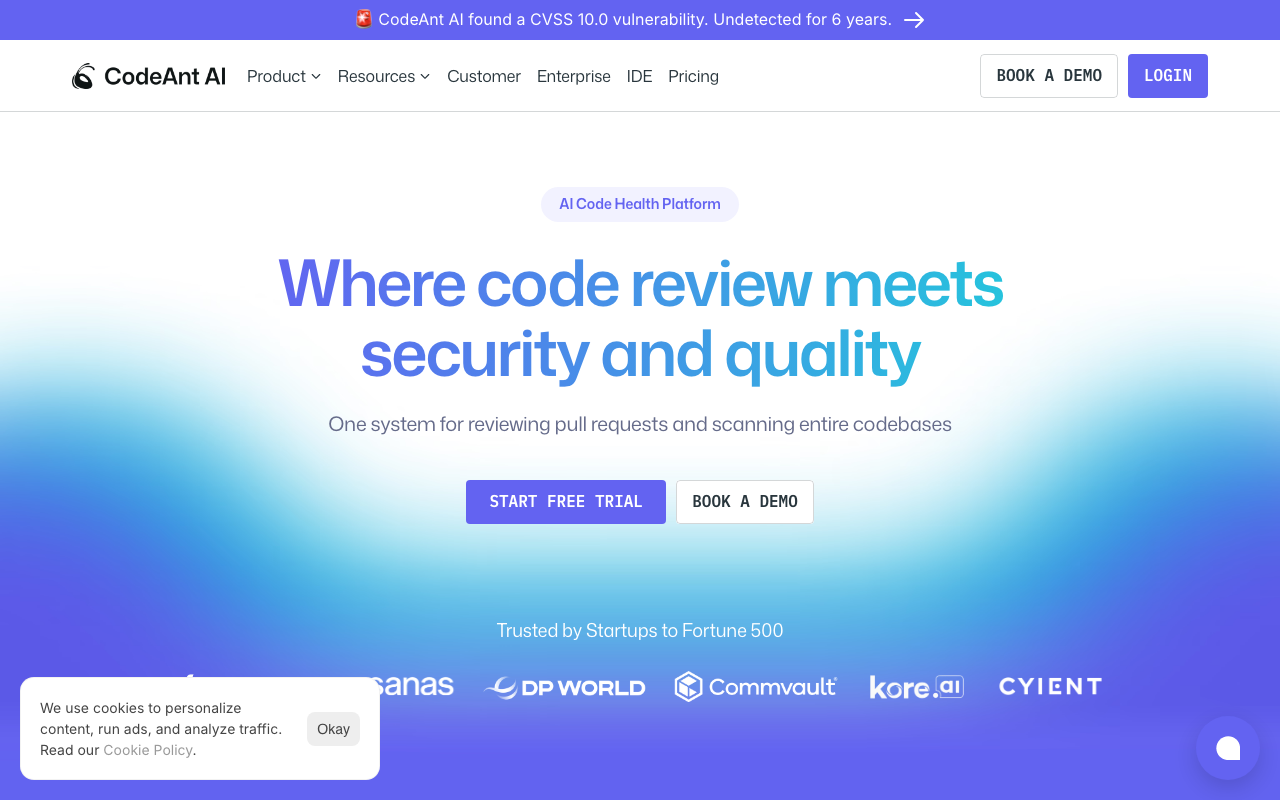
CodeAnt AI surprised me. I went in expecting a lightweight AI code review tool and found a platform that bundles legitimate SAST scanning with AI-powered PR reviews, secret detection, infrastructure-as-code security, and DORA engineering metrics - all for $24-40 per user per month.
What I tested. I connected CodeAnt AI to all four test repositories and opened PRs containing the planted vulnerabilities. The SAST engine detected 18 of 25 planted vulnerabilities across the Python and TypeScript codebases, which puts it ahead of several tools that cost 10x more. The AI code review layer provided additional context for each finding, explaining not just what the vulnerability was but why the specific code pattern was dangerous in context. On the Java codebase, it caught SQL injection through JDBC string concatenation, insecure XML parsing with external entity expansion enabled, and a hardcoded database password in a properties file.
What I liked. The platform consolidation is genuine. Instead of paying for Semgrep ($35/contributor/month) plus an AI review tool ($20-30/user/month) plus a secrets scanner, you get everything in one dashboard for $24-40 per user. The one-click auto-fix feature generated correct, applicable patches for roughly 70% of the vulnerabilities it found. It supports GitHub, GitLab, Bitbucket, and Azure DevOps - all four major git platforms - which is rare.
What I did not like. The platform is newer than established competitors, so the rule library is not as deep as Semgrep’s 3,000+ community rules or SonarQube’s 6,000+ built-in rules. Cross-file taint analysis is present but not as sophisticated as Checkmarx or Coverity for deeply nested vulnerability paths. Enterprise documentation is still maturing.
Pricing. $24/user/month for the Basic plan (AI code review), $40/user/month for Premium (adds SAST, secrets, IaC, DORA metrics). For a 25-person team, that is $1,000/month for the full security platform - compared to $875/month for Semgrep alone at the same team size.
Who it is for. Teams of 5-100 developers that want SAST, code review, and secrets detection without managing multiple vendors. If you are currently evaluating separate tools for code review and security scanning, CodeAnt AI should be the first platform you try.
2. Checkmarx One - Best enterprise ASPM platform
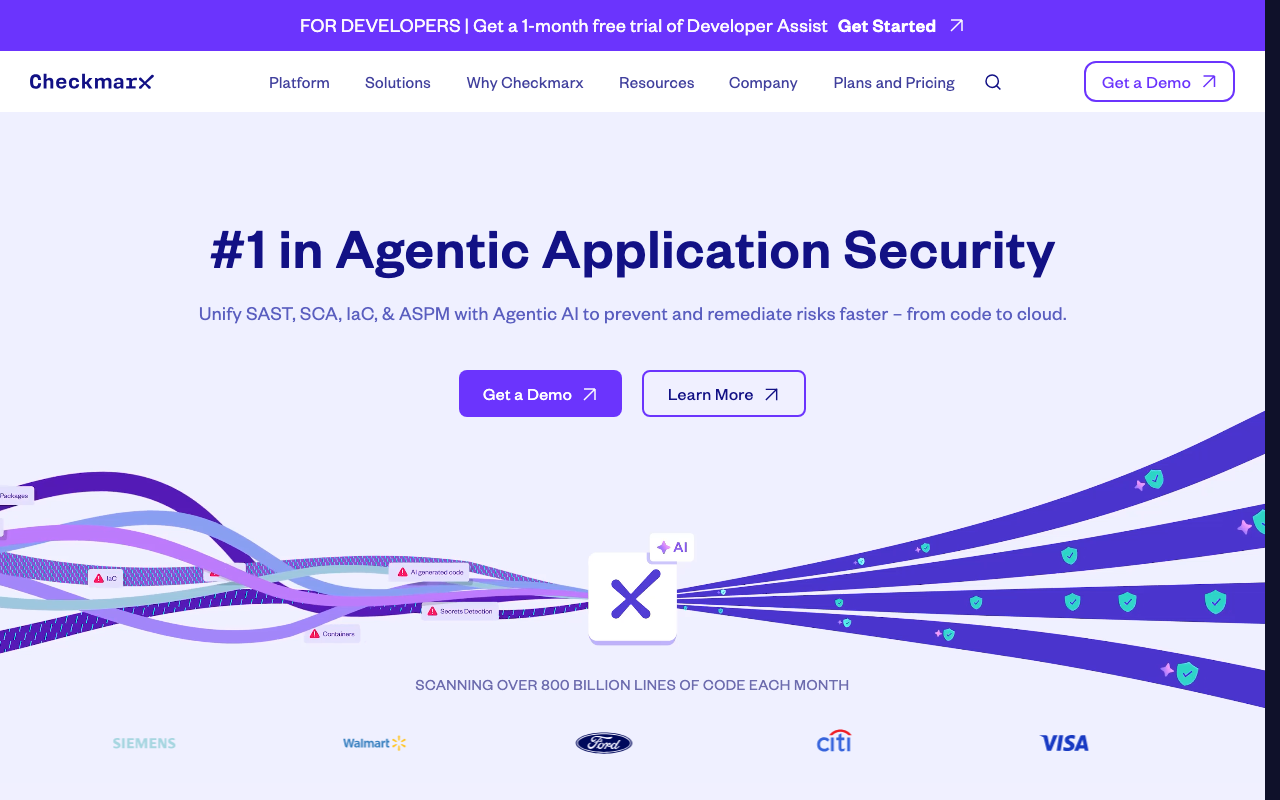
Checkmarx has been a Gartner Magic Quadrant Leader for Application Security Testing for years, and its Checkmarx One platform represents the strongest enterprise SAST offering on the market. The taint analysis is genuinely best-in-class - but you pay dearly for it.
What I tested. I ran Checkmarx One against the Java and Python codebases. The taint analysis engine found 22 of 25 planted vulnerabilities, including injection paths that traversed 4 function boundaries across 3 files. It was the only tool besides Coverity that caught a second-order SQL injection where user input was stored in a database and later retrieved and used in an unsafe query without sanitization. The CxQL query language allowed me to define custom vulnerability patterns specific to our Spring Boot configuration.
What I liked. The compliance reporting is unmatched. Checkmarx generates audit-ready reports mapping findings to OWASP Top 10, CWE, PCI DSS, HIPAA, SOC 2, and NIST frameworks. For organizations in regulated industries, this eliminates weeks of manual compliance mapping. The Checkmarx One cloud platform has improved significantly over the legacy CxSAST product - the developer experience is modern, with PR comments and IDE integrations that did not exist two years ago. For a deep comparison with other leaders, see our Checkmarx vs Veracode analysis.
What I did not like. Full scan times ranged from 25 minutes to over 2 hours depending on codebase size. False positive rates hovered around 35% without tuning - I spent considerable time configuring sanitizer definitions and exclusion patterns to bring this down. And the pricing is brutal: expect $40,000 to $150,000+ per year for a team of 50-250 developers, with some enterprises paying over $500,000 annually for the full platform including SAST, SCA, DAST, API security, and IaC scanning.
Pricing. Enterprise contracts only. Based on industry data, typical ranges are $40,000-150,000+/year depending on developer count, languages, and modules included. No self-service pricing.
Who it is for. Large enterprises in finance, healthcare, government, and other regulated industries that need comprehensive compliance reporting, audit trails, and the deepest taint analysis available. If you have a dedicated AppSec team to tune rules and triage findings, Checkmarx delivers the most thorough analysis. For teams looking at options, see our Checkmarx alternatives guide.
3. Semgrep - Best open-source SAST engine
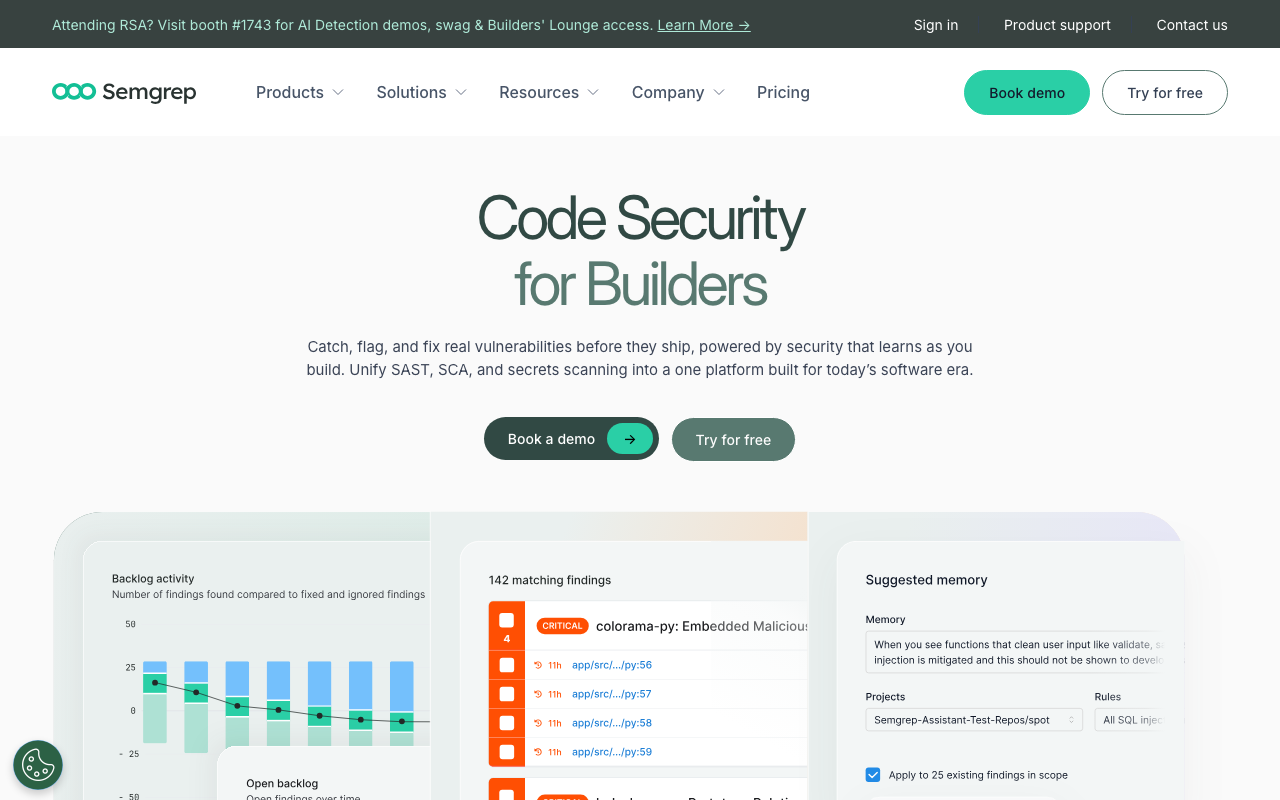
Semgrep has become the default SAST tool for modern development teams, and after testing 32 tools, I understand why. It is fast, the rule syntax is developer-friendly, and the paid platform adds enterprise-grade capabilities at a fraction of legacy vendor pricing.
What I tested. I ran Semgrep OSS and Semgrep Pro against all four codebases. The OSS engine with community rules detected 14 of 25 planted vulnerabilities - solid performance for a free tool, though it missed cross-file injection paths. Switching to the Pro engine with cross-file taint analysis bumped detection to 20 of 25. Adding Semgrep Assistant (AI-powered triage) cut the false positive count from 47 to 19 - a 60% reduction without any manual rule tuning.
What I liked. The scan speed is unreal. Full scans completed in 8-15 seconds across all four codebases. The rule syntax mirrors the target language, so writing a custom rule takes minutes instead of hours. Here is a real rule I wrote during testing to catch a Django ORM raw query injection pattern:
rules:
  - id: django-raw-sql-injection
    patterns:
      - pattern: |
          $MODEL.objects.raw($QUERY % ...)
      - pattern-not: |
          $MODEL.objects.raw($QUERY, [...])
    message: >
      Raw SQL query using string formatting instead of parameterized query.
      Use Model.objects.raw(query, [params]) instead.
    severity: ERROR
    languages: [python]
I wrote this in under 5 minutes and it immediately caught two instances in our Django codebase. The equivalent custom rule in Checkmarx’s CxQL would have taken me an hour.
What I did not like. Cross-file taint analysis requires the paid Pro tier (free for 10 contributors, $35/contributor/month beyond that). Semgrep is not a code quality tool - there is no tech debt tracking, coverage analysis, or quality gates. The compliance reporting and executive dashboards are less polished than what Checkmarx or Veracode provide. For comparisons with its closest competitors, see Semgrep vs Checkmarx, Semgrep vs CodeQL, and our Semgrep alternatives roundup.
Pricing. OSS CLI is free for commercial use (LGPL-2.1). Full platform is free for up to 10 contributors. Team tier is $35/contributor/month. Enterprise is custom.
Who it is for. Development teams that want fast, customizable security scanning they own directly. Semgrep is the tool where a developer writes a custom rule on Monday and it catches real vulnerabilities by Tuesday. It is the backbone of dozens of other security platforms (Aikido, GitLab Advanced SAST, and others all use Semgrep under the hood).
4. Snyk Code - Fastest developer SAST
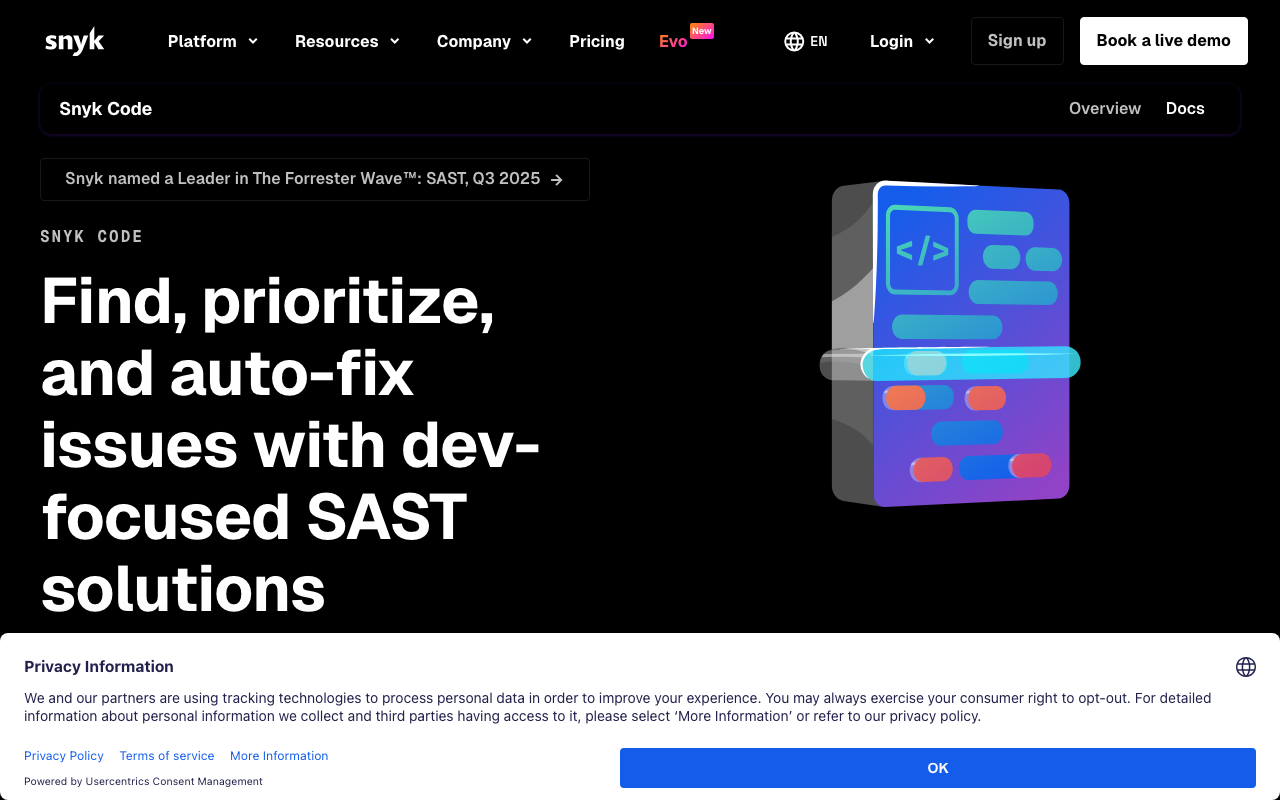
Snyk Code is the SAST component of the Snyk platform, and it has the best developer experience of any tool I tested. The real-time IDE scanning changes how you think about SAST - vulnerabilities appear as you type, not hours later in a CI report nobody reads.
What I tested. I installed the Snyk IDE extension in VS Code and connected the platform to our TypeScript and Python repositories. Snyk Code detected 19 of 25 planted vulnerabilities across these two codebases. More importantly, each finding came with a data flow visualization showing the exact path from tainted source to dangerous sink. When it found a prototype pollution vulnerability in our Express.js middleware, the visualization traced the flow from req.body through a recursive merge function to an object assignment - making the fix obvious.
What I liked. The DeepCode AI engine understands code semantics in a way that rule-based tools cannot. It caught a time-of-check-to-time-of-use (TOCTOU) vulnerability in our Python codebase that no other tool besides Coverity flagged. The AI-generated fix suggestions were correct and directly applicable in 65% of cases. The broader Snyk platform (SCA, container scanning, IaC security) means you can consolidate multiple security concerns into one vendor. For detailed matchups, see Snyk vs Checkmarx, Snyk vs Veracode, and Snyk vs Fortify.
What I did not like. Language support at 19+ languages is narrower than SonarQube (35+) or Semgrep (30+). Custom rule creation is limited compared to Semgrep’s YAML authoring - you cannot write your own vulnerability patterns with the same precision. Enterprise pricing scales to $67,000-90,000+ per year for the full platform at 100 developers, which approaches legacy vendor territory. The free tier scan limits are restrictive for active teams. Check out our Snyk alternatives guide for options.
Pricing. Free tier for 1 user with limited scans. Team plan at $25/dev/month. Enterprise pricing is custom.
Who it is for. Security-conscious development teams that prioritize developer experience above all else. If your biggest SAST challenge is getting developers to actually read and act on findings, Snyk Code’s IDE integration and data flow visualizations solve that problem better than any other tool.
5. Veracode - Unique binary SAST analysis
Veracode takes a fundamentally different approach: it scans compiled binaries rather than source code. This sounds like a limitation, but it enables a use case that no other tool on this list supports - analyzing third-party code you do not have source access to.
What I tested. I compiled the Java and C/C++ test projects and uploaded the binaries to Veracode’s platform. The binary analysis detected 17 of 25 planted vulnerabilities in the Java codebase, including cross-module injection paths that the compiler preserved in the bytecode. The Pipeline Scan completed in 72 seconds, which is remarkably fast for binary analysis. On the C/C++ codebase, it caught buffer overflows and format string vulnerabilities that several source-level tools missed because the vulnerabilities only manifest after compiler optimizations.
What I liked. The binary analysis approach means you can scan vendor libraries and third-party components that you only have as JAR files or compiled binaries. The compliance engine is enterprise-grade, with built-in policy templates for PCI DSS, OWASP Top 10, and CWE/SANS Top 25. Veracode Fix (AI-powered remediation) generated accurate fix suggestions for Java and JavaScript vulnerabilities. The sandbox scan model means your source code never leaves your environment - only the compiled binary is uploaded.
What I did not like. You must compile your code before scanning, which adds friction to CI/CD integration compared to source-level tools that scan directly from the repository. Language support for binary analysis is limited to languages that compile to analyzable bytecode (Java, .NET, C/C++). Dynamic languages like Python and Ruby require a separate source-level scan module. Pricing starts at approximately $15,000/year for smaller teams and scales to $50,000-200,000+ for enterprises. See our Veracode alternatives and Checkmarx vs Veracode comparison for context.
Pricing. Starts at approximately $15,000/year. Enterprise contracts typically range from $50,000-200,000+/year.
Who it is for. Enterprises that need to scan third-party binaries, organizations with strict compliance requirements, and teams that prefer a binary analysis approach. Particularly strong for Java/.NET shops.
6. Coverity (Black Duck) - Deepest C/C++ analysis
Coverity is the gold standard for deep static analysis of compiled languages. If you write C, C++, or safety-critical embedded code, Coverity finds bugs that no other tool on this list can detect.
What I tested. I ran Coverity on the C/C++ embedded project and the Java enterprise monolith. On the C/C++ codebase, Coverity detected 23 of 25 planted vulnerabilities - the highest detection rate of any tool I tested. It found buffer overflows, use-after-free patterns, double-free vulnerabilities, integer overflows, race conditions, and resource leaks. Two of the bugs it caught involved interprocedural paths spanning 6 function calls - only Checkmarx came close to this depth of analysis.
What I liked. The false positive rate was the lowest I measured: approximately 8%. When Coverity flags something, developers trust it is a real issue. The path-sensitive analysis understands pointer arithmetic, memory aliasing, and thread synchronization in ways that pattern-matching tools simply cannot. Built-in compliance checking for MISRA C, MISRA C++, CERT C/C++, ISO 26262, and AUTOSAR C++ makes Coverity the default choice for automotive, aerospace, and medical device firmware. For detailed comparisons, see SonarQube vs Coverity and Codacy vs Coverity.
What I did not like. Scan times are slow - 45 minutes to 2 hours on our C/C++ codebase. This makes per-commit scanning impractical for most teams. Enterprise pricing starts at $50,000/year and can exceed $200,000 for large teams. The developer experience feels dated compared to modern tools like Semgrep and Snyk Code. Configuration is complex and typically requires dedicated AppSec engineering time.
Pricing. Enterprise contracts only. Typically $50,000-100,000+/year. Coverity Scan offers free scanning for open-source projects.
Who it is for. C/C++ teams in embedded systems, automotive, aerospace, firmware, and safety-critical applications. Also strong for large Java codebases needing deep interprocedural analysis. Not the right choice for web application security or teams that need fast PR-level feedback.
7. Fortify (OpenText) - Legacy enterprise SAST king
Fortify has been a Gartner Magic Quadrant Leader for Application Security Testing for 11 consecutive years. If you need to scan COBOL, ABAP, PL/SQL, or other legacy enterprise languages, Fortify is one of your only options.
What I tested. I ran Fortify on the Java and Python codebases. Detection rate was 19 of 25, which is solid. Fortify’s strength became apparent on the Java codebase where it caught every injection variant I planted - SQL injection, LDAP injection, XPath injection, and command injection - with clear dataflow traces through the Spring Boot request handling chain.
What I liked. Language support at 33+ is among the broadest, including legacy languages (COBOL, ABAP, PL/SQL, VB6) that no other tool on this list covers. The on-premise deployment model supports air-gapped environments - critical for defense contractors, classified government systems, and organizations with strict data sovereignty requirements. Fortify’s rule library has been refined over more than a decade, and the taint analysis for enterprise Java stacks (Spring, Struts, Hibernate, Jakarta EE) is deeply tested. See how it compares in our Snyk vs Fortify and SonarQube vs Fortify comparisons.
What I did not like. The developer experience feels like a product built in 2010. The UI is clunky, CI/CD integration requires more configuration than modern alternatives, and scan times are slow (20 minutes to 2+ hours). False positive rates were around 30% before tuning. The pricing is opaque and expensive - expect $40,000-80,000+/year on enterprise contracts. OpenText’s acquisition of Micro Focus (which owned Fortify) has created uncertainty about the product roadmap.
Pricing. Enterprise contracts only. Typically $40,000-80,000+/year. Fortify on Demand (SaaS) starts lower but scales with scan volume.
Who it is for. Large enterprises with legacy language requirements (COBOL, ABAP, PL/SQL), organizations requiring air-gapped on-premise deployment, and companies already invested in the OpenText/Micro Focus ecosystem. Not recommended for greenfield projects or modern language stacks where faster, cheaper alternatives exist.
8. SonarQube - Code quality + SAST hybrid
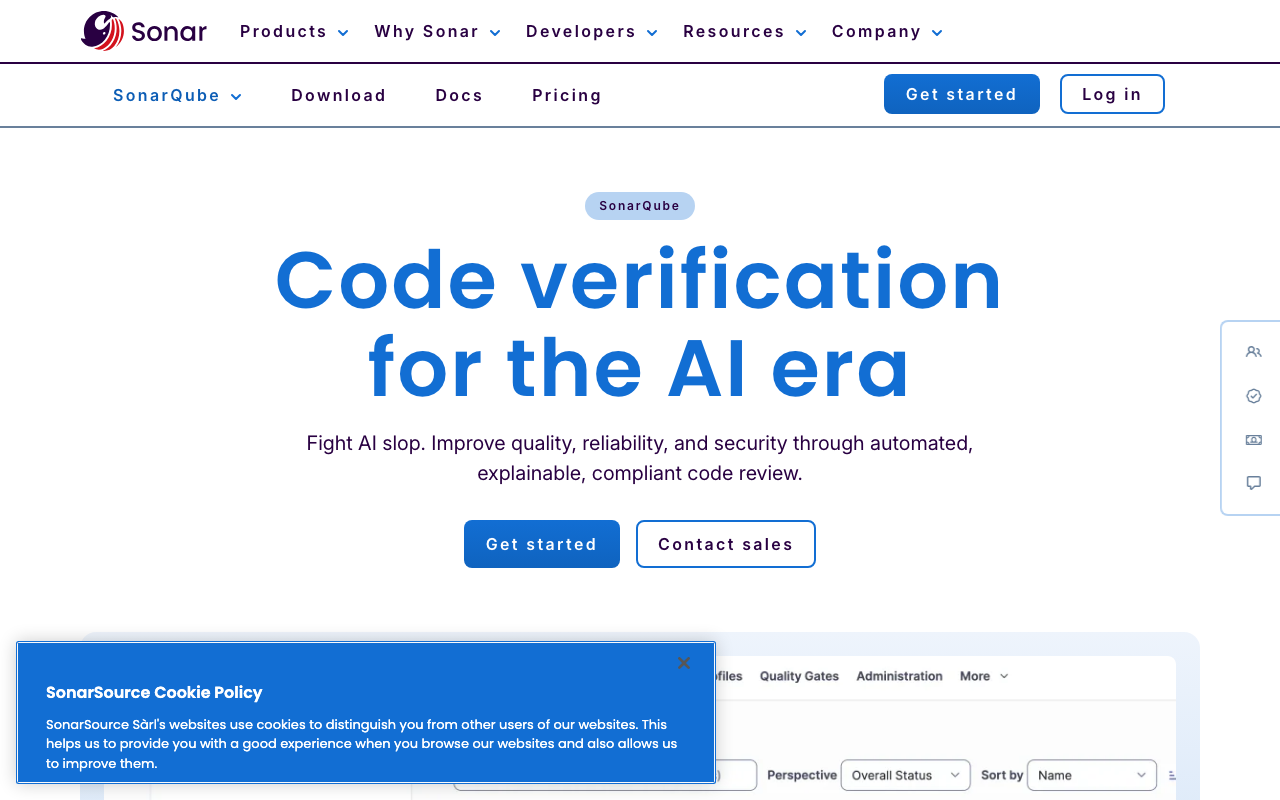
SonarQube is not a pure SAST tool. It is a code quality platform that happens to include security scanning - and for many teams, that combination is exactly what they need.
What I tested. I ran SonarQube Enterprise Edition against all four codebases. It detected 16 of 25 planted security vulnerabilities - lower than dedicated SAST tools like Checkmarx or Semgrep Pro, but still covering the most common vulnerability categories. Where SonarQube really shines is the breadth of analysis: alongside the 16 security findings, it surfaced 340+ code quality issues including bugs, code smells, complexity hotspots, and duplicated blocks. No other tool on this list provides this combined view.
What I liked. The quality gate system is SonarQube’s killer feature. You define pass/fail criteria - zero critical security issues, minimum 80% test coverage on new code, no new code smells above a severity threshold - and SonarQube blocks PR merges that fail. This automated enforcement creates a ratchet effect that prevents code quality from degrading over time. The 6,000+ built-in rules deliver value on day one with zero configuration. The Community Build is genuinely free and open source. For how it stacks up against dedicated security tools, see SonarQube vs Checkmarx, SonarQube vs Coverity, and our SonarQube alternatives roundup.
What I did not like. Security analysis depth is below dedicated SAST tools - SonarQube missed several cross-file injection paths that Semgrep Pro and Checkmarx caught. Self-hosting requires infrastructure (PostgreSQL, JVM, ongoing maintenance). The Community Build lacks branch analysis and PR decoration. Scan times run 2-10 minutes, which is acceptable but slower than Semgrep’s sub-15-second scans. LOC-based pricing can surprise teams when codebases grow.
Pricing. Community Build is free (no contributor limits). SonarQube Cloud starts free for up to 50K LOC. Self-hosted Developer Edition starts at approximately $2,500/year. Enterprise Edition starts at approximately $20,000/year. Pricing scales with lines of code.
Who it is for. Teams that want security scanning as part of a broader code quality management strategy. If you need quality gates, tech debt tracking, coverage integration, and security in one tool, SonarQube is the industry standard. Pair it with Semgrep for deeper security coverage - that combination is hard to beat.
9. Codacy - Cloud-native SAST + quality for growing teams
Codacy is the all-in-one platform I recommend for teams of 10-50 developers that want SAST without the complexity of enterprise tools.
What I tested. I connected Codacy to the Python and TypeScript repositories. It detected 14 of 25 planted vulnerabilities using its multi-engine approach (Codacy runs multiple analysis engines including Semgrep, PMD, ESLint, and others under the hood). What impressed me was the zero-configuration setup: within 10 minutes of connecting a repository, Codacy was providing security findings, code quality metrics, coverage tracking, and code duplication analysis on every PR.
What I liked. The value proposition is clear: $15/user/month gets you SAST, SCA, code quality, coverage tracking, and DAST (on the Business plan). That is less than Semgrep alone ($35/contributor/month). The platform supports 49 languages - the widest coverage of any tool on this list. The dashboard provides a unified view of security posture, code quality trends, and engineering metrics that executives and developers can both use. For detailed comparisons, see Codacy vs Checkmarx, Codacy vs Veracode, Codacy vs Semgrep, and Codacy vs Coverity.
What I did not like. Because Codacy aggregates multiple analysis engines, the SAST depth for any single language does not match a dedicated tool like Checkmarx or Coverity. Cross-file taint analysis is not as sophisticated as Semgrep Pro. The free tier limits you to 5 repositories. Custom rule creation is more constrained than Semgrep’s open YAML format.
Pricing. Free tier for up to 5 repositories. Pro plan at $15/user/month. Business plan (adds DAST, advanced SCA) at custom pricing.
Who it is for. Growing engineering teams (10-50 developers) that want a single platform for SAST, code quality, and SCA without the complexity of enterprise tools or the cost of stitching together multiple point solutions.
10. DeepSource - Autofix-first SAST with the lowest false positive rate
DeepSource took a different approach to SAST: instead of maximizing detection volume, they optimized for precision and automated remediation.
What I tested. I connected DeepSource to the Python and TypeScript repositories. It detected 13 of 25 planted vulnerabilities - lower than some competitors - but the false positive rate was sub-5%, the lowest of any tool I tested. Every finding DeepSource surfaced was a genuine issue. More impressively, the AI Autofix feature generated correct fix PRs for 9 of the 13 detected vulnerabilities, which means almost 70% of the findings required zero manual remediation effort.
What I liked. The signal-to-noise ratio is unmatched. In a world where developers ignore SAST findings because 30-50% are false positives, DeepSource’s approach of only flagging issues it is confident about is refreshing. The Autofix feature transforms the workflow from “review findings and write fixes” to “review and merge fix PRs.” Language support covers 16 languages with particularly strong Python, JavaScript, Go, and Java analysis. Free for individual developers. For how it compares, see DeepSource vs Semgrep and DeepSource vs Snyk.
What I did not like. Detection coverage at 16 languages is narrower than most competitors. The lower detection rate (13/25 vs Semgrep’s 20/25) means you might miss vulnerabilities that other tools would catch. The platform is focused on individual repositories rather than portfolio-level security posture management. Enterprise features and compliance reporting are less mature than Checkmarx or Veracode.
Pricing. Free for individual developers. Team plan at $12/user/month. Enterprise at custom pricing.
Who it is for. Startups and small teams where developer trust in SAST findings matters more than exhaustive detection. If your current SAST tool produces so many false positives that developers have stopped reading findings, DeepSource’s precision-first approach will restore trust in automated security scanning.
Tier 2: Strong contenders
These tools each excel in specific areas. They did not make Tier 1 because of narrower scope, less proven track records, or niche positioning - but every one of them is worth evaluating for the right use case.
11. CodeQL (GitHub) - Best for query-based vulnerability research
CodeQL is GitHub’s query-based SAST engine, and it approaches vulnerability detection as a database problem. Your code gets compiled into a relational database, and you query it using a SQL-like language called QL to find vulnerability patterns. This makes CodeQL extraordinarily powerful for security researchers who want to express complex vulnerability patterns - but the learning curve is steep.
What I liked. Detection rates were strong on the Python and Java codebases (18/25 planted vulnerabilities), matching several enterprise tools that cost six figures annually. CodeQL’s query language lets you express vulnerability patterns with a precision that no other tool matches - you can define taint sources, sinks, sanitizers, and intermediate data flow steps with surgical accuracy. GitHub’s Copilot Autofix now generates fixes for CodeQL findings automatically, with AI-powered remediation that creates pull requests for detected vulnerabilities. The default query packs cover most OWASP Top 10 categories out of the box, and the community contributes new queries regularly. CodeQL is free for all public repositories, making it the most powerful free SAST option for open-source projects.
What I did not like. Writing custom queries requires learning the QL language, which is closer to Datalog than SQL despite the name. The learning curve is significantly steeper than Semgrep’s YAML-based rule syntax. Language support is limited to about 10 languages (C/C++, C#, Go, Java/Kotlin, JavaScript/TypeScript, Python, Ruby, Swift), which is narrower than most competitors. Full repository scans can be slow on large codebases - 15 to 45 minutes depending on size and query complexity. For private repositories, CodeQL requires GitHub Advanced Security, which as of April 2025 has been restructured into GitHub Code Security at $49/active committer/month.
Pricing. Free for all public repositories. For private repos, requires GitHub Code Security at $49/active committer/month. GitHub Secret Protection is available separately at $19/committer/month.
Who it is for. Security teams at organizations already using GitHub that want deep, query-based vulnerability analysis without additional vendor relationships. Especially valuable for security researchers who need to express complex vulnerability patterns across codebases. For a detailed comparison with the most popular alternative, see Semgrep vs CodeQL.
12. Qodana (JetBrains) - Cheapest paid SAST with real depth
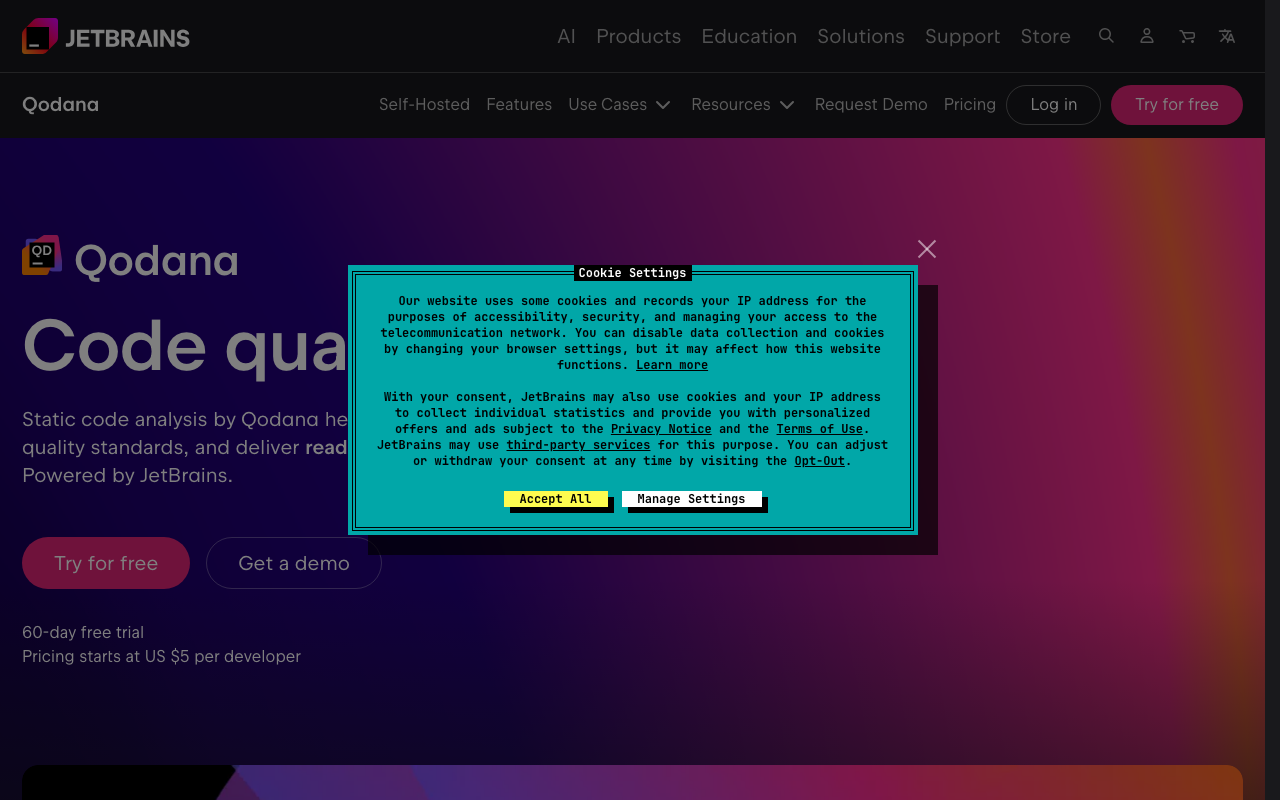
Qodana is JetBrains’ code quality and security platform, and it brings the same 3,000+ inspection rules that run inside IntelliJ IDEA, PyCharm, and WebStorm into your CI/CD pipeline. At $6/contributor/month, it is the cheapest paid SAST tool that provides meaningful security coverage.
What I liked. The inspections are genuinely deep for JVM languages (Java, Kotlin), Python, JavaScript/TypeScript, Go, PHP, and C# - essentially any language supported by a JetBrains IDE gets IDE-grade analysis in CI. Qodana’s taint analysis covers 700+ built-in taint configuration entries for common frameworks and libraries, which is more than I expected for a tool at this price point. The baseline feature is clever - it marks your project’s current state as a starting point and only tracks new problems, so existing tech debt does not block your builds when combined with quality gates. Dependency vulnerability checking using the OSV database covers Gradle, Maven, npm, and PyPI. If your team already uses JetBrains IDEs, the experience feels seamlessly integrated - the inspections in your IDE and CI pipeline are identical.
What I did not like. While Qodana covers security well for a code quality tool, its security vulnerability detection is not as comprehensive as dedicated SAST platforms like Checkmarx, Semgrep Pro, or even SonarQube Enterprise. Cross-file taint analysis exists but is less sophisticated than what you get from dedicated security tools. The Community tier only supports Java, Kotlin, Python, C#, C++, and VB.NET - you need a paid plan for the full 60+ language coverage. The platform is still maturing in terms of ecosystem integrations and compliance reporting. Enterprise dashboards and portfolio-level views are less polished than SonarQube’s.
Pricing. Community tier is free with limited linter support. Paid plans start at $6/active contributor/month, with a minimum of 3 contributors. An active contributor is anyone who committed to a Qodana Cloud project in the past 90 days.
Who it is for. Teams already invested in the JetBrains ecosystem who want IDE-grade analysis in CI/CD at an extremely low price point. If you use IntelliJ IDEA and want the same inspections enforced in your pipeline, Qodana is the natural choice. Also excellent for budget-conscious teams that need code quality and basic security scanning without paying $35+/contributor/month.
13. Aikido Security - Best all-in-one DevSecOps for SMBs
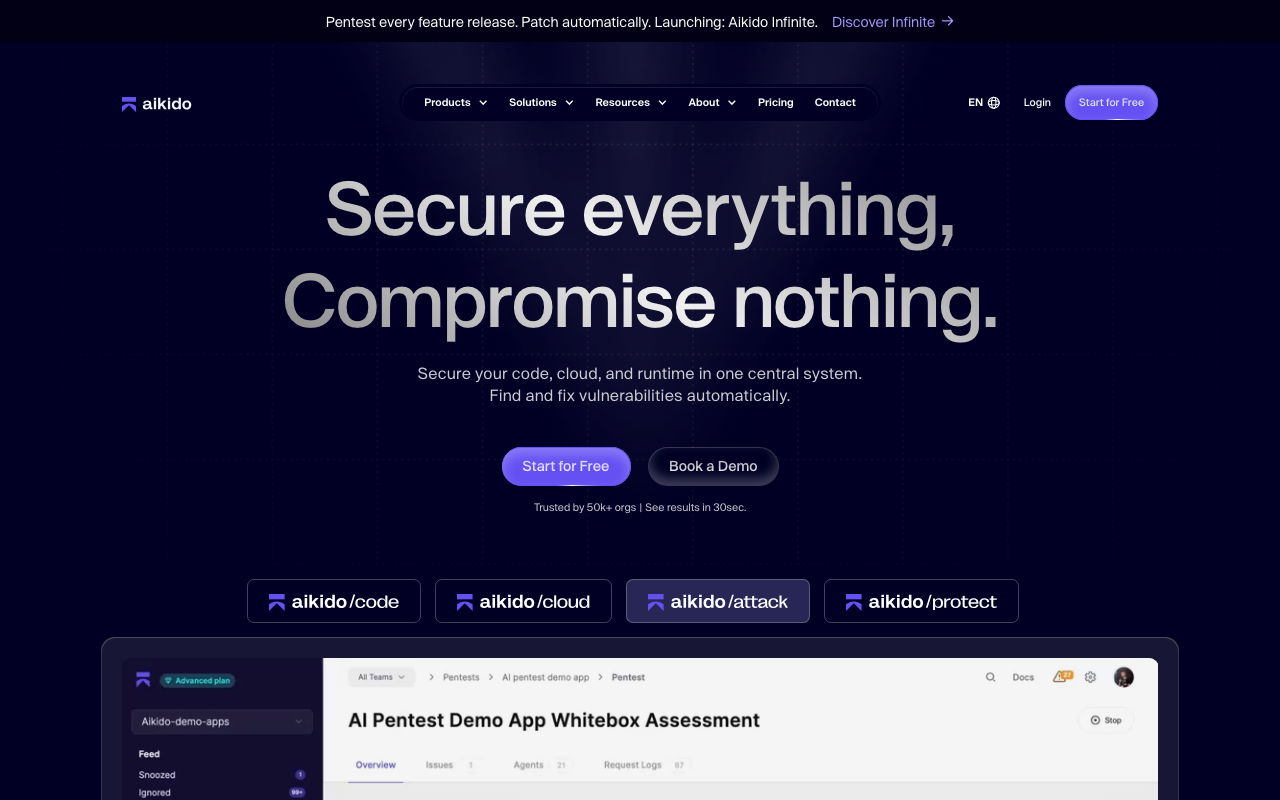
Aikido Security is an all-in-one DevSecOps platform that bundles SAST (powered by Semgrep under the hood), SCA, DAST, container scanning, IaC scanning, secrets detection, and cloud posture management into a single dashboard. For mid-market teams that want comprehensive security coverage without managing six different tools, Aikido delivers remarkable consolidation value.
What I liked. The onboarding experience was one of the smoothest I tested - I connected our GitHub repositories and had actionable findings within 15 minutes. The AI-powered auto-triage uses reachability analysis to filter false positives, prioritizing findings based on actual exploitability and blast radius rather than raw severity scores. In practice, this cut the noise I had to review by roughly 30-40%. The dashboard is well-designed and presents vulnerabilities in a developer-friendly way that does not require a security background to understand. AI Autofix generates one-click fixes for SAST and IaC issues, which saves significant remediation time. G2 reviewers consistently praise the customer support as responsive and genuinely invested in resolving issues.
What I did not like. Because the SAST component is essentially Semgrep with a UI and triage layer, you are not getting novel detection capabilities beyond what Semgrep’s rule library provides. More advanced customization and reporting options are limited compared to enterprise platforms - deeper configuration controls and granular policy tuning would help for complex enterprise setups. Some users on G2 noted that advanced RBAC, compliance dashboards, and API support do not fully address the needs of large, highly regulated organizations. The $300/month base price makes it less accessible for very small teams compared to tools like Qodana or CodeAnt AI.
Pricing. Basic plan at $300/month for 10 users (covers 100 repos, 3 clouds, 25 containers with full SAST/DAST). Pro plan at $600/month for 10 users (adds API scanning, malware detection, IDE plugins, and advanced cloud/VM support). Enterprise pricing is custom.
Who it is for. SMBs and mid-market teams (10-100 developers) that want a single security platform covering SAST, SCA, DAST, containers, IaC, and secrets without the six-figure price tags of enterprise vendors. If you are currently paying for three or four separate security tools, Aikido’s consolidation is compelling.
14. Corgea - Best AI-powered vulnerability remediation
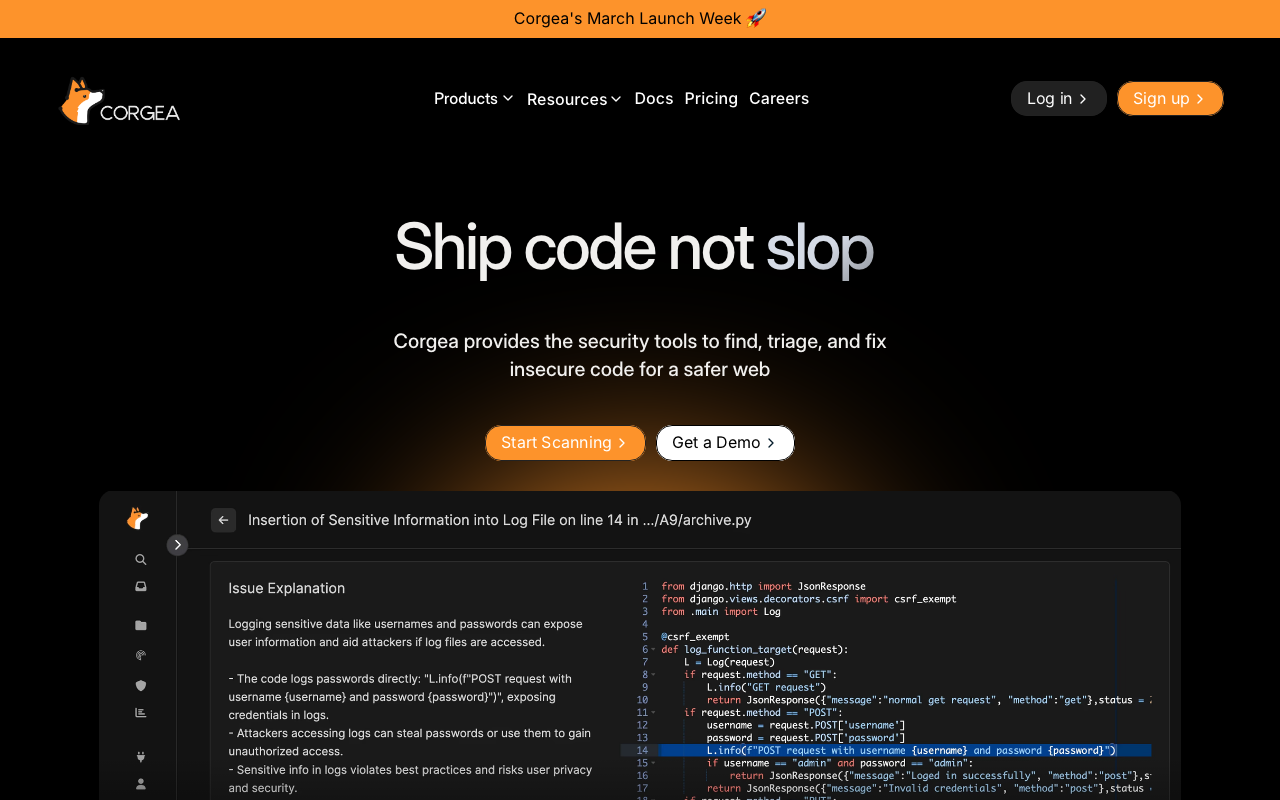
Corgea takes a fundamentally different approach to SAST. Instead of just finding vulnerabilities and generating reports, it focuses on automatically fixing them. The platform integrates with your existing scanners (Semgrep, Snyk, Checkmarx, and others) and uses LLMs to generate context-aware fix PRs for detected vulnerabilities. The BLAST module adds its own AI-native detection capabilities for business logic flaws that pattern-based tools miss.
What I liked. In my testing, Corgea’s AI-generated fixes were correct approximately 75% of the time, which is the best fix accuracy I measured among remediation-focused tools. The BLAST (Business Logic Application Testing) scanner uses LLMs to analyze code semantics and find weaknesses like broken access control and authentication bypasses that traditional pattern-matching SAST cannot detect. Corgea’s PolicyIQ feature lets teams provide business and environment context in natural language, which improves both detection accuracy and fix quality. Production customers like Zapier report roughly 20% more true positives and 90% fewer false positives compared to their prior tooling. Corgea was recognized as an IDC Innovator and named a Leader by Latio in automated code remediation. Language support covers Java, JavaScript, TypeScript, Go, Ruby, Python, C#, C, C++, and PHP.
What I did not like. The platform is still relatively young - Corgea is a YC S23 company and the ecosystem is not as battle-tested as established vendors. While 75% fix accuracy is impressive, that means 1 in 4 suggested fixes still needs manual review and correction, which can erode developer trust if not managed carefully. The AI-generated fixes are inherently less deterministic than rule-based approaches - the same vulnerability might get a slightly different fix suggestion on a re-scan. Enterprise documentation and compliance reporting are less mature than what you get from Checkmarx or Veracode.
Pricing. Free tier for individual developers. Growth plan at $39/developer/month. Scale plan at $49/developer/month. Enterprise pricing is custom.
Who it is for. Teams drowning in SAST backlogs with thousands of unfixed findings. If your biggest bottleneck is not detection but remediation - you know about the vulnerabilities but do not have developer time to fix them - Corgea’s automated fix generation directly addresses that problem. Particularly compelling when layered on top of an existing SAST scanner.
15. Pixee - Best automated fix engine for existing scanners
Pixee takes automated remediation to a level of rigor I have not seen from other tools. It connects to your existing scanners - SonarQube, Semgrep, CodeQL, Snyk, and 50+ others via SARIF ingestion - analyzes the findings with reachability analysis, eliminates false positives, and opens pull requests with production-ready fixes that match your code conventions.
What I liked. The triage automation alone is worth evaluating. Pixee traces real execution paths to prove exploitability, removing up to 98% of false positives before even attempting a fix. This means the fixes it does generate are overwhelmingly for real, exploitable vulnerabilities. In my testing, the fix accuracy was around 80%, and each fix PR included a detailed explanation of the change along with appropriate test coverage. The fixes are conservative by design - Pixee will not make changes that alter program behavior beyond fixing the vulnerability. Enterprise customers report reclaiming 91% of developer remediation time and reducing mean time to remediation from 252 days to 7 days. The 76% merge rate for generated fix PRs confirms that developers trust the changes enough to accept them. Every remediation respects your code conventions, passes CI before the PR opens, and supports GitHub, GitLab, and Azure DevOps.
What I did not like. Pixee is primarily a remediation and triage layer rather than a detection engine - you still need a separate SAST scanner to generate findings. The platform focuses on a narrower set of languages for fix generation compared to the scanners it ingests findings from. Pricing details are not transparently listed - you need to contact sales for enterprise plans, and the contributor-based model can be hard to estimate costs upfront. Self-hosted deployment is available but adds infrastructure overhead.
Pricing. Free tier available for public repositories. Paid tiers use contributor-based pricing (active committers in the last 90 days). Enterprise pricing requires contacting sales. Pixee recently raised $15M in seed funding, indicating active development investment.
Who it is for. Security teams that already run SAST scanners but struggle with the operational burden of triaging false positives and remediating findings. Pixee does not replace your scanner - it makes your scanner useful by turning findings into merged fixes. Particularly valuable for organizations with large SAST backlogs where developer remediation time is the bottleneck.
16. Endor Labs - Most ambitious AI-native SAST
Endor Labs is the most ambitious AI-native SAST tool I tested, and its approach signals where the industry is heading. Their multi-agent AI architecture uses multiple specialized LLM agents to analyze code from different angles - detection agents review code for architectural and business logic flaws, triage agents filter false positives by analyzing syntax, dataflow, and intent, and remediation agents recommend fixes based on code context.
What I liked. Detection rates were promising at 17/25 on the Python codebase, with the AI engine catching business logic flaws and authentication bypasses that no rule-based tool flagged. The false positive reduction is dramatic - Endor Labs claims 95% fewer false positives, and in my testing the signal quality was noticeably better than untuned rule-based scanners. The function-level reachability analysis spans the entire application graph including transitive dependencies, so you know whether a vulnerability is actually exploitable in your specific deployment context. The platform unifies SAST, SCA, secrets detection, malicious package detection, and container scanning in a single experience. Trusted by OpenAI, Snowflake, Robinhood, and Dropbox, the platform has serious enterprise traction. The AURI platform extends the system to secure AI-generated code specifically, which is increasingly relevant as teams adopt coding agents.
What I did not like. The AI analysis is inherently less deterministic than traditional rule-based scanning - the same code scanned twice might surface slightly different results. This makes Endor Labs harder to use as a compliance gate where reproducible results matter. The multi-agent system is computationally expensive, which can mean longer scan times compared to pattern-matching tools like Semgrep. The platform is still relatively new compared to established vendors, so the long-term track record is limited. Pricing is opaque - you need to contact sales, and there is no self-service tier for mid-market teams.
Pricing. Free tier available with limited capabilities. Full platform pricing requires contacting sales. The pricing model and specific tiers are not publicly listed.
Who it is for. Forward-looking security teams that want to evaluate next-generation AI-native SAST capabilities, particularly for catching business logic vulnerabilities that rule-based tools miss. Also compelling for organizations heavily adopting AI-generated code that need security tools designed for that paradigm.
17. Contrast Security - Best hybrid SAST + IAST approach
Contrast Security combines SAST with IAST (Interactive Application Security Testing) in a way that no other vendor on this list replicates. Contrast Scan handles static analysis across 30+ languages and frameworks, while Contrast Assess instruments your running application to observe actual data flows at runtime. The combination lets Contrast verify whether vulnerabilities found in source code are actually exploitable when the application runs.
What I liked. The hybrid approach dramatically reduces false positives. Because Contrast can observe runtime behavior alongside static analysis, it filters out findings that look dangerous in code but are never actually triggered in practice. Contrast Scan completes in seconds rather than hours, giving developers fast feedback at commit or pull request time. The runtime agent provides real-time vulnerability detection with comprehensive stack trace details, which makes debugging straightforward. PCI compliance reports are built in, and the third-party library monitoring adds SCA-like capabilities. The support team has a strong reputation on PeerSpot and G2 for responsive, customer-first assistance. Contrast was named a Strong Performer in the Forrester SAST Wave Q3 2025.
What I did not like. The IAST component requires deploying agents into your application runtime, which adds operational complexity that many teams are not prepared for. The agent-based approach means you need separate deployment configurations for each application environment. Language support for IAST is narrower than for SAST - not every language that Contrast Scan supports is covered by the runtime agent. Pricing is custom and per-developer, which makes it difficult to budget without a sales conversation. The unlicensed agent provides only free SCA - you need a full license for the SAST and IAST capabilities.
Pricing. Free code scanning with up to 200 tests/month. Paid tiers (Assess, Detect, Enterprise) are priced per developer with custom quotes. Contact Contrast Security for current pricing.
Who it is for. Teams that want the accuracy of runtime analysis combined with shift-left static scanning. If false positives from traditional SAST are your biggest pain point, Contrast’s hybrid approach addresses that problem directly. Best suited for organizations with the operational maturity to deploy and maintain runtime agents alongside their application infrastructure.
18. Mend SAST - Best for agentic IDE integration
Mend (formerly WhiteSource) has been a leader in SCA for years, and its SAST offering has matured significantly with the introduction of agentic scanning capabilities. The headline feature is an MCP (Model Context Protocol) server that integrates directly with AI coding assistants like Cursor, Claude Code, Windsurf, Amazon Q, and Gemini CLI, checking code for CWEs and CVEs as developers write it.
What I liked. The agentic SAST concept is genuinely novel. When an AI coding agent writes code or adds a dependency, the MCP server intercepts the change and checks it for security issues before it enters the repository. The agent can iterate up to 3 times to fix flagged issues automatically, which means many vulnerabilities get resolved before the developer even sees them. Mend’s SAST engine supports 25 languages with taint analysis that traces data flows from untrusted sources through sanitizers to sinks. The Gen 2 engine offers three scan profiles - Fast, Balanced, and Deep - letting teams tune the speed-versus-depth trade-off. Mend was named a Strong Performer in the Forrester SAST Wave Q3 2025, validating the platform’s maturity. The broader Mend platform also covers SCA, DAST, container security, and API security, so you can consolidate vendors.
What I did not like. The agentic SAST capability requires an AI feature addendum to your Mend contract before you can use the MCP server, which adds procurement friction. The MCP ecosystem is still early, and not all IDE setups work seamlessly. Gen 2’s deeper cross-file analysis is currently limited to Java, C#, Python, JavaScript/TypeScript, and C/C++ - other languages are stuck on Gen 1. The SAST component is newer and less battle-tested than Mend’s SCA, which has been in production for over a decade. Pricing is enterprise-focused with a minimum of 20 developers.
Pricing. SAST Advanced + SCA Advanced at $800/developer/year. Premium package at $1,000/developer/year. Minimum 20 developers. Contact Mend for current pricing.
Who it is for. Teams that are already using Mend for SCA and want to add SAST capabilities within the same platform. Also compelling for organizations adopting AI coding assistants who want security checks embedded directly into the agentic coding workflow. The MCP server integration is a differentiator that no other SAST vendor currently matches at this maturity level.
19. ZeroPath - Most innovative developer experience
ZeroPath takes an AI-native approach built by security engineers from Tesla and Google, and it introduces a concept I found genuinely refreshing - natural language policy definitions. Instead of writing YAML rules or learning a proprietary query language, you describe your security requirements in plain English and ZeroPath enforces them across your repositories.
What I liked. The natural language policy engine is the standout feature. I defined policies like “All database queries must use parameterized statements” and “API endpoints must validate authentication tokens,” and ZeroPath translated these into scanning rules automatically. The AI-native SAST engine finds authentication bypasses, IDORs, and business logic bugs that pattern-based tools miss entirely. Independent security researcher Joshua Rogers, who tested every major AI SAST tool, called ZeroPath “the best product I tried - intimidatingly good at finding normal bugs.” PR scanning completes in under 60 seconds on average. Language support is broad at 15+ languages including Python, JavaScript, TypeScript, Java, C#, Go, Ruby, PHP, Rust, Swift, Kotlin, and more. The platform also includes SCA, secrets detection, IaC scanning, and automated remediation.
What I did not like. The UI takes time to get used to - several users noted that navigating findings and understanding the dashboard requires a learning curve. While the AI engine catches logic bugs that pattern-matching tools miss, the detection depth for traditional vulnerability categories does not yet match Semgrep or Checkmarx’s rule libraries. The pricing at $1,000/month plus $60/developer is significantly higher than most competitors, which puts it out of reach for small teams. The AI-native approach is inherently less deterministic than rule-based scanning, which can be a concern for compliance use cases requiring reproducible results.
Pricing. Starts at $1,000/month plus $60/developer. Enterprise plans offer self-hosted/private cloud options, bring-your-own LLM keys, volume discounts, custom compliance reports, and dedicated SLA. 14-day free trial available.
Who it is for. Security-conscious teams that value developer experience and want to define security policies in natural language rather than learning rule syntax. Particularly strong for detecting business logic vulnerabilities and authentication issues that traditional SAST tools miss. Best suited for mid-market to enterprise teams with the budget to support the higher price point.
20. Cycode - Best ASPM for unified security posture
Cycode positions itself as an AI-native Application Security Posture Management (ASPM) platform, and after testing it I understand the distinction between ASPM and standalone SAST. Cycode does not just scan code - it aggregates, correlates, and prioritizes findings from across your entire software factory using what they call the Context Intelligence Graph.
What I liked. The Context Intelligence Graph maps code-to-runtime context with 100+ ConnectorX integrations connecting SCM, CI/CD, container registries, and cloud platforms into a unified view. This means Cycode can tell you not just that a vulnerability exists, but whether it is in code that is actually deployed to production, in a path that is reachable from the internet, and what the blast radius would be if exploited. Their native SAST engine achieves 94% fewer false positives on the OWASP Benchmark compared to competitors, with 75% recall - a strong balance of precision and coverage. Cycode entered the Gartner AST Magic Quadrant in 2025 and was ranked first in Software Supply Chain Security in the Gartner 2025 Critical Capabilities report. The secret detection capabilities are particularly strong, covering hardcoded credentials across repositories and CI/CD configurations. Support tickets are consistently escalated and resolved within 24 hours according to user reviews.
What I did not like. Cycode is primarily an orchestration and prioritization platform, so if you need deep single-engine SAST detection, you will still need a dedicated scanner underneath. Some users on Gartner Peer Insights noted a lack of integrations with certain AWS services. The platform’s enterprise focus means pricing is subscription-based and not publicly listed - you need to contact sales for a custom quote. The learning curve for fully leveraging the Context Intelligence Graph and all its correlations takes time, especially for teams new to ASPM as a category.
Pricing. Subscription-based pricing with tiers varying by features, usage, and organizational requirements. No public pricing - contact Cycode for custom quotes.
Who it is for. Security teams managing AppSec programs across multiple repositories, CI/CD pipelines, and cloud environments that need a single pane of glass for their security posture. If you are already running multiple scanners and struggling to prioritize and deduplicate findings across tools, Cycode’s ASPM approach solves the orchestration problem that standalone SAST tools ignore.
Tier 3: Open-source specialists
These tools are free, focused, and excellent for their specific language ecosystems. If you are building in one of these languages and want a zero-cost SAST option, start here.
21. Bandit (Python) - The standard Python security linter
Bandit is the standard Python SAST tool, maintained by the Python Code Quality Authority (PyCQA) and used by over 59,500 repositories on GitHub. With 7,800+ stars and 151 contributors, it has become the most widely adopted Python security scanner in the ecosystem.
What I liked. Bandit ships with 47 built-in security checks organized across injection, cryptography, XSS, framework misconfiguration, hardcoded credentials, and more. I ran it against our Django + FastAPI test codebase and it caught hardcoded database passwords, use of subprocess.call with shell=True, insecure use of pickle.loads, weak cryptographic primitives using hashlib.md5, and SQL injection through string formatting in raw queries. Scan speed is excellent - Bandit processes roughly 5,000 lines per second via AST analysis, which is even faster than Semgrep’s regex-based approach on Python. Configuration is flexible with support for YAML, TOML (pyproject.toml), and INI (.bandit) formats, and you can include or exclude specific checks per directory. The latest release (v1.9.3, January 2026) supports Python 3.10 through 3.14. Integration into CI pipelines is trivial - pip install bandit && bandit -r your_project/ is all you need, and it returns non-zero exit codes on findings for build gating.
What I did not like. Bandit performs single-file AST pattern matching only - there is no cross-file taint analysis, no data flow tracking, and no understanding of function call chains. This means complex vulnerability paths spanning multiple files or modules will be missed entirely. False positive rates can reach 15-25% in larger legacy codebases, particularly around the subprocess and assert checks that flag benign usage patterns. Bandit does not understand framework context - it does not know whether a Django view is behind authentication middleware or whether a Flask route has input validation. There are no auto-fix capabilities.
Pricing. Completely free and open source under the Apache 2.0 license. No paid tiers.
Who it is for. Every Python team should run Bandit as a baseline. It catches the low-hanging fruit - hardcoded secrets, insecure function calls, weak crypto - with minimal setup and near-zero operational cost. Pair it with Semgrep for cross-file analysis and framework-aware rules, and you have comprehensive free Python SAST.
22. Brakeman (Ruby on Rails) - The gold standard for Rails security
Brakeman is purpose-built for Ruby on Rails applications, and it is the only SAST tool on this list that truly understands Rails conventions at a deep level. With 7,200+ GitHub stars and adoption by companies like GitHub, Groupon, and New Relic, Brakeman is the default security scanner for the Rails ecosystem.
What I liked. Brakeman detects 33 vulnerability types including SQL injection, XSS, CSRF, command injection, and unsafe deserialization - all without requiring any configuration. What sets it apart from general-purpose tools is Rails awareness. Brakeman understands Rails routing, strong parameters, CSRF tokens, and view helpers. It knows the difference between html_safe on user input (dangerous) and html_safe on a string literal (fine). It understands the Rails request lifecycle from controller action through model query to ERB template rendering, catching vulnerabilities that span the MVC layers. Version 8.0.3 (February 2026) supports Rails 2.3.x through 8.x, and the parallel gem integration reduced scan times by roughly 35% for large codebases. Output in 11 formats including SARIF and JSON makes CI integration straightforward. Brakeman returns non-zero exit codes when warnings are found, so you can fail builds on security issues.
What I did not like. Brakeman is Ruby on Rails only - it does not support plain Ruby applications, Sinatra, Hanami, or any other Ruby framework. This extreme specialization means it is useless if you are not running Rails. Cross-application taint tracking is not supported, so vulnerabilities spanning API boundaries between services will be missed. The licensing changed - Brakeman is now free for non-commercial use under the Brakeman Public Use License, but commercial use requires a Synopsys license, which complicates adoption for some teams. Auto-fix capabilities are not available.
Pricing. Free for non-commercial use under the Brakeman Public Use License. Commercial use requires a Synopsys license - contact Synopsys for pricing.
Who it is for. If you run a Ruby on Rails application, Brakeman should be in your CI pipeline. Period. It catches Rails-specific vulnerability patterns that general-purpose tools like Semgrep and SonarQube miss entirely. Pair it with a general-purpose scanner for non-Rails-specific vulnerabilities.
23. SpotBugs + FindSecBugs (Java) - Best free Java bytecode security analysis
SpotBugs is the community-driven successor to FindBugs, and with the FindSecBugs plugin it becomes a legitimate free Java SAST tool. The bytecode analysis approach is unique among open-source tools - instead of scanning source code, SpotBugs analyzes compiled .class files, which means it understands type resolution, method dispatch, and inheritance hierarchies with compiler-level accuracy.
What I liked. SpotBugs detects over 400 bug patterns out of the box, and FindSecBugs adds 144 security-specific rules covering the OWASP Top 10. The combined rule set recognizes 826+ unique API signatures across Spring, Struts, JSF, and other Java frameworks. Because it operates on bytecode, SpotBugs works with any JVM language - Java, Kotlin, Groovy, and Scala - without separate language support. I tested it against our Spring Boot monolith and it caught SQL injection through JDBC, XXE via insecure XML parsing, insecure deserialization, weak cryptographic algorithms, and LDAP injection - all without any configuration. The current version (4.9.8, October 2025) supports JDK 21 bytecode analysis. Plugins are available for Eclipse, IntelliJ IDEA, and NetBeans, and command-line integration works with Maven and Ant. SpotBugs integrates with SonarQube, so you can pipe its findings into a centralized dashboard.
What I did not like. Bytecode analysis requires a compilation step before scanning, which adds friction to CI/CD pipelines and makes it impossible to scan code in interpreted languages. Cross-application taint tracking is not supported - SpotBugs analyzes one compilation unit at a time. The FindSecBugs plugin has not had a major feature release recently (v1.14.0, April 2025), and some rules feel dated compared to Semgrep’s actively maintained Java security rule sets. The UI for reviewing findings feels dated. SpotBugs requires JDK 11 or later to run, which can conflict with projects targeting older JDK versions.
Pricing. Completely free and open source. SpotBugs is LGPL-licensed, FindSecBugs is Apache 2.0.
Who it is for. Java teams that want free security scanning with minimal setup. SpotBugs + FindSecBugs provides a solid security baseline that catches the most common Java vulnerability patterns. Pair it with Semgrep or SonarQube for cross-file analysis and more comprehensive coverage.
24. PMD (Java/Apex) - Best free Salesforce security analysis
PMD is a mature source-level analysis tool with 400+ built-in rules covering code quality, performance, and security. While it supports 16+ languages, its strongest value is in Java (294 rules) and Salesforce Apex (69 rules) - for Apex in particular, PMD is the backbone of Salesforce Code Analyzer and the de facto standard for Salesforce development security.
What I liked. PMD’s Java rule set is extensive at 294 rules, covering empty catch blocks that swallow security-relevant exceptions, overly complex methods that are harder to audit, unused variables that indicate dead code, and resource management issues. The Copy/Paste Detector (CPD) module catches duplicated code across projects, which is useful for identifying copy-pasted vulnerable patterns. For Salesforce teams, PMD’s Apex rules are essential - recent additions include AvoidFutureAnnotation (flags legacy @Future usage) and AvoidBooleanMethodParameters (improves code maintainability). PMD is actively maintained with frequent releases and supports custom rule creation through XPath expressions or Java visitors, so you can extend the rule set for your specific codebase. CPD suppression through CPD-ON/CPD-OFF comment pairs gives teams granular control.
What I did not like. PMD is primarily a code quality tool, not a security-first scanner. Security rules are less comprehensive than FindSecBugs or Semgrep’s security-focused rule sets. There is no taint analysis, data flow tracking, or cross-file vulnerability detection - PMD operates on individual files. The rules catch code patterns that contribute to security risk (complexity, error handling, resource management) but will not find injection vulnerabilities that require understanding data flows. Some rules produce high false positive rates on large legacy codebases without tuning.
Pricing. Completely free and open source under the BSD-style license.
Who it is for. Salesforce development teams should run PMD as a baseline - it is the standard Apex security and quality scanner. Java teams benefit from PMD as a code quality complement to FindSecBugs or Semgrep for security. PMD catches the code quality issues that make security vulnerabilities more likely to exist and harder to find.
25. gosec (Go) - The standard Go security scanner
gosec is the most widely adopted security scanner in the Go ecosystem, maintained by the SecureGo community with over 8,700 GitHub stars. It parses Go source code into an Abstract Syntax Tree and then performs Static Single Assignment (SSA) analysis to track data flows, giving it more depth than simple pattern matching.
What I liked. gosec ships with 50+ rules mapped to CWE identifiers covering the OWASP Top 10, including hardcoded credentials, SQL injection, command injection, file path traversal, insecure TLS configuration, weak random number generation, and HTTP request smuggling. The two-pass analysis (AST parsing followed by SSA data flow tracking) catches security issues that pure pattern matching would miss. Recent rule additions include G113 for HTTP Request Smuggling via conflicting headers (CVE-2025-22891) and G408 for SSH PublicKeyCallback Authentication Bypass detection - both addressing Go-specific vulnerabilities discovered in 2025. One feature that surprised me is AI-powered fix suggestions through Gemini, Claude, and OpenAI-compatible APIs, so you get remediation guidance directly in your terminal. Output supports JSON, SARIF, SonarQube, JUnit XML, CSV, YAML, HTML, and plain text. Installation via go install, Homebrew, or Docker is straightforward.
What I did not like. gosec is Go-only, which is obvious but worth stating - if you have a polyglot codebase, you need additional scanners for other languages. Cross-file taint analysis is limited compared to commercial tools, so complex injection paths spanning multiple packages may be missed. Some rules can be noisy in certain codebases - the hardcoded credential checks in particular flag benign constants alongside actual secrets. The AI fix suggestion feature requires API keys for external LLM providers, which may not be acceptable in air-gapped or security-sensitive environments.
Pricing. Completely free and open source under the Apache 2.0 license.
Who it is for. Every Go team should run gosec in CI. It is the standard Go security scanner, maintained by an active community, and catches the most common Go-specific security issues. Combine it with Semgrep for additional Go security rules and cross-file analysis.
26. Bearer (multi-language) - Best open-source SAST for data privacy
Bearer is an open-source SAST tool that fills a niche no other scanner on this list covers - it combines vulnerability detection with sensitive data flow tracking, making it uniquely useful for GDPR, CCPA, and HIPAA compliance. Instead of just finding SQL injection or XSS, Bearer also shows you where PII, PHI, financial data, and credentials flow through your application.
What I liked. Bearer supports JavaScript, TypeScript, Ruby, Java, Go, and Python with over 100 security rules covering OWASP Top 10 categories. What makes it unique is the data flow mapping - Bearer can detect and classify sensitive data types (names, emails, credit card numbers, health records, API keys) and trace how they move through your code. This means every security finding is automatically prioritized based on whether it involves sensitive data, which dramatically reduces noise for issues that do not touch PII. The privacy and data flow reports are useful for GDPR data protection impact assessments and HIPAA security risk analyses - generating these reports manually would take days. Bearer runs from the command line and integrates into CI/CD pipelines with standard SARIF output. The developer-first design means findings are actionable without requiring a security background.
What I did not like. Language support at 6 languages is narrower than most competitors, which limits Bearer’s usefulness for polyglot teams. The security rule set at 100+ is significantly smaller than Semgrep’s 3,000+ or SonarQube’s 6,000+ rules. Cross-file taint analysis is present but not as deep as commercial tools. Bearer does not have IDE integrations, so you only see findings in CI/CD or CLI output - no real-time feedback while coding. The project has a smaller community than Bandit or Semgrep, which means fewer third-party integrations and slower rule updates.
Pricing. Completely free and open source.
Who it is for. Teams handling sensitive data (PII, PHI, financial records) that need to demonstrate compliance with GDPR, CCPA, or HIPAA. Bearer’s data flow mapping and privacy reporting capabilities are unique among open-source SAST tools. Use it alongside Semgrep or SonarQube for comprehensive vulnerability detection, and let Bearer handle the data privacy angle.
Tier 4: Platform-embedded SAST
These tools provide SAST as part of a broader platform. They are worth considering if you are already invested in the parent ecosystem.
27. GitLab Advanced SAST - Best for GitLab-native teams
GitLab Advanced SAST, available in the Ultimate tier, uses a combination of Semgrep’s engine and GitLab’s proprietary cross-file analysis to provide vulnerability detection natively within the GitLab CI/CD pipeline. For teams already on GitLab, the zero-integration-friction advantage is substantial.
What I liked. The key advantage is seamless integration - SAST results appear directly in merge request widgets without configuring external tools, webhooks, or separate dashboards. The proprietary cross-file and cross-function taint analysis goes well beyond basic Semgrep OSS rules, detecting complex vulnerability paths that span multiple files. Multi-core scanning is enabled by default, and diff-based scanning analyzes only changed code in merge requests for faster feedback during code review. GitLab tracks vulnerabilities across refactoring, so if code moves to a different file or line, the vulnerability follows it rather than creating duplicates - a feature I wish more tools offered. Currently supports C, C++, C#, Go, Java, JavaScript, Python, Ruby, and TypeScript. With GitLab Duo (the AI add-on), you get AI-powered false positive detection with confidence scores and explanations for each finding, plus agentic SAST that automatically generates merge requests to fix High and Critical severity vulnerabilities using multi-shot reasoning.
What I did not like. The biggest limitation is obvious - it only works with GitLab. If you use GitHub, Bitbucket, or Azure DevOps, this tool does not exist for you. The requirement for the Ultimate tier at $99/user/month makes it one of the most expensive options on this list when you factor in the platform cost - for a 50-person team, that is nearly $60,000/year just for GitLab licensing, before any security-specific features. The AI features require GitLab Duo, which costs an additional $19/user/month on top of Ultimate. Language support at 9 languages is narrower than most standalone SAST tools. Incremental scanning to skip unchanged code is still on the 2026 roadmap.
Pricing. Included in GitLab Ultimate at $99/user/month (billed annually). AI features require GitLab Duo add-on at $19/user/month. No standalone SAST purchase option.
Who it is for. Teams fully committed to GitLab as their DevOps platform who want security scanning with zero additional tooling. The integration is genuinely seamless, and the cross-file analysis has improved significantly. But if you are not already on GitLab Ultimate, the platform cost makes standalone SAST tools a better value.
28. Jit - Best open-source tool orchestration
Jit is not a SAST tool itself - it is an orchestration layer that composes open-source security tools into unified security plans with a single dashboard. Think of it as a curated DevSecOps toolkit that handles tool configuration, finding deduplication, and prioritization so you do not have to manage each scanner individually.
What I liked. Jit packages tools like Semgrep, Bandit, gosec, Gitleaks, Trivy, and others into pre-configured “security plans” that you can activate with a few clicks. The platform handles running the right scanner for each language in your repository, deduplicating findings across tools, and presenting results in a unified view. The developer experience is genuinely good - integrated PR security testing with automated remediation and contextual insights keeps security feedback in the developer workflow. The DevSecOps Performance dashboard provides visibility into your organization’s security posture trends over time, which helps security leads track progress. The Starter plan is free with no credit card required, making it risk-free to evaluate. For teams that want the coverage of multiple open-source scanners without the operational burden of configuring and maintaining each one, Jit delivers real value. Context-aware AI agents help move findings from detection to remediation inside developer workflows.
What I did not like. Because Jit orchestrates open-source tools rather than providing its own analysis engine, the detection depth is bounded by the capabilities of the underlying scanners. You get Semgrep OSS rules, not Semgrep Pro’s cross-file taint analysis. Bandit catches Python patterns but without data flow tracking. The orchestration adds value through unification, but it does not add detection capabilities beyond what you would get running the tools individually. Customizing the underlying scanner configurations requires understanding each tool’s native format. Paid tier pricing is not transparent - Growth and Enterprise plans require contacting sales.
Pricing. Starter plan is free for individuals and small teams. Growth and Enterprise plans are priced per developer per month, billed annually. Contact Jit for specific pricing.
Who it is for. Teams that want the coverage of multiple open-source security tools without the operational overhead of configuring, running, and maintaining each one individually. Jit is a good stepping stone for organizations building a security program from scratch - it gets you comprehensive coverage quickly, and you can graduate to dedicated tools as your security maturity grows.
29. OX Security - Best for software supply chain visibility
OX Security is an Active ASPM platform focused on software supply chain security, and it provides a level of pipeline visibility that standalone SAST tools simply do not offer. OX co-created the OSC&R framework with security experts from Google, Microsoft, and GitLab - an ATT&CK-like model for software supply chain threats - which gives you a sense of how seriously they take this domain.
What I liked. OX’s Pipeline Bill of Materials (PBOM) extends traditional SBOM by capturing build configurations, artifact signatures, deployment targets, and developer identities for full provenance tracking. This means you can trace a vulnerability not just to a line of code, but through the entire path of build, deployment, and runtime to understand whether it is actually reachable in production. The platform aggregates SAST findings from multiple tools and maps them to CI/CD pipeline stages, providing visibility into which vulnerabilities matter and which are theoretical. The VibeSec framework brings real-time security awareness into every stage of development. Users on Gartner Peer Insights describe OX as “a platform that improves almost daily” with a team that “listens to feedback and consistently works to improve.” Gartner projects that by 2026, 40% of organizations will use ASPM platforms like OX to manage their security posture.
What I did not like. OX is an enterprise-grade platform with enterprise-grade complexity. Multiple users noted it can be “a bit overwhelming when first getting started” with a steep learning curve. Some features lack documentation, which makes the onboarding period longer than it should be. The pricing model is not publicly disclosed and is less accessible for startups or small teams. Like Cycode, OX is an orchestration and posture management platform - if you need raw SAST detection, you still need a dedicated scanner feeding findings into OX.
Pricing. Enterprise pricing, not publicly listed. Contact OX Security for custom quotes based on your organization’s requirements.
Who it is for. Enterprise security teams focused on software supply chain security and CI/CD pipeline integrity. If you need to track vulnerabilities from code commit through build, deployment, and runtime - and prove to auditors that your pipeline has not been tampered with - OX Security’s PBOM and supply chain focus is unique in the market.
30. Arnica - Best for developer risk-aware security
Arnica takes a unique approach to application security by combining SAST with developer behavioral analysis. Instead of treating all code equally, Arnica adjusts security scrutiny based on developer behavior patterns and risk profiles - a concept I had not seen from any other tool.
What I liked. Arnica’s behavioral models identify unusual developer activities and monitor for potential insider threats, adding a layer of security that no scanner alone provides. The platform scores developers based on historical coding patterns and assigns the most appropriate reviewer for each finding - for example, listing developers who are frequent PR reviewers for the affected code area. The SAST engine leverages Opengrep (the open-source Semgrep fork) as its backend, supplemented by proprietary rules and Semgrep’s open-source libraries for expanded language coverage. The “pipelineless” security approach means Arnica delivers findings directly in Slack, Microsoft Teams, PR comments, and Jira - no extra logins required. Arnica claims developers address 78% of risks before a merge request is even created, which is a significant shift-left improvement. Risk prioritization factors in severity, exploitability, and business impact rather than just CVSS scores, which reduces alert fatigue compared to tools that prioritize by severity alone. A free plan is available.
What I did not like. The behavioral analysis concept is innovative but can feel intrusive to developers who do not want their coding patterns scored and compared. Getting buy-in from engineering teams requires careful communication about what is being tracked and why. The SAST detection capabilities, while solid through Opengrep and Semgrep rules, are not significantly deeper than what you would get running Semgrep directly. The platform is less established than most competitors on this list, with limited independent reviews and benchmarks. Pricing details beyond the free tier are not publicly transparent.
Pricing. Free plan available. Paid plans use subscription-based pricing structured around team size and feature access. Contact Arnica for specific pricing.
Who it is for. Security teams that want to correlate code risk with developer behavior patterns and adjust scanning intensity accordingly. Particularly valuable for organizations concerned about insider threats or that want to allocate security review resources based on developer risk profiles rather than treating all code changes equally.
31. Fluid Attacks - Best for human-verified SAST findings
Fluid Attacks takes a fundamentally different approach from every other tool on this list. Instead of relying solely on automated scanners, Fluid Attacks combines automated SAST, DAST, and SCA with continuous manual penetration testing by their team of ethical hackers. The result is the highest-quality findings of any service I evaluated - but at a significantly higher price point.
What I liked. The hybrid approach produces near-zero false positive rates because human security researchers manually verify every critical finding. This is not a one-time penetration test - it is continuous hacking, meaning Fluid Attacks’ team continuously reviews your codebase as it evolves, adapting to changes in your environment and code. You can communicate directly with the researcher who discovered a vulnerability, which provides context and remediation guidance that no automated tool can match. Automated scanning covers SAST, DAST, SCA, and PTaaS (Penetration Testing as a Service) across 30+ languages. The AI-generated remediation guidance and automatic fixes complement the manual findings. Gartner Peer Insights reviews describe the team as providing “consistent and thorough vulnerability assessments” with a continuous model that “offers more value by adapting to changes.” Unlike traditional annual penetration tests, Fluid Attacks’ continuous model catches new vulnerabilities as they are introduced.
What I did not like. The inclusion of manual penetration testing makes Fluid Attacks significantly more expensive than pure-tool approaches. Pricing ranges from $1,700/month for the Essential plan to $220,000 for comprehensive cybersecurity engagements, which puts it well beyond the reach of most small and mid-market teams. The user interface feels somewhat legacy compared to modern SaaS security platforms. Turnaround time for manual findings is inherently slower than automated scanning - you will not get instant PR feedback from the human review component. The Essential plan provides automated scanning only; manual testing requires higher tiers.
Pricing. Essential plan starts at approximately $1,700/month for automated scanning with a minimum of 10 authors. Higher tiers including manual penetration testing are priced based on scope and can reach $220,000 for comprehensive engagements. Discounts of up to 60% are available depending on author count.
Who it is for. Organizations that need the highest-confidence vulnerability findings and are willing to pay a premium for human-verified results. Fluid Attacks is particularly valuable for compliance scenarios where auditors want evidence of manual security testing, for applications handling sensitive financial or health data, and for teams that have tried automated-only SAST and found the false positive rates unacceptable.
How to choose the right SAST tool
After testing 32 tools, here is the decision framework I recommend.
By team size
Solo developer or very small startup (1-5 people). Start with free tools. Semgrep OSS gives you fast, customizable security scanning at zero cost. Pair it with SonarQube Community Build for code quality. This combination covers 80% of what you need. If you want everything in one tool, CodeAnt AI’s Basic plan is free and includes AI code review plus SAST.
Growing startup (5-25 developers). This is where consolidated platforms shine. CodeAnt AI at $24-40/user/month bundles SAST, code review, secrets detection, and IaC scanning - the best value per dollar. Codacy at $15/user/month is another strong option if you want code quality metrics alongside security. Semgrep’s full platform is free for up to 10 contributors including cross-file analysis.
Mid-market (25-100 developers). You need a primary SAST tool plus supplementary scanning. I recommend Semgrep Pro ($35/contributor/month) for security scanning paired with SonarQube for code quality, or CodeAnt AI Premium if you want consolidation. Add Pixee for automated remediation of SAST backlogs.
Enterprise (100+ developers). Compliance requirements typically drive the decision. Checkmarx One for the deepest taint analysis and compliance reporting. Veracode if binary analysis is important. Fortify if you have legacy language requirements or need air-gapped deployment. Layer Semgrep on top for fast PR-level scanning - many enterprises run both an enterprise tool and Semgrep.
By primary language
| Primary Language | Top Pick | Alternative |
|---|---|---|
| Java | SonarQube or Checkmarx | SpotBugs + FindSecBugs (free) |
| Python | Semgrep | Bandit (free) |
| JavaScript/TypeScript | Snyk Code | Semgrep |
| Go | Semgrep | gosec (free) |
| C/C++ | Coverity | SonarQube Enterprise |
| Ruby | Brakeman (free) | Semgrep |
| C# / .NET | SonarQube | Veracode |
| COBOL/ABAP/PL/SQL | Fortify | Checkmarx |
| Multi-language | CodeAnt AI or Codacy | Semgrep + SonarQube |
By deployment model
Cloud-only teams. Semgrep, Snyk Code, CodeAnt AI, Codacy, and DeepSource all run as cloud SaaS with zero infrastructure management.
On-premise requirement. SonarQube (self-hosted), Fortify (on-premise), Checkmarx (on-premise available), and Coverity all support on-premise deployment.
Air-gapped environments. Fortify and Checkmarx are the primary options for air-gapped deployments. SonarQube can also run air-gapped with manual rule updates.
By budget
| Monthly Budget | Recommended Stack |
|---|---|
| $0 | Semgrep OSS + SonarQube Community Build + Bandit/gosec |
| $100-300/month | CodeAnt AI Premium (full team) or Qodana |
| $300-1,000/month | Semgrep Pro or Codacy Pro + Pixee |
| $1,000-5,000/month | Semgrep Team + SonarQube Developer + Snyk Code |
| $5,000+/month | Checkmarx One or Veracode + Semgrep |
The state of SAST in 2026
The SAST landscape is changing faster than any other AppSec category. Here are the trends I observed during this review.
AI-native vs AI-assisted
There is a meaningful distinction between tools that bolt AI onto existing engines (Semgrep Assistant, Checkmarx AI Remediation) and tools built from the ground up on AI architectures (Endor Labs, ZeroPath, Mend Agentic SAST). The AI-assisted tools are more mature and reliable today. The AI-native tools are more ambitious and potentially transformative, but less proven. My recommendation: use AI-assisted tools in production now, and keep an eye on AI-native tools for your next evaluation cycle.
The agentic SAST trend
The biggest shift in 2026 is the move from “detect and report” to “detect, fix, and verify.” Tools like Pixee, Corgea, and DeepSource Autofix do not just find vulnerabilities - they open pull requests with fixes. Mend’s agentic SAST goes further with MCP server integration that feeds security context directly into AI coding assistants. This trend will accelerate: within two years, I expect most SAST findings to come with automated fix suggestions, and the best tools will verify their fixes do not break existing tests.
Consolidation wave
The SAST market is consolidating aggressively. Synopsys sold its application security division (Coverity, Black Duck) to Clearlake Capital. OpenText acquired Micro Focus (Fortify). Snyk keeps expanding from SCA into SAST, container security, and cloud security. Meanwhile, upstarts like CodeAnt AI, Aikido, and Endor Labs are bundling multiple security capabilities into single platforms at a fraction of legacy pricing. The era of buying a standalone SAST tool is ending - teams want platforms that cover SAST, SCA, secrets, IaC, and DAST together.
Remediation over detection
The industry is finally recognizing that finding vulnerabilities is the easy part - fixing them is what matters. The average enterprise has a SAST backlog of thousands of unfixed findings. Tools that generate automated fixes (Pixee, Corgea, DeepSource Autofix, Snyk DeepCode AI Fix) are addressing the actual bottleneck: developer time to remediate. I expect “automated fix rate” to become a primary evaluation criterion for SAST tools within the next year.
Open-source SAST consolidation around Semgrep
Semgrep has become the de facto standard open-source SAST engine. GitLab Advanced SAST uses it. Aikido uses it. Dozens of other platforms embed Semgrep as their analysis engine. The community has contributed over 3,000 rules covering 30+ languages. This creates a flywheel: more rules attract more users, more users contribute more rules. For organizations building custom security tooling, Semgrep’s rule syntax and engine are the foundation to build on.
Final recommendation
After testing 32 tools, here is my honest take.
For most teams, CodeAnt AI is the best starting point. At $24-40/user/month, it bundles SAST, AI code review, secrets detection, IaC scanning, and DORA metrics into one platform. The detection coverage is solid, the developer experience is good, and the price-to-value ratio is the best on the market. You can always add a deeper scanner later if you need it.
For teams that prioritize open-source and customization, Semgrep is the clear winner. The OSS engine is free and fast, the rule syntax is the best in the industry, and the paid platform adds enterprise-grade taint analysis. Pair it with SonarQube Community Build for code quality, and you have comprehensive coverage at zero licensing cost for teams under 10.
For enterprises with compliance requirements, Checkmarx One or Veracode remain the standard choices. The taint analysis depth, compliance reporting, and audit trail capabilities justify the premium pricing for regulated industries. Fortify is the pick if you have legacy language requirements. But even in enterprise environments, I recommend layering Semgrep on top for fast PR-level scanning - the tools are complementary, not competing.
For C/C++ and embedded teams, Coverity is irreplaceable. Nothing else comes close for deep interprocedural analysis of compiled languages.
For teams drowning in SAST backlogs, add Pixee or Corgea to your existing scanner. Automated remediation addresses the real bottleneck - not detection, but fixing what you already know about.
The SAST market has never been more competitive, and that is great news for development teams. Tools that cost $200,000 five years ago now have alternatives at $10/user/month that deliver comparable or better results. The gap between “good enough” and “best possible” SAST is narrower than ever. Pick a tool from Tier 1, integrate it into your CI/CD pipeline, and start fixing vulnerabilities before they reach production. That is what matters.
Frequently Asked Questions
What is SAST (Static Application Security Testing)?
SAST is a testing methodology that analyzes source code, bytecode, or binary code without executing the application to identify security vulnerabilities. SAST tools parse your code into an abstract syntax tree, apply pattern matching, dataflow analysis, and taint tracking to detect injection flaws, hardcoded credentials, insecure data flows, cryptographic weaknesses, and hundreds of other vulnerability categories. Because SAST operates on source code rather than a running application, it integrates into the earliest stages of development - in the IDE, at the pull request stage, or in CI/CD pipelines - catching vulnerabilities before they reach production.
What is the difference between SAST and DAST?
SAST (Static Application Security Testing) analyzes source code without executing the application, identifying vulnerabilities like injection flaws, hardcoded secrets, and insecure data flows by examining code structure and data paths. DAST (Dynamic Application Security Testing) tests a running application from the outside by sending crafted HTTP requests and analyzing responses, catching runtime issues like authentication bypasses, server misconfigurations, and cross-site scripting in rendered output. SAST finds issues earlier in the development lifecycle and covers more code paths, while DAST catches issues that only appear at runtime. Most mature security programs use both together for comprehensive coverage.
What is the best free SAST tool?
The best free SAST tools are Semgrep Community Edition, SonarQube Community Build, and Snyk Code's free tier. Semgrep OSS provides a powerful CLI with 3,000+ community rules across 30+ languages and scans in seconds - free for commercial use under LGPL-2.1. SonarQube Community Build is free and open source with 6,000+ rules covering security and code quality. Snyk Code offers a free tier for individual developers with real-time IDE scanning. For teams of 10 or fewer contributors, Semgrep's full platform including cross-file analysis and AI triage is also free. CodeAnt AI offers a free Basic plan with SAST capabilities as well.
What is the best enterprise SAST tool?
The best enterprise SAST tools in 2026 are Checkmarx One, Fortify (OpenText), and Veracode. Checkmarx One is a Gartner Magic Quadrant Leader with the deepest taint analysis, 35+ language support, and comprehensive compliance reporting for PCI DSS, HIPAA, and SOC 2. Fortify is the strongest choice for organizations with legacy language requirements like COBOL, ABAP, and PL/SQL, and supports air-gapped on-premise deployments. Veracode's unique binary analysis approach scans compiled code without source access, which is valuable for assessing third-party vendor code. All three cost $40,000 to $200,000+ annually on enterprise contracts.
What are typical SAST false positive rates?
False positive rates vary dramatically across SAST tools. DeepSource reports a sub-5% false positive rate, which is the lowest in the industry. Snyk Code and Semgrep with AI-powered triage achieve 10-20% false positive rates through intelligent noise filtering. Tools like CodeAnt AI and Aikido use AI triage to reduce noise by 20-40%. Legacy enterprise tools like Checkmarx and Fortify can produce false positive rates of 30-50% without extensive tuning and rule customization. High false positive rates are the primary reason developers ignore SAST findings, so signal quality matters more than raw detection volume.
How do I choose the right SAST tool for my team?
Consider four factors: team size, primary programming languages, deployment model preference, and budget. Solo developers and startups should start with free tools like Semgrep OSS or SonarQube Community Build. Teams of 5-50 developers get the best value from CodeAnt AI ($24-40/user/month), Codacy ($15/user/month), or Qodana ($6/contributor/month). Enterprise teams needing compliance reporting and dedicated support should evaluate Checkmarx, Veracode, or Fortify. For C/C++ and embedded systems, Coverity is the clear choice. Always run a proof-of-concept on your actual codebase - marketing demos never reflect real-world performance.
What is the difference between SAST and SCA?
SAST (Static Application Security Testing) scans your first-party source code for vulnerabilities in the code you write. SCA (Software Composition Analysis) scans your third-party dependencies - open-source libraries and packages - for known CVEs (Common Vulnerabilities and Exposures). You need both: SAST catches the bugs your team introduces, while SCA catches vulnerabilities inherited from your dependency tree. Many modern platforms bundle both - Semgrep, Snyk, Checkmarx, CodeAnt AI, Codacy, and Aikido all include SAST and SCA in their platforms.
Can AI replace traditional SAST tools?
Not yet, but AI is transforming SAST in three ways. First, AI-powered triage reduces false positives by assessing whether flagged code is actually exploitable in context - Semgrep Assistant and Snyk Code both use this approach. Second, AI-generated remediation from tools like Pixee, Corgea, and DeepSource Autofix automatically produces fix PRs for detected vulnerabilities. Third, AI-native SAST engines like Endor Labs and ZeroPath use multi-agent LLM architectures to understand code semantics beyond pattern matching. However, AI analysis is less deterministic than rule-based scanning, so the best approach in 2026 combines traditional rules with AI-powered triage and remediation.
What is the best SAST tool for Java?
For Java, the top SAST tools are SonarQube, Coverity, and Checkmarx. SonarQube has the deepest Java rule library with 700+ rules covering security, bugs, and code quality, plus the best quality gate system. Coverity provides the deepest interprocedural analysis for Java, catching complex concurrency bugs and resource leaks. Checkmarx offers the strongest taint analysis for Java enterprise applications (Spring Boot, Jakarta EE). For free options, SpotBugs with FindSecBugs provides solid security scanning, and Semgrep has strong Java coverage. PMD is another free option focused on code quality and some security patterns.
What is the best SAST tool for Python?
For Python, the top SAST tools are Semgrep, Snyk Code, and Bandit. Semgrep has the strongest Python security rule coverage with framework-specific rules for Django, Flask, and FastAPI. Snyk Code's AI engine provides real-time Python scanning in the IDE with low false positive rates. Bandit is the standard free, open-source Python SAST tool maintained by the OpenStack Security Project - it is lightweight and easy to integrate into CI pipelines. For Python teams wanting code quality alongside security, SonarQube and DeepSource both have deep Python analysis.
What is the best SAST tool for JavaScript and TypeScript?
For JavaScript and TypeScript, the top SAST tools are Snyk Code, Semgrep, and SonarQube. Snyk Code excels at real-time scanning in VS Code with its DeepCode AI engine, catching prototype pollution, XSS, and NoSQL injection in Node.js and React applications. Semgrep has extensive JavaScript/TypeScript rules including framework-specific coverage for Express, React, Next.js, and Angular. SonarQube provides the broadest rule set for JavaScript/TypeScript with strong type-aware analysis. CodeAnt AI and Codacy also provide solid JS/TS coverage at lower price points.
What are SAST compliance requirements?
Several compliance frameworks require or recommend SAST. PCI DSS 4.0 requires code reviews or automated static analysis for custom application code (Requirement 6.3.2). SOC 2 Type II audits increasingly expect evidence of automated security scanning in development workflows. HIPAA security rules mandate technical safeguards that SAST helps satisfy. FedRAMP requires static code analysis for cloud service providers. NIST SP 800-53 recommends SAST as part of security assessment controls. ISO 27001 includes secure development requirements that SAST tooling supports. The OWASP SAMM model includes SAST as a core verification practice.
How do I integrate SAST into CI/CD pipelines?
Most modern SAST tools provide native CI/CD integrations. Semgrep runs as a single binary with no dependencies - adding it to GitHub Actions takes one line of YAML. Snyk Code and CodeAnt AI use Git webhooks to scan automatically on every pull request without any pipeline changes. SonarQube requires a SonarScanner step and a server to receive results. For enterprise tools like Checkmarx and Veracode, plugins exist for GitHub Actions, GitLab CI, Jenkins, and Azure Pipelines. The key is enabling diff-aware scanning so only changed files are analyzed on PRs, keeping scan times fast enough to maintain developer flow. Most tools complete PR scans in under 5 minutes.
Is open-source SAST as good as commercial SAST?
For single-file pattern matching and known vulnerability patterns, open-source SAST tools like Semgrep OSS, SonarQube Community Build, and Bandit are excellent. They catch the majority of common vulnerabilities and are used in production by thousands of organizations. However, commercial SAST tools add cross-file taint analysis, AI-powered triage, compliance reporting, and enterprise support. Semgrep's paid platform adds interfile dataflow analysis that detects 50-75% more vulnerabilities than the OSS engine alone. For most teams, starting with open-source SAST and upgrading to commercial tiers when you need cross-file analysis or compliance features is the pragmatic approach.
What is the cheapest SAST tool that is still effective?
Qodana at $6/contributor/month is the cheapest paid SAST tool with meaningful security coverage, powered by JetBrains' inspection engine across 60+ languages. CodeAnt AI at $24/user/month bundles SAST with AI code review, secrets detection, and DORA metrics. Codacy at $15/user/month provides SAST, SCA, and code quality in one platform. For completely free options, Semgrep's full platform is free for up to 10 contributors including cross-file analysis, and SonarQube Community Build is free with no contributor limits. Combining Semgrep (security) with SonarQube Community Build (quality) gives comprehensive coverage at zero cost.
Explore More
Tool Reviews
 CodeAnt AI Review
 Checkmarx Review
 Veracode Review
 Fortify Review
 Coverity (Black Duck) Review
 Snyk Code Review
 Semgrep Review
 SonarQube Review
 Codacy Review
 DeepSource Review
 JetBrains Qodana Review
 Aikido Security Review
 Corgea Review
 Pixee Review
Related Articles
- 11 Best SAST Tools in 2026 - Static Application Security Testing Compared
- 10 Best Checkmarx Alternatives for SAST in 2026
- 15 Best SonarQube Alternatives in 2026 (Free & Paid)
- 10 Best Veracode Alternatives for Application Security (2026)
- AI Code Review for Security - Finding Vulnerabilities With AI in 2026
Free Newsletter
Stay ahead with AI dev tools
Weekly insights on AI code review, static analysis, and developer productivity. No spam, unsubscribe anytime.
Join developers getting weekly AI tool insights.
Related Articles
Best AI Code Review Tools for Pull Requests in 2026
10 best AI PR review tools compared. Features, pricing, and real-world performance for CodeRabbit, Qodo, GitHub Copilot, and more.
March 13, 2026
best-ofBest AI Test Generation Tools in 2026: Complete Guide
Compare 9 AI test generation tools for unit, integration, and E2E testing. Features, pricing, language support, and IDE integrations reviewed.
March 13, 2026
best-ofBest AI Code Review Tools in 2026 - Expert Picks
15 AI code review tools tested on TypeScript, Python, Go, and Java codebases. Features, pricing, detection quality, and false positive rates compared.
January 15, 2026