Codacy Review 2026: Is It Worth It for Your Team?
In-depth Codacy review covering features, pricing, pros and cons, and real-world performance. Find out if Codacy is worth it for your team.
Published:
Quick Verdict
Codacy is a strong all-in-one code quality and security platform that delivers the most value for small to mid-size teams wanting comprehensive coverage without assembling a multi-tool stack. At $15/user/month, it bundles SAST, SCA, secrets detection, AI code review, coverage tracking, and quality gates across 49 languages into a single dashboard. The free AI Guardrails IDE extension adds genuine value even before you commit to the paid plan.
Where Codacy excels is breadth. Where it falls short is depth. Teams that need best-in-class AI code review, enterprise-grade security scanning, or deep customization of analysis rules will find that specialized tools outperform Codacy in their respective niches. But for teams that want one platform to handle 80% of code quality and security needs at a predictable price, Codacy remains one of the most practical options on the market in 2026.
Rating: 4.6/5 - Recommended for teams of 5-30 developers who prioritize breadth of coverage over depth in any single capability.
What Is Codacy?
Codacy is an automated code quality and security platform trusted by over 15,000 organizations worldwide. Founded in 2012 and headquartered in Lisbon, Portugal, the company has built a platform that consolidates code analysis, security scanning, and developer feedback into a single service.
At its core, Codacy integrates with your Git provider - GitHub, GitLab, or Bitbucket - and scans every pull request for bugs, security vulnerabilities, code smells, duplication, complexity issues, and exposed secrets. It posts inline comments and status checks directly on your PRs, giving developers actionable feedback before code reaches the main branch.
What makes Codacy distinct from many competitors is its all-in-one approach. Rather than focusing on a single dimension of code analysis, Codacy bundles SAST (Static Application Security Testing), SCA (Software Composition Analysis), DAST (Dynamic Application Security Testing), secrets detection, AI-powered code review, coverage tracking, and quality gates into one subscription. This consolidation means teams can avoid the operational overhead of managing multiple tools, multiple CI pipeline integrations, and multiple vendor contracts.
Codacy achieves its broad language coverage by integrating over 40 open-source analysis tools - including ESLint, PMD, Pylint, Bandit, Semgrep, SpotBugs, and many others - under a unified configuration and reporting layer. This approach gives it the 49-language support figure that appears throughout its marketing, though the depth of analysis varies significantly between languages depending on which underlying tools are available.
Key Features in Detail
Over 40 Integrated Analysis Tools
Codacy’s defining technical feature is its aggregation of open-source analysis engines. Instead of building proprietary analyzers for every language, Codacy wraps established tools like ESLint for JavaScript, PMD for Java, Pylint for Python, and Semgrep for cross-language security scanning into a single execution and reporting pipeline. For developers, this means the quality of analysis for a given language depends heavily on which underlying tools Codacy has integrated and how well it has configured them.
The benefit of this approach is immediate breadth. A team using JavaScript, Python, and Go can get quality analysis for all three without installing separate linters or configuring multiple CI steps. The drawback is that teams deeply invested in a specific ecosystem - for example, advanced ESLint configurations with custom plugins - may find Codacy’s integration of that tool less flexible than running it directly.
Pull Request Analysis and Inline Feedback
PR-level analysis is where most teams interact with Codacy daily. When a developer opens a pull request, Codacy automatically scans the changed files and posts results directly on the PR. This includes inline comments highlighting specific issues, a summary comment showing the total number of new issues, coverage changes, and quality gate status, as well as a pass/fail status check that can be used with branch protection rules to block merges.

The PR analysis focuses only on new issues introduced in the changeset rather than flooding developers with every existing issue in the codebase. This incremental approach is critical for teams adopting Codacy on legacy codebases - you can enforce quality standards on new code without being overwhelmed by historical technical debt.
AI Reviewer and AI Guardrails
Codacy has invested significantly in AI features heading into 2026, shipping two distinct AI capabilities that address different stages of the development workflow.
AI Guardrails is a free IDE extension available for VS Code, IntelliJ, Cursor, and Windsurf. It scans code in real time as you write - or as an AI assistant generates it - and flags security vulnerabilities, quality issues, and secrets before you even commit. This is particularly valuable in the age of AI-assisted coding, where tools like GitHub Copilot and Cursor generate code that developers may accept without thorough review. AI Guardrails acts as a safety net at the earliest possible point in the workflow.
AI Reviewer is a paid feature on the Pro plan that provides context-aware PR feedback. Unlike pure pattern-matching static analysis, the AI Reviewer reads the PR description, linked Jira tickets, and the full file diff to generate suggestions that consider business context. It can identify logic errors, suggest refactoring opportunities, and flag potential performance issues that traditional static analysis rules would miss.
The AI Reviewer is useful but not market-leading. Dedicated AI review tools like CodeRabbit and CodeAnt AI produce deeper, more nuanced feedback because AI-powered review is their core product rather than one feature among many. For teams that want good AI review as part of a broader platform, Codacy delivers. For teams that want the best AI review available, a dedicated tool is the better choice.
Code Coverage Tracking
Codacy integrates with your CI pipeline to track code coverage over time. You install the Codacy Coverage Reporter in your test workflow, generate coverage reports in standard formats (LCOV, Cobertura, JaCoCo, or Clover), and upload them to Codacy after each test run. The platform then displays coverage metrics on your dashboard and in PR comments, showing both the overall repository coverage and the coverage delta for each pull request.
Quality gates can be configured to enforce minimum coverage thresholds. For example, you can require that every PR maintains at least 80% overall coverage or that new code has at least 90% coverage before the PR can be merged. This enforcement mechanism is one of the most practical features for teams trying to maintain or improve test coverage over time.
Security Scanning Suite
Codacy’s security offering spans four categories, making it one of the more comprehensive security bundles available at its price point.
SAST identifies vulnerabilities in your source code - SQL injection, cross-site scripting, insecure deserialization, hardcoded credentials, and other patterns from the OWASP Top 10 and CWE database. The SAST engine leverages the integrated analysis tools, particularly Semgrep, to detect these patterns across supported languages.
SCA (Software Composition Analysis) scans your dependency manifests - package.json, requirements.txt, pom.xml, and others - for known vulnerabilities in third-party libraries. It cross-references dependency versions against CVE databases and alerts you to vulnerabilities with severity ratings and remediation guidance.
Secrets detection scans commits and PRs for exposed API keys, tokens, passwords, and other sensitive credentials that developers may accidentally include in source code. This runs automatically on every commit and can catch secrets before they reach the main branch.
DAST (Dynamic Application Security Testing) is available exclusively on the Business plan. It uses ZAP (Zed Attack Proxy) to test running applications for runtime vulnerabilities that static analysis cannot detect, such as authentication bypasses, session management issues, and server configuration problems.
Dashboards and Reporting
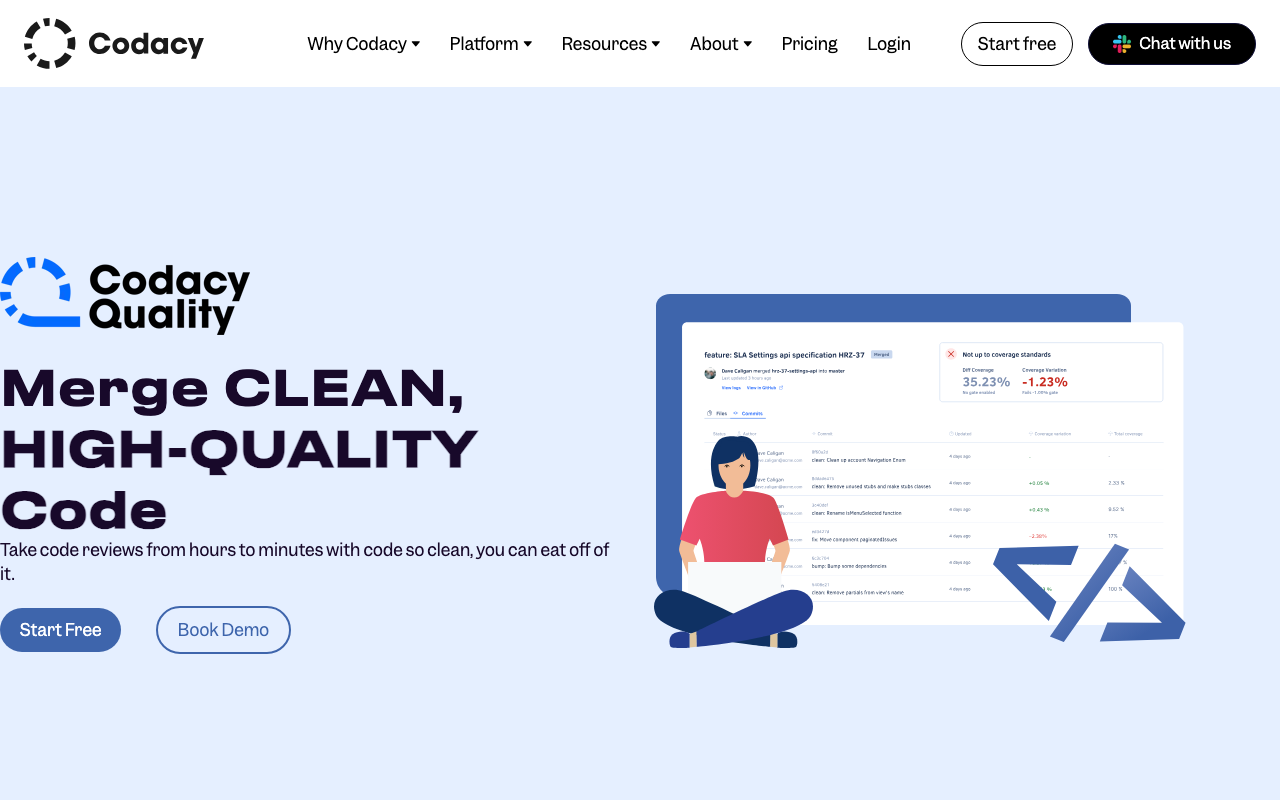
Codacy provides organization-level and repository-level dashboards that track code quality metrics over time. These include total issues by category and severity, code coverage trends, duplication percentages, complexity metrics, and quality gate pass/fail rates. Engineering leads and managers use these dashboards to identify repositories that need attention, track improvement trends, and report on code health to stakeholders.
The dashboards are well-designed and provide a useful high-level view. However, they are not as customizable as what enterprise-focused tools like SonarQube offer. You cannot create fully custom dashboards, build portfolio-level views across multiple organizations, or export data to external BI tools without using the API directly.
Pros and Cons
What Codacy Does Well
Breadth of coverage in a single platform. The combination of SAST, SCA, secrets detection, AI review, coverage tracking, and quality gates at $15/user/month is genuinely difficult to match. Assembling equivalent coverage from specialized tools would cost significantly more and require managing multiple integrations.
Fast and painless setup. Connecting Codacy to your repositories takes under 10 minutes. There is no infrastructure to provision, no CI pipeline modifications required for basic analysis, and no complex configuration files to write. See the setup guide for a detailed walkthrough. This low friction means teams can evaluate Codacy against real code quickly.
Predictable per-user pricing. Unlike tools that charge per line of code or per repository, Codacy’s $15/user/month pricing is straightforward and scales linearly with team size. You know exactly what your bill will be next month, which makes budgeting easier than with LOC-based pricing models.
Free AI Guardrails IDE extension. The free tier is not a hollow marketing gesture. AI Guardrails provides real-time security and quality scanning in your IDE, which is genuinely useful for catching issues before commit. It works with AI coding assistants, adding a safety layer for AI-generated code at no cost.
49-language support. Teams working across multiple languages get consistent analysis and reporting without configuring separate tools for each language. This is particularly valuable for polyglot organizations.
Strong Git platform integration. Codacy works equally well with GitHub, GitLab, and Bitbucket, providing native PR comments, status checks, and webhooks on all three platforms.
Where Codacy Falls Short
AI review is adequate, not exceptional. Codacy’s AI Reviewer provides useful feedback, but it does not match the depth and contextual awareness of dedicated tools like CodeRabbit or CodeAnt AI. Teams that prioritize AI-powered review as their primary need will be disappointed.
False positive noise on legacy codebases. Importing a legacy project into Codacy often generates a high volume of findings, many of which are false positives or low-priority style issues. Teams need to invest time tuning rules and configuring ignore patterns before the tool becomes genuinely useful on older codebases.
Support responsiveness on lower-tier plans. Multiple user reviews on G2 and Capterra note that support response times can exceed 24 hours on the Pro plan, and initial emails sometimes go unanswered. Business plan customers with SLA-backed support do not report this issue.
Self-hosted deployment requires Business plan. On-premises deployment is only available at the Business tier with custom pricing - estimated at 2.5x the cloud rate per seat. Teams with data sovereignty requirements may find this economically impractical.
DAST is Business-only. Dynamic security testing is gated behind the Business plan, which means Pro plan users only get static analysis and dependency scanning. Teams that need runtime security testing must either upgrade or use a separate DAST tool.
Analysis depth varies by language. The quality of analysis depends on which underlying open-source tools Codacy has integrated for a given language. Well-supported languages like JavaScript, Python, and Java have deep analysis. Less common languages may have thinner coverage.
Pricing Breakdown
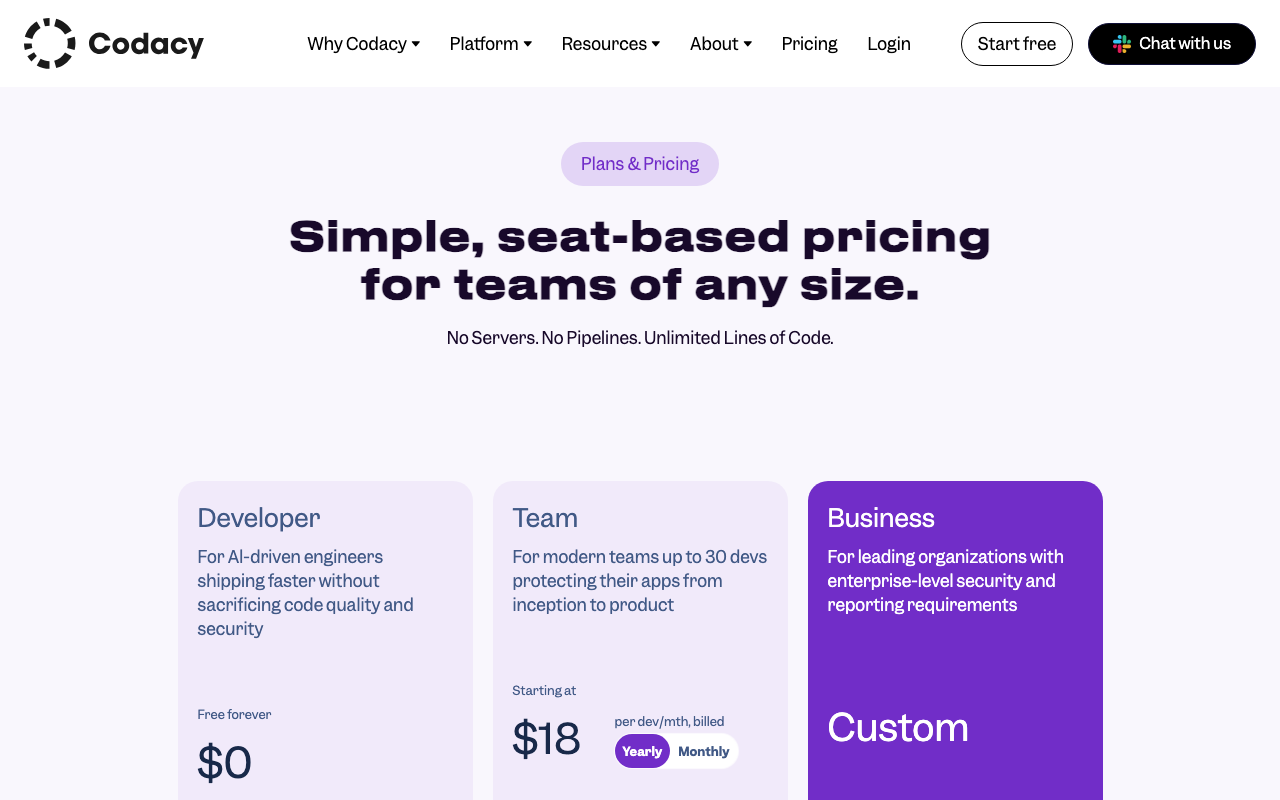
Codacy offers three pricing tiers. Understanding the boundaries between them is important because the feature gaps are significant, and moving from Pro to Business involves a sales conversation with no published pricing.
| Plan | Price | Key Limits | Best For |
|---|---|---|---|
| Developer (Free) | $0 | IDE-only, 4 languages | Individual developers |
| Pro | $15/user/month | Unlimited scans and LOC | Teams of 5-30 developers |
| Business | Custom (contact sales) | Unlimited repos and users | Enterprises, 30+ devs |
Developer (Free): Includes the AI Guardrails IDE extension with local SAST scanning, secrets detection, and quality analysis for TypeScript, JavaScript, Python, and Java. No cloud platform, no PR integration, no team features.
Pro ($15/user/month): Unlocks the full cloud platform with PR scanning across 49 languages, AI Reviewer, SAST, SCA, secrets detection, coverage tracking, quality gates, and dashboards. This is where most teams land.
Business (Custom): Adds DAST scanning, AI Risk Hub, self-hosted deployment, SSO/SAML, audit logs, unlimited repositories, and dedicated support. Required for teams exceeding 30 developers.
Open-source projects get the full Pro plan for free - a significant perk that makes Codacy a strong choice for open-source maintainers who want automated quality enforcement.
For a detailed cost analysis at various team sizes and comparison with competitors, see the Codacy pricing deep dive.
Real-World Usage and Performance
In practice, Codacy performs best when used by small to mid-size teams on relatively modern codebases. The initial setup is genuinely fast - most teams have their first analysis results within minutes of connecting a repository. PR analysis typically completes in 1-3 minutes for incremental changes, which is fast enough to avoid blocking developer workflows.
The analysis quality is solid across well-supported languages. JavaScript and TypeScript benefit from ESLint integration, Python from Pylint and Bandit, and Java from PMD and SpotBugs. Security scanning catches the common vulnerability patterns that matter most - injection flaws, authentication issues, and exposed secrets. For most teams, this level of analysis is sufficient to catch the issues that actually make it into production.
Where real-world usage reveals friction is in the tuning phase. Legacy codebases with years of accumulated technical debt will trigger thousands of findings on the initial analysis. Teams need to invest time configuring which rules matter, ignoring existing issues that are too costly to fix immediately, and setting quality gates that are achievable for the current state of the codebase. This tuning period typically takes 1-2 weeks for large codebases and is the most common source of frustration in early adoption.
The dashboards and trend tracking become valuable over time. Engineering leads report that being able to show a downward trend in issues and an upward trend in coverage during sprint reviews and quarterly planning is one of the most tangible benefits of the platform. The data helps justify the investment to non-technical stakeholders.
Coverage tracking works reliably but requires CI pipeline integration that some teams find tedious to configure, especially in complex monorepo setups. Once configured, the coverage delta shown on each PR is one of the most useful day-to-day features.
Who Should Use Codacy
Codacy is the right choice if you are:
- A team of 5-30 developers wanting code quality and security in one platform at a predictable price
- An open-source project that needs professional-grade analysis at no cost
- A team using multiple programming languages that wants unified reporting
- An engineering lead who needs dashboards and trend data for stakeholder reporting
- A team that values fast setup over deep customization
- An organization that wants SAST, SCA, and secrets detection without managing separate tools
Codacy is not the right choice if you are:
- A team that needs best-in-class AI code review (consider CodeRabbit or CodeAnt AI)
- An enterprise with 50+ developers needing transparent, published pricing
- A security team in a regulated industry that needs deep SAST with cross-function taint analysis (consider Semgrep or Snyk)
- A team that requires self-hosted deployment at an affordable price point
- An organization that needs extensive custom dashboards and portfolio-level reporting
- A team deeply invested in specific linter configurations that need full control over tool settings
How Codacy Compares to Alternatives
If you are evaluating Codacy alongside other tools, here is how it stacks up against the most common alternatives. For a comprehensive comparison with 10+ options, see the full Codacy alternatives guide.
Codacy vs SonarQube
SonarQube offers deeper rule coverage with 6,500+ rules across 35+ languages and stronger enterprise features including portfolio management and compliance reporting. Codacy offers easier setup, more predictable per-user pricing, and a broader feature set that includes SCA, secrets detection, and AI review - none of which SonarQube provides natively. SonarQube is the better choice for large enterprises that need deep customization and self-hosted deployment. Codacy is better for small to mid-size teams that want an all-in-one platform with minimal setup.
Read the detailed comparison: Codacy vs SonarQube
Codacy vs DeepSource
DeepSource focuses on signal quality with a sub-5% false positive rate, which is significantly lower than Codacy’s. It provides a five-dimension PR report card and AI-powered autofix for most detected issues. However, DeepSource costs $30/user/month compared to Codacy’s $15/user/month, supports 16 languages versus Codacy’s 49, and lacks DAST scanning. Choose DeepSource if false positive noise is your primary concern. Choose Codacy if you need broader coverage at a lower price.
Read the detailed comparison: Codacy vs DeepSource
Codacy vs CodeRabbit
CodeRabbit is an AI-first code review tool that uses LLMs for deep semantic analysis of pull requests with cross-file context awareness. Its AI review quality significantly exceeds Codacy’s AI Reviewer. However, CodeRabbit focuses exclusively on PR review and does not provide SAST, SCA, coverage tracking, or quality gates. Teams that want AI review as a primary capability should choose CodeRabbit. Teams that want comprehensive code quality and security coverage should choose Codacy.
Codacy vs CodeAnt AI
CodeAnt AI is a Y Combinator-backed platform that combines AI PR reviews, SAST, secrets detection, IaC security scanning, and DORA metrics starting at $24/user/month (Basic) or $40/user/month (Premium). CodeAnt AI offers deeper AI review capabilities and engineering analytics that Codacy does not match, including SOC 2 and HIPAA audit reports on the Premium plan. Codacy offers broader language coverage (49 vs 30+), more mature SCA scanning, and a lower entry price. CodeAnt AI is the stronger choice for teams that prioritize AI-driven insights and engineering metrics alongside security scanning.
Codacy vs CodeFactor
CodeFactor is a lighter-weight code quality tool that offers a generous free tier for public and private repositories. It provides basic static analysis and PR comments but lacks the depth of Codacy’s security scanning, AI features, and coverage tracking. CodeFactor is ideal for small teams or open-source projects that want basic quality checks at no cost. Codacy is the better choice when you need comprehensive security scanning and enforcement capabilities.
Read the detailed comparison: Codacy vs CodeFactor
For more alternatives including Semgrep, Qodana, and Qlty, see the complete Codacy alternatives roundup.
Final Verdict
Codacy earns its position as one of the most practical all-in-one code quality and security platforms available in 2026. At $15/user/month, the combination of SAST, SCA, secrets detection, AI review, coverage tracking, and quality gates across 49 languages represents strong value for money - especially for teams that would otherwise need to assemble and maintain multiple separate tools.
The platform is not the best at any single thing it does. SonarQube has deeper rules. CodeRabbit has better AI review. Semgrep has more powerful security scanning. DeepSource has fewer false positives. But Codacy does not need to be the best at everything - it needs to be good enough at everything, and for most teams, it is.
Choose Codacy if your team is between 5 and 30 developers, you want a single platform that covers code quality and security fundamentals, you value fast setup over deep customization, and you want predictable per-user pricing. The free AI Guardrails extension is worth installing regardless of whether you adopt the paid platform.
Look elsewhere if you need enterprise-scale deployment with transparent pricing, best-in-class AI code review, deep security scanning for regulated industries, or self-hosted deployment at an affordable price point. In those cases, explore the best code quality tools to find the right specialized alternative for your specific requirements.
For teams ready to get started, the Codacy setup guide walks through every step from account creation to quality gate configuration in detail.
Frequently Asked Questions
Is Codacy worth it in 2026?
Codacy is worth it for small to mid-size teams (5-30 developers) that want code quality, security scanning, and AI review in a single platform at $15/user/month. It covers 49 languages with SAST, SCA, secrets detection, and AI Reviewer. Teams that only need deep security analysis or best-in-class AI code review may find better value in specialized tools like Semgrep or CodeRabbit.
Is Codacy free to use?
Codacy offers a free Developer plan that includes the AI Guardrails IDE extension for VS Code, IntelliJ, Cursor, and Windsurf. This provides local SAST scanning, secrets detection, and quality issue detection for TypeScript, JavaScript, Python, and Java. The cloud platform with PR analysis, team dashboards, and quality gates requires the paid Pro plan at $15/user/month. Open-source projects get the full Pro plan for free.
How many languages does Codacy support?
Codacy supports 49 programming languages including JavaScript, TypeScript, Python, Java, C#, Go, Ruby, PHP, Kotlin, Swift, Scala, C, C++, Rust, and many more. It achieves this coverage by integrating over 40 open-source analysis tools like ESLint, PMD, Pylint, Semgrep, and SpotBugs under a unified platform.
What is the difference between Codacy and SonarQube?
Codacy is a cloud-first all-in-one platform offering SAST, SCA, DAST, secrets detection, and AI code review at $15/user/month with per-seat pricing. SonarQube is a self-hosted static analysis tool with 6,500+ rules across 35+ languages and LOC-based pricing. Codacy is easier to set up and more affordable for small teams. SonarQube offers deeper rule coverage and is better for enterprises needing full self-hosted control.
Does Codacy detect security vulnerabilities?
Yes, Codacy provides comprehensive security scanning including SAST for source code vulnerabilities, SCA for dependency vulnerabilities and license issues, secrets detection for exposed API keys and credentials, and DAST for runtime security testing on the Business plan. It covers OWASP Top 10, CWE, and common vulnerability patterns across all 49 supported languages.
How does Codacy's AI Reviewer work?
Codacy's AI Reviewer combines pattern-based static analysis with LLM-powered suggestions to provide context-aware feedback on pull requests. It reads the PR description, linked Jira tickets, and file diffs to generate inline comments about potential bugs, security issues, and code quality improvements. The AI Reviewer is included in the Pro plan at no additional cost.
What are the main drawbacks of Codacy?
The main drawbacks of Codacy are higher false positive rates on legacy codebases, AI review that is less advanced than dedicated AI-first tools like CodeRabbit, self-hosted deployment only on the Business plan, support response times exceeding 24 hours on non-Business plans, and some language analyzers that lag behind specialized competitors.
How does Codacy pricing work?
Codacy uses per-user pricing. The Developer plan is free for individual developers. The Pro plan costs $15/user/month with unlimited scans and lines of code. The Business plan has custom pricing through sales and adds DAST, self-hosted deployment, SSO, and audit logs. Open-source projects get the Pro plan for free. Only active Git contributors are counted as users.
Can Codacy replace multiple code quality tools?
Yes, Codacy can replace separate tools for linting, SAST, SCA, secrets detection, coverage tracking, and basic code review. It bundles over 40 analysis engines into a single platform. However, teams with specialized needs in security scanning, AI code review, or enterprise compliance may still benefit from dedicated tools like Semgrep, CodeRabbit, or SonarQube in addition to or instead of Codacy.
How long does it take to set up Codacy?
Codacy can be set up in under 10 minutes. You sign up with your GitHub, GitLab, or Bitbucket account, authorize the integration, select repositories, and Codacy begins its first analysis automatically. Configuring code patterns, quality gates, and coverage reporting adds another 20-30 minutes depending on how much customization you need.
Does Codacy work with GitHub, GitLab, and Bitbucket?
Yes, Codacy integrates with all three major Git platforms - GitHub, GitLab (cloud and self-managed), and Bitbucket (cloud and Data Center). It provides PR analysis, inline comments, status checks, and quality gate enforcement on all three platforms. Integration is handled through native apps and webhooks.
How does Codacy compare to CodeAnt AI?
Codacy is an established all-in-one code quality platform covering 49 languages at $15/user/month. CodeAnt AI is a Y Combinator-backed AI code health platform starting at $24/user/month that combines AI PR reviews, SAST, secrets detection, IaC security, and DORA metrics. CodeAnt AI offers deeper AI-powered review and engineering insights, while Codacy provides broader language coverage and more mature security scanning capabilities.
Explore More
Tool Reviews
 Codacy Review
 CodeAnt AI Review
Related Articles
- Best AI Code Review Tools for Pull Requests in 2026
- I Reviewed 32 SAST Tools - Here Are the Ones Actually Worth Using (2026)
- Codacy Free vs Pro: Which Plan Do You Need in 2026?
- Codacy GitHub Integration: Complete Setup and Configuration Guide
- Codacy GitLab Integration: Setup and Configuration Guide (2026)
Free Newsletter
Stay ahead with AI dev tools
Weekly insights on AI code review, static analysis, and developer productivity. No spam, unsubscribe anytime.
Join developers getting weekly AI tool insights.
Related Articles
Checkmarx Pricing in 2026: Plans, Per-Developer Costs, and Enterprise Quotes
Checkmarx pricing decoded - per-developer costs ($40-70+/dev/year), SAST/DAST/SCA bundle pricing, total cost of ownership, and enterprise negotiation tips.
March 13, 2026
reviewCodacy Pricing in 2026: Free, Team, and Business Plans Compared
Codacy pricing in 2026 - free Developer plan, Team at $18/dev/month, Business custom pricing, ROI calculation, and competitor comparisons.
March 13, 2026
reviewAI Code Review Tool - CodeAnt AI Replaced Me And I Like It
How CodeAnt AI replaced my manual code reviews with AI that learns from your codebase, catches security issues, and auto-fixes problems across 30+ languages.
March 13, 2026