AI Code Review for Enterprise: Security and Scale
Deploy AI code review at enterprise scale. Covers SOC 2, HIPAA, FedRAMP compliance, air-gapped deployment, ROI calculations, and migration strategies.
Published:
Last Updated:
Direct answer
Enterprise AI code review is a layered purchase, not a single tool. Of 26 vendors we checked, only 7 hold ISO/IEC 42001:2023 and only 4 will sign a HIPAA BAA (Anthropic, Cursor Enterprise, Augment Code, CodeAnt AI). Only 3 of 15 enterprise tiers publish a rate card at all. CodeRabbit gates SSO, audit logs and API access to Enterprise and requires 500+ seats to self-host. Anthropic Code Review is unavailable to orgs using ZDR, the HIPAA configuration or CMEK. Verified 2026-10-19.
Why enterprise teams need AI code review
The dynamics of code review change fundamentally when an organization crosses a threshold of scale. A 10-person startup reviewing 20 pull requests per week operates in a different universe than a 500-developer enterprise processing 2,000 PRs across 200 repositories. At enterprise scale, the problems with manual-only code review become existential rather than merely inconvenient.
Consistency breaks down first. When 50 different reviewers apply their own standards to code changes, the quality of review varies wildly. One team enforces strict input validation. Another rubber-stamps everything on Friday afternoon. A senior engineer catches a subtle race condition that a junior engineer on a different team would miss entirely. The same code pattern gets approved in one repository and rejected in another. This inconsistency is not just a quality issue - it is a security and compliance risk that auditors will flag.
Speed becomes the bottleneck. Enterprise code review queues routinely stretch to 24 to 48 hours. Senior engineers spend 20 to 30 percent of their time reviewing code rather than writing it. Pull requests sit idle over weekends and across time zones. Developers context-switch away from blocked PRs and lose the mental state needed to address review feedback efficiently. An earlier version of this section attributed a 50 percent abandonment figure to Google’s engineering productivity team; we could not find that study at source and have removed the claim. Our own measurement is better evidence anyway: across 2,189 human-authored merged PRs in 12 repositories we found open-to-first-review at p50 8.7 hours, p75 66 hours and p90 212 hours, and the median PR spends 52.7 percent of its open-to-merge life waiting for the first human (verified 2026-10-19, method in pull request review time). First-review-to-merge is only 6.7 hours at p50. The queue, not the reviewing, is the cost.
Compliance demands documentation. Regulated industries - finance, healthcare, government, defense - require evidence that code was reviewed before deployment. Not just that someone clicked “approve” in GitHub, but that specific categories of risk were evaluated. SOC 2 auditors ask how you ensure every code change is reviewed for security issues. HIPAA compliance officers want proof that code handling protected health information received appropriate scrutiny. Manual review processes rarely generate the documentation these audits demand.
Institutional knowledge walks out the door. When the architect who understands the authentication subsystem leaves the company, the quality of reviews on that subsystem drops immediately. When the security champion on the payments team moves to a different organization, the team’s ability to catch authorization vulnerabilities in code review degrades. AI code review tools create a persistent baseline of review quality that does not depend on any individual’s availability.
AI code review addresses all four of these enterprise challenges simultaneously. It provides consistent standards across every repository and every pull request. It delivers review feedback in minutes rather than hours. It generates structured audit trails that satisfy compliance requirements. And it encodes review knowledge in configurations and policies rather than in the heads of individual reviewers.
But deploying AI code review in an enterprise context introduces its own set of requirements that smaller teams never encounter. Security teams want to know where your code goes when an AI tool reviews it. Compliance teams need assurance that the tools meet regulatory standards. Infrastructure teams need deployment options that fit within existing security boundaries. Procurement teams need pricing models that work at scale.
This guide addresses all of those concerns in depth.
Enterprise security requirements for AI code review
Direct answer: SOC 2 Type II is the floor, not the answer. Of 26 vendors we checked, only 4 will sign a HIPAA BAA and only 7 hold ISO/IEC 42001:2023, the AI-specific standard. There is no such thing as HIPAA certification - HIPAA needs a signed BAA, and SOC 2 alone does not satisfy it. Verify every claim against the vendor’s trust centre, not a comparison table. Verified 2026-10-19.
Before an enterprise security team will approve any AI code review tool, they need answers to a specific set of questions. These questions are non-negotiable in regulated industries and increasingly standard even in technology companies that handle sensitive data.
SOC 2 Type II compliance
SOC 2 is the baseline security certification for SaaS tools that process enterprise data. A SOC 2 Type II report means an independent auditor has verified that the vendor’s security controls are not only designed appropriately (Type I) but have been operating effectively over a sustained period, typically 6 to 12 months.
For AI code review tools, the relevant SOC 2 trust service criteria include:
- Confidentiality - Is source code encrypted in transit and at rest? Who has access to customer code within the vendor’s organization? What data retention policies exist?
- Security - How does the vendor protect against unauthorized access to the review infrastructure? What happens if the vendor’s systems are breached?
- Processing integrity - Does the tool process code accurately and completely? Are there controls to prevent code from being altered during analysis?
- Availability - What uptime guarantees exist? What happens to your CI/CD pipeline if the review tool is unavailable?
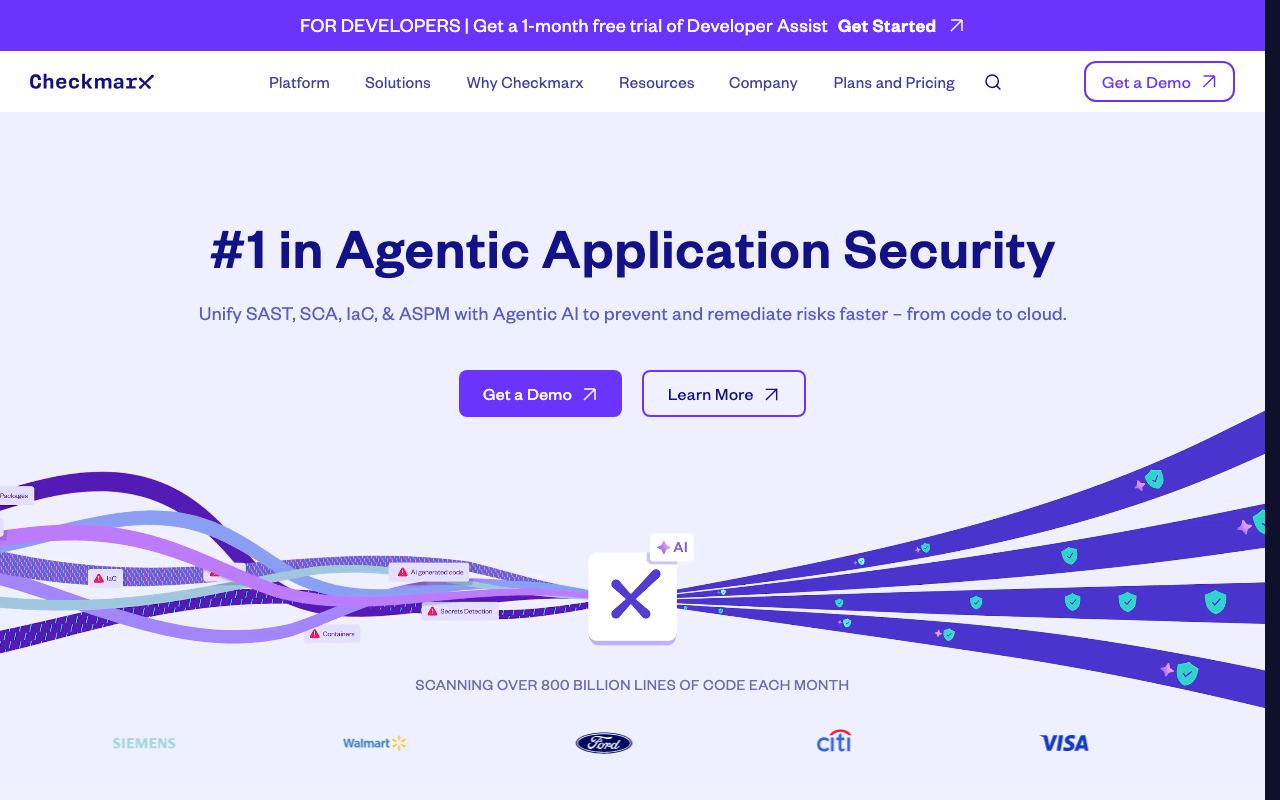
The following enterprise AI code review tools have achieved SOC 2 Type II compliance: CodeRabbit, Semgrep, Snyk Code, Checkmarx, Veracode, SonarQube (cloud edition), Codacy, and DeepSource. When evaluating these tools, request the actual SOC 2 report rather than relying on a compliance badge on the marketing page. Verify that the scope of the audit covers the specific product and infrastructure you plan to use.
Three hard negatives worth knowing before procurement, all read at source (verified 2026-10-19). cubic is SOC 2 Type I only, which is a design-of-controls opinion rather than the operating-effectiveness opinion a Type II gives you. Panto’s SOC 2 audit is still underway. Kodus displays a SOC 2 badge with zero documents behind it. Separately, Semgrep Inc. states in its own documentation that it is not ISO 27001 certified, which contradicts several third-party aggregator profiles that list it as PCI, HIPAA, FedRAMP, ISO and CSA-STAR compliant. If a comparison table and a vendor’s own trust centre disagree, the trust centre wins.
HIPAA compliance
Healthcare organizations and any company that processes protected health information (ePHI) must ensure that AI code review tools meet HIPAA requirements. The critical elements are:
- Business Associate Agreement (BAA) - The tool vendor must sign a BAA acknowledging their obligations under HIPAA when processing code that may contain ePHI references.
- Encryption standards - Code must be encrypted with AES-256 or equivalent at rest and TLS 1.2+ in transit.
- Access controls - The tool must support role-based access, audit logging of all access events, and automatic session termination.
- Data retention controls - You must be able to configure how long the vendor retains code data, with the ability to request deletion.
Checkmarx and Veracode offer HIPAA-compliant deployments with BAA availability. Self-hosted tools like SonarQube and Semgrep CE eliminate HIPAA concerns entirely since code never leaves your infrastructure. For cloud-based tools without explicit HIPAA support, the only compliant path is to ensure that no code containing ePHI references passes through the tool - which is difficult to guarantee at scale.
Two corrections that matter more than anything else in this subsection (verified 2026-10-19). First, “HIPAA certified” is not a real certification scheme. No auditor issues a HIPAA certificate. HIPAA requires a signed BAA plus demonstrable safeguards, and a SOC 2 Type II report on its own does not satisfy it. Any vendor page or comparison table claiming HIPAA certification is telling you something that cannot exist. Second, a signed BAA is available from only 4 of the 26 AI review vendors we checked: Anthropic, Cursor (Enterprise tier only), Augment Code, and CodeAnt AI. That is the single scarcest compliance artifact in this market.
There is a specific trap for healthcare teams looking at Anthropic’s Code Review, which went GA on 15 October 2026 (verified 2026-10-19). Code Review is unavailable to organisations configured with zero data retention, the HIPAA configuration, or customer-managed encryption keys. The exact configuration that makes Claude Code PHI-eligible disables Code Review. You can have one or the other, not both.
FedRAMP authorization
Federal agencies and contractors handling federal data require FedRAMP-authorized tools. FedRAMP establishes a standardized approach to security assessment, authorization, and continuous monitoring for cloud products and services.
The AI code review landscape for FedRAMP is limited:
- GitHub Advanced Security (including CodeQL) operates within GitHub’s FedRAMP-authorized Government Cloud environment
- Checkmarx offers FedRAMP-authorized deployment options
- Veracode has a FedRAMP-authorized platform
For other tools, federal organizations deploy self-hosted versions within their own FedRAMP-authorized cloud boundaries. SonarQube Enterprise and the Semgrep CE CLI can both run entirely within government cloud environments like AWS GovCloud or Azure Government without any external network dependencies.
Be sceptical of FedRAMP language in this category. When we checked the AI-review vendor set, the only published FedRAMP High package we could confirm was Anthropic’s (verified 2026-10-19). Aikido markets itself as “FedRAMP Certified: Class C (Moderate)”, which is not standard FedRAMP terminology and does not map to an authorization level. Treat any FedRAMP claim that you cannot find on the FedRAMP Marketplace as marketing until the vendor shows you the package.
Data residency requirements
European organizations subject to GDPR, Canadian organizations under PIPEDA, and many multinational enterprises have data residency requirements specifying that data must remain within certain geographic boundaries.
Key questions for AI code review vendors:
- Where are code analysis servers located? Some tools process code in US-only data centers, which violates EU data residency requirements.
- Can you select a processing region? Enterprise-tier tools typically offer region selection. Checkmarx offers EU and US processing regions. SonarQube Cloud offers EU hosting.
- Does the AI component send data to a different region? Some tools use AI models hosted by third parties (OpenAI, Anthropic) whose servers may be in a different region than the tool’s primary infrastructure. Verify the complete data flow.
- Do self-hosted options eliminate residency concerns? Yes - fully self-hosted deployments by definition keep data within your chosen infrastructure. This is why many European enterprises prefer SonarQube self-hosted, the Semgrep CE CLI, or on-premises Checkmarx deployments.
One residency detail specific to Anthropic Code Review, because it costs real money: connecting a GitHub Enterprise Cloud instance with data residency (a .ghe.com host) blocks the promotional review credits org-wide, including for reviews running on github.com (verified 2026-10-19). Availability is not affected - credits are. Anthropic’s GA page states “at least $10,000” in review credits for Claude Enterprise; press reporting describes a $10,000 to $50,000 range scaled by active Claude Code seats at claim time. We give primacy to Anthropic’s own wording. The claim window runs from 15 October 2026 to 23:59 UTC on 15 January 2027 and credits expire 30 days after claiming. Claude Team plans get the feature but not the credits.
Which AI code review tools meet enterprise compliance requirements?
Direct answer: For a signed HIPAA BAA, your shortlist is 4 vendors: Anthropic, Cursor Enterprise, Augment Code and CodeAnt AI. For ISO/IEC 42001:2023 it is 7: Anthropic, GitLab, GitHub Copilot, Cursor, Augment Code, Aikido and Veracode. Aikido’s 42001 certificate is the only scope in this market that names a review feature by name - “Deep PR Review”. Verified 2026-10-19.
The table below is the certification picture we could verify at source on 2026-10-19. A blank is not a denial, it is an absence of published evidence - and in enterprise procurement those are different things, so we mark them differently.
| Vendor | SOC 2 | ISO 27001 | ISO/IEC 42001:2023 | HIPAA BAA | Notes (verified 2026-10-19) |
|---|---|---|---|---|---|
| Anthropic Code Review | Yes | Yes | Yes (Schellman/ANAB, 2025) | Yes | Published FedRAMP High package. Code Review is blocked by ZDR, the HIPAA config and CMEK |
| GitHub Copilot | Yes | Yes | Yes (cert 2026, announced 25 Mar 2026) | Not published | Code review service runs in GitHub’s cloud, not on GHES |
| Cursor | Yes | Yes | Yes | Yes (Enterprise only) | Bugbot is no longer a standalone product |
| Augment Code | Yes | Yes | Yes | Yes | Review assets acquired by Harness on 8 Oct 2026 |
| Aikido | Yes | Yes | Yes - scope names “Deep PR Review” | Not published | ”FedRAMP Certified: Class C (Moderate)” is not standard FedRAMP terminology |
| Veracode | Yes | Yes | Yes | Yes, per vendor | FedRAMP-authorized platform |
| GitLab Duo | Yes | Yes | Yes (2026-09-04) | Not published | Self-hosted models GA in GitLab 18.4 |
| CodeAnt AI | Yes | Yes | Not published | Yes | 14-day trial with 100 PR reviews, no card |
| CodeRabbit | Yes | Not published | Not published | Not published | SSO, audit logs and API are Enterprise-tier only |
| Semgrep | Yes | Explicitly not certified, per its own docs | Not published | Not published | Network Broker is a tunnel to Semgrep’s cloud, not on-prem |
| Snyk Code | Yes | Yes | Not published | Not published | Snyk Broker is the same tunnel pattern as Semgrep’s |
| cubic | Type I only | Not published | Not published | Not published | No free tier as of 2026-10-18 |
| Panto | Audit underway | Not published | Not published | Not published | Treat as pre-certification |
| Gitar | Yes (Type 2) | Yes (ISO 27001:2022) | Not published | Not published | Sonar trust centre, updated 7 Sept 2026. No published third-party benchmark |
Disclosure: Gitar is a paid sponsor of this site and was acquired by Sonar in May 2026. It appears in this table on the same evidence standard as every other row, and its lack of any published third-party benchmark is noted wherever review quality is discussed.
ISO/IEC 42001:2023 is the row to care about if you are buying in 2026. It is the AI-specific management standard covering model integrity, training-data security and AI pipeline risk - the exact controls that SOC 2 and ISO 27001 were written before anyone needed. Seven of 26 vendors hold it (verified 2026-10-19). If your risk function has started asking AI-specific questions, that number is your real shortlist.
Self-hosted vs cloud: deployment models for enterprise AI code review
Direct answer: Genuine on-premises AI review is rarer than vendor pages suggest. SonarQube, Checkmarx, Coverity, Kodus (AGPLv3) and PR-Agent (MIT since 23 April 2026) actually run inside your network. Semgrep’s Network Broker and Snyk Broker are WireGuard-style tunnels to the vendor’s cloud, not on-prem deployment. GitHub Copilot’s review service stays in GitHub’s cloud even when validation runs on self-hosted runners. Verified 2026-10-19.
One of the most consequential decisions in enterprise AI code review deployment is whether to use cloud-hosted tools, self-hosted tools, or a hybrid approach. Each model has distinct implications for security, capability, cost, and operational overhead.
Cloud-hosted AI code review
Cloud-hosted tools are managed entirely by the vendor. You install a GitHub App or connect your repository platform, and the tool handles infrastructure, scaling, model hosting, and updates.
Advantages:
- Strongest AI capabilities - cloud tools leverage the latest and largest LLMs without you managing GPU infrastructure
- Zero operational overhead - no servers to maintain, no updates to apply, no scaling to manage
- Fastest time to value - most teams are running within an hour
- Continuous improvement - the vendor updates models, rules, and features without requiring action on your part
Disadvantages:
- Code leaves your infrastructure - diffs and sometimes full file context are transmitted to the vendor’s servers
- Dependency on vendor availability - if the vendor has an outage, your CI/CD pipeline may be affected
- Limited control over data handling - you rely on the vendor’s policies rather than your own controls
- Potential compliance gaps - not all cloud tools meet every compliance framework
Best cloud-hosted tools for enterprise:
- CodeRabbit - AI-first PR review with SOC 2 compliance, zero-retention policy for code, and enterprise SSO support
- Snyk Code - Cloud-native SAST with deep dataflow analysis and SOC 2/ISO 27001 compliance
- DeepSource - Low false-positive code analysis with SOC 2 compliance and configurable data retention
- Codacy - Code quality and security platform with SOC 2 compliance and GDPR readiness
Self-hosted AI code review
Self-hosted tools run entirely within your infrastructure. You deploy the tool on your own servers, in your own cloud account, or on bare metal within your data center.
Advantages:
- Code never leaves your network - eliminates all data transmission concerns
- Full control over infrastructure - choose your own cloud region, configure network policies, manage access controls
- Compliance by design - no need for BAAs, data processing agreements, or vendor trust when code stays internal
- Air-gap capable - some tools can run with zero internet connectivity
Disadvantages:
- Operational overhead - you are responsible for server provisioning, updates, scaling, backup, and monitoring
- Limited AI capabilities - self-hosted tools typically cannot leverage cloud-hosted LLMs, reducing the depth of AI analysis
- Slower feature updates - you must apply updates yourself, and may fall behind the cloud version
- Higher total cost of ownership - infrastructure costs, engineering time for maintenance, and opportunity cost
Best self-hosted tools for enterprise:
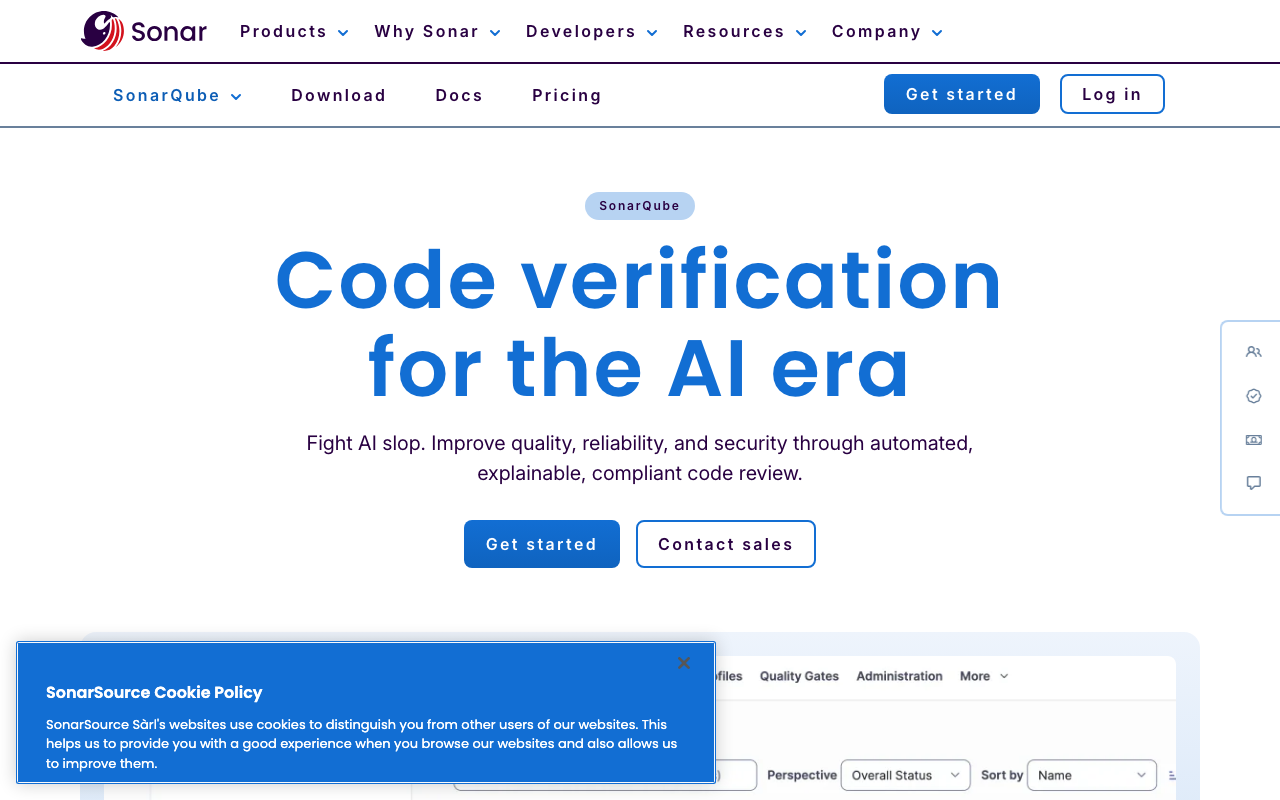
- SonarQube - Available in Community Build (free), Developer, Enterprise, and Data Center editions, all fully self-hosted. Community Build analyzes the main branch only and cannot analyze pull requests - Sonar’s own docs say Developer Edition is the minimum for branch and PR analysis (verified 2026-10-19). Community Build also excludes C, C++, Dart, Objective-C, PL/SQL, PowerShell, R, Shell, Swift and T-SQL, plus taint analysis, so “free SonarQube for a C++ shop” is a non-starter. It does include secrets detection
- Semgrep - The CE CLI runs anywhere with no network requirements. The Semgrep AppSec Platform is not self-hostable: its Network Broker is a tunnel to Semgrep’s cloud (verified 2026-10-19). Cross-file interfile taint requires the proprietary Pro engine; Semgrep CE cannot do it at all
- Checkmarx - Full on-premises deployment option with the complete enterprise feature set
- Veracode - Offers on-premises scanning agents that analyze code locally and send only metadata to the cloud
- PR-Agent - Relicensed to MIT on 23 April 2026 and moved to independent community governance under The-PR-Agent org (verified 2026-10-19). Runs as CLI, Docker, GitHub Action or webhook server against GitHub, GitLab, Bitbucket, Azure DevOps and Gitea, with OpenAI, Claude, Gemini or a local model via Ollama. Kodus is the other genuine option, AGPLv3 since September 2026 and free to self-host at any team size
Air-gapped environments
Some enterprise environments - defense contractors, intelligence agencies, financial trading systems, critical infrastructure operators - require tools that function with absolutely no internet connectivity. This is the most restrictive deployment model and significantly limits AI capabilities.
Tools that work in air-gapped environments:
- SonarQube Enterprise - Runs fully offline with no external dependencies. All rules, analysis engines, and dashboards work without internet access. Updates are applied via offline packages.
- Semgrep CE - The CLI runs locally with no network calls. Rules can be downloaded once and bundled with the installation. Custom rules work entirely offline. Interfile taint is not available in CE.
- Checkmarx on-premises - Designed for air-gapped deployment with offline rule updates and local-only scanning.
- Coverity - Deep static analysis that runs entirely on local infrastructure, designed for defense and aerospace organizations.
- SonarQube AI CodeFix - The strongest documented air-gap plus bring-your-own-model combination we found (verified 2026-10-19). Sonar’s docs describe it as designed to operate without outbound internet access and name Ollama, LiteLLM and vLLM as supported backends. GitLab Duo Code Review reached GA for self-hosted models in GitLab 18.4, covering Mistral, Llama, Claude and GPT via vLLM, Azure OpenAI or AWS.
The AI limitation in air-gapped environments. True AI code review - LLM-powered analysis that understands context, reasons about code, and generates natural language feedback - requires either internet access to cloud LLMs or a locally deployed language model. Deploying a capable LLM locally requires significant GPU infrastructure (at minimum 80GB+ VRAM for a production-quality model) and expertise in model deployment.
How much review quality you lose by going local is unmeasured, and we are not going to pretend otherwise. As of 2026-10-19 no published benchmark compares self-hosted local-model review quality against cloud-tier review quality for any shipping product. If you have seen a “60 to 70 percent of cloud quality” figure quoted for air-gapped setups - including in an earlier version of this page - it is a conflation of three unrelated numbers: a local GPU covering 60 to 70 percent of a daily coding task mix, a TCO analysis routing 60 to 70 percent of traffic locally, and GPU spend being 60 to 70 percent of self-hosted TCO. None of those measure review quality. We have removed it.
What we can say qualitatively, and what practitioners consistently report, is that the known weakness of smaller local models in review is multi-file and cross-file reasoning - which is unfortunately the single capability that distinguishes AI review from a linter. For most air-gapped environments the practical approach is combining self-hosted deterministic SAST (SonarQube, Semgrep CE) with human review, reserving AI for non-sensitive codebases that can use cloud tools.
The hybrid approach
Most enterprises land on a hybrid model that uses cloud-hosted AI review for general codebases and self-hosted deterministic scanning for sensitive ones.
A typical hybrid architecture looks like this:
- All repositories: Self-hosted SonarQube or Semgrep for deterministic SAST, quality gates, and compliance scanning. Code never leaves the enterprise network.
- General repositories (80% of codebase): Cloud-hosted CodeRabbit or Snyk Code for AI-powered PR review on codebases that do not contain highly sensitive data.
- Sensitive repositories (20% of codebase): No cloud AI tools. Enhanced manual review with security champions. Self-hosted scanning only.
This approach maximizes AI review coverage while respecting the security boundaries that enterprise compliance teams require.
Compliance automation with AI code review
One of the highest-value enterprise use cases for AI code review is automating compliance enforcement. Rather than relying on manual checklists and periodic audits, AI tools can continuously verify that code changes comply with security standards and regulatory requirements.
OWASP Top 10 and CWE mapping
Enterprise SAST tools map their findings directly to industry-standard vulnerability taxonomies:
- OWASP Top 10 - The most widely recognized web application security standard. SonarQube, Checkmarx, Veracode, and Semgrep all provide OWASP Top 10 coverage reports showing which categories are covered and which findings map to each category.
- CWE (Common Weakness Enumeration) - A more granular taxonomy with 900+ entries. Enterprise SAST tools tag each finding with its CWE ID, enabling precise tracking and reporting. Checkmarx maps findings to CWE IDs across 400+ weakness types. Veracode provides similar depth.
- SANS Top 25 - A prioritized subset of CWE focused on the most dangerous software weaknesses. SonarQube Enterprise and Semgrep include SANS Top 25 reporting.
Here is how OWASP mapping works in practice at enterprise scale:
# SonarQube quality gate configuration for OWASP compliance
# This blocks merges when OWASP-category vulnerabilities are found
quality_gate:
  conditions:
    - metric: new_security_hotspots_reviewed
      operator: LESS_THAN
      value: "100"
    - metric: new_vulnerabilities
      operator: GREATER_THAN
      value: "0"
      # Blocks merge on any new vulnerability
    - metric: new_security_rating
      operator: GREATER_THAN
      value: "1"
      # Requires A rating (no vulnerabilities)
Automated compliance reporting
Enterprise compliance teams spend significant time generating evidence for audits. AI code review tools reduce this burden by automatically generating compliance artifacts:
- Vulnerability trend reports - Show auditors that your vulnerability count is decreasing over time, demonstrating that your security program is effective.
- Coverage reports - Prove that every code change was scanned for specific vulnerability categories (OWASP Top 10, CWE Top 25).
- Remediation SLA reports - Demonstrate that vulnerabilities are being fixed within agreed timeframes.
- Policy enforcement evidence - Show that quality gates blocked non-compliant code from being merged.
Checkmarx and Veracode provide the most comprehensive compliance reporting out of the box, with pre-built report templates for SOC 2, PCI DSS, HIPAA, and other frameworks. SonarQube Enterprise includes compliance-focused dashboards. For tools that do not have built-in compliance reporting, you can build custom dashboards using their APIs to extract finding data.
Policy-as-code for security standards
The most sophisticated enterprise teams encode their security policies directly into their AI code review configuration. This ensures that policies are enforced automatically on every pull request, not just during periodic audits.
# CodeRabbit enterprise security policy example (.coderabbit.yaml)
reviews:
  instructions:
    - "Flag any API endpoint that accepts user input without input validation"
    - "Require authentication middleware on all routes under /api/"
    - "Flag any database query constructed with string concatenation"
    - "Warn when error responses include stack traces or internal details"
    - "Flag any use of eval(), exec(), or similar dynamic execution functions"
    - "Require rate limiting on all public-facing endpoints"
    - "Flag any hardcoded credentials, API keys, or secrets"
    - "Warn when logging statements include sensitive data fields"
# Semgrep enterprise policy configuration
# Applied across all repositories via CI/CD template
rules:
- id: enterprise-auth-required
patterns:
- pattern: |
app.$METHOD($PATH, async (req, res) => { ... })
- pattern-not: |
app.$METHOD($PATH, authMiddleware, async (req, res) => { ... })
message: "All API endpoints must use authMiddleware"
severity: ERROR
metadata:
owasp: "A01:2021 Broken Access Control"
cwe: "CWE-862: Missing Authorization"
compliance: ["SOC2-CC6.1", "HIPAA-164.312(d)"]This policy-as-code approach has three enterprise advantages. First, policies are version-controlled - you can track when a policy was introduced, who approved it, and why. Second, policies are testable - you can verify that your Semgrep rules or CodeRabbit instructions actually catch the patterns they are designed to catch. Third, policies are auditable - an auditor can read the configuration file and understand exactly what is being enforced.
Scaling AI code review across 100+ repositories
Deploying AI code review on a single repository is straightforward. Scaling it across hundreds of repositories with hundreds of developers requires deliberate architecture decisions around configuration management, organizational structure, and performance.
Centralized configuration management
The worst approach to scaling AI code review is configuring each repository individually. With 200 repositories, that means 200 separate configuration files that must be kept in sync, 200 places where a policy change needs to be applied, and 200 potential drift points where one repository falls out of compliance.
Organization-level configuration patterns:
- SonarQube uses quality profiles and quality gates that can be set as defaults for the entire organization. A single quality profile change propagates to all projects automatically. Individual projects can override the default only with explicit administrator approval.
- CodeRabbit supports organization-level
.coderabbit.yamlfiles that apply to all repositories. Individual repositories can extend or override the organization configuration, providing flexibility while maintaining a baseline. - Semgrep allows deploying custom rule packs as CI/CD templates. A shared GitHub Actions workflow or GitLab CI template includes the organization’s Semgrep configuration, ensuring every repository runs the same scans. Updates to the template propagate automatically.
- Checkmarx provides centralized policy management through its management console, where security teams define scanning presets that apply across all projects.
# Example: Shared GitHub Actions workflow for organization-wide Semgrep scanning
# .github/workflows/semgrep.yml in a shared workflow repository
name: Semgrep Enterprise Scan
on:
  workflow_call:
    secrets:
      SEMGREP_APP_TOKEN:
        required: true

jobs:
  scan:
    runs-on: ubuntu-latest
    container:
      image: semgrep/semgrep:latest
    steps:
      - uses: actions/checkout@v4
      - run: semgrep ci
        env:
          SEMGREP_APP_TOKEN: ${{ secrets.SEMGREP_APP_TOKEN }}
          SEMGREP_RULES: >-
            p/security-audit
            p/owasp-top-ten
            p/secrets
            org-specific/custom-rules
Each repository then references this shared workflow:
# In each repository: .github/workflows/security.yml
name: Security
on: [pull_request]
jobs:
  semgrep:
    uses: my-org/.github/.github/workflows/semgrep.yml@main
    secrets: inherit
Team-level customization within organizational guardrails
A purely centralized approach does not work either. A frontend team writing React needs different review focus than an infrastructure team writing Terraform. A data engineering team processing PII needs stricter security rules than an internal documentation team.
The most effective architecture uses a layered configuration model:
- Organization layer - Mandatory policies that apply to all repositories. Security scanning, secret detection, and compliance-critical rules. These cannot be overridden.
- Team or department layer - Additional rules relevant to the team’s technology stack and domain. A payments team adds PCI-relevant rules. A healthcare team adds HIPAA-relevant rules.
- Repository layer - Fine-tuning for the specific codebase. Suppressing false positives, adjusting severity levels, adding project-specific patterns.
Organization policy (mandatory)
    |
    +-- Backend team policy (additional)
    |       |
    |       +-- payments-service (fine-tuning)
    |       +-- user-service (fine-tuning)
    |
    +-- Frontend team policy (additional)
    |       |
    |       +-- web-app (fine-tuning)
    |       +-- mobile-app (fine-tuning)
    |
    +-- Infrastructure team policy (additional)
            |
            +-- terraform-modules (fine-tuning)
Performance at scale
AI code review tools that work smoothly for 10 repositories may struggle at 200. Performance considerations at enterprise scale include:
Concurrent analysis limits. Most cloud-hosted tools limit the number of simultaneous analyses. When 50 developers push PRs at the same time during a Monday morning surge, some analyses may queue. Verify the concurrency limits of your tool and plan for peak loads.
Analysis time budgets. Enterprise teams typically set a maximum acceptable review time - 5 minutes is a common threshold. If AI review takes longer than 5 minutes, developers switch context and lose the value of real-time feedback. Monitor p95 analysis times and investigate when they exceed your threshold.
Rate limiting and API quotas. Tools that interact with GitHub, GitLab, or Bitbucket APIs are subject to rate limits. At enterprise scale, a single tool consuming too many API calls can affect other integrations. Coordinate API usage across tools and use organization-level GitHub App installations rather than personal access tokens.
Self-hosted resource planning. SonarQube Data Center Edition is designed for enterprise scale, with horizontal scaling across multiple compute nodes. Plan for approximately 1 CPU core and 2GB of RAM per concurrent analysis for SAST scanning. Database sizing depends on the total lines of code under management and historical data retention requirements.
ROI calculation for enterprise AI code review
Direct answer: The model below is a model, not a measurement. It runs at $80 per loaded engineering hour and yields roughly 999 percent ROI for 100 developers, which should make you suspicious. For calibration: BLS March 2026 puts private-industry total compensation at $46.60 per hour, while third-party models put senior US engineers at $130 to $170 loaded. Run the arithmetic at $50, $75, $100 and $150 and pick your own number. Verified 2026-10-19.
Enterprise procurement requires quantified business justification. Here is a framework for calculating the return on investment of AI code review, based on commonly observed metrics across enterprise deployments. Every input below is an industry estimate or our own measurement, clearly labelled as such - none of it is a vendor-supplied ROI figure, and we have not audited any enterprise’s books.
Cost of manual review without AI
Start by quantifying the current cost of code review in your organization:
Developer time in review. Track the average time from PR submission to first review comment. For most enterprises, this is 4 to 24 hours. Then track the average time a reviewer spends per PR. Industry benchmarks suggest 15 to 45 minutes per review for a medium-complexity PR (200-500 lines changed).
For a 100-developer team producing an average of 10 PRs per developer per month (1,000 PRs per month):
Review time per PR:           30 minutes average
Total review time per month:  1,000 PRs x 30 min = 500 hours
Average developer cost:       $80/hour (fully loaded)
Monthly cost of review:       500 x $80 = $40,000
Annual cost of review:        $480,000
Cost of review-stage defects missed. Not all bugs and security issues are caught during review. Research consistently shows that manual code review catches approximately 60 percent of defects. The remaining 40 percent reach production, where they cost 6 to 15 times more to fix.
Defects introduced per month:         50 (estimate)
Defects caught in review (60%):       30
Defects reaching production (40%):    20
Average cost to fix in production:    $5,000
Monthly cost of missed defects:       20 x $5,000 = $100,000
Annual cost of missed defects:        $1,200,000
Cost of review bottlenecks. Developer wait time during review is the most hidden cost. A developer blocked on PR review cannot start their next task cleanly. The context-switching overhead when they return to address review feedback is estimated at 15 to 30 minutes per switch.
Average review wait time:         8 hours
PRs per month:                    1,000
Developer hours blocked:          8,000 hours/month
Productivity loss (20% estimate): 1,600 productive hours lost
Cost of lost productivity:        1,600 x $80 = $128,000/month
Annual cost of review bottleneck: $1,536,000
Total annual cost of manual-only review for 100 developers:
Review labor:            $480,000
Missed defects:          $1,200,000
Review bottleneck:       $1,536,000
Total:                   $3,216,000
Cost reduction with AI code review
AI code review does not eliminate manual review, but it significantly reduces its cost:
Review time reduction. AI provides initial feedback within minutes, allowing reviewers to focus on high-level design and logic rather than catching style issues, common bugs, and security patterns. Enterprise teams report a 30 to 50 percent reduction in human review time.
Review time reduction:    40%
Annual review labor saved: $480,000 x 0.40 = $192,000
Improved defect detection. AI catches patterns that humans miss, particularly for security vulnerabilities, edge cases, and consistency issues. The combined human + AI detection rate improves from approximately 60 percent to approximately 80 percent.
Previous detection rate:        60% (30 of 50 defects)
Improved detection rate:        80% (40 of 50 defects)
Additional defects caught:      10 per month
Production fix cost avoided:    10 x $5,000 = $50,000/month
Annual savings from detection:  $600,000
Reduced review bottleneck. AI review feedback arrives in 2 to 5 minutes instead of 4 to 24 hours. Developers can address AI feedback immediately while the change is still fresh in their minds. Even though human review is still required, the initial AI pass catches enough issues that the human review cycle is shorter and faster.
Average wait time with AI:      2 hours (down from 8)
Productivity recovery:          75%
Annual bottleneck savings:      $1,536,000 x 0.75 = $1,152,000
Total ROI calculation
Annual savings:
  Review labor reduction:       $192,000
  Improved defect detection:    $600,000
  Reduced review bottleneck:    $1,152,000
  Total annual savings:         $1,944,000

Annual tooling costs (100 developers):
  CodeRabbit Enterprise:        $28,800 ($24/user/month)
  SonarQube Enterprise:         $50,000 (LOC-based)
  Semgrep Team:                 $48,000 ($40/contributor/month)
  Integration and maintenance:  $50,000 (platform team time)
  Total annual cost:            $176,800

Net annual benefit:             $1,767,200
ROI:                            999%
Payback period:                 ~1.1 months
These numbers are directional, not precise - every organization’s numbers will differ based on team size, technology stack, existing tooling, and defect rates. Even conservative estimates that halve the savings projections still show ROI above 400 percent.
Three honest caveats on this model (verified 2026-10-19). First, the $80 per hour loaded cost is a mid-range pick, not a published figure: BLS March 2026 total compensation for private industry is $46.60 per hour, and third-party models for senior US engineers run $130 to $170 loaded. Halving the rate roughly halves the savings; doubling it roughly doubles them. Second, the “AI lifts combined detection from 60 to 80 percent” step is the weakest link in the chain, because no party without a commercial stake has published a false-positive rate, precision figure or noise measurement for any shipping commercial AI code reviewer. Every published detection number in this market belongs to a vendor scoring itself. Third, the bottleneck savings depend on reviewers actually acting on AI feedback faster; our own latency data shows first-approval-to-merge is already only 1.1 hours at p50, so the compressible part of the cycle is the wait for the first human, not the approval itself.
The key insight for enterprise decision-makers is that the tooling cost is trivial compared to the developer productivity costs it reduces. A $175,000 annual investment in AI code review tools is roughly equivalent to the fully loaded cost of a single senior engineer - while reducing costs attributable to hundreds of engineers.
Integration with enterprise toolchains
Enterprise engineering organizations do not operate in isolation. Code review is one step in a broader workflow that includes project management, incident response, change management, and security operations. AI code review tools must integrate with these systems to deliver full value.
Jira integration
Jira is the dominant project management tool in enterprise environments. AI code review integrates with Jira at several levels:
- PR-to-ticket linking. CodeRabbit reads Jira ticket references from PR titles, descriptions, and branch names (e.g.,
feature/PROJ-1234-add-auth) and includes the ticket context in its review. This helps the AI understand the intent behind the change. - Finding-to-ticket creation. SonarQube and Checkmarx can automatically create Jira tickets for security findings that exceed a severity threshold. Each ticket includes the vulnerability details, affected file, remediation guidance, and a link back to the tool’s dashboard.
- Sprint-level vulnerability tracking. Teams use Jira dashboards to track vulnerability remediation alongside feature work. AI code review findings flow into the same backlog, ensuring security work is visible and prioritized alongside business deliverables.
Write-capable is much rarer than “integrates with Jira” implies, and this is where most enterprise rollouts get surprised. When we read the integration docs for every tool in our set (verified 2026-10-19), only 3 of them document the ability to create or update an issue: CodeRabbit (chat.integrations.jira.usage creates issues, and notably its schema uses separate keys for read-context versus write-action, which proves the vendor understands the distinction), Semgrep (auto-creates Jira tickets, severity-gated, Jira Cloud only), and Snyk (a manual button plus two API endpoints). Documented read-only or undocumented: PR-Agent, Qodo Merge, GitHub Copilot, Cursor Bugbot, Graphite and Anthropic Code Review. Semgrep is the only vendor honest enough to document the negative, stating plainly that it “does not support bi-directional or two-way status syncing.”
No product in this market routes individual findings by CODEOWNERS (verified 2026-10-19). If you want a finding in payments/ to land on the payments team’s board and a finding in infra/ on the platform team’s, you are building that middleware yourself. It is the clearest unfilled gap in enterprise AI review tooling.
ServiceNow integration
ServiceNow is the enterprise standard for IT service management, change management, and security operations. Integration points include:
- Change management records. In organizations that require change management approval for production deployments, AI code review results can be attached to ServiceNow change requests as evidence that code was reviewed and scanned for security issues.
- Security incident creation. Critical security findings from tools like Checkmarx or Veracode can automatically create ServiceNow security incidents, ensuring they are triaged by the security operations team.
- CMDB integration. Mapping code repositories to ServiceNow configuration items (CIs) enables correlation between code changes and service health. When a production incident occurs, teams can trace it back to recent code changes and their review results.
PagerDuty integration
PagerDuty integration is primarily relevant for critical security findings that require immediate attention:
- Critical vulnerability alerting. When AI code review detects a critical vulnerability - for example, a SQL injection in a production-facing endpoint - an alert can be sent to PagerDuty to page the on-call security engineer.
- Build failure escalation. When security quality gates block a high-priority deployment, PagerDuty can alert the appropriate team to remediate the finding quickly.
SSO and identity management
Enterprise AI code review tools must integrate with the organization’s identity provider (IdP) for single sign-on (SSO) and user provisioning:
- SAML/OIDC SSO - All enterprise-tier tools (CodeRabbit, SonarQube, Checkmarx, Veracode, Snyk Code, Codacy/) support SAML 2.0 or OIDC-based SSO with providers like Okta, Azure AD, and PingFederate.
- SCIM provisioning - Automatic user provisioning and deprovisioning based on IdP group membership. This ensures that when a developer leaves the organization, their access to code review tools is revoked automatically.
- RBAC - Role-based access control that maps IdP groups to tool permissions. Security teams get admin access to policy configuration. Developers get standard access to view findings and manage suppressions. Auditors get read-only access to dashboards and reports.
Check which tier the SSO lives on before you budget. On CodeRabbit, SSO, audit logs and API access are all Enterprise-tier only (verified 2026-10-19). They are not in Essentials at $24, Team at $48, or Advanced at $72. If your security team has a hard SSO requirement, CodeRabbit’s real entry price is a custom Enterprise quote, not $24 a seat - and self-hosting it requires 500+ seats. Separately, Codacy customers on GitHub Enterprise Server should know that the Codacy AI Reviewer is cloud-and-GitHub-only while GHES requires Codacy Self-hosted, so GHES customers structurally cannot get the AI Reviewer (verified 2026-10-19). Anthropic Code Review does support GitHub Enterprise Server; Copilot code review does not.
Governance and audit trails
Enterprise governance for AI code review extends beyond the tools themselves. It encompasses policies, processes, and evidence that demonstrate the organization’s code review program is effective and compliant.
Audit trail requirements
Regulated industries require comprehensive audit trails that answer these questions:
- Who reviewed the code? Both human reviewers and AI tools should be tracked. The audit trail should show which AI tool reviewed the PR, what findings it generated, and which human approved the merge.
- What was the scope of review? Which files were analyzed? Which rules or policies were applied? Were any files excluded from scanning?
- When was the review performed? Timestamps for AI analysis initiation, completion, human review actions, and merge approval.
- What findings were generated? All findings, including those that were suppressed or marked as false positives. The suppression reason and approver should be recorded.
- What action was taken? For each finding, was it remediated, suppressed, or accepted as a known risk? Who made the decision?
Checkmarx and Veracode provide the most comprehensive audit trail capabilities out of the box, with detailed logs of every scan, finding, and user action. SonarQube Enterprise includes audit logging and activity history. For tools that do not have built-in audit trails, enterprise teams build custom audit logging using the tool’s API and their organization’s SIEM platform.
Governance dashboards
Executive stakeholders need visibility into the code review program without diving into individual findings. Effective governance dashboards include:
- Security posture over time - Trend lines showing total open vulnerabilities, time-to-remediation, and new vulnerability introduction rate. A downward trend demonstrates program effectiveness.
- Coverage metrics - Percentage of repositories with AI code review enabled, percentage of PRs that received AI review, percentage of findings remediated within SLA.
- Quality gate compliance - Percentage of merges that passed quality gates versus those that required manual override. A high override rate indicates gates that are either too strict or not well-understood.
- Tool effectiveness - False positive rate, finding-to-fix rate, and developer satisfaction with AI review feedback. These metrics inform ongoing tool tuning and selection decisions.
Enterprise Governance Dashboard - Key Metrics

Security:
  Open Critical Vulnerabilities:    12 (down 45% from Q1)
  Mean Time to Remediate (Critical): 18 hours (SLA: 24 hours)
  OWASP Coverage:                    9/10 categories covered

Coverage:
  Repositories with AI Review:       187/203 (92%)
  PRs Reviewed by AI (last 30 days): 4,823/4,891 (98.6%)
  Quality Gate Pass Rate:            94.2%

Efficiency:
  Average AI Review Time:            3.2 minutes
  Average Human Review Time:         18 minutes (down from 32)
  Developer Satisfaction (survey):   4.1/5.0
Finding suppression governance
One of the governance risks in AI code review is inappropriate finding suppression. If developers can freely suppress findings without oversight, the security value of the tool is undermined.
Enterprise best practices for finding suppression:
- Suppression requires a reason. All tools should be configured to require a comment or category when suppressing a finding (false positive, won’t fix, acceptable risk).
- Suppression review. Findings marked as “won’t fix” or “acceptable risk” should be reviewed by a security champion or security team member. Configure a monthly review cadence.
- Suppression expiration. Some enterprise teams set suppression expiration dates - a suppressed finding resurfaces after 90 days for re-evaluation. SonarQube supports this through its “accepted issues” workflow.
- Suppression audit. Track suppression rates by team and by developer. A consistently high suppression rate on a specific team may indicate that the tool needs tuning for their technology stack, or that the team needs additional security training.
Migration strategies: from manual-only to AI-augmented review
Migrating an enterprise from manual-only code review to AI-augmented review is a change management challenge as much as a technical one. Developers who are comfortable with their current workflow may resist changes. Teams that have been burned by noisy tools in the past may be skeptical. Security teams need assurance that AI review supplements rather than replaces their existing controls.
Phase 1: Pilot (weeks 1 through 4)
Select 2 to 3 willing teams. Choose teams that are open to experimentation, have a moderate PR volume (10 to 20 PRs per week), and represent different technology stacks. Avoid starting with the most security-sensitive codebases - you need room to tune.
Deploy in observation mode. Configure AI review tools to comment on PRs without blocking merges. This allows teams to evaluate the quality of AI feedback without disrupting their workflow. Tools like CodeRabbit and SonarQube both support this non-blocking mode.
Measure baseline metrics. Before enabling AI review, record the current state: average review time, defect escape rate, review throughput, and developer satisfaction. You will compare these metrics after each phase to demonstrate improvement.
Gather feedback weekly. Hold short weekly check-ins with pilot teams to understand what AI review is getting right, what it is getting wrong, and what needs tuning. Focus on reducing false positives during this phase - a noisy tool will kill adoption before it starts.
Phase 2: Department expansion (weeks 5 through 12)
Tune configurations based on pilot feedback. Before expanding, address every category of false positive that pilot teams identified. Write custom Semgrep rules that match your frameworks. Update CodeRabbit instructions to avoid patterns that generated unhelpful comments. Adjust SonarQube quality profiles to suppress rules that do not apply to your tech stack.
Enable quality gates for high-severity findings. Shift from observation mode to enforcement mode, but only for findings that are clearly actionable - critical and high-severity security vulnerabilities, hardcoded secrets, and patterns your teams agreed are always worth blocking on.
Create internal documentation. Write an internal guide that explains what the AI review tools do, how to interpret their feedback, how to suppress false positives, and when to escalate findings. Make this documentation discoverable in your internal wiki.
Assign a platform team. Designate 1 to 2 engineers as the code review platform team. They own the tool configuration, handle escalations, monitor tool performance, and coordinate with security teams on policy updates. Without a dedicated owner, configuration drift and unresolved issues will erode adoption.
Phase 3: Organization-wide rollout (months 3 through 6)
Deploy centralized configuration. Use the organization-level configuration patterns described in the scaling section. Shared CI/CD templates, organization-wide quality gates, and layered configuration that allows team-level customization within organizational guardrails.
Onboard teams in waves. Roll out to 3 to 5 teams per week rather than all at once. Each wave benefits from lessons learned in previous waves. The platform team can provide adequate support without being overwhelmed.
Establish governance. Implement the governance dashboards, suppression policies, and SLA tracking described in the governance section. Present initial results to executive stakeholders to maintain sponsorship.
Conduct a 90-day retrospective. After the full rollout stabilizes, conduct a comprehensive retrospective. Compare current metrics against baseline metrics from Phase 1. Document what worked, what did not, and what needs to change for the program to mature further.
Common migration pitfalls
Deploying to all repositories simultaneously. Teams discover tool-specific issues in their codebases - framework-specific false positives, language support gaps, configuration conflicts. Rolling out to all repositories at once means discovering these issues everywhere simultaneously, overwhelming the platform team and frustrating developers.
Starting with enforcement mode. Blocking merges on day one, before the tool is tuned, generates maximum developer resistance and minimum trust. Always start in observation mode.
No dedicated owner. AI code review tools require ongoing tuning, monitoring, and support. Without a dedicated platform team, tools drift toward misconfiguration, findings pile up without remediation, and the program slowly fails.
Ignoring developer feedback. Developers are the primary users of AI code review. If their feedback on false positives, unhelpful suggestions, and workflow friction is not addressed, they will find ways to route around the tools - ignoring comments, suppressing findings en masse, or lobbying for the tools to be removed.
Enterprise pricing comparison
Direct answer: Only 3 of the 15 enterprise tiers we checked publish a rate card at all - Snyk, Gitar and Entelligence. The other 12 are quote-only, which is itself the finding. Published self-serve anchors (verified 2026-10-19): CodeRabbit Essentials $24/dev/mo annual, Team $48, Advanced $72; Semgrep Code $30 per contributor; Copilot Business $19 monthly-only; Gitar Core $20 capped at 50 users. Verified 2026-10-19.
Enterprise pricing for AI code review tools varies significantly based on pricing model, feature tier, and contract structure. The following comparison is based on a representative enterprise with 200 developers and 500,000 lines of code. All per-seat figures are the vendor’s own published price read on 2026-10-19; every figure in the “Enterprise cost” column for a quote-only vendor is a third-party estimate, not a vendor-published number, and is labelled as such.
| Tool | Pricing model (verified 2026-10-19) | Free tier | Enterprise cost (200 devs) | Self-hosted | Enterprise gotcha |
|---|---|---|---|---|---|
| CodeRabbit | Per seat: Essentials $24/dev/mo annual ($30 monthly), Team $48 ($60), Advanced $72 | Public repos only. Private repos get 1 summary-only review/hour | ~$57,600/yr at Essentials list; Enterprise is quote-only | Enterprise tier, 500+ seats required | SSO, audit logs and API are Enterprise-only. Essentials covers 1 linked repo (Team 5, Advanced 10, Enterprise 20). 150 files/review on Essentials, 300 on Team+ |
| SonarQube | Per LOC, self-hosted or cloud | Community Build free, main branch only, no PR analysis | ~$20,000-$150,000/yr (estimate, quote-only) | Yes, all editions | Developer Edition is the minimum for PR analysis. AI agents (Vortex, Remediation, Hunter) are Enterprise-only and trigger above 50 developers |
| Checkmarx | Annual contract | No | ~$80,000-$200,000/yr (third-party estimate, not published) | Yes | No published rate card. Budget 6-8 weeks of procurement |
| Veracode | Annual contract | No | ~$100,000-$250,000/yr (third-party estimate, not published) | Partial, scanning agents | Holds ISO/IEC 42001:2023. No published rate card |
| Semgrep | Modular per contributor: Code $30, Supply Chain $30, Secrets $15 | Free: 10 contributors / 10 private repos / 60 AI credits | ~$72,000/yr for Code alone at list | CE CLI only. Network Broker is a cloud tunnel | Semgrep Inc. is explicitly not ISO 27001 certified. Interfile taint needs the proprietary Pro engine |
| Snyk Code | Prepaid credit platform subscription (1 credit = $1); Code metered at 1.0 credit per active contributor per day | Free: 5 projects / 100 Code tests/mo | Publishes a rate card - one of only 3 vendors that does | No. Snyk Broker is a cloud tunnel | Team caps at 100 projects / 1,000 tests/mo. The “Ignite $1,260/yr unlimited” figure is third-party and not on Snyk’s plans page |
| Codacy | Per seat: Team from $18/dev/mo yearly ($21 monthly), up to 30 devs | Developer tier free forever, IDE-focused. Free for open source | Business is custom-quoted | Self-hosted option | GHES customers structurally cannot get the AI Reviewer - it is cloud-and-GitHub-only |
| DeepSource | ~$24/dev/mo Team, plus AI review billed separately at $8 per 10K LOC (Standard) or $15 per 10K (Advanced) | Public repos analyzed free; up to $50 AI review credit | ~$57,600/yr seats before AI usage | No | Acquired by Harness on 9 September 2026. $100 annual AI credit per user offsets some usage |
| GitHub Copilot | Per seat, monthly only - annual billing retired 1 June 2026. Business $19, Enterprise $39 | Copilot Free exists but excludes code review | ~$45,600/yr Business, ~$93,600/yr Enterprise | No. Review service runs in GitHub’s cloud | Code review is included from Copilot Pro at $10, not just Enterprise. Private-repo reviews additionally consume GitHub Actions minutes, and GitHub publishes no per-review figure, so that cost is unmodellable |
| Greptile | Pro $30/seat/mo, 50 credits included, $1 per extra credit | Starter free for 1 active developer, 50 credits/mo | ~$72,000/yr at list before credit overage | No | A seat is any dev who received a review. Credits are per author and do not pool. Apex depth costs 10 credits per review |
| Gitar | Core $20/user/mo annual ($25 monthly), Pro $40 ($50) | Free for OSI-licensed public repos | Capped at 50 users - not an option at 200 devs | No | Publishes a rate card, one of only 3. No published third-party benchmark. Paid sponsor of this site |
| Entelligence | Flat bands: Startup $750/mo up to 15 engineers / 300 reviews, Scale $2,500/mo for 16-50 / 1,000 reviews, $1 per review after | No | Quote above 50 engineers | No | Publishes a rate card. Wins its own benchmark at 47.2% aggregate F1 |
Notes on enterprise pricing:
- Only 3 of 15 enterprise tiers in this market publish a rate card - Snyk, Gitar and Entelligence (verified 2026-10-19). The other 12 are quote-only. Any dollar figure you see for Checkmarx, Veracode, CodeRabbit Enterprise or SonarQube Enterprise, including in this table, is a third-party estimate.
- Annual contract tools (Checkmarx, Veracode) typically include volume discounts at 200+ seats.
- SonarQube pricing varies dramatically by edition and lines of code. Community Build is free but cannot analyze pull requests. Data Center Edition for a 500K LOC codebase with high availability can exceed $150,000/yr.
- Most per-seat tools offer enterprise tier pricing that is lower per seat than the listed price at 200+ users. Always negotiate.
- Integration costs (platform team time, CI/CD configuration, training) typically add 15 to 25 percent on top of license costs in year one.
- Two vendors we previously quoted are now unquotable. Tabnine was acquired by Tricentis on 30 July 2026 and its pricing page redirects to a Tricentis contact form, so no per-seat figure is verifiable. Cursor Bugbot is no longer a standalone product: the $40/seat plan was removed effective at each customer’s first renewal after 8 June 2026, and it now bills purely by usage from the Premium plan ($30/mo) upward at roughly $1.00 to $1.50 per review.
Budget allocation strategy
For a 200-developer enterprise, a practical budget allocation maximizes coverage while managing cost:
Tier 1 - Universal scanning (all repositories):
- SonarQube Developer or Enterprise for deterministic SAST and code quality. Self-hosted. $20,000 to $80,000/yr depending on edition and LOC. Developer Edition is the floor if you want PR analysis at all (verified 2026-10-19).
- CodeRabbit for AI-powered PR review across all repositories. $57,600/yr at the Essentials list price of $24/dev/mo, but note that at 200 developers you will need Enterprise for SSO, audit logs, API access and a linked-repo cap above 10 - and Enterprise is quote-only (verified 2026-10-19).
Tier 2 - Security-critical repositories (20% of codebase):
- Semgrep Team for advanced SAST with custom rules and supply chain scanning. Semgrep Team is modular: Code $30, Supply Chain $30 and Secrets $15 per contributor per month (verified 2026-10-19), so $72,000/yr for Code alone at 200 contributors and $180,000/yr for all three. It can be scoped to specific repositories.
- Snyk Code for cross-file dataflow analysis on the most security-sensitive services. $60,000 to $120,000/yr depending on scope.
Tier 3 - Compliance and deep scanning (quarterly or per-release):
- Checkmarx or Veracode for compliance reporting and deep scanning of regulated codebases. $80,000 to $200,000/yr.
Total annual investment: $230,000 to $550,000 depending on the depth of compliance requirements and the number of tools deployed. Against the ROI framework presented earlier, this represents a 350 to 800 percent return for a 200-developer organization.
Enterprise tool evaluation framework
When evaluating AI code review tools for enterprise deployment, use this structured framework to compare options across the dimensions that matter most at scale.
Security and compliance
- Does the tool have SOC 2 Type II certification? Request the report.
- Does the tool support your specific compliance requirements (HIPAA, FedRAMP, PCI DSS, GDPR)?
- What is the tool’s data retention policy? Can it be configured?
- Does the vendor sign BAAs for healthcare use cases?
- Where is code processed geographically? Can you select a region?
- Does the tool train on customer code? Get this in writing, not just from the marketing page.
Deployment flexibility
- Is self-hosted deployment available? What are the infrastructure requirements?
- Can the tool operate in an air-gapped environment?
- What is the operational overhead of self-hosted deployment?
- Does the cloud version offer the same features as self-hosted, or are some capabilities cloud-only?
Integration depth
- Does the tool integrate with your source code platform (GitHub, GitLab, Bitbucket, Azure DevOps)?
- Does it integrate with your CI/CD system (GitHub Actions, GitLab CI, Jenkins, CircleCI)?
- Does it integrate with your project management tool (Jira, Azure Boards)?
- Does it support SSO via your identity provider (Okta, Azure AD, PingFederate)?
- Does it support SCIM for automated user provisioning?
- Is there an API for building custom integrations and dashboards?
Scalability
- What are the concurrency limits for simultaneous analyses?
- What is the analysis time at your codebase size?
- Does the tool support organizational-level configuration?
- What is the maximum number of repositories supported?
- What is the vendor’s uptime SLA?
Developer experience
- How long does initial setup take per repository?
- Is the feedback delivered inline on PRs or only in a separate dashboard?
- What is the false positive rate for your technology stack?
- Can developers configure review preferences for their repositories?
- How do developers suppress false positives, and what governance exists around suppressions?
Real-world enterprise deployment patterns
Different enterprise architectures lead to different optimal tool combinations. Here are three common patterns based on organizational profile.
Pattern 1: Regulated financial services
A bank with 300 developers, strict compliance requirements (SOC 2, PCI DSS), and code that processes financial transactions.
Tool stack:
- Checkmarx Enterprise for comprehensive SAST with PCI DSS reporting
- SonarQube Enterprise (self-hosted) for code quality gates and OWASP dashboards
- CodeRabbit Enterprise for AI PR review on non-PCI codebases
- Semgrep Team for custom rules specific to their financial frameworks
Key architectural decisions:
- PCI-scoped repositories use only self-hosted tools - no cloud AI review
- All other repositories use the full tool stack including cloud AI review
- Jira integration for finding management with mandatory SLAs
- Quarterly deep scans with Checkmarx for compliance reporting
- Annual penetration testing to validate automated findings
Pattern 2: Healthcare technology company
A healthtech company with 150 developers building HIPAA-regulated software that processes protected health information.
Tool stack:
- SonarQube Enterprise (self-hosted) for all repositories - code never leaves the VPC
- Semgrep OSS for custom HIPAA-specific rules (PHI logging detection, encryption validation)
- Snyk Code with BAA for cloud-based dataflow analysis on non-PHI codebases
- CodeRabbit with custom HIPAA instructions for general code review
Key architectural decisions:
- Repositories that process ePHI use self-hosted tools exclusively
- Custom Semgrep rules detect logging of PHI fields, unencrypted PHI storage, and PHI in error messages
- ServiceNow integration for HIPAA incident management
- Audit trails maintained in Splunk for 7-year retention
Pattern 3: Large technology company
A technology company with 800 developers across 500+ repositories, no specific regulatory requirements, but strong internal security standards.
Tool stack:
- CodeRabbit Enterprise for AI PR review across all repositories
- SonarQube Data Center Edition (self-hosted, HA) for quality gates and technical debt tracking
- Semgrep Team for SAST and supply chain scanning
- GitHub Copilot Enterprise for in-IDE AI assistance
Key architectural decisions:
- Cloud tools used universally - no regulatory restrictions on data transmission
- SonarQube Data Center deployed with high availability for zero-downtime scanning
- Shared CI/CD templates enforce consistent scanning across all 500+ repositories
- Platform team of 3 engineers manages the review infrastructure
- Self-service onboarding: new repositories automatically inherit organization-level configuration
- Monthly security posture reports generated from aggregated tool data
The future of enterprise AI code review
The enterprise AI code review landscape is evolving rapidly. Several trends will reshape how large organizations approach automated code review over the next two to three years.
Agentic code review and auto-remediation. Current AI code review tools are passive - they analyze and comment. The next generation will be active. Tools will detect a vulnerability, generate a fix, run the test suite to verify the fix does not break anything, and submit the fix as a PR. Early versions of this capability exist in tools like DeepSource Autofix and Pixee, but enterprise adoption requires confidence that auto-generated fixes are reliable and auditable. Expect enterprise-grade agentic remediation to become mainstream by 2027.
Consolidation is already here, and it changes your vendor risk. Tracxn counted 351 automated code review startups in October 2026, of which 85 are funded and only 37 have reached Series A or beyond (verified 2026-10-19). The acquisitions landed fast in 2026: Harness acquired DeepSource on 9 September 2026 and Augment Code’s Cosmos, Auggie CLI and Code Context Engine on 8 October 2026, bringing Harness to 15 acquisitions in total. Cursor acquired Graphite on 19 December 2025. Tricentis acquired Tabnine on 30 July 2026. Sonar acquired Gitar in May 2026. Aikido acquired Trag in August 2025, and Trag now ships as Aikido Code Quality - the trag.ai domain no longer hosts the review tool at all and serves an unrelated product, so do not let a procurement doc point at it. If you are signing a three-year enterprise agreement in this category, assume a meaningful chance the counterparty changes hands inside the term, and negotiate assignment and roadmap-continuity language accordingly.
Unified security and quality platforms. The current enterprise landscape requires multiple tools for SAST, SCA, code quality, AI review, and compliance reporting. Market consolidation and platform expansion will reduce the number of tools enterprises need. Snyk Code already combines SAST and SCA. SonarQube combines quality and security. CodeRabbit is expanding from AI review into broader code intelligence. The end state is fewer tools with broader capabilities, reducing integration overhead and providing unified governance.
Enterprise-specific AI models. General-purpose LLMs are effective for code review, but they lack organization-specific context. Future tools will offer enterprise-specific model customization - not fine-tuning on your code (which raises IP concerns), but retrieval-augmented generation (RAG) that incorporates your organization’s coding standards, architecture decisions, past security findings, and domain-specific patterns. This will make AI review significantly more relevant and reduce false positives.
Regulatory frameworks for AI in development. As AI becomes embedded in critical software development processes, regulatory bodies will establish requirements for how AI tools are used, audited, and governed. The EU AI Act already classifies some AI applications by risk level. Enterprise teams should prepare for requirements around AI tool transparency, auditability of AI-generated findings, and human oversight mandates for AI-reviewed security-critical code.
Supply chain security for AI tools. The 2024-2025 period saw increasing attention to software supply chain security. The same scrutiny will extend to AI code review tools. Enterprises will demand SBOMs (Software Bills of Materials) for AI tools, transparency about model training data, and assurance that AI models have not been poisoned or tampered with. Vendors that proactively provide this transparency will have a significant competitive advantage in enterprise sales.
Conclusion
Deploying AI code review at enterprise scale is not simply a matter of installing a GitHub App and enabling it across all repositories. It requires deliberate decisions about security and compliance posture, deployment architecture, governance frameworks, integration with existing enterprise systems, and organizational change management.
The core principles for successful enterprise AI code review are:
Start with your constraints, not your wishlist. If you are in healthcare, HIPAA compliance determines your deployment model before you evaluate any tool’s features. If you are in government, FedRAMP narrows the field dramatically. If your security team requires air-gapped deployment, that eliminates most cloud AI tools. Let your compliance and security requirements define the feasible set of tools before evaluating capabilities.
Layer your tools, do not consolidate prematurely. No single tool provides comprehensive coverage across SAST, AI review, SCA, compliance reporting, and developer experience. The most effective enterprise programs use 2 to 4 complementary tools - typically a deterministic SAST tool (SonarQube, Semgrep/), an AI review tool (CodeRabbit/), and an enterprise SAST platform for compliance (Checkmarx, Veracode/) if required.
Invest in the platform team. The tools are the easy part. The hard part is configuration management, policy governance, developer enablement, finding triage, metric tracking, and continuous tuning. A 200-developer organization needs 1 to 3 engineers dedicated to the code review platform. Without this investment, tools degrade into shelfware that generates findings nobody reads.
Roll out gradually and measure continuously. Pilot with willing teams. Tune aggressively based on feedback. Expand in controlled waves. Measure the metrics that matter - review cycle time, defect escape rate, developer satisfaction, finding remediation rate - and use those metrics to justify continued investment and identify areas for improvement.
Treat AI review as augmentation, not replacement. AI code review makes human reviewers faster and more effective. It does not make them unnecessary. Security-critical code still requires human judgment. Architectural decisions still require human experience. Novel patterns that AI has not seen before still require human expertise. The goal is a system where AI handles the 80 percent of review work that is repetitive and pattern-based, freeing human reviewers to focus on the 20 percent that requires genuine engineering judgment.
Enterprise AI code review is not a product you buy - it is a capability you build. The tools are components. The value comes from how you deploy them, govern them, and integrate them into the way your organization develops software.
How we verified this
Date of this pass: 2026-10-19. We have no tool to sell and take no affiliate revenue, which is the only reason anything below is worth reading.
What we checked, and where. Every price, tier name, seat cap, file cap and linked-repo limit in this guide was read off the vendor’s own published pricing or documentation pages, not from a comparison site. Compliance claims were checked against each vendor’s trust centre or security documentation rather than a badge on a marketing page - that is how we found that Semgrep Inc. states it is not ISO 27001 certified, that cubic holds SOC 2 Type I only, that Panto’s SOC 2 audit is still underway, and that Kodus’s SOC 2 badge has no documents behind it. Deployment claims were checked against architecture docs, which is how Semgrep’s Network Broker and Snyk Broker ended up reclassified as tunnels to the vendor’s cloud rather than on-premises deployment options. Ownership was checked against acquirer press releases: Harness/DeepSource 9 September 2026, Harness/Augment 8 October 2026, Tricentis/Tabnine 30 July 2026, Cursor/Graphite 19 December 2025, Sonar/Gitar May 2026.
What is our own measurement. The review-latency figures in the opening section are ours: 2,189 human-authored merged PRs across 12 repositories, harvested from the GitHub GraphQL API on 2026-10-18, with bot authors and reviewers and self-reviews excluded. Open-to-first-review p50 8.7h / p75 66h / p90 212h, and the median PR spending 52.7 percent of its open-to-merge life waiting for the first human. Method and limitations are published in pull request review time. The honest limitation: only merged PRs are in frame, which biases latency downward.
What we could NOT verify, named specifically.
- Enterprise contract pricing for Checkmarx, Veracode, CodeRabbit Enterprise and SonarQube Enterprise. These are quote-only. The ranges in the pricing table are third-party estimates and we have labelled them that way rather than dropping them, because a labelled estimate is more useful to a budget-holder than a blank cell.
- The per-review cost of GitHub Actions minutes consumed by Copilot code review on private repos. GitHub confirms the consumption but publishes no per-review figure, so this cost is genuinely unmodellable (checked 2026-10-19).
- Review quality of self-hosted local models versus cloud-tier models. No published benchmark measures this. We removed a “60 to 70 percent of cloud quality” figure from an earlier version of this page because it conflated three unrelated measurements.
- Any independent false-positive rate for any shipping commercial AI code reviewer. No party without a commercial stake has published one. Anthropic’s own Code Review page claims 84 percent bug detection on PRs over 1,000 lines at under 1 percent false positives; that is vendor-published, unreplicated, and extraordinary relative to every academic measurement, so we report it as a claim and not as a fact.
- Gemini Code Assist’s free tier status. One source says it stopped serving requests on 18 June 2026, another still advertises it. We excluded it from the tables rather than guess.
- ISO/IEC 42001 and BAA status for vendors marked “Not published.” That marking means we found no published evidence, not that the vendor lacks the control. For procurement purposes those are different findings and we have not collapsed them.
Carried from a prior pass, not freshly re-checked on 2026-10-19. The ROI model’s structural inputs - 30 minutes of review per PR, a 60 percent manual detection rate, a 6-15x production-fix multiplier, $5,000 per production defect - are industry estimates carried forward from this page’s February 2026 version. They were not re-sourced in this pass and should be treated as a framework to populate with your own data, not as measurements. The same applies to the three deployment patterns, the migration phasing, and the governance dashboard example, all of which are our editorial judgement rather than dated findings.
Corrections applied in this pass. We removed an unsourced claim attributing a 50 percent PR-abandonment statistic to Google’s engineering productivity team. We corrected GitHub Copilot code review entitlement: it is included from Copilot Pro at $10, not Enterprise-only. We corrected Semgrep Team pricing from a flat $40 per contributor to the modular Code $30 / Supply Chain $30 / Secrets $15 structure. We corrected CodeRabbit’s free tier, which no longer covers private repositories, and added the Essentials single-repo cap. We corrected Codacy Team pricing from $15 to $18 per developer per month yearly. We removed the claim that the Semgrep AppSec Platform is self-manageable.
Further Reading
- The State of AI Code Review in 2026 - Trends, Tools, and What’s Next
- Best Code Review Tools for JavaScript and TypeScript in 2026
- 7 Best Semgrep Alternatives for Code Security Scanning in 2026
- 8 Best Snyk Alternatives for Developer Security in 2026
- AI Code Review for Security - Finding Vulnerabilities With AI in 2026
- AWS AI Code Review: Amazon Q Developer Guide
- Azure DevOps Pipelines: Complete CI/CD Guide (2026)
 Gitar
Comments are not enough
Gitar applies the fix, validates it in CI, and clears the queue.
See it on your repo Read our independent Gitar reviewFrequently Asked Questions
What is AI code review for enterprise teams?
AI code review for enterprise teams is the use of AI-powered tools to automatically analyze pull requests and code changes across large organizations. Enterprise AI code review goes beyond basic linting by incorporating security scanning, compliance automation, governance controls, and integration with enterprise toolchains like Jira, ServiceNow, and PagerDuty. Tools like CodeRabbit, SonarQube, and Checkmarx provide enterprise-grade features including SSO, audit trails, role-based access control, and data residency options.
Which AI code review tools are SOC 2 compliant?
Most mature AI code review tools have achieved SOC 2 Type II compliance, including CodeRabbit, Semgrep, Snyk Code, Checkmarx, Veracode, SonarQube (cloud edition), Codacy, and DeepSource. SOC 2 compliance means the tool has been independently audited for security, availability, processing integrity, confidentiality, and privacy controls. For enterprise procurement, always request the most recent SOC 2 Type II report and verify the scope covers the specific services you plan to use.
Can AI code review tools run on-premises or in air-gapped environments?
Yes, several AI code review tools support self-hosted and air-gapped deployment. SonarQube Community and Enterprise editions run fully on-premises. Semgrep OSS runs locally without any network connectivity. Checkmarx and Veracode offer on-premises deployment options. PR-Agent can run self-hosted with a local LLM backend. For full AI capabilities in air-gapped environments, you need a locally deployed LLM, which limits the depth of AI analysis compared to cloud-hosted models.
How do enterprise teams scale AI code review across hundreds of repositories?
Enterprise teams scale AI code review through centralized configuration management, organization-wide policy enforcement, and automated onboarding. Tools like SonarQube provide centralized quality gates that apply across all projects. CodeRabbit supports organization-level configuration files. Semgrep allows deploying custom rule packs across all repositories via CI/CD templates. The key is establishing a platform team that manages the review infrastructure while allowing individual teams to customize rules for their specific needs.
What is the ROI of enterprise AI code review?
Enterprise AI code review typically delivers 150-300% ROI within the first year. The primary savings come from reduced time spent on manual review (30-50% reduction), earlier bug detection that avoids costly production fixes (production bugs cost 6-15x more than bugs caught during review), reduced security remediation costs, and faster developer onboarding. For a 100-developer organization, the annual savings typically range from $500,000 to $1.5 million against tooling costs of $100,000-$300,000.
Does AI code review meet HIPAA compliance requirements?
AI code review can meet HIPAA requirements, but start by discarding the phrase HIPAA certified - it is not a real certification scheme and no auditor issues one. HIPAA requires a signed Business Associate Agreement plus demonstrable safeguards, and a SOC 2 Type II report alone does not satisfy it. A signed BAA is available from only 4 of the 26 AI review vendors we checked: Anthropic, Cursor at the Enterprise tier, Augment Code, and CodeAnt AI (verified 2026-10-19). There is a trap specific to Anthropic: Code Review is unavailable to organisations configured with zero data retention, the HIPAA configuration, or customer-managed encryption keys, so the exact setup that makes Claude Code PHI-eligible disables Code Review. For maximum control, self-hosted options like SonarQube eliminate the need for a BAA since code never leaves your infrastructure.
How do AI code review tools handle FedRAMP requirements?
FedRAMP compliance for AI code review requires that the tool operates within FedRAMP-authorized infrastructure. Checkmarx and Veracode have FedRAMP-authorized deployment options. For other tools, federal agencies typically deploy self-hosted versions within their own FedRAMP-authorized environments. SonarQube and Semgrep OSS can run entirely within government cloud boundaries. GitHub Advanced Security, which includes CodeQL scanning, operates within GitHub's FedRAMP-authorized Government Cloud offering.
What is the difference between self-hosted and cloud AI code review for enterprises?
Self-hosted AI code review runs entirely within your infrastructure, giving you full control over data, network access, and compliance posture. Cloud-based AI code review is managed by the vendor and typically offers stronger AI capabilities, faster updates, and less operational overhead. Self-hosted tools sacrifice some AI features since they cannot leverage the vendor's cloud-hosted LLMs, but they eliminate data transmission concerns. Most enterprises use a hybrid approach - self-hosted SAST for sensitive codebases and cloud AI review for general repositories.
How do enterprise teams integrate AI code review with Jira and ServiceNow?
Enterprise AI code review tools integrate with Jira and ServiceNow through native integrations, webhooks, and APIs. SonarQube and Checkmarx natively create Jira tickets for security findings. CodeRabbit can reference Jira tickets in PR reviews when linked through branch naming or PR descriptions. Semgrep integrates with Jira for finding management. For ServiceNow, most tools use webhook-based integrations or the ServiceNow API to create incidents from critical security findings. Enterprise teams typically build a middleware layer that normalizes findings across tools before routing them to the appropriate ticketing system.
What governance controls should enterprise teams implement for AI code review?
Enterprise governance for AI code review should include role-based access control for tool configuration, centralized policy management across all repositories, audit trails for all review actions and overrides, mandatory human approval for security-critical changes, SLA tracking for finding remediation, executive dashboards showing security posture trends, and regular reviews of AI tool accuracy and false positive rates. Tools like SonarQube, Checkmarx, and Veracode provide built-in governance dashboards. Supplement these with custom reporting that aggregates data across all tools in your pipeline.
How long does it take to migrate from manual code review to AI-augmented review?
A phased migration from manual-only to AI-augmented code review typically takes 3 to 6 months for a mid-size enterprise. The first phase (weeks 1-4) involves piloting on 2-3 repositories with willing teams. The second phase (weeks 5-12) expands to a full department with tuned configurations. The third phase (months 3-6) rolls out organization-wide with centralized governance. Critical success factors include executive sponsorship, a dedicated platform team, gradual rollout that builds trust, and measuring improvement metrics from day one.
Do AI code review tools train on my enterprise's proprietary code?
Most reputable AI code review tools explicitly state they do not train on customer code. CodeRabbit, Snyk, Codacy, Semgrep, and DeepSource all have public commitments that customer code is not used for model training. However, policies vary and can change over time. Enterprise teams should verify data handling commitments contractually through their vendor agreement, not just through marketing materials. For maximum assurance, self-hosted deployments with local LLMs guarantee that code never reaches any external training pipeline.
What enterprise pricing models exist for AI code review tools?
Enterprise AI code review pricing follows several models. Per-seat pricing charges by developer count - CodeRabbit Essentials at $24 per developer per month billed annually, Semgrep Team modularly at Code $30, Supply Chain $30 and Secrets $15 per contributor per month (verified 2026-10-19). Per-line-of-code pricing is used by SonarQube. Annual contract pricing is standard for Checkmarx and Veracode, neither of which publishes a rate card. In fact only 3 of the 15 enterprise tiers we checked publish any rate card at all - Snyk, Gitar and Entelligence - so 12 of 15 are quote-only. CodeRabbit is free on public repositories but no longer free for private ones. GitHub Copilot retired annual billing entirely on 1 June 2026 and is monthly-only.
Explore More
Tool Reviews
 CodeRabbit Review
 SonarQube Review
 Checkmarx Review
 Veracode Review
 Snyk Code Review
 Semgrep Review
 Codacy Review
 DeepSource Review
 GitHub Copilot Code Review Review
 Greptile Review
Free Newsletter
Stay ahead with AI dev tools
Weekly insights on AI code review, static analysis, and developer productivity. No spam, unsubscribe anytime.
Join developers getting weekly AI tool insights.
Related Articles
How to Measure AI Code Review False Positives: An Open Protocol
A reproducible protocol for measuring AI code review false positives: taxonomy, PR selection, blind classification and variance. Nobody has run it.
October 18, 2026
guideQodo Merge Pricing: Free vs Pro for PR Reviews in 2026
Qodo Merge pricing verified 2026-10-19 - a flat team fee near $30 a month for up to 30 users, pooled credits at $0.012, and free MIT PR-Agent.
March 4, 2026
guideQodo AI Pricing: Free vs Teams vs Enterprise Plans in 2026
Qodo pricing verified 2026-10-19 - a flat team fee near $30/month for up to 30 users, credits at $0.012 pooled with no rollover, and no free tier.
March 4, 2026