The State of AI Code Review in 2026 - Trends, Tools, and What's Next
How AI code review has evolved in 2026 - market trends, adoption data, tool landscape, and predictions for where AI code review is heading next.
Published:
Last Updated:
The state of AI code review in 2026 - an industry that grew up fast
Two years ago, AI code review was an experiment. A handful of early-stage startups were trying to convince skeptical engineering teams that a large language model could read a pull request and say something useful about it. Most developers were not convinced. The prevailing sentiment in late 2023 and early 2024 was that AI-generated code review comments were too noisy, too generic, and too often wrong to be worth the distraction.
That has changed dramatically. The state of AI code review in 2026 looks nothing like the tentative early days. Today, AI code review is a production-grade category with dozens of mature tools, measurable ROI data, and adoption across companies ranging from two-person startups to Fortune 500 enterprises. GitHub’s 2025 Octoverse report showed that repositories with AI-assisted review had 32% faster merge times and 28% fewer post-merge defects compared to repositories relying solely on human review. The JetBrains Developer Ecosystem Survey 2025 found that 44% of respondents had used an AI-powered code review tool in the previous 12 months, up from just 18% in the 2023 survey.
But maturity has not meant simplicity. The landscape has fragmented into distinct categories - dedicated AI PR reviewers, legacy code quality platforms adding AI features, coding assistants expanding into review, and security-focused tools with AI augmentation. Each category solves a different slice of the problem, and the overlap between them creates confusion for teams trying to choose the right stack.
This article is a comprehensive analysis of where AI code review stands in March 2026. It covers the market data, maps the tool landscape, identifies the six trends reshaping the category, provides an honest assessment of what works and what does not, and makes predictions for where this is all heading. The goal is not to sell you on any particular tool but to give you the context you need to make informed decisions for your team.
Market overview - the numbers behind the hype
Adoption rates
The adoption of AI code review tools has followed a classic S-curve, with the inflection point happening somewhere around mid-2025. Several data points tell the story.
GitHub’s Octoverse 2025 report revealed that over 1.3 million repositories were actively using at least one AI code review integration - a 4x increase from the roughly 300,000 reported in late 2024. Stack Overflow’s 2025 Developer Survey showed that 47% of professional developers had used AI-assisted code review in the past year, compared to 22% in the 2024 survey and just 11% in 2023. The JetBrains Developer Ecosystem Survey 2025 reported 44% adoption, with the highest rates among web developers (52%) and DevOps engineers (49%).
These numbers are imprecise - different surveys define “AI code review” differently, and some include basic linting with AI-powered suggestions while others only count LLM-based review tools. But the directional trend is unambiguous. AI code review has moved from early adopter territory to early majority.
Adoption varies significantly by team size. Small teams of 2-5 developers show the highest adoption rates, likely because the bottleneck of waiting for human review is most painful when every developer’s review queue is already full. Mid-size teams of 10-50 developers have the second-highest adoption, often driven by engineering leads looking to reduce cycle time as the team scales. Large enterprises of 500+ developers show lower overall adoption rates but are increasingly running pilot programs, with Gartner estimating that 30% of enterprises with more than 1,000 developers had deployed at least one AI code review tool by the end of 2025.
Market size and growth
Estimating the AI code review market size requires defining the boundaries of the category, and those boundaries are blurry. A narrow definition covering only tools whose primary function is AI-powered pull request review - CodeRabbit, Greptile, Sourcery, PR-Agent - puts the market at roughly $400-600 million in annual recurring revenue. A broader definition that includes code quality platforms with AI features (SonarQube, DeepSource, Codacy), security SAST tools with AI (Snyk Code, Semgrep, Checkmarx), and AI coding assistants with review capabilities (GitHub Copilot, Cursor BugBot, Claude Code) pushes the total market to $2-3 billion.
Growth rates across the category have been extraordinary. Multiple industry reports place the year-over-year growth at 30-40% for the narrow AI review category and 25-30% for the broader code quality and security tooling market. Venture capital has followed the growth - AI code review startups raised over $1.2 billion in combined funding between January 2024 and December 2025, with CodeRabbit, Greptile, and Qodo among the companies securing significant rounds.
Where the money goes
The economic argument for AI code review has moved beyond theoretical. Teams now have hard data on the return.
A frequently cited internal study from a mid-size SaaS company showed that deploying AI code review reduced their average PR cycle time from 27 hours to 11 hours - a 59% improvement. More importantly, the defect escape rate (bugs that made it to production) dropped by 34% in the six months following deployment. At an estimated cost of $5,000-15,000 per production incident, the tool paid for itself within the first quarter.
These numbers are not universal. Teams with already-strong review practices see smaller improvements. Teams with weak review practices sometimes see even larger gains. But the general pattern - meaningful reduction in cycle time and defect rates - is consistent enough that the ROI case no longer requires a leap of faith.
The tool landscape in 2026
The AI code review ecosystem has organized itself into four distinct categories, each serving different needs and often used in combination. Understanding these categories is essential for building the right tool stack.
Category 1 - Dedicated AI PR reviewers
These tools exist specifically to review pull requests using AI. They integrate with GitHub, GitLab, or Bitbucket, trigger automatically when a PR is opened, and post review comments on the diff. Their primary value is semantic code understanding - catching issues that require comprehension of what the code is doing, not just pattern matching.
Key players: CodeRabbit, Greptile, Sourcery, PR-Agent, Qodo
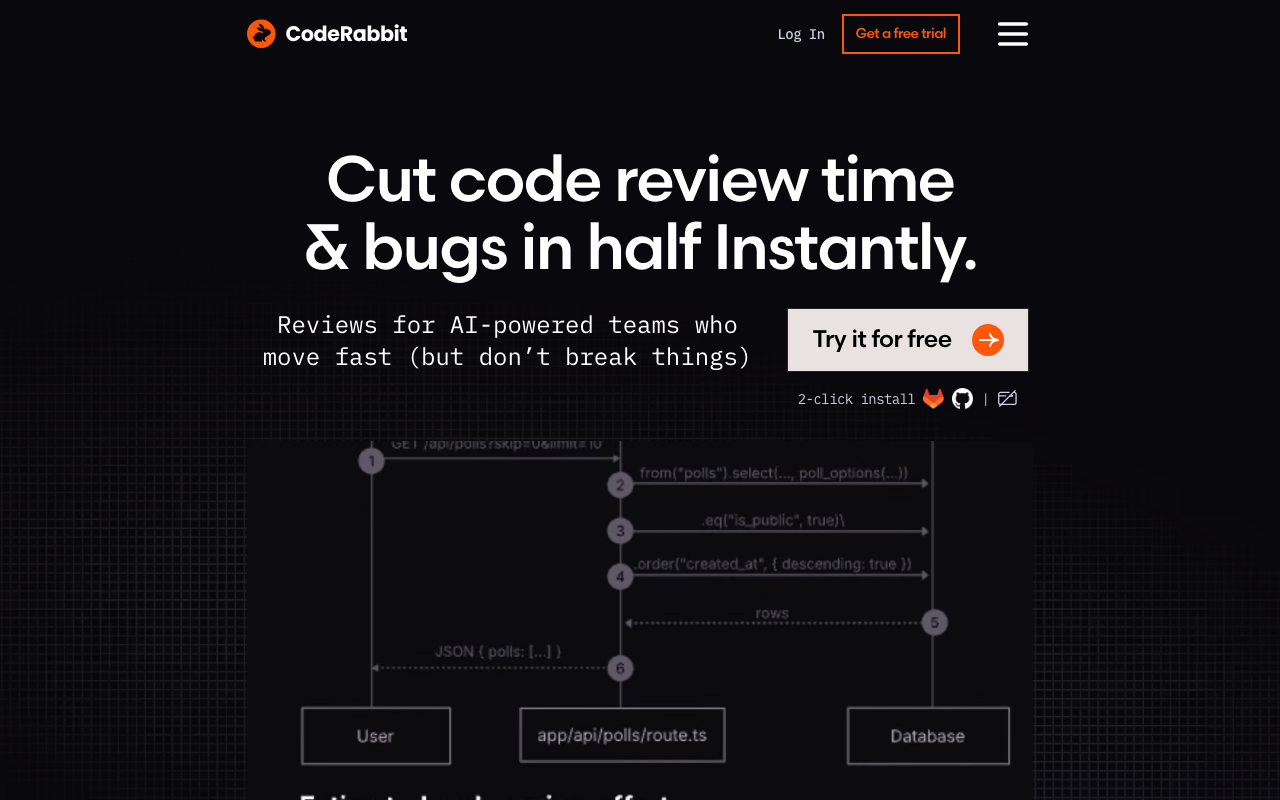
CodeRabbit remains the most widely adopted tool in this category, with over 2 million connected repositories and 13 million pull requests reviewed as of early 2026. Its combination of LLM-based semantic analysis and 40+ built-in linters provides broad coverage, and its natural language configuration system makes it accessible to teams without static analysis expertise. The free tier - unlimited reviews on unlimited public and private repos - has been a major driver of adoption.
Greptile has carved out a differentiated position by indexing entire codebases before reviewing PRs. This full-codebase understanding lets it catch cross-file issues, understand project-specific conventions, and provide context that diff-only tools miss. It is particularly strong for large monorepos where a change in one package can break behavior in another.
The dedicated AI PR reviewer category is the fastest-growing segment of the market. These tools offer the most direct improvement in developer workflow because they operate exactly where the review bottleneck exists - on the pull request itself.
Category 2 - Code quality platforms with AI features
These are established platforms that have been doing rule-based static analysis for years and have added AI capabilities on top. They tend to offer broader feature sets - dashboards, quality gates, technical debt tracking, coverage metrics - but their AI features are typically newer and less mature than the dedicated AI review tools.
Key players: SonarQube, DeepSource, Codacy, Semgrep
SonarQube is the incumbent in code quality, with over 400,000 organizations using it. Its rule library is massive - thousands of rules across 35+ languages - and its quality gate system is the standard in enterprise CI/CD pipelines. The addition of AI-powered suggestions in SonarQube 2025 editions brought LLM-based explanations and fix recommendations, though the core detection engine remains rule-based. For teams that need compliance reporting, audit trails, and deterministic quality gates, SonarQube remains the default choice.
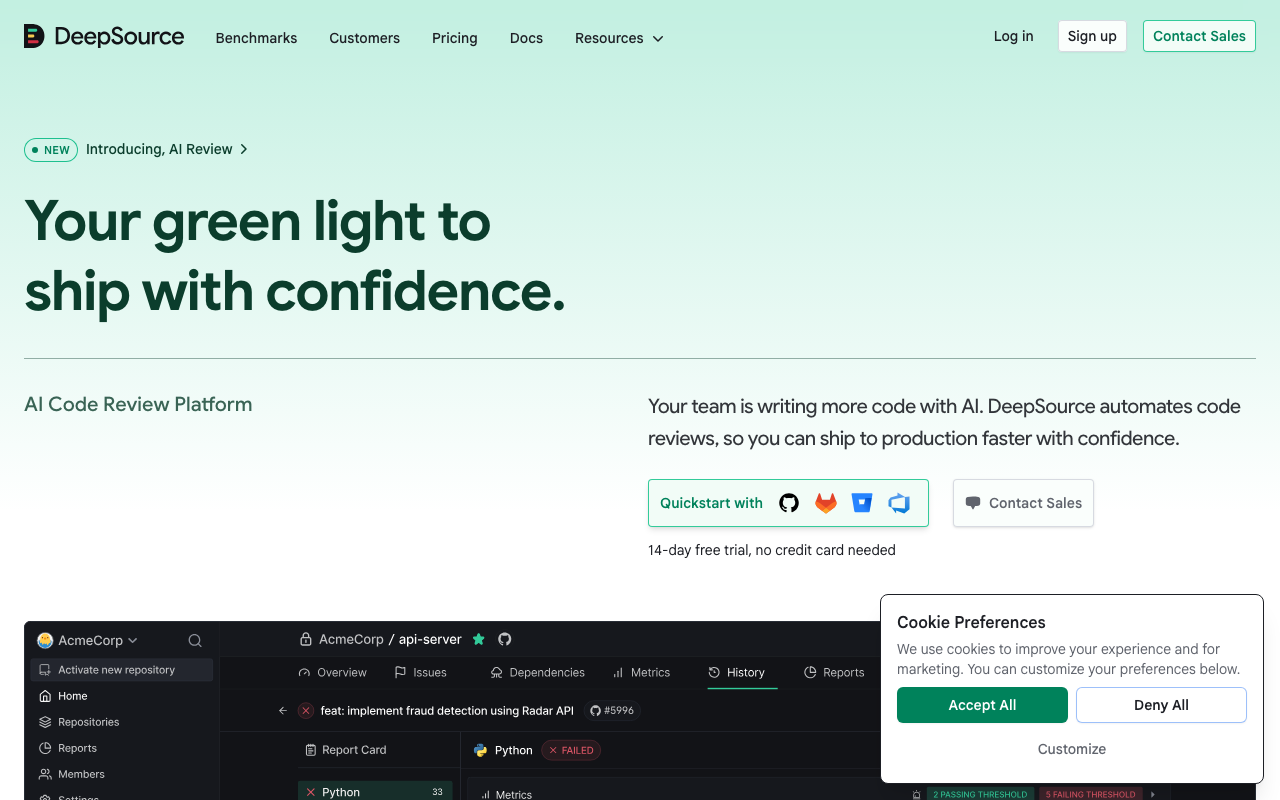
DeepSource represents the new generation in this category - built from the ground up with AI at the core rather than bolted on top. Its Autofix feature uses AI to generate and apply fixes for detected issues, and its sub-5% false positive rate is one of the lowest in the industry. DeepSource bridges the gap between the code quality platform and dedicated AI reviewer categories.
Codacy and Semgrep have also added AI features, though their core strengths remain in traditional static analysis and custom rule creation, respectively. Semgrep’s approach is particularly noteworthy - it uses AI to help users write custom rules rather than using AI to do the review itself, which appeals to security teams that want deterministic behavior with AI-assisted configuration.
Category 3 - AI coding assistants with review capabilities
This is the category that has expanded most aggressively into code review territory. These tools started as code generation assistants - autocomplete, chat-based coding, autonomous agents - and have added review features as a natural extension.
Key players: GitHub Copilot, Cursor BugBot, OpenAI Codex, Claude Code, Gemini Code Assist, Amazon Q Developer, Augment Code
GitHub Copilot’s code review feature, launched in late 2024 and significantly improved through 2025, is probably the most visible entry in this space. Because Copilot is already installed by millions of developers for code generation, adding review capabilities was a natural expansion. Copilot reviews are available directly in the GitHub pull request interface and can be requested the same way you request a human review. The quality has improved substantially since launch, but it is still more general-purpose than dedicated tools like CodeRabbit or Greptile - it catches common issues well but lacks the deep configurability and specialized detection of purpose-built review tools.
Cursor BugBot takes a different approach. Rather than reviewing PRs on the git platform, it operates within the Cursor IDE, analyzing code as you write and flagging issues before you even create a PR. This shift-left approach catches problems earlier in the development cycle but misses the collaborative review context of a pull request.
Claude Code, OpenAI Codex, Amazon Q Developer, Gemini Code Assist, and Augment Code all include code review as part of broader AI development platforms. Their review capabilities vary in depth, but the trend is clear - every major AI coding tool is building review features, and the line between code generation and code review is blurring.
Category 4 - Security-focused AI review
Security scanning tools have been using static analysis for decades, but AI has transformed what they can detect. The new generation of security-focused tools uses AI to understand data flow, identify business logic vulnerabilities, and reduce the false positive rates that have historically plagued SAST tools.
Key players: Snyk Code, Semgrep, Checkmarx
Snyk Code uses a combination of symbolic AI and machine learning to perform real-time security analysis. Its cross-file dataflow analysis can trace user input through multiple function calls and file boundaries to identify injection vulnerabilities that single-file analysis would miss. Checkmarx, one of the oldest names in application security testing, has integrated AI to reduce false positives and prioritize findings by exploitability.
For security-sensitive teams - fintech, healthcare, government contractors - these tools are not optional extras. They are compliance requirements. The AI capabilities they have added make them significantly more usable than the SAST tools of five years ago, where developers routinely ignored findings because 40-60% of them were false positives.
Key trends reshaping AI code review
The tool landscape tells you what exists today. The trends tell you where the category is headed. Six major trends are reshaping AI code review in 2026, and understanding them is essential for making technology decisions that will still make sense in 12-18 months.
Trend 1 - Agentic code review: find and fix, not just find
The most transformative trend in AI code review is the shift from passive analysis to active remediation. Early AI review tools found issues and described them. The current generation finds issues and fixes them.
This evolution has happened in stages. The first stage was better explanations - instead of cryptic error codes, AI tools provided natural language descriptions of why something was a problem. The second stage was suggested fixes - code snippets showing how to resolve the issue. The third stage, which became mainstream in 2025, is one-click fixes - the tool generates a patch and applies it directly to the PR with a single click or comment.
CodeRabbit’s commit suggestion feature, DeepSource’s Autofix, and Cursor BugBot’s in-editor remediation all exemplify this pattern. When the AI identifies a null safety issue, it does not just say “this might be null” - it generates the null check, the error handling, and sometimes the test case, then offers to apply all of it as a commit.
The next stage, which several tools are exploring in early 2026, is fully autonomous remediation. Instead of waiting for a developer to open a PR and then reviewing it, the AI proactively scans the codebase, identifies issues, generates fixes, and opens PRs itself. Pixee pioneered this approach for security findings, and CodeRabbit and Qodo have signaled similar capabilities in their roadmaps.
The implications for developer workflow are significant. If AI can not only review code but also fix the issues it finds, the review cycle collapses from hours to minutes. The developer opens a PR, receives AI comments, clicks “apply all suggestions,” and the PR is ready for human review with the mechanical issues already resolved.
However, agentic code review also raises new questions. Who is responsible when an AI-generated fix introduces a new bug? How do teams ensure that AI fixes align with architectural decisions? And how do you prevent the “just click accept” anti-pattern where developers blindly apply AI suggestions without understanding the changes? These questions do not have settled answers yet, and how the industry addresses them will shape the next phase of AI code review.
Trend 2 - Full-codebase understanding
The single biggest limitation of early AI code review tools was context. They analyzed the diff - the lines that changed - and sometimes the immediate surrounding context. But real code review requires understanding the entire codebase. A change to a utility function might break 15 callers. A new API endpoint might violate a naming convention established three years ago. A database migration might conflict with a query pattern used in a completely different service.
In 2024, most AI review tools operated on the diff plus maybe the changed files. In 2026, the leading tools index the entire repository. Greptile was the pioneer here, building its entire product around full-codebase indexing. When Greptile reviews a PR, it understands not just what changed but how the change relates to every other file in the repository. It catches cross-file issues, understands project-specific conventions, and can identify when a change contradicts patterns established elsewhere in the codebase.
Cursor BugBot takes a similar approach from the IDE side, analyzing the full project context as code is being written. CodeRabbit has expanded its context window significantly and now pulls in related files, dependency information, and linked issue context to inform its reviews.
The technical challenge of full-codebase understanding is substantial. Large repositories can contain millions of lines of code - far more than any current LLM context window can hold. Tools address this through a combination of retrieval-augmented generation (RAG), codebase embeddings, and intelligent context selection - determining which parts of the codebase are relevant to the current change and including only those in the AI’s context.
The payoff is enormous. In our testing for the best AI code review tools comparison, full-codebase-aware tools caught 40-60% more cross-file issues than diff-only tools. For monorepos and large codebases, this capability is the difference between useful and useless AI review.
Trend 3 - Multi-model architectures
In 2024, most AI code review tools used a single LLM - typically GPT-4 or Claude - for all their analysis. In 2026, the leading tools use multiple models for different tasks, optimizing for the specific strengths of each.
The logic is straightforward. General-purpose LLMs like GPT-4o and Claude Sonnet are excellent at understanding code semantics, generating natural language explanations, and suggesting fixes. But they are expensive to run at scale, their latency can be high for real-time use cases, and they sometimes generate plausible-sounding but incorrect analysis. Smaller, task-specific models can be faster, cheaper, and more accurate for well-defined detection tasks.
A typical multi-model architecture in 2026 might look like this: a lightweight classifier model does an initial pass to categorize the types of changes in a PR and route them to appropriate analyzers. A security-specialized model analyzes code for vulnerability patterns. A code-quality model checks for common bug patterns and anti-patterns. A large general-purpose LLM synthesizes the findings, generates natural language comments, and produces fix suggestions. A separate model generates the PR summary and walkthrough.
This architecture delivers better results than any single model because each component is optimized for its specific task. It also provides cost efficiency - the expensive large model is only invoked where its capabilities are actually needed, while cheaper specialized models handle the high-volume routine analysis.
Several tools have moved to multi-model architectures without publicly detailing the specifics. CodeRabbit and DeepSource both use proprietary model pipelines. Greptile combines its codebase-indexing system with LLM analysis. The trend toward multi-model architectures is likely to accelerate as more specialized code analysis models become available.
Trend 4 - Convergence of code generation and code review
Perhaps the most consequential long-term trend is the merging of code generation and code review into unified AI development platforms. The distinction between “the AI that writes code” and “the AI that reviews code” is collapsing.
Consider the workflow with GitHub Copilot in 2026. You use Copilot to generate code in your IDE. You open a PR, and Copilot reviews the changes - including the code it helped generate. You use Copilot chat to discuss the review findings. Copilot suggests fixes, which you apply. The entire cycle - generation, review, remediation - happens within a single AI system.
The same convergence is happening with Claude Code and OpenAI Codex, which offer both code generation and review capabilities. Amazon Q Developer and Gemini Code Assist are following the same path - building comprehensive AI development platforms that include review as one capability among many.
This convergence has significant implications. On the positive side, a unified system can understand the developer’s intent from the generation phase and use that context during review, potentially providing better feedback. It simplifies the toolchain - one integration instead of three. And it creates a feedback loop where the review system’s findings improve the generation system’s output.
On the negative side, convergence creates concerning blind spots. If the same AI model generates code and reviews it, it may be less likely to catch its own mistakes - a phenomenon researchers call “self-review bias.” There is also a competitive concern: as platforms like GitHub bundle review into Copilot, standalone review tools face pressure to justify their existence as separate products.
The market is likely to bifurcate. Large platform players - GitHub, GitLab, Google, Amazon - will offer integrated generation-and-review as part of their development platforms. Specialist tools - CodeRabbit, Greptile, DeepSource - will compete by offering deeper, more configurable, and more accurate review than the bundled alternatives. Both approaches will have a market, but the dynamics will shift as the platforms get better.
Trend 5 - Security-first AI review
Security has moved from a niche feature of AI code review to a primary driver of adoption. Several factors converged to make this happen.
First, the threat landscape has intensified. Supply chain attacks, dependency vulnerabilities, and injection-based exploits have made application security a board-level concern at most companies. Second, regulatory requirements - SOC 2, ISO 27001, GDPR technical controls, and the new EU Cyber Resilience Act - increasingly require demonstrable code-level security analysis. Third, AI has made security analysis dramatically more usable by reducing false positive rates and providing clear explanations of findings.
Snyk Code and Checkmarx have led this trend from the security side, adding AI capabilities to their existing SAST platforms. Semgrep has taken an interesting middle path, using AI to help users write custom security rules while keeping the detection engine deterministic. From the AI review side, CodeRabbit and DeepSource have significantly expanded their security detection capabilities, blurring the line between AI code review and application security testing.
The most significant shift is that security analysis is no longer something that happens in a separate pipeline run by a separate team. It is embedded directly in the code review process. When a developer opens a PR that introduces an SQL injection vulnerability, the AI flags it immediately with an explanation and a fix - not three weeks later when the security team runs a quarterly SAST scan.
This shift-left of security analysis is one of the highest-impact applications of AI in the software development lifecycle. It catches vulnerabilities when they are cheapest to fix - during development, before they reach production, before they appear in a penetration test report.
Trend 6 - Enterprise adoption and compliance
Enterprise adoption of AI code review crossed a critical threshold in 2025. The early adopters were startups and mid-size companies with flexible engineering cultures. In 2025 and early 2026, large enterprises - financial institutions, healthcare companies, defense contractors, and Fortune 500 technology companies - began deploying AI code review at scale.
This shift required the tools to mature in ways that go beyond review quality. Enterprise adoption demands SOC 2 Type II compliance, data residency controls, single sign-on integration, audit logging, role-based access control, and the ability to self-host. It also demands procurement-friendly pricing - annual contracts, purchase orders, and volume discounts rather than developer-by-developer credit card billing.
The tools that have succeeded in enterprise are the ones that invested in these capabilities early. SonarQube has decades of enterprise deployment experience. Snyk Code and Checkmarx are already established in enterprise security stacks. CodeRabbit launched a self-hosted enterprise edition with data residency options. Greptile offers on-premises deployment for regulated industries.
The compliance angle is particularly important. When an enterprise deploys an AI code review tool, the tool becomes part of the software development lifecycle that auditors examine. The tool needs to produce artifacts - audit logs, review records, quality gate pass/fail history - that satisfy compliance frameworks. Tools that cannot produce these artifacts are disqualified regardless of their review quality.
Enterprise adoption also drives a different set of feature priorities. Enterprises care less about individual developer productivity gains and more about organizational metrics - aggregate defect rates, review coverage percentage, time-to-merge distributions, and security finding trends across all repositories. The tools that provide these organizational analytics have a significant advantage in enterprise sales.
What works and what does not - an honest assessment
After two years of testing AI code review tools on production codebases, evaluating community feedback, and analyzing adoption data, clear patterns have emerged about where AI code review delivers genuine value and where it falls short.
What works well
Mechanical bug detection. AI code review is genuinely excellent at catching common bug patterns - null pointer dereferences, off-by-one errors, missing error handling, resource leaks, unvalidated inputs, race conditions in concurrent code. The best tools catch these issues with accuracy rates above 90% and false positive rates under 10%. This is the category’s core value proposition, and it delivers.
Security vulnerability detection. AI has dramatically improved the usability of security analysis. Traditional SAST tools generated so many false positives that developers ignored them. Modern AI-powered security tools like Snyk Code and CodeRabbit’s security analysis produce far fewer false positives and provide clear, actionable explanations. For common vulnerability patterns - injection, authentication bypass, insecure deserialization - AI detection is reliable enough for production use.
Review acceleration. The time savings are real. Multiple studies and our own testing confirm that AI code review reduces the average PR cycle time by 30-60%. The AI provides instant first-pass feedback, so when a human reviewer sits down to review the PR, the mechanical issues are already identified and often fixed. The human can focus on architecture and design decisions.
Onboarding assistance. An underappreciated benefit of AI code review is how it helps new team members learn codebase conventions. When a new developer opens a PR that violates an established pattern, the AI flags it with an explanation - not in a judgmental way, but as a factual observation about how the codebase works. This is faster and less socially fraught than having a senior developer leave the same comment.
PR summarization. Tools like CodeRabbit that generate PR walkthroughs - summaries of what changed and why - have become unexpectedly valuable. Reviewers consistently report that reading the AI-generated summary before looking at the diff makes the review process faster and more focused. Some teams have started using AI-generated PR summaries as lightweight documentation of changes.
What does not work well
Business logic validation. AI code review tools cannot reliably evaluate whether code implements the correct business logic. They can check that a function handles null inputs and returns the right type, but they cannot determine whether a 15% discount should apply to premium users or whether an order status transition from “processing” to “shipped” is valid in a specific business context. Business logic validation still requires human reviewers who understand the domain.
Architecture assessment. Should this be a microservice or a library? Is this the right abstraction boundary? Will this design scale to 100x traffic? These are the most valuable questions a code reviewer can ask, and AI tools cannot reliably answer any of them. Some tools attempt architectural feedback, but the results are too generic to be useful and occasionally misleading.
Highly domain-specific code. AI review quality degrades significantly for code in niche domains - financial modeling, bioinformatics, embedded systems, game physics engines - where the LLM has limited training data. In these domains, AI tools tend to fall back on generic coding best practices rather than domain-specific insights, and the feedback feels shallow.
Large PRs. Despite improvements in context window sizes, AI code review quality still degrades on very large PRs (500+ changed lines across many files). The tools either hit context limits and miss important connections, or they produce so many comments that developers experience review fatigue and stop reading them. The best practice - keep PRs small - remains essential for getting value from AI review.
Style and taste. AI tools are inconsistent at enforcing coding style preferences that go beyond formatting rules. Whether a piece of code is “readable” or “clean” involves judgment calls that vary between developers and teams. AI attempts at style feedback often feel arbitrary or contradictory, and this is a common source of the “noisy” perception that causes teams to disable tools.
The adoption curve - where different team types are
Not every team is at the same stage of AI code review adoption. Understanding where your team type falls on the curve helps you set realistic expectations and choose an appropriate entry point.
Early adopters (adopted 2023-2024) - refining and scaling
Teams that adopted AI code review in 2023 or early 2024 have moved past the experimentation phase. They have figured out which tools work for their codebase, tuned the configuration to reduce noise, and integrated AI review into their standard workflow. Their current focus is scaling - deploying across all repositories, establishing organization-wide policies, and measuring aggregate impact.
These teams are also encountering second-generation problems: managing multiple AI review tools that overlap, handling cases where AI and human reviewers disagree, and preventing “AI review fatigue” where developers start rubber-stamping AI suggestions without critical evaluation.
Early majority (adopted 2025) - finding the right configuration
The largest cohort of current users adopted AI code review during 2025. These teams have chosen a tool and deployed it, but many are still in the tuning phase - adjusting what the AI focuses on, which issue types to suppress, and how to integrate AI comments into their existing review workflow. The biggest risk for this cohort is abandonment - if the tool is not properly configured in the first few weeks, noise levels are too high, and the team disables it.
The most successful teams in this cohort invested 2-4 hours upfront in configuration: defining custom rules, setting severity thresholds, and writing clear instructions for what the AI should and should not flag. Teams that deployed with default settings and never customized saw significantly lower satisfaction.
Late majority (evaluating in 2026) - cautious but interested
A significant number of teams - particularly in enterprise environments, regulated industries, and organizations with strong existing review cultures - are just now beginning to evaluate AI code review. These teams are not opposed to AI; they are cautious. They want to see the data, understand the security implications of sending code to external AI services, and ensure compliance requirements are met.
For these teams, the right entry point is usually a pilot program - deploying an AI review tool on one or two non-critical repositories, running it alongside human review for 4-6 weeks, and measuring the impact before broader rollout. Self-hosted options and tools with strong data privacy guarantees (SonarQube, Snyk Code’s on-premises deployment, CodeRabbit’s enterprise edition) are particularly appealing to this cohort.
Laggards (not currently considering) - valid reasons and invalid ones
Some teams have no plans to adopt AI code review. Some of these reasons are valid - a three-person team with a fast review culture may genuinely not need the help. Teams writing exclusively in niche languages with limited AI support may not get enough value. Teams in air-gapped environments with no cloud access have limited options.
Other reasons are less valid - “we tried it once and it was noisy” (configuration matters enormously), “our code is too complex for AI” (it probably is not), or “we do not trust AI” (the question is not whether to trust AI blindly but whether AI catches things you currently miss). The data consistently shows that well-configured AI code review improves outcomes for most teams, and the teams that benefit most are often the ones that are most skeptical going in.
Challenges remaining
Despite the significant progress over the past two years, AI code review still has real limitations that teams need to understand and plan for.
False positives remain the primary adoption barrier
Even the best tools produce some false positives. In our testing, top-tier tools like CodeRabbit and DeepSource achieved false positive rates of 5-10%, while less mature tools ranged from 15-30%. A 10% false positive rate means that for every 10 comments, one is wrong or not useful. On a PR with 20 AI comments, two of them will waste the developer’s time.
This does not sound catastrophic in isolation, but false positives compound over time. A developer who sees a few wrong comments per PR starts reading AI feedback less carefully. After a month, they are skimming or ignoring AI comments entirely. This “cry wolf” effect is the most common reason teams abandon AI code review tools.
The mitigation strategies are known - configure the tool to focus on high-confidence findings, suppress low-severity issues, and invest time in teaching the AI about your codebase’s specific patterns. But these strategies require ongoing effort, and many teams underestimate the maintenance required to keep an AI review tool useful.
Context limitations still constrain quality
Despite the progress in full-codebase indexing, context remains a fundamental constraint. LLMs have finite context windows. Even with RAG and intelligent context selection, the AI may not have the right context for every issue. It might miss a dependency relationship, misunderstand a project convention, or fail to recognize that a seemingly redundant null check exists because of a known upstream bug.
The tools are getting better at context management every quarter, but the underlying challenge is not going away. Codebases are complex, interdependent systems, and no amount of indexing fully substitutes for the mental model that a developer who has worked in the codebase for years has built.
Trust and verification
AI code review introduces a trust challenge. When a human reviewer leaves a comment, the developer can evaluate the reviewer’s track record and ask follow-up questions. When an AI tool leaves a comment, the developer has to decide whether to trust it based on the comment itself. And because AI tools express confidence even when they are wrong - a well-known property of LLMs - developers cannot use the tone of the comment to judge its reliability.
Some tools have addressed this with confidence scores or by separating high-confidence findings from speculative suggestions. But the fundamental trust problem persists: every AI comment requires human judgment to evaluate, and that evaluation effort partially offsets the time savings.
Cost at scale
AI code review tools are typically priced per seat or per active contributor, with prices ranging from free to $35/user/month. For a 10-person team, even the most expensive tool is $350/month - trivial compared to developer salaries. But for a 500-person engineering organization, costs add up to $15,000-17,500/month, and enterprise pricing for tools like SonarQube, Snyk, or Checkmarx can be significantly higher.
The cost question becomes more interesting when teams deploy multiple tools - an AI PR reviewer, a code quality platform, and a security scanner. The combined cost for a large team can exceed $50,000/month. At that level, tool consolidation and ROI measurement become serious concerns.
AI-generated code reviewing AI-generated code
An increasingly common scenario in 2026: a developer uses an AI coding assistant to generate code, then an AI review tool reviews it. This creates a feedback loop where AI is checking AI’s work. When the generation model and review model share similar training data and biases, the review model may be less likely to catch errors that the generation model introduced. Research from several academic groups has identified cases where AI code review tools consistently failed to flag certain categories of AI-generated bugs, particularly subtle logic errors that were syntactically correct and followed common patterns.
This is not a crisis, but it is a real limitation that teams should be aware of. The mitigation is to use different models for generation and review (which most teams do by default) and to maintain human review as a final check, particularly for AI-generated code in critical paths.
Predictions for 2027
Based on the current trends, market dynamics, and technical developments, here is where we expect AI code review to be in 12-18 months.
Prediction 1 - Adoption will exceed 60% of professional developers
The adoption curve has been steeper than most analysts predicted, and there is no sign of it slowing. As platform players like GitHub bundle review into existing tools and free tiers remain generous, the friction of adopting AI code review will continue to decrease. We expect the Stack Overflow Developer Survey in late 2026 or early 2027 to report that more than 60% of professional developers have used AI-assisted code review in the previous year.
Prediction 2 - Fully autonomous code maintenance will emerge
The agentic trend will reach its logical conclusion: AI tools that autonomously monitor codebases, identify issues, generate fixes, and open PRs without any human initiation. The initial use cases will be narrow - dependency updates, security patch application, dead code removal, and test coverage improvements. But the capability will expand, and “autonomous maintenance PRs” will become a standard feature of AI code review platforms.
Prediction 3 - Tool consolidation will begin
The current landscape of 30+ AI code review tools is not sustainable. Expect significant consolidation through 2027 - acquisitions, mergers, and tools shutting down. The likely survivors are tools with strong distribution (GitHub Copilot), tools with deep technical moats (Greptile’s codebase indexing, SonarQube’s rule library), and tools with large user bases and strong network effects (CodeRabbit). Smaller tools without clear differentiation will struggle.
Prediction 4 - Regulation will shape enterprise adoption
The EU Cyber Resilience Act, evolving SOC 2 requirements, and potential US regulations around AI in software development will create compliance mandates that accelerate enterprise adoption of AI code review while simultaneously constraining which tools are acceptable. Tools that invest in compliance certifications, audit capabilities, and data sovereignty options will have a significant advantage.
Prediction 5 - AI will review AI’s architecture, not just its code
Current AI code review operates at the code level - functions, classes, files. The next frontier is architectural review - AI that can evaluate system design decisions, identify potential scalability bottlenecks, and flag architectural anti-patterns. Early versions of this capability already exist (Greptile’s codebase understanding is a precursor), but full architectural review requires advances in reasoning that are likely 12-24 months away.
Prediction 6 - Custom fine-tuned models will become common
Today, most AI code review tools use general-purpose LLMs. By 2027, leading tools will fine-tune models on their specific users’ codebases - learning project-specific patterns, conventions, and common errors. This will dramatically reduce false positive rates and improve the relevance of suggestions. The technical foundations for this (efficient fine-tuning, privacy-preserving training) already exist; the tools just need to implement them at scale.
How to get started with AI code review in 2026
If your team has not yet adopted AI code review, here is a practical framework for getting started without overcommitting or creating disruption.
Step 1 - Start with a free tool on a single repository
Do not start by evaluating 10 tools across your entire organization. Pick one tool with a free tier - CodeRabbit is the most common starting point because it offers unlimited free reviews on private repos. Install it on one repository, preferably one with active development and regular PRs.
Step 2 - Run it alongside human review for two weeks
Do not disable human review. Let the AI tool run in parallel with your existing process for at least two weeks. During this period, pay attention to three things: what does the AI catch that humans missed? What does the AI flag that is not actually an issue (false positives)? And what do humans catch that the AI missed?
Step 3 - Configure based on what you learned
After two weeks, you will have a clear picture of the tool’s strengths and weaknesses for your specific codebase. Configure accordingly. Suppress issue types that produce false positives. Add custom rules for patterns specific to your project. If the tool supports natural language instructions, write clear guidelines about what to focus on and what to ignore.
Step 4 - Expand to more repositories
Once the configuration is stable and the team is satisfied with the signal-to-noise ratio, expand to additional repositories. Use the same configuration as a starting point, adjusting for repository-specific needs.
Step 5 - Add specialized tools as needed
After the general-purpose AI review tool is established, evaluate whether you need additional coverage. If security is a priority, consider adding Snyk Code or Semgrep. If you need quality gates and compliance reporting, look at SonarQube or Codacy. If full-codebase understanding is critical for your monorepo, evaluate Greptile.
Step 6 - Measure and iterate
Track the metrics that matter to your team: PR cycle time, defect escape rate, developer satisfaction with the review process, and false positive rate. Review these metrics quarterly and adjust your tool configuration and stack accordingly. AI code review is not a set-and-forget technology - it requires ongoing tuning to maintain value.
Common mistakes to avoid
Deploying with default settings and never customizing. Every codebase is different. Default configurations produce acceptable results for average codebases, but customization is what makes AI review genuinely useful for your team. Spend the 2-4 hours upfront.
Installing too many tools at once. Each additional tool means more comments on every PR. Two or three tools can complement each other. Five tools will overwhelm your developers with noise, and they will start ignoring all of the AI feedback.
Removing human review prematurely. AI code review augments human review; it does not replace it. Teams that eliminated human review entirely consistently report higher defect rates in production. The right model is AI as first pass, humans as final pass.
Ignoring developer feedback. If developers on your team say the tool is noisy, believe them. A tool that developers ignore has zero value, regardless of its theoretical capabilities. Adjust the configuration or switch tools based on actual developer experience.
Evaluating tools based on marketing demos. Every AI code review tool looks impressive when the vendor chooses the demo repository and the demo PR. Evaluate tools on your code, with your PRs, in your workflow. A free trial on a real repository tells you more than any number of demo videos.
Conclusion - AI code review has crossed the threshold
The state of AI code review in 2026 is one of earned credibility. The tools have moved past the hype cycle and into genuine utility. Adoption data, ROI studies, and developer satisfaction surveys consistently show that well-configured AI code review improves code quality, reduces review cycle times, and catches issues that human reviewers miss.
But credibility is not perfection. The tools still produce false positives. They still struggle with business logic and architectural concerns. They still require configuration and ongoing tuning. And the convergence of code generation and review raises legitimate questions about AI reviewing its own output.
The most important conclusion from the data is that AI code review works best as augmentation, not replacement. The highest-performing teams use AI to handle the mechanical first pass - catching bugs, flagging security issues, enforcing patterns - so that human reviewers can focus on the higher-level concerns that AI cannot address. This division of labor produces better outcomes than either humans alone or AI alone.
For teams that have not yet adopted AI code review, the barrier to entry has never been lower. Free tiers are generous, setup takes minutes, and the risk of a two-week trial is essentially zero. The potential upside - 30-60% faster review cycles and measurably fewer production defects - is worth the experiment.
For teams already using AI code review, the focus should be on optimization: tuning configurations, measuring impact, evaluating whether your current tool stack has coverage gaps, and preparing for the agentic and full-codebase-aware tools that represent the category’s next phase.
The question is no longer whether AI code review works. The question is how to make it work best for your specific team, codebase, and workflow. The tools and data exist to answer that question. The state of AI code review in 2026 is mature enough to deliver real value and honest enough about its limitations to be trusted.
Frequently Asked Questions
How many developers use AI code review tools in 2026?
Based on GitHub's Octoverse data and Stack Overflow surveys, approximately 40-50% of professional developers now use some form of AI-assisted code review, up from roughly 15-20% in 2024. Adoption is highest among teams of 10-50 developers and in web development, cloud infrastructure, and security-sensitive industries.
What is the AI code review market size in 2026?
The AI code review and analysis market is estimated at $2-3 billion in 2026, growing at 30-40% annually. This includes dedicated AI review tools (CodeRabbit, Greptile), code quality platforms with AI features (SonarQube, Codacy, DeepSource), and AI coding assistants with review capabilities (GitHub Copilot, Cursor).
What are the biggest trends in AI code review?
Key trends include agentic code review (AI that can fix issues, not just find them), full-codebase understanding (tools indexing entire repos for context), multi-model architectures (combining different AI models for different tasks), and the convergence of code generation and code review into unified AI development platforms.
Is AI code review accurate enough for production use?
Yes, but with caveats. Leading tools like CodeRabbit and DeepSource achieve false positive rates under 10% for common issue types. However, accuracy varies significantly by issue type - AI is highly accurate for security vulnerabilities and null safety but less reliable for business logic and architectural concerns. Most teams use AI review as a first pass, not as the sole quality gate.
Will AI replace human code reviewers?
Not in 2026 or the foreseeable future. AI handles 40-60% of mechanical review tasks (style, bugs, security patterns), freeing human reviewers to focus on architecture, design, and business logic. The trend is toward AI augmenting human reviewers rather than replacing them. Teams that eliminated human review entirely reported higher defect rates.
What is agentic code review?
Agentic code review goes beyond finding issues to actually fixing them. Tools like Pixee, Cursor BugBot, and CodeRabbit's one-click fixes can generate and apply patches for detected issues. The next evolution is AI that can open PRs to fix issues it finds across the codebase, moving from passive analysis to active remediation.
What is the ROI of AI code review tools?
Teams deploying AI code review typically see a 30-60% reduction in PR cycle times and a 25-35% decrease in production defect rates. At an estimated cost of $5,000-15,000 per production incident, most organizations recoup their tool investment within the first quarter. The ROI is strongest for mid-size teams of 10-50 developers where review bottlenecks have the greatest impact on velocity.
What are the best AI code review tools in 2026?
The top AI code review tools in 2026 include CodeRabbit for dedicated AI PR review, Greptile for full-codebase understanding, DeepSource for AI-powered code quality with autofix, SonarQube for enterprise-grade static analysis, and GitHub Copilot for integrated code generation and review. The best choice depends on your team's priorities - CodeRabbit leads in adoption with over 2 million connected repos, while Greptile excels at catching cross-file issues in large monorepos.
How much do AI code review tools cost?
AI code review tool pricing ranges from free to $35 per user per month. CodeRabbit offers unlimited free reviews on public and private repos, making it the most accessible entry point. Enterprise plans from tools like SonarQube, Snyk Code, and Checkmarx can cost significantly more, especially when factoring in self-hosted deployment and compliance features. For a 10-person team, even premium tools cost under $350/month - trivial compared to developer salaries.
Are AI code review tools ready for enterprise use?
Yes, leading AI code review tools now meet enterprise requirements including SOC 2 Type II compliance, data residency controls, single sign-on, audit logging, and role-based access control. SonarQube, Snyk Code, and Checkmarx have years of enterprise deployment experience, while CodeRabbit and Greptile offer self-hosted and on-premises options for regulated industries. Gartner estimates that 30% of enterprises with over 1,000 developers had deployed at least one AI code review tool by the end of 2025.
What are the biggest challenges with AI code review?
The primary challenges are false positives (even top tools produce 5-10% incorrect findings), limited ability to evaluate business logic and architectural decisions, and context limitations when reviewing large PRs over 500 changed lines. The 'cry wolf' effect - where developers start ignoring AI feedback after encountering false positives - remains the most common reason teams abandon these tools. Proper configuration and ongoing tuning are essential to maintain value.
What will AI code review look like in 2027?
By 2027, AI code review adoption is expected to exceed 60% of professional developers, and fully autonomous code maintenance - where AI proactively scans codebases, generates fixes, and opens PRs without human initiation - will emerge for tasks like dependency updates and security patching. Significant tool consolidation is also predicted, with the 30+ current tools narrowing to a smaller set of survivors with strong distribution, technical moats, or large user bases.
Can AI code review detect security vulnerabilities?
AI-powered security detection has become one of the strongest use cases for AI code review in 2026. Tools like Snyk Code, Semgrep, and CodeRabbit reliably catch common vulnerability patterns including SQL injection, authentication bypass, insecure deserialization, and cross-file dataflow issues. Modern AI security tools have dramatically reduced false positive rates compared to traditional SAST tools, making security analysis usable as part of the everyday code review workflow rather than a separate quarterly scan.
How does AI code review compare to human code review?
AI code review excels at mechanical tasks - catching null pointer dereferences, security vulnerabilities, missing error handling, and style violations - with accuracy rates above 90% for common bug patterns. Human reviewers remain superior for evaluating business logic correctness, architectural decisions, and design trade-offs. The highest-performing teams use both together, with AI handling the first pass and humans focusing on higher-level concerns that AI cannot address.
How long does it take to set up an AI code review tool?
Most AI code review tools can be installed and running in under 10 minutes. Tools like CodeRabbit and GitHub Copilot integrate directly with GitHub, GitLab, or Bitbucket and begin reviewing PRs automatically after a one-click installation. However, teams should plan for 2-4 hours of initial configuration - defining custom rules, setting severity thresholds, and writing guidelines for what the AI should prioritize - to achieve the best signal-to-noise ratio.
Should you use multiple AI code review tools together?
Using two or three complementary tools can provide broader coverage - for example, a dedicated AI PR reviewer like CodeRabbit paired with a security scanner like Snyk Code and a quality gate platform like SonarQube. However, installing more than three tools often overwhelms developers with duplicate or conflicting comments, leading them to ignore all AI feedback. Teams should evaluate overlap carefully and consolidate where tools cover the same issue types.
What programming languages do AI code review tools support?
Most leading AI code review tools support all major programming languages including JavaScript, TypeScript, Python, Java, Go, Rust, C++, and C#. LLM-based tools like CodeRabbit and Greptile offer broad language support because large language models understand code across languages. However, AI review quality can degrade for niche languages or highly domain-specific code where the model has limited training data, such as embedded systems or financial modeling libraries.
Explore More
Tool Reviews
 CodeRabbit Review
 GitHub Copilot Code Review Review
 Greptile Review
 SonarQube Review
 Semgrep Review
 DeepSource Review
 Codacy Review
 Snyk Code Review
 Cursor BugBot Review
 OpenAI Codex Review
 Claude Code Review
Related Articles
- AI Code Review for Enterprise Teams: Security, Compliance, and Scale in 2026
- Best AI Tools for Developers in 2026 - Code Review, Generation, and Testing
- Best Code Review Tools for JavaScript and TypeScript in 2026
- Will AI Replace Code Reviewers? What the Data Actually Shows
- How to Set Up AI Code Review in GitHub Actions - Complete Guide
Free Newsletter
Stay ahead with AI dev tools
Weekly insights on AI code review, static analysis, and developer productivity. No spam, unsubscribe anytime.
Join developers getting weekly AI tool insights.
Related Articles
DeepSource Autofix: How Automatic Code Fixes Work in 2026
Learn how DeepSource Autofix detects and fixes code issues automatically - how it works, supported languages, accuracy, limitations, and alternatives.
March 13, 2026
guideDeepSource for Python: Static Analysis and Autofix Setup Guide
Set up DeepSource for Python projects. Covers .deepsource.toml config, Python rules, autofix, type checking, security analysis, and Django/Flask support.
March 13, 2026
guideIs Codacy Free? What You Get on the Open-Source Plan in 2026
Codacy is free for open-source projects and solo developers. See what the free plan includes, its limits, and when you need to upgrade.
March 13, 2026