Qodo AI Pricing: Free vs Teams vs Enterprise Plans in 2026
Qodo pricing verified 2026-10-19 - a flat team fee near $30/month for up to 30 users, credits at $0.012 pooled with no rollover, and no free tier.
Published:
Last Updated:
Direct answer
Qodo charges a flat team fee of roughly $30 per month for up to 30 users, plus credits at $0.012 each that are pooled across the team and do not roll over. Credit packs are 2,500, 5,000 and 20,000 units. There is a 14-day trial with unlimited reviews and no permanent free tier. On-prem and VPC deployment are available, with SOC 2 and GDPR. At 20 developers the subscription line is about $30 a month, not $600. Verified 2026-10-19.
The 2026 price list (verified 2026-10-19)
Direct answer: Qodo’s published model is a flat team fee near $30/month covering up to 30 users, plus credits at $0.012 each, pooled with no rollover, in packs of 2,500 / 5,000 / 20,000. Enterprise is quote-only. There is no permanent free tier - only a 14-day trial with unlimited reviews. This is a different shape from every per-seat competitor.
| Line item (verified 2026-10-19) | Cost | Notes |
|---|---|---|
| Team subscription | ~$30/month flat | Covers up to 30 users, not per seat |
| Credits | $0.012 each | Pooled across the team. No rollover. |
| Credit pack, 2,500 | ~$30 | At the published per-credit rate |
| Credit pack, 5,000 | ~$60 | - |
| Credit pack, 20,000 | ~$240 | - |
| Trial | 14 days, unlimited reviews | No permanent free tier |
| Enterprise | Quote only | Context engine, SSO, dashboard, on-prem, VPC |
| Credits consumed per review | Not published | You cannot convert a pack into a review count without measuring |
This page previously described a per-seat model and a free Developer plan. Both are corrected here. Earlier versions said Teams cost $30/month flat for up to 30 users ($38 monthly) with 2,500 credits per user, and that a free Developer plan gave 30 PR reviews and 250 credits per month. Those figures are not in Qodo’s current published pricing. The per-seat framing in particular distorts every comparison, because it makes Qodo look like the most expensive option in this market when its subscription is in fact the cheapest.
The thing to actually watch is credit behaviour, and two properties matter more than the rate. Credits pool across the team, which is the opposite of Greptile, where credits attach to the author who received the review and explicitly do not pool. Pooling is better for teams with uneven contribution patterns and worse if one person can drain the allocation. And credits do not roll over, so a quiet month is money lost while a busy month bills through.
Understanding Qodo’s Pricing Structure
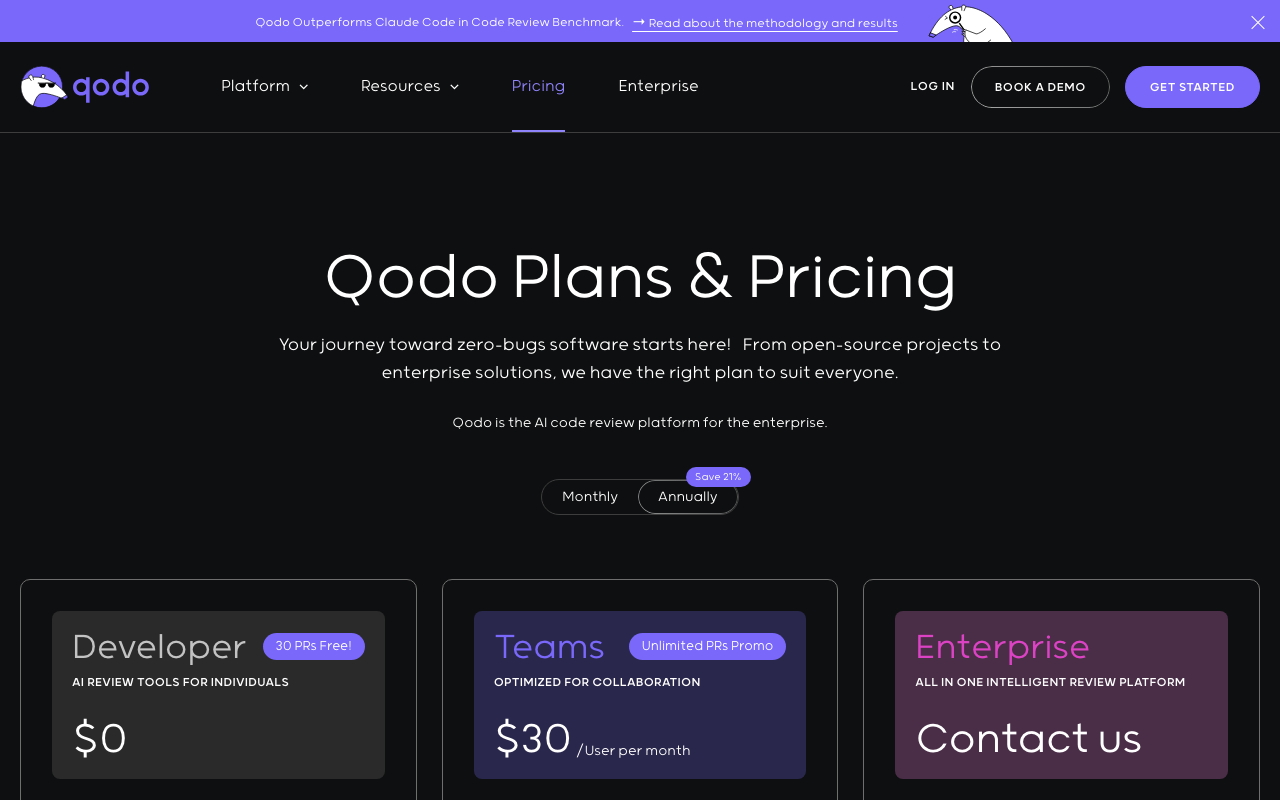
Qodo, formerly known as CodiumAI, is the only AI code quality platform that combines PR review, test generation, IDE assistance, and CLI tooling in a single product. That breadth comes with a pricing model that is more layered than most competitors - a credit system for IDE and CLI usage, a separate PR review allocation, and three tiers that range from a genuinely useful free plan to custom enterprise pricing.
Understanding what you actually pay for Qodo - and whether that price makes sense compared to alternatives like CodeRabbit, GitHub Copilot, and Codacy - requires looking at both the Qodo Gen (IDE/CLI) and Qodo Merge (PR review) sides of the platform. This guide breaks down every pricing tier, explains the credit system, compares costs at different team sizes, and helps you decide which plan fits your team.
For a full feature review beyond pricing, see our Qodo review. If you are exploring alternatives, check our Qodo alternatives guide and Qodo vs GitHub Copilot comparison.
Qodo Products: Gen, Merge, and PR-Agent
Before diving into pricing, it helps to understand the three product layers that make up the Qodo platform.
Qodo Gen is the IDE and CLI assistant. It provides code completion, test generation, local code review, and AI chat inside VS Code and JetBrains IDEs. The CLI tool extends these capabilities to the terminal. Qodo Gen usage is metered through a credit system.
Qodo Merge is the hosted PR review service. When you open a pull request on GitHub, GitLab, Bitbucket, or Azure DevOps, Qodo Merge’s multi-agent architecture analyzes the diff and posts inline review comments, PR summaries, and test suggestions. Qodo Merge usage is metered by the number of PR reviews per month.
PR-Agent is the open-source foundation of Qodo Merge. Teams can self-host PR-Agent on their own infrastructure using Docker, providing their own LLM API keys. The software is free. This is the zero-cost alternative for teams that have the DevOps capacity to manage their own deployment.
All three products are covered under the same Qodo subscription. Pricing tiers determine the limits for both Gen (credits) and Merge (PR reviews).
Plan-by-Plan Breakdown
There is no free tier - there is a 14-day trial
Direct answer: Qodo has no permanent free tier as of 2026-10-19. What exists is a 14-day trial with unlimited reviews and no credit card. The free Developer plan with 30 PR reviews and 250 credits per month that appears across comparison pages, including earlier versions of this one, is not in Qodo’s current published pricing.
The trial is actually a good evaluation instrument precisely because reviews are unlimited inside it - you can run your real PR volume rather than rationing against a monthly cap. The catch is the same as CodeRabbit’s: there is no soft landing. When the 14 days end, you are either paying or you have no reviewer.
If you need free rather than cheap, the honest options are:
- PR-Agent - MIT-licensed since 23 April 2026, moved to independent community governance at
The-PR-Agent/pr-agent, v0.48.0. Qodo remains a sponsor but no longer controls governance. Self-host via CLI, Docker, GitHub Action or webhook server; works with OpenAI, Claude, Gemini or local models through Ollama. Free software, you pay for tokens. - Kodus - AGPLv3, free to self-host at any team size, Community tier capped at 10 Kody Rules and 3 plugins.
- CodeRabbit - free forever on public repositories only; private repos get 1 summary-only review per hour.
- Codacy - Developer tier free forever for individuals, IDE-focused.
Team subscription - a flat fee, not a per-seat price
Direct answer: The team subscription is a flat fee of roughly $30 per month covering up to 30 users, not $30/month flat for up to 30 users (verified 2026-10-19). Credits are bought separately at $0.012 each in packs of 2,500 / 5,000 / 20,000, pooled across the team, with no rollover. Reviews are unlimited during the 14-day trial; Qodo does not publish a credits-per-review figure for ongoing use.
That flat structure is genuinely unusual and worth sitting with. At 5 developers it costs the same as at 30. At 31 developers you are in a sales conversation. Nothing else in our matrix prices this way - every per-seat competitor charges roughly 30 times more for 30 developers than for one.
Pricing: approximately $30 per month, flat, for up to 30 users. We could not verify an annual-versus-monthly split, so do not assume a 20 percent annual discount of the kind CodeRabbit offers.
Credits: $0.012 each, pooled, no rollover. Packs of 2,500 / 5,000 / 20,000. Qodo publishes no credits-per-review number, which is the single biggest forecasting gap in its pricing.
Deployment and compliance: on-prem and VPC are available, with SOC 2 and GDPR (verified 2026-10-19). That combination at this subscription price is rare - most vendors put on-prem behind a quote-only enterprise tier, and CodeRabbit puts self-hosting behind a 500-seat minimum.
Who it works for: teams up to 30 developers who want the lowest subscription line in the market and are willing to model credit consumption themselves. Teams that need a predictable fixed bill with no usage variable should price CodeRabbit Essentials or Team instead.
Enterprise Plan (Custom Pricing)
The Enterprise plan adds organizational controls, cross-repo intelligence, and flexible deployment options.
Pricing: quote-only. We could not confirm the approximately $45 per user per month figure that circulates, including in an earlier version of this page, against any Qodo document on 2026-10-19. Treat it as unverified. For context on how normal that is: of the 15 enterprise tiers we track, 12 are quote-only, only three vendors publish an enterprise rate card at all, and zero publish net terms, a PO process or a support SLA.
Key Enterprise-only features:
- Context engine for multi-repo awareness. Builds intelligence across multiple repositories, understanding how changes in one repo affect services in another. Critical for microservice architectures.
- Enterprise dashboard and analytics. Centralized visibility into code quality trends, review activity, and team performance across the organization.
- User-admin portal with SSO. Single sign-on through your existing identity provider with centralized access management.
- Enterprise MCP tools. Specialized tooling for Qodo agents within enterprise workflows.
- Priority support with 2-business-day SLA. Guaranteed response times for production issues.
- Deployment flexibility. SaaS, on-premises, or fully air-gapped deployment. This is the critical feature for regulated industries - finance, healthcare, defense, and government organizations that cannot send source code to external services.
Who it works for: Organizations with 50 or more developers that need self-hosted deployment, SSO, multi-repo intelligence, or compliance-grade audit controls.
Qodo Merge Pricing: Hosted vs Self-Hosted
Qodo Merge - the PR review product - has a distinct pricing consideration because of the open-source PR-Agent alternative.
Hosted Qodo Merge (Included in Plans)
Hosted PR review is included in the Qodo subscription and metered against pooled credits at $0.012 each (verified 2026-10-19). Reviews are unlimited during the 14-day trial. Qodo does not publish a credits-per-review figure, so the only way to convert a credit pack into a review count is to measure your own volume. Earlier versions of this page quoted 30 reviews per month on a free Developer plan and 20 per user per month on Teams; neither figure is in Qodo’s current published pricing.
Self-Hosted PR-Agent (Free)
PR-Agent is Qodo’s open-source PR review engine available on GitHub. Teams can deploy it for free using Docker on their own infrastructure. The only cost is LLM API usage.
Typical LLM API costs per review:
| PR Size | Estimated API Cost |
|---|---|
| Small (under 100 lines) | $0.02 - $0.05 |
| Medium (100-500 lines) | $0.05 - $0.10 |
| Large (500+ lines) | $0.10 - $0.25 |
For a 20-developer team processing 400 PRs per month:
| Deployment | Monthly Cost | Annual Cost |
|---|---|---|
| Qodo hosted (flat fee, up to 30 users) | ~$30 + credits at $0.012 | ~$360 + credits |
| PR-Agent (self-hosted) | $20 - $80 (LLM API only) | $240 - $960 |
Self-hosted PR-Agent reduces costs by 90% or more but requires DevOps capacity to deploy, maintain, and update the tool. Teams without dedicated infrastructure engineers should use the hosted option.
Feature Comparison Across Plans
| Feature (verified 2026-10-19) | 14-day trial | Team (~$30/mo flat, up to 30 users) | Enterprise (quote only) |
|---|---|---|---|
| PR reviews | Unlimited during trial | Metered by credits | Metered by credits |
| Credits | Included in trial | $0.012 each, pooled, no rollover | Negotiated |
| Credits consumed per review | Not published | Not published | Not published |
| Credit packs | - | 2,500 / 5,000 / 20,000 | Negotiated |
| Multi-agent PR review | Yes | Yes | Yes |
| IDE plugin (VS Code, JetBrains) | Yes | Yes | Yes |
| CLI tool | Yes | Yes | Yes |
| Test generation | Yes | Yes | Yes |
| Custom review instructions | Yes | Yes | Yes |
| PR summaries and walkthroughs | Yes | Yes | Yes |
| Private support | No | Yes | Priority (2-day SLA) |
| Data retention | Standard | No retention | Configurable |
| Context engine (multi-repo) | No | No | Yes |
| Enterprise dashboard | No | No | Yes |
| SSO | No | No | Yes |
| On-premises deployment | No | Yes - available | Yes |
| VPC deployment | No | Yes - available | Yes |
| SOC 2 and GDPR | Yes | Yes | Yes |
| Permanent free tier | None exists | - | - |
Cost at Different Team Sizes
Understanding Qodo’s total cost requires factoring in both the per-user subscription and the credit system. The table below uses annual billing.
Direct answer: The subscription does not scale with team size up to 30 users - it is a flat fee of roughly $30 per month whether you have 5 developers or 30 (verified 2026-10-19). Above 30 users you need a quote. What scales is credit consumption at $0.012 each, pooled with no rollover, and Qodo publishes no credits-per-review figure, so the variable half of the bill cannot be modelled from published data.
| Team size | Subscription (verified 2026-10-19) | Credit cost | CodeRabbit Essentials for comparison |
|---|---|---|---|
| 5 developers | ~$30/mo flat | Usage, $0.012/credit, pooled | $120/mo annual |
| 10 developers | ~$30/mo flat | Usage, pooled | $240/mo annual |
| 25 developers | ~$30/mo flat | Usage, pooled | $600/mo annual |
| 30 developers | ~$30/mo flat (ceiling) | Usage, pooled | $720/mo annual |
| 50 developers | Quote required | Negotiated | $1,200/mo annual |
| 100 developers | Quote required | Negotiated | $2,400/mo annual |
That table used to read $150 to $3,000 per month on a per-seat assumption. It was wrong by a factor of 5 to 100 and is corrected here. The honest caveat is on the right-hand column of the real bill: we cannot tell you what credits will cost you, because the credits-per-review figure is not published. Buy a 2,500-credit pack, run a month of real volume, and measure. That is the only defensible way to forecast Qodo.
Free Plan Limitations in Practice
Direct answer: The constraint is not a free-tier cap, because there is no free tier (verified 2026-10-19). It is the 14-day trial window and, after that, credits that are pooled with no rollover and no published per-review consumption rate. Those three properties - pooled, non-rolling, unmeasured - are the whole risk profile of Qodo’s pricing.
Pooled credits are a real advantage, stated honestly. A team where one engineer ships 40 PRs a month and three ship five each is badly served by per-author credits. Greptile’s credits attach to the developer who received the review and explicitly do not pool, so the heavy contributor pays overage while three allocations sit unused. Qodo’s pool absorbs that. The flip side is that nothing stops one person from consuming the team’s allocation.
No rollover is a real cost. Unused credits expire at the end of each cycle. If your volume is seasonal - a quiet December, a heavy January - you either over-buy and waste, or under-buy and run dry.
No published credits-per-review figure is the biggest gap. Every per-seat competitor lets you compute the bill from headcount. Qodo does not, and we are not going to estimate it. Measure a month.
The 75-reviews and 30-reviews figures are both obsolete. Qodo’s free allowance went from 75 per month to 30 per month and then to nothing. Comparison pages across this market, including earlier versions of this one, are frozen at one of the two earlier states.
When to buy, and what to measure first
Direct answer: Start the 14-day trial, run your real PR volume through it since reviews are unlimited inside the window, and buy a 2,500-credit pack to measure consumption before committing (verified 2026-10-19). There is no free tier to fall back on and no published credits-per-review figure, so measurement during the trial is the only way to forecast the bill.
Buy when you are under 30 users. The flat fee makes Qodo structurally cheap below that line and a quote-only conversation above it. If you are at 28 developers and growing, raise the 30-user ceiling with sales before you sign.
Buy when on-prem or VPC matters at a small team size. Qodo offers both, with SOC 2 and GDPR (verified 2026-10-19). That is genuinely rare at this price: CodeRabbit gates self-hosting behind 500+ seats, and Semgrep’s Network Broker and Snyk Broker are tunnels to the vendor’s cloud rather than on-prem deployments.
Do not buy on a credits estimate someone else gave you. Qodo does not publish credits per review and neither do we. Measure.
Check whether you need per-seat predictability instead. If finance needs a number that does not move, a per-seat tool is the better fit regardless of headline price.
Competitor Pricing Comparison
Pricing Overview Table
| Tool | Free tier (verified 2026-10-19) | Paid starting price | Billing model | Test generation |
|---|---|---|---|---|
| Qodo | None - 14-day trial, unlimited reviews | ~$30/month flat, up to 30 users | Flat team fee + credits at $0.012, pooled, no rollover | Yes |
| CodeRabbit | Public repos only; 1 summary-only private review/hr | $24/dev/mo annual, $30 monthly | Per PR creator; $0.25/file past hourly limit | No |
| GitHub Copilot | Copilot Free - no code review | $10/mo Pro (includes review), $19 Business | Per user, monthly only since 1 June 2026, AI Credits $0.01 | No |
| Codacy | Developer tier free forever (IDE) | $18/dev/mo yearly, $21 monthly | Per dev, up to 30 on Team | No |
| Greptile | Starter: 1 active dev, 50 credits/mo | $30/seat/mo | Per dev who received a review; credits do not pool; Apex = 10 credits | No |
| Sourcery | OSS repos only | $12/seat/mo annual | Per seat | No |
| PR-Agent | Self-host free, MIT since 23 Apr 2026 | $0 licence | You pay LLM calls | No |
Qodo vs CodeRabbit Pricing
Direct answer: Qodo’s subscription is a flat ~$30/month for up to 30 users; CodeRabbit Essentials is $24 per developer per month annual, $48 on Team (verified 2026-10-19). At 20 developers that is roughly $30 against $480 before Qodo’s credits. CodeRabbit covers 1 linked repo on Essentials and 5 on Team; Qodo bundles test generation. Neither has a usable free tier for private code.
The per-seat comparison that used to sit here - $24 against $30, CodeRabbit $6 cheaper - was comparing a per-seat price to a team price. On the corrected model Qodo is far cheaper on subscription and carries an unmeasured credit variable, which is a genuinely different trade rather than a $6 difference. CodeRabbit’s free tier is also no longer the more generous one in any meaningful sense: it covers public repositories only, with 1 summary-only review per hour on private repos.
However, Qodo bundles test generation, IDE code review, and CLI tooling alongside PR review. CodeRabbit focuses exclusively on PR review. If your team needs both a PR review tool and a test generation tool, buying them separately (CodeRabbit + a test gen tool) may cost more than Qodo’s all-in-one pricing.
For a 20-developer team on annual billing:
| Tool (verified 2026-10-19) | Monthly subscription | Annual subscription | Usage charges on top |
|---|---|---|---|
| Qodo (flat, covers up to 30 users) | ~$30 | ~$360 | Credits at $0.012, pooled, no rollover, per-review rate not published |
| CodeRabbit Essentials, 20 seats, 1 repo | $480 | $5,760 | $0.25 per reviewed file past the hourly limit |
| CodeRabbit Team, 20 seats, 5 repos | $960 | $11,520 | Same |
Qodo vs GitHub Copilot Pricing
Direct answer: Copilot Business is $19 per user per month, monthly-only since GitHub retired annual billing on 1 June 2026; Qodo is a flat ~$30/month for up to 30 users (verified 2026-10-19). At 20 developers that is $380 against about $30. Copilot code review is included from Pro at $10 - only Copilot Free lacks it - and private-repo reviews also consume GitHub Actions minutes with no published per-review figure.
The old framing here had Copilot $11 per user cheaper than Qodo. On the corrected models Qodo’s subscription is an order of magnitude cheaper at team scale, and Copilot is the broader platform rather than the cheaper one. Copilot’s premium requests were replaced by AI Credits at $0.01, included allowances were cut on 1 September 2026 to 1,900 Business and 3,900 Enterprise, and paid overage is on by default for organizations.
Qodo’s advantages over Copilot are deeper PR analysis through its multi-agent architecture, dedicated test generation, and support for GitLab, Bitbucket, and Azure DevOps (Copilot’s code review is GitHub-only). For teams already on GitHub Copilot, adding Qodo means paying for a second tool. The question is whether Qodo’s review depth and test generation justify roughly $30 per month plus credits on top of an existing Copilot subscription - which is a far easier case to make than the $30-per-seat figure this page used to quote (verified 2026-10-19).
For a detailed comparison, see our Qodo vs GitHub Copilot guide.
Qodo vs Codacy Pricing
Codacy runs a Developer tier free forever for individuals and a Team tier from $18/dev/month billed yearly ($21 monthly) for up to 30 devs, with Business quote-only (verified 2026-10-19). The $15 figure that circulates, including in an earlier version of this page, is stale.
Team bundles the AI reviewer with SAST, software composition analysis, secrets detection, coverage tracking and quality gates across 40+ languages, and it is free for open source. One structural catch to check before you plan a migration: Codacy’s AI Reviewer is cloud-and-GitHub-only while GitHub Enterprise Server requires Codacy Self-hosted, so GHES customers structurally cannot get it. At 20 developers Codacy Team is $360 per month against Qodo’s roughly $30 flat plus credits - so Qodo is cheaper on subscription and Codacy covers far more ground.
For a 20-developer team:
| Tool (verified 2026-10-19) | Plan | Monthly cost | Annual cost | Includes |
|---|---|---|---|---|
| Qodo | Team (flat, up to 30 users) | ~$30 + credits | ~$360 + credits | PR review + test gen + IDE + CLI; on-prem and VPC available |
| Codacy | Team, 20 devs | $360 | $4,320 | PR review + SAST + SCA + secrets + coverage + quality gates |
| Codacy | Business | Quote only | Quote only | Adds DAST, SSO, self-hosted |
Teams that need test generation should choose Qodo. Teams that need security scanning and dependency analysis should consider Codacy. Teams that need only PR review at the lowest price should compare Codacy Pro against CodeRabbit Essentials.
Qodo vs Greptile Pricing
Direct answer: Greptile Pro is $30 per seat per month with 50 credits included and $1 per extra credit, where a seat is any developer who received a review and credits do not pool; an Apex-depth review costs 10 credits (verified 2026-10-19). Qodo is a flat ~$30/month for up to 30 users with pooled credits at $0.012. At 20 developers that is $600 against about $30 plus usage.
Greptile’s Starter tier is free for 1 active developer with 50 credits a month. Published startup terms: 50% off pre-Series A under $2M revenue, one month free, plus special pricing for YC companies.
On the quality claim, be precise about who produced each number. The 82% is Greptile scoring Greptile on 50 PRs across 5 repositories, not independently validated. Augment’s re-run scored 45% - and that is an F-score (45% precision / 45% recall), not a catch rate, run after Augment rebuilt the answer key: it stated it had expanded and corrected the golden comments by reviewing each PR manually. So part of the 82-versus-45 gap is methodology rather than self-dealing. There is no industry average of 40 to 55 percent; that framing was in an earlier version of this page and we could not source it, so it is removed. The most neutral figure available is Martian Code Review Bench, from a company that sells model routing rather than a reviewer: CodeRabbit at 51.2% F1 / 49.2% precision across roughly 300,000 PRs. Qodo claimed #1 on that same leaderboard at 64.3%, and its own benchmark reports 60.1% F1 - both self-published, and four vendors have each declared themselves #1 on it.
Annual Cost Comparison for a 50-Developer Team
| Tool | Plan | Annual cost, 50 devs (verified 2026-10-19) | Key differentiator |
|---|---|---|---|
| PR-Agent | Self-hosted, MIT | $0 licence + LLM spend | Free software, your ops time |
| Qodo | Team flat fee | Quote required above 30 users | Flat to 30 users; on-prem and VPC at a small-team price |
| Sourcery | Pro $12 | $7,200 | Budget review, Python strength |
| Codacy | Team $18 yearly | $10,800 | Review + SAST + SCA + gates (not on GHES) |
| GitHub Copilot | Business $19, monthly only | $11,400 | All-in-one platform; unmodellable Actions minutes |
| CodeRabbit | Essentials $24 | $14,400 | 4 Git platforms, linter suite, 1 linked repo |
| Greptile | Pro $30 | $18,000 | Full-codebase indexing; credits do not pool |
| CodeRabbit | Team $48 | $28,800 | 5 linked repos, 300-file cap |
Qodo breaks this table rather than sitting in it, and that is the finding. Its flat fee covers up to 30 users, so a 50-developer organization needs a quote and we cannot give you an annual figure. Below 30 developers Qodo is the cheapest subscription in the market by an order of magnitude. Above it, Qodo is unpriced. The previous version of this page put Qodo at $18,000 a year for 50 developers on a per-seat assumption that does not match its published model.
Final Recommendation
Direct answer: Under 30 developers, Qodo is the cheapest subscription in this market - a flat fee of roughly $30 per month plus credits at $0.012, with on-prem and VPC available and SOC 2 and GDPR published (verified 2026-10-19). Above 30 users it is quote-only. There is no free tier, so evaluate on the 14-day trial and measure credit consumption before you commit.
Run the 14-day trial and measure. Reviews are unlimited inside the window, so push your real volume through it. Buy one 2,500-credit pack and record how far it goes. Qodo publishes no credits-per-review figure and neither will we - measurement is the only honest forecast.
Buy the Team subscription if you are under 30 users and want the lowest subscription line available. At 20 developers you are comparing roughly $30 a month against $480 for CodeRabbit Essentials, $380 for Copilot Business and $600 for Greptile Pro. The trade you are accepting is a variable usage component you have to model yourself instead of a fixed per-seat number.
Buy it specifically if you need on-prem or VPC at a small team size. Qodo offers both. CodeRabbit gates self-hosting behind 500+ seats, and Semgrep’s Network Broker and Snyk Broker are WireGuard-style tunnels to the vendor’s cloud rather than on-prem deployments. That combination - on-prem, SOC 2, GDPR, flat fee - is genuinely scarce.
Choose self-hosted PR-Agent if you want zero licence cost. MIT since 23 April 2026, independent community governance at The-PR-Agent/pr-agent, v0.48.0, with Qodo as a sponsor. Covers GitHub, GitLab, Bitbucket, Azure DevOps and Gitea, with OpenAI, Claude, Gemini or local models via Ollama. You trade subscription cost for ops time.
Choose Qodo Enterprise if you need the multi-repo context engine, SSO or an enterprise dashboard - or if you are over 30 users and need a contract. Pricing is quote-only and the roughly $45 per user figure in circulation is unverified.
Look elsewhere if finance needs a fixed number. Credits that are pooled, non-rolling and unmeasured are the wrong shape for a team that has to commit a budget line 12 months ahead. CodeRabbit at $24 or $48 per developer per month, or Codacy Team at $18 per developer per month yearly, are more forecastable - and in Codacy’s case bundle SAST, SCA and secrets detection as well.
How we verified this
Checked on 2026-10-19 against Qodo’s published pricing plus our own verified fact table. This page needed the largest correction of any in the Qodo cluster, because the pricing model had changed shape, not just the numbers.
What we corrected on this pass:
- Qodo does not price per seat. The published model is a flat team fee of roughly $30 per month covering up to 30 users, plus credits at $0.012 each. The previous version of this page described $30/month flat for up to 30 users annual and $38 monthly throughout, which overstated the cost at 20 developers by roughly 20x.
- Credits are pooled across the team and do not roll over, in packs of 2,500 / 5,000 / 20,000. The previous version described 2,500 credits per user per month with per-model credit costs.
- There is no permanent free tier. The previous version described a free Developer plan with 30 PR reviews and 250 credits per month, and before that the market quoted 75 reviews per month. Current: a 14-day trial with unlimited reviews and no card.
- The approximately $45 per user per month Enterprise figure is withdrawn as unverified.
- The 21 percent annual discount is withdrawn. We could not verify an annual-versus-monthly split for the current flat fee.
- Competitor prices corrected: Codacy Team is $18/dev/mo yearly ($21 monthly), not $15. CodeRabbit’s free tier is public-repo-only. Copilot code review is included from Pro at $10, premium requests were replaced by AI Credits at $0.01, and annual billing was retired entirely on 1 June 2026. Greptile bills per credit with no pooling and Apex reviews at 10 credits each. Sourcery Pro is $12/seat/mo.
- The “industry average 40 to 55 percent” catch rate is removed. We could not source it.
What we could NOT verify, named explicitly:
- Credits consumed per review. Qodo does not publish it. This is the single biggest gap in forecasting Qodo, and we will not estimate it. Measure during the trial.
- Whether an annual billing option exists for the flat team fee, and at what discount.
- Qodo’s Enterprise price. Quote-only.
- Exact pack prices. We give pack sizes of 2,500 / 5,000 / 20,000 and the per-credit rate of $0.012; the arithmetic products ($30 / $60 / $240) are ours, not Qodo’s published pack prices.
- Any independent measurement of Qodo’s review quality. Qodo claimed #1 on Martian Code Review Bench at 64.3% and its own benchmark reports 60.1% F1 - both self-published. Four vendors have each declared themselves #1 on Martian’s leaderboard. The precise claim we stand behind: no party without a commercial stake has published a false-positive rate, precision figure or noise measurement for any shipping commercial AI code reviewer. SWE-PRBench and CR-Bench publish false-positive data for bare models in fixed harnesses, not products you can buy.
- Qodo’s SOC 2 and GDPR documents. These are vendor statements on Qodo’s own pages, not retrieved reports. Verify against the trust centre, not a comparison table - and note that “HIPAA certified” is not a real certification scheme, which requires a signed BAA instead.
Carried from the prior pass (2026-10-18), not re-checked today: PR-Agent’s move to The-PR-Agent/pr-agent and v0.48.0; the CodeRabbit 500-seat self-hosting threshold; the Martian Code Review Bench figures dated 3 March 2026; and Augment’s Greptile re-run at 45% F on a rebuilt answer key.
Our method, including how we handle vendor-funded benchmarks and publish corrections visibly, is on our standards page.
For teams transitioning from CodiumAI, see our CodiumAI to Qodo migration guide. For a broader look at AI-powered testing options, check our best AI test generation tools roundup.
Further Reading
 Gitar
GitarComments are not enough
Gitar applies the fix, validates it in CI, and clears the queue.
See it on your repo Read our independent Gitar reviewFrequently Asked Questions
How much does Qodo cost per developer?
Qodo does not price per developer in the way most of this market does (verified 2026-10-19). Its published model is a flat team fee of roughly $30 per month covering up to 30 users, plus credits at $0.012 each that are pooled across the team and do not roll over. Credit packs come in 2,500, 5,000 and 20,000 units. There is a 14-day trial with unlimited reviews and no permanent free tier. So at 20 developers the subscription line is about $30 per month in total rather than $600, and your variable cost is credit consumption. That makes Qodo the cheapest headline subscription in this market and the hardest to forecast.
Is Qodo free to use?
No permanent free tier as of 2026-10-19. Qodo offers a 14-day trial with unlimited reviews and no card, then the flat team fee plus credits. Earlier versions of this page described a free Developer plan with 30 PR reviews and 250 credits per month; that is not in Qodo current published model and we are correcting it. If you need genuinely free AI review, the open-source route is PR-Agent, which was relicensed to MIT on 23 April 2026 and self-hosts on your own infrastructure with your own LLM keys. Qodo remains a sponsor of that project but no longer owns the governance.
What is the difference between Qodo Gen and Qodo Merge?
Qodo Gen is the IDE-based AI coding assistant that provides code completion, test generation, and local code review inside VS Code and JetBrains IDEs. Qodo Merge is the PR review product that analyzes pull requests on GitHub, GitLab, Bitbucket, and Azure DevOps. Both products are included under the same Qodo subscription. The open-source version of Qodo Merge is called PR-Agent, which teams can self-host for free with their own LLM API keys.
How does Qodo's credit system work?
Credits cost $0.012 each, are pooled across the whole team rather than allocated per seat, and do not roll over between cycles (verified 2026-10-19). Packs come in 2,500, 5,000 and 20,000 credits, which is $30, $60 and $240 respectively at the published rate. Pooling cuts both ways: a heavy contributor can draw on a light contributor unused allowance, which Greptile per-author credits explicitly cannot do, but there is no protection against one person burning the team allocation. No rollover means unused credits are lost each cycle. Qodo does not publish a credits-per-review figure, so you cannot convert a pack into a review count without measuring your own usage.
What happened to CodiumAI pricing?
CodiumAI rebranded to Qodo in 2024. All CodiumAI pricing plans and subscriptions transitioned to the Qodo brand. The product capabilities expanded from primarily test generation to a full code quality platform covering PR review, IDE assistance, CLI workflows, and test generation. Current Qodo pricing is a flat team fee of roughly $30 per month for up to 30 users plus credits at $0.012 each, with a 14-day trial and no permanent free tier, and quote-only Enterprise (verified 2026-10-19).
Is Qodo Merge (PR-Agent) free to self-host?
Yes. PR-Agent, the open-source foundation of Qodo Merge, is free to self-host. Teams deploy it on their own infrastructure using Docker and provide their own LLM API keys. The software itself has no license cost. LLM API costs typically range from $0.02 to $0.10 per review depending on PR size and model choice. For a team processing 500 PRs per month, total LLM costs might be $10 to $50 per month - dramatically cheaper than any SaaS option.
How does Qodo pricing compare to CodeRabbit?
The models are not comparable per seat (verified 2026-10-19). Qodo charges a flat team fee of roughly $30 per month for up to 30 users plus credits at $0.012; CodeRabbit charges $24 per developer per month on Essentials annual, $48 on Team. At 20 developers that is about $30 a month against $480, so Qodo is dramatically cheaper on subscription and carries the credit variable. CodeRabbit covers more linked repositories per tier and bundles a linter suite; Qodo bundles test generation, IDE review and CLI workflows. On free tiers neither is generous now: Qodo has no permanent free tier and CodeRabbit free covers public repositories only.
How does Qodo pricing compare to GitHub Copilot?
Qodo charges a flat team fee of roughly $30 per month for up to 30 users plus credits at $0.012, while GitHub Copilot Business is $19 per user per month and monthly-only since GitHub retired annual billing on 1 June 2026 (both verified 2026-10-19). At 20 developers that is about $30 against $380, so Qodo is cheaper on subscription, not more expensive as earlier versions of this page said. Note also that Copilot code review is included from Copilot Pro at $10 and only Copilot Free lacks it, and that private-repo Copilot reviews consume GitHub Actions minutes with no published per-review figure. Copilot is primarily a code completion and chat assistant with code review as one feature among many. Qodo focuses on code quality with deeper PR analysis, test generation, and multi-platform support for GitHub, GitLab, Bitbucket, and Azure DevOps. Copilot is limited to GitHub for code review.
Does Qodo offer annual billing discounts?
Qodo does not publish an annual-versus-monthly split for its current flat team fee, and we could not verify a 21 percent annual discount on 2026-10-19. An earlier version of this page stated $30 annual against $38 monthly per user; that figure belongs to a per-seat model Qodo no longer publishes. What is published is the flat fee of roughly $30 per month for up to 30 users plus credits at $0.012 each, pooled with no rollover. If annual terms matter to your procurement process, treat it as a question for Qodo sales rather than a published fact. For context, GitHub Copilot removed annual billing entirely on 1 June 2026, so monthly-only is not unusual in this market.
What does Qodo Enterprise include?
Qodo Enterprise adds a context engine for multi-repo codebase awareness, an enterprise dashboard and analytics, a user-admin portal with SSO, enterprise MCP tooling, and priority support. Deployment options include SaaS, on-premises and VPC, and Qodo publishes SOC 2 and GDPR (verified 2026-10-19). Pricing is quote-only - we could not confirm the roughly $45 per user per month figure that circulates, including in an earlier version of this page, against any Qodo document, so treat it as unverified. Qodo is not among the three vendors in our set that publish an enterprise rate card, and no vendor in this market publishes net terms, a PO process or a support SLA.
Is Qodo worth the price compared to alternatives?
On subscription cost Qodo is now the cheapest serious option in this market: a flat fee of roughly $30 per month for up to 30 users, against $24 per developer per month for CodeRabbit Essentials, $30 per seat for Greptile Pro and $18 per developer per month yearly for Codacy Team (all verified 2026-10-19). The variable is credits at $0.012 each, pooled with no rollover, and Qodo publishes no credits-per-review figure, so the real bill depends on measured usage. On quality, Qodo claimed the number one spot on Martian Code Review Bench at 64.3 percent and its own benchmark reports 60.1 percent F1 - both self-published, and four vendors have each declared themselves number one on that same leaderboard.
How many PR reviews does the Qodo free tier include?
None, because there is no permanent free tier as of 2026-10-19. Qodo offers a 14-day trial with unlimited reviews and no credit card, after which the flat team fee applies. Both the 75-reviews-per-month figure and the later 30-reviews-per-month figure that circulate on comparison pages, including earlier versions of this page, describe plans Qodo no longer publishes. If you need a free allowance rather than a trial, the realistic options are self-hosted PR-Agent under MIT, Kodus under AGPLv3, or CodeRabbit free on public repositories only.
Explore More
Tool Reviews
 Qodo Review
 Codacy Review
Related Articles
Free Newsletter
Stay ahead with AI dev tools
Weekly insights on AI code review, static analysis, and developer productivity. No spam, unsubscribe anytime.
Join developers getting weekly AI tool insights.
Related Articles
How to Measure AI Code Review False Positives: An Open Protocol
A reproducible protocol for measuring AI code review false positives: taxonomy, PR selection, blind classification and variance. Nobody has run it.
October 18, 2026
guideQodo Merge Pricing: Free vs Pro for PR Reviews in 2026
Qodo Merge pricing verified 2026-10-19 - a flat team fee near $30 a month for up to 30 users, pooled credits at $0.012, and free MIT PR-Agent.
March 4, 2026
guideSourcery AI Pricing: Free vs Pro vs Team Plans in 2026
Sourcery AI pricing in 2026 - free open-source tier, Pro at $12/seat/month, Team at $24/seat/month, and Enterprise custom pricing compared.
March 17, 2026