AI Code Review for Security - Finding Vulnerabilities
How AI code review detects security vulnerabilities, which tools are best for security scanning, and what risks AI review introduces. Covers OWASP Top 10.
Published:
Last Updated:
Direct answer
AI finds a different class of security bug than SAST does, and nobody independent has measured how well. LLM review catches logic-level flaws - missing authorization, TOCTOU gaps, incomplete validation - that pattern matching cannot see; deterministic SAST catches known patterns exhaustively. Run both. But no party without a commercial stake has published a false-positive rate, precision figure or noise measurement for any shipping commercial AI code reviewer, so treat every vendor accuracy number as marketing. Verified 2026-10-19.
The intersection of AI and security code review
Security vulnerabilities in production code remain one of the most expensive problems in software engineering. IBM’s 2025 Cost of a Data Breach report pegged the average breach cost at $4.88 million, with the average time to identify and contain a breach stretching to 258 days. The overwhelming majority of these breaches trace back to code-level vulnerabilities that were preventable - injection flaws, broken access control, authentication logic errors, and hardcoded secrets that made it through code review.
Traditional security code review has relied on two approaches: manual expert review and static application security testing (SAST). Manual review is thorough but does not scale. A senior security engineer reviewing a 500-line pull request for vulnerabilities takes 30 to 60 minutes. Multiply that by the dozens or hundreds of PRs a mid-size engineering team produces per week, and it becomes clear why most code ships with minimal security review.
SAST tools like Checkmarx, Veracode, and Coverity addressed the scale problem by automating pattern-based detection. They catch known vulnerability patterns deterministically and exhaustively. But they have their own limitations - high false positive rates, inability to understand business logic, slow scan times that break developer workflows, and a fundamental inability to catch vulnerabilities that do not match predefined patterns.
This is where AI enters the picture, and the intersection creates something genuinely new in 2026.
AI code review for security operates on two distinct levels. The first is using AI and LLMs to detect security vulnerabilities in your code - finding injection flaws, authentication bypasses, and logic-level security issues that rule-based scanners miss. The second, often overlooked, is understanding the security implications of using AI code review tools themselves - the data privacy risks of sending proprietary code to third-party models, the danger of hallucinated security fixes, and the supply chain risks that come with depending on AI-generated suggestions.
This guide covers both angles in depth. We will examine how AI detects vulnerabilities, which tools are strongest for security scanning, what OWASP categories each tool covers, and then turn the lens around to evaluate the security risks that AI code review introduces into your pipeline.
How AI detects security vulnerabilities
Direct answer: Three mechanisms, not one. Rule-based pattern matching (Semgrep, SonarQube) is deterministic and only finds what its rules describe. Taint and dataflow analysis (Snyk Code, Checkmarx, Veracode) follows untrusted input across files. LLM semantic analysis (CodeRabbit, Anthropic Code Review) reasons about intent and catches logic flaws. Cross-file interfile taint requires Semgrep’s proprietary Pro engine; Semgrep CE cannot do it at all. Verified 2026-10-19.
To understand what AI security scanning can and cannot do, you need to understand the different detection approaches that modern tools use. These are not just academic distinctions - they directly determine what classes of vulnerabilities a tool will catch.
Rule-based pattern matching
The oldest and most deterministic approach. Tools like Semgrep and SonarQube define rules that match specific code patterns associated with known vulnerabilities. A Semgrep rule for SQL injection, for example, looks for string concatenation or f-string interpolation inside SQL query strings.
# Semgrep rule for SQL injection in Python
rules:
  - id: sql-injection-format-string
    patterns:
      - pattern: |
          cursor.execute(f"...{$VAR}...")
      - pattern-not: |
          cursor.execute(f"...{CONST}...")
    message: "Potential SQL injection via f-string formatting"
    severity: ERROR
    languages: [python]
Rule-based scanning is precise and predictable. When a rule fires, you know exactly why - the code matched a known vulnerable pattern. The downside is that rule-based tools only catch what their rules describe. A novel vulnerability pattern, or a vulnerability that requires understanding business context, will slip through.
Taint tracking and dataflow analysis
A more sophisticated approach used by Snyk Code, Checkmarx, and Veracode. Taint analysis tracks how user-controlled input (sources) flows through the application until it reaches a sensitive operation (sinks). If untrusted data reaches a database query, file system operation, or HTML output without being sanitized along the way, the tool flags a vulnerability.
Dataflow analysis catches vulnerabilities that span multiple files and function calls. A user input might enter the system through an HTTP handler, pass through three service layers, and eventually reach a database query in a repository module. Rule-based tools that analyze individual files miss this entirely. Taint trackers follow the data across the full call graph.
The limitation of taint tracking is that it requires understanding the framework. A taint tracker needs to know that request.body in Express is a source, that pool.query() in pg is a sink, and that escape() is a sanitizer. Each framework and library requires specific modeling, which is why coverage varies significantly across tools and tech stacks.
There is a licence boundary here worth knowing before you plan around it. Semgrep’s cross-file (interfile) taint analysis is proprietary-only: it needs interfile: true with --pro, while --pro-intrafile handles cross-function-within-file (verified 2026-10-19). Semgrep CE cannot do interfile analysis at all. Opengrep’s --taint-intrafile matches --pro-intrafile under LGPL 2.1, which means “interfile taint analysis plus an open source licence” does not exist in this market. One nuance that cuts the other way: the Pro engine is listed on all hosted Semgrep tiers including Free (10 contributors / 10 private repos), so interfile taint is free-as-in-beer but never free-as-in-licence. Proprietary is not the same as paid. Scope matters too - Semgrep’s own maturity tiers are 20 GA languages, 2 beta and 19 experimental, with cross-file dataflow in only 8 languages, and the rule depth is wildly uneven: 710+ Pro rules for Python against 170+ for C#.
Two more deployment facts people get wrong, because the vendor naming invites it. Semgrep’s Network Broker is a WireGuard tunnel to Semgrep’s cloud, not an on-premises deployment. Snyk Broker is the same pattern (verified 2026-10-19). If your requirement is that source code never leaves your network, neither of those satisfies it.
LLM-based semantic analysis
The newest approach, used by tools like CodeRabbit, DeepSource AI features, and Semgrep Assistant. Rather than matching patterns or tracking data flow, an LLM reads the code and reasons about it the same way a human security reviewer would.
LLM-based analysis can catch vulnerability classes that pattern-matching and taint tracking fundamentally cannot:
- Business logic flaws - An endpoint that checks if a user is authenticated but does not check if they are authorized to access the specific resource
- Incomplete validation - Input validation that checks the format but not the range, or validates some fields but not others
- Race conditions with security implications - A time-of-check-to-time-of-use (TOCTOU) gap between verifying permissions and executing the action
- Contextual misconfigurations - Security settings that are technically valid but inappropriate for the application’s threat model
The trade-off is non-determinism. An LLM might flag a vulnerability on one review pass and miss it on the next. It might hallucinate a vulnerability that does not exist, or suggest a fix that introduces a new security issue. LLM-based scanning is powerful but unreliable as a sole security layer.
Hybrid approaches
The most effective modern tools combine multiple approaches. Semgrep pairs its rule engine with AI-powered triage (Semgrep Assistant) that reduces false positives by using an LLM to evaluate whether a rule match is actually exploitable in context. Snyk Code combines machine learning models trained on millions of vulnerability examples with traditional dataflow analysis. Aikido bundles SAST, DAST, SCA, and AI-based triaging into a single platform.
This hybrid approach is where the industry is heading. Deterministic rules for known patterns, dataflow analysis for cross-file issues, and AI for contextual reasoning and triage. No single approach is sufficient on its own.
OWASP Top 10 coverage by AI tools
Direct answer: Dedicated SAST (Checkmarx, Veracode, Semgrep) is strongest on A01, A03, A05 and A10. LLM review (CodeRabbit) is relatively stronger on A04 Insecure Design and A09 Logging Failures, the two categories that need intent rather than patterns. A06 Vulnerable Components is an SCA problem, not a SAST problem - only tools that bundle SCA cover it. No tool covers all ten. Verified 2026-10-19.
The OWASP Top 10 remains the standard framework for categorizing web application security risks. Understanding which AI code review tools cover which categories is essential for building a security pipeline without gaps.
The following table maps tool coverage across the OWASP Top 10 (2021 edition). Read the next sentence before you read the table. These ratings are our editorial assessment, built from each vendor’s published rule documentation and our own hands-on use (last reviewed 2026-10-19). They are not measured detection rates, because no measured per-category detection rates exist for these products. “Strong” means the tool documents and reliably catches the majority of vulnerability patterns in that category. “Moderate” means it catches common patterns but misses edge cases. “Weak” means limited or no coverage. If you need numbers rather than judgements, there are none to be had - see the accuracy section below.
| OWASP Category | Semgrep | Snyk Code | Checkmarx | CodeRabbit | DeepSource | SonarQube | Aikido | Veracode |
|---|---|---|---|---|---|---|---|---|
| A01: Broken Access Control | Strong | Strong | Strong | Moderate | Moderate | Moderate | Strong | Strong |
| A02: Cryptographic Failures | Moderate | Moderate | Strong | Weak | Weak | Moderate | Moderate | Strong |
| A03: Injection | Strong | Strong | Strong | Moderate | Moderate | Strong | Strong | Strong |
| A04: Insecure Design | Weak | Weak | Moderate | Moderate | Weak | Weak | Weak | Moderate |
| A05: Security Misconfiguration | Strong | Moderate | Strong | Moderate | Moderate | Moderate | Strong | Strong |
| A06: Vulnerable Components | Strong (SCA) | Strong (SCA) | Strong (SCA) | Weak | Weak | Moderate | Strong (SCA) | Strong (SCA) |
| A07: Auth Failures | Moderate | Moderate | Strong | Moderate | Moderate | Moderate | Moderate | Strong |
| A08: Software Integrity | Moderate | Strong | Strong | Weak | Weak | Weak | Strong | Strong |
| A09: Logging Failures | Moderate | Weak | Moderate | Moderate | Weak | Moderate | Moderate | Moderate |
| A10: SSRF | Strong | Strong | Strong | Moderate | Moderate | Moderate | Strong | Strong |
Several patterns emerge from this analysis.
Dedicated SAST tools dominate for known vulnerability patterns. Checkmarx and Veracode provide the most comprehensive OWASP coverage because they have the largest rule libraries and the deepest language-specific modeling. They have been accumulating vulnerability patterns for over a decade.
AI-native tools are stronger at logic-level categories. CodeRabbit performs relatively better on A04 (Insecure Design) and A09 (Logging Failures) - categories that require understanding intent rather than matching patterns. An LLM can recognize that a sensitive operation lacks audit logging even when no rule exists for that specific framework.
SCA is a separate concern. A06 (Vulnerable and Outdated Components) is fundamentally a Software Composition Analysis problem, not a SAST problem. Tools like Semgrep, Snyk Code, and Aikido that bundle SCA alongside SAST cover this category. Tools focused purely on code analysis do not.
No single tool covers everything. Even the strongest tools have gaps. This is the fundamental argument for layered security - combining dedicated SAST, AI code review, SCA, and eventually DAST to achieve comprehensive coverage.
What AI catches: vulnerable code examples
Abstract discussions about detection capabilities are useful, but concrete examples make the differences tangible. Here are five common vulnerability patterns, the vulnerable code, and how different AI tools respond to each.
SQL injection
SQL injection remains the most common and most dangerous web application vulnerability. It occurs when user input is concatenated directly into SQL queries without parameterization.
# Vulnerable: SQL injection via string formatting
from flask import Flask, request
import psycopg2

app = Flask(__name__)

@app.route('/users/search')
def search_users():
    name = request.args.get('name')
    conn = psycopg2.connect(database="myapp")
    cursor = conn.cursor()

    # VULNERABLE: User input directly in query string
    query = f"SELECT * FROM users WHERE name LIKE '%{name}%'"
    cursor.execute(query)

    results = cursor.fetchall()
    return {"users": results}
What AI tools flag: Rule-based scanners like Semgrep and SonarQube catch this immediately - the f-string interpolation inside a SQL query is a well-known pattern. Snyk Code traces the data flow from request.args.get('name') (source) to cursor.execute(query) (sink) and confirms no sanitization exists along the path. CodeRabbit identifies the vulnerability and suggests replacing the f-string with parameterized queries using %s placeholders - providing the fixed code inline.
# Fixed: Parameterized query
query = "SELECT * FROM users WHERE name LIKE %s"
cursor.execute(query, (f"%{name}%",))
Cross-site scripting (XSS)
XSS vulnerabilities occur when untrusted data is rendered in HTML without proper encoding. Modern frameworks provide automatic escaping in most cases, but developers frequently bypass it.
// Vulnerable: Reflected XSS via dangerouslySetInnerHTML
import React from 'react';
import { useSearchParams } from 'react-router-dom';

function SearchResults() {
  const [searchParams] = useSearchParams();
  const query = searchParams.get('q');

  return (
    <div>
      <h2>Results for:</h2>
      {/* VULNERABLE: Rendering user input as raw HTML */}
      <div dangerouslySetInnerHTML={{ __html: query }} />
    </div>
  );
}
What AI tools flag: Every major SAST tool flags dangerouslySetInnerHTML with user-controlled content. The interesting difference is in the suggestion quality. Rule-based tools flag the dangerous function call but may not understand the context well enough to suggest the right fix. LLM-based tools like CodeRabbit recognize that this is a search results page and suggest using a text node instead of HTML rendering, or applying DOMPurify sanitization if HTML rendering is actually needed for the use case.
// Fixed: Render as text content, not HTML
<div>{query}</div>

// Or if HTML is needed, sanitize first
import DOMPurify from 'dompurify';
<div dangerouslySetInnerHTML={{ __html: DOMPurify.sanitize(query) }} />
Authentication bypass
Authentication bypasses are logic-level vulnerabilities that are difficult for pattern-matching tools to catch. They require understanding the intended access control model.
// Vulnerable: Missing authorization check
const express = require('express');
const router = express.Router();

// Middleware checks authentication (is the user logged in?)
router.use(authMiddleware);

router.get('/api/documents/:id', async (req, res) => {
  const document = await Document.findById(req.params.id);

  if (!document) {
    return res.status(404).json({ error: 'Not found' });
  }

  // VULNERABLE: No check that req.user owns this document
  // Any authenticated user can access any document by ID
  return res.json(document);
});

router.delete('/api/documents/:id', async (req, res) => {
  // VULNERABLE: Same issue - no ownership check before deletion
  await Document.findByIdAndDelete(req.params.id);
  return res.status(204).send();
});
What AI tools flag: This is where AI-powered tools genuinely outperform rule-based scanners. Semgrep and SonarQube do not flag this because there is no pattern-matchable vulnerability - the code is syntactically correct and uses no dangerous functions. CodeRabbit and similar LLM-based tools recognize that a document access endpoint checks authentication but not authorization, and flag the missing ownership check. Snyk Code can sometimes catch this through its dataflow analysis if it models the authorization gap, but detection is less consistent than for injection-type vulnerabilities.
// Fixed: Add ownership verification
router.get('/api/documents/:id', async (req, res) => {
  const document = await Document.findById(req.params.id);

  if (!document) {
    return res.status(404).json({ error: 'Not found' });
  }

  // Check that the requesting user owns this document
  if (document.ownerId.toString() !== req.user.id) {
    return res.status(403).json({ error: 'Forbidden' });
  }

  return res.json(document);
});
Insecure deserialization
Insecure deserialization is a severe vulnerability that can lead to remote code execution. It occurs when untrusted data is deserialized without validation.
# Vulnerable: Insecure deserialization with pickle
import pickle
import base64
from flask import Flask, request

app = Flask(__name__)

@app.route('/api/import-config', methods=['POST'])
def import_config():
    encoded_data = request.form.get('config')

    # VULNERABLE: Deserializing untrusted data with pickle
    # An attacker can craft a pickle payload that executes arbitrary code
    config = pickle.loads(base64.b64decode(encoded_data))

    apply_config(config)
    return {"status": "Config imported successfully"}
What AI tools flag: This is a well-documented vulnerability pattern that most SAST tools catch reliably. Semgrep has specific rules for pickle.loads with untrusted input. Checkmarx and Veracode flag it through their taint analysis - tracing from request.form.get through base64.b64decode to pickle.loads. DeepSource also catches this pattern. LLM-based tools provide additional context by explaining the severity - pickle deserialization can lead to arbitrary code execution, not just data corruption - and suggesting safer alternatives like JSON parsing.
# Fixed: Use JSON instead of pickle for untrusted data
import json
import base64

@app.route('/api/import-config', methods=['POST'])
def import_config():
    encoded_data = request.form.get('config')
    config = json.loads(base64.b64decode(encoded_data))

    # Validate the config structure
    validate_config_schema(config)

    apply_config(config)
    return {"status": "Config imported successfully"}
Hardcoded secrets
Hardcoded secrets - API keys, database passwords, JWT signing keys embedded directly in source code - are among the most common vulnerabilities found in code reviews. They are also one of the easiest for AI to detect.
# Vulnerable: Hardcoded credentials
import boto3
import jwt

# VULNERABLE: AWS credentials hardcoded in source
AWS_ACCESS_KEY = "AKIAIOSFODNN7EXAMPLE"
AWS_SECRET_KEY = "wJalrXUtnFEMI/K7MDENG/bPxRfiCYEXAMPLEKEY"

# VULNERABLE: JWT secret hardcoded
JWT_SECRET = "super-secret-jwt-key-2026"

def get_s3_client():
    return boto3.client(
        's3',
        aws_access_key_id=AWS_ACCESS_KEY,
        aws_secret_access_key=AWS_SECRET_KEY
    )

def generate_token(user_id):
    return jwt.encode(
        {"user_id": user_id},
        JWT_SECRET,
        algorithm="HS256"
    )
What AI tools flag: Secret detection has the broadest tool coverage of any vulnerability category. Semgrep Secrets uses entropy analysis and pattern matching to detect hardcoded credentials with very low false positive rates. SonarQube flags hardcoded credentials through its built-in rules. Aikido includes secrets scanning as part of its bundled security platform. Even general-purpose AI review tools like CodeRabbit consistently flag this pattern because it is well-represented in LLM training data. The suggestion across all tools is consistent: move secrets to environment variables or a secrets manager, and add the patterns to .gitignore to prevent accidental commits.
# Fixed: Use environment variables
import os
import boto3
import jwt

def get_s3_client():
    return boto3.client(
        's3',
        aws_access_key_id=os.environ['AWS_ACCESS_KEY_ID'],
        aws_secret_access_key=os.environ['AWS_SECRET_ACCESS_KEY']
    )

def generate_token(user_id):
    return jwt.encode(
        {"user_id": user_id},
        os.environ['JWT_SECRET'],
        algorithm="HS256"
    )
How accurate is AI security scanning compared to traditional SAST?
Direct answer: Unknown, and anyone who tells you otherwise is selling something. No party without a commercial stake has published a false-positive rate, precision figure or noise measurement for any shipping commercial AI code reviewer (verified 2026-10-19). Greptile’s 82% is Greptile scoring Greptile. DeepSource’s 84.51% F1 is DeepSource scoring DeepSource. Entelligence wins its own benchmark. The closest neutral number is Martian’s 51.2% F1 for CodeRabbit.
That sentence is deliberately narrow, because the absolute version is falsifiable. Academic benchmarks do publish false-positive data - SWE-PRBench and CR-Bench both do. But they measure bare models in fixed harnesses, not products you can buy. The distinction is the whole claim. Nobody has independently measured the thing a buyer actually procures.
Here is the provenance of every detection figure circulating in this market, with who paid for it (verified 2026-10-19):
| Benchmark or figure | Who published it | Commercial stake | What it actually measures |
|---|---|---|---|
| Greptile 82% | Greptile | Sells the tool being scored | Internal evaluation, 50 PRs across 5 repos. Not independently validated |
| Greptile 45% | Augment Code | Sells a competing product | Re-run on the same 5 repos. It is an F-score (45% precision / 45% recall), not a catch rate, and Augment rebuilt the answer key: it says it expanded and corrected the golden comments by reviewing each PR manually. So the 82-versus-45 gap is partly a different answer key, not purely self-dealing. Augment’s review assets were acquired by Harness on 8 Oct 2026 |
| DeepSource 84.51% F1 (competitor at 36.19%) | DeepSource | Sells the tool being scored | Self-evaluation. DeepSource also published a post titled to the effect that every AI code review vendor benchmarks itself and wins - listing six vendors and omitting its own 84.51% |
| Entelligence 47.2% aggregate F1, #1 | Entelligence | Sells the tool being scored | Wins its own benchmark. Other Cal.com figures from the same run: Codex 58.8%, Claude 52.2%, Bugbot 50.0%, Greptile 47.4%, CodeRabbit 46.0%, Copilot 37.0%, Graphite 0.0% |
| CodeRabbit 51.2% F1 / 49.2% precision | Martian Code Review Bench | Martian sells model routing, not a reviewer | ~300k PRs, 3 March 2026, open-sourced. The least conflicted leaderboard in the market - though Qodo then claimed #1 at 64.3% on 15 March and Baz claimed #1 on 790 PRs. Four self-declared winners, one leaderboard |
| Anthropic: 84% bug detection on PRs over 1,000 lines at under 1% false positives | Anthropic | Sells the tool being scored | The most aggressive FP claim in the market. Vendor-published and unreplicated. Also claims ~7.5 issues per large change and $15-25 per review in token cost |
| Greptile 11 false positives per PR vs CodeRabbit 2 | Panto | Sells a competing product | Methodology is 17 PRs with an o3-mini classifier. We could not open a primary Panto page carrying that exact pair, so we label it reported, not confirmed |
| OpenSSF CVE Benchmark (165 CVEs) | Dataset is independent; the only published run is DeepSource’s | Runner sells the tool being scored | Do not present this as an independent evaluation of review tools |
| c-CRAB: 41.5% union across 4 tools (Claude Code 32.1%, Devin 24.8%, PR-Agent 23.1%, Codex 20.1%) | arXiv 2603.23448, five of six authors academic | One author lists SonarSource. Sonar sells SonarQube and acquired Gitar in May 2026; Gitar is a paid sponsor of this site | 184 PR instances / 67 repositories / 234 validated review comments, converted into executable tests. The paper carries a disclaimer that its conclusions do not represent SonarSource policy, and SonarQube is not among the four tools evaluated, which blunts the conflict. We disclose it anyway because we call out vendor-funded benchmarks everywhere else |
Two miscitations to stop repeating, both of which we have seen in security-tooling content. First, the widely-quoted “40 to 70 percent false positive rate” is not in the c-CRAB paper. No false-positive rate is reported for any reviewed tool. The phrase “false positive” appears twice, both times conceptually, never as a measurement, and the instance in section 4.2.1 is about tuning the authors’ own comment classifier rather than about the tools. Second, DeepSource’s advertised sub-5% false positive rate is a vendor claim, not a measurement anyone has reproduced. An earlier version of this page said DeepSource delivers on that claim in practice; that was our impression from using it, not evidence, and we have relabelled it accordingly.
The benchmarks that are genuinely disinterested, if you want to read primary sources. SWE-PRBench (independent, foundryhq.ai) runs 350 human-annotated PRs with LLM-as-judge validation at kappa 0.75 and is the only benchmark publishing a per-model false-positive rate - Claude Sonnet 4.6 lowest at 0.227, Llama 3.3 70B highest at 0.417, with 8 frontier models at 15-31% detection on diff-only. It also reports something awkward for the whole “more context wins” argument: performance degrades with more context, an attention-dilution effect. CR-Bench (Nutanix) reports precision, recall, F1 and an explicit signal-to-noise ratio because, in its own framing, false positives are costly - GPT-5.2 single-shot came in at 27.01% recall and 3.56% precision. Both measure models in harnesses, not products.
What this means for a security team. Do not procure on a detection number. Procure on mechanism (does it do interfile taint or not), on licence and deployment boundary (does code leave your network), on compliance artifacts (is there a signed BAA), and on a two-week trial against your own repositories where you count the findings yourself. Those four are all verifiable. Accuracy claims are not.
Security-focused tool deep dives
Not all code review tools approach security the same way. Some are purpose-built security scanners that happen to integrate into the code review workflow. Others are general-purpose code review tools that include security as one of many concerns. Understanding these differences is critical for choosing the right tools for your pipeline.
Semgrep - Best custom security rules and fastest scanning
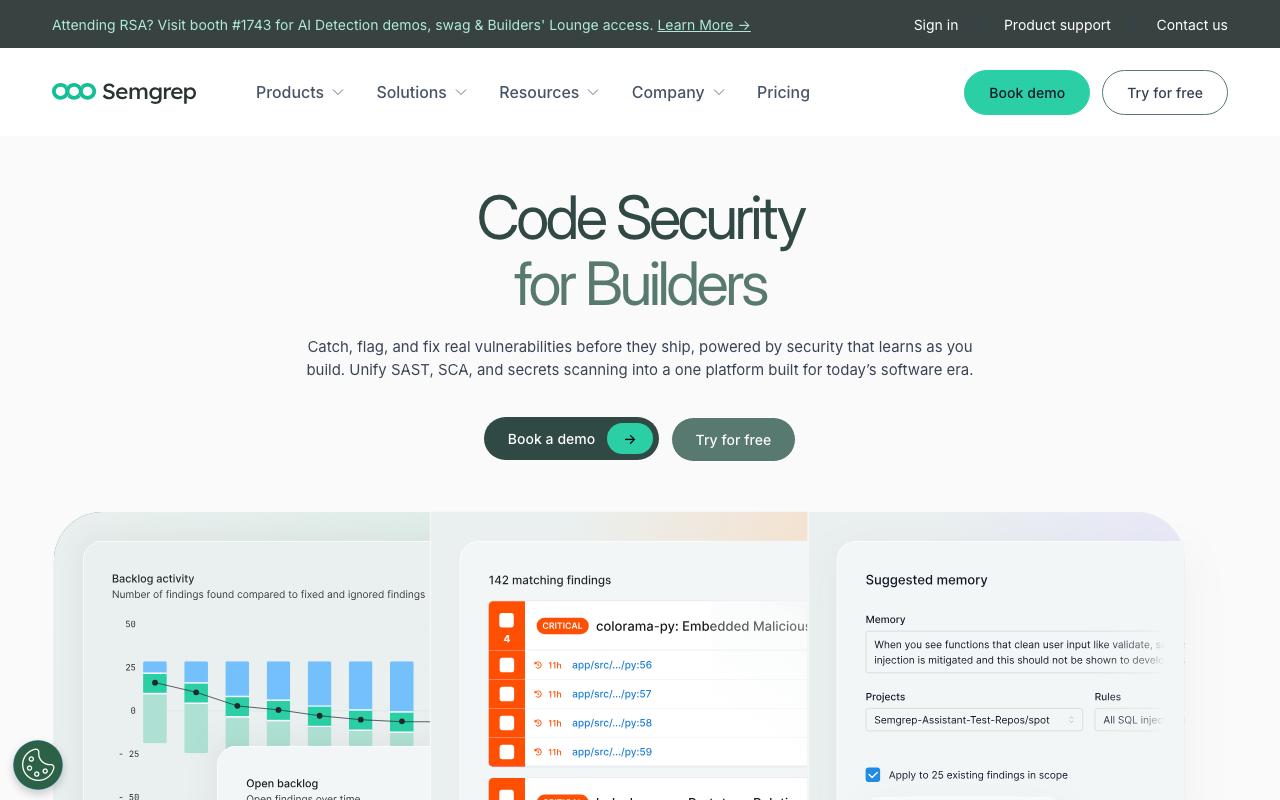
Semgrep is the tool that security engineers reach for most often, and for good reason. Its rule-based scanning engine is the fastest in the industry - completing scans in 10 to 30 seconds on most codebases - and its YAML-based rule authoring system makes it possible to write custom security rules that match your specific frameworks and patterns without being a compiler expert.
Security capabilities. Semgrep’s security coverage operates at three levels. The open-source Community Edition includes 2,800+ community rules covering common vulnerability patterns across 30+ languages. The Pro engine adds Pro rules maintained by Semgrep’s security research team plus cross-file analysis that tracks taint across function boundaries - and the licensing here is more specific than most write-ups admit. The Pro engine is listed on all hosted tiers including Free (10 contributors / 10 private repos / 60 AI credits), but it is proprietary, so Semgrep CE cannot do interfile taint under any circumstances (verified 2026-10-19). Rule depth is uneven: 710+ Pro rules for Python against 170+ for C#, with cross-file dataflow in only 8 languages and maturity split 20 GA / 2 beta / 19 experimental. Semgrep Secrets adds credential scanning with entropy analysis and verified detection - meaning it actually checks whether a detected secret is live. Semantic secrets analysis is excluded from the free tier. Pricing is modular at Code $30, Supply Chain $30 and Secrets $15 per contributor per month (verified 2026-10-19).
AI features for security. Semgrep Assistant is an AI layer that sits on top of the rule engine and evaluates whether each finding is actually exploitable in context. When a rule fires, the Assistant examines the surrounding code - is there a sanitizer upstream? Is the input actually attacker-controlled? Is the affected code even reachable? The “30 to 50 percent noise reduction” figure attached to Assistant is not an independently measured result (checked 2026-10-19) - it is the range vendors and users report, and no neutral party has published a before-and-after false-positive measurement for it. Budget a trial to measure it on your own repositories.
Compliance, stated plainly because aggregators get it wrong. Semgrep Inc. holds SOC 2, but its own documentation states that it is not ISO 27001 certified (verified 2026-10-19). Several third-party aggregator profiles list Semgrep as PCI, HIPAA, FedRAMP, ISO and CSA-STAR compliant. Those profiles are wrong. Also: the Semgrep AppSec Platform is not self-hostable - the Network Broker is a tunnel to Semgrep’s cloud. Only the CE CLI runs genuinely on your own hardware. Semgrep is, however, the only vendor in this guide honest enough to document an integration negative: it states outright that it does not support bi-directional or two-way status syncing with Jira, and its Jira auto-ticketing is Jira Cloud only.
Where Semgrep excels for security. Custom rule authoring is Semgrep’s strongest differentiator. If your application uses a custom ORM, a homegrown authentication library, or framework-specific patterns that commercial SAST tools do not model, Semgrep lets you write rules in minutes that target those exact patterns. The YAML syntax mirrors the target language, making rules readable by any developer.
Where Semgrep falls short. Semgrep is a scanning tool, not a code review tool. It does not generate PR summaries, does not evaluate code quality, and does not provide architectural feedback. It finds security issues and reports them. For teams that want a broader review experience, Semgrep needs to be paired with a tool like CodeRabbit or DeepSource.
Snyk Code - Best cross-file dataflow analysis
Snyk Code takes a fundamentally different approach to AI-powered security scanning. Rather than using an LLM, Snyk trained its own machine learning models on millions of code examples and known vulnerability patterns. These models perform semantic code analysis - understanding what code does, not just what it looks like - and combine that understanding with traditional dataflow analysis for cross-file vulnerability detection.
Security capabilities. Snyk Code’s primary strength is tracing data flow across multiple files and function calls. In a typical web application, user input might enter through an API handler, pass through validation middleware, flow through a service layer, and eventually reach a database query. Snyk Code maps this entire path and identifies whether untrusted data reaches a sensitive operation without adequate sanitization. This cross-file taint tracking catches vulnerabilities that single-file analyzers miss entirely.
AI features for security. Snyk’s ML models are trained specifically on vulnerability patterns, which gives them higher precision for security findings compared to general-purpose LLMs. The models understand framework-specific semantics - they know that req.body in Express is untrusted input, that sequelize.query with replacements is safe but sequelize.query with string interpolation is not. This framework awareness reduces false positives for teams using popular stacks.
Where Snyk Code excels. Developer experience is a genuine strength. Snyk integrates into IDEs (VS Code, JetBrains), CI/CD pipelines, and pull request workflows with minimal configuration. Findings include detailed explanations of the vulnerability, the data flow path from source to sink, and suggested fixes. The free tier - while limited to one user - provides enough functionality to evaluate the tool thoroughly before committing.
Where Snyk Code falls short. Snyk Code is part of the broader Snyk platform, which also includes SCA (Snyk Open Source), container scanning (Snyk Container), and infrastructure scanning (Snyk IaC). While bundling is convenient, it means Snyk Code’s pricing is often wrapped into a platform deal that can be expensive for teams that only need SAST. Custom rule authoring is also significantly more limited compared to Semgrep.
Checkmarx - Best enterprise compliance and coverage depth
Checkmarx is the enterprise SAST tool that security teams have relied on for over a decade. Its vulnerability database is among the deepest in the industry, covering obscure frameworks, legacy languages, and complex vulnerability patterns that newer tools have not yet modeled.
Security capabilities. Checkmarx SAST performs full abstract syntax tree analysis with deep taint tracking across the entire codebase. It covers 30+ languages with thousands of vulnerability queries. The platform also includes SCA (Checkmarx SCA), API security testing, and infrastructure-as-code scanning. For teams in regulated industries - finance, healthcare, government - Checkmarx provides the compliance certifications (SOC 2, ISO 27001, FedRAMP) and audit reporting that procurement and compliance teams require.
AI features for security. Checkmarx has added AI capabilities in recent years, including AI-assisted remediation guidance that explains vulnerabilities in developer-friendly language and suggests context-specific fixes. The platform also uses ML for finding prioritization - ranking vulnerabilities by exploitability, business impact, and fix complexity to help teams focus on what matters most.
Where Checkmarx excels. Comprehensive coverage and compliance. If your organization needs to demonstrate OWASP Top 10 coverage to auditors, generate detailed vulnerability reports for compliance frameworks, or scan legacy codebases in languages like COBOL or PL/SQL, Checkmarx handles it. The depth of its vulnerability modeling is unmatched for common enterprise frameworks like Spring, .NET, and Django.
Where Checkmarx falls short. Cost, speed, and developer experience. Checkmarx publishes no rate card - the $40,000-per-year starting figure and the $150,000+ ceiling for large deployments are third-party estimates, not vendor-published numbers, and we could not verify either at source on 2026-10-19. Only 3 of the 15 enterprise security and review tiers we checked publish any rate card at all (Snyk, Gitar, Entelligence), so quote-only is the market norm rather than a Checkmarx quirk. Full scans on large codebases take 30 minutes to several hours. The dashboard is oriented toward security teams rather than developers. False positive rates out of the box can be high without tuning. These factors are why many teams are migrating to newer tools for day-to-day scanning while retaining Checkmarx for periodic deep scans and compliance reporting.
CodeRabbit - Best AI-first security review in context
CodeRabbit is not a dedicated security scanner, but its LLM-powered code review catches a class of security issues that dedicated SAST tools miss. Because it reads and reasons about code the way a human reviewer would, it identifies logic-level security problems - missing authorization checks, insufficient input validation, insecure defaults, and unsafe error handling - that pattern-matching tools cannot detect.
Security capabilities. CodeRabbit reviews every pull request and leaves inline comments on security issues alongside other code quality feedback. It catches common vulnerabilities like SQL injection and XSS, but its real security value is in contextual analysis. It recognizes when a new API endpoint lacks rate limiting, when a sensitive operation does not have audit logging, when a database query returns more data than the API contract specifies, and when error messages expose internal implementation details.
AI features for security. CodeRabbit’s natural language instruction system allows teams to encode security policies in plain English. A .coderabbit.yaml file can include instructions like “Flag any API endpoint that modifies data without checking user permissions” or “Warn when sensitive fields like email, SSN, or password are included in API responses without explicit allowlisting.” This makes security policy enforcement accessible to teams without dedicated AppSec engineers.
Where CodeRabbit excels for security. Logic-level vulnerability detection that rule-based tools miss. The ability to define security policies in plain English rather than YAML rules or regex patterns. Real-time feedback during PR review, which is the best moment to catch and fix security issues. CodeRabbit shipped a dedicated Security Agent on 12 August 2026 alongside Agentic Change Management, Triage and Change Stack, the same day it announced its $143M Series C at a $1.5B valuation (verified 2026-10-19).
The free tier no longer helps a private codebase, and this is the single most common stale claim about CodeRabbit. Its pricing page now says free reviews forever for public repositories; private repos are not included (verified 2026-10-19). A free account gets 1 private PR review per hour, summary-only, plus 3 IDE and 3 CLI reviews per hour. Paid tiers were renamed in September 2026 - Pro became Essentials at $24/dev/mo annual ($30 monthly), Pro Plus became Team at $48 ($60), and a new Advanced tier sits at $72 - with prices unchanged. Lite and Pro Legacy were retired on 8 June 2026. If you see “CodeRabbit Pro” quoted anywhere, including in an older version of this page, it is stale.
Where CodeRabbit falls short for security. Non-determinism - the same code might receive different security feedback on different review passes. No formal OWASP coverage guarantees. SSO, audit logs and API access are Enterprise-tier only, which matters a lot if your reason for buying is auditability rather than detection (verified 2026-10-19). Self-hosting requires 500+ seats. Essentials covers exactly 1 linked repository (Team 5, Advanced 10, Enterprise 20), and the file cap is 150 files per review on Free and Essentials, 300 on Team and above. No SCA capability for dependency vulnerabilities. CodeRabbit is a powerful complement to SAST, not a replacement for it.
DeepSource - Best low-noise security analysis
DeepSource markets a sub-5% false positive rate. That is a vendor claim, not a measurement anyone outside DeepSource has reproduced (verified 2026-10-19), and an earlier version of this page said DeepSource delivers on it in practice - that was our impression from using the tool, not evidence, and we have corrected the framing. What we can say is that in our own use its output is among the least noisy in this guide, and low noise matters behaviourally: developers read findings they trust.
Ownership changed, and it is not reflected on most comparison pages yet. Harness acquired DeepSource on 9 September 2026 (verified 2026-10-19). DeepSource is now a Harness product, with 6,000+ customers at acquisition, inside a company that has made 15 acquisitions including Codecov, ShiftLeft and Augment Code’s review assets on 8 October 2026. Price the roadmap risk into any multi-year deal.
Pricing is not just the seat. The Team seat is roughly $24/dev/month, but AI review is billed separately at $8 per 10,000 processed lines on Standard and $15 per 10,000 on Advanced, offset by a $100 annual AI credit per user and up to $50 of bundled AI review credit (verified 2026-10-19). Public repositories are analysed free.
Security capabilities. DeepSource includes security analyzers for Python, Go, JavaScript, TypeScript, Java, Ruby, and Rust. Its security rules cover injection vulnerabilities, insecure cryptographic usage, hardcoded credentials, insecure deserialization, and common framework-specific security anti-patterns. The Autofix feature can automatically generate pull requests that remediate certain vulnerability classes, reducing the time from detection to fix.
Where DeepSource excels for security. Low noise means high trust. When DeepSource flags a security issue, developers take it seriously because they have learned that DeepSource findings are almost always real problems. This behavioral outcome - developers actually fixing flagged issues - matters more than raw detection count.
Where DeepSource falls short for security. Narrower vulnerability coverage compared to dedicated SAST tools. Limited cross-file analysis. No SCA capability. For comprehensive security scanning, DeepSource should be paired with a dedicated security tool.
SonarQube - Best combined quality and security
SonarQube sits at the intersection of code quality and security. Its 6,000+ built-in rules span both domains, and its quality gate feature can block merges when security issues are detected. For teams that want a single tool covering bugs, code smells, technical debt, and security vulnerabilities, SonarQube delivers breadth that few competitors match.
Security capabilities. SonarQube includes security-specific rules covering the OWASP Top 10, CWE Top 25, and SANS Top 25. The Developer Edition and above add security hotspot detection - flagging code patterns that are not necessarily vulnerable but require human security review. The Enterprise Edition adds taint analysis for cross-file vulnerability tracking. SonarQube also includes 400+ secrets detection patterns for identifying hardcoded credentials.
Where SonarQube excels for security. Combined quality and security enforcement through quality gates. A single dashboard covering both domains. The Community Build is free and open source, making it accessible to every team. The IDE plugin (SonarLint) provides security feedback while developers are writing code, before it even reaches a PR.
Where SonarQube falls short for security. Security is one of many concerns, not the primary focus. Dedicated SAST tools like Semgrep and Checkmarx have deeper vulnerability coverage. Scan times are slower (2 to 10 minutes versus Semgrep’s 10 to 30 seconds). Custom security rule authoring is more complex than Semgrep’s YAML-based approach.
The Community Build boundary is sharper than “lacks taint analysis” suggests, and two products get conflated constantly. Sonar’s own docs state that Developer Edition is the minimum required for branch and pull request analysis, and that SonarQube Community Build cannot analyze pull requests - it analyzes the main branch only (verified 2026-10-19). Community Build also excludes taint analysis and excludes C, C++, Dart, Objective-C, PL/SQL, PowerShell, R, Shell, Swift and T-SQL, plus ABAP, Apex, COBOL, Gosu, JCL, Dataweave, PL-I and RPG as commercial-only. So free SonarQube for a C++ shop is a non-starter. It does include secrets detection - Sonar’s live language overview lists that in Community Build, and an earlier version of this page implied otherwise. Separately, SonarQube Cloud’s free tier does include PR analysis, up to 50k LOC on private projects, and never expires. Community Build and Cloud free are different products with different capabilities; most comparison pages merge them. AI features including the Vortex, Remediation and Hunter agents are Enterprise-tier and trigger above 50 developers.
One genuinely under-covered strength. SonarQube AI CodeFix is the strongest documented air-gap plus bring-your-own-model combination we found in this market (verified 2026-10-19): Sonar’s docs describe it as designed to operate without outbound internet access and name Ollama, LiteLLM and vLLM as supported backends. If your constraint is that no code and no prompt may leave the building, that is a short list and SonarQube is on it.
Aikido - Best all-in-one security platform
Aikido takes the platform approach to application security, bundling SAST, DAST, SCA, secrets scanning, container scanning, and infrastructure-as-code scanning into a single product. For teams that want comprehensive security coverage without managing five different tools, Aikido eliminates integration complexity.
Security capabilities. Aikido’s SAST engine scans for common vulnerability patterns across major languages. Its SCA component monitors dependencies for known vulnerabilities with automated upgrade suggestions. The DAST scanner tests running applications for runtime vulnerabilities. Secrets detection scans code and configuration for hardcoded credentials. Cloud posture management checks infrastructure-as-code for misconfigurations.
AI features for security. Aikido uses AI for finding prioritization - triaging and ranking vulnerabilities based on exploitability, reachability, and business context. This reduces the volume of findings that developers need to evaluate manually, focusing attention on the vulnerabilities most likely to be exploited.
Where Aikido excels for security. Breadth of coverage in a single platform. Teams that would otherwise need Semgrep (SAST) plus Snyk (SCA) plus a DAST scanner plus a secrets scanner can consolidate into Aikido.
Aikido holds the single most interesting certification in this market. It is one of only 7 vendors out of 26 we checked holding ISO/IEC 42001:2023, the AI-specific management standard - and its 42001 certificate scope explicitly names “Deep PR Review” (verified 2026-10-19). That is the only certification scope in this category that names a code review feature. If your risk function is asking AI-specific questions, that is a materially stronger artifact than another SOC 2 badge. Two caveats in the other direction: Aikido’s marketed “FedRAMP Certified: Class C (Moderate)” is not standard FedRAMP terminology and does not map to an authorization level, and we could not find a published HIPAA BAA.
Pricing is flat, not per seat, which changes the comparison completely. Basic is $300/mo for 10 users, Pro $600, and Advanced $600 plus 100 credits (verified 2026-10-19). Deep PR Review consumes credits and is Advanced-tier and above only. Aikido also acquired Trag in August 2025 - Trag now ships as Aikido Code Quality, there is no standalone Trag to buy, and the trag.ai domain no longer hosts the review tool at all. Aikido subsequently acquired Allseek and Haicker in September 2025 and raised a $60M Series B at a $1B valuation on 14 January 2026.
Where Aikido falls short for security. Depth of analysis in any single category does not match the best-in-class point solutions. Semgrep’s SAST rules are deeper, Snyk’s SCA is more comprehensive, and dedicated DAST tools test more thoroughly. Aikido trades depth for breadth - a valid trade-off for many teams, but not ideal for organizations with advanced security requirements.
Veracode - Best for regulated industries
Veracode has been a mainstay in enterprise application security for nearly two decades. Its combination of SAST, DAST, SCA, and manual penetration testing services makes it a one-stop shop for organizations in regulated industries that need comprehensive security assurance and detailed compliance reporting.
Security capabilities. Veracode’s SAST engine supports 30+ languages with deep vulnerability detection. Its binary analysis capability - scanning compiled applications without source code access - is unique among the tools in this guide. The platform includes policy-based governance, allowing security teams to define acceptable risk thresholds and automatically gate deployments based on vulnerability severity.
Where Veracode excels for security. Compliance-driven organizations in finance, healthcare, and government. Veracode provides the audit trails, compliance reports, and certifications that regulators expect. The combination of automated scanning and managed penetration testing services provides assurance that pure tooling cannot match.
Where Veracode falls short for security. Developer experience is behind newer tools. Scan times can be long. Pricing is enterprise-only and opaque. Integration into modern CI/CD workflows requires more configuration than developer-first tools like Semgrep or Snyk. These factors make Veracode better suited as a periodic deep-scan and compliance tool rather than a real-time PR review tool.
Coverity - Best for C/C++ and embedded systems
Coverity (now part of Black Duck, formerly Synopsys) specializes in deep static analysis for compiled languages, particularly C, C++, and Java. Its analysis engine performs interprocedural path-sensitive analysis - examining all possible execution paths through a program - which catches subtle vulnerabilities that lighter tools miss.
Security capabilities. Coverity’s strength is in detecting memory safety vulnerabilities (buffer overflows, use-after-free, null pointer dereferences), concurrency issues (race conditions, deadlocks), and resource leaks - vulnerability classes that are critical in systems programming but less relevant in web application development. For C/C++ codebases, Coverity’s detection depth is essentially unmatched.
Where Coverity excels for security. Embedded systems, firmware, operating system code, and any codebase where memory safety vulnerabilities can lead to remote code execution. If your security concern is memory corruption rather than injection or authentication logic, Coverity is the right tool.
Where Coverity falls short for security. Limited relevance for web application security. The analysis engine is heavyweight - scans are slow and require significant compute resources. Pricing is enterprise-only. The developer experience is oriented toward security teams performing periodic audits rather than developers reviewing PRs.
HackerOne Code - Best crowd-sourced security intelligence

HackerOne Code brings a unique angle to AI security scanning by combining automated analysis with intelligence from HackerOne’s bug bounty platform. The patterns that automated tools look for are informed by real-world vulnerability reports from tens of thousands of security researchers.
Security capabilities. HackerOne Code scans for vulnerability patterns derived from actual bug bounty submissions, which means its detection models are trained on how attackers actually exploit applications rather than theoretical vulnerability taxonomies. This gives it practical detection advantages for vulnerability classes that are commonly exploited in the wild.
Where HackerOne Code excels. Organizations that already run a bug bounty program through HackerOne benefit from the integration between automated scanning and crowd-sourced testing. The vulnerability patterns are continuously updated based on new bug bounty submissions.
Where HackerOne Code falls short. Narrower adoption and less mature than established SAST tools. Limited language and framework coverage compared to Semgrep or Checkmarx. Best used as a complement to comprehensive SAST rather than a standalone solution.
Security risks of AI code review itself
Direct answer: Four risks, in descending order of how often they bite. Code leaves your network (a signed HIPAA BAA exists at only 4 of 26 vendors we checked). Hallucinated fixes that look right and are not. Deskilling, where nobody on the team can catch what the model misses. And a new supply-chain link with read access to every repository you own. “HIPAA certified” is not a real certification scheme. Verified 2026-10-19.
Up to this point, we have discussed using AI to find security vulnerabilities. But there is an equally important question that most guides ignore: what security risks does AI code review itself introduce into your development pipeline?
Sending your source code to a third-party AI service, trusting AI-generated security fixes, and depending on AI models for vulnerability detection all create new attack surfaces and risk vectors. Engineering teams need to evaluate these risks with the same rigor they apply to any other third-party dependency.
Data privacy and code exposure
When you connect an AI code review tool to your repository, you are sending your source code - or at least the diffs of every pull request - to a third-party service. For many organizations, source code is among the most sensitive intellectual property they possess. The questions to ask are:
Does the tool train on your code? Some AI services use customer data to improve their models. If your proprietary code becomes part of a training dataset, fragments of your business logic, security patterns, or internal architecture could surface in suggestions made to other users. Most reputable tools explicitly state they do not train on customer code - CodeRabbit, Snyk, and Codacy all have public commitments on this. But “most” is not “all,” and policies can change.
Where is code stored and for how long? Even if a tool does not train on your code, it may retain copies for caching, debugging, or analytics purposes. Ask about data retention policies. Some tools process code in memory and never persist it. Others retain diffs for days or weeks. The best tools provide configurable retention - allowing you to set code to be deleted immediately after analysis.
What compliance certifications does the tool have? SOC 2 Type II is the minimum standard for handling sensitive code, and it is a floor rather than an answer. Four corrections worth more than the rest of this subsection, all read at source on 2026-10-19:
- “HIPAA certified” is not a real certification scheme. No auditor issues a HIPAA certificate. HIPAA requires a signed Business Associate Agreement plus demonstrable safeguards, and a SOC 2 Type II report alone does not satisfy it. Any vendor page or comparison table claiming HIPAA certification is describing something that cannot exist.
- A signed BAA is available from only 4 of the 26 AI review vendors we checked: Anthropic, Cursor at the Enterprise tier, Augment Code, and CodeAnt AI. It is the scarcest compliance artifact in this market.
- ISO/IEC 42001:2023 is the standard to ask about in 2026, because it covers model integrity, training-data security and AI pipeline risk - the controls SOC 2 and ISO 27001 were written before anyone needed. Held by 7 of 26: Anthropic, GitLab, GitHub Copilot, Cursor, Augment Code, Aikido and Veracode. Aikido’s certificate scope explicitly names “Deep PR Review”, the only cert scope in this market naming a review feature.
- Semgrep Inc. states in its own documentation that it is not ISO 27001 certified, contradicting several aggregator profiles that list it as PCI, HIPAA, FedRAMP, ISO and CSA-STAR compliant. Also on the negative side of the ledger: cubic is SOC 2 Type I only, Panto’s SOC 2 audit is still underway, and Kodus’s SOC 2 badge has no documents behind it. Verify against the vendor’s trust centre, never a comparison table - including this one.
Self-hosted alternatives eliminate this risk - but fewer tools qualify than claim to. SonarQube runs fully self-hosted in every edition, Checkmarx and Coverity offer genuine on-premises deployment, the Semgrep CE CLI runs entirely locally, PR-Agent is MIT-licensed as of 23 April 2026 and runs against a local model via Ollama, and Kodus is AGPLv3 and free to self-host at any team size (verified 2026-10-19). What does not qualify: Semgrep’s Network Broker and Snyk Broker are tunnels to the vendor’s cloud, not on-premises deployments, and GitHub Copilot’s review service stays in GitHub’s cloud even when validation runs on self-hosted Actions runners. These options sacrifice some AI capabilities, and how much quality you lose is unmeasured - no published benchmark compares self-hosted local-model review quality against cloud-tier quality for any shipping product (checked 2026-10-19). The known weakness is multi-file and cross-file reasoning, which is unfortunately the capability that separates AI review from a linter.
Hallucinated security fixes
LLMs hallucinate. This is not a bug that will be fixed - it is a fundamental characteristic of how large language models generate text. In the context of security code review, hallucination takes several dangerous forms:
False sense of security. An AI tool might review a piece of vulnerable code and declare it safe. If the development team trusts this assessment and skips manual security review, the vulnerability ships to production. This is worse than not having AI review at all, because without it, the team would know the code had not been security-reviewed.
Incorrect fix suggestions. An AI might correctly identify a vulnerability but suggest a fix that does not actually remediate it - or worse, introduces a new vulnerability. For example, an AI might suggest replacing string concatenation in a SQL query with a different form of string interpolation that is equally injectable, or suggest a sanitization function that does not cover all attack vectors.
Phantom vulnerabilities. An AI might flag a vulnerability that does not exist, causing the development team to modify working code unnecessarily. These false positives waste time and can introduce bugs when developers “fix” code that was not broken.
Mitigation strategies for hallucination risks. Never trust AI security findings or fix suggestions without verification. Treat AI security review as a first-pass filter that identifies code requiring human attention, not as a definitive security assessment. Use deterministic SAST tools alongside AI review to ensure known vulnerability patterns are always caught regardless of LLM reliability. Require human sign-off on any security-relevant code change, even if AI review approved it.
Over-reliance and deskilling
A subtler risk is that teams begin to rely on AI security review as their primary security mechanism, gradually losing the internal knowledge and discipline needed for effective security practices. This manifests in several ways:
Reduced manual review rigor. If developers believe that “the AI will catch it,” they may pay less attention to security during their own code writing and review. This creates a dependency on a system that, as discussed above, is not reliable enough to be a sole security layer.
Loss of security expertise. If junior developers never learn to identify security vulnerabilities themselves because AI catches them first, the team’s overall security capability degrades. When the AI misses something - and it will - nobody on the team has the skills to catch it either.
Alert fatigue from noise. Paradoxically, AI tools that generate too many security findings (including false positives) cause teams to ignore all findings, including legitimate ones. This is the “boy who cried wolf” problem applied to security scanning.
Mitigation strategies. Maintain a security champion program where specific developers are responsible for security review regardless of AI tooling. Conduct periodic manual security reviews that do not rely on AI findings. Include security training as part of developer onboarding. Treat AI security review as one layer in a defense-in-depth strategy, never as the only layer.
Supply chain risks of AI dependencies
AI code review tools are themselves software - with dependencies, APIs, and infrastructure that can be compromised. Adding an AI review tool to your pipeline adds a new link in your supply chain:
Model poisoning. If an AI model is trained on intentionally malicious data, it could learn to approve vulnerable patterns or suggest insecure code. While this is a theoretical risk for established tools with controlled training pipelines, it is a real concern for open-source or community-trained models.
Service compromise. If an AI code review service is compromised, an attacker could modify the service to approve all code (removing a security layer), inject vulnerable suggestions into reviews, or exfiltrate source code that flows through the service. Standard third-party risk assessment should apply to AI review tools just as it does to any other SaaS dependency.
API key and token exposure. AI review tools typically require read access to your repositories. The tokens and API keys that grant this access become high-value targets. A compromised AI tool integration token gives an attacker read access to your entire codebase. Use the least-privilege principle when configuring integrations - grant read access only to the repositories the tool needs, and rotate tokens regularly.
Building a security review pipeline
Given the capabilities and limitations discussed above, the most effective approach is a layered security pipeline that combines deterministic scanning, AI-powered review, and human oversight. Here is a practical architecture that provides comprehensive coverage without creating unsustainable overhead.
Layer 1: Pre-commit and IDE - catch issues before they reach a PR
The fastest security feedback loop happens before code even leaves the developer’s machine.
- SonarLint (the IDE plugin from SonarQube/) provides real-time security feedback in VS Code, JetBrains, and Eclipse as developers type. It catches common vulnerability patterns immediately, with explanations and fix suggestions.
- Semgrep CLI can run as a pre-commit hook, scanning changed files in under a second and blocking commits that contain high-severity vulnerabilities. Configure it with
--severity ERRORto flag only critical issues and avoid slowing down the development loop. - Secrets scanners like git-secrets, gitleaks, or Semgrep Secrets should run pre-commit to prevent credentials from ever entering version control. Once a secret is committed, it exists in git history forever (unless the repo is rewritten), making prevention far more valuable than detection.
# .pre-commit-config.yaml
repos:
  - repo: https://github.com/semgrep/semgrep
    hooks:
      - id: semgrep
        args: ['--config', 'p/security-audit', '--severity', 'ERROR']
  - repo: https://github.com/gitleaks/gitleaks
    hooks:
      - id: gitleaks
Layer 2: Pull request review - the primary security checkpoint
The pull request is where security scanning delivers the most value. Code is about to be merged into the main branch, the author is available to address findings, and the context of the change is fresh.
- AI code review (CodeRabbit or similar) reviews every PR for logic-level security issues, missing authorization checks, insufficient input validation, and security anti-patterns. The AI provides contextual feedback that rule-based tools cannot.
- SAST scanning (Semgrep, Snyk Code, or both) runs on the PR diff and reports findings as inline comments or status checks. Configure quality gates to block merges when high-severity vulnerabilities are found.
- SCA scanning (Snyk Open Source, Semgrep Supply Chain, or Dependabot) checks whether the PR introduces or updates dependencies with known vulnerabilities. This addresses OWASP A06 (Vulnerable and Outdated Components).
# Example GitHub Actions workflow for security PR checks
name: Security Review
on: [pull_request]

jobs:
  semgrep:
    runs-on: ubuntu-latest
    steps:
      - uses: actions/checkout@v4
      - uses: semgrep/semgrep-action@v1
        with:
          config: >-
            p/security-audit
            p/secrets
            p/owasp-top-ten

  snyk-code:
    runs-on: ubuntu-latest
    steps:
      - uses: actions/checkout@v4
      - uses: snyk/actions/code@master
        env:
          SNYK_TOKEN: ${{ secrets.SNYK_TOKEN }}

  # CodeRabbit runs automatically via GitHub App
  # No workflow configuration needed
Layer 3: Periodic deep scans - catching what PR review misses
PR-level scanning only analyzes changed files and their immediate context. Periodic full-codebase scans catch vulnerabilities that emerge from the interaction of multiple changes over time, or from newly discovered vulnerability patterns that were not in the rule set when the code was originally committed.
- Full SAST scans run weekly or on each release branch. Use Checkmarx, Veracode, or Semgrep with Pro rules for maximum coverage.
- Dependency audits check the full dependency tree for known vulnerabilities, including transitive dependencies that PR-level SCA might miss.
- Infrastructure-as-code scanning checks Terraform, CloudFormation, Kubernetes manifests, and Docker configurations for security misconfigurations.
Layer 4: Human security review - the final gate
Automated tools should identify and triage security issues. Humans should make risk decisions.
- Security champion review for any PR that touches authentication, authorization, cryptography, input validation, or data handling logic. AI review can flag these PRs for attention, but a human should verify the findings.
- Threat modeling for new features, especially those that introduce new data flows, external integrations, or user-facing attack surfaces.
- Periodic manual code audits where a security engineer reviews critical modules without relying on automated tool output. This catches issues that all automated tools miss and prevents the deskilling problem discussed earlier.
AI security review vs penetration testing vs bug bounties
Engineering teams sometimes ask whether AI security scanning can replace penetration testing or bug bounty programs. The answer is no - they address fundamentally different concerns - but understanding the differences helps allocate security budget effectively.
AI security scanning (SAST + AI review)
What it tests. Source code and configuration, analyzed without running the application. Looks for vulnerability patterns, insecure data flows, and logic issues in code as written.
Strengths. Comprehensive coverage of the codebase. Fast feedback during development. Catches issues before they reach production. Low marginal cost per scan after initial setup. Integrates into the development workflow.
Limitations. Cannot test runtime behavior. Cannot test authentication flows, session management, or network-level issues. Cannot find vulnerabilities in deployment configuration, server software, or third-party services. Cannot assess actual exploitability of a finding.
Penetration testing
What it tests. A running application, tested from the outside (and sometimes the inside) by a skilled security professional. Simulates real-world attack scenarios against the deployed system.
Strengths. Tests the actual attack surface, including server configuration, network architecture, authentication flows, and business logic as experienced by a real attacker. Finds exploitable vulnerability chains that no single automated tool can detect. Validates (or invalidates) automated tool findings with actual exploitation.
Limitations. Point-in-time assessment - the next code change could introduce new vulnerabilities. Expensive ($10,000 to $100,000+ per engagement). Time-consuming (typically 1 to 4 weeks). Does not scale to every PR or every sprint.
Bug bounty programs
What it tests. The deployed application, tested continuously by a crowd of independent security researchers with diverse skills and perspectives.
Strengths. Diverse perspectives uncover vulnerabilities that internal teams and tools miss. Pay-for-results model means you only pay for real, verified vulnerabilities. Continuous testing rather than point-in-time. Leverages the collective expertise of thousands of researchers. HackerOne Code brings some of this intelligence into automated scanning.
Limitations. Requires a mature security program to triage and respond to reports. Scope management is critical - researchers will test everything you expose. Can be expensive for high-severity findings. Requires public or semi-public exposure of the application.
How they complement each other
The most robust security programs use all three:
- AI security scanning catches known vulnerability patterns early in development, at low cost, across the entire codebase. This is the foundation.
- Penetration testing validates the security posture of the deployed application on a regular cadence (quarterly or before major releases) and identifies runtime and infrastructure vulnerabilities that code scanning cannot find.
- Bug bounty programs provide continuous external testing and catch edge cases that internal processes and automated tools miss.
Think of it as defense in depth applied to security testing. Each layer catches things the others miss. Removing any layer creates gaps.
Security scanning cost comparison
Direct answer: For 20 developers, Semgrep Code is $600/mo at $30 per contributor, CodeRabbit Essentials is $480 at $24/dev, and Aikido is $600 flat at Pro rather than per seat. The genuinely free security stack is the Semgrep CE CLI plus SonarQube Community Build plus gitleaks - CodeRabbit’s free tier no longer covers private repositories. Checkmarx and Veracode publish no rate card at all. Verified 2026-10-19.
Security tooling costs vary dramatically, from free open-source options to six-figure enterprise contracts. Here is how the tools in this guide compare for a team of 20 developers, with every figure read off the vendor’s own pricing page on 2026-10-19 and every estimate labelled as an estimate.
| Tool | Free tier (verified 2026-10-19) | 20 devs monthly | Self-hosted | Compliance note |
|---|---|---|---|---|
| Semgrep | Yes: 10 contributors / 10 private repos / 60 AI credits. Semantic secrets analysis excluded | $600 (Code at $30/contributor). $1,500 for Code + Supply Chain + Secrets | CE CLI only. Network Broker is a cloud tunnel | SOC 2. Explicitly not ISO 27001, per its own docs |
| Snyk Code | Yes: 5 projects / 100 Code tests per month | Enterprise is a prepaid credit subscription (1 credit = $1), Code metered at 1.0 credit per active contributor per day | No. Snyk Broker is a cloud tunnel | SOC 2, ISO 27001. One of only 3 vendors publishing a rate card |
| Checkmarx | No | No published rate card. Third-party estimate ~$3,300+/mo on annual contract | Yes, genuine on-prem | SOC 2, ISO 27001, FedRAMP-authorized options |
| CodeRabbit | Public repos only. Private repos get 1 summary-only review/hour | $480 (Essentials $24/dev annual). Team $48, Advanced $72 | Enterprise, 500+ seats | SOC 2. SSO and audit logs are Enterprise-only |
| DeepSource | Public repos analysed free; up to $50 AI review credit | ~$480 seats, plus AI review billed separately at $8 per 10K LOC (Standard) or $15 per 10K (Advanced) | No | SOC 2. Now a Harness product (9 Sept 2026) |
| SonarQube | Community Build free but main branch only, no PR analysis. Cloud free tier does include PR analysis up to 50k LOC | ~$260 (LOC-based, Developer Edition is the floor for PR analysis) | Yes, all editions. AI CodeFix runs air-gapped with Ollama / LiteLLM / vLLM | SOC 2 (Cloud). AI agents are Enterprise-only above 50 devs |
| Aikido | Limited | $600 flat at Pro, not per seat (Basic $300 for 10 users, Advanced $600 + 100 credits). Deep PR Review is Advanced+ and consumes credits | No | SOC 2, ISO 27001, ISO/IEC 42001:2023 with “Deep PR Review” in scope |
| Veracode | No | No published rate card. Third-party estimate ~$4,100+/mo on annual contract | Partial, scanning agents | SOC 2, ISO 27001, ISO/IEC 42001:2023, FedRAMP-authorized |
| Coverity | No | Quote-only | Yes, genuine on-prem | Now part of Black Duck, formerly Synopsys |
| HackerOne Code | No | Quote-only | No | SOC 2 |
A practical budget approach, updated for the 2026 free tiers. The genuinely free security stack is now the Semgrep CE CLI for deterministic SAST plus SonarQube Community Build for quality and secrets plus gitleaks pre-commit. CodeRabbit no longer belongs in a zero-cost stack for private code - its free tier covers public repositories only as of 2026-10-19, with a single summary-only private review per hour, so the real entry cost for AI review on a private repo is $24 per developer per month. If you need AI review free on private code, PR-Agent self-hosted (MIT since 23 April 2026) and Kodus (AGPLv3) are the options, and you pay your own model bill instead. Add Snyk Code or Semgrep’s Pro engine when you need interfile taint. Reserve Checkmarx and Veracode for organizations whose compliance requirements justify a quote-only contract.
Common mistakes in AI security scanning adoption
After working with numerous engineering teams implementing AI security scanning, several patterns of failure emerge consistently. Avoiding these mistakes is as important as choosing the right tools.
Treating AI review as a security stamp of approval
The most dangerous mistake is treating an AI review pass as proof that code is secure. AI code review is a layer that increases the probability of catching vulnerabilities. It is not a guarantee. Teams that skip manual security review because “the AI checked it” will eventually ship a critical vulnerability that the AI missed. Always treat AI security findings as input to a security decision, not as the decision itself.
Ignoring findings because of noise
When a tool produces too many false positives, developers learn to ignore its output. This is worse than not having the tool, because the team believes they have security coverage when they effectively do not. Invest time in tuning your tools. Semgrep’s rule configuration, CodeRabbit’s instruction system, and SonarQube’s quality profiles all allow you to reduce noise. A tool that flags 5 real issues and 0 false positives is more valuable than a tool that flags 10 real issues buried in 50 false positives.
Running only one type of scanning
SAST alone misses runtime vulnerabilities. AI review alone misses deterministic patterns it happens to hallucinate past. SCA alone misses vulnerabilities in your own code. Secret scanning alone misses injection flaws. Each scanning type addresses a different risk. Running only one type leaves significant gaps. The layered pipeline described in the previous section exists because no single tool or approach is sufficient.
Failing to act on findings
Scanning without remediation is security theater. If your team runs security scans but does not allocate time to fix the findings, you are generating compliance artifacts, not reducing risk. Set clear SLAs for vulnerability remediation - for example, critical findings fixed within 24 hours, high within one week, medium within one sprint. Use quality gates that block merges for critical and high findings so that remediation happens in the natural development workflow rather than as a separate backlog item.
Scanning only the main branch
Many teams configure security scanning to run on their main branch but not on pull requests. This means developers do not learn about vulnerabilities until after the code is merged, which makes remediation slower, more expensive, and more likely to be deprioritized. Shift security scanning as far left as possible - pre-commit hooks for secrets, PR-level scanning for SAST and AI review, and post-merge scanning only for full-codebase analysis that cannot run at PR time.
The future of AI security scanning
The AI security scanning landscape is evolving rapidly, and several trends will shape the next generation of tools.
Agentic security scanning. Current AI review tools analyze code passively - they read the diff and generate comments. The next generation will take actions: automatically generating fix PRs for detected vulnerabilities, running test suites to verify fixes do not break functionality, and even creating regression tests that verify the vulnerability stays fixed. Early versions of this capability exist in tools like DeepSource Autofix and Pixee, but the scope and reliability will increase significantly.
Context-aware vulnerability prioritization. Today’s tools report vulnerabilities with severity ratings based on the vulnerability type. Future tools will incorporate deployment context - is this code internet-facing? Does it handle PII? Is it behind a WAF? - to prioritize findings by actual business risk rather than theoretical severity. Aikido and Semgrep Assistant are moving in this direction.
Training-free custom models. Current AI security tools use general-purpose LLMs or models trained on public vulnerability datasets. Future tools will build project-specific understanding without requiring additional training - using techniques like retrieval-augmented generation (RAG) to incorporate your team’s security policies, past vulnerability reports, and codebase-specific patterns into the analysis. This will close the gap between generic scanning and organization-specific security requirements.
Regulatory requirements for AI in security. As AI-generated code and AI-assisted security review become standard practice, regulatory frameworks will evolve to address them. Expect future compliance standards to require documentation of AI tool usage in the security review process, auditability of AI findings, and human oversight requirements for security-critical code reviewed by AI.
Conclusion
AI code review for security is not a single capability - it is a spectrum of approaches ranging from AI-assisted triage of traditional SAST findings to LLM-powered semantic analysis that catches logic-level vulnerabilities humans and rules miss. The most effective security programs in 2026 treat AI as a powerful addition to their existing security layers, not as a replacement for any of them.
For teams starting from zero, begin with free tools. Install the Semgrep CE CLI for deterministic SAST scanning. Configure pre-commit hooks with gitleaks for secrets detection. Add SonarQube Cloud’s free tier if you want pull request analysis without paying - Community Build will not do PR analysis. For the AI layer on a public repository, CodeRabbit is still free; on a private repository it is not any more, and the honest free options are PR-Agent self-hosted or Kodus, where you pay your own model bill (verified 2026-10-19).
For teams with existing SAST, add AI code review to catch the logic-level vulnerabilities your SAST tool misses. Configure your AI reviewer with security-specific instructions. Use AI triage features (Semgrep Assistant, Snyk’s ML prioritization) to reduce the false positive burden from your SAST tool.
For enterprise teams with compliance requirements, maintain your enterprise SAST platform (Checkmarx, Veracode, or Coverity/) for compliance reporting and deep scanning. Layer AI review on top for real-time security feedback during development. Invest in self-hosted options where data privacy requirements demand it.
Regardless of team size, remember the dual nature of AI security. Use AI to find vulnerabilities in your code, but also evaluate the security risks that AI tools themselves introduce. Verify data handling policies. Test AI-suggested fixes before applying them. Maintain human security expertise alongside automated tooling. And never treat any tool - AI or otherwise - as the sole security layer protecting your application.
Security is not a product you buy. It is a practice you maintain. AI makes that practice faster and broader, but it does not make it optional.
How we verified this
Date of this pass: 2026-10-19. We sell no security tool and take no affiliate revenue on any product named here, which is the only reason this section is worth reading.
What we checked, and where. Every price, tier name, contributor cap, credit allowance and free-tier limit was read off the vendor’s own published pricing or documentation page, not from a comparison site. Licence and deployment boundaries were checked against architecture docs - that is how Semgrep’s Network Broker and Snyk Broker ended up classified as tunnels to the vendor’s cloud rather than on-premises deployments, and how we pinned down that interfile taint requires Semgrep’s proprietary Pro engine and is unavailable in Semgrep CE at any price. Compliance claims were checked against each vendor’s trust centre or security documentation rather than a badge, which is how we found that Semgrep Inc. states it is not ISO 27001 certified, that cubic is SOC 2 Type I only, that Panto’s SOC 2 audit is still underway, and that Aikido’s ISO/IEC 42001:2023 certificate scope names “Deep PR Review” - the only certification scope in this market naming a review feature. Benchmark provenance was traced to the publishing party in every case, including reading the c-CRAB v3 author block to establish the SonarSource affiliation we disclose above.
What we could NOT verify, named specifically.
- Enterprise contract pricing for Checkmarx, Veracode, Coverity and HackerOne Code. All four are quote-only. The monthly figures in the cost table for Checkmarx and Veracode are third-party estimates and are labelled as such rather than dropped, because a labelled estimate is more useful to a budget-holder than an empty cell.
- Any independent false-positive rate, precision figure or noise measurement for any shipping commercial AI code reviewer. This is the central finding of this page, not an omission. Every number in circulation belongs to a party with a commercial stake. Anthropic’s claim of under 1% false positives at 84% detection on PRs over 1,000 lines is vendor-published and unreplicated; we report it as a claim.
- Semgrep Assistant’s noise reduction. The 30 to 50 percent figure is reported by vendors and users, not independently measured. We could not find a before-and-after false-positive measurement from any neutral party.
- The Panto figure of 11 false positives per PR for Greptile versus 2 for CodeRabbit. We could not open a primary Panto page carrying that exact pair, so it stays labelled reported, not confirmed. Its stated methodology is 17 PRs classified by o3-mini.
- Self-hosted local-model review quality versus cloud-tier quality. No published benchmark measures this for any shipping product. If you see a “60 to 70 percent of cloud quality” figure, it conflates a local GPU covering 60-70% of a daily coding task mix, a TCO analysis routing 60-70% of traffic locally, and GPU spend being 60-70% of self-hosted TCO. None of those measure review quality.
- Gemini Code Assist’s free tier. One source says it stopped serving requests on 18 June 2026, another still advertises it. Excluded from tables rather than guessed at.
- Per-language precision or recall for any tool. No vendor publishes it, and SWE-PRBench, CR-Bench, CRBugBench and c-CRAB have zero language breakouts. We use capability data instead.
Carried from a prior pass, not freshly re-checked on 2026-10-19. The OWASP Top 10 coverage matrix is our editorial assessment from this page’s February 2026 version, refreshed against current vendor rule documentation but not re-measured - and as stated above it was never a measurement. The vulnerable-code examples and their fixes, the four-layer pipeline architecture, the IBM breach-cost figure ($4.88M average, 258 days to identify and contain, from IBM’s 2025 report), the penetration testing cost range of $10,000 to $100,000+ per engagement, and the common-mistakes section are all carried forward. Treat them as framework rather than as dated findings.
Corrections applied in this pass. We relabelled DeepSource’s sub-5% false-positive rate as a vendor claim rather than something we asserted it delivers. We corrected CodeRabbit’s free tier, which no longer covers private repositories, in four places on this page. We corrected Semgrep pricing from roughly $35 per contributor to the modular Code $30 / Supply Chain $30 / Secrets $15 structure, and removed the implication that the Semgrep AppSec Platform is self-hostable. We added Semgrep’s explicit non-certification against ISO 27001. We corrected Aikido pricing from per-seat to flat, and noted that Deep PR Review is Advanced-tier and credit-consuming. We corrected the SonarQube Community Build boundary, including that it cannot analyze pull requests and that it does include secrets detection. We added DeepSource’s acquisition by Harness on 9 September 2026 and the separate per-10K-LOC billing of its AI review. We labelled the Checkmarx and Veracode price figures as third-party estimates. We removed the phrase “HIPAA compliance” where it implied a certification, because no such certification exists.
Further Reading
- I Reviewed 32 SAST Tools - Here Are the Ones Actually Worth Using (2026)
- 11 Best SAST Tools in 2026 - Static Application Security Testing Compared
- 10 Best Checkmarx Alternatives for SAST in 2026
- 10 Best Veracode Alternatives for Application Security (2026)
- AI Code Review for Enterprise Teams: Security, Compliance, and Scale in 2026
- AWS AI Code Review: Amazon Q Developer Guide
- Azure DevOps Pipelines: Complete CI/CD Guide (2026)
 Gitar
Comments are not enough
Gitar applies the fix, validates it in CI, and clears the queue.
See it on your repo Read our independent Gitar reviewFrequently Asked Questions
Can AI find security vulnerabilities in code?
Yes. AI-powered code review tools can detect a wide range of security vulnerabilities including SQL injection, XSS, CSRF, authentication bypasses, insecure deserialization, and hardcoded credentials. LLM-based tools like CodeRabbit catch logic-level security issues that rule-based scanners miss, such as insufficient authorization checks and business logic flaws. However, AI tools also produce false positives and should not be the sole security layer.
What is the best AI tool for security code review?
For dedicated security scanning, Semgrep with AI-powered triage (Semgrep Assistant) provides the best balance of detection depth and low false positives. Snyk Code offers the strongest cross-file dataflow analysis. For broader AI review that includes security, CodeRabbit catches security issues alongside code quality problems. For enterprise compliance, Checkmarx and Veracode remain the industry standard.
Is it safe to send code to AI review tools?
Most reputable AI code review tools have SOC 2 compliance, do not train on customer code, and offer data retention controls. CodeRabbit, Snyk, and Codacy explicitly state they do not use customer code for model training. But SOC 2 is a floor, not an answer: a signed HIPAA BAA is available from only 4 of the 26 vendors we checked, and ISO/IEC 42001:2023, the AI-specific standard, is held by only 7 (verified 2026-10-19). For highly sensitive code, genuinely self-hosted options are the Semgrep CE CLI, PR-Agent under MIT, Kodus under AGPLv3, SonarQube in any edition, Checkmarx on-premises and Coverity. What does not qualify despite the naming: Semgrep's Network Broker and Snyk Broker are tunnels to the vendor's cloud, not on-premises deployments.
What OWASP vulnerabilities can AI detect?
AI code review tools can detect all OWASP Top 10 categories to varying degrees. They are strongest at detecting injection (A03), broken access control (A01), and security misconfiguration (A05). They are weaker at detecting cryptographic failures (A02) that require understanding deployment context, and vulnerable components (A06) which requires SCA rather than SAST. Coverage varies significantly by tool.
How accurate is AI security scanning compared to traditional SAST?
AI-powered security scanning typically has higher detection rates for logic-level vulnerabilities and lower false positive rates for common patterns, thanks to contextual understanding. Traditional SAST tools have more comprehensive rule coverage for known vulnerability patterns. The most effective approach combines both - AI for contextual analysis and traditional SAST for exhaustive pattern matching.
Should I replace my SAST tool with AI code review?
No. AI code review and traditional SAST are complementary. SAST tools like Semgrep and Checkmarx provide deterministic, exhaustive scanning against known vulnerability patterns. AI review tools add contextual understanding and catch logic-level issues. Use both layers for comprehensive security coverage.
What is the best free security scanning tool for code review?
The Semgrep CE CLI is the best free security scanner, offering 2,800+ community rules with scan times of 10-30 seconds, though it cannot do cross-file interfile taint analysis - that needs the proprietary Pro engine (verified 2026-10-19). SonarQube Community Build is strong on rules but analyzes the main branch only and cannot analyze pull requests; SonarQube Cloud's free tier does include PR analysis up to 50k lines of code on private projects. CodeRabbit's free tier no longer covers private repositories - it is public repos only, with one summary-only private review per hour. For free AI review on private code the realistic options are PR-Agent self-hosted, which has been MIT-licensed since 23 April 2026, or Kodus under AGPLv3, where you pay your own model bill.
How much do AI security code review tools cost?
Costs range from free to quote-only six figures. Semgrep's free tier covers 10 contributors, 10 private repos and 60 AI credits, and paid Semgrep Team is modular at Code $30, Supply Chain $30 and Secrets $15 per contributor per month (verified 2026-10-19). CodeRabbit Essentials is $24 per developer per month billed annually; its free tier covers public repositories only. Aikido prices flat rather than per seat at $300 per month for 10 users on Basic and $600 on Pro, with Deep PR Review restricted to Advanced and above. Checkmarx and Veracode publish no rate card at all - the commonly quoted $40,000 and $50,000 annual starting figures are third-party estimates we could not verify at source. Only 3 of 15 enterprise tiers in this market publish a rate card.
Does AI code review work for all programming languages?
Most AI code review tools support 20-30+ languages, with the strongest coverage for JavaScript, TypeScript, Python, Java, Go, and C#. LLM-based tools like CodeRabbit handle any language the underlying model understands. Rule-based tools like Semgrep and SonarQube have deeper security rules for popular languages but thinner coverage for niche ones. Check each tool's language support page before committing.
What is the difference between SAST, DAST, and SCA?
SAST (Static Application Security Testing) analyzes source code without running it, catching vulnerabilities like SQL injection and XSS. DAST (Dynamic Application Security Testing) tests a running application from the outside, finding runtime issues like authentication flaws. SCA (Software Composition Analysis) scans dependencies for known vulnerabilities. A comprehensive security pipeline uses all three approaches together.
Can AI detect zero-day vulnerabilities in code?
AI code review tools can detect novel vulnerability patterns that rule-based scanners miss, particularly logic-level flaws like missing authorization checks and business logic bypasses. However, they are not specifically designed for zero-day discovery and should not be relied upon for that purpose. For discovering truly novel vulnerabilities, penetration testing and bug bounty programs are more effective complements to automated scanning.
How do I set up security scanning in my CI/CD pipeline?
Add security scanning as a GitHub Action or GitLab CI job that runs on every pull request. Install Semgrep for SAST scanning, configure it with the p/security-audit ruleset, and set it to block merges on high-severity findings. Add a secrets scanner like gitleaks as a pre-commit hook. Layer on AI review with CodeRabbit for contextual security analysis. This three-layer setup takes under an hour and costs nothing with free-tier tools.
What are the limitations of AI security scanning?
AI security scanning has several key limitations. It is non-deterministic, meaning the same code may receive different findings on different passes. It can hallucinate vulnerabilities that do not exist or suggest fixes that introduce new issues. It cannot test runtime behavior, deployment configuration, or network-level security. It also cannot assess actual exploitability of findings the way penetration testing can. Always use AI scanning as one layer in a defense-in-depth strategy, never as the sole security measure.
Is self-hosted AI code review more secure than cloud-based?
Self-hosted AI code review keeps your source code within your network perimeter, eliminating data transmission risks entirely. Tools like Semgrep OSS, SonarQube Community Build, and PR-Agent can run fully on-premises with local LLM endpoints. The trade-off is reduced AI capabilities - cloud-based tools like CodeRabbit leverage more powerful models and continuous updates. For highly sensitive codebases in regulated industries, self-hosted options are often worth the trade-off.
Explore More
Tool Reviews
 Semgrep Review
 Snyk Code Review
 Checkmarx Review
 CodeRabbit Review
 DeepSource Review
 SonarQube Review
 Aikido Security Review
 Veracode Review
 Coverity (Black Duck) Review
 HackerOne Code Security Review
Free Newsletter
Stay ahead with AI dev tools
Weekly insights on AI code review, static analysis, and developer productivity. No spam, unsubscribe anytime.
Join developers getting weekly AI tool insights.
Related Articles
How to Measure AI Code Review False Positives: An Open Protocol
A reproducible protocol for measuring AI code review false positives: taxonomy, PR selection, blind classification and variance. Nobody has run it.
October 18, 2026
guideQodo Merge Pricing: Free vs Pro for PR Reviews in 2026
Qodo Merge pricing verified 2026-10-19 - a flat team fee near $30 a month for up to 30 users, pooled credits at $0.012, and free MIT PR-Agent.
March 4, 2026
guideQodo AI Pricing: Free vs Teams vs Enterprise Plans in 2026
Qodo pricing verified 2026-10-19 - a flat team fee near $30/month for up to 30 users, credits at $0.012 pooled with no rollover, and no free tier.
March 4, 2026