7 Best Semgrep Alternatives for Code Security Scanning in 2026
7 Semgrep alternatives compared - SonarQube, Snyk Code, Checkmarx, CodeRabbit, DeepSource, and Codacy with real pricing and migration tips.
Published:
Last Updated:
Why teams look for Semgrep alternatives
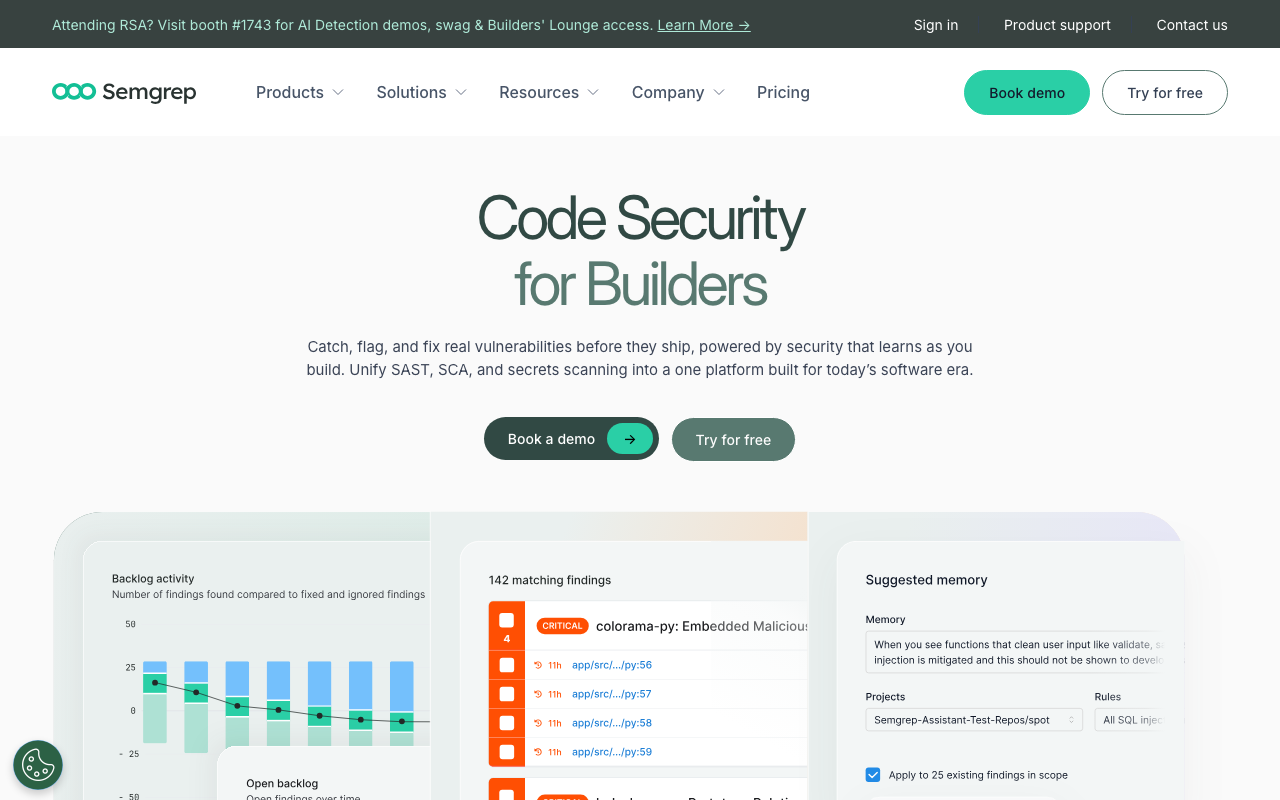
Semgrep earned its reputation as the developer-friendly SAST tool that actually works. The open-source engine, the intuitive pattern syntax that mirrors your source code, the sub-second scan times, the massive community rule registry - it solved real problems that legacy security tools had ignored for years. For a while, Semgrep was the easy recommendation for any team that wanted security scanning without the complexity and cost of enterprise tools like Checkmarx or Veracode.
But the landscape has shifted, and a growing number of engineering teams are evaluating alternatives. The reasons break down into three categories: pricing changes, rule maintenance burden, and the need for broader analysis beyond pure security pattern matching.
The pricing evolution is the most common trigger. Semgrep’s journey from fully open-source project to commercial platform has been gradual but significant. The open-source CLI engine remains free under LGPL-2.1, and you can still run it locally or in CI with community rules at zero cost. But the features that made Semgrep compelling for production security programs - cross-file taint analysis, the AppSec Platform dashboard, supply chain scanning, secrets detection, and managed rule packs - now sit behind the paid Semgrep Code product. At $35 per contributor per month for the Team tier, a 25-person team pays roughly $10,500 per year. That is still far cheaper than Checkmarx or Veracode, but it is no longer “free” in the way many teams initially adopted Semgrep.
The pricing change itself is not unreasonable - building and maintaining a security platform costs money - but it has prompted teams to ask whether they are getting the best value. If you are paying for SAST, SCA, and secrets detection anyway, should you evaluate tools that bundle those capabilities differently or more affordably?
The second driver is rule maintenance burden. Semgrep’s greatest strength - the ability to write custom rules in an intuitive syntax - becomes a liability at scale. Teams that have invested in dozens or hundreds of custom rules find themselves maintaining a growing library that needs updating when frameworks change, when new vulnerability patterns emerge, and when false positive patterns are discovered. Custom rules are code, and code requires maintenance.
The community rule registry helps, but community rules vary in quality and coverage. Some are excellent and actively maintained. Others are stale, overly broad, or produce false positives that erode developer trust. Teams that rely heavily on community rules find themselves curating and testing rules as an ongoing operational cost - effectively running a small security research function to keep their rule set effective.
The third reason is scope. Semgrep is fundamentally a security-focused tool. It does security pattern matching exceptionally well, but it does not provide code quality analysis, technical debt tracking, test coverage enforcement, code duplication detection, or the broader engineering health metrics that platforms like SonarQube, DeepSource, and Codacy deliver. Teams that want a single tool (or at least fewer tools) covering both security and code quality find themselves evaluating platforms that do both, rather than maintaining Semgrep for security alongside a separate tool for quality.
Other factors that come up in migration discussions include:
- Single-file analysis limitations in the OSS tier. Without cross-file taint tracking (a paid feature), the open-source engine misses vulnerabilities that span function boundaries, module imports, and library calls. This is the most impactful capability gap between free and paid Semgrep.
- Dashboard and reporting gaps. The open-source CLI produces findings, but tracking remediation progress, triaging at scale, and generating compliance reports requires the paid platform or third-party tooling.
- Ecosystem fragmentation. Running Semgrep for SAST, a separate SCA tool, a secrets scanner, and a code quality platform means managing four dashboards, four CI integrations, and four sets of findings. Consolidated platforms reduce this operational overhead.
- AI-powered analysis. Newer tools like Snyk Code and CodeRabbit use machine learning to detect vulnerability patterns that rule-based systems miss, particularly in novel code patterns and complex data flows. Semgrep has added AI features, but tools built AI-first have a head start in this area.
This guide evaluates seven alternatives that address these pain points across different team sizes, budgets, and priorities - from enterprise SAST platforms to AI-powered code review tools that approach security from an entirely different angle.
Understanding the tool categories
Before comparing specific tools, it helps to understand that “Semgrep alternative” means different things depending on what you use Semgrep for. The seven tools in this guide span three distinct categories, and understanding which category fits your needs prevents apples-to-oranges comparisons.
Traditional SAST (Static Application Security Testing) tools analyze source code for security vulnerabilities using rule-based pattern matching, taint analysis, and data flow tracking. Semgrep, SonarQube, Checkmarx, and Veracode fall into this category. They scan code without running it, identifying issues like injection flaws, hardcoded credentials, insecure cryptographic usage, and dangerous API calls. If you use Semgrep primarily for security scanning in CI/CD, these are your direct replacements.
Code quality platforms combine security analysis with broader engineering health metrics - code smells, duplication, test coverage, complexity metrics, and maintainability scores. SonarQube, DeepSource, and Codacy span this category. If you run Semgrep alongside a separate code quality tool and want to consolidate, these platforms replace two tools with one.
AI-powered code review tools like CodeRabbit take a fundamentally different approach. Instead of scanning code against predefined rules, they use large language models to review pull requests contextually - understanding the intent of changes, identifying logical errors, suggesting improvements, and flagging security concerns in the same review. This is not a one-to-one Semgrep replacement, but for teams where PR review is the primary feedback loop, an AI reviewer can catch security issues that pattern-based tools miss while also improving code quality.
Most teams benefit from combining tools across categories rather than choosing a single replacement. A common pattern is pairing a SAST scanner (for comprehensive security rule coverage) with an AI code review tool (for contextual analysis that rules cannot capture). The reviews below will help you identify which combination fits your workflow.
Quick comparison table
| Tool | Type | Languages | False Positive Rate | Scan Speed | PR Integration | Best For | Starting Price |
|---|---|---|---|---|---|---|---|
| SonarQube | SAST + code quality | 35+ | Medium | Medium | Via CI | Combined quality + security | Free (Community) |
| Snyk Code | SAST (AI-powered) | 15+ | Low | Very fast | Native | Developer experience | Free (limited) |
| Checkmarx | Enterprise SAST | 25+ | Medium-High | Slow-Medium | Via plugin | Enterprise compliance | ~$40,000/yr |
| CodeRabbit | AI PR review | 30+ | Low | Fast | Native | AI-powered code review | Free (OSS) |
| DeepSource | AI code quality | 12+ | Low | Fast | Native | AI code quality + auto-fix | Free (limited) |
| Veracode | Enterprise SAST + DAST | 25+ | Medium | Medium | Via plugin | Enterprise AppSec | ~$15,000/yr |
| Codacy | Code quality platform | 49 | Low-Medium | Fast | Native | Affordable all-in-one | Free (limited) |
| Semgrep | SAST + custom rules | 30+ | Low | Fast (seconds) | Native | Custom rule flexibility | Free (OSS) |
Pricing comparison
Cost is a significant factor in SAST tool decisions, so here is a detailed breakdown with realistic numbers for different team sizes.
| Tool | Free Tier | Paid Starting Price | Mid-Size Team (25 devs/yr) | Enterprise (100+ devs/yr) |
|---|---|---|---|---|
| SonarQube | Community Edition (full, self-hosted) | ~$30/mo (Developer Cloud) | ~$6,000-10,000 | ~$20,000-50,000 |
| Snyk Code | 1 org, limited scans | $25/dev/mo (Team) | ~$7,500 | Custom |
| Checkmarx | No free tier | ~$40,000/yr (minimum) | ~$60,000-100,000 | ~$100,000-200,000+ |
| CodeRabbit | Unlimited (OSS repos) | $24/user/mo (Pro) | ~$7,200 | Custom |
| DeepSource | Small teams, limited repos | $30/user/mo (Business) | ~$9,000 | Custom |
| Veracode | No free tier | ~$15,000/yr (SAST only) | ~$50,000-80,000 | ~$100,000-200,000+ |
| Codacy | Developer tier (free) | $15/user/mo (Pro) | ~$4,500 | Custom |
| Semgrep | OSS engine, CLI, community rules | $35/contributor/mo (Team) | ~$10,500 | Custom |
The cost picture varies significantly by approach. Teams that only need Semgrep’s free OSS engine capabilities can find equivalent or broader coverage in SonarQube Community Edition (free, self-hosted) or Codacy’s free Developer tier. Teams currently paying for Semgrep Code may find better value in Codacy Pro at $15/user/month versus Semgrep’s $35/contributor/month - especially if they also want code quality analysis. Enterprise teams evaluating Checkmarx or Veracode face a different calculus entirely, where the question is whether $50,000-200,000 per year delivers proportionally more value than tools at one-tenth the price.
Detailed reviews
1. SonarQube - Best for combined code quality and security
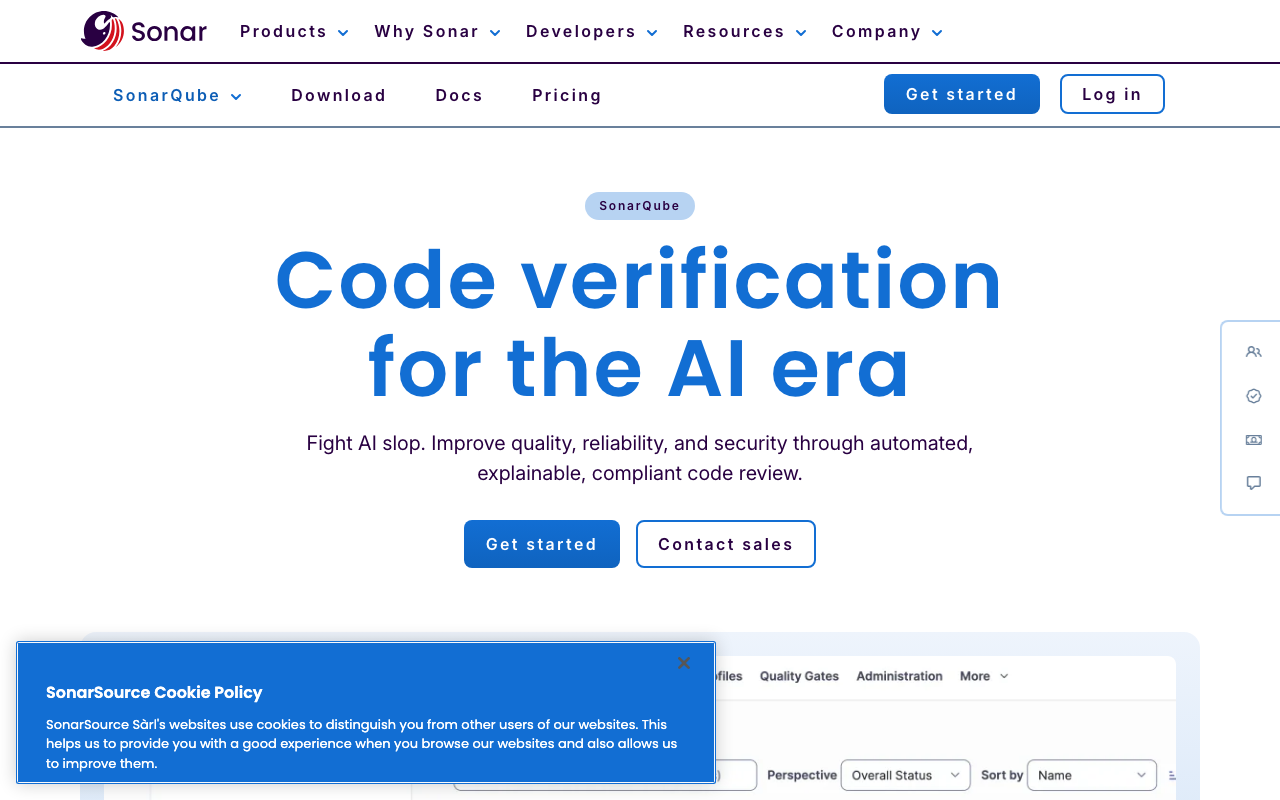
SonarQube is the most widely deployed static analysis platform in the software industry, with over 7 million developers using it across 400,000+ organizations. While Semgrep is purpose-built for security pattern matching, SonarQube covers a much broader surface - code quality, technical debt, test coverage, code duplication, complexity metrics, and security vulnerabilities in a single platform. For teams that run Semgrep alongside a separate code quality tool, SonarQube consolidates both functions.
SonarQube’s rule library dwarfs Semgrep’s. With 6,000+ built-in rules across 35+ languages, SonarQube covers security vulnerabilities, code smells, bugs, and maintainability issues out of the box. The security-specific rules cover OWASP Top 10, CWE Top 25, and SANS Top 25 categories. While Semgrep’s community registry offers thousands of additional patterns, SonarQube’s rules are maintained by a dedicated team at SonarSource with consistent quality standards - there is no “community rule quality lottery” that you get with crowd-sourced registries.
The quality gate concept is SonarQube’s most powerful feature for engineering teams. A quality gate is a set of conditions that code must pass before it can merge - for example, zero critical security vulnerabilities, code coverage above 80%, no new code duplication above 3%, and no new bugs rated “major” or higher. This unified enforcement mechanism means security and quality standards are checked in a single pass, with a single pass/fail result that developers see in their PR. With Semgrep, security findings are separate from whatever code quality tool you use, creating two feedback streams that developers must reconcile.
SonarQube’s Community Edition is genuinely free and fully functional for single-branch analysis. It supports 35+ languages, all core rules, quality gates, and CI/CD integration. The Developer Edition (from ~$30/month for SonarCloud, or license-based for self-hosted) adds branch analysis, PR decoration, and more advanced security rules. The Enterprise Edition adds portfolio management, project transfer, and regulatory reporting.
Where SonarQube falls short compared to Semgrep is in custom rule flexibility and scan speed. Writing a custom SonarQube rule requires Java development, plugin packaging, and deployment to the SonarQube server - a process that takes hours or days compared to Semgrep’s 15-minute custom rule workflow. Scan speed is also slower; SonarQube performs deeper analysis (data flow, control flow, type resolution) that takes minutes rather than the seconds Semgrep requires. For per-commit scanning in fast-paced CI pipelines, this difference matters.
Key strengths:
- 6,000+ maintained rules across 35+ languages
- Quality gates unify code quality and security enforcement in one check
- Free Community Edition is genuinely capable for single-branch workflows
- Already deployed in most engineering organizations - zero adoption friction
- Self-hosted option for compliance-driven organizations
- SonarCloud offers managed hosting with GitHub, GitLab, and Azure DevOps integration
Limitations:
- Custom rule authoring requires Java development and plugin deployment
- Slower scans than Semgrep (minutes vs. seconds for large codebases)
- Community Edition lacks branch analysis and advanced security rules
- Security analysis depth does not match Checkmarx or Veracode for complex taint tracking
- PR decoration requires Developer Edition or higher
Pricing: Free (Community Edition, self-hosted), SonarCloud from ~$30/month, Developer Edition from ~$170/month (self-hosted), Enterprise Edition from ~$400/month. For a team of 25, expect $6,000-10,000/year for Developer tier.
Best for: Teams that want to consolidate security scanning and code quality analysis into a single platform with unified enforcement. Particularly strong if SonarQube is already deployed in your organization - enabling security rules requires no new tooling.
2. Snyk Code - Best developer-first security scanning
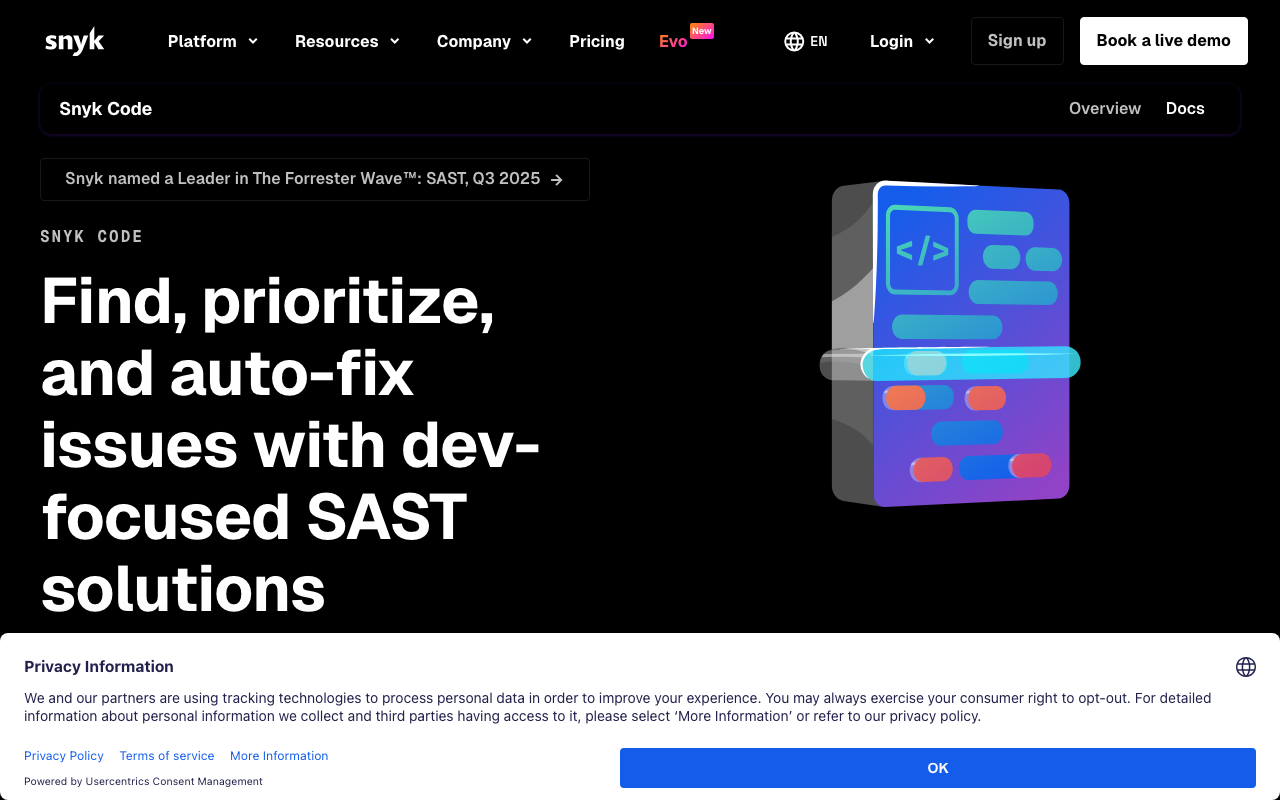
Snyk Code is Snyk’s SAST product, and it takes a fundamentally different approach to vulnerability detection than Semgrep. Where Semgrep uses pattern-based matching (you define the pattern, it finds matches), Snyk Code uses machine learning models trained on millions of real-world code samples to identify vulnerable patterns - including novel variations that no predefined rule would catch. This AI-first approach produces remarkably low false positive rates while catching vulnerability classes that pattern-based tools miss.
The real-time IDE experience is where Snyk Code shines brightest. In VS Code, JetBrains, or Eclipse, Snyk Code scans as you type, flagging vulnerabilities before you even commit. This is not incremental scanning on save - it is continuous analysis that provides security feedback at the speed of thought. Semgrep has IDE plugins too, but they run the CLI in the background on file save rather than providing true real-time analysis. The difference is subtle but meaningful: Snyk Code catches the vulnerability as you write it, not after you save and wait for a scan cycle.
When Snyk Code flags a finding, it provides three things that make remediation straightforward. First, a clear natural language explanation of why the code is vulnerable. Second, a data flow visualization showing exactly how tainted input travels from source to sink across functions and files. Third, a suggested fix generated by Snyk’s DeepCode AI that you can apply with a single click. This combination reduces the median time from finding to fix to minutes rather than the hours or days typical with tools that just report vulnerability IDs and CWE references.
The broader Snyk platform extends beyond SAST to cover software composition analysis (SCA) for open-source dependencies, container image scanning, and infrastructure-as-code (IaC) security. If you adopt Snyk Code and later need SCA or container scanning, adding modules within the same platform is seamless - same dashboard, same CI integration, same PR comments. With Semgrep, SCA and secrets detection are separate paid modules; with Snyk, the unified platform experience is more cohesive.
The trade-off is transparency. Semgrep’s rules are readable - you can inspect exactly what pattern is being matched and why. Snyk Code’s AI model is a black box. When it flags something, you cannot inspect the underlying detection logic. For security teams that need to justify findings to auditors or explain exactly why a pattern is dangerous, Semgrep’s transparency is an advantage. For teams that just want accurate findings with clear fixes, Snyk Code’s AI approach delivers better results with less configuration.
Key strengths:
- AI-powered detection catches vulnerability patterns that rule-based tools miss
- Real-time IDE scanning provides feedback as you write code
- Data flow visualizations make findings immediately understandable
- DeepCode AI generates one-click fix suggestions
- Broader Snyk platform covers SCA, containers, and IaC in one ecosystem
- Named a Gartner Magic Quadrant Leader for AST in 2025
Limitations:
- AI model is a black box - you cannot inspect detection logic like Semgrep rules
- Language support (15+) is narrower than Semgrep (30+) or SonarQube (35+)
- Free tier scan limits are restrictive for active development teams
- No custom rule authoring - you cannot extend detection the way you can with Semgrep
- Pricing scales steeply at larger team sizes ($25/dev/month adds up)
Pricing: Free (1 org, limited scans), Team tier at $25/developer/month. For a team of 25 developers, roughly $7,500/year. Enterprise pricing is custom and typically includes volume discounts.
Best for: Development teams that want the most accurate security findings with the least configuration. Particularly strong for teams that do not have dedicated AppSec engineers to write and maintain custom rules - Snyk Code’s AI handles what custom Semgrep rules would otherwise need to cover.
3. Checkmarx - Best enterprise SAST for compliance-driven organizations
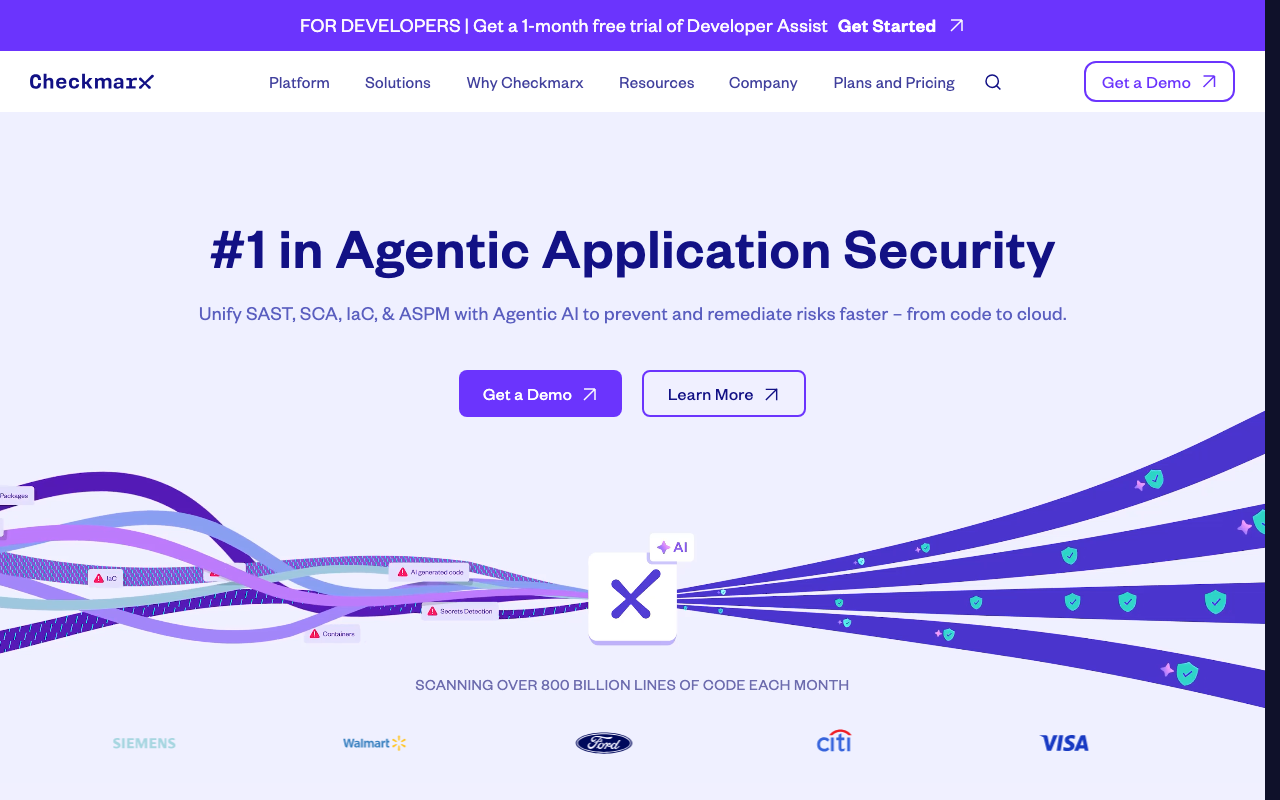
Checkmarx sits at the opposite end of the spectrum from Semgrep. Where Semgrep is lightweight, fast, and developer-owned, Checkmarx is heavyweight, thorough, and security-team-managed. It is the enterprise SAST platform that compliance officers and auditors recognize by name, with the deepest taint analysis, the broadest vulnerability database, and the most comprehensive compliance reporting in the market. Teams that need Checkmarx-level capabilities usually know it - the question is whether that level is actually necessary for their risk profile.
Checkmarx’s cross-file taint analysis is genuinely deeper than what Semgrep offers, even in Semgrep’s paid tier. Checkmarx can trace data flow across compilation units, through reflection, across serialization boundaries, and through complex inheritance hierarchies. For large enterprise codebases with intricate architectures - particularly Java EE and .NET applications with dozens of service layers - this depth catches vulnerabilities that shallower tools miss. The trade-off is scan time: full Checkmarx scans on large codebases take 30 minutes to several hours, compared to seconds for Semgrep.
Checkmarx One, the cloud-native platform, has improved the developer experience significantly compared to the legacy on-premises product. PR comments are clearer, IDE plugins provide faster feedback, and the dashboard has been modernized. It is still not as developer-friendly as Semgrep or Snyk Code, but the gap has narrowed. The platform now covers SAST, SCA, DAST, API security, IaC scanning, and container security in a single offering - the broadest combined feature set of any tool on this list.
The compliance and reporting capabilities are where Checkmarx justifies its premium pricing for organizations that need them. Automated mapping to compliance frameworks (PCI DSS, HIPAA, SOC 2, ISO 27001, OWASP ASVS), audit-ready reports, trending dashboards, and policy enforcement across the enterprise are mature and well-regarded by auditors. If your organization undergoes regular security audits and the auditors expect to see specific SAST reporting, Checkmarx delivers what they expect.
The fundamental question is whether your organization needs this depth. For most modern development teams building web applications and APIs, Semgrep or Snyk Code catches 85-95% of the same vulnerabilities at 5-10% of the cost. The remaining 5-15% are edge cases in complex data flows that matter for high-risk financial, healthcare, or government applications but are unlikely to be exploited in typical SaaS products. If you are in a regulated industry with strict compliance requirements and large legacy codebases, Checkmarx is a legitimate choice. If you are a startup or mid-size company building modern applications, it is almost certainly overkill.
Key strengths:
- Deepest cross-file taint analysis in the market
- Broadest combined platform (SAST + DAST + SCA + API + IaC + containers)
- Mature compliance reporting recognized by auditors
- Custom CxQL queries allow deep customization for enterprise needs
- Checkmarx One cloud platform has significantly improved developer experience
- Strong language support including legacy languages (25+)
Limitations:
- Enterprise pricing starts around $40,000/year and easily reaches $150,000+
- Slow scan times (30 minutes to hours) break developer feedback loops
- High false positive rates require dedicated AppSec tuning
- CxQL queries are proprietary, creating vendor lock-in
- Implementation takes weeks, not hours
- Overkill for most non-regulated development teams
Pricing: Enterprise-only, typically $40,000-150,000+/year. No free tier. Expect multi-week sales and implementation cycles.
Best for: Enterprise organizations in regulated industries (finance, healthcare, government) with dedicated AppSec teams, strict compliance requirements, and large legacy codebases where deep taint analysis provides meaningful security value. For a comprehensive comparison of alternatives to Checkmarx itself, see our Checkmarx alternatives guide.
4. CodeRabbit - Best AI-powered PR review with security checks
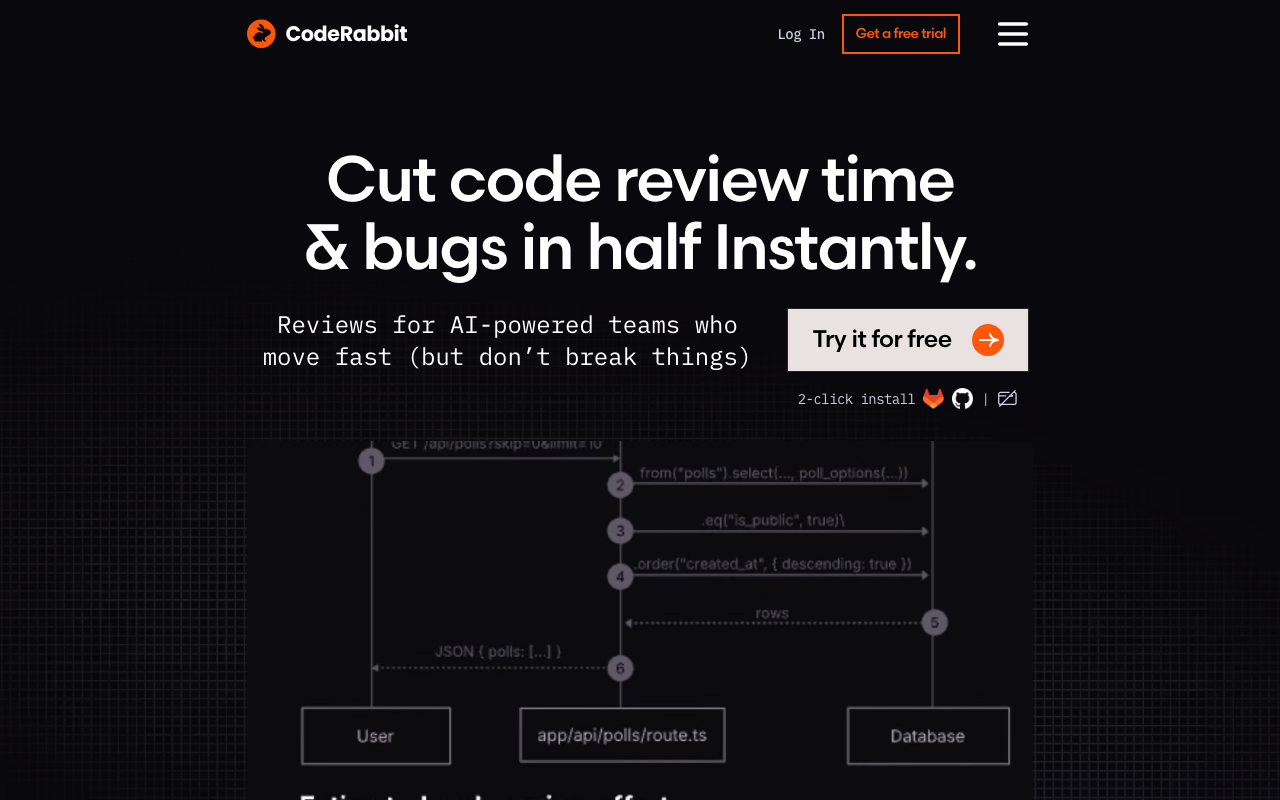
CodeRabbit approaches security from a completely different angle than Semgrep. Instead of scanning code against predefined rules, CodeRabbit uses large language models to review pull requests contextually - understanding what the code change intends to do, evaluating whether it does so correctly and securely, and providing feedback that reads like a senior developer’s review. This is not a SAST replacement in the traditional sense, but for teams where PR review is the primary quality gate, CodeRabbit catches security issues that rule-based tools miss while also improving code quality, design, and maintainability.
CodeRabbit’s contextual understanding is its fundamental advantage over pattern-based tools. Semgrep matches patterns in code regardless of context. CodeRabbit understands context - it knows that a function handling user authentication requires different security standards than a utility function formatting dates. It can identify logical security flaws (like checking permissions after performing the action instead of before) that no pattern-based rule would catch because the individual code patterns are not inherently insecure - only the ordering is wrong.
The tool has reviewed over 13 million pull requests across 500,000+ developers, and the AI model learns from each review. It integrates natively with GitHub, GitLab, and Bitbucket as a PR reviewer, posting line-by-line comments that explain what the issue is, why it matters, and how to fix it. Developers interact with CodeRabbit the same way they interact with a human reviewer - replying to comments, asking for clarification, or requesting re-review after changes. This conversational workflow is natural in a way that SAST tool dashboards are not.
CodeRabbit also bundles 40+ built-in linters and static analysis tools (including ESLint, Semgrep community rules, LanguageTool, and others), orchestrating them behind the scenes and presenting consolidated findings alongside AI-generated insights. So you are not choosing between rule-based analysis and AI review - you get both, with the AI layer providing the contextual intelligence that makes rule-based findings more actionable.
The limitation is determinism. Semgrep’s rules are deterministic - the same code always produces the same findings. CodeRabbit’s AI reviews can vary between runs and may occasionally miss patterns that a well-tuned rule would consistently catch. For compliance-driven organizations that need reproducible, auditable security scans, CodeRabbit is a complement to SAST, not a replacement. For teams that prioritize catching the broadest range of issues in the PR workflow, CodeRabbit’s AI reviews are often more comprehensive than rule-based scans alone.
Key strengths:
- AI-powered contextual review catches logical security flaws that rules miss
- Natural PR review workflow - developers already know how to interact with it
- 40+ built-in linters provide rule-based analysis alongside AI insights
- Conversational feedback allows developers to ask questions and get clarifications
- Free tier for open-source projects with unlimited reviews
- Supports 30+ languages through multi-model AI analysis
Limitations:
- Non-deterministic - AI reviews may vary between runs
- Not a compliance-grade SAST tool (no OWASP benchmark certification)
- Security findings are embedded in broader code review, not separately reportable
- Does not replace dedicated SAST for organizations with regulatory requirements
- AI can occasionally produce false insights that require developer judgment
Pricing: Free (unlimited OSS repos), Pro tier at $24/user/month, Enterprise tier with custom pricing. For a team of 25 developers, roughly $7,200/year at Pro tier.
Best for: Teams that want AI-powered code review as their primary quality and security gate. Pairs well with a dedicated SAST tool (Semgrep, SonarQube) for teams that need both contextual AI review and deterministic rule-based scanning. Particularly strong for teams that do not have senior developers available for thorough PR reviews.
5. DeepSource - Best AI-powered code quality with auto-fix
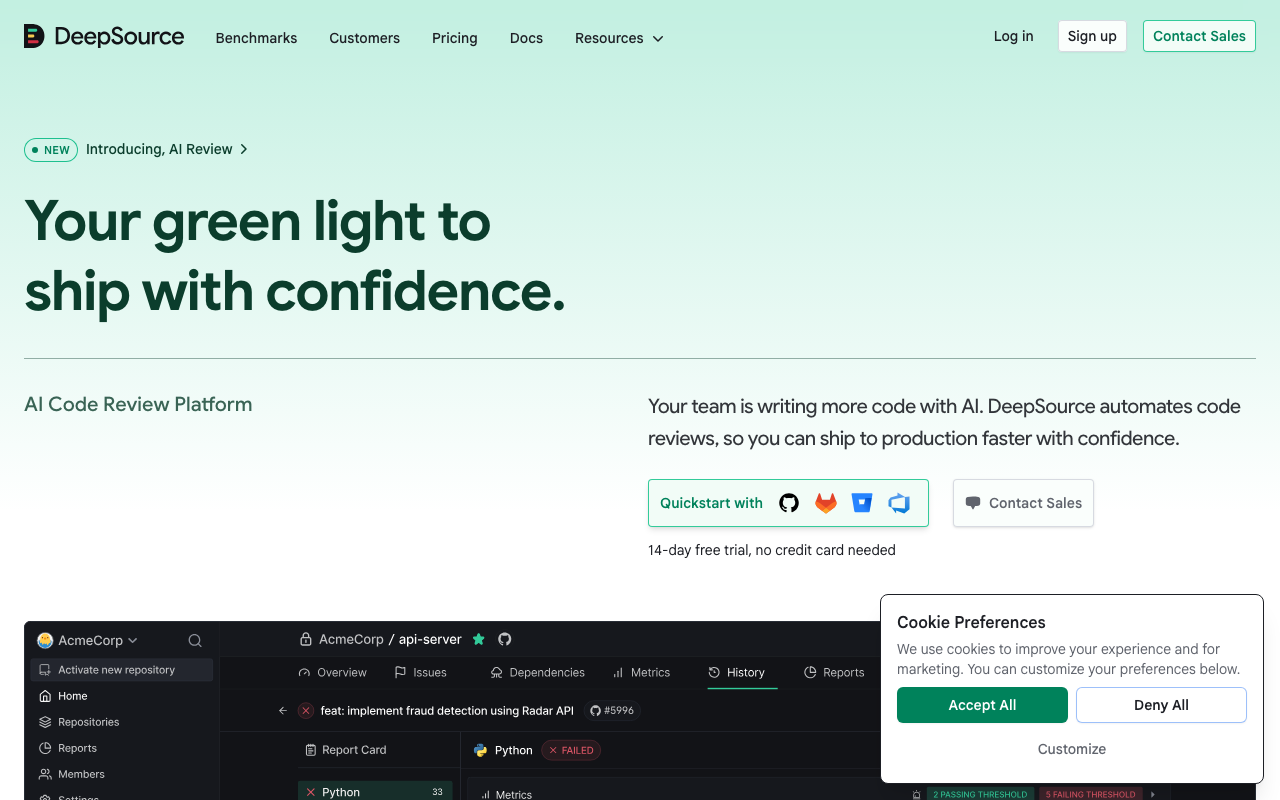
DeepSource combines static analysis with AI-powered code review and automated remediation. Its Autofix AI does not just find problems - it generates fixes and submits them as pull requests that developers review and merge. For teams where the bottleneck is not finding vulnerabilities but fixing them, DeepSource’s approach directly addresses the most expensive step in the security workflow.
DeepSource’s detection engine covers 5,000+ rules across quality and security dimensions. The analysis spans five categories: security, anti-patterns, performance, bug risks, and style. This is broader than Semgrep’s security-focused approach, catching code smells, performance issues, and anti-patterns alongside security vulnerabilities. The false positive rate is advertised at sub-5%, which aligns with user reports - DeepSource’s findings are generally trustworthy enough that developers do not develop the “alert fatigue” that plagues noisier tools.
The Autofix AI feature is the primary differentiator. When DeepSource identifies an issue, it can automatically generate a fix that follows your codebase’s existing patterns and conventions. The fix is presented as a PR or inline suggestion that a developer reviews and approves. For security vulnerabilities specifically, this means a SQL injection finding comes with a parameterized query replacement that uses your project’s existing database abstraction layer - not a generic code snippet from documentation. This contextual fix generation is a meaningful step beyond what Semgrep offers, where remediation is the developer’s manual responsibility.
DeepSource’s AI code review module (separate from the static analysis engine) reviews PRs for correctness, security, performance, and design. Like CodeRabbit, it provides contextual feedback, but DeepSource integrates this with its static analysis findings for a unified view. The combination of deterministic rules (static analysis) and contextual AI (code review) in a single platform is compelling for teams that want comprehensive coverage without managing multiple tools.
The trade-off compared to Semgrep is customizability. Semgrep lets you write arbitrary custom rules in an intuitive syntax. DeepSource’s rule set is curated and maintained by DeepSource’s team - you cannot write custom detection patterns the way you can with Semgrep. For teams with unique security requirements or proprietary frameworks, this lack of extensibility is a real limitation. For teams that primarily use built-in rules and want better remediation tooling, DeepSource delivers more value per dollar.
Key strengths:
- Autofix AI generates contextual fixes, not just findings
- 5,000+ rules spanning security, quality, performance, and style
- Sub-5% false positive rate maintains developer trust
- AI code review provides contextual analysis alongside static rules
- Free tier available for small teams and open-source projects
- Fast incremental analysis runs in seconds on PRs
Limitations:
- No custom rule authoring - cannot extend detection like Semgrep
- Security rule depth is narrower than dedicated SAST tools (Semgrep, Checkmarx)
- 12+ languages is fewer than Semgrep (30+) or SonarQube (35+)
- No DAST, SCA, or container scanning
- Enterprise features (SSO, audit logs) require Business tier
Pricing: Free (limited), Business tier at $30/user/month. For a team of 25 developers, roughly $9,000/year. Pricing has increased from earlier tiers, so verify current pricing directly.
Best for: Teams that want automated remediation as a first-class feature, not an afterthought. Particularly strong for teams without dedicated AppSec engineers who need the tool to not only find issues but also propose fixes that developers can quickly review and merge.
6. Veracode - Best enterprise application security platform
Veracode occupies the same enterprise tier as Checkmarx but with a generally better developer experience and more flexible packaging. It offers SAST, DAST, SCA, container security, and AI-powered remediation in a single platform, with the compliance certifications (FedRAMP, SOC 2 Type II) and audit-ready reporting that regulated industries require. For teams that have outgrown Semgrep’s capabilities and need enterprise-grade application security, Veracode is a serious contender.
Veracode’s pipeline scan mode is significantly faster than its full scan, returning SAST results in minutes rather than the hours typical of Checkmarx full scans. This makes it feasible to run Veracode in PR pipelines for fast feedback while reserving full scans for nightly builds or release gates. Semgrep is still faster (seconds vs. minutes), but Veracode’s pipeline scan closes the gap enough that developers get feedback within the PR workflow rather than days later in a separate dashboard.
The policy engine is where Veracode delivers enterprise value that Semgrep does not attempt to match. You define policies based on compliance frameworks (PCI DSS, HIPAA, SOC 2, OWASP ASVS), and Veracode automatically maps findings to policy violations, tracks remediation progress, generates compliance reports, and enforces policy gates in the pipeline. For organizations that spend significant manual effort mapping SAST findings to compliance requirements, this automation saves hundreds of hours annually.
Veracode Fix, the AI-powered remediation feature, generates code fixes for identified vulnerabilities. Unlike DeepSource’s Autofix, which works within its own analysis engine, Veracode Fix addresses findings from Veracode’s comprehensive SAST analysis - including the deep cross-file taint tracking findings that simpler tools cannot detect. The quality of generated fixes varies by vulnerability type and language, but for common patterns (injection, XSS, insecure deserialization), the fixes are production-ready.
The eLearning platform is a unique differentiator. When a developer introduces a vulnerability, Veracode assigns targeted security training modules that teach the underlying concepts - not just how to fix this specific instance, but how to avoid the vulnerability class entirely. Over time, this reduces the number of new vulnerabilities developers introduce, which is more valuable than any scanning tool. Security training that is triggered by actual mistakes is far more effective than generic annual compliance training.
Key strengths:
- Comprehensive enterprise platform (SAST + DAST + SCA + containers)
- Pipeline scan mode provides fast feedback in PR workflows
- Policy engine automates compliance framework mapping and reporting
- Veracode Fix generates AI-powered remediation suggestions
- eLearning platform turns findings into developer security education
- FedRAMP authorized and SOC 2 Type II attested
Limitations:
- Enterprise pricing ($15,000-200,000+/year) puts it out of reach for most small teams
- Full scan times are slow for large codebases (30+ minutes)
- Developer experience, while improved, is still security-team-oriented
- No custom rule authoring like Semgrep’s pattern syntax
- Vendor lock-in through proprietary analysis engine and policies
- Complex procurement and implementation process
Pricing: SAST-only from approximately $15,000/year. Full platform pricing ranges from $50,000 to $200,000+/year for enterprise deployments. No free tier.
Best for: Enterprise organizations that need compliance-certified application security with automated policy enforcement and developer training. A step up from Semgrep when regulatory requirements demand deeper analysis, compliance reporting, and vendor certification. Not appropriate for startups or budget-conscious teams.
7. Codacy - Best affordable all-in-one code quality platform
Codacy is the most comprehensive code quality platform on this list in terms of breadth relative to price. It covers SAST, SCA, secrets detection, DAST (via partner integration), code quality, code coverage, duplication analysis, and complexity metrics across 49 languages - more languages than any other tool reviewed here. For teams that want a single platform covering the most ground at the lowest cost, Codacy is the value leader.
Codacy’s language coverage is its standout feature. Supporting 49 languages means virtually every codebase is covered regardless of tech stack diversity. Polyglot organizations that use Python for ML, TypeScript for frontend, Go for microservices, Rust for performance-critical components, and Terraform for infrastructure get unified analysis across all of these in a single dashboard. Semgrep supports 30+ languages and SonarQube supports 35+, but Codacy’s 49 covers edge cases that the others miss - including languages like Apex, Elixir, Crystal, and others.
The platform bundles open-source analysis engines (including PMD, ESLint, Pylint, Bandit, SpotBugs, Brakeman, and others) with Codacy’s own analysis layer and AI-powered review capabilities. This means you get the detection breadth of specialized linters combined with centralized management - rule configuration, finding triage, dashboards, and PR integration are all handled through Codacy rather than managing each linter independently. If you have ever tried to coordinate ESLint, Bandit, SpotBugs, and Brakeman across 20 repositories, you understand the value of centralized orchestration.
Codacy’s AI Guardrails and AI Reviewer features add machine learning-powered analysis on top of the rule-based engines. AI Guardrails prevent insecure AI-generated code from merging by analyzing output from coding assistants like GitHub Copilot and Cursor. The AI Reviewer provides contextual feedback similar to CodeRabbit, but integrated into Codacy’s broader platform. Named a G2 Leader for Static Code Analysis, Codacy has earned industry recognition for the breadth and usability of its platform.
The security-specific capabilities are solid but not as deep as dedicated SAST tools. Codacy covers OWASP Top 10 patterns, common CWE categories, and secrets detection. For advanced taint analysis across complex architectures, Semgrep’s paid tier or Checkmarx provides deeper coverage. But for the majority of teams whose security risks are standard web application vulnerabilities (injection, XSS, SSRF, insecure crypto, hardcoded secrets), Codacy’s security rules are more than sufficient.
Key strengths:
- 49 languages supported - broadest coverage on this list
- Free Developer tier includes SAST, SCA, secrets detection, and code quality
- $15/user/month Pro tier is among the most affordable paid options
- AI Guardrails catch insecure AI-generated code
- Bundles multiple open-source engines with centralized management
- Native GitHub, GitLab, and Bitbucket integration
Limitations:
- Security analysis depth does not match dedicated SAST tools for complex taint tracking
- No custom rule syntax like Semgrep - rule configuration is through engine settings
- Reliance on bundled open-source engines means detection quality varies by language
- DAST is via partner integration, not native
- Enterprise features (custom security policies, SAML SSO) require higher tiers
Pricing: Free (Developer tier with SAST, SCA, secrets), Pro at $15/user/month, Custom enterprise pricing. For a team of 25 developers, roughly $4,500/year at the Pro tier - the most affordable paid option on this list.
Best for: Polyglot teams that want the broadest language coverage and a comprehensive quality-plus-security platform at an affordable price. Particularly strong for organizations with diverse tech stacks where specialized tools would mean managing multiple scanners.
Head-to-head: Semgrep vs. each alternative
To make the comparison concrete, here is how each alternative stacks up against Semgrep on the dimensions that matter most.
Semgrep vs. SonarQube
Choose SonarQube if: You want combined code quality and security analysis in a single tool with quality gate enforcement. SonarQube is also better if you want a self-hosted solution with a mature, stable platform that has been around for over a decade.
Stay with Semgrep if: Custom rule flexibility is essential to your workflow, you need the fastest possible CI scans, or you want transparency into exactly how each finding is detected. Semgrep’s pattern syntax is far more accessible than SonarQube’s Java-based custom rule development.
Semgrep vs. Snyk Code
Choose Snyk Code if: You want AI-powered detection with minimal rule management, real-time IDE scanning, and one-click fix suggestions. Snyk Code is better for teams without dedicated AppSec engineers who need the tool to handle detection intelligence automatically.
Stay with Semgrep if: You need custom rule authoring, broader language support, or an open-source core that avoids vendor lock-in. Semgrep’s transparent rule syntax also makes it easier to audit and explain findings to security teams and auditors.
Semgrep vs. Checkmarx
Choose Checkmarx if: You operate in a regulated industry that requires certified compliance reporting, deep cross-file taint analysis across complex enterprise architectures, and an application security platform that auditors recognize by name.
Stay with Semgrep if: You prioritize scan speed, developer experience, custom rule flexibility, and cost efficiency. For most teams outside regulated industries, Semgrep covers 85-95% of what Checkmarx detects at a fraction of the cost and complexity.
Semgrep vs. CodeRabbit
Choose CodeRabbit if: Your primary security gate is the PR review, and you want AI that catches logical security flaws, design issues, and code quality problems that rule-based tools cannot detect. CodeRabbit is best as a complement to SAST, not a replacement.
Stay with Semgrep if: You need deterministic, reproducible security scans for compliance, detailed vulnerability reporting, or security analysis outside the PR context (e.g., scanning entire codebases on a schedule).
Semgrep vs. DeepSource
Choose DeepSource if: Automated remediation (Autofix AI) is more valuable to your team than custom rule flexibility. DeepSource is better for teams where the bottleneck is fixing issues rather than finding them.
Stay with Semgrep if: You need custom rules for proprietary frameworks, broader language support, or the ability to run the engine entirely on your own infrastructure with the open-source CLI. Semgrep’s rule ecosystem is also more mature for security-specific patterns.
Semgrep vs. Veracode
Choose Veracode if: You need enterprise-grade compliance certifications (FedRAMP, SOC 2 Type II), combined SAST + DAST + SCA in a certified platform, automated policy enforcement, and developer security training.
Stay with Semgrep if: Budget is a consideration (Veracode costs 5-20x more), you value developer-owned security tooling, or you want fast per-commit scanning. Veracode is a lateral move for enterprise requirements, not a better version of Semgrep.
Semgrep vs. Codacy
Choose Codacy if: You need the broadest language coverage (49 languages), want combined code quality and security at the lowest price point, or need centralized management of multiple analysis engines across a polyglot codebase.
Stay with Semgrep if: Security is your primary concern (Semgrep’s security rules are deeper), custom rule authoring is essential, or you need Semgrep’s specific pattern matching capabilities for framework-specific security checks.
Migration guide: Moving from Semgrep to a new tool
Switching SAST tools requires more than swapping a CLI command in your CI pipeline. Here is a practical migration checklist based on common patterns we have seen in production teams.
Step 1: Audit your current Semgrep usage
Before evaluating alternatives, document exactly how you use Semgrep today.
- List all custom rules. Export your .semgrep.yml files and any custom rule directories. Count how many rules are custom vs. from the community registry vs. from managed rule packs. This determines how much migration effort custom rules will require.
- Identify managed features you depend on. If you use Semgrep Code’s cross-file analysis, SCA, secrets detection, or the AppSec Platform dashboard, note these as hard requirements for the replacement.
- Document CI/CD integration points. Where does Semgrep run? GitHub Actions, GitLab CI, Jenkins, CircleCI? What happens when it finds issues - block the PR, post a comment, create a ticket? Replicate this workflow with the new tool.
- Export suppressed findings and false positives. Your triage decisions (nosemgrep annotations, ignored findings in the dashboard) represent institutional knowledge. Export these before switching so you can replicate them.
Step 2: Run the new tool in parallel
Do not switch cold. Run the replacement tool alongside Semgrep for at least 2-4 weeks on your actual codebase.
- Configure the new tool to scan the same repositories Semgrep covers
- Compare findings: what does the new tool catch that Semgrep does not (and vice versa)?
- Track false positive rates for both tools during the parallel period
- Measure scan times in your actual CI pipeline
- Get developer feedback on the PR integration experience
Step 3: Migrate custom rules
This is the most labor-intensive step for teams with extensive custom rules.
- For SonarQube migration: Custom Semgrep rules need to be converted to SonarQube custom plugins (Java) or, more practically, check whether SonarQube’s built-in rules already cover the same patterns. Many custom Semgrep rules replicate detection that SonarQube handles natively.
- For Snyk Code migration: Custom rules are not supported. Verify that Snyk Code’s AI model detects the vulnerability patterns your custom rules cover. If not, you may need to maintain a lightweight Semgrep instance for custom patterns alongside Snyk Code.
- For Codacy migration: Configure the appropriate underlying engines (Bandit for Python, SpotBugs for Java, etc.) to match your custom Semgrep rule intent. Codacy supports custom configurations for each bundled engine.
- For CodeRabbit migration: Custom rules are not applicable in the same way. Instead, use CodeRabbit’s review instructions to guide the AI toward specific patterns you care about.
Step 4: Update CI/CD pipelines
Replace Semgrep CLI invocations with the new tool’s scanner. Most tools provide pre-built GitHub Actions, GitLab CI templates, or generic Docker images for CI integration.
Step 5: Communicate to developers
Announce the switch, explain why (cost savings, broader analysis, better experience), and provide documentation on interpreting findings from the new tool. Developers who are accustomed to Semgrep’s finding format need to know where to find equivalent information in the new tool.
Free vs. paid: What you actually get
For budget-conscious teams, here is an honest comparison of free tier capabilities.
| Tool | Free Tier Includes | What You Lose Without Paying |
|---|---|---|
| Semgrep (OSS) | CLI engine, community rules, single-file analysis, CI integration | Cross-file taint analysis, SCA, secrets detection, dashboard, managed rules |
| SonarQube Community | 35+ languages, 6,000+ rules, quality gates, single-branch CI | Branch analysis, PR decoration, advanced security rules, portfolio management |
| Snyk Code Free | 1 org, IDE scanning, limited CI scans | Unlimited CI scans, advanced reporting, priority support |
| CodeRabbit Free | Unlimited OSS repo reviews, AI PR analysis | Private repo reviews, advanced configuration, enterprise features |
| DeepSource Free | Limited repos, basic analysis, Autofix | Full repo access, advanced analysis, priority support, team features |
| Codacy Developer | SAST, SCA, secrets, code quality, GitHub/GitLab/Bitbucket | Custom security policies, advanced dashboards, SAML SSO, priority support |
For individual developers and very small teams: Codacy’s free Developer tier is the most generous - it includes SAST, SCA, secrets detection, and code quality analysis with no user limit on public repos. Paired with CodeRabbit’s free OSS tier for AI code review, you get comprehensive coverage at zero cost.
For teams of 5-15 developers: SonarQube Community Edition (self-hosted) provides the most mature free SAST platform with quality gate enforcement. Add CodeRabbit Pro for AI-powered PR review at $24/user/month. This combination provides both rule-based and AI-powered analysis for roughly $3,600-4,300/year for a 15-person team.
For teams of 15-50 developers: Codacy Pro at $15/user/month is the most cost-effective paid option that covers SAST, SCA, secrets, and code quality. Alternatively, SonarQube Developer Edition plus CodeRabbit Pro provides deeper analysis with AI review. Budget roughly $4,500-12,000/year depending on the combination.
Which OWASP Top 10 categories does each tool cover?
The OWASP Top 10 is the standard benchmark for web application security coverage. Here is how each tool performs across the 2021 categories.
| OWASP Category | Semgrep | SonarQube | Snyk Code | Checkmarx | CodeRabbit | DeepSource | Veracode | Codacy |
|---|---|---|---|---|---|---|---|---|
| A01: Broken Access Control | Yes | Yes | Yes | Yes | Contextual | Partial | Yes | Yes |
| A02: Cryptographic Failures | Yes | Yes | Yes | Yes | Contextual | Yes | Yes | Yes |
| A03: Injection | Yes | Yes | Yes | Yes | Contextual | Yes | Yes | Yes |
| A04: Insecure Design | Partial | Partial | Partial | Yes | Yes (AI) | Partial | Yes | Partial |
| A05: Security Misconfiguration | Yes | Yes | Partial | Yes | Contextual | Partial | Yes | Yes |
| A06: Vulnerable Components | Pro only | Partial | Yes (SCA) | Yes | No | No | Yes | Yes (SCA) |
| A07: Auth Failures | Yes | Yes | Yes | Yes | Contextual | Yes | Yes | Yes |
| A08: Software/Data Integrity | Partial | Partial | Partial | Yes | Contextual | Partial | Yes | Partial |
| A09: Logging/Monitoring | Yes | Yes | Partial | Yes | Contextual | Partial | Yes | Yes |
| A10: SSRF | Yes | Yes | Yes | Yes | Contextual | Yes | Yes | Yes |
Note on CodeRabbit’s “Contextual” ratings: CodeRabbit’s AI review can identify these vulnerability categories, but its detection is contextual (based on understanding the code’s intent) rather than deterministic (based on pattern matching). This means it may catch instances that rule-based tools miss, but it may also miss instances that rules consistently catch. For compliance purposes, contextual AI detection is not equivalent to deterministic SAST rule coverage.
How to choose the right Semgrep alternative
The right choice depends on what problem you are actually solving. Here is a decision framework based on common scenarios.
If your primary concern is cost:
You are paying for Semgrep Code and want to reduce spend without losing coverage. Codacy Pro at $15/user/month covers SAST, SCA, secrets, and code quality for roughly 60% less than Semgrep Code at $35/contributor/month. SonarQube Community Edition is free and covers security plus code quality, though you lose the managed SaaS experience. If you only need Semgrep’s OSS capabilities, the open-source engine remains free - the question is whether the paid features are worth the cost versus alternatives.
If your primary concern is developer experience:
Snyk Code provides the best IDE experience with real-time scanning and AI-generated fixes. CodeRabbit provides the best PR review experience with contextual AI analysis. For teams that want both, pair Snyk Code (IDE and CI security scanning) with CodeRabbit (AI PR review) - this combination is more expensive than Semgrep alone but provides both pattern-based and AI-powered analysis.
If your primary concern is breadth of analysis:
You want more than just security - code quality, duplication, complexity, coverage. SonarQube is the established leader here with 6,000+ rules across quality and security. Codacy covers the broadest language set (49 languages) with combined quality and security. DeepSource adds AI-powered auto-fix on top of quality and security analysis.
If your primary concern is compliance:
Move to Checkmarx or Veracode. No lightweight tool matches their compliance certifications, audit reporting, and regulatory framework mapping. Semgrep is increasingly used in compliance-driven organizations, but Checkmarx and Veracode have the attestations and track record that auditors expect.
If your primary concern is custom rule flexibility:
Stay with Semgrep. No other tool matches Semgrep’s custom rule syntax for accessibility and power. SonarQube supports custom rules but requires Java development. Checkmarx has CxQL, which is powerful but proprietary. Other tools on this list do not support custom detection rules at all.
Decision matrix
| Your Primary Concern | Top Pick | Runner-Up | Budget Option |
|---|---|---|---|
| Cost reduction | Codacy | SonarQube Community | Semgrep OSS (free) |
| Developer experience | Snyk Code | CodeRabbit | CodeRabbit free tier |
| Breadth of analysis | SonarQube | Codacy | SonarQube Community |
| AI-powered detection | Snyk Code | CodeRabbit | CodeRabbit free tier |
| Auto-remediation | DeepSource | Snyk Code | DeepSource free tier |
| Compliance / audit | Veracode | Checkmarx | SonarQube Enterprise |
| Enterprise SAST | Checkmarx | Veracode | N/A |
| Language coverage | Codacy (49) | SonarQube (35+) | Codacy free tier |
| Code quality + security | SonarQube | DeepSource | SonarQube Community |
| AI PR review + security | CodeRabbit | DeepSource | CodeRabbit free tier |
Common tool combinations
Most production teams do not rely on a single tool. Here are effective combinations that cover more ground than any single alternative.
Budget combination (free): Semgrep OSS + SonarQube Community + CodeRabbit Free
- Semgrep OSS handles targeted security patterns with custom rules
- SonarQube Community provides broad code quality and security rules with quality gates
- CodeRabbit Free adds AI review on open-source repositories
- Total cost: $0
Mid-market combination (~$5,000-10,000/year for 25 devs): Codacy Pro + CodeRabbit Pro
- Codacy Pro covers SAST, SCA, secrets, code quality across 49 languages
- CodeRabbit Pro adds AI-powered PR review with contextual security analysis
- Total cost: ~$4,500 + ~$7,200 = ~$11,700/year for 25 developers
Enterprise combination (~$20,000-50,000/year for 25 devs): Snyk Code + SonarQube Developer + CodeRabbit Pro
- Snyk Code provides AI-powered SAST with IDE integration and SCA
- SonarQube Developer adds quality gates, branch analysis, and comprehensive code quality rules
- CodeRabbit Pro adds AI contextual review
- Total cost: ~$7,500 + ~$6,000 + ~$7,200 = ~$20,700/year for 25 developers
Compliance-grade combination ($50,000+/year): Veracode or Checkmarx + Semgrep OSS
- Enterprise tool handles compliance reporting, deep taint analysis, and audit requirements
- Semgrep OSS provides fast per-commit scanning for immediate developer feedback
- Total cost: $50,000-150,000+ depending on enterprise tool
Conclusion
Semgrep remains an excellent SAST tool - the open-source engine is genuinely powerful, the rule syntax is the most developer-friendly in the industry, and the community rule registry provides extensive coverage for common vulnerability patterns. It earned its position as the default recommendation for modern development teams, and for teams that primarily need customizable security pattern matching, it is still the best choice.
But “best security pattern matcher” is not the same as “best tool for every team.” The alternatives on this list address real gaps that different teams prioritize differently.
If you want to consolidate security and code quality into fewer tools, SonarQube and Codacy provide broader analysis than Semgrep alone. SonarQube’s quality gates and Codacy’s 49-language coverage with integrated SCA and secrets detection mean fewer dashboards, fewer CI integrations, and fewer tools to manage.
If you want AI-powered detection instead of rule-based matching, Snyk Code and CodeRabbit represent where security tooling is heading. Snyk Code’s ML model catches vulnerability patterns that rules miss, and CodeRabbit’s contextual AI review identifies logical security flaws that no pattern-based tool can detect. These approaches are not better or worse than rules - they are complementary, and the strongest security posture combines both.
If you want automated remediation, DeepSource closes the loop that Semgrep leaves open. Finding vulnerabilities is necessary but not sufficient - what matters is fixing them. DeepSource’s Autofix AI generates production-ready fixes that developers review and merge, turning the finding-to-fix cycle from hours or days to minutes.
If your organization has compliance mandates, Checkmarx and Veracode provide the certified platforms, audit reporting, and regulatory framework mapping that Semgrep does not target. These tools cost 5-20x more, but compliance is not optional for the teams that need it.
Our recommendation for most teams: Start with Codacy or SonarQube for combined code quality and security analysis, add CodeRabbit for AI-powered PR review, and keep Semgrep’s open-source engine running for any custom rules that address your specific security patterns. This combination provides rule-based analysis, AI-powered contextual review, quality enforcement, and custom security rules - all for less than Semgrep Code alone. Evaluate and iterate as your needs evolve; the security tooling market is moving fast, and what serves you best today may not be the right answer in twelve months.
Frequently Asked Questions
What are the best Semgrep alternatives in 2026?
The best Semgrep alternatives in 2026 are SonarQube for combined code quality and security, Snyk Code for developer-first AI-powered security scanning, Checkmarx for enterprise SAST with deep taint analysis, CodeRabbit for AI-driven PR review with security checks, DeepSource for AI-powered code quality and auto-fix, Veracode for enterprise compliance-driven AppSec, and Codacy for an affordable all-in-one code quality platform. The best choice depends on whether you prioritize cost, developer experience, compliance, or breadth of analysis.
Why are teams looking for Semgrep alternatives?
Teams look for Semgrep alternatives for several reasons. The shift from a fully open-source model to a commercial platform with Semgrep Code (now requiring paid tiers for cross-file analysis, secrets detection, and supply chain scanning) has pushed budget-conscious teams to explore options. Rule maintenance burden is another factor - keeping custom Semgrep rules updated across framework versions requires ongoing engineering investment. Some teams also need broader code quality analysis beyond pure security, which tools like SonarQube, DeepSource, and Codacy provide natively.
Is Semgrep still free and open source?
Semgrep's core CLI engine remains open source under LGPL-2.1, and you can run it locally or in CI with community rules at no cost. However, many advanced features that were previously accessible have moved behind paid tiers. Cross-file taint analysis, the Semgrep AppSec Platform dashboard, supply chain (SCA) scanning, secrets detection, and managed rule packs all require a paid Semgrep Code subscription starting at $35 per contributor per month. The free open-source engine is still powerful for single-file pattern matching, but teams needing deeper analysis now face a paywall.
How does Semgrep compare to SonarQube?
Semgrep excels at fast, lightweight pattern-based security scanning with a developer-friendly rule syntax, while SonarQube provides broader code quality analysis including code smells, technical debt tracking, test coverage, and duplication alongside security rules. SonarQube has a larger built-in rule set (6,000+ rules across 35+ languages) and quality gate enforcement that blocks PRs on combined quality and security thresholds. Semgrep is faster for pure security scanning and easier for writing custom rules. Many teams use both - Semgrep for targeted security patterns and SonarQube for overall code quality governance.
How does Semgrep compare to Snyk Code?
Semgrep uses pattern-based analysis with a transparent rule syntax that developers can read, customize, and extend. Snyk Code uses AI and machine learning trained on millions of code samples to detect vulnerabilities with low false positive rates. Snyk Code provides real-time IDE scanning, data flow visualizations, and integrates into the broader Snyk platform (SCA, containers, IaC). Semgrep offers more control over rules and is open-source at its core. Snyk Code is better for teams that want AI-powered detection with minimal configuration, while Semgrep suits teams that want transparency and customizability.
Can I replace Semgrep with a free tool?
Yes, several free alternatives cover significant ground. SonarQube Community Edition provides free SAST with 6,000+ rules across 35+ languages, including security hotspot detection. DeepSource offers a free tier for small teams with security analysis and auto-fix capabilities. Codacy has a free developer tier with SAST, SCA, and secrets detection. CodeRabbit provides a free open-source tier with AI code review that includes security checks. None of these individually replicate Semgrep's custom rule flexibility, but for teams primarily using Semgrep's built-in rules, these free options provide comparable or broader coverage.
What is the best SAST tool for startups in 2026?
For startups, DeepSource or Codacy are the best starting points. Both offer generous free tiers, fast setup (under 10 minutes), and combine security scanning with code quality analysis. DeepSource's Autofix AI automatically generates remediation code, reducing developer burden. Codacy covers 49 languages and includes SAST, SCA, and secrets detection in its free tier. For startups that specifically need security-focused scanning with custom rules, Semgrep's open-source engine remains excellent. CodeRabbit is also worth considering if you want AI-powered PR review that catches security issues alongside code quality problems.
Is Checkmarx better than Semgrep?
Checkmarx offers deeper cross-file taint analysis, broader compliance reporting (PCI DSS, HIPAA, SOC 2), and combined SAST/DAST/SCA/API security in a single enterprise platform. Semgrep is faster, more developer-friendly, more affordable, and gives teams direct control over security rules without a proprietary query language. For enterprise teams with dedicated AppSec staff and compliance mandates, Checkmarx may justify its cost. For most modern development teams, Semgrep provides better value with faster feedback loops, lower false positive rates, and a fraction of the cost.
How much does Semgrep cost in 2026?
Semgrep's open-source CLI is free. Semgrep Code (the commercial platform) starts at $35 per contributor per month for the Team tier, which adds cross-file analysis, the AppSec Platform dashboard, and managed rules. The Enterprise tier adds SSO, custom roles, premium support, and advanced deployment options at custom pricing. For a team of 25 developers, Semgrep Code Team costs approximately $10,500 per year. This is significantly less than enterprise tools like Checkmarx ($40,000-150,000+/year) or Veracode ($50,000-200,000+/year), but more expensive than alternatives like Codacy ($4,500/year) or DeepSource ($9,000/year) at the same team size.
What languages does Semgrep support?
Semgrep supports over 30 languages including Python, JavaScript, TypeScript, Java, Go, Ruby, PHP, C, C++, C#, Kotlin, Scala, Rust, Swift, Terraform, Dockerfile, YAML, JSON, and more. Language support depth varies - Python, JavaScript, Java, and Go have the most comprehensive rule coverage, while newer language additions may have fewer community rules. Most alternatives support similar modern language sets, though SonarQube (35+), Codacy (49), and Checkmarx (25+) have broader coverage for niche or legacy languages.
Does Semgrep work with GitHub, GitLab, and Bitbucket?
Yes, Semgrep integrates natively with GitHub, GitLab, and Bitbucket for PR-level scanning. The open-source CLI can run in any CI/CD pipeline (GitHub Actions, GitLab CI, Jenkins, CircleCI, etc.) with direct output or SARIF format for native security tab integration. The commercial Semgrep Code platform adds a managed GitHub/GitLab App for automated PR comments, finding management, and dashboard reporting. Most alternatives on this list offer similar SCM integrations, with CodeRabbit and Codacy also providing native GitHub, GitLab, and Bitbucket support.
Can Semgrep detect secrets and API keys?
Semgrep Secrets is available as a paid add-on in the Semgrep Code platform. It detects hardcoded API keys, tokens, passwords, and credentials using both pattern matching and entropy analysis, with validation against live services to reduce false positives. The open-source Semgrep CLI can match basic secret patterns using custom rules, but lacks the validation and entropy features of the paid product. Free alternatives for secrets detection include Codacy (includes secrets detection in free tier), GitGuardian (dedicated secrets scanner with free tier), and TruffleHog (open source).
How do I migrate from Semgrep to another SAST tool?
Start by auditing your current Semgrep setup: list all custom rules, note which managed rule packs you use, and document any CI/CD pipeline integrations. Run your replacement tool in parallel for 2-4 weeks, comparing findings side by side. Map your custom Semgrep rules to equivalent rules or configurations in the new tool - most SonarQube and Checkmarx rules cover the same vulnerability patterns that Semgrep's managed packs detect. Export your suppressed findings and false positive annotations so you can replicate triage decisions. Finally, update CI/CD configurations to replace the Semgrep CLI with the new tool's scanner.
Explore More
Tool Reviews
 Semgrep Review
 SonarQube Review
 Snyk Code Review
 Checkmarx Review
 CodeRabbit Review
 DeepSource Review
 Veracode Review
 Codacy Review
Related Articles
- 8 Best Snyk Alternatives for Developer Security in 2026
- AI Code Review for Enterprise Teams: Security, Compliance, and Scale in 2026
- 15 Best SonarQube Alternatives in 2026 (Free & Paid)
- I Reviewed 32 SAST Tools - Here Are the Ones Actually Worth Using (2026)
- AI Code Review for Security - Finding Vulnerabilities With AI in 2026
Free Newsletter
Stay ahead with AI dev tools
Weekly insights on AI code review, static analysis, and developer productivity. No spam, unsubscribe anytime.
Join developers getting weekly AI tool insights.
Related Articles
CodiumAI Alternatives: Best AI Tools for Automated Testing in 2026
Explore the best CodiumAI (now Qodo) alternatives for AI test generation, code review, and quality analysis with pricing and honest comparisons.
March 13, 2026
alternativesBest Free Snyk Alternatives for Vulnerability Scanning in 2026
Discover the best free Snyk alternatives for vulnerability scanning. Compare Trivy, Grype, Semgrep, CodeQL, and more open source security tools.
March 13, 2026
alternativesFree SonarQube Alternatives: Best Open Source Code Quality Tools in 2026
Discover the best free SonarQube alternatives for code quality and security. Open source tools, free tiers, and budget options compared.
March 13, 2026