10 Best Codacy Alternatives for Code Quality in 2026
Looking beyond Codacy? Compare 10 alternatives for code quality, security, and AI review. Features, pricing, and honest recommendations for every team size.
Published:
Last Updated:
Why Teams Consider Switching from Codacy
Codacy is a solid all-in-one platform trusted by 15,000+ organizations, covering code quality, SAST, SCA, DAST, secrets detection, and AI review across 49 languages at $15/user/month. It is well-positioned for small to mid-size teams wanting a single vendor. But it is not the best tool for every scenario, and several recurring pain points drive teams to explore alternatives.
AI review features are not best-in-class. Codacy’s AI Reviewer provides useful hybrid analysis that combines pattern matching with LLM-powered suggestions. However, dedicated AI review tools like CodeRabbit produce deeper, more contextual feedback that considers repository history, linked issues, and PR descriptions holistically. If AI-powered review is your primary need, Codacy’s offering will feel limited compared to tools that have made AI review their core product.
False positive noise on legacy codebases. Users on G2 and Capterra consistently report that importing legacy projects into Codacy generates a high volume of findings, many of which are false positives or low-priority style issues. Teams need to invest significant time configuring rules and ignoring patterns to reduce noise before the tool becomes genuinely useful. This initial tuning period can take weeks for large codebases, and during that time developer trust in the tool erodes.
Support responsiveness varies by plan. Multiple user reviews note that Codacy’s support team can take more than 24 hours to respond and sometimes misses questions in initial emails. Non-Business plan users feel this friction most. For teams that need rapid support during critical deployment issues or integration breakages, the response times on lower-tier plans can be frustrating.
SAST depth is adequate, not market-leading. Codacy’s security analysis covers the basics well, including common vulnerabilities like SQL injection, XSS, and insecure deserialization. But it does not match the depth of dedicated security platforms like Snyk, Checkmarx, or Semgrep. Teams with stringent security requirements in regulated industries - finance, healthcare, government - often need something more specialized than what Codacy’s generalist approach provides.
Self-hosted limitations. On-premises deployment is only available on the Business plan at approximately 2.5x the hosted license cost per seat, pricing out many teams that need data sovereignty. Organizations in the EU or those subject to data residency regulations often find that the self-hosted option is technically available but economically impractical.
Limited CI/CD pipeline customization. While Codacy integrates with major CI/CD systems, some teams report that customizing scan behavior, quality gates, and failure conditions within complex pipeline configurations is less flexible than competing tools that offer deeper CLI and configuration options.
The alternatives below span code quality platforms, dedicated security scanners, AI review tools, and behavioral analysis platforms. Each excels in a specific area where Codacy falls short. Pick based on your primary pain point.
Quick Comparison Table
| Tool | Type | Free Tier | Starting Price | Languages | Best For |
|---|---|---|---|---|---|
| SonarQube | Static analysis + quality gates | Yes | $30/month (Cloud) | 35+ | Enterprise rule depth and compliance |
| DeepSource | Code quality + AI review | Yes (individual) | $30/user/month | 16 GA | Low false positives + autofix |
| CodeRabbit | AI code review | Yes (unlimited repos) | $24/user/month | 30+ | Best AI-powered PR review |
| Semgrep | Security scanning (SAST) | Yes (10 contributors) | $35/contributor/month | 30+ | Custom security rules |
| Qlty | Code health + linting | Yes | $15/contributor/month | 40+ | Polyglot codebases + metrics |
| CodeScene | Behavioral code analysis | Yes (OSS) | EUR 18/author/month | 30+ | Tech debt prioritization |
| Qodana | Code quality | Yes | $6/contributor/month | 20+ | JetBrains teams on a budget |
| Snyk Code | Security platform | Yes (limited) | $25/dev/month | 19+ | Full-stack security |
| Pixee | Automated remediation | Yes (public repos) | Contact sales | 5 | Fixing scanner backlogs |
| CodeClimate | Maintainability metrics | Yes | ~$15/user/month | 15+ | Engineering productivity |
What Is the Difference Between Semgrep and Codacy?
This is one of the most common questions teams ask when evaluating alternatives, and the answer comes down to scope versus depth.
Codacy is an all-in-one platform. It bundles code quality analysis, SAST, SCA, DAST, secrets detection, AI code review, and coverage tracking into a single $15/user/month subscription. It covers 49 programming languages and aims to be the only code analysis tool your team needs. The trade-off is that no individual capability is the deepest in its class.
Semgrep is a security-focused tool. It does one thing - static analysis for security vulnerabilities - and does it exceptionally well. Its custom rule engine lets developers write detection patterns using syntax that mirrors the source code being scanned, making rules that take hours in other tools take minutes in Semgrep. The platform ships 20,000+ Pro rules and its AI-powered triage (Semgrep Assistant) reduces false positives by 20-40% on day one.
The practical difference shows up in specific scenarios. If you are scanning a Python web application for SQL injection, Codacy will catch the obvious patterns. Semgrep’s cross-file dataflow analysis will trace tainted data through multiple function calls, decorators, and middleware layers to catch the non-obvious patterns too. If you need to enforce a custom security policy - say, preventing direct database access outside your ORM layer - Semgrep lets you write that rule in minutes. With Codacy, you would need to request a custom rule from their team or work around the limitation.
Choose Codacy when you want a single tool that covers quality and security adequately across the board. Choose Semgrep when security scanning depth and custom rule flexibility matter more than code quality metrics.
What Is the Difference Between Veracode and Codacy?
These two tools target fundamentally different buyers and budgets.
Veracode is an enterprise application security platform. It provides SAST, DAST, SCA, and binary analysis (scanning compiled code without needing source access). It is designed for security teams in regulated industries that need compliance certifications, audit trails, and centralized security dashboards. Typical pricing starts at $100,000+ per year for mid-size organizations.
Codacy is a developer-focused code quality and security platform. It targets development teams that want quality and security integrated into their workflow at $15/user/month. It does not provide binary analysis or the depth of DAST that Veracode offers, but it covers code quality metrics, technical debt tracking, and AI-powered review that Veracode does not touch.
The key differences in practice:
- Pricing: Veracode costs 10-50x more than Codacy for the same team size. A 50-developer team might pay $5,000-9,000/year for Codacy versus $100,000-200,000/year for Veracode.
- Audience: Veracode is sold to CISOs and security teams. Codacy is sold to engineering leads and developers.
- Scan types: Veracode includes binary analysis and comprehensive DAST. Codacy includes code quality metrics, coverage tracking, and AI code review.
- Compliance: Veracode’s compliance reporting is deeper and more suited to regulatory audits. Codacy covers the basics with OWASP and CWE mapping.
- Developer experience: Codacy integrates more natively into the developer workflow with PR comments, IDE extensions, and quick onboarding. Veracode often requires a separate security review step.
Choose Veracode if you are in a regulated industry where compliance certifications, binary analysis, and enterprise-grade DAST are requirements. Choose Codacy if you want developer-friendly code quality and security in one affordable platform.
Detailed Reviews
1. SonarQube - Best for Enterprise Rule Depth
SonarQube is the industry standard for static code analysis, used by 7M+ developers with 6,500+ analysis rules across 35+ languages. Where Codacy provides adequate rule coverage across many languages, SonarQube goes deep. Its quality gate enforcement, technical debt tracking, and compliance reporting (OWASP, CWE, SANS) are unmatched by any general-purpose platform.
Core strengths over Codacy. SonarQube’s quality gates are the most robust enforcement mechanism in the market. You can define conditions that block PR merges based on coverage percentage, new bug count, duplication thresholds, and security vulnerability severity. The SonarLint IDE plugin provides connected-mode analysis that is consistent with CI pipeline results, creating a true shift-left experience where developers see and fix issues before they even commit code. The technical debt quantification translates every issue into estimated remediation time, giving engineering leaders data to justify quality investments.
Language depth is a differentiator. SonarQube’s Enterprise Edition supports legacy languages like COBOL, ABAP, and PL/SQL that Codacy does not cover. For organizations maintaining legacy systems alongside modern applications, this coverage eliminates the need for multiple scanning tools. Even for mainstream languages, SonarQube’s rule count per language typically exceeds Codacy’s - Java alone has over 900 rules covering bugs, vulnerabilities, code smells, and security hotspots.
Self-hosted deployment is production-ready. Unlike Codacy’s self-hosted option (available only on the Business plan at 2.5x cost), SonarQube Server is the primary deployment model. Organizations with strict data sovereignty requirements can run SonarQube entirely on-premises with full feature parity. The Data Center Edition provides high availability with horizontal scaling for large enterprises.
Why switch from Codacy: You need deeper rule coverage, self-hosted deployment with full data control, or compliance reporting for regulated industries. SonarQube is also the better choice when your team needs granular quality gate enforcement that goes beyond pass/fail checks.
Why stay with Codacy: SonarQube requires significant infrastructure for self-hosting. LOC-based pricing can become unpredictable as your codebase grows. Setup takes a full day of DevOps effort versus Codacy’s 10-minute pipeline-less onboarding. SonarQube’s AI capabilities (AI CodeFix) are less mature than Codacy’s AI Guardrails and AI Reviewer. SonarQube also lacks DAST, and its SCA capabilities were only added in 2025 as an Enterprise add-on.
Pricing: Free Community Build (limited, no branch/PR analysis). Cloud Free (50K LOC). Cloud Team from EUR 30/month. Developer Edition from ~$2,500/year. Enterprise from ~$20,000/year. Data Center Edition custom pricing.
2. DeepSource - Best for Signal Quality
DeepSource is the strongest alternative for teams frustrated with Codacy’s false positive rates. Its sub-5% false positive rate is the lowest in the industry, meaning nearly every finding is actionable. The platform provides 5,000+ rules, AI code review with five-dimension PR report cards, and Autofix AI that generates context-aware fixes for nearly all detected issues.
Signal quality is the core differentiator. When your analysis tool generates hundreds of findings and half of them are irrelevant, developers stop paying attention. DeepSource solves this problem at the analysis level by investing heavily in reducing false positives. The result is that development teams actually read and act on DeepSource findings, which is the metric that matters most for any code analysis tool.
The five-dimension report card structures feedback effectively. Every PR gets scored across Security, Reliability, Complexity, Hygiene, and Coverage. This structured approach makes it immediately clear what kind of issues a PR introduces, rather than presenting a flat list of unrelated findings. For code reviewers, this structure significantly reduces the time needed to understand the quality impact of a change.
Autofix AI reduces manual remediation workload. DeepSource generates context-aware fixes for the majority of detected issues. Teams report that Autofix reduces manual refactoring workload by 30-40%. The fixes are not generic templates - they account for the surrounding code context, existing patterns, and project conventions.
Why switch from Codacy: If false positive noise is your primary pain point, DeepSource delivers dramatically better signal quality. The five-dimension report card provides structured feedback that is easier to act on than Codacy’s flat list of findings. Autofix AI is more effective at generating ready-to-merge fixes than Codacy’s AI suggestions.
Why stay with Codacy: DeepSource’s Team plan at $30/user/month is double Codacy’s price. Language support covers 16 languages at GA versus Codacy’s 49. DeepSource lacks DAST, and some important languages (C/C++, Swift, Kotlin) remain in beta. For teams that need broad language coverage or DAST scanning, Codacy provides more out of the box.
Pricing: Free for individuals. Open Source plan (free, public repos only). Team plan $30/user/month. Enterprise custom.
3. CodeRabbit - Best AI Code Review
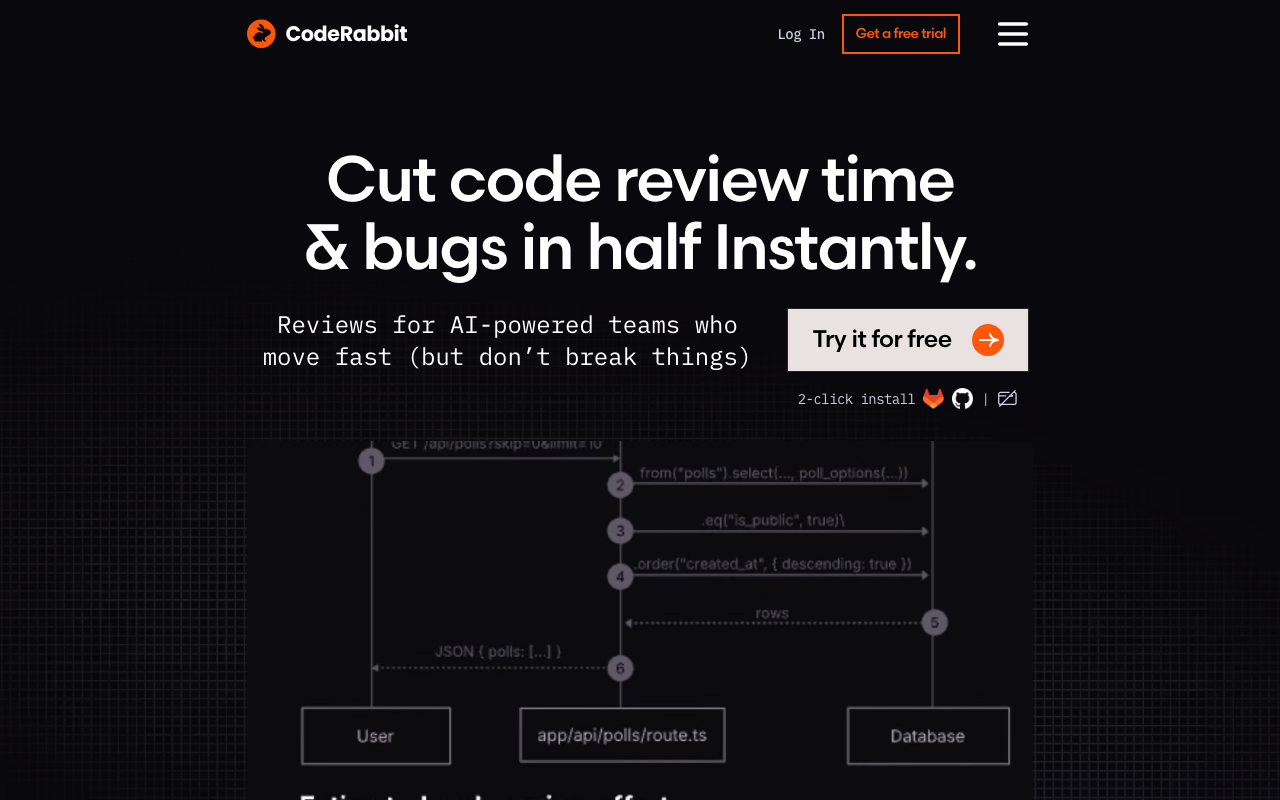
CodeRabbit is the most widely installed AI code review application, with 2M+ repos connected and 13M+ PRs reviewed. It uses LLMs to understand code semantics, not just patterns. Reviews land in 2-4 minutes with inline comments, auto-fix suggestions, and structured PR summaries. The free tier covers unlimited public and private repos.
AI review quality is in a different category. Where Codacy’s AI Reviewer supplements its static analysis with some contextual suggestions, CodeRabbit’s entire product is built around AI-powered review. It reads your PR description, linked Jira or Linear tickets, repository conventions, and prior review conversations to generate comments that sound like they came from a senior developer who knows the codebase. The difference in review quality is immediately noticeable.
Natural language instructions replace complex configuration. Instead of learning a rule configuration language, you tell CodeRabbit what to check for in plain English. Instructions like “always verify database queries use parameterized inputs” or “flag React components that do not handle loading states” work directly. This makes the tool accessible to every developer on the team, not just those who understand static analysis rule syntax.
Learnable preferences reduce noise over time. CodeRabbit tracks which suggestions your team accepts and which they dismiss. Over weeks, the tool learns your team’s coding style and preferences, generating increasingly relevant feedback. This learning loop does not exist in Codacy’s static rules or even in its AI Reviewer.
Why switch from Codacy: If AI-powered review quality is your top priority, CodeRabbit is in a different league. Its natural language instruction system, learnable preferences, and contextual analysis go far beyond what Codacy’s AI Reviewer provides. Supports Azure DevOps, which Codacy does not. The free tier with unlimited repos makes it easy to evaluate.
Why stay with Codacy: CodeRabbit is only a review tool. It does not offer SAST, SCA, DAST, secrets detection, coverage tracking, or quality gates. At $24/user/month for review-only, it is more expensive per feature than Codacy’s $15/user/month all-in-one. You would need additional tools to match Codacy’s breadth. Most teams that adopt CodeRabbit use it alongside a static analysis tool like SonarQube, Qlty, or even Codacy itself.
Pricing: Free (unlimited public and private repos, rate-limited). Pro $24/user/month. Enterprise custom.
4. Semgrep - Best for Custom Security Rules
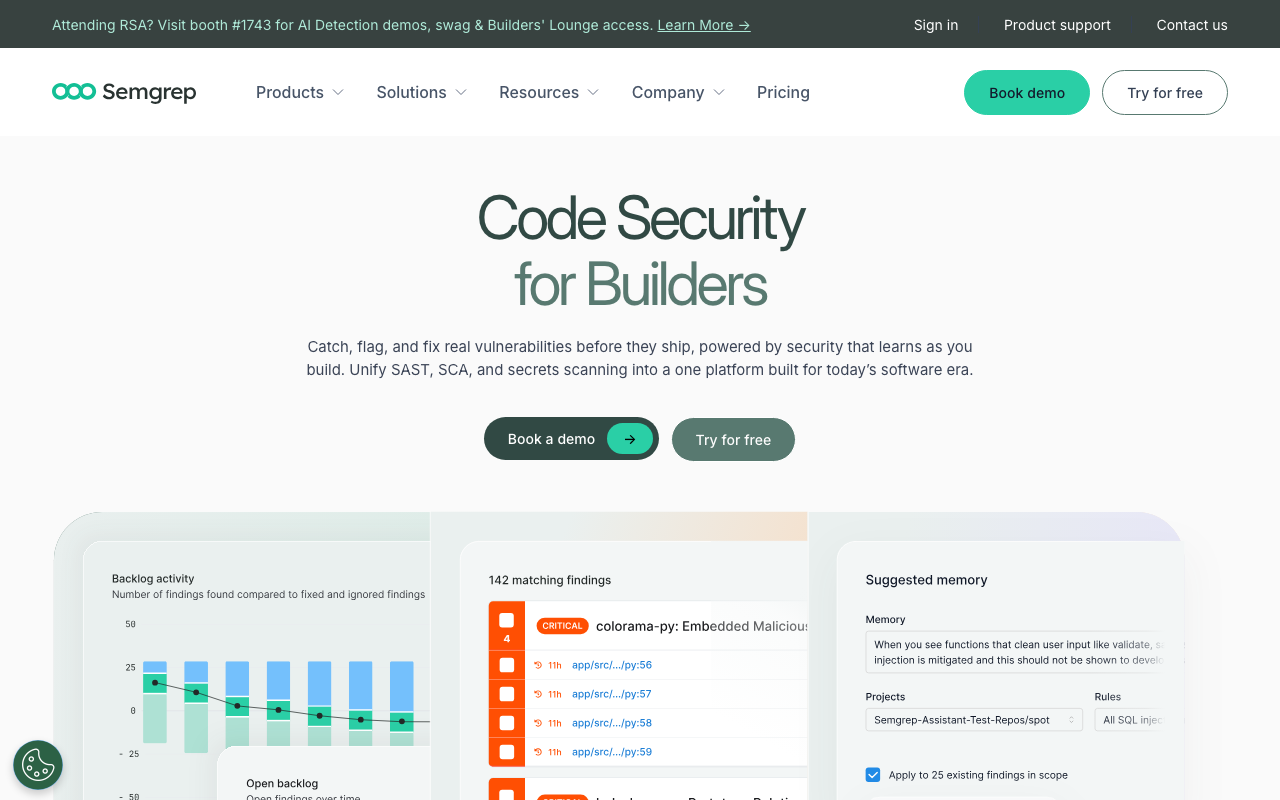
Semgrep takes a fundamentally different approach to security scanning. Instead of relying on a fixed rule set maintained by a vendor, it lets developers write custom detection rules using syntax that mirrors the source code being scanned. This means a Python developer can write a Semgrep rule that looks like Python, a Java developer writes rules that look like Java, and so on. Rules that take hours in traditional SAST tools take minutes in Semgrep.
The custom rule engine is unmatched. No other tool in this comparison comes close to Semgrep’s rule authoring experience. You can encode organization-specific security policies, architecture constraints, and internal coding standards as Semgrep rules and enforce them in every PR. The Semgrep Registry contains 20,000+ community and Pro rules that cover common patterns, but the real power is in writing rules tailored to your codebase.
Cross-file dataflow analysis catches complex vulnerabilities. Semgrep Pro tracks how data flows across multiple files and functions, catching vulnerabilities like second-order SQL injection where tainted input enters through one file and reaches a query in another. This analysis catches 72-75% of vulnerabilities in benchmark tests versus single-file tools that miss multi-file data flow chains. The median scan time remains at 10 seconds in CI even with cross-file analysis enabled.
Semgrep Assistant reduces triage workload. The AI-powered assistant analyzes findings and provides context on whether they represent real risks or false positives, reducing triage workload by 20-40% on day one. For teams that have experienced alert fatigue with other tools - including Codacy - this automated triage is a significant quality-of-life improvement.
Why switch from Codacy: You need deeper, more customizable security scanning. Semgrep’s cross-file dataflow analysis catches vulnerabilities that single-file scanners miss. The custom rule engine is essential for teams with organization-specific security policies. Free for up to 10 contributors, making it accessible for small security-conscious teams.
Why stay with Codacy: Semgrep is security-only. No code quality metrics, coverage tracking, duplication detection, or technical debt management. At $35/contributor/month for the full platform, it is more than double Codacy’s price while covering less surface area. You would need to pair it with another tool for code quality. Semgrep also lacks AI code review, DAST, and SCA in its base product.
Pricing: Free open-source engine. Team $35/contributor/month (free up to 10 contributors). Enterprise custom.
5. Qlty - Best for Polyglot Codebases
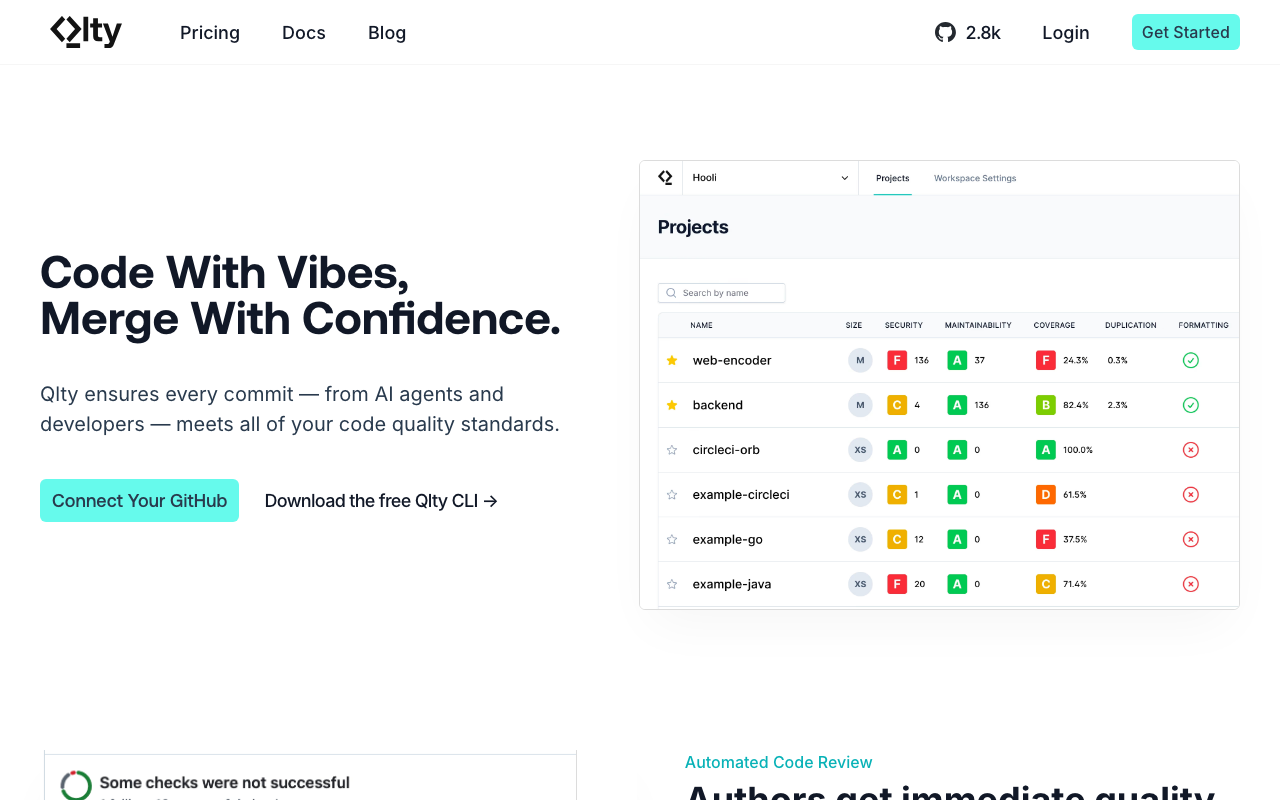
Qlty, built by the Code Climate team, packages 70+ static analysis tools into a unified CLI covering 40+ languages with 20,000+ code quality rules. The free CLI is completely unrestricted for commercial use. The Cloud platform adds maintainability grading (A-F), technical debt quantification with estimated remediation hours, and quality gate enforcement.
Breadth of analysis tool coverage is unparalleled. Where Codacy uses its own built-in analyzers, Qlty orchestrates established open-source tools - ESLint, Pylint, RuboCop, PHPStan, Clippy, and dozens more. This means you get the analysis quality of purpose-built tools for each language, not a single vendor’s interpretation of rules across all languages. For teams working with 5+ languages, the difference in analysis depth per language is noticeable.
Maintainability grading translates quality into business language. The A-F grading system makes it immediately obvious whether a module or repository is in good shape or needs attention. Engineering managers can present these grades to non-technical stakeholders without explaining what cyclomatic complexity or duplication ratios mean. Codacy provides similar metrics but lacks this simplified grading system.
Git-aware incremental analysis avoids the legacy codebase problem. Qlty only flags new issues by default, avoiding the overwhelming finding dump that occurs when importing legacy projects into Codacy. Teams can choose to address existing issues gradually through a planned remediation approach rather than being confronted with thousands of findings on day one.
Why switch from Codacy: Broader analysis tool coverage (70+ plugins versus Codacy’s built-in analyzers). The maintainability grading system translates code quality into language non-technical stakeholders understand. Git-aware incremental analysis only flags new issues, avoiding the noise problem on legacy codebases. The free CLI is more useful than Codacy’s free Guardrails extension for quality analysis.
Why stay with Codacy: Qlty lacks AI-powered review suggestions. Security scanning is less comprehensive than Codacy’s SAST/SCA/DAST suite. The analysis minutes model adds a variable cost dimension that can be unpredictable. No AI Guardrails equivalent for scanning AI-generated code in real time.
Pricing: Free (unlimited repos, 250 analysis min/month). Team $15/contributor/month. Enterprise $36/contributor/month.
6. CodeScene - Best for Technical Debt Strategy
CodeScene is the only code analysis platform that combines technical quality measurement with behavioral analysis of how teams work with their code. It analyzes Git history to find hotspots (complex code that changes frequently), knowledge silos (bus factor risks), and coordination bottlenecks. The CodeHealth metric scores files on a 1-10 scale based on 25+ research-backed factors.
Behavioral analysis reveals risks that no static analysis tool detects. Every other tool in this list analyzes your code. CodeScene also analyzes how your team interacts with the code. It identifies files where only one developer has expertise (bus factor = 1), modules where multiple teams frequently create merge conflicts, and areas where developer turnover has created knowledge gaps. These organizational risks directly impact delivery speed and bug rates but are invisible to traditional analysis tools.
Hotspot detection prioritizes refactoring for maximum impact. Not all technical debt is equally costly. A complex file that no one touches is low priority. A complex file that three developers modify every sprint is a hotspot that actively slows down your team. CodeScene’s hotspot detection, based on research by Dr. Adam Tornhill, combines complexity metrics with change frequency data from Git history to surface the files where refactoring will have the greatest return on investment.
CodeHealth trends connect quality investment to delivery outcomes. CodeScene tracks the CodeHealth metric over time and correlates it with delivery metrics like lead time and defect rates. This data helps engineering leaders make the case for refactoring sprints by showing concrete evidence that quality improvements lead to faster delivery. This is a fundamentally different conversation than “SonarQube says we have 2,000 issues.”
Why switch from Codacy: You need strategic visibility into technical debt, not just a list of findings. Hotspot detection ensures refactoring effort targets code with the highest business impact. Knowledge distribution mapping reveals organizational risks that no static analysis tool can detect. Valuable for engineering leaders who need data to justify quality investment to stakeholders.
Why stay with Codacy: CodeScene is not a traditional static analysis or security scanner. It does not replace Codacy’s SAST, SCA, or DAST capabilities. The learning curve is steeper because behavioral analysis requires understanding new concepts. AI refactoring is limited to 6 languages. Best used as a complement to a code quality platform, not a replacement.
Pricing: Free for open-source. Standard EUR 18/author/month. Pro EUR 27/author/month. Enterprise custom.
7. JetBrains Qodana - Best Budget Option
Qodana runs 3,000+ IntelliJ inspections in your CI/CD pipeline at the lowest price point in the market: $6/contributor/month for the Ultimate tier. A 50-developer team pays $300/month versus $750/month for Codacy. The defining feature is IDE consistency: results in JetBrains IDEs match exactly what the pipeline reports, eliminating the frustrating discrepancies that occur with separate tools.
IDE-pipeline consistency solves a real problem. If you have ever fixed an issue flagged by your CI scanner only to find a different issue in your IDE (or vice versa), you understand why this matters. Qodana uses the same IntelliJ inspection engine that powers JetBrains IDEs, so the rules are identical in both environments. Developers see and fix issues in their editor before they commit, and the CI pipeline confirms the same set of rules. Zero discrepancies.
JVM language depth rivals any tool on this list. For Java, Kotlin, Scala, and Groovy, Qodana’s inspection depth is exceptional. The IntelliJ platform has invested decades in JVM language analysis, and that depth shows. If your team primarily works in JVM languages and uses JetBrains IDEs, Qodana provides analysis quality that matches or exceeds more expensive alternatives.
The 60-day free trial is generous. Unlike Codacy, which does not offer a trial for its Pro plan, Qodana gives you 60 days to evaluate the full Ultimate tier. This is enough time to integrate it into your CI pipeline, tune the configuration, and assess the analysis quality on your actual codebase.
Why switch from Codacy: Budget is your primary constraint and your team uses JetBrains IDEs. At $6/month versus $15/month per user, the savings are substantial - a 50-developer team saves $5,400/year. For JVM languages (Java, Kotlin, Scala, Groovy), Qodana’s inspection depth rivals or exceeds Codacy.
Why stay with Codacy: Qodana has no AI-powered review capabilities. Analysis depth varies significantly by language outside the JVM ecosystem. Smaller community and ecosystem. No DAST, SCA, or secrets detection. Limited integrations outside the JetBrains ecosystem. Teams using VS Code or other editors will not get the IDE-pipeline consistency benefit.
Pricing: Free Community (limited). Ultimate $6/contributor/month. Ultimate Plus $15/contributor/month.
8. Snyk Code - Best for Security-First Teams
Snyk Code is the most comprehensive developer-first security platform, covering SAST, SCA, container security, IaC scanning, and cloud security in a single subscription. Named a Gartner Magic Quadrant Leader for AST in 2025, Snyk has established itself as the default choice for teams that prioritize security above all else.
The DeepCode AI engine goes beyond pattern matching. Snyk’s SAST engine performs interfile data flow analysis, tracing how potentially dangerous data moves through your application across multiple files and functions. It is trained on over 25 million data flow cases from open-source projects. When it finds a vulnerability, it generates an AI-powered fix suggestion trained on curated human remediation patterns. This means you get not just the vulnerability report but a ready-to-apply fix.
SCA with reachability analysis eliminates dependency noise. Most SCA tools flag every known CVE in your dependency tree, including vulnerabilities in code paths your application never calls. Snyk’s reachability analysis determines whether your application actually uses the vulnerable functions, dramatically reducing false positives. The vulnerability database updates within 24 hours of new CVE disclosures, and Snyk automatically generates PRs to upgrade affected dependencies.
Container and IaC scanning cover your full stack. Snyk Container analyzes Docker images for vulnerabilities in base images and installed packages. Snyk IaC scans Terraform, CloudFormation, Kubernetes manifests, and ARM templates for misconfigurations. This full-stack security coverage means your infrastructure is protected alongside your application code - something Codacy does not offer.
Why switch from Codacy: Security is your primary concern and you need deeper coverage than Codacy provides. Snyk’s reachability analysis for SCA eliminates noise from unused vulnerable code paths. Container and IaC scanning cover infrastructure that Codacy does not touch. AI auto-fix is trained on curated human remediation patterns. Gartner Magic Quadrant Leader status provides procurement confidence in enterprise settings.
Why stay with Codacy: Snyk is security-only. No code quality metrics, coverage tracking, or technical debt management. At $25/dev/month, it costs more than Codacy while covering less surface area in terms of code quality. Minimum 5 developers on the Team plan. Enterprise pricing can reach $67K-$90K for 100 developers. If you need quality and security in one tool, Codacy provides both.
Pricing: Free (100 SAST tests/month, 400 SCA tests). Team $25/dev/month (min 5 devs). Enterprise custom (~$670-$900/dev/year).
9. Pixee - Best for Automated Remediation
Pixee does not detect new issues. It fixes the ones your existing tools already found. It ingests findings from SonarQube, Snyk, Semgrep, or Codacy, triages false positives (80% reduction in noise), and creates production-ready PRs with context-aware code fixes. A 76% developer merge rate validates the quality of its automated fixes, and enterprise users report a 91% reduction in remediation time.
The remediation gap is the biggest problem in code analysis. Every tool on this list is excellent at detecting issues. The industry-wide problem is that findings pile up in dashboards faster than teams can fix them. Pixee addresses this problem directly by converting findings into ready-to-merge PRs. Instead of a developer reading a vulnerability report, understanding the context, writing a fix, and testing it, Pixee generates the fix automatically with test coverage.
False positive triage saves significant developer time. Before generating fixes, Pixee analyzes findings for false positives and filters out approximately 80% of noise. This triage step alone provides value even before you merge a single Pixee-generated fix. Teams that use Pixee alongside Codacy report that the combination - Codacy for detection, Pixee for triage and remediation - is significantly more effective than Codacy alone.
The 76% merge rate is the quality metric that matters. When three out of four automated fixes are good enough to merge as-is, the tool is genuinely saving developer time rather than creating additional review work. This merge rate is higher than any other automated remediation tool on the market and reflects Pixee’s focus on generating fixes that match the existing code style and conventions of the project.
Why switch from Codacy: You already run Codacy (or another scanner) and have a growing backlog of unresolved findings. Pixee transforms your detection-only workflow into a detection-and-remediation pipeline. It is a complement to Codacy, not a replacement, and works best when paired with any detection tool.
Why stay with Codacy: Pixee does not replace any of Codacy’s detection capabilities. Language support is limited to Java, Python, JavaScript/TypeScript, C#, and Go. Pricing is not publicly available, which makes budgeting difficult. For teams that keep up with their finding backlog, Pixee adds less value.
Pricing: Free for public repos. Pro and Enterprise require sales contact.
10. CodeClimate
CodeClimate pioneered cloud-based code quality analysis in 2011 and provides maintainability grading, test coverage tracking, and engineering productivity metrics. It is simpler than Codacy but also narrower: no SAST, SCA, DAST, AI features, or AI code governance. Language support covers about 15 languages, which is smaller than Codacy’s 49.
Maintainability grading is the core value proposition. CodeClimate assigns A-F grades to files and repositories based on complexity, duplication, and code structure. These grades are easy to understand, easy to track over time, and easy to communicate to non-technical stakeholders. For teams that primarily care about code maintainability rather than security, CodeClimate provides a focused, distraction-free experience.
Engineering productivity metrics extend beyond code quality. CodeClimate’s Velocity product tracks DORA metrics (deployment frequency, lead time, change failure rate, mean time to recovery) alongside code quality data. This combination helps engineering leaders understand how code quality correlates with delivery performance - a connection that tools like Codacy do not make.
Choose CodeClimate only if engineering productivity metrics are your primary concern and you do not need security scanning, AI review, or deep static analysis. For most teams, Codacy or one of the other alternatives on this list provides more value.
Pricing: Free tier available. Paid plans from approximately $15/user/month. Velocity product priced separately.
Migration Guide: Moving Away from Codacy
Migrating from Codacy to a new tool requires careful planning to avoid disrupting your team’s workflow. Here is a practical step-by-step approach that minimizes risk.
Step 1: Audit Your Current Codacy Usage
Before selecting a replacement, document what your team actually uses in Codacy. Many teams subscribe to Codacy’s all-in-one platform but only actively use a subset of features. Identify which capabilities are critical:
- Quality gates: Are PRs blocked on Codacy findings? If so, you need a replacement that supports PR-level quality gate enforcement.
- Security scanning (SAST/SCA/DAST): Does your team actively review and remediate security findings? Or does the security dashboard go unread?
- AI review: Do developers interact with Codacy’s AI Reviewer comments? Or do they skip them?
- Coverage tracking: Is Codacy your primary coverage reporting tool? If so, you need an alternative that integrates with your coverage framework.
- Custom configurations: Have you spent time tuning rules, ignoring patterns, and configuring quality standards? This configuration investment will need to be replicated.
Step 2: Run the New Tool in Parallel
Do not remove Codacy until you have confirmed the replacement works for your team. Run both tools simultaneously for 2-4 weeks. This parallel period lets you:
- Compare finding quality (false positive rates, missed issues, actionability)
- Verify CI/CD integration reliability
- Assess developer adoption and satisfaction
- Identify feature gaps you did not anticipate
Step 3: Migrate Configurations Gradually
If you have invested time configuring Codacy’s rules and ignore patterns, replicate that configuration in your new tool. Most alternatives provide similar configuration mechanisms:
- SonarQube uses quality profiles and quality gates
- DeepSource uses
.deepsource.tomlconfiguration files - Semgrep uses
.semgrep.yamlrule files - Qlty uses
.qlty.tomlconfiguration - CodeRabbit uses
.coderabbit.yamlor web dashboard settings
Step 4: Communicate the Change to Your Team
Switching code analysis tools affects every developer’s daily workflow. Announce the change, explain the reasoning (be specific about which Codacy pain points you are addressing), and provide documentation or training for the new tool. Resistance to tool changes is natural; clear communication about the benefits reduces friction.
Step 5: Decommission Codacy
Once your team is comfortable with the replacement and all critical workflows are migrated, remove the Codacy integration from your repositories. Cancel the subscription and archive any Codacy-specific configuration files in your repositories.
Decision Framework: Which Alternative Is Right for You?
Choosing the right Codacy alternative depends on identifying your primary pain point. Use this framework to narrow down the options quickly.
If your problem is false positive noise…
Go with DeepSource. Its sub-5% false positive rate is the lowest in the industry. The five-dimension report card and Autofix AI further reduce the time developers spend on analysis results. The premium ($30/user/month vs. $15/user/month) is justified by the signal quality improvement.
If your problem is shallow AI review…
Go with CodeRabbit. It is not a replacement for Codacy - it is a complement. The most effective setup is CodeRabbit for AI-powered review alongside a static analysis tool (SonarQube, Qlty, or even Codacy) for deterministic quality gates and metrics. The free tier makes it easy to evaluate.
If your problem is security depth…
Go with Semgrep for customizable SAST or Snyk Code for comprehensive security coverage. Semgrep excels at custom rules and is free for up to 10 contributors. Snyk provides the broadest security coverage with SAST, SCA, container, and IaC scanning. Both are security-focused tools that pair well with a code quality platform.
If your problem is budget…
Go with Qodana at $6/contributor/month for JetBrains IDE teams, or Qlty CLI for free quality analysis across 40+ languages. Qodana saves 60% compared to Codacy. Qlty’s free tier is unrestricted for commercial use.
If your problem is technical debt visibility…
Go with CodeScene. No other tool provides behavioral analysis, hotspot detection, and knowledge distribution mapping. Use it alongside a static analysis tool, not instead of one. The ROI is highest for engineering leaders who need data to justify quality investments.
If your problem is a growing finding backlog…
Go with Pixee. It works with your existing tools - including Codacy - to convert findings into ready-to-merge PRs. The 76% merge rate means most fixes require no manual intervention.
If you need everything Codacy does, just better…
There is no single tool that replaces Codacy’s breadth at the same price. The closest option is running two tools together: a static analysis platform (SonarQube, DeepSource, or Qlty) for code quality plus a security tool (Semgrep or Snyk) for deeper security coverage. This combination costs more than Codacy but delivers better results in both dimensions.
Recommendations by Use Case
For teams that need everything in one place (Codacy’s strength): Stay with Codacy or switch to DeepSource if false positive noise is the main complaint. DeepSource costs more but delivers dramatically better signal quality. If budget allows, adding CodeRabbit for AI review on top of either platform creates the strongest combined experience.
For enterprise teams needing deeper analysis: SonarQube provides the deepest rule coverage, strongest quality gate enforcement, and compliance reporting. Expect to invest in DevOps resources for setup and maintenance. The Enterprise Edition covers legacy languages that no other tool on this list supports.
For teams wanting the best AI review: CodeRabbit paired with Codacy (or SonarQube or Qlty for static analysis). CodeRabbit handles contextual AI review; the other tool handles deterministic quality gates and metrics. This pairing is the most popular combination we see in practice.
For security-first teams: Semgrep for customizable SAST with the best developer experience, or Snyk Code for comprehensive coverage across SAST, SCA, containers, and IaC. Both are security-focused tools that you would pair with a code quality platform. Semgrep’s free tier for up to 10 contributors makes it the more accessible starting point.
For budget-conscious teams: Qodana at $6/contributor/month if you use JetBrains IDEs. Qlty CLI for free linting and quality analysis across 40+ languages. Both provide substantial value at a fraction of Codacy’s cost, though with narrower feature sets.
For engineering leaders focused on technical debt: CodeScene for behavioral analysis, hotspot detection, and data-driven refactoring prioritization. Best used alongside a static analysis tool, not instead of one. The investment pays off most when you need to present technical debt data to non-technical stakeholders.
For teams drowning in scanner findings: Pixee to automatically generate fixes for your existing backlog. Works with Codacy, SonarQube, Snyk, or Semgrep findings. The 76% merge rate means three out of four generated PRs are ready to merge without modification.
Conclusion
Codacy occupies a valuable sweet spot as an all-in-one platform, and for many small to mid-size teams, it remains the right choice. The $15/user/month pricing with unlimited scans, 49-language support, and SAST/SCA/DAST/secrets detection is hard to beat on a features-per-dollar basis.
But if Codacy’s AI review feels shallow, switch to CodeRabbit for AI review and pair it with your static analysis tool of choice. If false positives are the problem, DeepSource delivers the cleanest signal in the market. If you need enterprise-grade rule depth and compliance, SonarQube is the benchmark. If security is the priority, Semgrep or Snyk Code go deeper than any general-purpose platform. And if budget is the constraint, Qodana at $6/month or Qlty with its free CLI provide compelling value.
The best approach is to identify your biggest pain point with Codacy and pick the tool that solves that specific problem. No single alternative matches Codacy’s breadth at the same price, but every alternative on this list beats Codacy in its area of specialization. The right choice depends on which dimension matters most to your team.
Related Articles
10 Best Checkmarx Alternatives for SAST in 2026
Checkmarx too expensive or complex? Compare 10 SAST alternatives with real pricing ($0 to $100K+/year), scan speed benchmarks, developer experience ratings, and migration tips. Free and paid options included.
March 12, 2026
alternatives10 Best DeepSource Alternatives for Code Quality (2026)
Looking beyond DeepSource for code quality? Compare 10 alternatives with real pricing, feature matrices, deeper analysis, and stronger security. Find the right tool for your team.
March 12, 2026
alternatives10 Best GitHub Copilot Alternatives for Code Review (2026)
GitHub Copilot lacks deep code review. Compare 10 alternatives with better PR analysis, security scanning, and review automation. Includes pricing, feature comparison, and migration tips.
March 12, 2026