Codacy vs SonarQube: Code Quality Platforms Compared (2026)
Codacy vs SonarQube - pricing, language support, SAST depth, AI features, and self-hosted options. Honest comparison with recommendations for every team.
Published:
Last Updated:
Quick Verdict
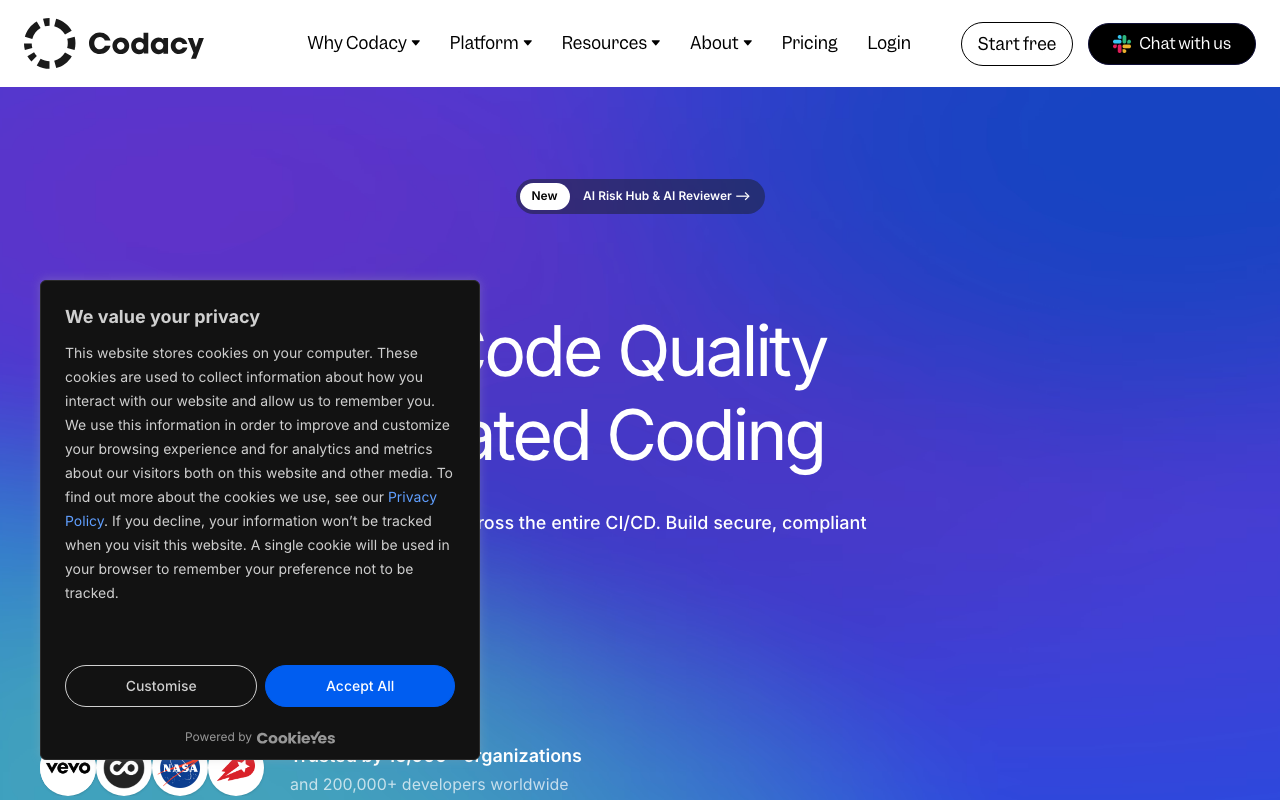
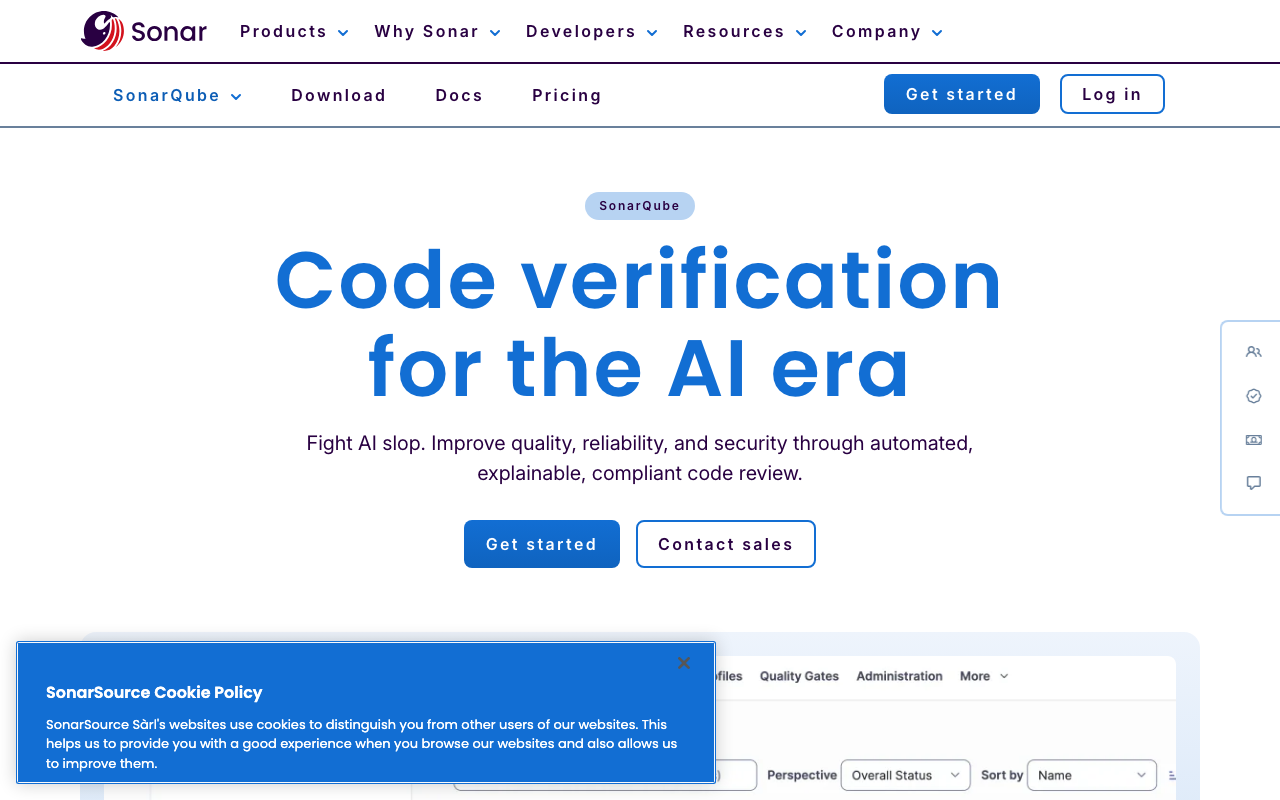
Codacy and SonarQube are the two most commonly compared code quality platforms in 2026. Both provide static analysis, security scanning, quality gates, and PR-level feedback. The difference lies in depth versus breadth and simplicity versus control. SonarQube has the deepest deterministic rule engine in the market (6,500+ rules across 35+ languages), the most mature quality gate enforcement system, and a self-hosted deployment option trusted by 7 million developers. Codacy packages code quality, SAST, SCA, DAST, secrets detection, coverage tracking, and AI-powered review into a single cloud-native platform with predictable per-user pricing and a setup experience that takes minutes instead of hours.
Choose Codacy if: you want a single platform that covers code quality, security scanning (SAST, SCA, DAST, secrets), coverage tracking, and AI-powered review at $15/user/month. You value fast setup, predictable costs, and AI Guardrails for scanning AI-generated code in the IDE. You do not need legacy language support or self-hosted deployment at the team level.
Choose SonarQube if: you need the deepest deterministic rule coverage, self-hosted deployment for data sovereignty, enterprise compliance reporting (OWASP, CWE, SANS, MISRA), and support for 35+ languages including COBOL, ABAP, and PL/SQL. You have DevOps resources for server setup and maintenance, and you prioritize rule depth and quality gate enforcement over breadth of security features.
If budget and team size allow: Consider running one of these platforms alongside a complementary tool rather than trying to do everything with a single product. Pairing SonarQube with CodeRabbit for AI review, or pairing Codacy with Semgrep for deeper SAST, gives you better coverage than any single tool alone. But if you must pick exactly one platform, this comparison will help you make the right call.
At-a-Glance Comparison
| Category | Codacy | SonarQube |
|---|---|---|
| Primary focus | All-in-one code quality + security | Code quality + security (quality-first) |
| Analysis rules | Embedded engines across 49 languages | 6,500+ deterministic rules across 35+ languages |
| SAST | Yes (built-in) | Yes (taint analysis in Developer+ editions) |
| SCA (dependency scanning) | Yes (Pro plan) | Advanced Security add-on (Enterprise) |
| DAST | Yes (ZAP-powered, Business plan) | No |
| Secrets detection | Yes | Yes (400+ patterns) |
| AI code review | AI Reviewer (hybrid rule + AI) | AI CodeFix (newer, less mature) |
| AI code governance | AI Guardrails (free IDE extension) | AI Code Assurance |
| Quality gates | Customizable thresholds | Best-in-class enforcement |
| Technical debt tracking | Quality dashboards and trends | Remediation time estimates + trend charts |
| Code coverage | Yes | Yes |
| Duplication detection | Yes | Yes |
| IDE integration | VS Code, Cursor, Windsurf (Guardrails) | SonarLint (VS Code, JetBrains, Eclipse, Visual Studio) |
| Git platforms | GitHub, GitLab, Bitbucket | GitHub, GitLab, Bitbucket, Azure DevOps |
| Self-hosted | Business plan only (~2.5x cloud cost) | Core offering (Community Build is free) |
| Free tier | AI Guardrails IDE extension | Community Build (self-hosted) + Cloud Free (50K LOC) |
| Starting paid price | $15/user/month (Pro) | EUR 30/month (Cloud Team) or ~$2,500/year (Server Developer) |
| Pricing model | Per active user | Lines of code (Server) or LOC tiers (Cloud) |
| Setup time | Under 10 minutes | Minutes (Cloud) to full day (self-hosted Server) |
| User base | 15,000+ orgs, 200K+ devs | 7M+ developers, 400K+ orgs |
Code Quality Analysis
Rule Engine Depth
This is the dimension where the gap between the two tools is widest. SonarQube’s rule engine contains over 6,500 deterministic rules, with language-specific rule sets that go remarkably deep. Java alone has over 900 rules covering null pointer dereferences, resource leaks, thread safety violations, incorrect API usage, and hundreds of other patterns. Python, JavaScript/TypeScript, C#, C++, and Go each have similarly deep rule sets. Every rule is documented with compliant and non-compliant code examples, remediation guidance, and severity classification. The rules are not generic pattern matches - they are language-specific analysis that understands the idioms, conventions, and common pitfalls of each ecosystem.
Codacy takes a different approach. Rather than building a single massive rule engine, Codacy embeds multiple third-party analysis engines and wraps them in a unified interface. The platform runs tools like ESLint, Pylint, PMD, SpotBugs, Bandit, Brakeman, Gosec, and dozens of other language-specific analyzers across its 49 supported languages. This gives Codacy broad coverage, but the depth of analysis per language depends on the capabilities of the embedded engine rather than a purpose-built rule set. The practical result is that Codacy catches the most common and impactful issues effectively, but SonarQube’s proprietary rules catch deeper, more subtle problems - especially in languages like Java and C# where SonarSource has invested years of engineering effort.
The practical impact: For most teams working in mainstream languages, both tools catch the vast majority of real bugs and quality issues. The difference shows up at the margins - SonarQube catches more obscure patterns like complex resource leaks across try-catch-finally blocks, thread safety violations in concurrent data structures, and subtle API misuse that only manifests under specific conditions. Teams that care about exhaustive static analysis coverage need SonarQube. Teams that want “good enough” coverage with less operational overhead often find Codacy sufficient.
Quality Gates
Quality gates are arguably SonarQube’s most important feature and the primary reason enterprise teams adopt the platform. A quality gate is a set of conditions that code must meet before it can be merged or deployed. Typical conditions include: minimum code coverage percentage on new code, zero new bugs above a severity threshold, duplication below a percentage limit, and technical debt ratio within acceptable bounds. When a pull request fails the quality gate, SonarQube blocks the merge and posts the failing conditions directly in the PR through PR decoration on GitHub, GitLab, Bitbucket, or Azure DevOps. In GitHub, teams configure branch protection rules to require the SonarQube quality gate to pass, creating an automated enforcement mechanism that prevents code quality from degrading over time.
SonarQube’s quality gate implementation is the most mature in the market. The conditions are highly configurable, can be applied per-project or across portfolios, and the enforcement is deterministic - there is no ambiguity about whether code passes or fails. Engineering managers consistently cite quality gates as the feature that delivers the most long-term value, because they create a behavioral feedback loop: developers write cleaner code proactively because they know the gate will catch problems.
Codacy also offers quality gates with customizable thresholds. Teams can set conditions for code coverage, complexity, issue count, and duplication that block non-compliant PRs. The quality gates work out of the box and do not require separate CI/CD configuration. However, the sophistication and granularity of Codacy’s quality gates do not match SonarQube’s. SonarQube allows more fine-grained conditions, supports different quality gates for different projects within the same organization, and integrates more deeply with enterprise compliance workflows. For teams that need basic quality enforcement, Codacy’s gates are adequate. For teams that need enterprise-grade enforcement with compliance audit trails, SonarQube’s gates are substantially stronger.
Code Coverage and Duplication
Both tools track code coverage and detect duplication, and the capabilities are broadly comparable. SonarQube displays coverage metrics on the project dashboard, tracks coverage trends over time, and can enforce minimum coverage on new code through quality gates. It parses coverage reports from most common testing frameworks and supports both line coverage and condition coverage. Codacy similarly tracks coverage, integrates with standard coverage report formats, and includes coverage thresholds in its quality gates.
For duplication detection, both tools identify copy-paste code across the codebase. SonarQube provides a duplication percentage metric, highlights the specific duplicated blocks, and tracks duplication trends. Codacy offers the same basic capability through its embedded analysis engines.
The meaningful difference is in the depth of coverage analysis rather than the presence of the feature. SonarQube’s coverage reporting includes condition coverage (not just line coverage), correlates coverage gaps with complexity hotspots, and presents this data in the context of technical debt remediation estimates. Codacy’s coverage tracking is more straightforward - it shows the metrics and enforces the thresholds, but the analytical depth is shallower.
Technical Debt Tracking
SonarQube quantifies technical debt as estimated remediation time - the total hours required to fix all identified issues. This metric is tracked over time and broken down by project, module, language, and severity. The trend charts on the dashboard show whether your codebase is improving or degrading, making technical debt management a data-driven process. The Enterprise Edition adds portfolio management that aggregates technical debt across multiple projects, providing executive-level visibility into organizational code health. For engineering managers who need to report metrics to leadership, this capability is difficult to replicate with any other tool.
Codacy provides quality dashboards and trend tracking that show issue density, coverage changes, and security findings over time. The dashboards are clean and actionable for team-level use. However, Codacy does not estimate remediation time for individual issues the way SonarQube does, and it does not provide the portfolio-level aggregation that SonarQube Enterprise offers. For teams that need to answer “how many engineering hours would it take to fix our technical debt?” with a concrete number, SonarQube provides that answer and Codacy does not.
Security Scanning
SAST Depth
Both Codacy and SonarQube provide SAST capabilities, but the depth and approach differ significantly.
SonarQube’s security rules cover OWASP Top 10, CWE Top 25, and SANS Top 25 vulnerability categories. Approximately 15% of its 6,500+ rules are security-focused, which translates to roughly 1,000 security rules - a substantial number. The Developer Edition and above include taint analysis, which tracks the flow of data through the application to detect injection vulnerabilities that span multiple methods or classes. This is critical for catching SQL injection, XSS, and other injection attacks where the tainted input enters the application in one function and reaches a dangerous sink several layers deeper. SonarQube’s security analysis is deterministic and auditable - every finding traces to a documented rule, making it suitable for compliance workflows.
Codacy’s SAST engine runs across 49 languages using a combination of embedded analyzers. For security-specific analysis, Codacy integrates engines that detect injection flaws, authentication issues, cryptographic weaknesses, insecure data handling, and other common vulnerability patterns. The results integrate directly into pull requests as inline comments with severity ratings and remediation guidance. Codacy’s SAST coverage is effective for common vulnerability patterns but does not match the depth of SonarQube’s taint analysis for complex, multi-file vulnerability chains.
Bottom line on SAST: SonarQube’s security analysis is deeper per vulnerability class, especially for injection attacks requiring data flow analysis across multiple files. Codacy’s SAST is broader in language coverage and adequate for common vulnerability detection. Teams in regulated industries or those processing highly sensitive data should lean toward SonarQube (or a dedicated security tool like Semgrep or Snyk Code) for SAST depth.
Software Composition Analysis (SCA)
This is an area where Codacy has a meaningful advantage over SonarQube for most teams.
Codacy includes SCA in its Pro plan at $15/user/month. It scans dependency manifests (package.json, requirements.txt, pom.xml, and others) to identify known vulnerabilities in open-source packages, tracks CVEs across the dependency tree, and alerts teams to newly disclosed vulnerabilities. This is available to every paying Codacy customer without additional licensing.
SonarQube added SCA capabilities in 2025 through its Advanced Security add-on. This extension provides dependency vulnerability scanning, malicious package detection, license compliance checking, and SBOM generation in CycloneDX and SPDX formats. However, Advanced Security is only available for SonarQube Server Enterprise Edition and SonarQube Cloud Enterprise - meaning it requires either the $20,000+/year Enterprise tier or the enterprise cloud subscription. Teams on the Developer Edition or Cloud Team plan do not have access to SCA at all.
The accessibility gap is significant. A 20-developer team on Codacy Pro pays $3,600/year and gets SCA included. The same team would need to be on SonarQube Enterprise (starting at $20,000/year) to get comparable SCA functionality. For organizations already on SonarQube Enterprise, the Advanced Security add-on is a natural extension. For everyone else, Codacy’s included SCA or a dedicated tool like Snyk Code is the more practical path.
Neither Codacy nor SonarQube matches the SCA depth of dedicated dependency scanning platforms. Snyk’s reachability analysis, which determines whether vulnerable code paths in your dependencies are actually called by your application, is not available in either tool. But for teams that want basic-to-moderate SCA without adding another vendor, Codacy’s included offering is more accessible than SonarQube’s gated add-on.
DAST and Secrets Detection
Codacy offers DAST (Dynamic Application Security Testing) powered by ZAP on its Business plan. DAST scanning tests running applications for vulnerabilities by sending requests and analyzing responses, catching issues like authentication bypasses, configuration errors, and runtime injection attacks that static analysis cannot detect. This is a genuinely differentiating capability - SonarQube does not offer DAST at all. Teams that need DAST alongside static analysis would need to add a separate tool if they use SonarQube, but get it built into Codacy (albeit on the higher-tier Business plan).
Both tools provide secrets detection. SonarQube detects 400+ secret patterns, including API keys, database passwords, authentication tokens, and private certificates. Codacy also scans for accidentally committed secrets across repositories. Both tools surface these findings in pull requests to prevent secrets from being merged. The coverage is broadly comparable, with SonarQube’s 400+ pattern count suggesting slightly broader coverage, but neither tool should be considered a replacement for dedicated secrets management solutions like GitGuardian or TruffleHog for organizations with strict secrets management requirements.
SBOM Generation
SonarQube’s Advanced Security add-on includes SBOM (Software Bill of Materials) generation in both CycloneDX and SPDX formats. This is increasingly important for compliance with regulatory requirements like the US Executive Order on Cybersecurity and the EU Cyber Resilience Act. Codacy does not currently offer SBOM generation. For organizations that need to produce SBOMs as part of their compliance workflow, this is a point in SonarQube’s favor - assuming the organization is on the Enterprise tier that includes Advanced Security.
AI Features Comparison
Codacy’s AI Capabilities
Codacy has made AI code governance a central pillar of its platform through three interconnected features.
AI Guardrails is a free IDE extension for VS Code, Cursor, and Windsurf that scans every line of code - both human-written and AI-generated - in real time. Using MCP (Model Context Protocol) technology, Guardrails integrates directly with AI assistants to catch and auto-remediate security and quality issues before code is even committed. The auto-fix capability means issues are detected and remediated before the code is printed to the editor. This is not a paid feature - any developer can install and use Guardrails at zero cost, making it one of the most accessible AI code governance tools available.
AI Reviewer is a hybrid code review engine that combines deterministic, rule-based static analysis with context-aware AI reasoning. It draws context from changed files, PR metadata, and optionally associated Jira tickets to produce more accurate feedback than purely rule-based or purely AI-driven approaches. It detects critical functions without unit tests, flags overly complex functions with context-aware simplification advice, and cross-references PR descriptions against actual code changes to flag promised business logic that was not implemented.
AI Risk Hub (Business plan) provides organizational-level visibility into AI code risk, letting teams track their AI Risk Level based on progress implementing essential AI safeguards. This is valuable for engineering managers and CISOs who need to quantify how safe their AI-generated code is.
SonarQube’s AI Capabilities
SonarQube’s AI features are newer and more focused on two specific problems.
AI Code Assurance automatically detects code generated by AI coding assistants like GitHub Copilot, applies enhanced verification rules to that code, and provides a real-time quality status for projects containing AI-generated code. SonarSource reports that teams using AI Code Assurance are 24% more likely to report lower vulnerability rates and 20% more likely to report lower defect rates from AI-generated code. The approach is different from Codacy’s - rather than scanning in the IDE, AI Code Assurance works at the server level during analysis scans.
AI CodeFix generates remediation suggestions when the analysis engine identifies an issue. The suggestions are functional for straightforward issues like null check additions, resource cleanup, and simple refactoring. However, multiple reviews and comparisons note that AI CodeFix produces template-like suggestions that lack the contextual depth of AI-native tools. The fixes work for common patterns but do not demonstrate deep understanding of the surrounding code context or the developer’s intent.
Head-to-Head AI Assessment
Codacy’s AI strategy is more comprehensive and more mature. AI Guardrails provides real-time IDE scanning that catches issues before they reach a commit. AI Reviewer provides context-aware PR analysis. AI Risk Hub provides organizational visibility. The three features form a coherent governance pipeline from IDE to PR to dashboard.
SonarQube’s AI features are additive to its core deterministic engine. AI Code Assurance is a valuable detection layer for AI-generated code, and AI CodeFix is a convenience for faster remediation. But neither feature approaches the depth of Codacy’s AI Reviewer for PR analysis, and SonarQube has no equivalent to Codacy’s free AI Guardrails IDE extension.
Bottom line: If AI code governance is a priority - and with 30-70% of code now AI-generated in many organizations, it should be - Codacy has a meaningful lead. SonarQube’s AI features are useful additions but do not constitute a comprehensive AI strategy. Teams that want the most advanced AI-powered review should consider pairing either platform with a dedicated AI reviewer like CodeRabbit, which provides deeper contextual analysis than both Codacy’s AI Reviewer and SonarQube’s AI CodeFix.
Pricing Breakdown
Codacy Pricing
| Plan | Price | What You Get |
|---|---|---|
| Developer (Free) | $0 | AI Guardrails IDE extension for VS Code, Cursor, Windsurf |
| Pro | $15/user/month | Unlimited scans, repos, LOC. AI Guardrails + AI Reviewer. SAST, SCA, secrets detection. Coverage, duplication, quality gates. GitHub, GitLab, Bitbucket integration |
| Business | Custom | Everything in Pro + DAST (ZAP-powered), AI Risk Hub, self-hosted option, SSO/SAML, audit logs, dedicated support |
SonarQube Pricing
| Plan | Price | What You Get |
|---|---|---|
| Community Build (self-hosted) | Free | Open source, 20+ languages, basic quality gates, no branch/PR analysis |
| Cloud Free | Free | Up to 50K LOC, 30 languages, branch/PR analysis, GitHub/GitLab/Bitbucket/Azure DevOps |
| Cloud Team | From EUR 30/month | Up to 100K LOC at base, full branch/PR analysis, quality gates on PRs, SonarLint connected mode |
| Developer Edition (Server) | From ~$2,500/year | 35+ languages, branch/PR analysis, PR decoration, secrets detection, taint analysis |
| Enterprise Edition (Server) | From ~$20,000/year | Portfolio management, security reports, COBOL/ABAP/PL/SQL, Advanced Security add-on available |
| Data Center Edition (Server) | Custom | High availability, horizontal scaling, component redundancy |
Side-by-Side Cost at Scale
| Team Size | Codacy Cost (Annual) | SonarQube Cost (Annual) | Notes |
|---|---|---|---|
| 5 devs (startup) | $900 (Pro) | Free (Cloud Free or Community) | SonarQube wins on free tier |
| 10 devs (100K LOC) | $1,800 (Pro) | ~$384 (Cloud Team) or ~$2,500 (Developer Server) | Cloud Team is cheapest; Codacy includes SCA |
| 20 devs (500K LOC) | $3,600 (Pro) | ~$2,500 (Developer Server) | Similar total; Codacy includes SAST+SCA+secrets |
| 50 devs (2M LOC) | $9,000 (Pro) | ~$10,000 (Developer Server) | Comparable; Codacy’s per-user model now cheaper |
| 100 devs (5M LOC) | $18,000 (Pro) | ~$35,000 (Enterprise Server) | Codacy significantly cheaper with broader security |
Key Pricing Observations
Codacy’s per-user model becomes increasingly favorable at scale. At 100 developers, Codacy Pro costs $18,000/year - roughly half of what SonarQube Enterprise Edition costs at $35,000+/year. And Codacy Pro includes SCA, secrets detection, and AI Reviewer at that price, while SonarQube Enterprise charges extra for the Advanced Security add-on that provides SCA.
SonarQube’s free tiers are more useful. The Community Build gives you a full self-hosted static analysis server at zero cost (albeit without branch analysis). Cloud Free gives you 50K LOC with branch and PR analysis. Codacy’s free tier is limited to the Guardrails IDE extension - valuable, but not a substitute for centralized repository analysis. For individuals and small teams evaluating tools, SonarQube’s free options provide more comprehensive functionality.
SonarQube’s LOC-based pricing can be unpredictable. As your codebase grows - through organic development, acquisitions, or monorepo adoption - SonarQube costs increase even if your team size stays the same. Codacy’s per-user pricing is immune to codebase growth, which provides welcome predictability for budgeting. Multiple SonarQube users on G2 have noted “aggressive pricing increases” at renewal, particularly on cloud plans.
The hidden cost of SonarQube is operations. SonarQube Server requires a database (PostgreSQL), JVM tuning, upgrade management, and ongoing monitoring. Even if the license is cheaper, the DevOps hours required for maintenance add to the effective cost. Codacy eliminates this overhead entirely as a fully managed cloud platform. For teams without dedicated DevOps resources, Codacy’s operational simplicity has a real dollar value.
CI/CD and Integration Support
Git Platform Support
| Platform | Codacy | SonarQube |
|---|---|---|
| GitHub | Yes | Yes |
| GitLab | Yes | Yes |
| Bitbucket | Yes | Yes |
| Azure DevOps | No | Yes |
SonarQube supports Azure DevOps, which Codacy does not. For teams on Azure DevOps, this is a decisive factor that eliminates Codacy from consideration entirely. For teams on GitHub, GitLab, or Bitbucket, both tools provide full support.
CI/CD Pipeline Integration
Codacy’s pipeline-less approach is its most distinctive operational advantage. Connect your repository, and Codacy begins scanning every commit and pull request automatically without any changes to your CI/CD configuration. There is no YAML to write, no scanner to install, and no build step to add. Analysis runs on Codacy’s infrastructure. For teams that want advanced features like code coverage tracking, CI/CD integration is needed to upload coverage reports, but the core scanning experience requires zero pipeline configuration.
SonarQube requires scanner configuration. For SonarQube Cloud, teams add the SonarScanner to their CI/CD pipeline. For SonarQube Server, the setup involves configuring the scanner, setting project keys, and establishing authentication between the CI runner and the SonarQube server. SonarSource provides official integrations for GitHub Actions, GitLab CI, Azure Pipelines, Jenkins, Maven, Gradle, and .NET, which streamlines the process. But there is inherently more setup than Codacy’s approach.
The tradeoff is control versus convenience. SonarQube’s explicit CI/CD integration gives teams precise control over when analysis runs, what code is scanned, and how results are reported. Codacy’s implicit integration is faster to set up but offers less fine-grained control. For most teams, Codacy’s approach is sufficient. For teams with complex build pipelines or specific scan timing requirements, SonarQube’s explicit integration is an advantage.
PR Decoration and Feedback
Both tools decorate pull requests with analysis results, but the implementation differs.
SonarQube posts quality gate status (pass/fail) along with a summary of new issues, coverage changes, and duplication changes directly in the PR. In GitHub, the quality gate status can be configured as a required check through branch protection rules, creating a hard block on merging non-compliant code. The PR decoration is clean and informative, showing exactly which quality gate conditions passed or failed.
Codacy posts inline comments on specific lines of code, highlighting issues with severity ratings, descriptions, and suggested fixes. The AI Reviewer adds context-aware feedback that goes beyond individual rule violations to consider the PR as a whole. Quality gate results are also posted as PR status checks. The inline commenting approach means developers see issues directly on the lines they changed, which some teams prefer over a summary-level quality gate status.
Both approaches are effective. SonarQube’s approach is more structured and compliance-friendly. Codacy’s approach is more developer-friendly with inline issue context. The best experience depends on whether your team values strict gate enforcement (SonarQube) or inline issue context (Codacy).
Build System Support
SonarQube has broader build system integration through dedicated plugins for Maven, Gradle, .NET/MSBuild, and Ant, plus a standalone CLI scanner for other environments. The SonarLint IDE plugin provides pre-commit feedback. The ecosystem is extensive and well-documented after over a decade of development.
Codacy supports GitHub Actions, GitLab CI, Bitbucket Pipelines, and other CI/CD systems for coverage upload and advanced scanning configurations. The CLI tool provides flexibility for custom integrations. However, the depth of build system-specific plugins does not match SonarQube’s breadth.
Self-Hosted vs Cloud Options
SonarQube: Self-Hosted as a Core Strength
Self-hosted deployment is fundamental to SonarQube’s value proposition. The Community Build is free and open source, allowing any organization to deploy a SonarQube server on their own infrastructure. Commercial editions (Developer, Enterprise, Data Center) add features while maintaining the self-hosted model. The Data Center Edition provides high availability with horizontal scaling for mission-critical deployments.
For organizations in regulated industries - government, defense, financial services, healthcare - the ability to keep all code and analysis data within their own network is often a non-negotiable requirement. SonarQube has been meeting this requirement for over a decade, with battle-tested deployment patterns, extensive documentation, and a large community of self-hosted users.
SonarQube Cloud (formerly SonarCloud) provides the managed SaaS alternative for teams that do not need or want self-hosted infrastructure. The analysis engine is the same, and SonarQube Cloud typically receives new features before the Server editions.
Codacy: Cloud-First with Self-Hosted Option
Codacy is cloud-native by default. The standard deployment model is fully managed SaaS - Codacy handles all infrastructure, scaling, and maintenance. This is the deployment model available on the Pro plan at $15/user/month.
Self-hosted deployment is available on Codacy’s Business plan at custom pricing. Users have reported that on-premises pricing is approximately 2.5x the hosted license cost per seat. This means a team of 20 developers paying $3,600/year for cloud-hosted Codacy Pro would pay roughly $9,000/year for self-hosted Codacy Business (before accounting for additional Business plan features). The self-hosted option exists, but it is clearly positioned as an add-on for organizations that specifically require it, not as a core deployment model.
Which Deployment Model Fits Your Organization?
If data sovereignty is a hard requirement: SonarQube is the clear choice. The free Community Build alone provides a self-hosted static analysis server, and the commercial editions have a decade-long track record in air-gapped and highly regulated environments. Codacy’s self-hosted option is available but newer, less battle-tested, and significantly more expensive relative to its cloud pricing.
If cloud deployment is acceptable: Both tools offer capable cloud platforms. SonarQube Cloud Free provides a generous starting point (50K LOC with branch analysis). Codacy Pro provides the full platform at $15/user/month with no LOC cap. The choice between them depends on the other factors covered in this comparison rather than the deployment model.
If you currently self-host SonarQube and are considering migration: Moving from SonarQube Server to Codacy Cloud means losing self-hosted data control but gaining operational simplicity, SCA, DAST (Business plan), AI Guardrails, and potentially lower costs at scale. The trade-off is worth evaluating, but the migration should be driven by specific pain points with SonarQube rather than a general desire for change.
Language and Framework Support
Breadth of Coverage
Codacy supports 49 programming languages, which is the higher number. This includes mainstream languages (JavaScript, TypeScript, Python, Java, C#, Go, PHP, Ruby, Kotlin, Swift, Rust), niche languages (Scala, Elixir, Dart, Shell), and infrastructure languages (Terraform, Dockerfile, CloudFormation). The breadth comes from Codacy’s approach of embedding multiple third-party analyzers, each covering its target language.
SonarQube supports 35+ languages in its commercial editions (20+ in the free Community Build). The language list includes all mainstream languages plus legacy enterprise languages that Codacy does not support - COBOL, ABAP, PL/SQL, PL/I, RPG, and VB6. These languages are only available in the Enterprise Edition ($20,000+/year), but for organizations maintaining legacy codebases, SonarQube may be the only commercial tool that provides analysis for these languages.
Depth of Analysis Per Language
This is where the raw language count is misleading. SonarQube’s analysis depth per language is significantly greater than Codacy’s for the most popular languages. Java has 900+ rules in SonarQube, covering everything from basic null checks to complex thread safety patterns, resource leak detection across try-catch-finally blocks, and API-specific rules for Spring, JEE, and other frameworks. Python, JavaScript/TypeScript, C#, and C++ have similarly deep rule sets.
Codacy’s per-language depth depends on the embedded analyzer. For Python, it runs Pylint and Bandit. For JavaScript, it runs ESLint and other tools. These are capable analyzers, but each one is a general-purpose linter or security scanner - not a purpose-built analysis engine with hundreds of framework-specific rules. SonarQube’s advantage here is not small. The difference between “this code has a style violation” and “this code has a subtle resource leak that only manifests when the database connection fails during a retry” is the difference between a linter and a deep static analyzer.
Framework-Specific Analysis
SonarQube provides framework-specific rules for popular frameworks - Spring Boot, JEE, Django, Flask, React, Angular, ASP.NET, and others. These rules catch framework-specific anti-patterns, misconfigurations, and performance issues that generic rules cannot detect.
Codacy’s framework-specific analysis depends on the embedded engines. Some analyzers (like ESLint with framework plugins) provide framework-aware checking, but this is less consistent and less deep than SonarQube’s purpose-built framework rules.
Infrastructure as Code
Both tools can analyze Infrastructure as Code files. SonarQube’s Community Build includes IaC support for Terraform, Kubernetes, Docker, and CloudFormation. Codacy covers these through embedded engines. For basic IaC analysis, both tools are adequate. For deep IaC security scanning, neither tool matches dedicated IaC tools like Semgrep or Snyk IaC.
Developer Experience
Setup and Onboarding
Codacy’s setup experience is faster and simpler. Connect your GitHub, GitLab, or Bitbucket account, select repositories, and analysis begins automatically on the next pull request. There is no CI/CD configuration required for basic scanning. Total time from signup to first analysis results: under 10 minutes. This pipeline-less approach eliminates the biggest friction point in adopting a code quality tool.
SonarQube Cloud setup is reasonably straightforward - connect your Git platform account, configure the SonarScanner in your CI/CD pipeline, and analysis begins running. Total time: 30 minutes to a few hours depending on your build system complexity. SonarQube Server (self-hosted) setup is substantially more involved - provisioning a database, deploying the server, configuring authentication, installing the scanner, and tuning JVM settings. Total time: a full day of DevOps effort.
For teams that want to be running within the hour, Codacy is the decisive winner. For teams with DevOps resources that are willing to invest setup time for greater control, SonarQube’s setup overhead is a one-time cost that pays off in configuration flexibility.
IDE Integration
SonarQube’s IDE integration through SonarLint is one of the best IDE experiences in the static analysis category. SonarLint is a free plugin available for VS Code, JetBrains IDEs (IntelliJ, WebStorm, PyCharm, and others), Eclipse, and Visual Studio. It runs analysis rules in real time as developers write code. The killer feature is connected mode: when connected to a SonarQube Server or Cloud instance, SonarLint synchronizes the team’s Quality Profile so that what developers see in their IDE matches exactly what the CI pipeline will enforce. This eliminates the frustrating cycle of pushing code, waiting for CI, finding issues, and pushing fixes. Issues are caught before code is even committed.
Codacy’s IDE integration is through AI Guardrails, a free extension for VS Code, Cursor, and Windsurf. Guardrails scans code in real time - including AI-generated code - and auto-remediates issues before they are printed to the editor. The MCP integration allows AI assistants to view and fix scan results in bulk. Guardrails is specifically designed for the AI-assisted development workflow, where code is generated by tools like GitHub Copilot and needs immediate verification.
The key difference: SonarLint focuses on rule synchronization - ensuring IDE feedback matches CI enforcement. Codacy Guardrails focuses on real-time remediation - fixing issues as they are written or generated. SonarLint covers more IDEs (including Eclipse and Visual Studio). Codacy Guardrails covers the newer AI-native editors (Cursor and Windsurf). Both are free. Both are valuable. SonarLint is the better choice for teams that prioritize consistency between IDE and CI. Guardrails is the better choice for teams that prioritize catching AI-generated code issues at the earliest possible point.
PR Review Experience
Codacy’s PR experience combines deterministic analysis with AI-powered review. The AI Reviewer posts context-aware comments that consider the full PR - changed files, PR description, linked Jira tickets - and provides feedback on logic, complexity, and missing test coverage. Deterministic findings from the embedded analyzers appear as inline comments with severity ratings and fix suggestions. This dual-layer approach means developers get both concrete rule violations and higher-level AI feedback in the same PR.
SonarQube’s PR experience is more structured. The quality gate status (pass/fail) is prominently displayed, with a breakdown of new issues, coverage changes, and duplication changes. Individual findings link to detailed rule documentation with compliant and non-compliant code examples. AI CodeFix suggestions appear for some findings. The experience is less conversational than Codacy’s AI Reviewer but more deterministic and auditable.
Teams that want AI-augmented feedback prefer Codacy’s approach. Teams that want strict, auditable enforcement prefer SonarQube’s approach. Teams that want the best AI-powered PR review should consider adding CodeRabbit to either platform.
Dashboard and Reporting
SonarQube’s dashboards are more mature and more detailed. Project-level dashboards show quality ratings (A through E), technical debt in hours, coverage percentage, duplication percentage, and security hotspot counts. Trend charts show how these metrics change over time. The Enterprise Edition adds portfolio management that aggregates metrics across multiple projects, plus security compliance reports aligned to OWASP and CWE standards. Executive dashboards summarize organizational code health for leadership presentations.
Codacy’s dashboards provide team-level visibility into code quality metrics, security vulnerabilities, coverage trends, and issue density over time. The dashboards are clean and modern, but they do not match SonarQube’s depth of technical debt quantification, portfolio-level aggregation, or compliance-specific reporting. The AI Risk Hub (Business plan) adds a unique dimension that SonarQube does not cover - organizational AI code risk tracking.
For engineering managers who need to report code health metrics to executive leadership, SonarQube’s dashboards and compliance reports are more comprehensive. For team leads who need day-to-day visibility into quality trends, both tools provide adequate dashboards.
When to Choose Codacy
Small to mid-size teams (5-50 developers) wanting a single platform. Instead of assembling separate tools for code quality (SonarQube), security (Snyk), coverage (Codecov), and AI review (CodeRabbit), Codacy covers all of these at $15/user/month. The operational simplicity of one tool, one dashboard, and one vendor is significant for teams without dedicated DevOps or security staff.
Teams heavily using AI coding assistants. If your developers generate substantial code through GitHub Copilot, Cursor, or Windsurf, Codacy’s AI Guardrails is specifically designed to catch security and quality issues in AI-generated code in real time. The free IDE extension catches issues before they reach a commit, and the AI Reviewer provides context-aware PR analysis. No other code quality platform offers this depth of AI code governance at this price point.
Organizations that want predictable costs. Per-user pricing means your bill scales linearly with team size, not codebase size. Unlike SonarQube’s LOC-based pricing on Server editions, there are no surprises as your codebase grows. For startups and growing teams that expect their codebases to double in the coming year, Codacy’s pricing model provides welcome predictability.
Teams that need security scanning alongside code quality without adding another vendor. Codacy’s Pro plan includes SAST, SCA, and secrets detection. The Business plan adds DAST. For teams with basic-to-moderate security requirements - not highly regulated industries that need enterprise SAST depth - Codacy’s security suite is often sufficient.
Teams that prioritize setup speed and low operational overhead. Codacy’s pipeline-less setup means you can go from signup to scanning pull requests in under 10 minutes with no infrastructure to manage. For teams that have struggled with the complexity of self-hosted SonarQube or do not have DevOps resources to dedicate, Codacy eliminates that burden.
Codacy is not ideal if: You need the deepest deterministic rule coverage (SonarQube has more rules and deeper per-language analysis). You require self-hosted deployment at team-tier pricing. You use Azure DevOps (Codacy does not support it). You need legacy language support for COBOL, ABAP, or PL/SQL. You need portfolio-level management and compliance reporting for enterprise governance.
When to Choose SonarQube
Enterprise engineering organizations with strict quality standards. SonarQube’s 6,500+ rules and quality gate enforcement are unmatched. The depth of analysis per language catches subtle bugs, resource leaks, and security issues that broader but shallower tools miss. If your organization has hundreds of contributors and needs to enforce minimum quality standards consistently, SonarQube’s enforcement mechanism is proven at scale.
Teams in regulated industries. Finance, healthcare, government, and defense organizations that need security analysis aligned to OWASP, CWE, SANS, and MISRA standards get compliance-ready reports from SonarQube Enterprise. The Advanced Security module adds SCA and SBOM generation for supply chain compliance. Codacy does not offer MISRA compliance or the same depth of regulatory reporting.
Organizations that require self-hosted deployment. If data sovereignty is a hard requirement - code and analysis data must stay within your network - SonarQube Server is the most capable self-hosted option. The free Community Build provides a starting point, and commercial editions scale to Data Center Edition with high availability. Codacy’s self-hosted option exists but is limited to the Business plan at premium pricing.
Large teams with diverse or legacy tech stacks. SonarQube’s Enterprise Edition supports COBOL, ABAP, PL/SQL, PL/I, RPG, and VB6 alongside modern languages. For organizations maintaining code across multiple decades of technology, SonarQube may be the only commercial tool that covers everything under one platform.
Teams that use Azure DevOps. Codacy does not support Azure DevOps. SonarQube supports it fully with PR decoration and quality gate enforcement. For Azure DevOps teams, SonarQube is the only option between these two tools.
Teams that prioritize the IDE feedback loop. SonarLint’s connected mode - synchronizing team quality rules to VS Code, JetBrains, Eclipse, and Visual Studio - creates the tightest feedback loop between what developers see locally and what the CI pipeline enforces. This genuine shift-left experience is SonarQube’s underrated advantage for teams that want to catch issues before code is committed.
SonarQube is not ideal if: You want the simplest possible setup without DevOps overhead (Codacy is faster to deploy). You need SAST, SCA, and DAST in a single affordable plan (SonarQube gates SCA behind Enterprise, and has no DAST). You want per-user pricing with no LOC caps. You prioritize AI code governance features. You have a small team and want the lowest total cost.
Alternatives to Consider
If neither Codacy nor SonarQube perfectly matches your requirements, several other tools are worth evaluating.
DeepSource is the modern, AI-native alternative to both tools. It offers 5,000+ analysis rules with a sub-5% false positive rate - the highest signal-to-noise ratio in the category. DeepSource’s five-dimension PR report cards and AI-powered Autofix are more advanced than either Codacy’s or SonarQube’s AI features. It supports 16 languages at GA level, offers self-hosted deployment on the Enterprise plan, and charges $12/user/month for the Team plan. The main limitations are narrower language coverage than either Codacy or SonarQube, no SCA capability, and a smaller user base. For mid-size teams working in modern languages that want the best balance of static analysis depth and AI-powered remediation, DeepSource is a strong contender.
Semgrep is the leading open-source SAST engine, offering over 10,000 community rules plus Semgrep Pro with cross-file and cross-function data flow analysis. If your primary concern is security scanning rather than code quality metrics, Semgrep provides deeper SAST coverage than either Codacy or SonarQube at the security layer. Semgrep Pro starts at $35/contributor/month, and the open-source engine is free. Teams often pair Semgrep with a code quality tool like SonarQube or Codacy rather than using it as a standalone replacement.
CodeRabbit is the best dedicated AI code review tool available in 2026. If your primary gap is AI-powered PR feedback - not static analysis or quality gates - CodeRabbit provides deeper, more contextual AI review than either Codacy’s AI Reviewer or SonarQube’s AI CodeFix. It supports GitHub, GitLab, Azure DevOps, and Bitbucket, includes 40+ built-in linters, and offers a generous free tier. CodeRabbit is best used alongside Codacy or SonarQube, not as a replacement - it does not provide quality gates, coverage tracking, or security scanning.
Snyk Code is the best option for teams that need deep security scanning across code, dependencies, containers, and infrastructure as code. Snyk’s DeepCode AI engine provides SAST with interfile data flow analysis, and Snyk Open Source provides SCA with reachability analysis. If security is your primary concern and code quality is secondary, Snyk covers the security dimension more comprehensively than either Codacy or SonarQube. Snyk starts at $25/dev/month (Team plan) and is cloud-only.
Qlty (from the Code Climate team) is worth considering for teams that want developer productivity metrics alongside code quality analysis. It focuses on engineering team analytics - cycle time, review turnaround, deployment frequency - paired with quality scoring. If your motivation for evaluating code quality tools is partly about measuring engineering effectiveness, Qlty covers that dimension.
Qodana (by JetBrains) is particularly strong for teams already invested in the JetBrains ecosystem. It uses the same analysis engine as JetBrains IDEs, which means findings are consistent between the IDE and CI. If your team uses IntelliJ, WebStorm, or PyCharm exclusively, Qodana offers the tightest integration with your existing development environment.
Migration Considerations
Migrating from SonarQube to Codacy
If you are considering moving from SonarQube to Codacy, the most common motivations are: reducing operational overhead from self-hosted SonarQube Server, getting SCA and DAST without additional licensing, switching from LOC-based to per-user pricing, and accessing AI Guardrails for AI-generated code governance.
Before migrating, evaluate these risks:
- Rule depth will decrease. SonarQube’s 6,500+ proprietary rules are deeper per language than Codacy’s embedded engines. Complex bugs, subtle resource leaks, and framework-specific anti-patterns that SonarQube catches may not be detected by Codacy.
- Quality gate sophistication will decrease. If your team relies heavily on fine-grained quality gate conditions and portfolio-level enforcement, Codacy’s gates are functional but less granular.
- SonarLint connected mode will be lost. SonarLint’s synchronized IDE experience is a genuine loss that Codacy’s Guardrails addresses differently but not equivalently. Guardrails focuses on real-time remediation rather than rule synchronization.
- Azure DevOps support will be lost. If any part of your organization uses Azure DevOps, Codacy cannot serve those teams.
A practical migration approach: run both tools in parallel for 4-8 weeks. Compare findings on the same codebases. Identify any SonarQube findings that Codacy misses and evaluate whether those findings are important to your team. If the missed findings are in categories that matter (complex bugs, framework-specific issues), the migration may not be justified. If the missed findings are low-priority or already covered by other tools in your stack, the migration simplifies your operations.
Migrating from Codacy to SonarQube
If you are considering moving from Codacy to SonarQube, the most common motivations are: needing deeper rule coverage, requiring self-hosted deployment, adding compliance reporting capabilities, or supporting Azure DevOps.
Before migrating, evaluate these trade-offs:
- You will lose integrated SCA (unless on Enterprise). Codacy’s Pro plan includes dependency scanning. SonarQube gates SCA behind the Enterprise Edition’s Advanced Security add-on. You may need to add a separate SCA tool.
- You will lose DAST. SonarQube does not offer DAST. If you rely on Codacy’s ZAP-powered DAST, you will need a separate tool.
- Setup and maintenance overhead will increase. If you choose SonarQube Server, you will need to provision and maintain infrastructure. SonarQube Cloud reduces this overhead but at higher cost for larger teams.
- AI Guardrails will be lost. SonarQube has no equivalent to Codacy’s free IDE extension for real-time AI code scanning. SonarLint provides IDE-level analysis but does not specifically target AI-generated code in the same way.
Starting Fresh
For teams setting up code analysis for the first time, here is a practical starting framework:
If you have zero budget: Start with SonarQube Community Build (free self-hosted, 20+ languages, basic quality gates) plus Codacy Guardrails (free IDE extension). This gives you server-side analysis and IDE-level AI code governance at zero cost.
If you have a small budget ($200-500/month): Choose between Codacy Pro ($15/user/month) and SonarQube Cloud Team (from EUR 30/month based on LOC). Codacy gives you broader security coverage (SAST + SCA + secrets) and AI features. SonarQube gives you deeper rule coverage and SonarLint connected mode. For teams prioritizing simplicity, choose Codacy. For teams prioritizing analysis depth, choose SonarQube.
If you can invest in a comprehensive stack: Pick one platform as your baseline (Codacy for breadth or SonarQube for depth), then add complementary tools: CodeRabbit for AI-powered PR review, Semgrep or Snyk Code for deeper security scanning, and Codecov for detailed coverage analytics if needed. The combined stack costs more but covers more ground than any single tool.
Head-to-Head on Specific Scenarios
| Scenario | Better Choice | Why |
|---|---|---|
| Enforcing minimum code coverage on PRs | SonarQube | Quality gates with coverage conditions are best-in-class |
| Scanning npm/PyPI dependencies for CVEs | Codacy | SCA included in Pro plan; SonarQube requires Enterprise + add-on |
| Detecting complex SQL injection (multi-file) | SonarQube | Taint analysis in Developer Edition traces data flow across methods |
| Scanning AI-generated code in the IDE | Codacy | AI Guardrails with MCP integration, free for all developers |
| Self-hosted deployment on a budget | SonarQube | Free Community Build; Codacy self-hosted requires premium Business plan |
| COBOL or ABAP analysis | SonarQube | Enterprise Edition uniquely supports legacy languages |
| Single-platform quality + security for a startup | Codacy | SAST, SCA, secrets, coverage, quality gates at $15/user/month |
| Compliance reporting (OWASP, CWE, SANS) | SonarQube | Enterprise security reports aligned to compliance standards |
| Azure DevOps integration | SonarQube | Codacy does not support Azure DevOps |
| DAST (runtime vulnerability testing) | Codacy | ZAP-powered DAST on Business plan; SonarQube has no DAST |
| Portfolio management across 50+ projects | SonarQube | Enterprise Edition portfolio management with executive dashboards |
| Fastest setup for a new team | Codacy | Pipeline-less setup, under 10 minutes to first results |
| AI-powered PR review with Jira context | Codacy | AI Reviewer cross-references PR metadata and Jira tickets |
| IDE rule synchronization (write = enforce) | SonarQube | SonarLint connected mode syncs team rules to the IDE |
| Reducing technical debt with time estimates | SonarQube | Remediation time estimates and trend tracking |
| Predictable cost at growing codebase size | Codacy | Per-user pricing immune to codebase growth |
Final Verdict
Codacy and SonarQube represent two different philosophies of code quality tooling. SonarQube is the depth-first approach - the deepest rule engine, the most mature quality gates, the broadest IDE coverage, the most battle-tested self-hosted deployment. Codacy is the breadth-first approach - code quality, SAST, SCA, DAST, secrets detection, AI Guardrails, AI Reviewer, coverage tracking, and quality gates in a single cloud-native platform with simple pricing.
For teams under 50 developers working in modern languages (JavaScript, TypeScript, Python, Java, Go, C#): Codacy Pro at $15/user/month provides the best value proposition. You get code quality analysis, security scanning across four dimensions, AI code governance, and quality gates without managing infrastructure or juggling multiple vendors. The analysis depth is sufficient for most applications, and the operational simplicity is a genuine advantage for teams that lack dedicated DevOps resources.
For enterprise teams (50+ developers) with compliance requirements, legacy codebases, or data sovereignty mandates: SonarQube remains the stronger choice. The 6,500+ rule engine catches issues that broader tools miss. Quality gate enforcement is unmatched. Self-hosted deployment provides full data control. Compliance reporting aligns with industry standards. The Enterprise Edition with Advanced Security provides SCA and SBOM generation for supply chain compliance. The operational overhead is real, but enterprise teams typically have the DevOps resources to manage it.
For teams that want best-in-class coverage across all dimensions: Neither tool alone is sufficient. The strongest toolchain in 2026 pairs a code quality platform (Codacy or SonarQube) with a dedicated AI reviewer (CodeRabbit) and, if security requirements are stringent, a dedicated security scanner (Semgrep or Snyk Code). This layered approach costs more than a single tool but provides coverage that no single platform can match.
The question is not “which tool is objectively better” - it is “which tool fits your team’s priorities, budget, and operational capacity.” SonarQube has earned its market position through depth and maturity. Codacy has earned its growing adoption through breadth and simplicity. Both are legitimate choices. The comparison above should give you enough detail to make the right one for your specific situation.
Frequently Asked Questions
Is Codacy better than SonarQube?
It depends on your use case. Codacy is better for teams that want an all-in-one platform at a lower, predictable per-user price, prefer SaaS-first deployment with minimal setup, and value built-in AI Guardrails for scanning AI-generated code. SonarQube is better for teams that need the deepest deterministic rule coverage (6,500+ rules), self-hosted deployment for data sovereignty, enterprise quality gate enforcement, compliance reporting aligned to OWASP/CWE/SANS/MISRA standards, and support for legacy languages like COBOL and ABAP. For small to mid-size teams in modern stacks, Codacy often delivers sufficient value with less overhead. For enterprise teams with compliance requirements, SonarQube remains the stronger choice.
Is SonarQube free?
Yes, partially. The SonarQube Community Build is free and open source for self-hosted deployment, supporting 20+ languages with basic quality gates. SonarQube Cloud Free provides cloud-hosted analysis for up to 50,000 lines of code across 30 languages, including branch and PR analysis. However, the Community Build lacks branch analysis and PR decoration, and the Cloud Free tier is capped at 50K LOC. The Developer Edition starts at approximately $2,500/year for self-hosted, and the Enterprise Edition starts at approximately $20,000/year. SonarQube Cloud Team starts at EUR 30/month.
How much does Codacy cost?
Codacy offers a free tier that includes the AI Guardrails IDE extension for VS Code, Cursor, and Windsurf. The Pro plan costs $15/user/month and includes unlimited scans, unlimited lines of code, unlimited repositories, AI Guardrails, AI Reviewer, SAST, SCA, secrets detection, code coverage tracking, duplication detection, and quality gates. The Business plan has custom pricing and adds DAST scanning, self-hosted deployment, SSO/SAML, audit logs, and the AI Risk Hub. All plans use per-user pricing with no line-of-code caps.
Can I use Codacy and SonarQube together?
Yes, some teams do run both, though the overlap is significant. A common pattern is to use SonarQube for its deep quality gate enforcement and deterministic rule coverage while using Codacy for its AI Guardrails, AI Reviewer, and broader security scanning (SAST, SCA, DAST, secrets detection). However, most teams find the overlap too large to justify the cost and operational complexity of both tools, so they typically pick one. If you need complementary coverage, pairing either tool with a dedicated AI reviewer like CodeRabbit or a security-focused scanner like Snyk is usually more effective than running both Codacy and SonarQube.
Which tool has better language support?
Codacy supports 49 languages through its embedded analysis engines, which is the broader number. SonarQube supports 35+ languages in its commercial editions (20+ in the free Community Build). Codacy covers more languages overall, but SonarQube's analysis depth per language is significantly greater, with 6,500+ rules including hundreds of language-specific rules for Java, Python, JavaScript, C#, and other popular languages. SonarQube also uniquely supports legacy enterprise languages like COBOL, ABAP, PL/SQL, and RPG in its Enterprise Edition, which Codacy does not cover.
Which is easier to set up?
Codacy is significantly easier to set up. It is cloud-hosted by default, requires no CI/CD pipeline configuration for basic scanning, and can connect to GitHub, GitLab, or Bitbucket repositories and begin analyzing pull requests within minutes. SonarQube Cloud is similarly straightforward, but self-hosted SonarQube Server requires provisioning a database (PostgreSQL), configuring the SonarScanner in your build pipeline, setting up authentication, and tuning JVM settings, which typically takes a full day of DevOps effort. For teams that want the fastest possible setup, Codacy's pipeline-less approach wins decisively.
Does Codacy support Azure DevOps?
No, Codacy does not support Azure DevOps. This is a significant limitation for organizations standardized on Azure DevOps for source control and CI/CD. SonarQube fully supports Azure DevOps with PR decoration, quality gate enforcement, and Azure Pipelines integration. Teams using Azure DevOps should choose SonarQube or consider alternatives like Snyk Code or CodeRabbit that also support the platform.
Which tool has better AI features?
Codacy has more comprehensive AI features in 2026. Its AI Guardrails provides free real-time IDE scanning of AI-generated code in VS Code, Cursor, and Windsurf. The AI Reviewer combines rule-based analysis with context-aware AI feedback on pull requests. SonarQube's AI features include AI CodeFix for automated fix suggestions and AI Code Assurance for detecting AI-generated code, but these are newer and less mature. For teams generating significant AI code, Codacy has a meaningful lead.
Is SonarQube Cloud better than self-hosted SonarQube?
SonarQube Cloud eliminates server management, database maintenance, and upgrade overhead, making it ideal for teams without dedicated DevOps resources. It also receives new features before the Server editions. Self-hosted SonarQube Server is better for organizations with data sovereignty requirements, air-gapped environments, or compliance mandates that require on-premises deployment. The Cloud Free tier supports up to 50K lines of code with branch analysis, making it a strong starting point for evaluation.
How do Codacy and SonarQube handle monorepos?
Both tools handle monorepos effectively. SonarQube can be configured with separate project keys for different modules within a monorepo, allowing independent quality gates and analysis profiles per module. Codacy automatically detects languages across the monorepo and applies relevant analysis engines. SonarQube's approach offers more granular control for large monorepos with distinct components, while Codacy's automatic detection is simpler to configure.
Which tool is better for compliance reporting?
SonarQube is significantly stronger for compliance reporting. The Enterprise Edition provides security reports aligned to OWASP Top 10, CWE Top 25, and SANS Top 25 standards, plus SBOM generation in CycloneDX and SPDX formats through the Advanced Security add-on. Codacy covers OWASP and SANS mapping but lacks the depth of SonarQube's compliance-specific reporting, MISRA compliance for embedded systems, and portfolio-level security dashboards. For regulated industries, SonarQube is the safer choice.
Can I switch from SonarQube to Codacy without losing data?
You cannot directly migrate historical analysis data from SonarQube to Codacy as they use different data models and storage formats. However, Codacy will begin building its own historical trends from the point of connection. The recommended approach is to run both tools in parallel for 4-8 weeks, compare findings on the same codebases, and identify any SonarQube findings that Codacy misses before fully migrating. Quality gate configurations will need to be manually recreated in Codacy's format.
Explore More
Tool Reviews
 Codacy Review
 SonarQube Review
Related Articles
- Codacy vs Checkmarx: Developer Code Quality vs Enterprise AppSec in 2026
- Codacy vs SonarCloud: Cloud Code Quality Platforms Compared (2026)
- I Reviewed 32 SAST Tools - Here Are the Ones Actually Worth Using (2026)
- Codacy Pricing in 2026: Free, Team, and Business Plans Compared
- DeepSource Pricing in 2026: Free, Team, and Enterprise Plans Explained
Free Newsletter
Stay ahead with AI dev tools
Weekly insights on AI code review, static analysis, and developer productivity. No spam, unsubscribe anytime.
Join developers getting weekly AI tool insights.
Related Articles
Checkmarx vs Veracode: Enterprise SAST Platforms Compared in 2026
Checkmarx vs Veracode - enterprise SAST, DAST, SCA, Gartner positioning, pricing ($40K-250K+), compliance, and when to choose each AppSec platform.
March 13, 2026
comparisonCodacy Free vs Pro: Which Plan Do You Need in 2026?
Codacy Free vs Pro compared - features, limits, pricing, and when to upgrade. Find the right Codacy plan for your team size and workflow.
March 13, 2026
comparisonCodacy vs Checkmarx: Developer Code Quality vs Enterprise AppSec in 2026
Codacy vs Checkmarx - developer code quality vs enterprise AppSec, pricing ($15/user vs $40K+), SAST, DAST, SCA, compliance, and when to choose each.
March 13, 2026