Snyk vs Semgrep: SCA Platform vs Custom SAST Rules in 2026
Snyk vs Semgrep compared - auto-fix SCA platform versus lightweight custom SAST rules. Features, pricing, CI/CD integration, and use cases for each tool.
Published:
Last Updated:
Quick verdict
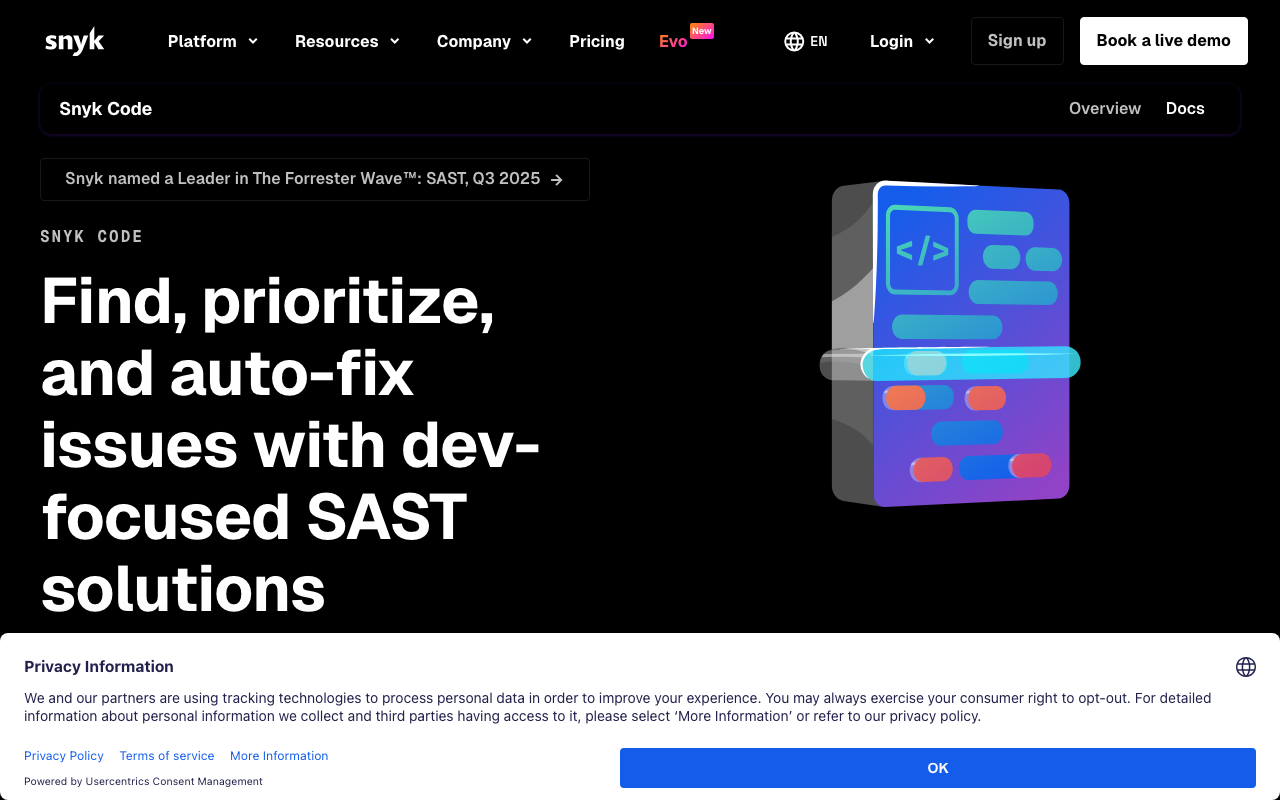
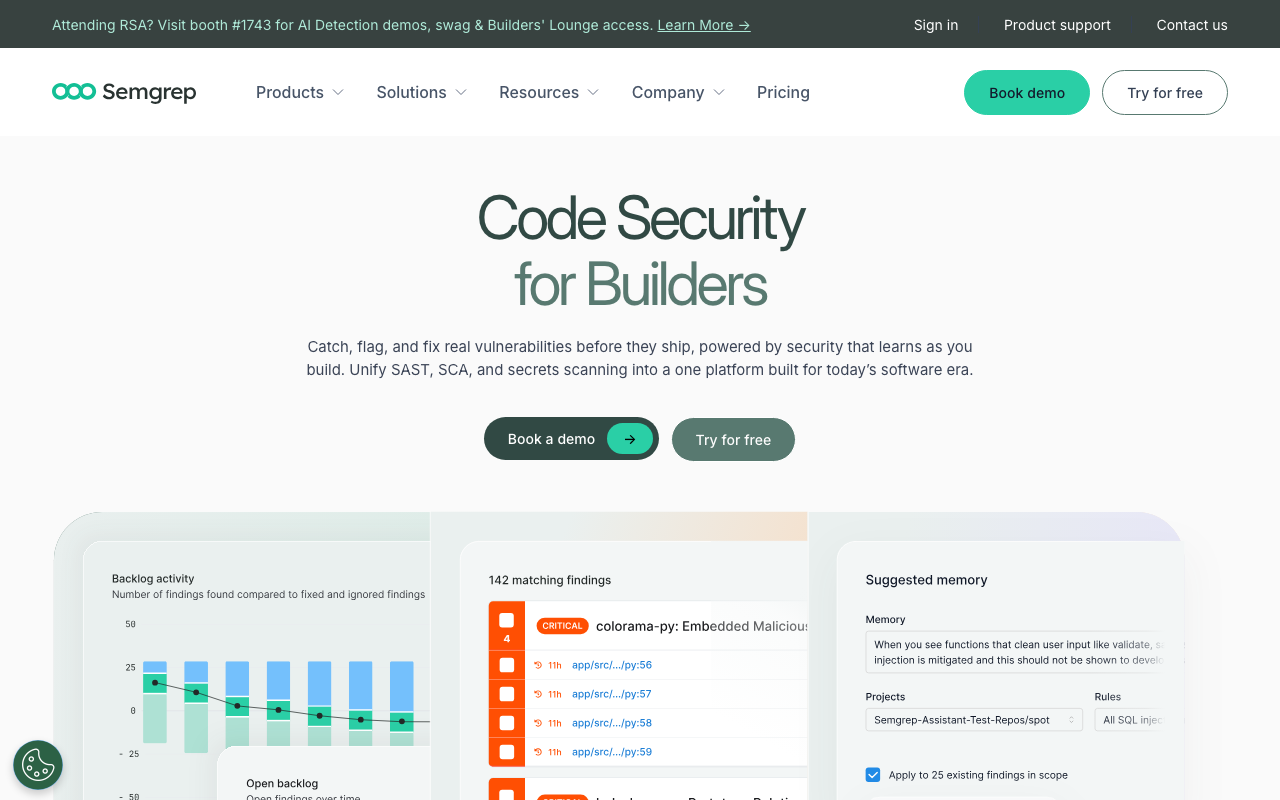
Snyk and Semgrep are two of the most widely adopted application security tools in 2026, but they approach the problem from fundamentally different directions. Snyk is a developer security platform that covers the entire application stack - SCA (dependency vulnerabilities), SAST (code-level bugs), container image scanning, and infrastructure-as-code security - with a signature focus on automated remediation through fix pull requests. Semgrep is a lightweight, programmable SAST engine built around custom rules that mirror the syntax of the target language, giving development and security teams an unmatched ability to encode organization-specific security policies and scan at blazing speed.
If dependency vulnerability management is your top priority, choose Snyk. Its SCA engine monitors over 15 million open-source packages, maintains a proprietary vulnerability database updated by a dedicated research team, and automatically opens pull requests that upgrade vulnerable dependencies to safe versions. No other tool in this comparison matches Snyk’s SCA breadth and remediation automation.
If custom SAST rules and lightweight CI scanning are your top priority, choose Semgrep. Its YAML-based rule authoring is the best in the industry, scans complete in 10-30 seconds, and the open-source CLI is free for commercial use with no project limits. For teams that need to enforce internal security policies or detect novel vulnerability patterns specific to their codebase, Semgrep’s rule engine is unrivaled.
If you want the broadest security coverage, run both. Snyk for SCA, container scanning, and IaC, paired with Semgrep for custom SAST rules and fast CI scanning. Many security-mature organizations use exactly this combination.
At-a-glance comparison
| Dimension | Snyk | Semgrep |
|---|---|---|
| Primary focus | Developer security platform (SCA, SAST, Container, IaC) | Lightweight SAST with custom rules |
| Core strength | SCA with auto-fix PRs | Custom rule authoring |
| SAST approach | DeepCode AI semantic analysis | Pattern-matching with taint tracking |
| SCA / dependency scanning | Industry-leading - 15M+ packages monitored | Semgrep Supply Chain with reachability |
| Container scanning | Yes - image vulnerability scanning | Dockerfile linting only |
| IaC scanning | Yes - Terraform, CloudFormation, K8s, ARM | Yes - Terraform, CloudFormation, K8s, Docker |
| Custom rules | Limited (Enterprise only) | Excellent - YAML-based, code-like syntax |
| Open source edition | No (free tier, not open source) | Yes - Community Edition (LGPL-2.1) |
| Pricing model | Per developer/month | Per contributor/month |
| Free tier | 5 SCA projects, 1 SAST project | Full platform for 10 contributors |
| Paid starting price | $25/developer/month (Team) | $35/contributor/month (Team) |
| AI features | DeepCode AI, auto-fix suggestions | Semgrep Assistant (AI triage) |
| Languages supported | 20+ (SAST), all major ecosystems (SCA) | 30+ |
| CI/CD integration | CLI + native integrations | Single binary CLI, zero dependencies |
| Scan speed (typical) | 30-90 seconds (SAST) | 10-30 seconds |
| Auto-fix PRs | Yes - dependency upgrades | No |
| Reachability analysis | Limited | Yes (Semgrep Supply Chain) |
| Secrets detection | Yes (part of Snyk Code) | Yes (Semgrep Secrets with validation) |
| IDE integration | VS Code, JetBrains, Eclipse, Visual Studio | VS Code (LSP-based) |
| Self-hosted option | Yes (Snyk Enterprise) | Yes (OSS CLI) |
| Cloud-hosted option | Yes (Snyk Cloud) | Yes (Semgrep Cloud) |
Understanding the comparison: security platform vs programmable scanner
Before examining features in detail, it is important to understand a core architectural difference. Snyk and Semgrep are not the same category of tool, even though both perform static application security testing (SAST). Recognizing this distinction prevents apples-to-oranges confusion and helps you pick the tool that best fits your threat model and workflow.
Snyk is a developer security platform. It wraps multiple security capabilities - SCA, SAST, container scanning, IaC scanning, and license compliance - into a unified interface aimed at developers. The philosophy is to meet developers where they work (IDE, CLI, CI/CD, SCM) and make security findings actionable by providing fix suggestions, auto-fix pull requests, and prioritized dashboards. Snyk’s SCA engine is its historical flagship product, and the depth of its vulnerability database and automated remediation workflows remain its strongest differentiator.
Semgrep is a programmable static analysis engine. Its core identity is a pattern-matching tool that lets developers and security engineers write rules in YAML that mirror the syntax of the target language. The philosophy is to give security teams a “grep for code” that understands abstract syntax trees - fast enough to run on every commit, flexible enough to encode any pattern, and lightweight enough to deploy anywhere without infrastructure overhead. The commercial platform adds cross-file analysis, AI triage, SCA with reachability, and secrets detection, but the custom rule engine remains the foundation.
The practical implication: If your primary security challenge is managing known vulnerabilities in third-party dependencies across a large application portfolio, Snyk’s SCA breadth and auto-fix PRs directly address that problem. If your primary challenge is finding and preventing custom vulnerability patterns in first-party code - especially patterns unique to your organization’s APIs, frameworks, or business logic - Semgrep’s rule engine is purpose-built for that workflow. Many organizations face both challenges simultaneously, which is why running both tools together is a common and effective strategy.
What is Snyk?
Snyk is a comprehensive developer security platform that helps teams find and fix vulnerabilities across the entire software development lifecycle. Founded in 2015 and named a Gartner Magic Quadrant Leader for Application Security Testing in 2024 and 2025, Snyk has grown into one of the most widely adopted security platforms in the industry, used by over 3 million developers across more than 100,000 organizations.
How Snyk works
Snyk operates as a multi-product platform with four core scanning engines:
-
Snyk Open Source (SCA): Scans project manifests and lockfiles to identify known vulnerabilities in third-party dependencies. Monitors over 15 million open-source packages across all major ecosystems (npm, PyPI, Maven, NuGet, Go modules, RubyGems, and more). Automatically opens fix pull requests that upgrade vulnerable packages to the nearest safe version. The vulnerability database is maintained by Snyk’s dedicated security research team and includes advisories not yet published in public databases like the NVD.
-
Snyk Code (SAST): Performs real-time semantic code analysis using the DeepCode AI engine acquired in 2020. Unlike traditional pattern-matching SAST tools, Snyk Code uses machine learning trained on millions of code commits to understand code semantics and detect vulnerabilities with high accuracy. Supports 20+ languages with inline fix suggestions.
-
Snyk Container: Scans container images for vulnerabilities in operating system packages and application-level dependencies. Provides base image upgrade recommendations - for example, suggesting a more secure Alpine base image that eliminates 50 known CVEs. Integrates with container registries (Docker Hub, Amazon ECR, Google GCR, Azure ACR) for continuous monitoring.
-
Snyk Infrastructure as Code (IaC): Scans Terraform, CloudFormation, Kubernetes manifests, and ARM templates for security misconfigurations. Detects issues like overly permissive IAM policies, unencrypted storage, and publicly exposed services before they reach production.
Key strengths of Snyk
SCA with automated remediation. Snyk’s defining feature is its ability to not just find vulnerabilities in dependencies but fix them automatically. When Snyk detects a vulnerable package, it can open a pull request that upgrades the dependency to the nearest non-vulnerable version, accounting for breaking changes and transitive dependencies. This turns a “vulnerability found” alert into a “fix ready for review” workflow, dramatically reducing the mean time to remediation. For organizations managing hundreds of repositories with thousands of dependencies, this automation is transformative.
Proprietary vulnerability database. Snyk maintains its own vulnerability database, curated by a dedicated security research team. This database often includes vulnerability disclosures before they appear in the National Vulnerability Database (NVD), giving Snyk users an early warning advantage. The database also includes contextual information like exploit maturity, social proof (are attackers actively exploiting this?), and remediation guidance that goes beyond what CVE entries typically provide.
Unified platform experience. Having SCA, SAST, container scanning, and IaC scanning in a single platform eliminates the operational overhead of managing four separate tools. Security teams get a consolidated dashboard showing vulnerabilities across all dimensions - code, dependencies, containers, and infrastructure - with consistent prioritization and reporting. This unified view is especially valuable for security teams that need to report on organizational risk posture across the entire application portfolio.
Developer-first design. Snyk’s user interface, CLI experience, and integration model are designed for developers, not security specialists. IDE plugins surface findings as developers write code. CLI commands fit into existing development workflows. PR integrations add security context without requiring developers to leave their normal tools. This design philosophy reduces friction and increases adoption - a critical factor since developer engagement is the primary predictor of whether security tools actually improve outcomes.
Broad IDE integration. Snyk’s IDE plugins are available for VS Code, JetBrains IDEs (IntelliJ, PyCharm, WebStorm), Eclipse, and Visual Studio. The plugins provide real-time feedback as developers write code, surfacing both code-level vulnerabilities (SAST) and dependency risks (SCA) directly in the editor. The breadth of IDE support is wider than Semgrep’s VS Code-focused approach.
Enterprise compliance and reporting. Snyk provides license compliance scanning for open-source dependencies, SBOM generation (CycloneDX and SPDX formats), and security reports aligned with OWASP, CWE, and PCI DSS frameworks. For organizations in regulated industries, these compliance features can be a purchasing requirement.
What is Semgrep?
Semgrep is a lightweight, programmable static analysis engine built for application security. Created by Return To Corp (now Semgrep, Inc.), it scans source code for patterns that match rules you define or pull from a community registry. The core engine is open source under the LGPL-2.1 license, runs as a single binary with no external dependencies, and completes scans in seconds rather than minutes.
How Semgrep works
Semgrep takes a fundamentally different approach from traditional SAST tools. Rather than building a full abstract syntax tree and running complex dataflow analyses at startup, Semgrep uses a pattern-matching approach where rules describe the code you want to find using syntax that mirrors the target language. This design makes rules readable by any developer - not just security specialists - and keeps scan times extremely fast.
The Semgrep engine operates in three tiers:
-
Community Edition (OSS): Single-file, single-function analysis. The core pattern-matching engine with 2,800+ community rules. Free forever, runs anywhere.
-
Pro Engine: Cross-file and cross-function dataflow analysis. Traces tainted data from sources to sinks across entire codebases. Available with the Team tier. Independent testing found that the Pro engine detected 72-75% of vulnerabilities in test suites compared to just 44-48% for the Community Edition.
-
Semgrep AppSec Platform: The commercial product that wraps the engine with AI triage (Semgrep Assistant), a managed dashboard, policy management, and integrations. Includes three product modules - Semgrep Code (SAST), Semgrep Supply Chain (SCA with reachability), and Semgrep Secrets (credential detection with validation).
Key strengths of Semgrep
Custom rule authoring. Semgrep’s rule syntax is the gold standard for static analysis. Rules are written in YAML and use patterns that mirror the target language. A rule to detect SQL injection via string concatenation in Python looks like this:
rules:
  - id: sql-injection-concat
    patterns:
      - pattern: |
          $QUERY = "..." + $INPUT + "..."
      - metavariable-regex:
          metavariable: $QUERY
          regex: (?i)(select|insert|update|delete)
    message: >
      Possible SQL injection: query built with string concatenation.
      Use parameterized queries instead.
    severity: ERROR
    languages: [python]
Any developer who reads Python can read this rule. The learning curve is measured in hours, not weeks. The syntax supports metavariables, pattern matching, taint tracking, and inter-procedural analysis - powerful enough for sophisticated security rules while remaining readable. This matters enormously for organizations that need to encode internal security policies or detect novel vulnerability patterns specific to their codebase.
Scan speed. Semgrep scans a typical repository in 10-30 seconds. The median CI scan time reported by Semgrep is 10 seconds. This speed makes it practical to run on every commit and every pull request without becoming a bottleneck. Many SAST tools take minutes or even hours on large codebases, which pushes teams to run scans less frequently or only on nightly builds.
AI-powered triage. Semgrep Assistant uses AI to analyze findings, assess exploitability, and prioritize fixes. Instead of presenting a flat list of 200 findings sorted by severity, Assistant groups them by likelihood of real impact and can auto-triage known false positive patterns. Semgrep reports that Assistant reduces false positive noise by 20-40% out of the box. The Assistant Memories feature lets the system learn organization-specific context over time - one Fortune 500 customer reported a 2.8x improvement in false positive detection with just two added memories.
Reachability analysis. Semgrep Supply Chain does not just report that your dependency has a known CVE. It traces whether the vulnerable function in that dependency is actually called from your code. A vulnerability in a library function your code never invokes is still worth knowing about, but it is not the same priority as one in a function you call on every request. This dramatically reduces the noise from SCA scanning.
Open-source core. The Semgrep CLI is genuinely open source (LGPL-2.1), can be used commercially, and has no project or contributor limits. This means any team can add Semgrep to their CI pipeline at zero cost with zero vendor lock-in. The commercial platform adds valuable features (cross-file analysis, AI triage, managed dashboard), but the open-source engine is production-ready for many use cases.
Feature-by-feature deep dive
SAST (Static Application Security Testing)
Both Snyk and Semgrep offer SAST capabilities, but the underlying technology and user experience differ significantly.
Snyk Code uses the DeepCode AI engine for semantic code analysis. Acquired in 2020, DeepCode was trained on millions of code commits and uses machine learning to understand code semantics rather than relying purely on pattern matching. This approach enables Snyk Code to detect complex vulnerability patterns that require understanding data flow, control flow, and the semantic meaning of code constructs. Snyk claims this results in a low false positive rate because the ML model has learned to distinguish between vulnerable and safe patterns from real-world code examples.
Snyk Code supports approximately 20+ languages for SAST scanning, including Java, JavaScript, TypeScript, Python, C#, Go, Ruby, PHP, Kotlin, Swift, C, and C++. The analysis runs quickly - typically under a minute for average-sized repositories - and provides inline fix suggestions that show developers how to remediate each finding. Snyk Code integrates with IDEs, providing real-time feedback as code is written.
Semgrep uses pattern-matching with taint tracking for SAST. The core engine matches rules written in YAML against the abstract syntax tree of target code. The Pro engine extends this with cross-file and cross-function dataflow analysis, tracing tainted data from untrusted sources (user input, environment variables, API responses) to dangerous sinks (SQL queries, system commands, file operations) across file boundaries.
Semgrep supports 30+ languages for SAST scanning, including all the languages Snyk covers plus Rust, Elixir, and several infrastructure-as-code languages. The scan speed is faster than Snyk Code - typically 10-30 seconds versus 30-90 seconds. The trade-off is that Semgrep’s detection relies on having the right rules configured, while Snyk Code’s ML-based approach can detect patterns that have not been explicitly codified as rules.
The key SAST differentiator is the custom rule experience. Semgrep’s YAML-based rules are readable, writable, and deployable by any developer within hours of first exposure. Snyk Code offers some custom rule capability on its Enterprise plan, but the authoring experience is not as flexible or developer-friendly as Semgrep’s system. For organizations where the ability to rapidly encode new vulnerability patterns into automated scanning is a priority, Semgrep’s SAST offering is the clear winner.
| SAST dimension | Snyk Code | Semgrep |
|---|---|---|
| Detection approach | ML-based semantic analysis | Pattern-matching with taint tracking |
| Languages | 20+ | 30+ |
| Cross-file analysis | Yes | Yes (Pro engine) |
| Custom rules | Limited (Enterprise) | Excellent - YAML-based |
| Scan speed | 30-90 seconds | 10-30 seconds |
| Fix suggestions | Yes - AI-powered | Yes - via rule metadata |
| IDE support | VS Code, JetBrains, Eclipse, VS | VS Code |
| False positive handling | ML-based confidence scoring | AI triage (Semgrep Assistant) |
SCA (Software Composition Analysis)
SCA is where Snyk’s historical advantage is most apparent. Snyk built its reputation on dependency vulnerability scanning, and the product reflects years of focused investment.
Snyk Open Source is an industry-leading SCA solution. It monitors over 15 million packages across every major ecosystem - npm, PyPI, Maven, NuGet, Go modules, RubyGems, Composer, CocoaPods, Cargo, and more. The proprietary vulnerability database is maintained by Snyk’s security research team and frequently includes disclosures before the NVD publishes them. Snyk’s database also enriches CVE data with exploit maturity ratings, social proof of active exploitation, and detailed remediation guidance.
The most impactful SCA feature is automated fix pull requests. When Snyk detects a vulnerable dependency, it can automatically create a PR that upgrades the package to the nearest non-vulnerable version. The upgrade logic accounts for semantic versioning, transitive dependency conflicts, and breaking changes. For organizations managing hundreds of repositories, this automation converts what would be thousands of manual hours into automated, reviewable PRs.
Snyk also provides license compliance scanning, identifying dependencies with licenses that may conflict with your organization’s policies (for example, flagging a GPL-licensed library in a proprietary codebase). This is critical for organizations in regulated industries or those with strict intellectual property policies.
Semgrep Supply Chain provides SCA with a unique reachability angle. Rather than simply reporting that a dependency has a known CVE, Semgrep traces whether the vulnerable function in that dependency is actually invoked from your code. This reachability analysis dramatically reduces noise - a CVE in a library function your code never calls is not the same priority as one in a function called on every API request.
Semgrep Supply Chain supports major package ecosystems (npm, PyPI, Maven, Go modules, RubyGems, and others), though its coverage is not as broad as Snyk’s. It does not offer automated fix pull requests - you are informed about the vulnerability and its reachability status, but creating the fix is a manual step. License compliance scanning is also more limited compared to Snyk.
| SCA dimension | Snyk Open Source | Semgrep Supply Chain |
|---|---|---|
| Package ecosystems | All major + many niche | Major ecosystems |
| Vulnerability database | Proprietary + NVD, early disclosure | Relies on public advisories + Semgrep research |
| Auto-fix PRs | Yes - upgrades to safe versions | No |
| Reachability analysis | Limited | Yes - traces function calls |
| License compliance | Yes - policy-based | Basic |
| SBOM generation | Yes (CycloneDX, SPDX) | Limited |
| Transitive dependency tracking | Yes - full dependency tree | Yes |
| Continuous monitoring | Yes - alerts on new CVEs | Yes - via platform |
The SCA verdict: Snyk is the stronger SCA tool for most organizations. Its broader package coverage, proprietary vulnerability database, and automated fix PRs deliver more value for dependency vulnerability management. Semgrep Supply Chain’s reachability analysis is a genuinely valuable feature that Snyk lacks, but it does not compensate for the overall gap in SCA breadth. Organizations that need best-in-class SCA should lean toward Snyk; organizations that want SCA as part of a lightweight SAST-first workflow will find Semgrep Supply Chain adequate.
Container scanning
Snyk Container is a dedicated container security solution. It scans container images for known vulnerabilities in both OS-level packages (Debian, Alpine, Ubuntu, Red Hat) and application-level dependencies embedded in the image. Key capabilities include:
- Base image upgrade recommendations - Snyk suggests alternative base images that eliminate known CVEs
- Container registry integration - continuous monitoring of images in Docker Hub, ECR, GCR, ACR, and other registries
- Kubernetes integration - scanning running workloads to identify vulnerable images in production
- SBOM generation for container images
- Priority scoring based on whether vulnerable packages are loaded at runtime
Semgrep does not offer container image scanning. Semgrep can scan Dockerfiles for misconfigurations and security anti-patterns (running as root, using latest tags, exposing unnecessary ports, missing health checks), but this is Dockerfile linting, not container image vulnerability scanning. Semgrep does not inspect the contents of built container images.
The container scanning verdict: If container security is a requirement, Snyk is the only choice between these two tools. Semgrep’s Dockerfile linting is useful but does not replace the need for container image vulnerability scanning. Organizations using containers should either choose Snyk or pair Semgrep with a dedicated container scanner like Trivy, Grype, or Anchore.
Infrastructure-as-Code (IaC) scanning
Both tools scan IaC templates for security misconfigurations, but with different strengths.
Snyk IaC scans Terraform, CloudFormation, Kubernetes manifests, and ARM templates. It detects common misconfigurations like:
- Overly permissive IAM policies
- Unencrypted storage buckets and databases
- Publicly exposed services
- Missing logging and monitoring configurations
- Insecure network configurations
Snyk IaC integrates with the broader Snyk platform, so IaC findings appear alongside code, dependency, and container vulnerabilities in a unified dashboard. The fix suggestions are actionable and specific to each cloud provider.
Semgrep scans Terraform, CloudFormation, Kubernetes manifests, and Dockerfiles with community-driven rules. The IaC rule coverage in the Semgrep Registry is extensive, with rules contributed by both the Semgrep team and the community. The key advantage is custom rule authoring - you can write Semgrep rules that enforce your organization’s specific cloud security policies (for example, requiring all S3 buckets to use a specific KMS key, or mandating that all ECS tasks use a specific logging configuration).
The IaC scanning verdict: Both tools provide competent IaC scanning. Snyk has the advantage of a unified platform experience, while Semgrep has the advantage of custom rule authoring for organization-specific policies. For teams with standard IaC security requirements, either tool works well. For teams with highly customized cloud security policies, Semgrep’s rule authoring capability is more valuable.
Custom rules
This is the single most important differentiator between the two tools and deserves a thorough examination.
Semgrep’s custom rules are the gold standard in static analysis. Rules are written in YAML using patterns that mirror the target language. Here is a taint-tracking rule that detects command injection through a Flask endpoint:
rules:
  - id: flask-command-injection
    mode: taint
    pattern-sources:
      - patterns:
          - pattern: flask.request.$ANYTHING
    pattern-sinks:
      - patterns:
          - pattern: subprocess.call(...)
    message: >
      User input from flask.request flows to subprocess.call(),
      creating a command injection vulnerability.
    severity: ERROR
    languages: [python]
This rule is readable by any Python developer. The taint-tracking mode tells Semgrep to trace data from the source (Flask request parameters) to the sink (subprocess calls), including through intermediate variables and function calls. Writing this rule takes minutes. Deploying it to CI takes seconds.
The Semgrep Registry hosts over 20,000 Pro rules and 2,800+ community-contributed rules. Rules are organized by language, framework, and vulnerability class. Organizations can maintain private rule repositories and share rules across teams. The semgrep publish command pushes custom rules to the registry, and CI configurations can pull from multiple rule sources.
Snyk Code’s custom rule support is more limited. Snyk introduced Custom Rules for Snyk Code on its Enterprise plan, allowing organizations to create rules that detect patterns specific to their codebase. However, the custom rule authoring experience is not as mature or flexible as Semgrep’s system. The rule language is less intuitive, the documentation is less comprehensive, and the community ecosystem is smaller.
For most organizations using Snyk, the expectation is that the built-in DeepCode AI engine detects vulnerabilities without requiring custom rules. This works well for common vulnerability patterns (OWASP Top 10 categories), but falls short when teams need to enforce internal coding standards, detect organization-specific anti-patterns, or encode novel vulnerability types that the ML model has not been trained on.
The practical impact is significant. Consider a scenario where your security team discovers that a specific internal API must always be called with an authentication token, and any call without authentication is a security vulnerability. With Semgrep, you can write a custom rule, test it in the playground, and deploy it to CI in under an hour. With Snyk, you would either need to file a feature request, rely on the ML model eventually learning the pattern, or use the Enterprise-tier custom rules feature which has a higher barrier to entry.
Pricing breakdown
Snyk and Semgrep use per-developer/contributor pricing models, but the tier structures and free offerings differ meaningfully.
Snyk pricing:
| Tier | Price | What you get |
|---|---|---|
| Free | $0 | 5 SCA projects, 1 SAST project, limited container/IaC tests, 200 Snyk Code tests/month |
| Team | $25/developer/month (annual billing) | Unlimited projects, unlimited tests, Jira integration, reports, API access |
| Enterprise | Custom pricing | SSO/SAML, custom rules, advanced reporting, dedicated support, SLA guarantees, private registry support |
Semgrep pricing:
| Tier | Price | What you get |
|---|---|---|
| Community Edition (OSS) | Free | Open-source engine, 2,800+ community rules, single-file analysis, CLI and CI/CD |
| Team | $35/contributor/month (free for first 10 contributors) | Cross-file analysis, 20,000+ Pro rules, Semgrep Assistant (AI triage), Semgrep Supply Chain (SCA), Semgrep Secrets, dashboard and reporting |
| Enterprise | Custom pricing | Everything in Team plus SSO/SAML, custom deployment, advanced reporting, dedicated support, SLA guarantees |
Cost comparison for different team sizes:
| Team size | Snyk Team (annual) | Semgrep Team (annual) | Notes |
|---|---|---|---|
| 5 developers | ~$1,500/year | $0 (free for 10 contributors) | Semgrep is free |
| 10 developers | ~$3,000/year | $0 (free for 10 contributors) | Semgrep is free |
| 15 developers | ~$4,500/year | $6,300/year (5 paid contributors) | Snyk is cheaper |
| 25 developers | ~$7,500/year | $6,300/year (15 paid contributors) | Roughly equivalent |
| 50 developers | ~$15,000/year | $16,800/year (40 paid contributors) | Roughly equivalent |
| 100 developers | ~$30,000/year | $37,800/year (90 paid contributors) | Snyk is cheaper at scale |
Important pricing notes:
- Semgrep’s free tier for 10 contributors includes the full platform with cross-file analysis, AI triage, and the Pro rule library. This is genuinely generous and makes Semgrep the clear winner for teams under 10 people.
- Snyk’s free tier is more limited - 5 SCA projects and 1 SAST project - making it a trial experience rather than a production-ready free offering for most teams.
- Snyk’s Team tier includes SCA, SAST, container scanning, and IaC scanning in one subscription. Achieving equivalent coverage with Semgrep would require the Team tier plus potentially a separate container scanning tool.
- At enterprise scale (100+ developers), both tools move to custom pricing where negotiation determines actual cost. Published pricing is less relevant at this tier.
- Semgrep’s open-source CLI is always free with no contributor limits, though it lacks cross-file analysis and AI triage. Teams can use the OSS CLI in production and only pay for the platform features they need.
Language and framework support
Both tools support the major programming languages, but Semgrep has broader overall coverage while Snyk has deeper analysis for its core languages.
Snyk Code supports approximately 20+ languages for SAST: Java, JavaScript, TypeScript, Python, C#, Go, Ruby, PHP, Kotlin, Swift, C, C++, Scala, Apex, and several others. The DeepCode AI engine provides deep semantic analysis for these languages, understanding framework-specific patterns and API semantics. For Snyk’s core languages (Java, JavaScript, Python, Go), the analysis depth is excellent.
Snyk Open Source supports SCA for all major package ecosystems: npm, PyPI, Maven, Gradle, NuGet, Go modules, RubyGems, Composer, CocoaPods, Cargo, Swift Package Manager, Hex, and more. SCA coverage is broader than SAST coverage because dependency scanning requires understanding package manifests rather than language semantics.
Semgrep supports 30+ languages for SAST: All the languages Snyk covers, plus Rust, Elixir, Lua, OCaml, R, Solidity, and infrastructure-as-code languages (Terraform/HCL, CloudFormation/JSON/YAML, Kubernetes YAML, Dockerfiles). The breadth is wider, though analysis depth varies by language. Python, Java, JavaScript, TypeScript, Go, and Ruby have the deepest rule coverage in the Semgrep Registry.
Framework-specific coverage is where Semgrep’s community-driven model shines. The Semgrep Registry includes rules tailored to specific frameworks - Django, Flask, FastAPI, Express.js, Next.js, Spring Boot, Rails, Laravel, and many others. These framework-aware rules understand the security semantics of each framework’s APIs. Snyk Code also has framework awareness through its ML training data, but the coverage is less transparent since it is baked into the model rather than visible as discrete rules.
CI/CD integration
Both tools integrate well with modern CI/CD systems, but the integration model differs.
Semgrep is the easiest security tool to add to CI/CD. The Semgrep CLI runs as a single binary with zero external dependencies. Adding it to a GitHub Actions workflow takes one step:
- uses: semgrep/semgrep-action@v1
  with:
    config: p/default
There is no server to maintain, no database to configure, and no warm-up time. Scans complete in 10-30 seconds. Diff-aware scanning analyzes only changed files, making incremental scans even faster. Semgrep supports GitHub Actions, GitLab CI, Jenkins, CircleCI, Bitbucket Pipelines, Azure Pipelines, and any CI system that can run a command-line tool.
Snyk’s CI/CD integration is also straightforward but involves more moving parts. The Snyk CLI runs SCA, SAST, container, and IaC scans from a single command. A typical GitHub Actions integration looks like this:
- uses: snyk/actions/node@master
  env:
    SNYK_TOKEN: ${{ secrets.SNYK_TOKEN }}
  with:
    command: test
Snyk requires an API token for authentication and communicates with the Snyk cloud service to access its vulnerability database and report results. This means CI scans need network access to Snyk’s API. The total scan time is longer than Semgrep because Snyk runs multiple scanning engines (SCA + SAST + container + IaC), but you get broader coverage in a single pipeline step.
Snyk’s unique CI/CD advantage is the auto-fix PR workflow. When Snyk detects a vulnerable dependency during a CI scan, it can automatically create a fix PR that upgrades the dependency. This closed-loop remediation workflow is something no other tool in this comparison offers. The PR is created automatically, tested by your CI pipeline, and ready for human review - converting a security alert into an actionable code change with zero developer effort.
| CI/CD dimension | Snyk | Semgrep |
|---|---|---|
| Setup complexity | Low - CLI + API token | Very low - single binary, no auth needed for OSS |
| Scan speed | 30-90 seconds (SAST only), longer with all engines | 10-30 seconds |
| Network dependency | Yes - requires Snyk API access | No (OSS CLI) / Yes (Cloud platform) |
| Diff-aware scanning | Yes | Yes |
| PR comments | Yes | Yes |
| Auto-fix PRs | Yes (SCA) | No |
| SARIF output | Yes | Yes |
| GitHub Actions | Official action | Official action |
| GitLab CI | Yes | Yes |
| Jenkins | Yes (Snyk plugin) | Yes |
Rule ecosystem and community
Snyk’s detection is driven by its proprietary ML model and vulnerability database. The DeepCode AI engine has been trained on millions of code samples and can detect vulnerability patterns without explicit rules. The Snyk vulnerability database includes hundreds of thousands of advisories across all supported ecosystems. This “built-in intelligence” approach means teams get comprehensive detection on day one without configuring rulesets.
The trade-off is less transparency. When Snyk flags a finding, the reasoning comes from an ML model rather than a human-readable rule. This can make it harder to understand why a specific pattern was flagged, to customize detection thresholds, or to contribute new patterns back to the community.
Semgrep’s detection is driven by an open, community-powered rule ecosystem. The Semgrep Registry hosts over 20,000 Pro rules and 2,800+ community rules, all written in readable YAML. Rules are organized by language, framework, vulnerability class (OWASP, CWE), and confidence level. Anyone can browse rules, understand exactly what they detect, suggest improvements, or contribute new rules.
This transparency has practical benefits. When Semgrep flags a finding, you can read the exact rule that triggered it, understand the pattern being detected, and assess whether it is relevant to your context. If a rule produces false positives in your codebase, you can fork it and adjust the pattern. If you discover a new vulnerability class, you can write a rule and share it with the community.
The ecosystem verdict: Snyk’s approach is better for teams that want comprehensive detection without effort. Semgrep’s approach is better for teams that want transparency, customizability, and the ability to contribute to and benefit from a community rule library.
False positive handling
False positives are the bane of security scanning. A tool that produces too many false positives trains developers to ignore findings, which defeats the purpose of scanning entirely. Both Snyk and Semgrep have invested heavily in reducing false positive noise.
Snyk Code reduces false positives through ML-based confidence scoring. Because the DeepCode AI engine was trained on millions of real-world code examples (both vulnerable and safe), it can distinguish between patterns that are genuinely vulnerable and patterns that merely look suspicious. Snyk Code assigns confidence scores to findings and can filter out low-confidence results. The ML approach means that as the training data improves, false positive rates decrease without requiring rule changes.
Semgrep reduces false positives through AI-powered triage and reachability analysis. Semgrep Assistant analyzes each finding using AI, assesses exploitability in context, and can auto-triage known false positive patterns. The Assistant Memories feature lets the system learn from an organization’s triage decisions - when a security engineer marks a finding as a false positive and explains why, Assistant remembers that context and applies it to similar findings in the future. For SCA findings, Semgrep Supply Chain’s reachability analysis filters out CVEs where the vulnerable function is never called from your code, eliminating an entire category of noise.
The practical difference: Snyk’s false positive handling is more automated and requires less configuration. Semgrep’s false positive handling is more customizable and improves over time with organizational context. For teams that want a “set and forget” experience, Snyk’s ML approach requires less ongoing tuning. For teams willing to invest in tuning for their specific codebase, Semgrep’s learning system can achieve lower false positive rates over time.
Use cases and recommendations
When to choose Snyk
Choose Snyk when:
Managing open-source dependency risk is your primary challenge. If your team works with hundreds of third-party packages across multiple repositories and the main security concern is known CVEs in dependencies, Snyk’s SCA engine is purpose-built for this. The auto-fix PR workflow converts vulnerability alerts into reviewable code changes, and the proprietary database provides early warning of new disclosures.
You need a unified security platform across SCA, SAST, containers, and IaC. If your security team wants a single dashboard showing risk across all dimensions - code vulnerabilities, dependency CVEs, container image issues, and infrastructure misconfigurations - Snyk’s multi-product platform eliminates the need to manage and correlate findings from separate tools.
Container security is a requirement. If your organization builds and deploys container images, Snyk Container provides dedicated scanning capabilities that Semgrep does not offer. Base image upgrade recommendations and registry monitoring are particularly valuable for containerized workloads.
Developer adoption is your primary concern. Snyk’s developer-first design, broad IDE integration (VS Code, JetBrains, Eclipse, Visual Studio), and actionable fix suggestions lower the barrier to developer engagement. If getting developers to actually pay attention to security findings is your biggest challenge, Snyk’s UX is designed to solve exactly that problem.
Compliance and reporting are priorities. Snyk provides license compliance scanning, SBOM generation, and security reports aligned with regulatory frameworks. For organizations in financial services, healthcare, government, or other regulated industries, these features can be purchasing requirements.
You have a larger team and do not need extensive custom rules. For teams of 15+ developers that primarily need detection of common vulnerability patterns (OWASP Top 10) without heavy custom rule authoring, Snyk’s built-in ML detection provides strong coverage at a competitive price point.
When to choose Semgrep
Choose Semgrep when:
Custom security rules are a core requirement. If your organization has internal security policies, proprietary API patterns, or novel vulnerability types that require custom detection rules, Semgrep’s YAML-based rule authoring is unmatched. Writing, testing, and deploying a new rule takes under an hour, compared to the much higher effort required to achieve equivalent custom detection in Snyk.
Scan speed and CI/CD simplicity are non-negotiable. If your team has frequent merges, practices continuous deployment, and cannot tolerate scan times over 30 seconds, Semgrep’s lightweight CLI and sub-minute scans avoid creating a pipeline bottleneck. The zero-dependency architecture means no infrastructure to maintain.
You have 10 or fewer contributors. Semgrep’s full platform - including cross-file analysis, AI triage, SCA with reachability, and secrets detection - is free for up to 10 contributors. This is the most generous free tier in the application security space, giving small teams enterprise-grade scanning at zero cost.
Your stack includes infrastructure-as-code that needs custom policies. While both tools scan IaC, Semgrep’s custom rule authoring lets you encode organization-specific cloud security policies that go beyond generic best practices. For platform engineering teams managing complex cloud environments, this flexibility is critical.
You want an open-source core without vendor lock-in. Semgrep’s OSS CLI is genuinely free, genuinely open source, and genuinely capable. You can build your entire security scanning workflow on the open-source engine, adding the commercial platform only if and when you need its features. This is not possible with Snyk, which requires its cloud service for full functionality.
Transparency in detection logic is important. If your security team needs to understand exactly why each finding was flagged, review the detection logic, and customize it for your context, Semgrep’s human-readable rules provide that transparency. Snyk’s ML-based detection is more opaque.
When to use both together
Running Snyk and Semgrep together is the strongest security posture for many organizations. The tools have complementary strengths with minimal overlap. Common patterns include:
Pattern 1 - Snyk for supply chain, Semgrep for code:
- Snyk handles SCA (dependency vulnerability scanning with auto-fix PRs), container image scanning, and license compliance
- Semgrep handles SAST (custom vulnerability rules in first-party code), secrets detection with validation, and IaC policy enforcement
- Result: comprehensive supply-chain security from Snyk, deep code-level security from Semgrep
Pattern 2 - Snyk as platform, Semgrep for custom rules:
- Snyk provides the unified dashboard, compliance reporting, and broad scanning across all dimensions
- Semgrep fills gaps with custom rules for organization-specific patterns that Snyk’s ML model does not detect
- Result: Snyk’s platform coverage with Semgrep’s custom rule flexibility
Pattern 3 - Cost-optimized security stack:
- Semgrep Team (free for 10 contributors) for SAST, SCA with reachability, and secrets detection
- Snyk Free tier for container image scanning and additional SCA coverage
- Total cost for a small team: $0
- Result: multi-layered security at zero cost for small teams
Pattern 4 - Enterprise security program:
- Snyk Enterprise for organizational SCA with auto-fix, container security, compliance reporting, and SBOM generation
- Semgrep Enterprise for custom SAST rules, AI-powered triage, and fast CI scanning
- Result: best-in-class tools for each domain, unified through security orchestration
The key insight is that Snyk’s biggest strength (SCA with auto-fix) and Semgrep’s biggest strength (custom SAST rules with speed) address different dimensions of application security. Running both does not create redundancy - it creates depth.
How Snyk and Semgrep compare to alternatives
Snyk vs Checkmarx
Checkmarx is an enterprise SAST and SCA platform that competes with Snyk primarily on deep dataflow analysis and compliance features. Checkmarx offers more sophisticated SAST capabilities with its KICS IaC scanner and Checkmarx One unified platform. Snyk is more developer-friendly with easier onboarding and better auto-fix capabilities. Checkmarx is typically chosen by large enterprises with dedicated AppSec teams, while Snyk is chosen by organizations that want developers to own security.
Semgrep vs SonarQube
SonarQube is a code quality platform that overlaps with Semgrep on security scanning but covers broader ground including code smells, technical debt, and coverage metrics. Semgrep is the stronger choice for security-focused teams that need custom rules and fast scans. SonarQube is the stronger choice for teams that want comprehensive code quality analysis. Many teams run both - see our Semgrep vs SonarQube comparison for a detailed breakdown.
AI-powered code review as a complement
Both Snyk and Semgrep focus on finding vulnerabilities in code, but neither provides the contextual code review that catches architectural issues, logic errors, and design problems. AI-powered code review tools like CodeRabbit complement both Snyk and Semgrep by reviewing pull requests for quality, maintainability, and correctness alongside security. A mature development workflow might use Semgrep for custom SAST rules, Snyk for SCA with auto-fix, and CodeRabbit for AI-powered code review - each tool covering a distinct dimension that the others miss.
Migration considerations
Moving from Snyk to Semgrep
If you are considering replacing Snyk with Semgrep, be aware of what you will gain and what you will lose:
You will gain: Faster scans, superior custom rule authoring, reachability-based SCA, open-source core, and a more generous free tier for small teams.
You will lose: Automated fix PRs for dependency upgrades, container image scanning, the proprietary vulnerability database with early disclosures, broad IDE integration (JetBrains, Eclipse, Visual Studio), and the unified multi-product dashboard covering code, dependencies, containers, and infrastructure.
Migration advice: Unless you have a strong reason to fully replace Snyk, consider keeping Snyk for SCA (its strongest feature) and adding Semgrep for custom SAST rules. Full replacement makes most sense for teams that primarily use Snyk Code (SAST) and do not heavily rely on Snyk’s SCA auto-fix or container scanning.
Moving from Semgrep to Snyk
If you are considering replacing Semgrep with Snyk, the trade-offs are the reverse:
You will gain: SCA with auto-fix PRs, container scanning, broader IDE integration, the proprietary vulnerability database, and a unified platform experience.
You will lose: The industry-best custom rule authoring, sub-30-second scan times, the open-source CLI, reachability-based SCA, the generous free-for-10-contributors tier, and the transparent, readable rule ecosystem.
Migration advice: Full replacement makes sense if your team does not write custom rules and primarily needs SCA and container scanning. If custom rules are part of your security workflow, keep Semgrep for that purpose even if you add Snyk for other capabilities.
Developer experience compared
The day-to-day developer experience differs meaningfully between the two tools.
Snyk’s developer experience centers on actionability. When Snyk finds a vulnerability - whether in code, a dependency, a container image, or an IaC template - it tries to give developers a concrete next step. For dependencies, that next step is often an auto-fix PR. For code issues, it is an inline fix suggestion. For container images, it is a base image upgrade recommendation. This “find and fix” loop reduces the cognitive burden on developers, who can review and merge fixes rather than researching and implementing them from scratch.
The Snyk dashboard provides a portfolio view showing vulnerabilities across all projects, making it easy for engineering leads to understand organizational risk. The priority scoring system (which accounts for exploit maturity, reachability, and CVSS score) helps teams focus on the most impactful findings first.
Semgrep’s developer experience centers on speed and transparency. Scans complete in seconds, findings include the exact rule that triggered them (readable YAML), and the output integrates naturally into CLI-oriented workflows. Developers who prefer working in terminals and CI systems tend to gravitate toward Semgrep’s lightweight approach.
The Semgrep Cloud dashboard provides a centralized view of findings with AI-powered triage, but the core value proposition is in the scanning engine itself rather than the management layer. Security engineers love that they can write a rule in the playground, test it against real code, and deploy it to CI in under an hour.
IDE experience comparison: Snyk has broader IDE coverage (VS Code, JetBrains, Eclipse, Visual Studio), while Semgrep’s IDE integration is primarily focused on VS Code. For teams that standardize on VS Code, this difference is irrelevant. For teams with mixed IDE environments, Snyk’s broader support is an advantage.
Security scanning depth
For teams evaluating both tools specifically for their security scanning capabilities, a detailed comparison of detection depth is warranted.
Snyk Code’s semantic analysis excels at detecting complex vulnerability patterns. Because the DeepCode AI engine understands code semantics rather than just syntax patterns, it can detect vulnerabilities that require understanding the meaning of code constructs. For example, Snyk Code can detect that a specific API call is unsafe when called with user-controlled input but safe when called with a constant, even without a specific rule for that API. This semantic understanding is the benefit of the ML approach.
Semgrep’s taint tracking excels at tracing data flow across custom code patterns. The Pro engine’s cross-file dataflow analysis traces tainted data from sources to sinks across file and function boundaries. The key advantage is that security teams can define exactly which sources and sinks to track - including internal APIs, custom frameworks, and organization-specific patterns that no pre-trained model would know about. This programmability makes Semgrep more powerful for detecting vulnerabilities that are unique to your codebase.
Secrets detection comparison: Semgrep Secrets detects hardcoded credentials and adds a validation step - testing whether discovered secrets are still active (for example, checking whether an exposed AWS key can authenticate). This validation reduces noise by confirming which leaked secrets are actually exploitable versus those that have already been rotated. Snyk detects secrets as part of its SAST scanning but does not perform active validation.
IaC scanning depth comparison: Both tools detect common IaC misconfigurations, but Semgrep’s custom rule capability allows security teams to encode organization-specific cloud policies that go beyond generic best practices. For example, a Semgrep rule can enforce that all S3 buckets in your AWS organization use a specific encryption key, or that all Kubernetes deployments include specific resource limits. Snyk IaC covers common best practices well but does not offer the same custom policy flexibility.
Scalability and performance
Semgrep scales linearly with codebase size. The pattern-matching engine processes files independently, meaning scan time is roughly proportional to the number of files analyzed. Diff-aware scanning in CI means only changed files are scanned, keeping incremental scan times constant regardless of total codebase size. For monorepo architectures, Semgrep handles large codebases naturally without special configuration.
Snyk’s scalability depends on the scanning dimension. SCA scanning is fast because it analyzes manifests and lockfiles rather than entire codebases. SAST scanning with Snyk Code scales reasonably well but involves sending code to Snyk’s cloud analysis service, which adds network latency. Container scanning depends on image size. IaC scanning is fast due to the limited size of IaC files.
For very large organizations (thousands of repositories), Snyk’s platform architecture is designed for portfolio-scale management. The dashboard, reporting, and policy features work across hundreds of projects, and the API supports automation at scale. Semgrep’s platform also supports large organizations, but the management features are less mature than Snyk’s at enterprise scale.
Compliance and governance
Snyk provides more comprehensive compliance features out of the box. License compliance scanning identifies open-source dependencies with potentially problematic licenses. SBOM generation produces standard-format (CycloneDX, SPDX) software bills of materials required by many regulatory frameworks. Security reports map findings to OWASP Top 10, CWE, and PCI DSS categories for audit consumption.
Semgrep provides security-focused compliance features. Findings map to OWASP Top 10 and CWE categories. The dashboard supports compliance-oriented views. However, Semgrep does not offer license compliance scanning or SBOM generation, which are important for organizations subject to supply chain regulations like the US Executive Order on Cybersecurity.
The compliance verdict: For organizations in regulated industries or those with specific compliance requirements (SOC 2, ISO 27001, PCI DSS, HIPAA), Snyk’s broader compliance feature set is an advantage. Semgrep covers security compliance well but lacks the supply-chain compliance features that Snyk provides.
Frequently asked questions
Is Snyk worth it in 2026?
Yes, Snyk is worth it for organizations where dependency vulnerability management and supply chain security are priorities. The SCA engine with auto-fix PRs provides genuine, measurable value by converting vulnerability alerts into actionable code changes. The unified platform covering SCA, SAST, containers, and IaC eliminates tool sprawl. The main considerations are cost (the Team tier at $25/developer/month adds up for large teams) and the fact that Snyk’s SAST (Snyk Code) is strong but not best-in-class for custom rule authoring compared to Semgrep.
Can Semgrep replace Snyk completely?
Semgrep cannot fully replace Snyk if you rely on Snyk’s container image scanning, automated fix PRs for dependencies, license compliance scanning, or SBOM generation. Semgrep Supply Chain provides SCA with reachability analysis, but its package ecosystem coverage is narrower, it does not generate fix PRs, and it lacks license compliance features. If you only use Snyk Code (SAST) and do not need the broader platform features, Semgrep is a capable replacement with better custom rules and faster scans.
Which is better for a DevSecOps team?
For a DevSecOps team, the answer depends on workflow priorities. If the team’s primary workflow is managing dependency vulnerabilities across a large portfolio and they value automated remediation, Snyk fits the DevSecOps model well. If the team writes custom security policies, needs fast CI scanning, and values the ability to rapidly encode new detection patterns, Semgrep fits better. Many DevSecOps teams run both, using Snyk for supply chain security and Semgrep for custom code-level scanning.
How do Snyk and Semgrep compare on secrets detection?
Both tools detect hardcoded secrets, but Semgrep Secrets adds active validation - testing whether discovered credentials are still functional (for example, checking if an exposed API key can authenticate). Snyk detects secrets as part of SAST scanning but does not validate them. For prioritizing remediation, Semgrep’s validation is valuable because it distinguishes between active (exploitable) secrets and rotated (harmless) ones.
What is the best tool stack for complete application security?
A comprehensive application security stack might include: Snyk for SCA with auto-fix PRs and container security, Semgrep for custom SAST rules and fast CI scanning, SonarQube for code quality and technical debt management, and CodeRabbit for AI-powered code review. This four-tool stack covers dependency vulnerabilities, code-level security, container security, code quality, and review-time defect detection. For teams with smaller budgets, Semgrep (free for 10 contributors) plus SonarQube Community Build (free) provides strong coverage at zero cost.
Bottom line
Snyk and Semgrep are both excellent application security tools, but they solve different problems and excel in different areas. Snyk is a comprehensive developer security platform whose defining strength is SCA with automated remediation - the ability to not just find vulnerable dependencies but open PRs that fix them. Semgrep is a programmable SAST engine whose defining strength is custom rule authoring - the ability to encode any security pattern in readable YAML and scan for it in seconds.
If forced to choose one: pick Snyk if your primary concern is supply chain security (dependency vulnerabilities, container images, license compliance) and you want a unified platform with automated remediation. Pick Semgrep if your primary concern is code-level security (custom vulnerability patterns, organization-specific policies, fast CI scanning) and you want maximum flexibility with a lightweight, open-source core.
But the strongest posture is running both. Snyk for what it does best - SCA with auto-fix, container scanning, compliance reporting - and Semgrep for what it does best - custom SAST rules, AI triage, sub-minute CI scans. The tools complement each other with minimal overlap, and both offer free tiers that make dual deployment financially viable for teams of any size.
For teams just starting their application security journey, begin with Semgrep’s free tier (full platform for 10 contributors) for broad security scanning, then add Snyk specifically for SCA as your dependency footprint grows. For teams with mature security programs, the combination of Snyk’s supply chain coverage and Semgrep’s custom rule engine provides defense in depth that neither tool delivers alone.
Frequently Asked Questions
Is Snyk better than Semgrep for dependency scanning?
Yes, Snyk is generally better than Semgrep for dependency scanning (SCA). Snyk's SCA engine monitors over 15 million open-source packages, provides automated fix pull requests that upgrade vulnerable dependencies to safe versions, and has a proprietary vulnerability database maintained by a dedicated research team. Semgrep Supply Chain offers SCA with reachability analysis that tells you whether the vulnerable function is actually called in your code, which reduces noise. However, Snyk's SCA coverage is broader, its vulnerability database is larger, and the automated fix PRs make remediation significantly faster.
Is Semgrep better than Snyk for custom security rules?
Yes, Semgrep is significantly better than Snyk for custom security rules. Semgrep's YAML-based rule syntax mirrors the target language, making rules readable by any developer and writable in minutes. The Semgrep Registry hosts over 20,000 Pro rules and 2,800+ community rules. Writing a custom taint-tracking rule in Semgrep takes minutes, while Snyk Code does not offer the same level of custom rule authoring capability. For organizations that need to encode internal security policies or detect novel vulnerability patterns specific to their codebase, Semgrep is the clear choice.
Can I use Snyk and Semgrep together?
Yes, and many security-conscious organizations do exactly this. The most effective pattern is using Snyk for SCA (dependency vulnerability scanning with auto-fix PRs), container scanning, and IaC scanning, while using Semgrep for custom SAST rules, organization-specific security policies, and lightweight CI scanning. The tools have complementary strengths with minimal overlap - Snyk excels at known vulnerability detection and remediation across the software supply chain, while Semgrep excels at finding custom code-level vulnerability patterns. Running both provides broader coverage than either tool alone.
How much does Snyk cost compared to Semgrep?
Snyk offers a free tier for individual developers (limited to 5 projects for SCA, 1 project for SAST), with the Team plan starting at $25/developer/month (annual billing). The Enterprise plan uses custom pricing. Semgrep's open-source CLI is free for commercial use, and the full Semgrep AppSec Platform is free for up to 10 contributors. Beyond 10 contributors, the Team tier costs $35/contributor/month. For a 20-person team, Snyk Team costs roughly $6,000/year while Semgrep Team costs roughly $8,400/year. However, Semgrep's free tier is more generous for small teams, while Snyk's per-developer pricing scales more predictably.
Which tool has fewer false positives, Snyk or Semgrep?
Both tools have invested heavily in reducing false positives, but they use different approaches. Snyk Code uses its DeepCode AI engine for semantic analysis and claims a low false positive rate through machine learning-based detection. Semgrep uses AI-powered triage via Semgrep Assistant, which reduces false positive noise by 20-40% out of the box and can learn organization-specific context through the Assistant Memories feature. For SCA scanning, Semgrep Supply Chain's reachability analysis filters out CVEs where the vulnerable function is never called, which Snyk does not offer. The practical false positive rate depends heavily on your codebase and language.
Does Snyk support custom SAST rules like Semgrep?
Snyk Code has limited custom rule support compared to Semgrep. Snyk allows creating custom rules through its Snyk Code Custom Rules feature (available on Enterprise plans), but the authoring experience is not as flexible or developer-friendly as Semgrep's YAML-based system. Semgrep's custom rule engine is widely considered the best in the industry - rules mirror the syntax of the target language, support metavariables, taint tracking, and inter-procedural analysis, and can be written and deployed in under an hour. If custom rule authoring is a primary requirement, Semgrep is the stronger choice.
Which is faster in CI/CD, Snyk or Semgrep?
Semgrep is faster for SAST scanning in CI/CD pipelines. Semgrep typically completes scans in 10-30 seconds as a lightweight CLI with no external dependencies. Snyk Code SAST scans are generally fast as well (often under a minute for typical repositories), but the full Snyk pipeline including SCA, container, and IaC scanning takes longer. For pure SAST speed, Semgrep's pattern-matching engine is hard to beat. However, Snyk's broader scanning (SCA + SAST + container + IaC in one pipeline) may save overall time compared to running multiple separate tools.
Is Snyk free for open source projects?
Yes, Snyk offers a free tier that includes SCA scanning for up to 5 projects, Snyk Code SAST for 1 project, and limited container and IaC scanning. For open-source projects specifically, Snyk provides more generous free access. The free tier includes 200 Snyk Code tests per month, unlimited SCA tests for open-source projects, and basic reporting. Semgrep's open-source CLI is also free for any project (commercial or open source) with no project limits, though it lacks cross-file analysis and AI triage features available in the paid tiers.
What languages do Snyk and Semgrep support?
Snyk Code supports approximately 20+ languages for SAST scanning including Java, JavaScript, TypeScript, Python, C#, Go, Ruby, PHP, Kotlin, Swift, C, C++, and Scala. Snyk SCA supports package managers for all major ecosystems. Semgrep supports 30+ languages for SAST including all the languages Snyk covers plus Rust, Elixir, Terraform, CloudFormation, Kubernetes YAML, Dockerfiles, and others. Semgrep has broader language coverage overall, especially for infrastructure-as-code languages, while Snyk has deeper analysis for its core supported languages through its DeepCode AI engine.
Which tool is better for container security, Snyk or Semgrep?
Snyk is significantly better for container security. Snyk Container scans container images for known vulnerabilities in OS packages and application dependencies, provides base image upgrade recommendations, and integrates with container registries (Docker Hub, ECR, GCR, ACR). Semgrep can scan Dockerfiles for misconfigurations and security anti-patterns but does not scan container images for known CVEs. For teams that build and deploy containers, Snyk Container is a dedicated solution, while Semgrep's container support is limited to Dockerfile linting.
Should I choose Snyk or Semgrep for a startup?
For startups, Semgrep is often the better initial choice because its full platform is free for up to 10 contributors, including cross-file analysis, AI triage, SCA with reachability, and secrets detection. This gives a small team enterprise-grade security scanning at zero cost. Snyk's free tier is more limited (5 SCA projects, 1 SAST project). However, if your startup heavily relies on open-source dependencies and needs automated fix PRs, Snyk's SCA capabilities may deliver more immediate value. Many startups start with Semgrep for broad security scanning and add Snyk specifically for SCA as they scale.
How do Snyk and Semgrep handle secrets detection?
Both tools offer secrets detection but with different approaches. Snyk detects hardcoded secrets as part of its SAST scanning capabilities, covering common patterns like API keys, tokens, and credentials. Semgrep Secrets is a dedicated module that detects credentials and validates whether they are still active - for example, testing if an exposed AWS key can authenticate. This validation step helps prioritize remediation by confirming which leaked secrets are actually exploitable. Semgrep Secrets is included in the Team tier, while Snyk's secrets detection is part of Snyk Code.
Which tool integrates better with GitHub?
Both tools have strong GitHub integration, but Snyk has a slight edge for the complete workflow. Snyk creates automated fix pull requests for vulnerable dependencies, adds security status checks to PRs, and integrates with GitHub's security tab (Dependabot-like). Semgrep integrates with GitHub Actions for CI scanning, posts PR comments with findings, and supports GitHub's code scanning API (SARIF upload). Snyk's auto-fix PR feature is a unique differentiator - it not only tells you about vulnerabilities but opens PRs to fix them, reducing the developer effort required for remediation.
Explore More
 Snyk Code Review
 Semgrep Review
 SonarQube Review
 Checkmarx Review
 CodeRabbit Review
Related Articles
- Checkmarx Pricing in 2026: Plans, Per-Developer Costs, and Enterprise Quotes
- Semgrep Pricing in 2026: Open Source vs Team vs Enterprise Costs
- AI Code Review for Enterprise Teams: Security, Compliance, and Scale in 2026
- AI Code Review for Security - Finding Vulnerabilities With AI in 2026
- 7 Best Semgrep Alternatives for Code Security Scanning in 2026
Free Newsletter
Stay ahead with AI dev tools
Weekly insights on AI code review, static analysis, and developer productivity. No spam, unsubscribe anytime.
Join developers getting weekly AI tool insights.
Related Articles
Checkmarx vs Veracode: Enterprise SAST Platforms Compared in 2026
Checkmarx vs Veracode - enterprise SAST, DAST, SCA, Gartner positioning, pricing ($40K-250K+), compliance, and when to choose each AppSec platform.
March 13, 2026
comparisonCodacy Free vs Pro: Which Plan Do You Need in 2026?
Codacy Free vs Pro compared - features, limits, pricing, and when to upgrade. Find the right Codacy plan for your team size and workflow.
March 13, 2026
comparisonCodacy vs Checkmarx: Developer Code Quality vs Enterprise AppSec in 2026
Codacy vs Checkmarx - developer code quality vs enterprise AppSec, pricing ($15/user vs $40K+), SAST, DAST, SCA, compliance, and when to choose each.
March 13, 2026