DeepSource vs Coverity: Static Analysis Platforms Compared (2026)
DeepSource vs Coverity - AI code review vs enterprise SAST. False positive rates, pricing, compliance, and which tool fits your team in 2026.
Published:
Last Updated:
Quick Verdict
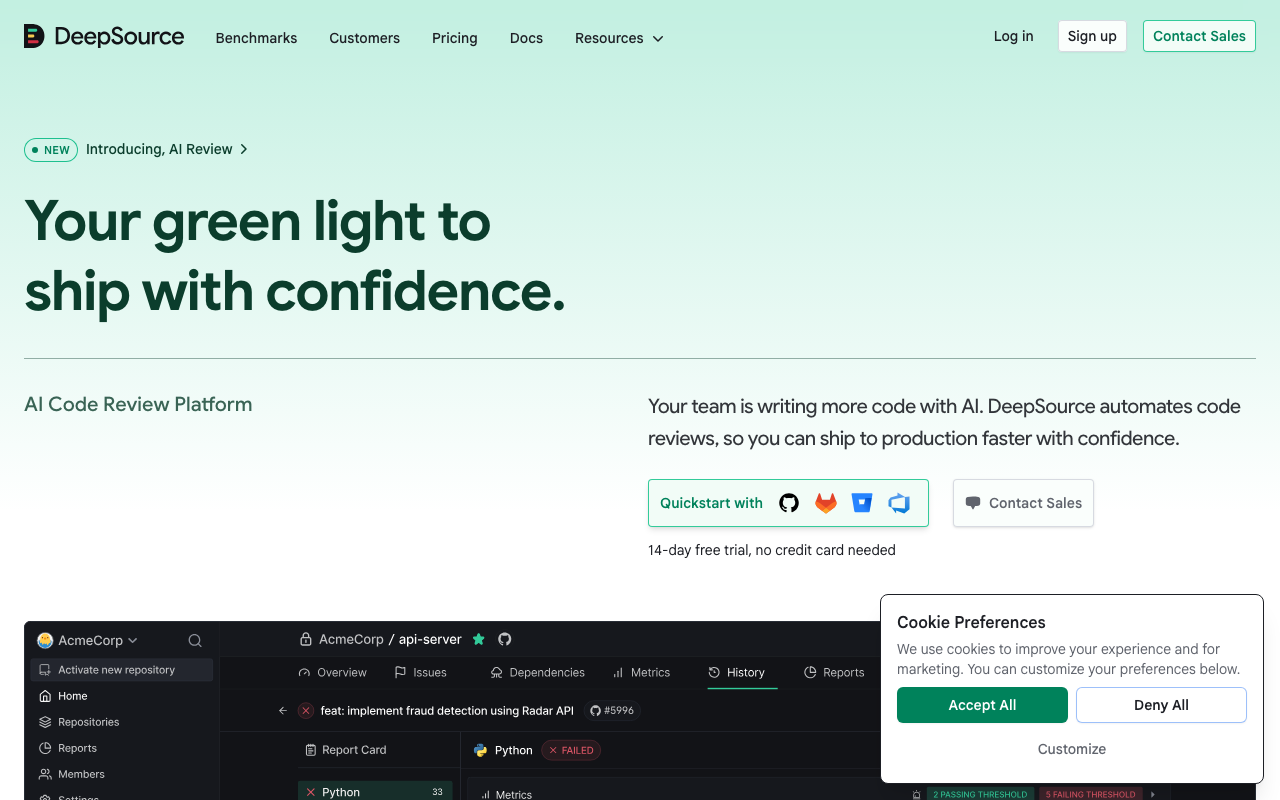
DeepSource and Coverity are both static analysis platforms, but they solve fundamentally different problems for fundamentally different customers. DeepSource is a modern, cloud-hosted code quality and AI code review platform that delivers fast PR feedback, automated remediation, and a sub-5% false positive rate for teams writing Python, JavaScript, Go, Java, and other modern languages. Coverity - now owned by Black Duck Software (formerly Synopsys Software Integrity Group) - is a deep enterprise defect detection engine purpose-built for safety-critical C, C++, and Java development, delivering interprocedural path-sensitive analysis that finds memory corruption, concurrency defects, and resource management bugs no pattern-based tool can detect.
If you need to pick one: Choose DeepSource if your team builds web applications, cloud services, APIs, or internal tools and wants fast developer feedback, AI-powered code review, and automated fixes without operational overhead. Choose Coverity if you build safety-critical embedded systems, automotive software, avionics, medical devices, or high-reliability financial systems in C, C++, or Java, where compliance with MISRA, CERT, or AUTOSAR standards is non-negotiable.
The real answer for most teams: DeepSource is the right default. It is cloud-hosted, setup takes under 10 minutes, and the combination of static analysis with AI code review and Autofix AI delivers measurable value for everyday product development. Coverity is the right answer when “a bug could injure someone” or “a missed defect triggers a product recall” - circumstances where its deep interprocedural analysis and compliance reporting justify the substantial cost and setup complexity.
For teams evaluating related tools, see our comparisons of DeepSource vs Codacy, SonarQube vs Coverity, Codacy vs Coverity, and DeepSource vs Semgrep.
At-a-Glance Feature Comparison
| Category | DeepSource | Coverity (Black Duck) |
|---|---|---|
| Primary focus | Code quality + AI code review + automated remediation | Deep defect detection + safety compliance |
| Core strength | Sub-5% false positive rate, Autofix AI, five-dimension PR report cards | Path-sensitive interprocedural analysis for C/C++/Java |
| Analysis approach | Rule-based SAST + LLM-powered AI review + post-processing filter | Interprocedural dataflow analysis, whole-program modeling |
| False positive rate | Sub-5% (post-processing filter) | 15-20% (path-proved defects only) |
| Languages (GA) | 16 (Python, JS, TS, Go, Java, Ruby, Rust, C#, PHP, Scala, Dart, Shell, SQL, Docker, Terraform, Ansible) | 22+ (deepest for C, C++, Java) |
| C/C++ analysis | Beta support only | Industry-leading, purpose-built, deepest available |
| Memory safety bugs | Limited | Comprehensive (buffer overflow, use-after-free, double-free) |
| Concurrency defects | Limited | Deep (races, deadlocks, atomicity violations) |
| Resource leaks | Pattern-based detection | Interprocedural lifecycle tracking |
| MISRA compliance | No | Yes (MISRA C, MISRA C++) |
| CERT compliance | No | Yes (CERT C, CERT C++, CERT Java) |
| AUTOSAR compliance | No | Yes (AUTOSAR C++14) |
| OWASP/CWE coverage | Yes | Yes |
| AI code review | Yes - five-dimension PR report cards | No |
| Autofix AI | Yes - LLM-powered, context-aware | No |
| Agentic capabilities | Yes - DeepSource Agents | No |
| Secrets detection | 30+ services | No (via Black Duck SCA separately) |
| SCA | No | Via Black Duck SCA (separate product) |
| IDE plugin | VS Code, IntelliJ, PyCharm | CodeSight (VS Code, IntelliJ, Eclipse) |
| Cloud platform | Cloud-hosted by default | Polaris (Black Duck platform) |
| IaC scanning | Yes (Terraform, Docker, Ansible at GA) | Limited |
| Free tier | Free for individuals; Open Source plan for public repos | Coverity Scan (open source only) |
| Commercial pricing | $24/user/month (Team); Enterprise custom | Enterprise pricing, not publicly listed |
| Setup time | Under 10 minutes, zero infrastructure | Weeks of configuration |
| Deployment | Cloud-hosted; self-hosted on Enterprise plan | On-premises or cloud (Polaris) |
| Azure DevOps support | No | Yes |
| Best for | Modern product teams, AI-powered quality and security | Safety-critical C/C++, regulated industries |
What Is DeepSource?
DeepSource is an AI-native code quality and code review platform founded in 2019. It has undergone a significant evolution - from a static analysis startup focused on minimal false positives to a comprehensive AI code review platform that combines traditional SAST with LLM-powered PR review, automated remediation, and autonomous security agents. The platform serves over 2,000 teams across 16 supported languages and analyzes code on every commit and pull request via webhook integration with GitHub, GitLab, and Bitbucket.
The platform’s defining characteristic is its sub-5% false positive rate, achieved through a post-processing framework that applies both explicit and implicit signals to filter unlikely findings before they reach developers. This single characteristic drives DeepSource’s adoption story - developers trust the findings, engage with the tool, and actually fix the issues it surfaces. The behavioral outcome is qualitatively different from tools that produce 20-30% false positives, where developers learn to ignore findings within weeks of deployment.
What Makes DeepSource Different
AI Code Review with Five-Dimension Report Cards. DeepSource runs an AI code review engine alongside static analysis on every pull request. Each PR receives a structured report card across five dimensions: Security, Reliability, Complexity, Hygiene, and Coverage. This is not a simple summary - it is a structured quality assessment that helps reviewers understand overall PR health at a glance, without parsing a flat list of individual findings. The AI catches novel issues, architectural concerns, and second-order quality problems that rule-based analysis cannot reach.
Autofix AI. When DeepSource identifies an issue, it generates a context-aware fix using large language models. The fix generation analyzes imports, related functions, coding patterns elsewhere in the project, and language idioms to produce changes that look like they were written by a team member. DeepSource reports that Autofix AI can generate fixes for nearly all detected issues - a dramatic improvement over rule-based autofix systems that cover roughly 30% of issues. The platform is also introducing Iterative Fix Refinement, allowing developers to provide feedback at the diff level and regenerate improved fixes. Applied at scale, automated remediation reduces manual refactoring workload by an estimated 30-40%.
DeepSource Agents. Launched in 2025, Agents observe every line written in the codebase, reason about changes with full context, and take autonomous action to secure code. Agents access a comprehensive graph of code and third-party dependencies, understand organizational memory and historical patterns, and can create pull requests and manage CVEs autonomously. This push into agentic AI moves DeepSource from passive analysis to proactive code security.
Infrastructure-as-Code Support. DeepSource supports Terraform, Docker, and Ansible at GA level - meaning teams managing cloud infrastructure can scan IaC configurations with the same accuracy-first engine as their application code. This is a differentiator for modern DevOps teams that manage infrastructure-as-code alongside application development.
Zero-Infrastructure Setup. DeepSource is cloud-hosted by default. A repository connected to DeepSource requires a .deepsource.toml configuration file in the root and a Git platform integration - no servers, no databases, no CI pipeline changes. Analysis starts within minutes of connection, which removes the adoption barrier that has historically slowed down SAST deployments.
DeepSource Pricing
DeepSource restructured its pricing in February 2026, replacing older Free and Business tiers with a three-tier model.
| Tier | Price | Key inclusions |
|---|---|---|
| Free | $0 | Individual developers, public and private repos, basic static analysis |
| Open Source | $0 | Public repos only, 1,000 analysis runs/month, metered AI features |
| Team | $24/user/month | AI code review, Autofix AI, security scanning, code health dashboards, bundled AI credits |
| Enterprise | Custom | Self-hosted deployment, SSO/SCIM, IP restrictions, SLA, dedicated account manager |
DeepSource uses committer-based billing - you are charged only for users who actively push code to analyzed repositories, not every seat in the organization. For a 25-person team where 20 are active contributors, you pay for 20 seats.
What Is Coverity (Black Duck)?
Coverity is widely regarded as the gold standard for static application security testing in safety-critical and mission-critical software development. Originally built from Stanford University research into path-sensitive program analysis and commercialized in 2002, Coverity was acquired by Synopsys in 2014 for $334 million. In October 2024, Synopsys divested its entire application security business - including Coverity, Black Duck SCA, and the Polaris platform - to private equity firms Clearlake Capital and Francisco Partners in a $2.1 billion deal. The resulting independent company was rebranded as Black Duck Software, Inc.
Coverity holds a strong reputation in industries subject to stringent functional safety standards: automotive (ISO 26262), aerospace (DO-178C), medical devices (IEC 62304), and defense. On G2, Coverity holds approximately a 4.2/5 rating. Black Duck (formerly Synopsys) has been recognized as a Leader in the Gartner Magic Quadrant for Application Security Testing for eight consecutive years through 2025.
What Makes Coverity Different
Deep Path-Sensitive Interprocedural Analysis. This is Coverity’s core technical differentiator. While most SAST tools rely on pattern matching - looking for known vulnerability signatures in code - Coverity builds a comprehensive model of all possible execution paths through the program. It traces how data flows across function boundaries, through complex control flow, and across entire codebases. When Coverity reports a defect, it provides a concrete execution path showing exactly how the bug is triggered - the specific sequence of function calls, branch conditions, and variable states that lead to the problem. This path-proof approach is what drives the tool’s low false positive rate: every finding is a demonstrated execution scenario, not a pattern match.
Memory Safety Defect Detection. Coverity’s deepest capabilities are in memory safety analysis for C and C++. Buffer overflows, heap buffer overflows, stack buffer overflows, use-after-free errors, double-free errors, memory leaks, uninitialized memory reads, and null pointer dereferences buried in rare execution paths - these are Coverity’s specialty. These defect categories are the root cause of most critical security vulnerabilities in C/C++ software and the primary reason safety-critical industries mandate Coverity-class analysis.
Concurrency Defect Detection. Data races, deadlocks, atomicity violations, and lock-order inversions are among the most dangerous and hardest to find bugs in multi-threaded software. They depend on thread scheduling and timing, making them nearly impossible to reproduce reliably through testing. Coverity’s static analysis identifies these issues by analyzing thread synchronization patterns across the program without needing to reproduce the specific timing conditions that trigger them in production.
Compliance Checking and Reporting. Coverity provides built-in compliance checkers and audit-ready reports for MISRA C, MISRA C++, CERT C, CERT C++, CERT Java, AUTOSAR C++14, CWE Top 25, and OWASP Top 10. These compliance reports map findings directly to specific standard rules, providing the documentary evidence that regulatory certification processes require. No other commercial SAST tool matches Coverity’s depth and breadth of safety standard compliance support.
CodeSight IDE Plugin. The CodeSight plugin delivers real-time static analysis inside VS Code, Visual Studio, IntelliJ IDEA, and Eclipse. Developers receive immediate feedback with CWE classifications and remediation guidance without leaving their editor. CodeSight also integrates Black Duck SCA for open-source dependency scanning in the IDE.
Polaris Cloud Platform. Black Duck has been migrating Coverity capabilities to the Polaris unified cloud platform, which provides a centralized dashboard for managing SAST, SCA, and other security testing across an entire application portfolio. Polaris includes natural language queries, remediation dashboards tracking mean time to fix, and triage approval workflows for governance.
Coverity Pricing
Coverity’s commercial pricing is not publicly listed and follows an enterprise quote-based model.
| Plan | Price | Notes |
|---|---|---|
| Coverity Scan (open source) | Free | Open source projects only; weekly build quotas by codebase size |
| CodeSight IDE plugin | ~$500/developer/year (historic) | 10-developer minimum; pricing may have changed under Black Duck |
| Enterprise Platform | Contact sales | Full analysis engine, Coverity Connect, CI/CD integration, compliance reporting |
| Polaris Cloud | Contact sales | Cloud-managed SAST + Black Duck SCA bundled |
Enterprise platform costs vary widely based on team size, codebase scale, language mix, and support requirements. User reports on PeerSpot indicate significant annual investments - often tens of thousands to hundreds of thousands of dollars for mid-size and large teams. These costs are justifiable in industries where a single missed defect triggers a product recall or regulatory penalty, but are difficult to rationalize for standard web application development.
Feature-by-Feature Breakdown
Analysis Depth: Pattern Matching vs. Path-Sensitive Analysis
The most important technical difference between DeepSource and Coverity is how they analyze code.
DeepSource uses rule-based static analysis with aggressive post-processing filtering. Its 5,000+ rules identify known patterns of problematic code - security vulnerabilities, quality issues, antipatterns, and coding standard violations. A sophisticated post-processing framework then filters findings through multiple explicit and implicit signals before surfacing them to developers. This filtering is what achieves the sub-5% false positive rate. The approach is fast, scales well across many languages, and produces high-signal results - but it has structural limits on the complexity of defects it can detect. Issues that only manifest under specific combinations of conditions across multiple function calls and files are beyond the reach of this approach.
Coverity uses deep path-sensitive interprocedural analysis. It does not match patterns - it builds a model of all possible execution paths through the program and traces data flow, control flow, and resource states along those paths. This approach finds defects that pattern-based tools structurally cannot detect: a null pointer dereference that only occurs when a specific combination of three input conditions aligns across two modules, a race condition that only triggers under a specific thread interleaving, or a buffer overflow hidden ten function calls deep in a call chain where an unchecked size parameter originated.
When does the depth difference matter? For teams writing web applications in Python, JavaScript, or TypeScript, DeepSource catches the vast majority of issues that matter - common security vulnerabilities, code quality problems, and OWASP Top 10 patterns. Coverity’s deeper analysis provides diminishing returns for these languages and application types.
For teams writing C/C++ systems software, embedded firmware, or high-reliability Java, the depth difference is critical. Memory safety bugs, concurrency defects, and resource leaks are subtle, dangerous, and extremely hard to find through testing. Coverity finds them through static analysis before they reach production. The cost of a missed defect in safety-critical software - measured in product recalls, regulatory penalties, or human safety - justifies the tool’s enterprise pricing.
Language Support
DeepSource supports 16 languages at GA: Python, JavaScript, TypeScript, Go, Java, Ruby, Rust, C#, PHP, Scala, Dart, Shell, SQL, Docker, Terraform, and Ansible. C/C++, Swift, and Kotlin are in beta. The inclusion of IaC languages (Terraform, Docker, Ansible) is notable - teams managing cloud infrastructure can scan configurations with the same accuracy-first engine as application code. Within supported GA languages, DeepSource’s analyzers are framework-aware: the Python analyzer understands Django and Flask patterns, the Go analyzer understands goroutine safety, and the JavaScript analyzer understands React and Node.js conventions.
Coverity supports 22+ languages, with the deepest analysis for C, C++, and Java. Recent Polaris updates have expanded coverage for Kotlin, Go, and Scala. Coverity’s analysis depth is not uniform across all languages - C, C++, and Java receive the full depth of interprocedural analysis, while other languages may receive lighter coverage. The key differentiator is that Coverity’s C/C++ analysis engine is purpose-built and the industry benchmark - no other commercial tool matches it for these languages.
For polyglot teams using modern languages primarily within DeepSource’s 16 GA set, language coverage is not a deciding factor. For teams with C/C++ as a primary language, Coverity’s depth for those specific languages is a decisive advantage.
AI and Automation Capabilities
This is an area where the tools diverge completely.
DeepSource has invested heavily in AI capabilities and it shows in every part of the product:
- AI Code Review runs on every PR, providing structured five-dimension report cards (Security, Reliability, Complexity, Hygiene, Coverage) that communicate overall PR quality at a glance
- Autofix AI generates context-aware, LLM-powered fixes for nearly all detected issues - analyzing imports, related functions, and project-specific patterns to produce idiomatic code changes
- DeepSource Agents observe code changes with full codebase context and take autonomous action - creating PRs, managing CVEs, and identifying cross-file issues
- Iterative Fix Refinement lets developers provide feedback at the diff level and regenerate improved fixes collaboratively
Coverity has no AI code review or automated remediation capabilities. This is not a gap - it is a deliberate design decision. Coverity’s customers in regulated industries need deterministic, auditable, repeatable analysis results. Safety assessors and regulatory bodies require that static analysis findings can be traced to specific, reproducible execution paths. AI-generated recommendations are not acceptable evidence in many compliance contexts. Coverity’s value is its ability to prove defects, not suggest them.
The practical implication: teams that want AI-powered development acceleration alongside static analysis should choose DeepSource or pair Coverity with a dedicated AI review tool like CodeRabbit. Teams that need auditable, regulatory-compliant static analysis results should choose Coverity precisely because it does not introduce AI uncertainty into the analysis.
Safety Standard Compliance
This is Coverity’s uncontested domain.
Coverity provides compliance checking and reporting for:
- MISRA C and MISRA C++ - mandatory in automotive (ISO 26262), aerospace, and medical device software
- CERT C, CERT C++, and CERT Java - Carnegie Mellon CERT security coding standards
- AUTOSAR C++14 - automotive software platform coding guidelines
- CWE Top 25 - common weakness enumeration
- OWASP Top 10 - web application security standard
These are not optional features in safety-critical industries. An automotive OEM building autonomous driving software must demonstrate MISRA C compliance as part of ISO 26262 functional safety certification. An aerospace contractor writing avionics code must demonstrate CERT compliance for DO-178C certification. Coverity provides the analysis, evidence, and report artifacts that these regulatory processes require.
DeepSource provides security scanning aligned with OWASP Top 10 and SANS Top 25 but does not check for MISRA, CERT, or AUTOSAR compliance. Teams in regulated industries with safety standard obligations cannot use DeepSource as their compliance analysis tool. There is no workaround or configuration that enables MISRA or CERT checking in DeepSource - these capabilities simply do not exist in the platform.
Security Scanning
Both tools perform security vulnerability detection, but from different angles.
DeepSource detects security vulnerabilities aligned with OWASP Top 10 and SANS Top 25, plus secrets detection for 30+ services. The security findings benefit from the same sub-5% false positive rate - when DeepSource flags a security issue, it is almost certainly worth investigating. DeepSource Agents add an autonomous security layer, proactively identifying and remediating security issues before they are merged. The platform does not offer SCA (dependency vulnerability scanning) or DAST (dynamic application security testing) - teams needing those capabilities must use separate tools like Snyk Code or Semgrep.
Coverity excels at security vulnerability detection through its taint analysis capabilities. It traces untrusted input from sources (user input, network data, file reads) to sensitive sinks (database queries, system commands, file operations, memory operations) through complex, multi-function code paths. This interprocedural taint analysis catches injection vulnerabilities, authentication bypasses, and other security defects that span multiple function calls - the kind that pattern-based security scanners miss. Coverity does not include secrets detection, SCA, or DAST, though it is available as part of the Black Duck portfolio (Black Duck SCA is a separate product).
The security depth comparison depends on language. For Python, JavaScript, and modern language security, DeepSource’s pattern-based OWASP scanning with sub-5% false positives is practical and effective. For C/C++ and Java security - especially memory safety vulnerabilities, integer overflows, and injection flaws hidden in deep call chains - Coverity’s interprocedural analysis provides security depth that DeepSource cannot match.
IDE and Developer Workflow Integration
DeepSource integrates with VS Code, IntelliJ IDEA, and PyCharm, providing real-time feedback as developers write code. This shift-left approach catches issues before they reach the PR stage. The primary workflow, however, is PR-level: analysis runs automatically on every commit and pull request via webhook, with findings posted as PR comments that developers see during code review.
Coverity provides the CodeSight IDE plugin for VS Code, Visual Studio, IntelliJ IDEA, and Eclipse. CodeSight runs Coverity’s Rapid Scan engine locally, flagging defects in real time with CWE classifications and remediation guidance. CodeSight also integrates Black Duck SCA for dependency scanning in the IDE. The primary Coverity workflow is CI/CD-level: full analysis intercepts the build process, with results flowing to Coverity Connect or the Polaris dashboard for triage and management.
A key operational difference: DeepSource’s PR-level feedback is designed for developers to act on during code review. Coverity’s findings flow into a defect management workflow where security and quality teams triage, classify, and assign issues. This reflects the different cultures each tool serves - DeepSource serves developer-centric teams where developers own quality; Coverity serves enterprise teams where AppSec or quality assurance teams manage defect backlogs.
CI/CD and Build Integration
DeepSource operates through Git webhooks with no pipeline changes required. Analysis runs as a cloud service triggered by push and pull request events. For teams that want explicit CI/CD integration, the DeepSource CLI can be added to GitHub Actions, GitLab CI, or other CI systems. Analysis results appear on PRs within minutes of code push.
Coverity integrates by intercepting the build process. You configure Coverity to wrap your existing build commands (make, gradle, maven, cmake), and it captures compilation units to build an internal program representation. The analysis engine then examines this representation for defects. This build-capture approach ensures Coverity analyzes exactly the code that gets compiled. CI/CD integration uses plugins and command-line tools for Jenkins, GitHub Actions, GitLab CI, and Azure DevOps. Full analysis can be time-consuming for large codebases; Coverity’s incremental and Rapid Scan modes are used for PR-level CI gates where scan speed matters.
The operational difference is significant. DeepSource is a zero-configuration SaaS service that starts providing value immediately. Coverity requires build infrastructure integration, a defect management server or Polaris subscription, triage workflow configuration, and ongoing tuning. For teams without dedicated DevOps engineers, DeepSource removes an adoption barrier that has historically prevented many organizations from deploying SAST consistently.
Pricing Comparison
DeepSource Pricing
| Tier | Price | Key features |
|---|---|---|
| Free | $0 | Individual developers, public and private repos, basic static analysis |
| Open Source | $0 | Public repos only, 1,000 analysis runs/month, metered AI |
| Team | $24/user/month (active contributors) | AI code review, Autofix AI, security scanning, code health dashboards |
| Enterprise | Custom | Self-hosted, SSO/SCIM, IP restrictions, SLA, dedicated account manager |
Coverity Pricing
| Plan | Price | Notes |
|---|---|---|
| Coverity Scan | Free | Open source projects only; build quotas by codebase size |
| CodeSight IDE | ~$500/dev/year (historic) | 10-dev minimum; may have changed post-Black Duck acquisition |
| Enterprise | Contact sales | Full analysis, Coverity Connect, compliance, CI/CD integration |
| Polaris Cloud | Contact sales | Cloud SAST + Black Duck SCA bundle |
Cost Comparison by Team Size
| Team size | DeepSource Team (annual) | Coverity Enterprise (estimated annual) |
|---|---|---|
| 5 developers | $1,440/year | Not practical (no commercial free tier) |
| 10 developers | $2,880/year | ~$5,000-$15,000/year |
| 25 developers | $7,200/year | ~$12,500-$37,500/year |
| 50 developers | $14,400/year | ~$25,000-$75,000/year |
| 100 developers | $28,800/year | ~$50,000-$150,000/year |
| 250 developers | $72,000/year | ~$125,000-$375,000/year |
Important caveat on Coverity estimates: Coverity does not publish pricing. The ranges above are based on industry reports, PeerSpot user discussions, and historic pricing data. Actual pricing depends on team size, codebase scale, language mix, deployment model, and support level. Treat these as rough directional estimates only.
DeepSource is dramatically more accessible. For a 25-person team, DeepSource costs roughly $7,200/year - a figure that clears budget approval in most organizations without escalation. Coverity at the same team size likely starts at $12,500+ and can reach $37,500+ depending on usage parameters. For safety-critical industries where Coverity’s capabilities are required, the cost is justified. For teams without those requirements, the price difference is difficult to justify.
Coverity’s cost-per-defect-found can be favorable. This argument is made by Coverity advocates and has merit in specific contexts: lower false positive rates mean less wasted engineering time on triage. A tool that generates 200 false positives per month costs real developer hours. In safety-critical industries, a missed defect can cost millions in recalls or liability. For those teams, Coverity’s pricing is an investment with measurable ROI. For teams not in those industries, the same logic is harder to construct.
Use Cases - When to Choose Each
Choose DeepSource If…
Your team builds web applications, cloud services, or APIs. DeepSource is purpose-designed for the workflows of modern product development teams. PR-level analysis with sub-5% false positive rates, AI code review, and one-click Autofix are the features these teams need. Coverity’s depth provides diminishing returns for web application security and code quality relative to its cost and setup complexity.
You want automated remediation, not just detection. DeepSource’s Autofix AI generates context-aware, working fixes for nearly all detected issues. If reducing the manual effort of addressing static analysis findings is important - and for most teams, it is - DeepSource’s automation capabilities are unmatched in this comparison. Coverity does not offer automated fix generation.
Your team works primarily in Python, JavaScript, TypeScript, Go, Java, Ruby, or Rust. DeepSource’s 16 GA languages cover most modern development stacks. If your codebase lives within this set, language coverage is not a limiting factor, and DeepSource’s analysis depth for these languages is comprehensive.
You need setup in hours, not weeks. DeepSource requires no infrastructure provisioning, no server management, and no build system integration. Connect a repository and analysis starts immediately. For teams that need to demonstrate code quality tooling quickly - whether for an engineering manager, a new client, or a security audit - DeepSource’s time-to-value is measurably faster.
You want AI code review alongside static analysis. DeepSource’s five-dimension PR report cards, Autofix AI, and DeepSource Agents represent genuine AI-powered development acceleration that Coverity does not offer. Teams that want both static analysis and AI code review from a single platform should choose DeepSource over assembling separate tools.
You scan Infrastructure-as-Code. DeepSource’s GA support for Terraform, Docker, and Ansible means IaC configurations get the same accuracy-first analysis as application code. Teams operating in DevOps environments with significant IaC surface area will find this natively integrated.
Choose Coverity If…
You build safety-critical software. If your code runs in vehicles, aircraft, medical devices, industrial control systems, or defense applications, Coverity’s compliance reporting for MISRA, CERT, and AUTOSAR standards is a regulatory requirement. No amount of DeepSource configuration produces MISRA compliance evidence. This is not a knock on DeepSource - it is simply not the tool for that regulatory context.
C and C++ are your primary languages. Coverity was built for C/C++ and its analysis engine is the deepest available for these languages. Memory safety bugs, integer overflows, concurrency defects, and resource management issues in C/C++ code are the defects that cause catastrophic failures, and Coverity finds them through analysis that pattern-based tools structurally cannot replicate.
Finding the most dangerous bugs matters more than finding all bugs. Coverity’s path-sensitive analysis is designed to find the bugs that escape code reviews, unit tests, and integration tests - the ones that only manifest under rare conditions. If your team’s primary goal is eliminating the highest-severity defects rather than enforcing code quality standards, Coverity’s precision is the right tool.
You need cross-function and cross-file defect detection. A buffer overflow caused by an unchecked parameter passed through four levels of function calls is invisible to tools that analyze functions in isolation. Coverity’s whole-program analysis traces data flow and control flow across all function and module boundaries, finding defects that span the full call graph.
Scan speed is less critical than scan depth. Coverity’s full analysis is time-consuming for large codebases (30 minutes to several hours for complex C++ projects). If your team’s workflow accommodates nightly or per-build deep analysis rather than requiring sub-minute PR gates, Coverity’s depth justifies the time investment. Its incremental and Rapid Scan modes mitigate this for daily CI/CD use.
Azure DevOps is your CI/CD platform. DeepSource does not support Azure DevOps. Coverity integrates with Azure DevOps pipelines. For organizations standardized on the Microsoft DevOps stack, Coverity is a viable option where DeepSource is not.
Consider Both If…
Large organizations with heterogeneous codebases sometimes run both tools for different parts of the stack. A practical configuration: Coverity handles deep defect detection and compliance for safety-critical C/C++ components (embedded firmware, real-time systems, hardware drivers), while DeepSource handles code quality, AI code review, and automated remediation for application-layer code in Python, Go, or Java. The tools target different concerns with minimal overlap - Coverity finds deep bugs, DeepSource enforces quality and accelerates development. For organizations where both concerns are real and budget allows, the combination provides broad coverage. See also our comparison of SonarQube vs Coverity for how quality platforms pair with Coverity in enterprise environments.
Alternatives Worth Considering
If neither DeepSource nor Coverity is the right fit, several alternatives deserve evaluation.
SonarQube is the most widely adopted static analysis platform with 6,500+ rules across 35+ languages, a generous free Community Build, and battle-tested self-hosted deployment. It falls between DeepSource and Coverity in analysis depth - deeper than DeepSource for some defect categories, but without Coverity’s interprocedural precision for C/C++. SonarQube’s Developer Edition ($2,500/year) includes C/C++ support and taint analysis, making it a cost-effective alternative to Coverity for teams not in safety-critical industries. See our SonarQube vs Coverity comparison for the detailed breakdown.
Semgrep provides fast, lightweight SAST with exceptional custom rule authoring. Community rules are free, the AppSec Platform is free for up to 10 contributors, and the Team tier is $35/contributor/month. Semgrep’s cross-file taint analysis and SCA with reachability analysis make it a strong security scanner, complementing rather than replacing a code quality platform like DeepSource. See our DeepSource vs Semgrep comparison.
Checkmarx is an enterprise application security platform with SAST, DAST, SCA, API security, and container scanning. It competes with Coverity on SAST depth (though not on C/C++ memory safety depth) and provides a more modern developer experience than Coverity at comparable enterprise pricing. For web application security programs, Checkmarx is a strong alternative to Coverity.
Snyk Code provides developer-first SAST with AI-powered analysis, strong IDE integration, and the industry’s best SCA with reachability analysis. At $25/developer/month, it sits between DeepSource and Coverity on both price and analysis depth. For teams where security is the primary concern - not code quality - Snyk provides security scanning depth that DeepSource does not match, without Coverity’s complexity.
Codacy offers broad code quality and security coverage at $15/user/month with 49-language support, SAST, SCA, DAST, and secrets detection in a single platform. It is cheaper than DeepSource and dramatically more accessible than Coverity. For budget-constrained teams that need broad coverage over precision, Codacy delivers more per dollar. See our DeepSource vs Codacy and Codacy vs Coverity comparisons.
For a broader view of the SAST landscape, see our best SAST tools guide.
Head-to-Head Use Case Scenarios
| Scenario | Better choice | Why |
|---|---|---|
| Buffer overflows in C++ embedded firmware | Coverity | Purpose-built interprocedural memory safety analysis for C/C++ |
| Python web app security vulnerabilities | DeepSource | Sub-5% false positive OWASP scanning, no setup overhead |
| MISRA C compliance for automotive software | Coverity | Full MISRA C checker; DeepSource does not support MISRA |
| AI-generated code review on every PR | DeepSource | Five-dimension report cards, Autofix AI; Coverity has no AI review |
| Null pointer dereferences buried 4 calls deep | Coverity | Path-sensitive interprocedural analysis proves execution paths |
| Go microservices code quality enforcement | DeepSource | GA Go support with framework awareness; sub-5% false positives |
| Concurrency bugs in multi-threaded Java | Coverity | Deep concurrency analysis; DeepSource has limited concurrency detection |
| Automated fix generation for detected issues | DeepSource | Autofix AI generates context-aware fixes; Coverity has no autofix |
| CERT C++ compliance for defense software | Coverity | Full CERT C++ checker; DeepSource has no CERT compliance |
| TypeScript/React front-end code quality | DeepSource | Framework-aware GA TypeScript/React analysis |
| Startup or small team (under 20 devs) | DeepSource | Free tier available; Coverity has no commercial free tier |
| Medical device IEC 62304 compliance | Coverity | Safety standard compliance reporting; DeepSource cannot provide this |
| Secrets detection in application code | DeepSource | 30+ services secrets detection included; Coverity has no secrets detection |
| Large C++ codebase nightly deep scan | Coverity | Whole-program analysis on full build; DeepSource has beta C/C++ only |
| Budget under $5K/year for 10 developers | DeepSource | $2,880/year (Team plan); Coverity has no accessible commercial tier |
| Terraform and Docker IaC scanning | DeepSource | GA IaC support; Coverity does not emphasize IaC |
| Azure DevOps CI/CD integration | Coverity | Azure DevOps plugin available; DeepSource does not support Azure DevOps |
| Finding race conditions in C++ before code review | Coverity | Static concurrency analysis identifies potential races across the codebase |
Final Recommendation
DeepSource and Coverity are not competing for the same customer - they solve different problems for different teams at fundamentally different price points and complexity levels.
For the vast majority of software teams - those building web applications, cloud services, mobile backends, internal tools, or standard enterprise software in Python, JavaScript, TypeScript, Go, Java, or Rust - DeepSource is the clear choice. Its sub-5% false positive rate means findings are trustworthy and actionable. Autofix AI reduces remediation burden by an estimated 30-40%. The five-dimension AI PR report cards provide structured feedback that accelerates code review without increasing noise. Setup takes under 10 minutes and requires no infrastructure. The Team plan at $24/user/month (billed per active contributor) is accessible for any organization with a real engineering budget. If you need code quality enforcement, security vulnerability detection, and AI-powered development acceleration in a single cloud-hosted platform, DeepSource delivers this with a developer experience that is difficult to match.
For teams in safety-critical industries - automotive, aerospace, medical devices, defense, industrial control, and nuclear - Coverity is a near-requirement. No other tool provides the depth of interprocedural, path-sensitive C/C++ analysis, MISRA and CERT compliance checking, and auditable regulatory evidence that these environments demand. Coverity’s deep defect detection finds the bugs that matter most in environments where software failures have physical consequences. The enterprise pricing and significant setup investment are justified when the alternative is a missed defect that triggers a product recall or regulatory penalty. Consider pairing Coverity with SonarQube for code quality metrics that Coverity does not provide.
For C/C++ teams outside safety-critical industries - game development, systems programming, performance-critical applications, or infrastructure software - the calculus is less clear. Coverity’s analysis depth remains the best available for C/C++, but the cost and operational overhead may not be justified if MISRA/CERT compliance is not required. SonarQube’s Developer Edition provides C/C++ analysis at $2,500/year. Semgrep covers C/C++ with custom security rules at lower cost. Evaluate these alternatives before committing to Coverity’s enterprise pricing unless deep interprocedural analysis is genuinely needed.
On the Black Duck ownership transition: Coverity customers and prospective buyers should factor the 2024 private equity acquisition into their long-term tooling decisions. Engage directly with Black Duck sales to understand product roadmap commitments, support SLAs, and pricing stability under the new ownership structure. The product remains technically excellent, but ownership transitions introduce uncertainty worth acknowledging.
The bottom line: if you are asking whether to choose DeepSource or Coverity, the answer is probably DeepSource - because teams that genuinely need Coverity usually already know it. Safety engineers and regulatory compliance teams in automotive, aerospace, and medical devices know they need deep SAST with MISRA compliance before they start evaluating tools. If you reached this comparison uncertain whether you need that level of analysis, DeepSource is almost certainly sufficient for your use case.
Frequently Asked Questions
Is DeepSource better than Coverity?
It depends entirely on what you need from static analysis. DeepSource is better for teams that want a modern, cloud-hosted code quality platform with AI-powered code review, automated remediation via Autofix AI, and a sub-5% false positive rate on everyday quality and security issues. It is excellent for mid-size product teams writing Python, JavaScript, Go, Java, or Rust who want fast PR feedback and automated fixes. Coverity is better for teams building safety-critical or mission-critical software in C, C++, or Java, where deep interprocedural path-sensitive analysis is required to catch memory corruption, concurrency defects, and resource leaks that pattern-based tools miss. Coverity is also essential when compliance with MISRA, CERT, or AUTOSAR standards is a regulatory requirement. For standard web or cloud application teams, DeepSource delivers more value. For embedded, automotive, aerospace, medical, or defense software teams, Coverity is the industry standard.
Does DeepSource compete with Coverity?
Not directly. DeepSource and Coverity overlap in the broad category of static analysis, but they serve fundamentally different markets and use cases. DeepSource targets modern product development teams that want cloud-native code quality enforcement with AI-powered review and automated remediation. Coverity targets enterprise teams in safety-critical industries that need the deepest possible defect detection accuracy and compliance reporting for regulated standards. The two tools are rarely evaluated as direct replacements - teams choosing between them have usually already decided whether they need enterprise SAST accuracy or developer-friendly code quality tooling.
Can DeepSource replace Coverity for C and C++ projects?
Not for safety-critical C and C++ development. While DeepSource has C/C++ support in beta, Coverity's C and C++ analysis engine is purpose-built, interprocedural, and path-sensitive - it finds buffer overflows, use-after-free errors, null pointer dereferences, race conditions, and memory leaks buried in rare execution paths across entire codebases. DeepSource's beta C/C++ support does not approach this depth. For teams building embedded firmware, operating systems, automotive ECU software, avionics code, or medical device firmware in C or C++, Coverity's analysis depth is a requirement that DeepSource cannot match. For teams writing C++ in non-critical contexts who want general quality and common vulnerability detection, DeepSource's beta support may be sufficient.
What is Coverity's false positive rate compared to DeepSource?
Both tools are known for low false positive rates, but they achieve this through different mechanisms. DeepSource uses a post-processing filter that applies multiple explicit and implicit signals to suppress unlikely findings before surfacing them to developers, achieving a sub-5% false positive rate. Coverity achieves a 15-20% false positive rate through precision engineering - its deep path-sensitive analysis engine only flags issues when it can construct a concrete execution path demonstrating the defect. Both rates are well below industry averages for SAST tools, which often run at 30-50% false positives. Coverity's rate is higher than DeepSource's in absolute terms, but every Coverity finding comes with a proof path that shows exactly how the bug is triggered - which developers find highly trustworthy. DeepSource's lower rate reflects aggressive filtering; Coverity's slightly higher rate reflects that every finding is a verified execution path.
How does Coverity pricing compare to DeepSource?
The pricing structures are dramatically different. DeepSource Team plan costs $24/user/month (billed per active contributor) with all features included - AI code review, Autofix AI, security scanning, and code health dashboards. Coverity's enterprise pricing is not publicly listed and requires a custom sales engagement. The CodeSight IDE plugin was previously listed at approximately $500/developer/year as a standalone entry point. Full Coverity platform deployment costs significantly more - user reports on PeerSpot suggest costs in the tens of thousands to hundreds of thousands of dollars annually depending on team size, codebase scale, and support level. DeepSource is dramatically more accessible on pricing, making it feasible for any team size. Coverity pricing is justified in industries where a missed defect costs millions in recalls or liability, but is difficult to rationalize for standard web application development.
Does Coverity have AI code review features like DeepSource?
No. Coverity does not include LLM-powered code review, structured PR report cards, or Autofix AI. Its strength is deterministic, auditable, path-sensitive static analysis that produces repeatable results - a critical requirement in regulated industries where AI-generated recommendations may not be acceptable for compliance purposes. DeepSource's AI code review runs alongside static analysis on every pull request, providing five-dimension report cards (Security, Reliability, Complexity, Hygiene, Coverage) and generating context-aware fixes via Autofix AI. For teams that want AI-powered development assistance alongside static analysis, DeepSource or a dedicated AI reviewer like CodeRabbit is the right choice.
Does DeepSource support compliance standards like MISRA and CERT?
No. DeepSource provides security vulnerability detection aligned with OWASP Top 10 and SANS Top 25 but does not include compliance checkers for MISRA C, MISRA C++, CERT C, CERT C++, CERT Java, or AUTOSAR C++14. These compliance standards are mandatory in automotive (ISO 26262), aerospace (DO-178C), and medical device (IEC 62304) development. Coverity provides built-in compliance checking and reporting for all of these standards, with audit-ready evidence that regulatory processes require. If your project requires demonstrating compliance with safety coding standards, Coverity is necessary - DeepSource cannot fulfill this requirement.
Which tool is easier to set up - DeepSource or Coverity?
DeepSource is dramatically easier to set up. You connect your GitHub, GitLab, or Bitbucket repository, add a .deepsource.toml configuration file, and analysis begins automatically on the next commit or pull request. The entire process takes under 10 minutes with no server infrastructure, no database to configure, and no CI/CD pipeline changes required. Coverity requires intercepting the build process, installing analysis components, configuring the Coverity Connect or Polaris defect management interface, tuning checkers for your codebase, and establishing triage workflows. A typical Coverity deployment takes weeks of dedicated effort and ongoing configuration. This operational complexity is justified for safety-critical environments but is significant overhead for teams that simply want code quality feedback on pull requests.
What are the best alternatives to Coverity if the pricing is too high?
The best Coverity alternatives depend on why you need it. For deep C/C++ analysis without Coverity's price tag, consider Polyspace (MathWorks), Parasoft C++test, or PC-lint Plus - though these also carry enterprise pricing. For teams that need SAST without safety-critical compliance requirements, SonarQube Developer Edition ($2,500/year) provides C/C++ analysis at a significantly lower cost. For application security across multiple languages, Semgrep AppSec Platform offers deep taint analysis at $35/contributor/month. For teams where Coverity's compliance reporting was the primary draw, there is no direct inexpensive replacement - MISRA and CERT compliance tools are inherently specialized and costly. See our guide on best SAST tools for a broader overview.
Can I use DeepSource and Coverity together?
Yes, and this combination can be effective for large organizations with heterogeneous codebases. A practical deployment would use Coverity for deep defect detection and compliance reporting on safety-critical C/C++ components, while using DeepSource for code quality analysis, AI code review, and automated remediation on application code in Python, JavaScript, Go, and other languages. Coverity does not provide code quality metrics, technical debt tracking, or AI-powered remediation - DeepSource fills those gaps. The tools target different parts of the codebase and different types of issues, so their findings do not significantly overlap. The combined cost is substantial, but for organizations where both concerns are real, the pairing provides broad coverage.
Does Coverity work with GitHub, GitLab, and Bitbucket like DeepSource?
Yes, Coverity integrates with GitHub, GitLab, Azure DevOps, and other CI/CD systems, though the integration model differs significantly from DeepSource. DeepSource integrates via webhooks as a cloud-hosted service - no pipeline configuration needed. Coverity integrates by intercepting the build process in CI/CD pipelines (Jenkins, GitHub Actions, GitLab CI, Azure DevOps) and submitting results to Coverity Connect or the Polaris cloud platform. The Black Duck Security GitHub App (released August 2025) simplifies Coverity-on-Polaris GitHub integration. Coverity also supports Azure DevOps, which DeepSource does not - making it a viable option for organizations on the Microsoft DevOps stack.
Which tool is better for a startup or early-stage team?
DeepSource is the clear choice for startups and early-stage teams. Its free plan for individual developers, $24/user/month Team plan, and zero-infrastructure cloud-hosted model mean you can get high-quality static analysis running in under 10 minutes with no DevOps overhead. Coverity has no commercially viable free tier and requires an enterprise sales engagement for pricing - it is simply not designed for startup budgets or timelines. For early-stage teams that want the depth of enterprise SAST without the cost, Semgrep's free Community Edition and SonarQube's free Community Build are alternatives worth evaluating alongside DeepSource.
Explore More
Tool Reviews
 DeepSource Review
 Coverity (Black Duck) Review
 SonarQube Review
 Semgrep Review
 Snyk Code Review
 Checkmarx Review
Related Articles
- I Reviewed 32 SAST Tools - Here Are the Ones Actually Worth Using (2026)
- AI Code Review for Security - Finding Vulnerabilities With AI in 2026
- 11 Best SAST Tools in 2026 - Static Application Security Testing Compared
- 10 Best Checkmarx Alternatives for SAST in 2026
- 15 Best SonarQube Alternatives in 2026 (Free & Paid)
Free Newsletter
Stay ahead with AI dev tools
Weekly insights on AI code review, static analysis, and developer productivity. No spam, unsubscribe anytime.
Join developers getting weekly AI tool insights.
Related Articles
Checkmarx vs Veracode: Enterprise SAST Platforms Compared in 2026
Checkmarx vs Veracode - enterprise SAST, DAST, SCA, Gartner positioning, pricing ($40K-250K+), compliance, and when to choose each AppSec platform.
March 13, 2026
comparisonCodacy Free vs Pro: Which Plan Do You Need in 2026?
Codacy Free vs Pro compared - features, limits, pricing, and when to upgrade. Find the right Codacy plan for your team size and workflow.
March 13, 2026
comparisonCodacy vs Checkmarx: Developer Code Quality vs Enterprise AppSec in 2026
Codacy vs Checkmarx - developer code quality vs enterprise AppSec, pricing ($15/user vs $40K+), SAST, DAST, SCA, compliance, and when to choose each.
March 13, 2026