DeepSource vs Semgrep: Static Analysis Tools Compared (2026)
DeepSource vs Semgrep - dashboard-first auto-fix platform vs CLI-first rule engine. Custom rules, pricing, and security scanning compared.
Published:
Last Updated:
Ownership and pricing update, verified 2026-10-18: DeepSource was acquired by Harness, announced 9 September 2026, and is now a Harness product folding into the Harness Autonomous SDLC Platform over time (announcement); existing workspaces, integrations and workflows continue unchanged and DeepSource Cloud remains self-serve. Two pricing facts also changed: DeepSource’s free tier now covers public repositories only (the individual Free plan that supported private repos has been retired), and AI Review is billed separately from the $24/user/month Team seat at $8 per 10K processed LOC (Standard) or $15 per 10K (Advanced), against a $100 annual AI Review credit per user.
Quick verdict
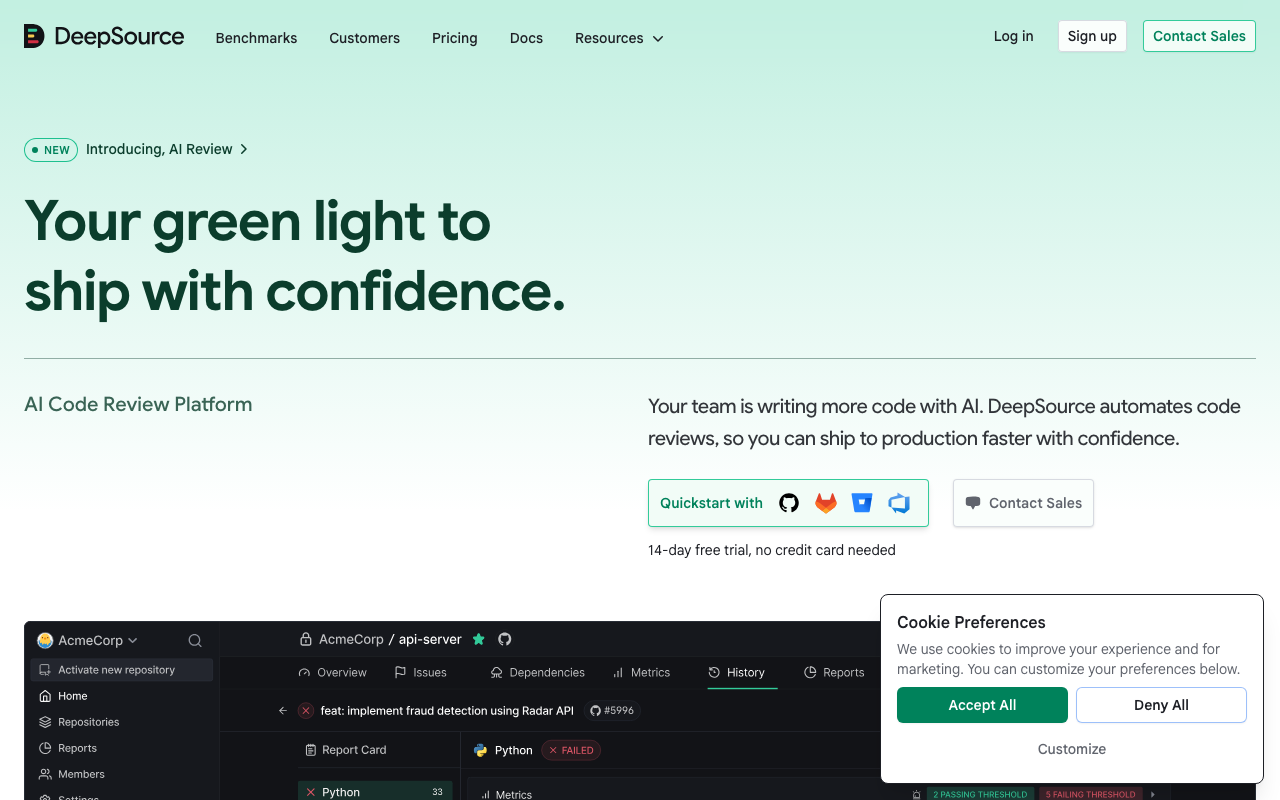
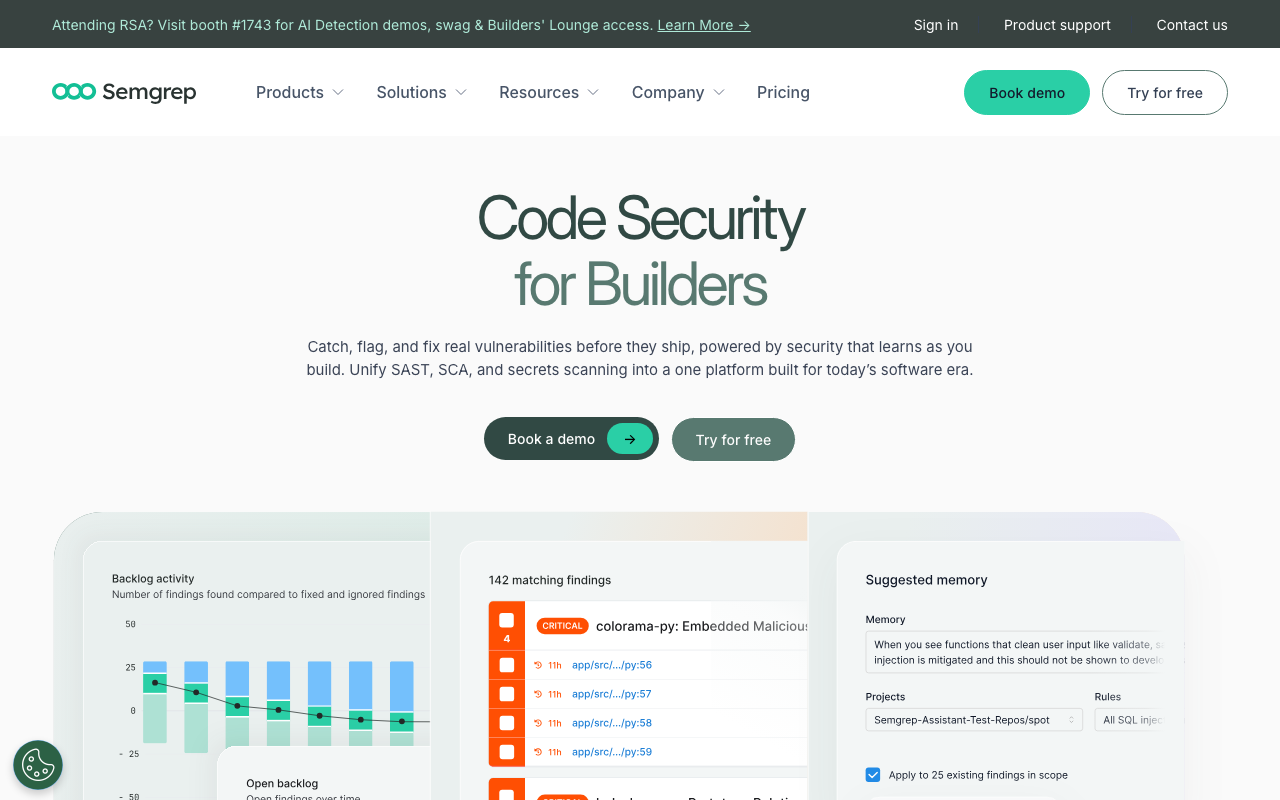
DeepSource and Semgrep are both static analysis tools, but they approach the problem from fundamentally different directions. DeepSource is a dashboard-first code quality platform that aggregates multiple analyzers, provides AI-powered autofix, and delivers structured PR report cards. Semgrep is a CLI-first security scanning engine built around a single powerful pattern-matching core with the best custom rule authoring in the industry. They occupy different categories, solve different primary problems, and - importantly - work exceptionally well together.
If code quality and automated remediation are your priorities, choose DeepSource. Its sub-5% false positive rate means developers trust every finding. Autofix AI generates context-aware fixes for nearly all detected issues. The five-dimension PR report cards organize feedback into Security, Reliability, Complexity, Hygiene, and Coverage - structured analysis that helps reviewers assess PRs at a glance rather than parsing individual findings.
If security scanning and custom rule authoring are your priorities, choose Semgrep. Its YAML-based custom rules are writable in minutes by any developer. Scans complete in 10-30 seconds. The Pro engine traces tainted data across files and functions. Semgrep Supply Chain provides SCA with reachability analysis. And the full platform is free for up to 10 contributors.
If you want the strongest overall posture, run both. DeepSource for code quality, AI review, and autofix. Semgrep for deep security scanning, custom vulnerability rules, and supply chain analysis. The tools have minimal overlap and complement each other naturally.
At-a-glance comparison
| Dimension | DeepSource | Semgrep |
|---|---|---|
| Primary focus | Code quality + AI remediation | Security scanning + custom rules |
| Tool category | Code quality platform | SAST scanner (+ SCA, Secrets) |
| Analysis approach | Aggregates multiple analyzers with post-processing | Single pattern-matching engine |
| Built-in rules | 5,000+ | 20,000+ Pro / 2,800+ community |
| Custom rule authoring | Supported but limited | Industry-leading YAML-based |
| False positive rate | Sub-5% (post-processing framework) | Reduced 20-40% via AI triage |
| AI code review | Five-dimension PR report cards | Not available |
| Autofix | Autofix AI (LLM-powered, context-aware) | Not available |
| AI triage | Part of analysis pipeline | Semgrep Assistant (95% agreement rate) |
| SAST | Yes - OWASP Top 10, SANS Top 25 | Yes - purpose-built with taint tracking |
| SCA (dependency scanning) | Not available | Yes - Semgrep Supply Chain with reachability |
| Secrets detection | 30+ services | Yes - with validation of active credentials |
| Cross-file analysis | Yes | Yes (Pro engine, paid tier) |
| Scan speed | Asynchronous (webhook-based) | 10-30 seconds (CLI-based) |
| Languages (GA) | 16 | 30+ |
| IaC scanning | Terraform, Docker, Ansible | Terraform, Dockerfile, K8s, CloudFormation |
| Open source | No - proprietary | Yes - Community Edition (LGPL-2.1) |
| Free tier | Free for individuals | Free for 10 contributors (full platform) |
| Paid starting price | $30/user/month (Team) | $35/contributor/month (Team) |
| Self-hosted | Enterprise plan only | Yes (OSS CLI runs anywhere) |
| Git platforms | GitHub, GitLab, Bitbucket | GitHub, GitLab, Bitbucket |
| IDE support | VS Code, IntelliJ, PyCharm | VS Code |
Understanding the comparison: platform vs engine
Before diving into features, it is essential to understand that DeepSource and Semgrep are not the same category of tool. This distinction shapes how they analyze code, what they report, and which teams they serve best.
DeepSource is a dashboard-first code quality platform. It aggregates multiple analyzers behind a unified interface, applies aggressive post-processing to eliminate false positives, and layers AI-powered code review and automated remediation on top. The platform’s defining characteristic is its approach to the developer experience - clean dashboards, structured PR feedback, one-click autofix. DeepSource wants to be the single pane of glass for code quality, covering bugs, code smells, security hygiene, and maintainability in a single subscription.
Semgrep is a CLI-first security scanning engine. It uses a single, powerful pattern-matching core that lets you write rules in YAML using syntax that mirrors the target language. The engine is designed for speed - scanning in seconds rather than minutes - and for extensibility. Semgrep’s value proposition is not about providing a beautiful dashboard. It is about giving security teams a programmable, fast, accurate scanning engine that they can customize to their organization’s specific security policies.
The practical implication is significant. Teams that adopt DeepSource get a polished platform experience from day one - connect your repo, get findings, apply autofixes. Teams that adopt Semgrep get a powerful engine that rewards investment in configuration and custom rules. DeepSource is easier to adopt; Semgrep is more powerful to master. DeepSource gives you answers; Semgrep gives you the tools to find answers.
They compete in a narrow overlap zone - both perform SAST and both detect security vulnerabilities. But DeepSource approaches security as one dimension of broader code quality analysis, while Semgrep approaches security as its core mission with dedicated products for SAST, SCA, and secrets detection. This is why running both is a genuinely strong strategy rather than redundant waste.
What is DeepSource?
DeepSource is an AI-native code analysis platform that combines traditional static analysis with LLM-powered code review and automated remediation. Founded in 2019, it has built its reputation on the characteristic that matters most to developers: when DeepSource flags an issue, it is almost certainly real.
How DeepSource works
DeepSource connects directly to your GitHub, GitLab, or Bitbucket repository. After adding a .deepsource.toml configuration file that specifies which analyzers to enable, the platform automatically analyzes every commit and pull request. The analysis runs asynchronously through webhooks - it does not block your CI pipeline. Results appear as PR comments with clear explanations and, where possible, ready-to-apply Autofix AI corrections.
The analysis engine runs 5,000+ rules, then applies a post-processing framework that filters findings through both explicit signals (rule confidence levels, code context, language-specific heuristics) and implicit signals (patterns learned from millions of analyses). This filtering step is what delivers the sub-5% false positive rate. The engine may detect more potential issues internally, but only surfaces the ones it has high confidence are genuine problems.
In parallel with static analysis, DeepSource’s AI code review engine examines each PR through a different lens. While static analysis catches known patterns and antipatterns, the AI review detects novel issues, provides architectural feedback, and evaluates code against higher-level quality criteria. Each PR receives a structured report card across five dimensions: Security, Reliability, Complexity, Hygiene, and Coverage.
Key strengths of DeepSource
Sub-5% false positive rate. This is DeepSource’s signature differentiator. On Capterra, DeepSource holds a 4.8/5 overall rating, with users consistently citing the accuracy of findings as the primary reason they chose the platform. When developers trust that 95%+ of findings are real issues worth fixing, they engage with the tool. They read the explanations, apply the fixes, and develop a habit of checking results before requesting review. This behavioral dynamic is what separates effective static analysis deployments from the ones that get disabled after three months.
Autofix AI. When DeepSource identifies an issue, it does not just describe the problem - it generates a context-aware fix. The fix generation analyzes imports, related functions, coding patterns used elsewhere in the project, and language idioms to produce changes that look like they were written by a team member. DeepSource reports that Autofix AI can generate fixes for nearly all detected issues. The Iterative Fix Refinement feature lets developers provide feedback at the diff level and regenerate improved fixes. This transforms DeepSource from a tool that finds problems into one that solves them.
Five-dimension PR report cards. Rather than presenting a flat list of findings, DeepSource organizes feedback into five structured dimensions: Security, Reliability, Complexity, Hygiene, and Coverage. Each PR gets a report card that communicates overall quality at a glance. This is particularly valuable for code reviewers who need to quickly assess whether a PR is ready for merge without reading through dozens of individual findings.
DeepSource Agents. Launched in 2025, these agents observe code changes, reason with full codebase context, and take autonomous action to secure code. They access a comprehensive graph of code and third-party dependencies, organizational memory and historical patterns, and can create pull requests and manage CVEs autonomously.
Zero-infrastructure setup. DeepSource is cloud-hosted by default. Connect your repository, add a configuration file, and analysis starts within minutes. No servers to provision, no databases to maintain, no CLI to install. For teams without dedicated DevOps resources, this operational simplicity eliminates a major adoption barrier.
What is Semgrep?
Semgrep is a lightweight, programmable static analysis engine built for application security. Created at Facebook and now maintained by Semgrep, Inc. (formerly r2c), it scans source code for patterns you define or pull from a massive community and Pro rule registry. The core engine is open source under the LGPL-2.1 license, runs as a single binary with no external dependencies, and completes scans in seconds rather than minutes.
How Semgrep works
Semgrep takes a fundamentally different approach from platforms like DeepSource. Rather than aggregating multiple analyzers behind a dashboard, Semgrep uses a single pattern-matching engine where rules describe the code you want to find using syntax that mirrors the target language. This design makes rules readable by any developer - not just security specialists - and keeps scan times extremely fast.
The Semgrep engine operates in three tiers:
-
Community Edition (OSS): Single-file, single-function analysis. The core pattern-matching engine with 2,800+ community rules. Free forever, runs anywhere.
-
Pro Engine: Cross-file and cross-function dataflow analysis. Traces tainted data from sources to sinks across entire codebases. Independent testing found that the Pro engine detected 72-75% of vulnerabilities in test suites compared to just 44-48% for the Community Edition.
-
Semgrep AppSec Platform: The commercial product that wraps the engine with AI triage (Semgrep Assistant), a managed dashboard, policy management, and integrations. Includes three product modules - Semgrep Code (SAST), Semgrep Supply Chain (SCA with reachability), and Semgrep Secrets (credential detection with validation).
Key strengths of Semgrep
Custom rule authoring. Semgrep’s rule syntax is the gold standard for static analysis. Rules are written in YAML and use patterns that mirror the target language. A rule to detect SQL injection via string concatenation in Python looks like this:
rules:
  - id: sql-injection-concat
    patterns:
      - pattern: |
          $QUERY = "..." + $INPUT + "..."
      - metavariable-regex:
          metavariable: $QUERY
          regex: (?i)(select|insert|update|delete)
    message: >
      Possible SQL injection: query built with string concatenation.
      Use parameterized queries instead.
    severity: ERROR
    languages: [python]
Any developer who reads Python can read this rule. The learning curve is measured in hours, not weeks. The syntax supports metavariables, pattern matching, taint tracking, and inter-procedural analysis - powerful enough for sophisticated security rules while remaining readable. This matters enormously for organizations that need to encode internal security policies or detect novel vulnerability patterns specific to their codebase.
Scan speed. Semgrep scans a typical repository in 10-30 seconds. The median CI scan time reported by Semgrep is 10 seconds. This speed makes it practical to run on every commit and every pull request without becoming a bottleneck. Many SAST tools take minutes or even hours on large codebases, which pushes teams to run scans less frequently.
AI-powered triage. Semgrep Assistant uses AI to analyze findings, assess exploitability, and prioritize fixes. Instead of presenting a flat list of findings sorted by severity, Assistant groups them by likelihood of real impact and can auto-triage known false positive patterns. Semgrep reports that Assistant reduces false positive noise by 20-40% out of the box. The Assistant Memories feature lets the system learn organization-specific context over time - one Fortune 500 customer reported a 2.8x improvement in false positive detection with just two added memories.
Reachability analysis. Semgrep Supply Chain does not just report that your dependency has a known CVE. It traces whether the vulnerable function in that dependency is actually called from your code. A vulnerability in a library function your code never invokes is still worth knowing about, but it is not the same priority as one in a function you call on every request. This dramatically reduces the noise from SCA scanning.
Open-source core. The Community Edition is a genuinely powerful tool - not a crippled trial. It covers 30+ languages, runs locally or in CI, and works with 2,800+ community rules. For many teams, the free edition provides meaningful security scanning at zero cost. The commercial platform builds on this foundation rather than replacing it.
Feature-by-feature breakdown
Analysis approach and architecture
This is the most fundamental difference between the two tools and shapes every other comparison dimension.
DeepSource aggregates multiple analyzers behind a unified platform. For each supported language, DeepSource maintains a dedicated analyzer that understands language-specific semantics, framework conventions, and common patterns. The Python analyzer understands Django and Flask. The JavaScript analyzer understands React and Node.js. The Go analyzer understands goroutine safety. These analyzers run in parallel on every PR, and their outputs are merged, deduplicated, and filtered through the post-processing framework before being presented to developers.
This aggregation approach has a key advantage: DeepSource can combine findings from different analysis dimensions into a single, coherent view. A PR might have security issues, complexity problems, and code hygiene violations - all presented in a structured report card with clear priorities. The developer sees one set of findings from one tool, not separate reports from separate engines.
Semgrep uses a single pattern-matching engine that processes rules sequentially. Rather than building separate analyzers for each language, Semgrep has one engine that understands the syntax of 30+ languages and applies YAML-defined rules against parsed code. The engine matches patterns, tracks metavariables, and (in the Pro tier) traces data flow across files and functions.
This single-engine approach has a different key advantage: consistency and predictability. Every rule behaves the same way. The rule syntax is the same across all languages. Custom rules use the same engine as built-in rules. There is no “black box” analyzer making decisions you cannot inspect - every finding traces back to a specific rule you can read, modify, or disable. For security teams that need to understand exactly why a finding was generated, this transparency is invaluable.
The architectural difference affects performance characteristics. DeepSource’s multi-analyzer approach runs asynchronously through webhooks and presents results when analysis completes. Semgrep’s single-engine approach runs synchronously in CI and returns results in seconds. Neither approach is inherently better - they optimize for different use cases. DeepSource optimizes for comprehensive analysis without blocking developer workflows. Semgrep optimizes for fast feedback that can gate CI pipelines.
Custom rules and extensibility
This is where Semgrep has its clearest advantage over DeepSource - and over nearly every other static analysis tool on the market.
Semgrep’s custom rule authoring is the industry benchmark. Rules are written in YAML using patterns that look like the code being scanned. A taint-tracking rule that detects when user input from a Flask request reaches a subprocess call:
rules:
  - id: flask-command-injection
    mode: taint
    pattern-sources:
      - patterns:
          - pattern: flask.request.$ANYTHING
    pattern-sinks:
      - patterns:
          - pattern: subprocess.call(...)
    message: >
      User input from flask.request flows to subprocess.call(),
      creating a command injection vulnerability.
    severity: ERROR
    languages: [python]
This rule is readable by any Python developer. Writing it takes minutes. The taint-tracking mode traces data from the source (Flask request parameters) to the sink (subprocess calls), including through intermediate variables and function calls. The Semgrep Registry contains over 2,800 community-contributed rules plus 20,000+ Pro rules maintained by Semgrep’s security research team.
DeepSource supports custom analysis rules but with less flexibility. The platform allows teams to define custom rules within the .deepsource.toml configuration, and it supports custom analyzers. However, the rule authoring experience is not as mature or well-documented as Semgrep’s. DeepSource’s strength lies in its built-in 5,000+ rules that have been pre-tuned for accuracy, not in letting users write their own.
The practical difference is significant for security teams. When a security engineer discovers a new vulnerability pattern specific to their organization - say, an internal API that must always be called with authentication headers - a Semgrep rule can be written, tested in the playground at semgrep.dev, and deployed to CI in under an hour. The equivalent workflow in DeepSource is less straightforward. For teams that need to rapidly encode and enforce organization-specific security policies, Semgrep’s rule engine is a decisive advantage.
Autofix and remediation
This is where DeepSource has its clearest advantage over Semgrep.
DeepSource’s Autofix AI is the most comprehensive automated remediation in either tool. When DeepSource identifies an issue, it generates a context-aware fix that analyzes imports, related functions, project-specific patterns, and language idioms. The fix looks like it was written by someone on the team, not generated by a template engine. Developers can apply fixes with a single click from the PR interface. The Iterative Fix Refinement feature lets developers provide feedback at the diff level and regenerate improved fixes, creating a collaborative loop between the developer and the AI.
Autofix AI transforms the economics of code quality. Instead of a developer spending 10-20 minutes understanding a finding, researching the fix, and implementing it, Autofix generates a ready-to-merge fix in seconds. For teams with backlogs of code quality issues, this automated remediation can reduce manual refactoring workload by 30-40% according to user reports.
Semgrep does not offer automated fix generation. Semgrep focuses on detection and triage, not remediation. When Semgrep finds a vulnerability, it provides a description, a severity rating, and a link to remediation guidance - but the developer must write the fix manually. Semgrep’s philosophy is that security fixes require human judgment and context that automated systems cannot reliably provide.
Semgrep’s AI-powered triage (Semgrep Assistant) serves a different purpose. Rather than fixing issues, Assistant classifies findings as true or false positives, provides confidence scores, and auto-triages known false positive patterns. This reduces the volume of findings that security teams need to review manually, but it does not generate fixes. The distinction matters: DeepSource’s AI helps developers fix issues faster; Semgrep’s AI helps security teams triage issues faster.
The net assessment for remediation: If automated fix generation is a priority - particularly for teams dealing with large backlogs of code quality issues - DeepSource’s Autofix AI is a significant capability that Semgrep does not match. If your team’s bottleneck is triaging findings rather than fixing them, Semgrep Assistant addresses that pain point directly.
Language and framework support
Semgrep supports more languages overall. The engine covers 30+ languages including Python, JavaScript, TypeScript, Java, Go, Ruby, C, C++, C#, PHP, Kotlin, Rust, Swift, Scala, and many more. All of these have full support for the pattern-matching engine, and the Pro rule library covers security patterns specific to each language’s ecosystem.
DeepSource supports 16 languages at GA level: Python, JavaScript, TypeScript, Go, Java, Ruby, Rust, C#, PHP, Scala, Dart, Shell, SQL, Docker, Terraform, and Ansible. Beta support exists for C/C++, Swift, and Kotlin. The GA list covers the most common modern languages, but the gap is real for teams using C/C++, Swift, or Kotlin in production - these are full GA in Semgrep but still beta in DeepSource.
DeepSource’s analyzers go deeper within supported languages. The Python analyzer understands Django and Flask patterns. The JavaScript analyzer understands React and Node.js conventions. The Go analyzer understands goroutine safety. This framework-level awareness produces more relevant code quality findings than generic language-level analysis. DeepSource’s quality-focused rules (complexity, hygiene, maintainability) benefit from this deep framework understanding.
Semgrep has stronger framework-specific security rules. The Semgrep Registry includes rules tailored to specific frameworks - Django, Flask, Express.js, Spring Boot, Rails, FastAPI, and many more. These framework-aware rules understand the security semantics of each framework’s APIs. For example, rules that detect missing CSRF protection in Django views, insecure session configuration in Express, or missing input validation in Spring Boot controllers. The community-driven registry provides broader framework security coverage than DeepSource’s built-in rules.
Both tools support infrastructure-as-code scanning. DeepSource has GA support for Terraform, Docker, and Ansible. Semgrep covers Terraform, Dockerfile, Kubernetes manifests, and CloudFormation templates. For teams managing cloud infrastructure alongside application code, both tools provide IaC coverage, though Semgrep’s rule registry has more IaC security patterns.
CI/CD and workflow integration
Semgrep integrates into CI/CD as a pipeline step. The CLI runs as a single binary with no external dependencies, completing scans in 10-30 seconds. Adding Semgrep to a GitHub Actions workflow takes one line:
- uses: semgrep/semgrep-action@v1
  with:
    config: p/default
Semgrep supports diff-aware scanning that only analyzes changed files, keeping incremental scans even faster. Results can block PRs, post inline comments, or output in SARIF format for integration with other tools. Semgrep supports GitHub Actions, GitLab CI, Jenkins, CircleCI, Bitbucket Pipelines, Azure Pipelines, and any CI system that can run a command-line tool.
DeepSource integrates through Git webhooks rather than CI pipeline steps. Connect your GitHub, GitLab, or Bitbucket repository, and DeepSource automatically analyzes every commit and pull request. There is no CI configuration required - analysis happens asynchronously on DeepSource’s cloud infrastructure. Results appear as PR comments with inline findings and autofix suggestions.
The key architectural difference: Semgrep runs inside your CI pipeline and can block merges based on scan results. DeepSource runs outside your CI pipeline and provides analysis results without blocking the pipeline. Both can enforce quality gates through PR status checks, but Semgrep gives you more control over when and how scanning happens in the build process.
DeepSource’s pipeline-less approach has operational advantages. No CI minutes consumed, no pipeline configuration to maintain, no scanner to update. The trade-off is less control over exactly when and how analysis runs.
Semgrep’s CLI-based approach has flexibility advantages. Run locally before pushing, run in CI with different rule sets for PRs versus main branches, run on schedule for full-codebase scans. The trade-off is more configuration and maintenance.
| CI/CD dimension | DeepSource | Semgrep |
|---|---|---|
| Integration method | Git webhooks (automatic) | CLI in pipeline (configurable) |
| Pipeline impact | None - runs asynchronously | 10-30 seconds per scan |
| Configuration | .deepsource.toml in repo | CLI flags or config file |
| Diff-aware scanning | Yes (only changed files) | Yes (only changed files) |
| PR comments | Yes - inline with autofix | Yes - inline findings |
| Status checks | Yes | Yes |
| GitHub Actions | Not required | First-class support |
| Azure DevOps | Not supported | Supported |
| Local scanning | Via IDE extensions | Via CLI |
| SARIF output | No | Yes |
Security scanning depth
This is where the tools diverge most dramatically because security scanning is Semgrep’s entire reason for existing while it is one of several dimensions for DeepSource.
Semgrep is a purpose-built security scanner. Its three product modules cover the most important application security dimensions:
- Semgrep Code (SAST): Cross-file taint tracking traces data from untrusted sources (user input, environment variables, external APIs) to dangerous sinks (SQL queries, system commands, file operations) across entire codebases. The Pro engine’s cross-file analysis detected 72-75% of vulnerabilities in independent testing compared to 44-48% for single-file analysis.
- Semgrep Supply Chain (SCA): Combines dependency vulnerability detection with reachability analysis. Rather than flagging every dependency with a known CVE, it determines whether the vulnerable code path is actually called by your application. This dramatically reduces noise from traditional SCA scanning.
- Semgrep Secrets: Uses semantic analysis to detect leaked credentials and validates whether detected secrets are still active (for example, testing whether an exposed AWS key can still authenticate). This validation differentiates real exposure from already-rotated credentials.
DeepSource provides security scanning as part of its broader code quality analysis. Security rules are aligned with OWASP Top 10 and SANS Top 25 standards. Secrets detection covers 30+ services. DeepSource Agents add an autonomous security layer that observes changes and takes action to remediate security issues proactively.
However, DeepSource does not offer SCA or secrets validation. Teams using DeepSource that need dependency vulnerability scanning must pair it with a separate tool. DeepSource’s secrets detection identifies hardcoded credentials but does not validate whether they are still active. These are meaningful gaps for security-focused teams.
The security depth comparison is clear. If finding and preventing security vulnerabilities is your primary concern, Semgrep provides deeper, more specialized coverage. Its taint tracking, reachability-based SCA, secrets validation, and custom rule engine are purpose-built for security teams. DeepSource’s security findings benefit from its sub-5% false positive rate - when DeepSource flags a security issue, it is almost certainly real - but the breadth and depth of security analysis does not match a dedicated security tool.
| Security dimension | DeepSource | Semgrep |
|---|---|---|
| SAST | Yes - OWASP Top 10, SANS Top 25 | Yes - purpose-built with taint tracking |
| Cross-file taint analysis | Yes | Yes (Pro engine) |
| SCA (dependency scanning) | Not available | Yes - with reachability analysis |
| Secrets detection | 30+ services | Yes - with active credential validation |
| Custom security rules | Limited | Industry-leading YAML-based |
| Security-focused rules | Part of 5,000+ rule set | 20,000+ Pro security rules |
| AI security agents | DeepSource Agents | Not available |
| AI triage for security | Part of analysis pipeline | Semgrep Assistant (95% agreement) |
| IaC security scanning | Terraform, Docker, Ansible | Terraform, Docker, K8s, CloudFormation |
| False positive handling | Sub-5% rate via post-processing | 20-40% reduction via AI triage |
Pricing comparison
DeepSource and Semgrep use similar per-contributor pricing models, making comparison relatively straightforward. The critical difference is in their free tiers and what each paid tier includes.
DeepSource pricing:
| Tier | Price | Key inclusions |
|---|---|---|
| Free | $0 | Individual developers, public + private repos, basic static analysis |
| Open Source | $0 | Public repos only, 1,000 analysis runs/month, metered AI features |
| Team | $30/user/month | All features: AI code review, Autofix AI, security scanning, code health dashboards, $10/month AI credits per contributor |
| Enterprise | Custom | Self-hosted deployment, SSO/SCIM, IP restrictions, dedicated support |
Semgrep pricing:
| Tier | Price | Key inclusions |
|---|---|---|
| Community Edition (OSS) | Free | Open-source engine, 2,800+ community rules, single-file analysis, CLI and CI/CD |
| Team | $35/contributor/month (free for first 10 contributors) | Cross-file analysis, 20,000+ Pro rules, Semgrep Assistant (AI triage), SCA with reachability, Secrets detection, dashboard |
| Enterprise | Custom | Everything in Team plus SSO/SAML, custom deployment, advanced reporting, SLA |
Cost comparison by team size:
| Team size | DeepSource Team | Semgrep Team | Annual difference |
|---|---|---|---|
| 5 developers | $150/month ($1,800/year) | $0 (free for 10 contributors) | Semgrep saves $1,800/year |
| 10 developers | $300/month ($3,600/year) | $0 (free for 10 contributors) | Semgrep saves $3,600/year |
| 15 developers | $450/month ($5,400/year) | $175/month ($2,100/year) | Semgrep saves $3,300/year |
| 25 developers | $750/month ($9,000/year) | $875/month ($10,500/year) | DeepSource saves $1,500/year |
| 50 developers | $1,500/month ($18,000/year) | $1,750/month ($21,000/year) | DeepSource saves $3,000/year |
| 100 developers | $3,000/month ($36,000/year) | $3,500/month ($42,000/year) | DeepSource saves $6,000/year |
Key pricing observations:
Semgrep is dramatically cheaper for small teams. The free-for-10-contributors policy means teams under 10 developers get the full Semgrep platform - cross-file analysis, AI triage, SCA, secrets detection, 20,000+ Pro rules - at zero cost. DeepSource’s free tier is limited to individuals with basic static analysis. For startups and small teams, this makes Semgrep the clear value winner.
DeepSource becomes cheaper at scale. Beyond 10 contributors, Semgrep’s $35/contributor/month exceeds DeepSource’s $30/user/month. At 25 developers, DeepSource saves $1,500/year. At 100 developers, it saves $6,000/year. For larger organizations, DeepSource’s per-seat cost advantage grows.
The tools serve different purposes, so pricing is not the whole story. Comparing DeepSource and Semgrep on price alone misses the point. DeepSource’s $30/user/month includes AI code review, Autofix AI, and code quality analysis that Semgrep does not offer. Semgrep’s $35/contributor/month includes SCA with reachability, secrets validation, and custom rule authoring that DeepSource does not offer. The question is not which is cheaper but which provides more value for your specific needs.
Running both is cost-effective for small teams. A 10-person team could run DeepSource Team ($3,600/year) plus Semgrep free tier ($0/year) for $3,600/year total - getting both comprehensive code quality and deep security scanning. This is less than many single-tool enterprise SAST solutions.
For more detailed pricing analysis, see our DeepSource pricing guide and Semgrep pricing guide.
Use cases - when to choose each
When to choose DeepSource
Choose DeepSource when:
Code quality and maintainability are your primary concerns. If your team’s biggest pain point is code quality - bugs, complexity, code hygiene, maintainability - rather than security vulnerabilities specifically, DeepSource covers all of these dimensions in a single platform. Semgrep is a security scanner that does not address non-security code quality issues like complexity metrics, code smells, or maintainability scoring.
Automated remediation is a priority. If your team has a backlog of code quality issues and wants a tool that not only identifies them but generates working fixes, DeepSource’s Autofix AI is a significant capability that Semgrep does not offer. Teams report that automated remediation reduces manual refactoring workload by 30-40%. If you want to fix issues, not just find them, DeepSource delivers more remediation value.
You want the fewest possible false positives without tuning. DeepSource’s sub-5% false positive rate means every finding is worth investigating from day one. There is no initial tuning phase, no rule adjustment, no noise filtering setup. For teams that have experienced “alert fatigue” from noisy tools - where developers stop reading findings because too many are false positives - DeepSource directly solves this problem.
AI code review quality matters. DeepSource’s five-dimension PR report cards provide structured feedback that organizes quality concerns into clear categories. This is particularly valuable for teams with varying experience levels, as it communicates what matters in a PR without requiring reviewers to parse individual findings. Semgrep does not offer AI code review - its focus is on security detection, not code review.
You want zero-infrastructure setup. DeepSource is cloud-hosted with webhook-based analysis. No CLI to install, no CI pipeline to modify, no servers to maintain. For teams without dedicated DevOps resources or teams that want the fastest possible path from evaluation to production use, DeepSource’s operational simplicity is a genuine advantage.
Your team works primarily in DeepSource’s 16 GA languages. If your entire technology stack falls within Python, JavaScript, TypeScript, Go, Java, Ruby, Rust, C#, PHP, Scala, Dart, Shell, SQL, Docker, Terraform, and Ansible, the language coverage gap is irrelevant. Many modern development teams work exclusively in these languages.
When to choose Semgrep
Choose Semgrep when:
Security scanning is your primary use case. If the reason you are evaluating static analysis tools is to find and fix security vulnerabilities, Semgrep is purpose-built for this. Its taint tracking, reachability analysis, secrets validation, and security-focused rule library provide deeper vulnerability detection than DeepSource’s security features. Semgrep’s entire engineering effort goes into making security scanning better.
You need custom rules for organization-specific patterns. If your organization has internal security policies, custom API patterns, or novel vulnerability types that require custom rules, Semgrep’s YAML-based authoring is a decisive advantage. Rules mirror the target language’s syntax, are readable by any developer, and can be written and deployed in under an hour. No other tool matches this rule authoring experience.
Fast CI/CD scans are non-negotiable. If your team has frequent merges and cannot tolerate multi-minute scan delays, Semgrep’s 10-30 second scans avoid creating a pipeline bottleneck. The diff-aware scanning mode analyzes only changed files, keeping incremental scans even faster. For teams practicing continuous deployment, this speed is critical.
You need SCA with reachability analysis. If dependency vulnerability scanning is a requirement, Semgrep Supply Chain provides SCA that goes beyond flagging every CVE - it determines whether the vulnerable code path is actually called by your application. This reachability analysis dramatically reduces noise compared to traditional SCA tools. DeepSource does not offer SCA at all.
You have 10 or fewer contributors. The full Semgrep platform - including cross-file analysis, AI triage, SCA, and secrets detection - is free for 10 contributors. This is an extraordinary value for small teams and startups that need enterprise-grade security scanning without enterprise-grade budgets.
You want an open-source foundation. Semgrep’s Community Edition is open source under LGPL-2.1. You can inspect the engine, run it anywhere, and use it without any account or login. For teams that value transparency, auditability, and vendor independence, the open-source core provides confidence that the tool will not disappear behind a paywall.
Your stack includes languages outside DeepSource’s GA list. If your team uses C, C++, Swift, or Kotlin in production, Semgrep has full support for these languages while DeepSource only has beta support. The quality difference between GA and beta analysis can be significant for production use.
Can you use both together?
Yes - and this is one of the strongest configurations available. DeepSource and Semgrep complement each other naturally because they focus on different problems with minimal overlap.
The recommended dual-tool pattern
DeepSource handles code quality:
- 5,000+ rules for bugs, code smells, complexity, and maintainability
- AI code review with five-dimension PR report cards
- Autofix AI generates context-aware fixes
- Code health dashboards track quality trends over time
- Sub-5% false positive rate for all findings
Semgrep handles security:
- Deep SAST with cross-file taint tracking
- Custom rules for organization-specific security policies
- SCA with reachability analysis for dependency vulnerabilities
- Secrets detection with active credential validation
- AI-powered triage reduces false positive noise by 20-40%
Why this combination works
The overlap between the tools is small. Both perform some SAST, but DeepSource’s security rules focus on general security hygiene aligned with OWASP Top 10 and SANS Top 25, while Semgrep’s security rules go deeper into specific vulnerability patterns with taint tracking and custom detection. DeepSource does not offer SCA or secrets validation. Semgrep does not offer code quality analysis, autofix, or AI code review. Running both gives you comprehensive coverage across both code quality and security without significant finding duplication.
Cost of running both
For a 10-person team, the combined cost is:
- DeepSource Team: $300/month ($3,600/year)
- Semgrep full platform: $0 (free for 10 contributors)
- Total: $3,600/year
For a 25-person team:
- DeepSource Team: $750/month ($9,000/year)
- Semgrep Team: $875/month ($10,500/year)
- Total: $19,500/year
At smaller team sizes, this dual-tool approach is remarkably cost-effective - often less than a single enterprise SAST tool like Checkmarx or Veracode.
Alternative combinations
If running both tools is beyond budget, consider these alternatives:
- DeepSource + Snyk: DeepSource for code quality and AI review, Snyk Code for security scanning and SCA. See our DeepSource vs Snyk comparison.
- Semgrep + SonarQube: Semgrep for security, SonarQube for code quality and quality gates. The most common practitioner pattern in 2026. See our Semgrep vs SonarQube comparison.
- Semgrep + Codacy: Semgrep for security, Codacy for code quality at $15/user/month with 49-language support.
Alternatives to consider
If neither DeepSource nor Semgrep is the right fit - or if you want to evaluate the broader landscape - several alternatives address similar needs.
SonarQube is the industry standard for enterprise static analysis. With 6,000+ built-in rules across 35+ languages, the most mature quality gate system available, and battle-tested self-hosted deployment, SonarQube is the safest choice for large enterprises with compliance requirements. The Community Build is free and open source with no contributor limits. The trade-offs are operational complexity (self-hosted requires server infrastructure), slower scan times, and a dated user interface. See our Semgrep vs SonarQube comparison for a detailed breakdown.
Codacy provides broad code quality and security coverage at a lower price point. With 49-language support, SAST + SCA + DAST + secrets detection in a single platform, and $15/user/month pricing, Codacy delivers more functional breadth per dollar than either DeepSource or Semgrep. The AI Guardrails IDE extension scans AI-generated code in real time for free. See our DeepSource vs Codacy comparison and DeepSource vs CodeClimate comparison for related context.
Snyk Code provides developer-first security scanning with strong IDE integration, SCA with reachability analysis, and container scanning. At $25/developer/month, it sits between Semgrep and DeepSource on price while focusing exclusively on security rather than code quality. See our Semgrep vs Checkmarx comparison for how Snyk fits into the broader SAST landscape.
CodeQL (by GitHub) is free for public repositories on GitHub and offers the deepest semantic analysis among free SAST tools, achieving 88% accuracy in independent benchmarks. However, the query language has a steep learning curve, scans are slower, and private repository scanning requires GitHub Advanced Security at $49/committer/month. See our Semgrep vs CodeQL comparison for details.
ESLint is the definitive JavaScript/TypeScript linter. If your codebase is JavaScript-only and your primary concern is code quality rather than security, ESLint provides faster, more granular analysis for that specific ecosystem. However, ESLint is language-specific and does not cover security with the depth of either DeepSource or Semgrep.
For comprehensive lists of alternatives, see our guides to DeepSource alternatives, Semgrep alternatives, best code quality tools, and best SAST tools.
Final recommendation
DeepSource and Semgrep are both excellent tools that solve fundamentally different problems. DeepSource is a code quality platform that finds issues and fixes them automatically. Semgrep is a security scanning engine that gives security teams the power to detect exactly the vulnerabilities they care about.
Choose DeepSource if your primary frustration is code quality. If developers are spending too much time on code review, if autofix would save your team hours per week, if you want a structured view of code health across Security, Reliability, Complexity, Hygiene, and Coverage - DeepSource delivers these capabilities with an accuracy-first approach that earns developer trust. Its sub-5% false positive rate is the difference between a tool that gets used and one that gets ignored.
Choose Semgrep if your primary frustration is security gaps. If your team needs to enforce custom security policies, if dependency vulnerabilities are a concern, if you need a scanning engine that runs in seconds and can be customized in minutes - Semgrep is purpose-built for this. The free tier for 10 contributors makes it the most accessible enterprise-grade security scanner available.
Choose both if you want the strongest overall posture. DeepSource for code quality, AI review, and automated remediation. Semgrep for deep security scanning, custom vulnerability rules, and supply chain analysis. The tools complement each other naturally, and for small teams the combined cost can be remarkably low thanks to Semgrep’s generous free tier.
Start with whichever tool addresses your most urgent pain point. If code quality noise is the problem, try DeepSource. If security coverage gaps are the problem, try Semgrep. Both offer free tiers that make evaluation low-risk. The right choice depends not on which tool is objectively “better” - they are both best-in-class at what they do - but on which problem your team needs solved first.
Further Reading
- DeepSource vs Coverity: Static Analysis Platforms Compared (2026)
- AI Code Review for Enterprise Teams: Security, Compliance, and Scale in 2026
- How to Set Up AI Code Review in GitHub Actions - Complete Guide
- AI Code Review for Security - Finding Vulnerabilities With AI in 2026
- AI Code Review vs Manual Review - When to Use Each (2026)
- Semgrep vs PMD: Static Analysis for Java Compared (2026)
- Semgrep vs Pylint: Security Analysis vs Code Quality (2026)
 Gitar
GitarComments are not enough
Gitar applies the fix, validates it in CI, and clears the queue.
See it on your repo Read our independent Gitar reviewFrequently Asked Questions
Is DeepSource better than Semgrep?
It depends on what you need. DeepSource is better for teams that want a dashboard-first code quality platform with AI-powered autofix, structured PR report cards, and a sub-5% false positive rate across code quality and security findings. Semgrep is better for security-focused teams that need custom rule authoring, sub-minute CI scans, cross-file taint tracking, and SCA with reachability analysis. DeepSource is a broader code quality platform; Semgrep is a deeper security scanner. Choose based on whether code quality or security scanning is your primary concern.
Can I use DeepSource and Semgrep together?
Yes, and this is actually one of the strongest configurations available. DeepSource handles code quality analysis with its 5,000+ rules and AI-powered autofix, while Semgrep handles security-specific scanning with custom rules, taint tracking, SCA with reachability, and secrets detection with validation. The tools have minimal overlap because DeepSource focuses on code quality and general security hygiene while Semgrep focuses on deep vulnerability detection. Running both gives you comprehensive coverage without significant redundancy.
Is Semgrep free for commercial use?
Yes. Semgrep's open-source Community Edition is released under the LGPL-2.1 license and is free for commercial use. You can run it in CI/CD pipelines on proprietary code, write custom rules, and use 2,800+ community rules at no cost. The full Semgrep AppSec Platform is also free for up to 10 contributors, which includes cross-file analysis, AI-powered triage, 20,000+ Pro rules, SCA with reachability, and secrets detection. Beyond 10 contributors, the Team tier costs $35/contributor/month.
Is DeepSource free?
DeepSource offers a free plan for individual developers covering both public and private repositories with basic static analysis. The Open Source plan is free for organizations working on public repositories with 1,000 analysis runs per month. The Team plan at $30/user/month includes all features - AI code review, Autofix AI, security scanning, and code health dashboards. Enterprise pricing is custom and includes self-hosted deployment and SSO/SCIM.
Which tool has better custom rule support?
Semgrep has dramatically superior custom rule authoring. Its YAML-based rules mirror the syntax of the target language, making them readable by any developer and writable in minutes. Semgrep supports metavariables, taint tracking, pattern combinators, and cross-file analysis in custom rules. DeepSource supports custom analysis rules but its rule authoring system is less flexible and less documented than Semgrep's. For teams that need to encode organization-specific security policies or detect custom vulnerability patterns, Semgrep is the clear winner.
Which tool is faster in CI/CD pipelines?
Semgrep is significantly faster. It completes typical scans in 10-30 seconds with a median CI scan time of 10 seconds. Semgrep runs as a single CLI binary with no external dependencies and supports diff-aware scanning that only analyzes changed files. DeepSource's cloud-hosted analysis typically takes longer because it runs a comprehensive suite of 5,000+ rules and AI review on each PR. However, DeepSource's pipeline-less architecture means it does not block your CI pipeline - analysis happens asynchronously via webhooks.
Does DeepSource have SCA (dependency scanning)?
No, DeepSource does not offer Software Composition Analysis or dependency vulnerability scanning. Teams using DeepSource that need SCA must pair it with a dedicated tool like Semgrep Supply Chain, Snyk, or GitHub Dependabot. Semgrep Supply Chain provides SCA with reachability analysis, which determines whether the vulnerable function in a dependency is actually called by your application code, reducing noise from traditional SCA tools.
Which tool has better AI features?
Both tools have strong AI features, but they serve different purposes. DeepSource's Autofix AI generates context-aware code fixes for nearly all detected issues by analyzing imports, related functions, and project patterns. Its AI code review produces five-dimension PR report cards covering Security, Reliability, Complexity, Hygiene, and Coverage. Semgrep Assistant uses AI for triage - classifying findings as true or false positives, providing confidence scores, and learning from organization-specific context through Assistant Memories. DeepSource's AI is stronger for remediation; Semgrep's AI is stronger for noise reduction.
How do DeepSource and Semgrep handle false positives differently?
DeepSource addresses false positives through its post-processing framework that applies multiple filtering passes before findings reach developers, achieving a sub-5% false positive rate. The filtering happens before results are surfaced. Semgrep addresses false positives through AI-powered triage via Semgrep Assistant, which analyzes each finding and assesses exploitability after detection, reducing noise by 20-40% out of the box. Assistant Memories let the system learn organization-specific patterns over time. DeepSource prevents false positives from appearing; Semgrep triages them after detection.
Which tool supports more programming languages?
Semgrep supports more languages overall with 30+ languages including C, C++, Swift, and Kotlin at full support. DeepSource supports 16 languages at GA level with beta support for C/C++, Swift, and Kotlin. Both cover the most common modern languages - Python, JavaScript, TypeScript, Java, Go, Ruby, Rust, C#, and PHP. DeepSource includes infrastructure-as-code support for Terraform, Docker, and Ansible at GA. Semgrep also covers Terraform, Dockerfile, Kubernetes, and CloudFormation for IaC scanning.
What are good alternatives to both DeepSource and Semgrep?
The main alternatives include SonarQube for comprehensive code quality with 6,000+ built-in rules and free self-hosted deployment, Codacy for broad code quality and security coverage at $15/user/month with 49-language support, Snyk Code for developer-first security scanning with strong IDE integration and SCA, and CodeRabbit for the best AI-powered pull request reviews. Many teams combine a code quality tool like DeepSource or SonarQube with a security scanner like Semgrep or Snyk Code for complete coverage.
Can Semgrep replace DeepSource?
Semgrep cannot fully replace DeepSource because they serve different primary purposes. Semgrep does not provide code quality analysis (bugs, code smells, complexity), code health dashboards, AI-powered autofix with context-aware fix generation, or structured PR report cards across quality dimensions. If your team only needs security scanning, Semgrep alone is sufficient and likely superior. If you need both code quality management and security scanning, you should either use DeepSource alone (supplementing with a dedicated security tool) or run both tools together.
Explore More
Tool Reviews
 DeepSource Review
 Semgrep Review
Free Newsletter
Stay ahead with AI dev tools
Weekly insights on AI code review, static analysis, and developer productivity. No spam, unsubscribe anytime.
Join developers getting weekly AI tool insights.
Related Articles
CodeRabbit vs Qodo: AI Code Review Tools Compared (2026)
CodeRabbit vs Qodo - we compare pricing, features, test generation, and review quality so you can pick the right AI reviewer for your team.
February 21, 2026
comparisonWhat Happened to CodiumAI? The Rebrand to Qodo Explained
CodiumAI rebranded to Qodo in 2024. Here's what changed, what stayed the same, and what it means for existing users and new buyers.
February 22, 2026
comparisonGitar vs Qodo: Workflow Automation or Test Generation?
Gitar vs Qodo compared on review architecture, test generation, self-hosting, migrations, CI ownership, and pricing. Which AI code quality platform fits your team.
August 12, 2026