Qodo vs SonarQube: AI-Powered vs Traditional Analysis (2026)
Qodo vs SonarQube compared - AI multi-agent PR review and test generation vs 6,500+ rule static analysis. Pricing, features, which tool your team needs.
Published:
Last Updated:
Quick Verdict
Qodo and SonarQube represent two fundamentally different philosophies about how to improve code quality - and understanding that difference is more important than comparing feature checklists.
Qodo is an AI-powered PR review and test generation platform. Its multi-agent architecture analyzes pull requests semantically, detecting logic errors, contextual issues, and coverage gaps that no predefined rule can catch. When Qodo finds a bug, it can generate a unit test that proves the bug exists and would prevent regression. This combination - AI review plus automated testing - is unique in the market.
SonarQube is the industry-standard deterministic static analysis platform. Its 6,500+ rules apply guaranteed pattern matching to every analysis, enforcing quality gates that block bad code from merging and tracking technical debt across your entire codebase over time. When SonarQube flags a null pointer dereference, you can trace exactly which rule triggered, read the documentation, and know with certainty that the finding is reproducible.
Choose Qodo if: your team needs AI-powered contextual review combined with automated test generation, you want to catch logic errors and requirement mismatches that static rules cannot detect, or you need a tool that improves test coverage alongside review quality.
Choose SonarQube if: your team needs deterministic enforcement via quality gates, compliance-ready security reporting aligned to OWASP and CWE standards, long-term technical debt tracking, or self-hosted deployment starting from a free Community Build.
The strongest teams run both. Qodo and SonarQube complement each other with minimal overlap: SonarQube provides the deterministic safety net and enforcement backbone, Qodo provides the intelligence layer and test generation capability. The rest of this comparison will help you decide whether you need one, the other, or both.
Why This Comparison Matters
Both Qodo and SonarQube appear in enterprise evaluations for “code quality tools” - but the category label obscures how different their approaches really are. Teams that choose one expecting it to replace the other typically find gaps they did not anticipate.
Qodo, formerly CodiumAI, launched the February 2026 Qodo 2.0 release introducing a multi-agent review architecture that achieved the highest F1 score (60.1%) in comparative benchmarks against seven other AI code review tools. This architectural advance - specialized agents collaborating on bug detection, code quality, security, and test coverage simultaneously - makes Qodo the current benchmark for AI-powered PR review quality.
SonarQube has been the industry standard for static analysis for over a decade. With 7 million developers and 400,000+ organizations using the platform, and 6,500+ rules covering 35+ languages, it represents the accumulated knowledge of a decade of code quality research. The 2025 launches of AI Code Assurance and Advanced Security show SonarSource adapting to the AI-generated code era, but the core value proposition remains deterministic, auditable rule enforcement.
The comparison matters because these tools are evaluated together, budget for code quality tooling is often finite, and the right answer is genuinely context-dependent. A 10-person startup with 50 PRs per month has different needs than a 500-person enterprise managing a 10-million-line codebase with regulatory compliance requirements.
For a broader look at either tool’s alternative landscape, see our SonarQube alternatives guide and the Qodo vs GitHub Copilot comparison.
At-a-Glance Comparison
| Dimension | Qodo | SonarQube |
|---|---|---|
| Analysis approach | AI multi-agent semantic review | Deterministic rule-based static analysis |
| Rules / analyzers | Multi-agent AI + open PR-Agent foundation | 6,500+ deterministic rules |
| Languages | 10+ major languages | 35+ (commercial), 20+ (free Community Build) |
| Free tier | 30 PR reviews + 250 IDE/CLI credits/month | Community Build (self-hosted) or Cloud Free (50K LOC) |
| Paid starting price | $30/user/month (Teams) | EUR 30/month Cloud Team or ~$2,500/year Dev Server |
| Enterprise pricing | Custom | ~$20,000+/year (Enterprise Server) |
| Quality gates | Advisory (no hard enforcement) | Full pass/fail enforcement on PRs |
| Test generation | Yes - automated, coverage-gap aware | No |
| Technical debt tracking | No | Yes - quantified remediation time, trend charts |
| Security standards mapping | General AI detection | OWASP Top 10, CWE Top 25, SANS Top 25 |
| Compliance reports | No | Enterprise Edition (OWASP, CWE reports) |
| PR decoration | Native inline comments | Developer Edition and above |
| SCA / dependency scanning | No | Advanced Security add-on |
| IDE integration | VS Code, JetBrains (Qodo plugin) | SonarLint (VS Code, JetBrains, Eclipse, Visual Studio) |
| Self-hosted | Enterprise plan (on-premises, air-gapped) | All Server editions including free Community Build |
| Open-source core | Yes - PR-Agent on GitHub | Community Build is open source |
| AI auto-fix | Yes - contextual AI suggestions | AI CodeFix (newer, limited coverage) |
| Setup time | Under 10 minutes | 10 min (Cloud) to 1 day (Server) |
| Git platforms | GitHub, GitLab, Bitbucket, Azure DevOps | GitHub, GitLab, Bitbucket, Azure DevOps |
| Multi-repo intelligence | Yes (Enterprise context engine) | Portfolio management (Enterprise Edition) |
| Benchmark accuracy | 60.1% F1 score (highest among 8 tools tested) | Deterministic (no miss rate for matched rules) |
What Is Qodo?
Qodo (formerly CodiumAI) is an AI-powered code quality platform that uniquely combines automated PR code review with test generation. Founded in 2022 by Itamar Friedman and Dedy Kredo, the company raised $40 million in Series A funding in 2024 and was recognized as a Visionary in the Gartner Magic Quadrant for AI Code Assistants in 2025.
The February 2026 release of Qodo 2.0 introduced a multi-agent review architecture where specialized agents collaborate on different aspects of a pull request simultaneously. A bug detection agent analyzes logic errors, null pointer risks, and incorrect assumptions. A code quality agent evaluates structure, complexity, and maintainability. A security agent looks for common vulnerability patterns. A test coverage agent identifies which changed code paths lack tests and generates tests to fill those gaps. This architecture achieved an overall F1 score of 60.1% in comparative benchmarks - the highest result among eight AI code review tools tested - with a recall rate of 56.7%.
The platform spans four components:
- Git plugin for automated PR reviews across GitHub, GitLab, Bitbucket, and Azure DevOps
- IDE plugin for VS Code and JetBrains with local code review and test generation via the
/testcommand - CLI plugin for terminal-based quality workflows and CI/CD integration
- Context engine (Enterprise) for multi-repo intelligence that understands cross-service dependencies
Qodo’s open-source PR-Agent foundation is a meaningful differentiator. The core review engine is publicly available on GitHub, allowing teams to inspect review logic, deploy in air-gapped environments, and contribute improvements. This transparency is rare among commercial AI review tools.
For a complete feature breakdown, see the Qodo review.
What Is SonarQube?
SonarQube is the most widely adopted static code analysis platform in the software industry, built and maintained by SonarSource. Used by over 7 million developers across 400,000+ organizations including BMW, Cisco, Deutsche Bank, and Samsung, SonarQube has defined the category of continuous code quality inspection for over a decade. Its 6,500+ built-in analysis rules across 35+ programming languages make it the deepest rule-based static analysis tool available.
The platform is available in two deployment models. SonarQube Server for self-hosted installations comes in Developer Edition ($2,500/year), Enterprise Edition ($20,000+/year), and Data Center Edition (custom pricing). SonarQube Cloud (formerly SonarCloud) is a fully managed SaaS service starting from a free tier for up to 50K lines of code. Both share the same core analysis engine and rule set.
SonarQube categorizes findings into four types: bugs (runtime behavior errors), vulnerabilities (exploitable security patterns), code smells (maintainability issues), and security hotspots (patterns requiring manual review). Every finding maps to a documented rule with compliant and non-compliant code examples, severity classification, and references to OWASP, CWE, or SANS standards where applicable.
Quality gates are SonarQube’s defining feature. A quality gate defines conditions - minimum coverage percentage, zero new critical bugs, maximum duplication rate, no new security vulnerabilities - that code must meet before merging. When a PR fails the quality gate, SonarQube blocks the merge. This behavioral enforcement changes how teams write code because developers know the gate will catch violations.
In 2025, SonarSource launched AI Code Assurance for verifying AI-generated code quality and SonarQube Advanced Security adding SCA, SBOM generation (CycloneDX and SPDX formats), and malicious package detection. These additions reflect SonarSource’s strategy to evolve into a comprehensive application security platform.
For a complete feature breakdown, see the SonarQube review. For pricing details, see our SonarQube pricing guide.
Feature-by-Feature Breakdown
Review Approach: AI Semantics vs Deterministic Rules
This is the core difference between the two tools, and understanding it shapes every other dimension of the comparison.
Qodo understands what your code is trying to do. When a developer opens a PR refactoring an authentication service, Qodo reads the diff semantically, considers the broader context of how the function fits into the codebase, and can detect issues like “this refactor removed the rate-limiting check that every other endpoint implements.” No static analysis rule can make that connection because it requires understanding intent, not just matching patterns.
The multi-agent architecture deploys specialized agents concurrently. One agent focuses on bugs - logic errors, incorrect boundary conditions, null pointer risks, off-by-one errors. Another focuses on code quality - cognitive complexity, redundant patterns, maintainability issues. Another focuses on security - missing input validation, insecure API configurations, authorization logic gaps. A fourth focuses on test coverage - identifying which code paths introduced by the PR lack test coverage and generating tests to address those gaps.
SonarQube knows with certainty what your code violates. Its 6,500+ deterministic rules define specific patterns - null pointer dereferences, resource leaks, thread safety violations, SQL injection vectors, cognitive complexity thresholds - and flag every instance reliably. Each finding is traceable to a documented rule. The same code always produces the same result. There is no probability involved.
This determinism is critical in two contexts. First, for compliance: when an auditor asks how you ensure your code does not contain OWASP Top 10 vulnerabilities, SonarQube’s quality gate reports backed by specific rule-to-standard mappings provide a definitive answer. Second, for enforcement: when a quality gate condition says “zero new critical bugs,” teams can rely on SonarQube to consistently enforce that condition because the underlying analysis is deterministic.
The practical gap: Qodo catches things no rule can cover - logic errors, requirement mismatches, architectural inconsistencies. SonarQube catches things AI tools occasionally miss - well-defined vulnerability patterns, thread safety violations, resource leaks that follow specific code structures. Running both tools produces substantially more findings than either alone, with minimal duplication because they analyze different dimensions.
Test Generation - Qodo’s Key Differentiator
Test generation is what most clearly separates Qodo from every other tool in this comparison, including SonarQube.
Qodo’s test generation is proactive and automated. During PR review, Qodo identifies code paths in the changed code that lack test coverage and generates complete unit tests without being asked. In the IDE, the /test command triggers test generation for selected code - Qodo analyzes the function’s behavior, identifies edge cases and error conditions commonly missed by developers, and produces test files in the project’s testing framework (Jest, pytest, JUnit, Vitest, Mocha, and others). These tests contain meaningful assertions that exercise specific behaviors, not placeholder stubs.
This creates a feedback loop that SonarQube - or any static analysis tool - cannot replicate: Qodo finds a logic error, then generates a test that would have caught that error. The finding becomes actionable not just as a code change but as a testing improvement that prevents future regression.
Consider a concrete scenario: a developer opens a PR adding a new validatePayment function with five conditional branches. Qodo reviews the PR, identifies that only two of the five branches have test coverage, and generates three additional tests covering the unhandled cases - including edge cases like null payment objects and expired card states with specific return value assertions.
Meanwhile, SonarQube’s quality gate may be configured to require 80% coverage. Without test generation help, the developer would need to write the three missing tests manually before the gate passes. With Qodo running alongside SonarQube, those tests are generated automatically during the same PR review cycle. The tools complement each other directly.
SonarQube does not generate tests. It measures coverage (by integrating with your testing framework), can require coverage thresholds via quality gates, and identifies code paths that need better testing through its analysis - but it cannot produce the tests themselves. This is a genuine capability gap for teams that want to improve coverage without manual test writing effort.
Quality Gates and Enforcement
SonarQube’s quality gates are the industry standard for automated code quality enforcement. A quality gate defines concrete, measurable conditions: zero new bugs with Critical severity or above, minimum 80% line coverage on new code, no new security vulnerabilities, maximum 3% code duplication in new code. When a PR fails any condition, SonarQube decorates the PR with a clear fail status and lists the specific conditions that were not met.
Teams configure branch protection rules in their Git platform to require the SonarQube quality gate to pass before PRs can be merged. This creates an automated enforcement mechanism where no code - regardless of who wrote it or how urgent the fix seems - can bypass quality standards. Multiple G2 reviewers cite this enforcement mechanism as the feature that most fundamentally changed how their teams write code: “developers started writing cleaner code proactively because they know the gate will catch problems.”
Quality gates are configurable at the project and organization level. Different projects can have different gates - stricter conditions for production services, lighter conditions for internal tooling, graduated conditions for legacy codebases being incrementally improved. This flexibility allows teams to adopt standards progressively rather than enforcing maximum strictness immediately.
Qodo does not offer quality gates with equivalent enforcement. Qodo reviews PRs and posts AI-powered comments, but it operates in advisory mode. Teams can configure their Git platform to require a Qodo review before merging (treating it like a required reviewer), but Qodo does not provide a quantitative pass/fail condition based on specific measurable criteria. If deterministic, auditable merge blocking based on code quality metrics is a requirement, SonarQube is the tool for that job.
Technical Debt Tracking
SonarQube quantifies and tracks technical debt over time in ways Qodo cannot match. The platform expresses technical debt as estimated remediation time - how long it would take to fix all identified issues - and tracks this metric historically. Dashboard trend charts show whether code quality is improving or degrading. SonarQube assigns A-through-E ratings for reliability, security, and maintainability based on the severity of the worst issues in each category.
The Enterprise Edition adds portfolio management for tracking quality across multiple projects simultaneously, along with executive dashboards that aggregate metrics for leadership reporting. Engineering managers can answer questions like “which of our 20 services has the highest security debt?” or “is our technical debt growing faster than we are paying it down?” with concrete, quantified data.
Qodo does not track technical debt over time. It reviews individual pull requests and provides feedback in the moment. There is no historical data, no trend analysis, no aggregate quality metrics. If you need to demonstrate to a VP of Engineering that code quality is improving over a six-month initiative, SonarQube provides that evidence. Qodo does not.
For teams in this position, running SonarQube for long-term tracking while using Qodo for PR review and test generation is the natural combination: SonarQube provides the measurement and governance, Qodo provides the feedback and test coverage improvement mechanisms.
Security Analysis
SonarQube provides deeper, more formal security analysis with compliance-ready reporting.
Its security rules cover OWASP Top 10, CWE Top 25, and SANS Top 25 vulnerability categories. Developer Edition and above include taint analysis that tracks data flow from input sources to potential sink vulnerabilities, identifying SQL injection and path traversal risks that span multiple methods or classes. Security hotspots flag patterns that may or may not be vulnerable depending on context - dynamic SQL construction, file I/O operations, cryptographic implementations - requiring developer review to classify.
The Enterprise Edition generates compliance reports mapping findings directly to security standards, suitable for regulatory audits. SonarQube Advanced Security adds SCA for third-party dependency vulnerabilities, malicious package detection for supply chain threats, license compliance checking, and SBOM generation in CycloneDX and SPDX formats.
Qodo’s security analysis is broader and more contextual, but not compliance-ready. Its AI agents detect missing input validation, insecure API configurations, broken authorization logic, and common vulnerability patterns without requiring predefined rules. Qodo can catch security issues that arise from architectural decisions - an endpoint that exposes too much data relative to the rest of the API, or a function that bypasses the authentication middleware used by every other route - because the AI understands the codebase’s patterns. SonarQube’s rule-based approach cannot detect these context-dependent security issues.
However, Qodo’s findings do not map to formal security standards. There is no “CWE-89 SQL Injection” finding traceable to a documented rule. This makes Qodo’s security analysis valuable for catching real issues but unsuitable as the basis for compliance reporting.
For teams with formal security requirements, neither tool fully replaces dedicated SAST platforms like Semgrep or Snyk Code. For broader comparisons see our Snyk vs SonarQube and Semgrep vs SonarQube guides.
IDE Integration
SonarLint is one of the best IDE-based static analysis experiences available.
Available for VS Code, JetBrains IDEs (IntelliJ, WebStorm, PyCharm, GoLand, and others), Visual Studio, and Eclipse, SonarLint runs SonarQube’s analysis rules in real-time as developers write code. Issues are highlighted inline before code is committed. In “connected mode,” SonarLint synchronizes with your SonarQube Server or Cloud instance so that the rules enforced in the IDE exactly match what the CI pipeline will enforce. This eliminates the frustrating cycle of pushing code, waiting for CI, finding issues, and pushing fixes.
The shift-left experience SonarLint provides is genuinely one of SonarQube’s strongest differentiators. When developers catch issues at the keyboard rather than at the PR stage, review cycles shorten and the cognitive cost of context-switching drops.
Qodo’s IDE plugin provides a different but complementary experience. Available for VS Code and JetBrains, the plugin brings Qodo’s review capabilities into the editor - developers can review code locally before committing, use the /test command to generate tests for new functions, and get AI-powered suggestions for improvements. The plugin supports multiple AI models including GPT-4o, Claude 3.5 Sonnet, DeepSeek-R1, and Local LLM support through Ollama for privacy-conscious teams.
The key distinction is that SonarLint runs deterministic rules in real-time as code is typed (immediate, rule-based feedback), while Qodo’s IDE plugin provides AI-powered review and test generation on demand (deeper feedback when requested). SonarLint is better for catching rule violations as you write. Qodo’s plugin is better for comprehensive AI review and test generation before committing.
Teams ideally use both: SonarLint for continuous background rule checking while writing, Qodo’s plugin for deeper AI review and test generation before opening a PR.
Language and Platform Support
SonarQube supports a broader range of languages, especially in enterprise contexts. Commercial editions cover 35+ languages including Java, JavaScript, TypeScript, Python, C#, C, C++, Go, Ruby, PHP, Kotlin, Scala, Swift, Rust, and legacy languages like COBOL, ABAP, PL/SQL, PL/I, RPG, and VB6. This breadth makes SonarQube the default choice for enterprise codebases spanning multiple technology generations. The free Community Build covers 20+ languages.
Qodo supports the major modern development languages - JavaScript, TypeScript, Python, Java, Go, C++, C#, Ruby, PHP, Kotlin, and Rust. This covers the vast majority of active codebases in 2026 but does not extend to legacy languages. For organizations maintaining COBOL or ABAP code alongside modern services, SonarQube’s language coverage is a practical requirement.
Both tools support GitHub, GitLab, Bitbucket, and Azure DevOps for PR-level integration. Qodo’s PR-Agent foundation also extends to CodeCommit and Gitea. The experience is different at the PR level: Qodo installs as a Git platform app and reviews PRs without CI/CD pipeline changes. SonarQube requires adding a scanner to the CI/CD pipeline (GitHub Actions, GitLab CI, Jenkins, Azure Pipelines) which adds integration effort but provides deeper pipeline integration.
Pricing Comparison
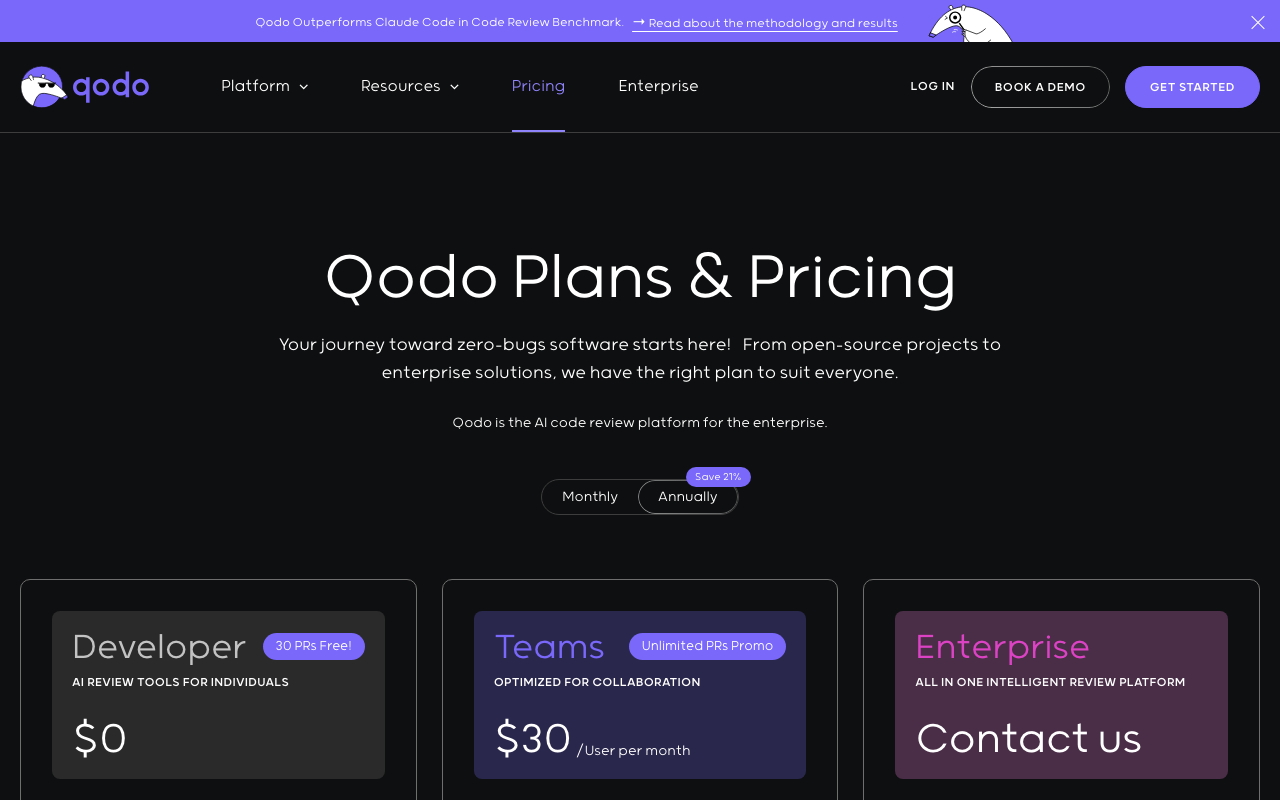
Qodo Pricing
| Plan | Price | Key Capabilities |
|---|---|---|
| Developer (Free) | $0 | 30 PR reviews/month, 250 IDE/CLI credits/month, community support |
| Teams | $30/user/month (annual) | Unlimited PR reviews (limited-time promo), 2,500 credits/user/month, no data retention, private support |
| Enterprise | Custom | Context engine, multi-repo intelligence, SSO, dashboard, on-premises/air-gapped deployment, 2-business-day SLA |
The credit system applies to IDE and CLI interactions. Standard operations cost 1 credit each. Premium models cost more: Claude Opus 4 costs 5 credits per request, Grok 4 costs 4 credits per request. Credits reset on a rolling 30-day schedule from first use, not on a calendar month.
Note that the Teams plan currently includes unlimited PR reviews as a limited-time promotion. The standard allowance is 20 PRs per user per month. Teams with high PR volume should confirm current terms before committing to an annual contract.
SonarQube Pricing
| Plan | Price | Key Capabilities |
|---|---|---|
| Community Build (Server) | Free | 20+ languages, basic quality gates, no branch/PR analysis |
| Cloud Free | Free | Up to 50K LOC, 30 languages, branch and PR analysis |
| Cloud Team | From EUR 30/month | Up to 100K LOC base, PR analysis, quality gates, SonarLint connected mode |
| Developer Server | From ~$2,500/year | 35+ languages, branch/PR analysis, PR decoration, taint analysis, secrets detection |
| Enterprise Server | From ~$20,000/year | Portfolio management, OWASP/CWE compliance reports, executive dashboards, legacy languages |
| Data Center Edition | Custom | High availability, horizontal scaling, component redundancy |
SonarQube’s pricing scales with lines of code (Cloud) or LOC tiers (Server). G2 reviewers have flagged aggressive pricing increases at renewal as a notable pain point. Multi-year Enterprise contracts can yield significant discounts negotiated 90+ days before expiration.
Side-by-Side Cost at Scale
The pricing models differ fundamentally - Qodo charges per user regardless of codebase size, SonarQube Cloud charges by lines of code. This creates meaningful cost differences depending on team composition and codebase scale.
| Scenario | Qodo Teams | SonarQube Cloud Team | SonarQube Dev Server |
|---|---|---|---|
| 5 devs, 100K LOC | $150/month | ~$32/month | ~$208/month (annualized) |
| 10 devs, 500K LOC | $300/month | ~$65/month | ~$208/month |
| 20 devs, 1M LOC | $600/month | ~$130/month | ~$417/month |
| 50 devs, 2M LOC | $1,500/month | ~$208/month | ~$833/month |
| 50 devs, 2M LOC + compliance | $1,500/month | N/A (Enterprise) | ~$1,667/month |
| Both tools, 10 devs, 500K LOC | - | $365/month combined | $508/month combined |
SonarQube Cloud is significantly cheaper than Qodo for most team configurations, particularly when codebase size is moderate. SonarQube’s cost advantage narrows with large codebases and expands as team size grows without LOC growth.
The hidden cost with SonarQube Server is operations. Self-hosted deployments require PostgreSQL, a Java runtime, JVM tuning, ongoing maintenance, and version upgrades. A conservative estimate adds $500 to $2,000/month in infrastructure and DevOps time at production scale. SonarQube Cloud eliminates this entirely.
For teams deciding purely on cost: SonarQube Cloud Team is almost always cheaper than Qodo Teams. The question is whether Qodo’s AI review quality and test generation capability justify the premium.
Deployment and Data Sovereignty
This dimension is important for teams in regulated industries where code cannot leave their own infrastructure.
Qodo offers three deployment models: SaaS (cloud-hosted default), on-premises, and air-gapped. The air-gapped Enterprise deployment means code never reaches Qodo’s cloud - no external API calls, no data transmitted to third parties. The open-source PR-Agent foundation allows inspection of the review logic, providing the level of auditability that regulated industries require. This combination of air-gapped deployment, open-source foundation, and Enterprise SSO makes Qodo the strongest AI code review option for defense, government, and strict financial services environments.
SonarQube has offered self-hosted Server editions since its inception. All Server editions - including the free Community Build - can be deployed on your own infrastructure with full control over data. The Data Center Edition supports high availability and horizontal scaling for mission-critical deployments. SonarQube’s self-hosted options are more mature and have a longer track record than Qodo’s Enterprise deployment.
Both tools support the full spectrum from cloud SaaS to completely air-gapped deployment, which is uncommon in the AI code review space. Most AI code review tools are cloud-only. For regulated industries, the existence of self-hosted options for both tools means the choice between them can be made on capability grounds rather than deployment constraints.
Use Cases - When to Choose Each
When Qodo Makes More Sense
Teams with low test coverage who want to improve it systematically. Qodo’s test generation is the most practical mechanism available for bootstrapping test coverage. If your team has been writing tickets about “we need more tests” for six months without progress, Qodo provides a realistic path: every PR review generates tests for the changed code, gradually improving coverage without requiring dedicated sprint time.
Teams that need AI-powered semantic review. The class of issues Qodo catches - logic errors, requirement mismatches, architectural inconsistencies, N+1 performance patterns, missing edge cases - fall outside what any deterministic rule set can detect. For PRs involving complex business logic, new service integrations, or nuanced state management, Qodo’s AI-driven understanding of code intent is valuable in ways SonarQube cannot replicate.
Organizations needing broad AI code review across GitLab, Bitbucket, or Azure DevOps. Both tools support these platforms, but Qodo’s AI review experience is specifically designed for PR-level interaction and works seamlessly across all four platforms with no CI/CD pipeline changes required.
Teams in regulated industries needing both AI review and air-gapped deployment. Qodo’s Enterprise plan with air-gapped deployment is the strongest option for defense, government, or financial services teams that want modern AI code review but cannot send code to third-party cloud services.
Teams that want a modern, conversational review experience. Qodo’s review comments are written to be actionable and contextual, like feedback from a senior engineer. Developers can interact with Qodo in PR comments, ask follow-up questions, and request alternative implementations. This conversational quality is different from SonarQube’s dashboard-and-rule-documentation approach.
When SonarQube Makes More Sense
Teams that need quality gate enforcement. If your organization requires automated merge blocking based on quantifiable quality conditions - zero critical bugs, minimum coverage thresholds, no new vulnerabilities - SonarQube’s quality gates are the proven mechanism. Qodo cannot provide equivalent deterministic enforcement.
Organizations with compliance and audit requirements. SonarQube Enterprise generates security reports mapped to OWASP Top 10, CWE Top 25, and SANS Top 25. When auditors require documentation that specific vulnerability classes are consistently checked, SonarQube’s rule-to-standard mappings and quality gate reports provide that evidence. No AI review tool can substitute for this.
Teams managing large multi-language codebases including legacy languages. The 35+ language support in SonarQube’s commercial editions, including COBOL, ABAP, PL/SQL, RPG, and VB6, covers enterprise codebases that span decades of technology evolution. For organizations maintaining mainframe code alongside modern microservices, SonarQube covers everything.
Engineering managers who need longitudinal code quality data. SonarQube’s technical debt tracking, trend charts, portfolio management, and A-E quality ratings provide the quantitative foundation for resource allocation decisions and leadership reporting. This capability does not exist in Qodo.
Teams already heavily invested in the SonarQube ecosystem. Organizations with existing quality profiles, quality gates, SonarLint deployments, and historical data built up over years of SonarQube usage are unlikely to abandon that investment for an AI review tool. In this situation, the right question is whether to add Qodo alongside SonarQube rather than replace one with the other.
When to Run Both
The strongest code quality setups run both tools with clearly defined roles.
SonarQube handles the deterministic layer: 6,500+ rule enforcement, quality gate blocking, technical debt quantification, compliance reporting, and long-term trend tracking. It provides the governance backbone.
Qodo handles the intelligence layer: semantic PR review that catches logic errors and contextual issues, automated test generation that improves coverage, and the kind of actionable AI feedback that makes every PR a learning experience. It provides the improvement engine.
A typical combined workflow looks like this:
- Developer writes code; SonarLint highlights rule violations in real-time in the IDE and Qodo’s IDE plugin is available for AI review and test generation on demand.
- Developer opens a PR; SonarQube scanner runs in CI, checks quality gate, and posts PR decoration with findings. Qodo’s multi-agent review runs simultaneously and posts AI-powered comments.
- Developer sees both: SonarQube’s deterministic findings (specific rule violations with documentation) and Qodo’s contextual AI feedback (logic analysis, architectural suggestions, generated tests for coverage gaps).
- If the PR fails SonarQube’s coverage requirement, Qodo’s generated tests may be the most efficient path to bringing coverage up to the threshold.
- Both tools satisfied - quality gate passes, AI review comments addressed, human reviewer approves.
The combined cost for a 10-developer team is approximately $300-365/month ($300 for Qodo Teams plus $65 for SonarQube Cloud Team at 500K LOC). For organizations where a single prevented production bug or security incident saves more than this monthly investment, the combined tooling is straightforwardly justified.
Alternatives to Consider
If neither Qodo nor SonarQube is the right fit alone, several alternatives deserve evaluation.
CodeRabbit is the most widely deployed dedicated AI code review tool with 13+ million PRs reviewed and 2+ million connected repositories. Like Qodo, it provides AI-powered PR review without test generation, includes 40+ built-in deterministic linters, and supports all four major Git platforms. CodeRabbit prices at $12-24/user/month, less than Qodo’s $30/user/month. For teams that want AI PR review without the test generation component, CodeRabbit is a strong alternative to Qodo. See our CodeRabbit vs SonarQube comparison for how CodeRabbit stacks up against SonarQube specifically.
DeepSource is a code quality platform with 5,000+ rules, a sub-5% false positive rate, and a simpler cloud-native setup than SonarQube. It catches many of the same static analysis issues with less setup friction and more predictable per-user pricing. Teams that find SonarQube’s setup overhead unacceptable but still want rule-based analysis should evaluate DeepSource. See our SonarQube vs DeepSource comparison.
Semgrep is a lightweight, open-source static analysis tool that allows custom rule writing in YAML. It is particularly strong for security-focused teams that need to enforce custom patterns specific to their codebase and policies. Semgrep is less comprehensive than SonarQube out of the box but more flexible for custom security rules. Our Semgrep vs SonarQube comparison covers this in depth.
Snyk Code is a developer-first security platform focused on dependency vulnerabilities, SAST, container security, and IaC scanning. For teams whose primary concern is security rather than code quality broadly, Snyk offers strong developer experience and real-time dependency monitoring that both Qodo and SonarQube lack as standalone tools. See the Snyk vs SonarQube comparison for the security-focused angle.
For a broader overview of the code review tool landscape, see our best AI code review tools roundup.
Verdict - Which Should You Choose?
Qodo and SonarQube serve different needs with different philosophies. The decision comes down to what problem you are primarily trying to solve.
If your primary goal is catching more issues in PR review and improving test coverage, Qodo is the right choice. Its multi-agent AI architecture catches logic errors, architectural inconsistencies, and contextual issues that static rules cannot detect. Its test generation capability is unique - no other code quality tool proactively generates unit tests as part of the review workflow. The $30/user/month Teams pricing is above average for AI review tools, but the combined review-plus-testing capability justifies the cost for teams with test coverage challenges.
If your primary goal is deterministic enforcement, compliance reporting, and long-term code quality governance, SonarQube is the right choice. Its quality gates provide the industry-standard merge blocking mechanism. Its compliance reports satisfy auditors asking for OWASP and CWE documentation. Its technical debt tracking gives engineering leaders the quantitative data they need. The free Community Build and SonarQube Cloud Free provide genuine entry points with no financial commitment.
If your team can invest in both, run them together. The combination is the highest-performing code quality setup available: SonarQube provides the deterministic safety net and governance layer, Qodo provides the AI intelligence layer and test generation capability. They complement each other with minimal overlap. A 10-developer team running both on SonarQube Cloud Team can do so for approximately $365/month - a modest investment relative to the value of prevented bugs, security incidents, and accumulated technical debt.
Practical recommendations by team profile:
-
Small teams (under 10 developers) who want to ship better code: Start with SonarQube Cloud Free for deterministic analysis. Add Qodo’s free Developer plan for AI review (30 PRs/month covers most teams this size). Upgrade Qodo to Teams when free tier is insufficient.
-
Teams with low test coverage: Qodo is the higher-priority investment. SonarQube can measure coverage deficits; Qodo actually generates the tests to fix them. Address test coverage with Qodo first, then add SonarQube once coverage baselines are established.
-
Enterprise teams with compliance requirements: SonarQube Enterprise is required for OWASP/CWE compliance reports and quality gate enforcement at scale. Qodo Enterprise can add AI review and test generation if budget allows, with air-gapped deployment for data sovereignty.
-
Teams evaluating moving away from SonarQube: Do not replace SonarQube with Qodo - they do different things. If the issue is SonarQube’s setup complexity, consider SonarQube Cloud instead of self-hosted Server. If the issue is cost, evaluate whether SonarQube Cloud Team (from EUR 30/month) addresses the budget concern. If you genuinely want to exit the SonarQube ecosystem, DeepSource or Codacy are the closest rule-based alternatives. Read our SonarQube alternatives guide for a complete overview.
The bottom line is direct: Qodo and SonarQube are complementary tools that are better together than either is alone. If you can only choose one, let your primary need decide - AI-powered review and test generation chooses Qodo, deterministic enforcement and compliance governance chooses SonarQube.
Frequently Asked Questions
Is Qodo a replacement for SonarQube?
No - Qodo and SonarQube are not direct replacements for each other. Qodo is an AI-powered PR review and test generation platform that excels at detecting logic errors, contextual issues, and coverage gaps through a multi-agent architecture. SonarQube is a deterministic static analysis platform with 6,500+ rules, quality gate enforcement, and long-term technical debt tracking. Qodo provides AI-driven semantic feedback; SonarQube provides auditable, rule-based enforcement. Many engineering teams run both: SonarQube for deterministic analysis and quality gates, Qodo for AI-powered review and automated test generation.
Does Qodo have quality gates like SonarQube?
Qodo does not offer quality gates in the same way SonarQube does. SonarQube's quality gates define hard pass/fail conditions - zero new critical bugs, minimum code coverage, no new vulnerabilities - and block PR merges when conditions are not met. Qodo operates primarily as an AI reviewer that posts comments and suggestions. Teams can configure their Git platform to require Qodo reviews before merging, but the blocking mechanism is advisory rather than rule-based. For teams that need deterministic merge blocking based on quantifiable quality conditions, SonarQube's quality gates are the industry standard.
Can Qodo generate tests that SonarQube would require?
Yes, and this is one of the most practical workflow integrations possible between the two tools. If SonarQube's quality gate requires a minimum code coverage percentage (say, 80%), but your PR falls short, Qodo can generate the missing unit tests to bring coverage up and pass the gate. Qodo proactively identifies untested logic paths, edge cases, and error scenarios during PR review and generates framework-appropriate tests (Jest, pytest, JUnit, etc.) with meaningful assertions. The tools are complementary: SonarQube enforces the coverage requirement, Qodo provides the mechanism to meet it efficiently.
How much does Qodo cost compared to SonarQube?
Qodo's Teams plan costs $30/user/month (billed annually) with a free Developer tier offering 30 PR reviews and 250 IDE/CLI credits per month. SonarQube Cloud Team starts at EUR 30/month (approximately $32) for up to 100K lines of code, scaling with codebase size. SonarQube Cloud Free covers up to 50K LOC at no cost. SonarQube Developer Server starts at approximately $2,500/year for self-hosted deployments. The pricing models are fundamentally different: Qodo charges per user regardless of codebase size, while SonarQube Cloud charges per lines of code. For small teams with large codebases, SonarQube Cloud can be significantly cheaper. For large teams with many developers but smaller codebases, per-user SonarQube Cloud costs can exceed Qodo's.
Does SonarQube do AI code review like Qodo?
SonarQube has added AI features - AI CodeFix for generating fix suggestions on findings, and AI Code Assurance for verifying quality of AI-generated code - but these are fundamentally different from Qodo's AI-powered review. SonarQube's core strength is its 6,500+ deterministic rules applied through static analysis. AI CodeFix layers suggested remediations on top of those rule-based findings. Qodo's multi-agent architecture uses AI to understand code semantics, detect logic errors without predefined rules, identify contextual issues, and generate test code. Qodo's AI capabilities are significantly more mature for PR review; SonarQube's AI features are best understood as enhancements to its core deterministic analysis.
Which tool is better for security analysis - Qodo or SonarQube?
SonarQube is stronger for formal, compliance-ready security analysis. Its security rules are mapped to OWASP Top 10, CWE Top 25, and SANS Top 25 standards. The Enterprise Edition generates audit-ready compliance reports. Developer Edition and above include taint analysis that traces data flow to identify injection vulnerabilities. The Advanced Security add-on adds SCA, SBOM generation, and malicious package detection. Qodo catches security issues through AI analysis - missing input validation, insecure API configurations, authorization logic errors - but its findings do not map to formal security standards and cannot produce compliance reports. For teams with security compliance requirements, SonarQube is the right choice. For teams that want contextual security feedback alongside code quality review, Qodo and SonarQube together provide comprehensive coverage.
Does Qodo support self-hosted deployment like SonarQube?
Yes. Qodo's Enterprise plan supports on-premises and fully air-gapped deployment - a meaningful differentiator from most AI code review tools. Qodo's core review engine is built on PR-Agent, an open-source project on GitHub, which can be self-hosted independently. SonarQube has offered self-hosted Server editions since its inception, and all Server editions - including the free Community Build - can be deployed on your own infrastructure. Both tools support data-sovereign deployment, which is critical for regulated industries. SonarQube's self-hosted options are more mature and start from the free Community Build, while Qodo requires the Enterprise plan for on-premises deployment.
What is the difference between Qodo and SonarQube for technical debt tracking?
This is an area where the tools differ significantly. SonarQube tracks technical debt as quantified remediation time across your entire codebase, maintains trend charts showing whether debt is increasing or decreasing, assigns A-through-E ratings for reliability, security, and maintainability, and provides portfolio management for tracking quality across multiple projects. Engineering managers use this data to justify refactoring investments and report code health to leadership. Qodo does not provide equivalent long-term technical debt tracking. It reviews individual pull requests and provides feedback in the moment, but does not maintain historical quality metrics. If long-term tracking and trend analysis are priorities, SonarQube is the only option of the two.
Which tool is easier to set up - Qodo or SonarQube?
Qodo is significantly faster to set up. Installing the Qodo app from GitHub Marketplace or equivalent on other platforms and connecting your repositories takes under 10 minutes, with no CI/CD pipeline changes required. SonarQube Cloud setup takes approximately 5-10 minutes. Self-hosted SonarQube Server installation - including database provisioning (PostgreSQL), JVM configuration, scanner integration in CI/CD pipelines, quality profile setup, and authentication configuration - typically takes a full day for a DevOps engineer. The ongoing maintenance burden of SonarQube Server (upgrades, backups, monitoring, JVM tuning) is another consideration that SonarQube Cloud and Qodo both avoid.
Can Qodo and SonarQube work together on the same pull request?
Yes, and this is a recommended workflow. When a developer opens a PR, SonarQube runs its scanner in the CI/CD pipeline and posts quality gate results and rule-based findings as PR decorations. Qodo independently reviews the same PR through its multi-agent architecture and posts AI-powered comments. Developers see both sets of feedback on the same pull request: SonarQube's deterministic rule violations and Qodo's contextual AI insights. The two tools do not conflict because they operate independently through different mechanisms. If Qodo also identifies test coverage gaps, it can generate tests that help the PR pass SonarQube's coverage-based quality gate conditions.
Which tool is better for teams on GitLab, Bitbucket, or Azure DevOps?
Both tools support GitHub, GitLab, Bitbucket, and Azure DevOps. Qodo's PR review works across all four platforms through its open-source PR-Agent foundation, which also extends to CodeCommit and Gitea. SonarQube Cloud and SonarQube Server both integrate with all four major platforms for PR decoration and quality gate reporting. For teams on non-GitHub platforms, both tools are solid options. The choice between them comes down to whether AI-powered review with test generation (Qodo) or deterministic rule-based analysis with quality gate enforcement (SonarQube) is the primary need.
Is there a free version of Qodo or SonarQube?
Both tools offer meaningful free tiers. Qodo's Developer plan is free and provides 30 PR reviews per month plus 250 credits for IDE and CLI interactions - enough for a solo developer or small team to evaluate the platform thoroughly. SonarQube offers two free options: the Community Build (self-hosted, 20+ languages, basic quality gates, no PR decoration or branch analysis) and SonarQube Cloud Free (cloud-hosted, up to 50K lines of code, 30 languages, branch analysis and PR decoration included). For teams that need cloud-hosted analysis without infrastructure overhead, SonarQube Cloud Free is more feature-complete than Qodo's free tier. For teams that want AI-powered PR review at no cost, Qodo's 30 free reviews per month is the better starting point.
Explore More
Tool Reviews
 Qodo Review
 SonarQube Review
Related Articles
- Will AI Replace Code Reviewers? What the Data Actually Shows
- Best AI Code Review Tools in 2026 - Expert Picks
- Best Code Review Tools for Python in 2026 - Linters, SAST, and AI
- Codacy vs Checkmarx: Developer Code Quality vs Enterprise AppSec in 2026
- Codacy vs SonarCloud: Cloud Code Quality Platforms Compared (2026)
Free Newsletter
Stay ahead with AI dev tools
Weekly insights on AI code review, static analysis, and developer productivity. No spam, unsubscribe anytime.
Join developers getting weekly AI tool insights.
Related Articles
Checkmarx vs Veracode: Enterprise SAST Platforms Compared in 2026
Checkmarx vs Veracode - enterprise SAST, DAST, SCA, Gartner positioning, pricing ($40K-250K+), compliance, and when to choose each AppSec platform.
March 13, 2026
comparisonCodacy Free vs Pro: Which Plan Do You Need in 2026?
Codacy Free vs Pro compared - features, limits, pricing, and when to upgrade. Find the right Codacy plan for your team size and workflow.
March 13, 2026
comparisonCodacy vs Checkmarx: Developer Code Quality vs Enterprise AppSec in 2026
Codacy vs Checkmarx - developer code quality vs enterprise AppSec, pricing ($15/user vs $40K+), SAST, DAST, SCA, compliance, and when to choose each.
March 13, 2026