Qodo vs GitHub Copilot: AI Code Review and Testing Compared (2026)
Qodo vs GitHub Copilot - AI test generation and deep code review vs all-in-one AI coding platform. Pricing, features, and which tool fits your team.
Published:
Last Updated:
Quick Verdict
Qodo and GitHub Copilot are built around fundamentally different philosophies. Qodo is a specialist that combines deep AI code review with automated test generation - two capabilities most tools treat as entirely separate problems. GitHub Copilot is a generalist platform that bundles code completion, chat, code review, and an autonomous coding agent into one subscription deeply integrated with GitHub. These tools are not really competing for the same buyer.
Choose Qodo if: your team needs the deepest possible PR review combined with automated test generation, you use GitLab, Bitbucket, or Azure DevOps, you require self-hosted or air-gapped deployment, or you want the open-source transparency of PR-Agent as the foundation.
Choose GitHub Copilot if: you are fully committed to GitHub, you want a single AI tool for code completion, chat, review, and autonomous agents without managing multiple products, and you prioritize breadth of AI assistance over depth of review specialization.
The key difference in practice: When Qodo finds a bug during PR review, it can generate a test that exercises that exact bug scenario. When Copilot finds a bug, it posts a comment. Both find bugs. Only Qodo closes the loop with testable validation.
Why This Comparison Matters
Both tools are prominent in the AI code review space and appear in the same evaluations when teams shop for “AI code review tools.” But the overlap is more superficial than it looks.
Qodo began life as CodiumAI, a test generation tool. It evolved into a code review platform while keeping test generation as a first-class feature. The February 2026 release of Qodo 2.0 introduced a multi-agent architecture that achieved the highest F1 score (60.1%) among eight tools tested in comparative benchmarks - outperforming the next best solution by 9%.
GitHub Copilot began as a code completion tool and added code review as a natural extension of its AI assistance vision. As of March 2026, its code review runs on a fully agentic architecture that uses tool-calling to analyze broader context beyond just the diff. The result is genuinely improved review quality - but review remains one feature within a broader platform whose primary identity is code generation assistance.
This distinction matters for budget decisions, workflow design, and expectations about what these tools can do.
At-a-Glance Comparison
| Dimension | Qodo | GitHub Copilot |
|---|---|---|
| Primary focus | AI code review + test generation | AI coding platform (completion, chat, review, agent) |
| Review architecture | Multi-agent (Qodo 2.0) | Agentic with tool-calling (March 2026) |
| Test generation | Yes - proactive, coverage-gap detection | No - manual prompting only |
| Benchmark F1 score | 60.1% (highest among 8 tools tested) | ~54% bug catch rate in testing |
| Git platforms | GitHub, GitLab, Bitbucket, Azure DevOps | GitHub only |
| IDE plugin | VS Code, JetBrains | VS Code, JetBrains, Neovim, Xcode |
| Open source core | Yes - PR-Agent on GitHub | No |
| Self-hosted / air-gapped | Yes (Enterprise) | No |
| Free tier | 30 PR reviews + 250 credits/month | 2,000 completions + 50 premium requests/month |
| Paid starting price | $30/user/month (Teams) | $10/month (Pro individual), $19/user/month (Business) |
| Code completion | No | Yes - core feature |
| Autonomous coding agent | No | Yes - Copilot coding agent |
| Multi-repo context engine | Yes (Enterprise) | Limited |
| Custom review instructions | Yes | Yes (copilot-instructions.md, 4,000 char limit) |
| SSO / audit logs | Enterprise plan | Business and Enterprise plans |
| Gartner recognition | Visionary (AI Code Assistants, 2025) | Leader / broadly recognized |
| Data retention policy | No data retention on Teams+ | Microsoft data handling policies |
What Is Qodo?
Qodo (formerly CodiumAI) is an AI-powered code quality platform founded in 2022 by Itamar Friedman and Dedy Kredo. The product uniquely combines automated PR code review with test generation in a single platform - a combination no direct competitor offers. Qodo raised $40 million in Series A funding in 2024 and was recognized as a Visionary in the Gartner Magic Quadrant for AI Code Assistants in 2025.
The February 2026 release of Qodo 2.0 introduced a multi-agent review architecture where specialized agents collaborate on different aspects of a pull request - one focused on bug detection, another on code quality best practices, others on security and test coverage gaps. This architecture produced the highest overall F1 score (60.1%) in comparative benchmarks, with a recall rate of 56.7% - meaning Qodo finds more real issues than any other solution tested, while maintaining competitive precision with fewer false positives.
The platform spans four components:
- Git plugin for automated PR reviews across GitHub, GitLab, Bitbucket, and Azure DevOps
- IDE plugin for VS Code and JetBrains, providing local code review and test generation
- CLI plugin for terminal-based quality workflows
- Context engine (Enterprise) for multi-repo intelligence that understands cross-service dependencies
The open-source PR-Agent foundation is a meaningful differentiator. Teams can inspect the review logic, contribute improvements, and deploy in air-gapped environments - options that proprietary competitors including GitHub Copilot cannot offer.
For a complete feature breakdown, see the Qodo review.
What Is GitHub Copilot?
GitHub Copilot is GitHub’s AI coding platform, originally launched as a code completion tool and now spanning code completion, chat, code review, and an autonomous coding agent. It holds approximately 42% of the AI coding tools market and has processed over 60 million code reviews. As of 2026, Copilot supports multiple AI models including GPT-5.4, Claude Opus 4, and Gemini 3 Pro, giving developers the ability to select the model best suited to their task.
The code review capability runs on a fully agentic architecture as of March 5, 2026. Rather than analyzing only the diff, it uses tool-calling to read relevant files, examine directory structure, and trace references across the codebase before generating feedback. Review comments appear as native GitHub PR comments, indistinguishable from human feedback in the UI.
What makes Copilot strategically unique is the bundling. For $19/user/month (Business), organizations get unlimited code completions, chat, code review, access to multi-model selection, and the coding agent that can autonomously implement features and open PRs. No single-purpose review tool matches that breadth at that price point. The catch is the constraint: everything requires GitHub. If your code is not hosted on GitHub, Copilot Code Review is not available to you.
For a detailed breakdown, see the GitHub Copilot review. For pricing specifics, see our GitHub Copilot pricing guide.
Feature-by-Feature Breakdown
Code Review Depth and Accuracy
This is the dimension where the comparison is most direct - both tools review pull requests and post findings as inline comments.
Qodo’s multi-agent approach deploys specialized agents for different review dimensions simultaneously. A bug detection agent analyzes the diff for logic errors, null pointer risks, off-by-one errors, and incorrect assumptions. A code quality agent evaluates structure, complexity, and maintainability. A security agent looks for common vulnerability patterns. A test coverage agent identifies which changed code paths lack test coverage and can generate tests to fill those gaps. The agents’ outputs are aggregated into a coherent review that includes line-level comments, a PR summary and walkthrough, and risk level assessment.
In benchmark testing across eight AI code review tools, Qodo 2.0 achieved an F1 score of 60.1% - the highest result - with a recall rate of 56.7%. This means Qodo found proportionally more real bugs than any other tool tested. The previous version of Qodo scored below this, meaning the 2.0 architecture change delivered a measurable improvement.
GitHub Copilot’s agentic review uses tool-calling to gather additional context around the diff: reading relevant source files, examining directory structure, and tracing function references. This context-gathering approach produces findings that account for how changes fit into the broader architecture, not just whether the changed lines themselves look correct. Copilot’s reviews typically complete in 2-5 minutes and appear as native GitHub PR comments.
In testing, Copilot caught approximately 54% of intentionally planted bugs - solid but below Qodo’s 60.1% F1 score. Users consistently report that Copilot reviews are good at catching obvious issues (type errors, missing null checks, common antipatterns) but occasionally miss deeper architectural concerns and nuanced logic errors. The context window limit is a practical constraint: on very large pull requests, Copilot may analyze only a portion of the diff, potentially missing issues in sections it did not examine.
The practical gap: For most pull requests (routine features, bug fixes, refactors under 500 lines), both tools provide useful, actionable feedback. The gap becomes meaningful in complex PRs with subtle logic errors, cross-file dependencies, or security-sensitive code. Qodo’s recall advantage and coverage-aware approach produce more thorough results in these scenarios.
Test Generation - The Key Differentiator
This is the most important functional difference between the two tools, and the one that most clearly separates their intended use cases.
Qodo’s test generation is proactive and automated. When reviewing a PR, Qodo identifies code paths that lack test coverage and generates complete unit tests without being explicitly asked. In the IDE, the /test command triggers test generation for selected code - Qodo analyzes the function’s behavior, identifies edge cases and error conditions that are commonly missed, and produces test files in the project’s existing framework (Jest, pytest, JUnit, Vitest, and others). These are not placeholder tests with // TODO: implement - they contain meaningful assertions that exercise the specific behaviors identified.
This creates a feedback loop that no other review tool replicates: Qodo finds a bug, then generates a test that would have caught that bug. The finding becomes actionable not just as a code change but as a testing improvement that prevents regression.
Users on G2 consistently highlight Qodo’s test generation with comments like “it generates great unit tests in seconds, sometimes covering edge cases that I had not considered, and finds bugs before the end-user does.” For teams that know they need better test coverage but lack the engineering bandwidth to write tests systematically, Qodo offers a realistic path to improvement.
GitHub Copilot can help you write tests, but not the same way. Through chat and code completion, Copilot will generate test code if you describe what you want: “write a unit test for this function that handles null input.” The quality of the generated test depends on how well you describe the requirement. Copilot does not proactively analyze coverage gaps or generate tests autonomously during PR review. There is no equivalent to Qodo’s /test command that produces coverage-aware tests without manual prompting.
For teams with mature test cultures where developers already write thorough tests, this difference is smaller - Copilot’s chat-based test assistance may be sufficient. For teams trying to bootstrap a testing practice or recover from low coverage, Qodo’s autonomous generation is a genuinely different capability.
Code Completion and IDE Assistance
GitHub Copilot is the industry standard for code completion. With 42% market share and billions of completions delivered, Copilot’s inline suggestion quality is excellent across JavaScript, TypeScript, Python, Go, Java, Rust, and a dozen other languages. Completions appear as you type, suggesting the next line, an entire function, or a complete block based on context. Ghost text previews appear inline; press Tab to accept. The experience is seamless and well-integrated in VS Code, JetBrains, Neovim, and Xcode.
Copilot Chat extends this further into multi-turn conversations about your code. Explain a function, ask for refactoring suggestions, debug an error, ask how to implement a pattern - Chat handles all of these within the IDE with full context of your open files.
Qodo’s IDE plugin focuses on review and testing, not completion. The VS Code and JetBrains extensions bring Qodo’s review capabilities into the editor for shift-left quality - you can review code locally before committing, generate tests, and get AI suggestions for improvements without opening a PR. But the IDE plugin does not provide Copilot-style inline code completion as you type. It is a quality tool that lives in the IDE, not a code generation assistant.
For teams who want AI-powered code completion as they write, Copilot wins this dimension entirely. Qodo does not compete on code completion.
Platform Support and Git Integration
Qodo supports all four major Git platforms: GitHub, GitLab, Bitbucket, and Azure DevOps. Through its open-source PR-Agent foundation, it also supports CodeCommit and Gitea. This breadth is unmatched in the AI code review market. For organizations with heterogeneous Git infrastructure, or those standardized on GitLab or Azure DevOps, Qodo is one of very few serious options.
GitHub Copilot Code Review works exclusively on GitHub. This is not a minor limitation - it is a binary constraint. If your team’s code is hosted on GitLab, Bitbucket, or Azure DevOps, Copilot Code Review is simply not available to you. Copilot’s IDE features (code completion and chat) work regardless of where code is hosted, but the PR review functionality requires GitHub pull requests. Many organizations that otherwise prefer Copilot are forced to evaluate alternatives because of this constraint.
The practical impact is significant. Organizations that use GitHub for most projects but have legacy systems on other platforms cannot use Copilot uniformly. Acquisitions and partnerships often bring different Git platforms into the same organization. For these situations, Qodo’s broad support is not just a nice-to-have - it is a prerequisite.
Deployment and Security Options
Qodo offers three deployment models: SaaS (cloud-hosted, the default), on-premises, and air-gapped. The air-gapped Enterprise deployment means code never leaves your own infrastructure - no external API calls, no data sent to Qodo’s cloud. This is a hard requirement in regulated industries including defense contracting, financial services with strict data sovereignty rules, healthcare with HIPAA constraints, and government agencies.
The open-source PR-Agent foundation also allows teams to self-host the core review engine with full transparency into what the code does, what data it sends, and how reviews are generated. No other commercial AI code review tool provides this level of auditability.
GitHub Copilot is cloud-only. All code processing happens on Microsoft and GitHub infrastructure. GitHub provides detailed documentation on data handling, including commitments that Enterprise and Business subscribers’ code is not used to train the model. Microsoft’s security certifications (SOC 2, ISO 27001) cover the service. But for organizations with absolute data sovereignty requirements - code that must never leave their own datacenter - Copilot is not an option. There is no self-hosted version.
For most commercial software teams, Copilot’s cloud architecture is perfectly acceptable. For regulated industries or defense contractors, Qodo’s air-gapped option may be the deciding factor.
Multi-Repo Intelligence
Qodo’s context engine (Enterprise plan) builds awareness across multiple repositories, understanding how changes in one repo affect services in another. This matters in microservice architectures where an API change in a shared library can break multiple downstream consumers, or where configuration changes have cascading effects. The context engine also learns from pull request history, improving suggestion relevance based on past review patterns and team feedback.
GitHub Copilot Enterprise includes knowledge bases that allow organizations to index custom documentation and internal code for Copilot to reference during chat interactions. Copilot Enterprise also supports custom fine-tuned models trained on your organization’s codebase. These features provide organizational context but are focused on making completions and chat more relevant to your specific codebase rather than detecting cross-repo impact.
For pure multi-repo code review intelligence, Qodo’s context engine is more directly applicable. For broader organizational knowledge integration, Copilot Enterprise’s knowledge bases and custom models provide different but valuable context.
Custom Review Instructions
Both tools allow teams to customize review behavior.
Qodo’s custom review instructions are configured as part of the PR-Agent settings and applied alongside its built-in analysis. Teams can define project-specific standards, architectural guidelines, security requirements, and review priorities. Instructions can be granular - specifying how to handle error handling patterns, naming conventions, or framework-specific best practices unique to your codebase.
GitHub Copilot’s custom instructions use copilot-instructions.md files in the .github directory. These guide review priorities, coding standards, and architectural preferences. Teams can also create language-specific or component-specific instruction files using *.instructions.md with applyTo frontmatter. The practical limitation is the 4,000 character cap per instruction file - concise, well-structured directives work better than lengthy prose descriptions. If your team’s conventions need more than 4,000 characters to describe, you will need to prioritize.
Both systems work well for straightforward customization. Qodo’s approach is more flexible for complex, organization-specific requirements. Copilot’s system is simpler to set up and sufficient for most teams.
Pricing Comparison
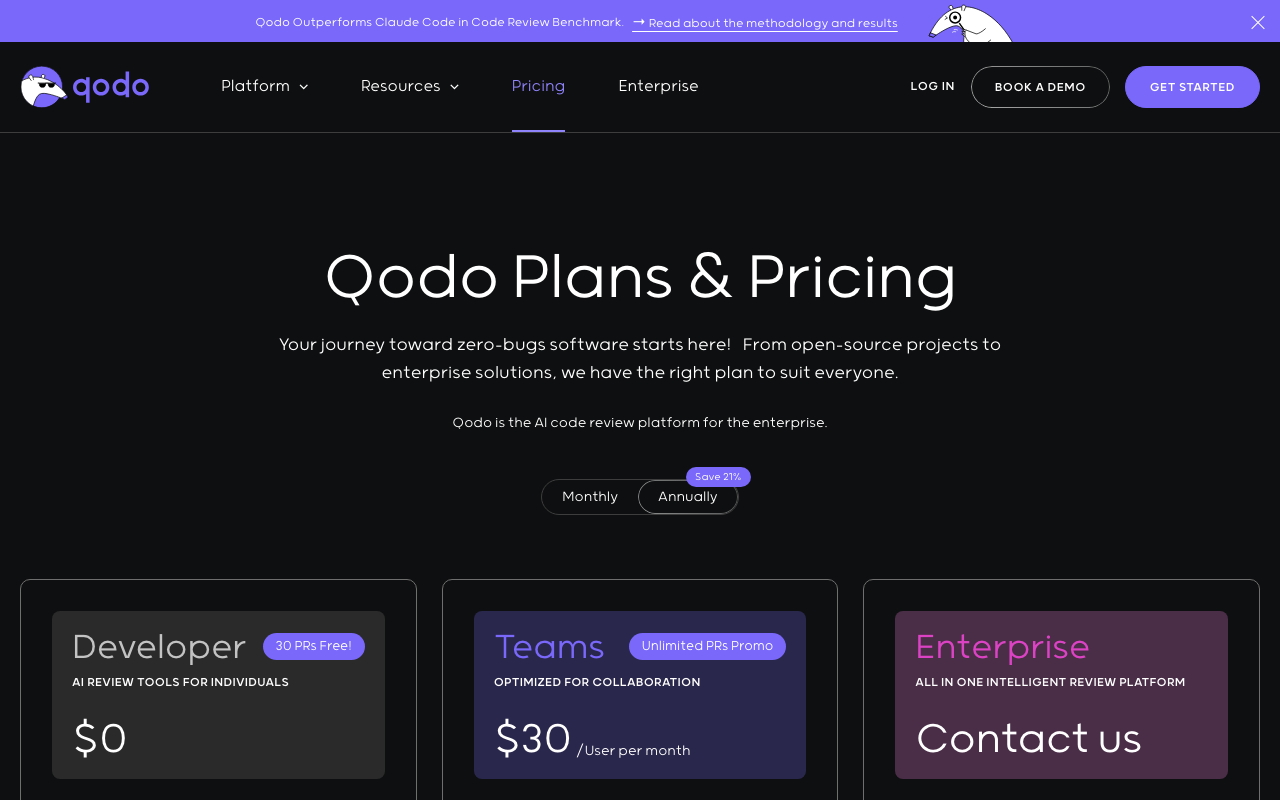
Qodo Pricing
| Plan | Price | Key Capabilities |
|---|---|---|
| Developer (Free) | $0 | 30 PR reviews/month, 250 IDE/CLI credits/month, community support |
| Teams | $30/user/month | Unlimited PR reviews (limited-time promo), 2,500 credits/user/month, no data retention, private support |
| Enterprise | Custom | Context engine, multi-repo intelligence, SSO, enterprise dashboard, on-premises/air-gapped deployment, 2-business-day SLA |
The credit system applies to IDE and CLI interactions. Most standard operations cost 1 credit. Premium models cost more: Claude Opus 4 costs 5 credits per request, Grok 4 costs 4 credits per request. Credits reset on a 30-day rolling schedule from first use, not on a calendar month. At $30/user/month, Qodo’s Teams plan is above the average price for AI code review tools but reflects the platform’s dual specialization in review and test generation.
One important note: the Teams plan currently offers unlimited PR reviews as a limited-time promotion. The standard allowance is 20 PRs per user per month. Teams with high PR volume should confirm current terms before committing.
GitHub Copilot Pricing
| Plan | Price | Key Capabilities |
|---|---|---|
| Copilot Free | $0 | 2,000 completions/month, 50 premium requests/month, basic model access |
| Copilot Pro | $10/month | Unlimited completions, 300 premium requests/month, code review, coding agent, multi-model |
| Copilot Pro+ | $39/month | Everything in Pro, 1,500 premium requests/month, all models including Claude Opus 4 and o3 |
| Copilot Business | $19/user/month | Everything in Pro, organization policies, audit logs, IP indemnity |
| Copilot Enterprise | $39/user/month | Everything in Business, knowledge bases, 1,000 premium requests/user, custom models |
Premium requests power chat, agent mode, code reviews, and model selection. Overages cost $0.04 per request. Heavy users of agent mode and code review on lower-tier plans can accumulate meaningful overage charges. The premium request metering system generated substantial developer criticism when introduced in June 2025 and remains a friction point.
For a detailed Copilot pricing walkthrough, see our GitHub Copilot pricing guide.
Side-by-Side Cost at Scale
| Team Size | Qodo Teams (Annual) | Copilot Business (Annual) | Running Both |
|---|---|---|---|
| 1 developer | $360/year | $228/year | $588/year |
| 5 developers | $1,800/year | $1,140/year | $2,940/year |
| 10 developers | $3,600/year | $2,280/year | $5,880/year |
| 20 developers | $7,200/year | $4,560/year | $11,760/year |
| 50 developers | $18,000/year | $11,400/year | $29,400/year |
For teams purely optimizing on price, Copilot Business costs less per seat and provides more total features per dollar if you use code completion and chat in addition to code review. Qodo costs more but delivers deeper review quality and test generation that Copilot does not provide.
The meaningful question is not “which is cheaper?” but “what do you actually need?” Teams that want to improve test coverage need Qodo’s test generation - there is no cheaper substitute for that specific capability. Teams that need code completion plus review and are GitHub-only find Copilot’s bundled value compelling.
Pricing Notes
Qodo’s credit system adds unpredictability. If your team regularly uses premium models like Claude Opus 4 in the IDE (5 credits per request), the 2,500 monthly credit limit disappears faster than expected. Teams should track credit consumption during trial before committing to the Teams tier.
Copilot’s overage pricing is a real risk. Teams using agent mode heavily (which is metered by premium requests) on lower-tier plans should monitor usage. A team that triggers significant agent mode and code review activity can exceed monthly limits by a factor of 2-3x, making effective costs much higher than the base subscription.
CodeAnt AI is a notable alternative at $24-40/user/month. It combines AI code review with code quality analysis and sits between Qodo and enterprise-tier tools on pricing. Teams comparing Qodo and Copilot should also evaluate CodeAnt AI if budget is a constraint and test generation is not a primary requirement.
Use Cases - When to Choose Each
When Qodo Makes More Sense
Teams with low test coverage who want to improve it systematically. Qodo’s test generation is the only automated, proactive approach to coverage improvement among AI review tools. If your team has been saying “we need to write more tests” for six months without progress, Qodo provides a realistic mechanism - not just a review comment pointing out that tests are missing.
Organizations on GitLab, Bitbucket, or Azure DevOps. This is non-negotiable. Copilot Code Review requires GitHub. Qodo’s four-platform support makes it one of very few serious AI code review options for non-GitHub teams, and among those options it has the strongest review benchmarks.
Teams in regulated industries requiring self-hosted or air-gapped deployment. Finance, healthcare, government, and defense teams often cannot send code to third-party cloud services. Qodo’s Enterprise plan offers on-premises and air-gapped deployment. Copilot does not.
Teams that want maximum review depth and are willing to pay for specialization. If code review quality is the primary metric - catch the most real bugs, miss the fewest, provide the most actionable feedback - Qodo’s benchmark results and multi-agent architecture represent the current state of the art among tested tools.
Open-source teams or teams with transparency requirements. PR-Agent is publicly available on GitHub. Teams can inspect exactly how reviews are generated, which is not possible with any proprietary tool.
When GitHub Copilot Makes More Sense
Teams fully committed to GitHub who want an all-in-one AI coding platform. If your workflow is entirely on GitHub and you want code completion, chat, code review, and an autonomous coding agent under one subscription without managing multiple vendor relationships, Copilot is the obvious choice. The zero-friction setup for existing Copilot subscribers is genuinely valuable.
Teams already paying for Copilot who want to add code review at no extra cost. Organizations on Copilot Business or Enterprise already have PR code review included. Adding Qodo on top means paying twice for overlapping capabilities. The practical question is whether Qodo’s superior review depth and test generation justify $30/user/month on top of an existing Copilot subscription.
Individual developers and small teams on a budget. Copilot Pro at $10/month is one of the most affordable ways to get AI code completion, chat, and review. Qodo’s lowest paid tier is $30/user/month. For solo developers who want AI assistance across the full development workflow, Copilot’s value per dollar is hard to match.
Teams that want AI code completion as a primary feature. Qodo’s IDE plugin does not provide inline code completion. If generating code with AI assistance as you type is a priority, Copilot is the right tool. Many teams use both: Copilot for completion and Qodo for review and testing.
Teams wanting the deepest GitHub integration. Copilot’s PR reviews appear as native GitHub comments, the coding agent opens real PRs through the native GitHub interface, and everything operates within existing GitHub permissions and CODEOWNERS configurations. No third-party tool matches the depth of integration that comes from being built by GitHub itself.
The Test Generation Advantage in Practice
It is worth spending additional time on test generation because it represents a genuine qualitative difference in how the two tools affect engineering practice - not just a feature checkbox difference.
Consider a common scenario: a developer opens a PR adding a new authentication service. The service has a validateToken function with six conditional branches: valid token, expired token, malformed token, revoked token, wrong audience, and wrong algorithm.
With Copilot reviewing the PR, you might receive a comment like “Consider adding tests for edge cases such as expired tokens and malformed token formats.” This is useful. It identifies a gap and suggests action.
With Qodo reviewing the same PR, you receive a comment identifying the same gap - plus Qodo generates six unit tests, one per conditional branch, using your project’s testing framework, with assertions that validate the specific return values and error types for each case. The tests are in a new file formatted according to your project’s testing conventions, ready to commit.
The difference is between acknowledging a problem and solving it. Over a year of development on a moderately active team (50+ PRs per month), the cumulative impact on test coverage and code confidence is substantial. Qodo users on G2 report this specific pattern repeatedly: tests they would not have written appear automatically, covering edge cases they had not considered, and occasionally catching bugs in the process.
For teams that already maintain excellent test coverage through disciplined development practice, this advantage is smaller - Copilot’s code review quality is strong enough for typical use. For teams trying to recover from technical debt in their test suite, or teams adopting test-driven development for the first time, Qodo’s test generation is a meaningful force multiplier.
Alternatives to Consider
If neither Qodo nor GitHub Copilot is the right fit, several alternatives are worth evaluating.
CodeRabbit is the most widely deployed dedicated AI code review tool with over 2 million connected repositories and 13 million PRs reviewed. It focuses exclusively on PR review, uses AST-based analysis alongside AI reasoning, and includes 40+ built-in deterministic linters (ESLint, Pylint, Golint, and others). CodeRabbit supports GitHub, GitLab, Bitbucket, and Azure DevOps and prices at $12-24/user/month, less than Qodo’s $30/user/month. It does not offer test generation. For teams that want top-tier review quality without the test generation component at a lower per-seat cost, CodeRabbit is the strongest alternative to Qodo. See our CodeRabbit vs Qodo comparison and CodeRabbit vs GitHub Copilot comparison for detailed breakdowns.
Greptile takes a different approach by indexing your entire codebase upfront and using that full-codebase context for every review. In independent benchmarks it achieved an 82% bug catch rate - significantly higher than Qodo’s 60.1% F1 score - though the benchmark methodologies differ. Greptile supports only GitHub and GitLab, has no free tier, and does not offer test generation. It is the strongest choice for teams on GitHub or GitLab that prioritize absolute review depth over test generation and multi-platform support.
CodeAnt AI combines AI code review with code quality analysis and SAST, priced at $24-40/user/month. It is positioned between specialized review tools and full enterprise platforms. For teams that need security-focused code quality analysis alongside review and do not need Qodo’s test generation capability, CodeAnt AI is worth evaluating as a middle-ground option.
Cursor is a VS Code fork with deep AI integration for code generation, making it a Copilot alternative for teams that prioritize the code writing experience over review. Cursor does not provide automated PR review as a standalone capability in the same way Copilot and Qodo do, but its code generation quality is often rated higher for complex, multi-file changes. Teams that care about AI assistance while writing code but use separate review tooling should consider Cursor plus Qodo as an alternative to Copilot.
For a broader view of the market, see our best AI code review tools roundup, our GitHub Copilot alternatives guide, and the state of AI code review in 2026.
Verdict - Which Should You Choose?
The Qodo vs GitHub Copilot comparison does not have a single right answer because the tools serve genuinely different needs. The decision comes down to three questions.
What is your primary Git platform? If it is not GitHub, Copilot Code Review is not available to you and Qodo becomes the clear choice among these two tools. If it is GitHub, both are available.
Do you need automated test generation? If your team needs to systematically improve test coverage and wants AI to generate tests proactively rather than just suggest that you write them, Qodo is the only option of the two. There is no GitHub Copilot feature that replicates Qodo’s autonomous coverage gap detection and test generation.
Do you want a specialist or a generalist? Qodo is the specialist - it does code review and test generation exceptionally well and nothing else. GitHub Copilot is the generalist - it provides code completion, chat, review, and an autonomous agent as a bundle. If you want the best possible code review and testing tool and do not need AI-powered code completion, choose Qodo. If you want a single AI platform across your entire development workflow and can accept somewhat less specialized review depth, choose Copilot.
The practical recommendation for most teams:
-
Solo developers and very small teams on GitHub with budget constraints: Start with Copilot Pro at $10/month. You get code completion, chat, and code review. Upgrade to Qodo if you find yourself wishing for proactive test generation.
-
Teams of 5-20 on GitHub that already use Copilot Business: Evaluate whether Copilot’s included code review is sufficient, or whether Qodo’s deeper review and test generation justify adding $30/user/month. If test coverage is a known pain point, the answer is likely yes.
-
Teams of 5-20 on GitLab, Bitbucket, or Azure DevOps: Qodo is the default recommendation. Copilot Code Review is not available. Qodo provides strong review benchmarks and the added test generation benefit.
-
Enterprise teams with compliance or air-gapped requirements: Qodo Enterprise is the stronger fit. Its self-hosted and air-gapped deployment options, open-source PR-Agent foundation, and multi-platform support address constraints that Copilot cannot accommodate.
-
Teams heavily invested in AI coding workflows (not just review): Use both. Copilot handles code completion and autonomous agent tasks while writing code. Qodo handles PR review and test generation after code is written. The tools do not conflict - they complement each other at different workflow stages.
The bottom line is direct: Qodo is the better tool if review quality and test generation are your metrics. GitHub Copilot is the better platform if breadth of AI assistance across the full development lifecycle is your metric. Neither answer is wrong - they are answers to different questions.
Frequently Asked Questions
Is Qodo better than GitHub Copilot for code review?
For dedicated code review and test generation, yes - Qodo is better. Its multi-agent architecture achieved the highest F1 score (60.1%) in comparative benchmarks and produces more thorough line-level feedback with deeper coverage gap analysis. GitHub Copilot's agentic code review has improved significantly with the March 2026 architecture upgrade, but it remains one feature within a broader platform rather than the tool's core focus. If your team's primary need is deep PR review combined with automated test generation, Qodo wins. If you want an all-in-one AI coding platform with code completion, chat, autonomous agents, and code review under one subscription, Copilot wins.
Does Qodo generate tests automatically?
Yes. Test generation is one of Qodo's core capabilities and what originally differentiated CodiumAI (the company's previous name) from all competitors. In the IDE, the /test command generates unit tests for selected code, analyzing behavior, identifying edge cases and error scenarios, and producing framework-appropriate tests in Jest, pytest, JUnit, and other frameworks. During PR review, Qodo identifies untested logic paths and suggests tests that would validate the specific changes being reviewed. This test generation capability is unique among AI code review tools - GitHub Copilot does not have an equivalent automated test generation feature built into its review workflow.
Can GitHub Copilot generate unit tests?
GitHub Copilot can suggest test code through its chat and code completion features - you can describe what you want to test and Copilot will generate a test based on your prompt. However, this is different from Qodo's proactive test generation. Qodo analyzes your code autonomously, identifies untested logic paths, and generates tests with meaningful assertions covering edge cases without you asking for specific tests. Copilot requires you to prompt it explicitly. For teams that want AI to proactively identify and fill test coverage gaps, Qodo's automated approach is significantly more useful.
What is Qodo (formerly CodiumAI)?
Qodo is an AI-powered code quality platform that combines automated PR code review with test generation. It was originally founded as CodiumAI in 2022, rebranding to Qodo as the platform expanded beyond test generation into a full-spectrum quality platform. Qodo was recognized as a Visionary in the Gartner Magic Quadrant for AI Code Assistants in 2025 and raised $40 million in Series A funding. The February 2026 release of Qodo 2.0 introduced a multi-agent review architecture that achieved the highest overall F1 score (60.1%) in comparative benchmarks. Qodo supports GitHub, GitLab, Bitbucket, and Azure DevOps.
How much does Qodo cost compared to GitHub Copilot?
Qodo's Teams plan costs $30/user/month (or $38/user/month if billed monthly rather than annually). Its Developer plan is free with 30 PR reviews and 250 IDE/CLI credits per month. GitHub Copilot costs $10/month for Pro (individual), $19/user/month for Business, and $39/user/month for Enterprise. Both tools have free tiers. Qodo's free tier is more focused on code review and testing. Copilot's free tier includes code completion, chat, and 50 premium requests but is limited for heavy review use. For pure code review and testing, Qodo is more expensive per seat but more specialized. Copilot provides more features per dollar if you use its full platform.
Does Qodo work with GitLab and Azure DevOps?
Yes. Qodo supports GitHub, GitLab, Bitbucket, and Azure DevOps for its PR review feature, which is the broadest platform support among AI code review tools. This is a meaningful advantage over GitHub Copilot Code Review, which works exclusively on GitHub. Qodo's open-source PR-Agent foundation also supports CodeCommit and Gitea. For teams on GitLab, Bitbucket, or Azure DevOps that want AI code review, Qodo is one of the strongest options available. GitHub Copilot is simply not an option for non-GitHub teams when it comes to code review.
Is Qodo open source?
Qodo's commercial platform is not open source, but its core review engine is built on PR-Agent, which is open source and available on GitHub. PR-Agent can be self-hosted and supports GitHub, GitLab, Bitbucket, Azure DevOps, CodeCommit, and Gitea. Teams can inspect the review logic, contribute improvements, and run the tool in air-gapped environments. GitHub Copilot is entirely proprietary with no open-source components. For regulated industries or teams with strict data sovereignty requirements, Qodo's open-source foundation and on-premises/air-gapped Enterprise deployment offer security options that Copilot cannot match.
Which is better for enterprise teams - Qodo or GitHub Copilot?
The answer depends on what 'better' means for your organization. GitHub Copilot Enterprise ($39/user/month) wins on breadth: it provides code completion, chat, code review, an autonomous coding agent, knowledge bases, and custom models trained on your codebase within the GitHub ecosystem. Qodo Enterprise wins on depth of review and testing: its multi-agent architecture, multi-repo context engine, air-gapped deployment, SSO, and dedicated SLA make it the stronger choice for teams that prioritize code review quality and test coverage over general-purpose AI assistance. Organizations on non-GitHub platforms must choose Qodo. Organizations on GitHub that want both can run both tools in the same workflow.
What is CodeAnt AI and how does it compare?
CodeAnt AI is an AI code review and code quality platform priced at $24-40/user/month, sitting between Qodo and higher-priced enterprise tools. Like Qodo, it combines automated PR review with code quality analysis. CodeAnt AI focuses on detecting code quality issues, security vulnerabilities, and anti-patterns across pull requests. It is a newer entrant compared to Qodo's established PR-Agent foundation and Gartner recognition. For teams deciding between Qodo, GitHub Copilot, and alternatives like CodeAnt AI, the key differentiator remains Qodo's test generation capability and its open-source foundation, which neither Copilot nor CodeAnt AI can match.
Can you use Qodo and GitHub Copilot together?
Yes, and many teams do. The tools serve different parts of the workflow. Copilot handles real-time code completion and chat inside your IDE as you write code. Qodo handles automated PR review and test generation after code is committed. There is no conflict because they operate at different stages. The combined cost for a team of 10 would be approximately $19/user/month for Copilot Business plus $30/user/month for Qodo Teams, totaling $49/user/month. That is a significant investment, so teams should evaluate whether both tools' capabilities are needed or whether Qodo alone (which includes an IDE plugin) or Copilot alone is sufficient.
What is the free tier comparison between Qodo and GitHub Copilot?
Qodo's free Developer plan includes 30 PR reviews per month and 250 credits for IDE and CLI interactions, with community support via GitHub. GitHub Copilot Free includes 2,000 code completions and 50 premium requests per month covering chat, code review, and agent interactions combined. Both free tiers are meaningful for individual evaluation. Qodo's free tier is more focused - 30 full PR reviews per month is enough for a solo developer or small team to judge review quality thoroughly. Copilot's free tier spans more features but the 50 premium request limit runs out quickly with heavy review and chat usage. For evaluating specifically code review and test generation quality, Qodo's free tier is more useful.
Which tool is better for improving test coverage?
Qodo is significantly better for improving test coverage. It is the only tool in this comparison that proactively generates unit tests, not just review comments suggesting you write tests. Qodo analyzes code, identifies untested logic paths and edge cases, and produces complete test files in your project's testing framework. During PR review, it identifies coverage gaps introduced by new changes and suggests specific tests. GitHub Copilot can help you write tests when you ask, but it does not autonomously detect coverage gaps and generate tests as part of its review workflow. If improving test coverage is a goal, Qodo is the purpose-built solution.
Explore More
Tool Reviews
 Qodo Review
 GitHub Copilot Code Review Review
Related Articles
- CodiumAI vs GitHub Copilot: Which AI Coding Assistant Should You Choose?
- Best AI Code Review Tools for Pull Requests in 2026
- Best AI Test Generation Tools in 2026: Complete Guide
- Will AI Replace Code Reviewers? What the Data Actually Shows
- Best AI Tools for Developers in 2026 - Code Review, Generation, and Testing
Free Newsletter
Stay ahead with AI dev tools
Weekly insights on AI code review, static analysis, and developer productivity. No spam, unsubscribe anytime.
Join developers getting weekly AI tool insights.
Related Articles
Checkmarx vs Veracode: Enterprise SAST Platforms Compared in 2026
Checkmarx vs Veracode - enterprise SAST, DAST, SCA, Gartner positioning, pricing ($40K-250K+), compliance, and when to choose each AppSec platform.
March 13, 2026
comparisonCodacy Free vs Pro: Which Plan Do You Need in 2026?
Codacy Free vs Pro compared - features, limits, pricing, and when to upgrade. Find the right Codacy plan for your team size and workflow.
March 13, 2026
comparisonCodacy vs Checkmarx: Developer Code Quality vs Enterprise AppSec in 2026
Codacy vs Checkmarx - developer code quality vs enterprise AppSec, pricing ($15/user vs $40K+), SAST, DAST, SCA, compliance, and when to choose each.
March 13, 2026