CodiumAI Review: AI-Powered Test Generation for VS Code
CodiumAI review covering test generation, VS Code extension, rebrand to Qodo, pricing, pros and cons, and how it compares to competitors.
Published:
What Is CodiumAI?
CodiumAI was an AI-powered test generation tool that launched in 2022, founded by Itamar Friedman and Dedy Kredo. It quickly gained recognition for its ability to analyze code behavior and automatically generate comprehensive unit tests directly inside VS Code and JetBrains IDEs. Unlike traditional code completion tools, CodiumAI focused specifically on the testing side of development - understanding what your code does, identifying untested logic paths, and producing meaningful tests with proper assertions.
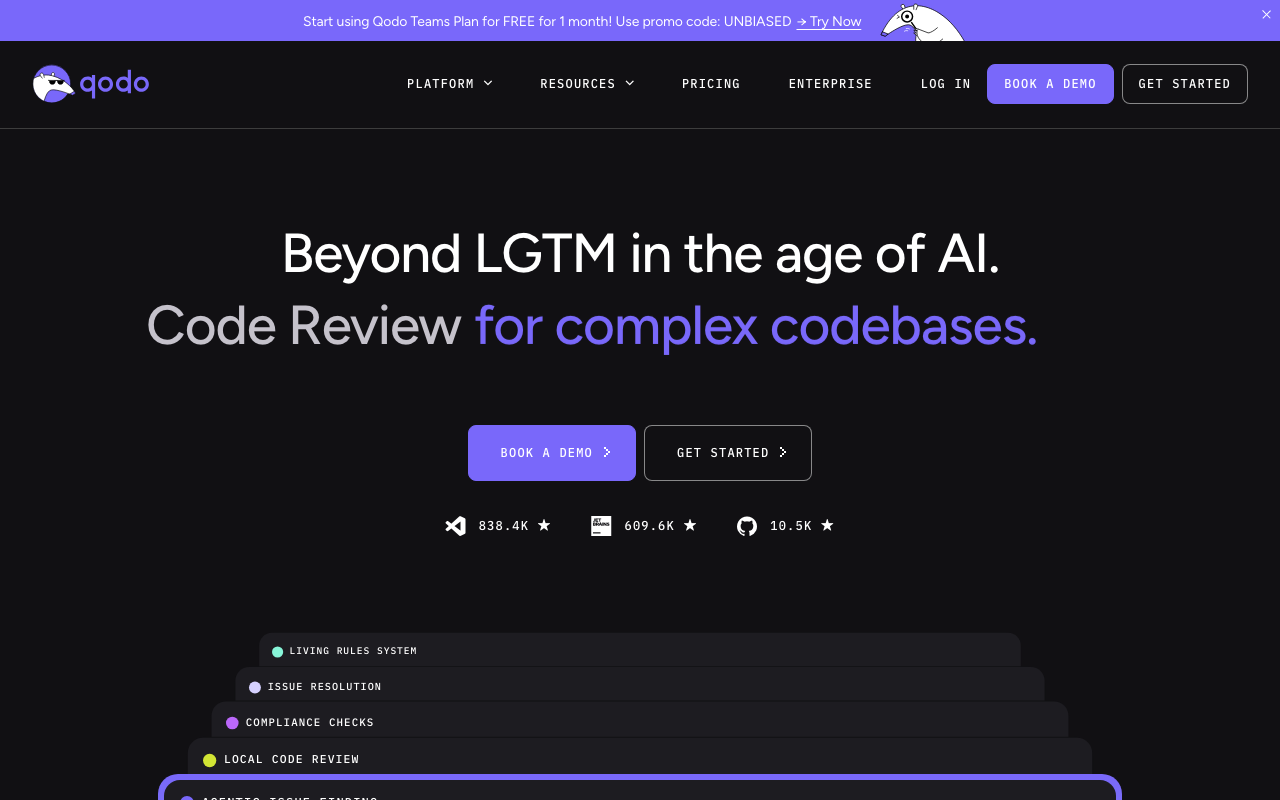
In 2024, CodiumAI rebranded to Qodo to reflect its expansion from a test generation tool into a full AI code quality platform. The rebrand also resolved persistent name confusion with VSCodium, an unrelated open-source fork of Visual Studio Code. All CodiumAI products, accounts, and integrations were migrated to Qodo automatically. The underlying technology, team, and product capabilities remained the same - only the name and branding changed.
This review covers the full history and capabilities of CodiumAI through its evolution into Qodo, including test generation, code review, IDE extensions, pricing, and how it stacks up against competitors in 2026.
The CodiumAI to Qodo Rebrand
Understanding the rebrand is important context for anyone researching CodiumAI in 2026. When CodiumAI launched in 2022, it was a focused tool with a clear mission - generate better unit tests using AI. The VS Code extension allowed developers to select a function, trigger test generation, and receive a complete test suite with edge cases and boundary conditions covered.
As the product matured, the company expanded beyond test generation. They built PR-Agent, an open-source PR review tool, and released it on GitHub. They added IDE chat capabilities, CLI tools, and a context engine for multi-repository awareness. By 2024, calling the product “CodiumAI” no longer captured what it did. The company also faced ongoing confusion with VSCodium - a community-maintained binary distribution of VS Code without Microsoft’s telemetry. Users frequently mixed up the two projects, which created brand identity problems.
The rebrand to Qodo addressed both issues. The new name was distinctive and reflected the broader code quality mission. After the transition, the product split into two main components - Qodo Gen for IDE and CLI experiences (including the original test generation capabilities) and Qodo Merge for PR review. Both products are included in all Qodo plans.
If you are searching for “CodiumAI” today, you are effectively looking for Qodo. Every feature, pricing plan, and integration described in this review applies to the current Qodo platform, which is the direct continuation of CodiumAI.
Core Features
AI-Powered Test Generation
Test generation is the feature that made CodiumAI stand out and remains Qodo’s most distinctive capability. The system does not simply generate stub test files with placeholder assertions. Instead, it analyzes code behavior to understand what a function does, identifies the logical paths through the code, and produces complete tests that validate edge cases, error handling, boundary conditions, and expected outputs.
When you select a function in VS Code or a JetBrains IDE and trigger the /test command, CodiumAI (now Qodo Gen) performs several steps. First, it analyzes the function’s signature, return types, dependencies, and internal logic. Then it maps the behavioral paths - what happens with null inputs, empty collections, boundary values, concurrent access, and exception scenarios. Finally, it generates tests in your project’s existing testing framework.
The supported frameworks include Jest and Vitest for JavaScript and TypeScript, pytest for Python, JUnit for Java, and others. The generated tests use proper fixtures, meaningful variable names, and assertions that actually test behavior rather than trivially passing. This is a critical distinction from AI code completion tools that can generate tests but often produce shallow assertions like checking that a function returns “something” rather than verifying specific behavior.
During PR review, the test generation capability becomes even more powerful. When Qodo Merge reviews a pull request and identifies untested code changes, it can generate tests that specifically target the new code paths being introduced. This creates a feedback loop - review findings become immediately actionable through generated tests rather than items on a backlog that may never get addressed.
Behavior Coverage Analysis
Traditional code coverage tools measure line coverage - whether a particular line of code was executed during testing. CodiumAI introduced behavior coverage analysis, which takes a fundamentally different approach. Instead of counting executed lines, it maps the logical behaviors of your code and evaluates which behaviors have been validated by tests.
Consider a function that processes user input with validation, transformation, and database storage steps. A test that passes one valid input and checks the return value might achieve 80% line coverage. But behavior coverage analysis would reveal that the function’s error handling for invalid inputs, its behavior with null values, its handling of database connection failures, and its concurrent access patterns are all untested. This approach frequently surfaces edge cases that developers overlook even when line coverage percentages look healthy.
Behavior coverage analysis informs both the test generation engine and the code review feedback. When reviewing a pull request, Qodo can identify not just that a function lacks tests, but specifically which behaviors of that function are unvalidated. This level of detail makes the review feedback significantly more actionable than a generic “add tests for this function” comment.
Multi-Agent Code Review (Qodo 2.0)
In February 2026, Qodo released version 2.0 with a multi-agent code review architecture. Instead of a single AI model analyzing the entire diff in one pass, specialized agents work in parallel - one focused on bug detection, another on code quality best practices, a third on security analysis, and a fourth on test coverage gaps.
This architecture achieved the highest overall F1 score of 60.1% in comparative benchmarks against seven other leading AI code review tools, outperforming the next best solution by 9%. The recall rate of 56.7% means Qodo catches more real issues than any other tool tested. For teams evaluating CodiumAI’s evolution, the Qodo 2.0 release represents a significant leap in review quality from the original CodiumAI test generation tool.
For a detailed analysis of the current product, see the full Qodo review.
VS Code Extension
The VS Code extension was CodiumAI’s original distribution channel, and it remains one of the primary ways developers interact with Qodo today. The extension integrates directly into the editor with several capabilities.
Test generation is triggered through the /test command or by right-clicking a function and selecting the test generation option. The extension analyzes the selected code in the context of the broader file and project, then generates tests in a side panel where you can review, modify, and accept individual test cases before inserting them into your test files.
Code chat provides a conversational interface for asking questions about your code, requesting explanations of complex logic, and getting suggestions for improvements. Unlike general-purpose AI chat tools, the chat is aware of your project context and can reference other files in your workspace.
Local code review analyzes your changes before you commit or open a pull request. This catches issues at the earliest possible point in the development cycle, before code enters the review queue and consumes reviewer time.
The extension supports multiple AI models including GPT-4o, Claude 3.5 Sonnet, and DeepSeek-R1. For privacy-conscious teams, local LLM support through Ollama keeps all code processing on your own machines without sending anything to external services.
JetBrains Plugin
CodiumAI expanded beyond VS Code with a JetBrains plugin that supports IntelliJ IDEA, PyCharm, WebStorm, and other JetBrains products. The plugin provides the same core capabilities as the VS Code extension - test generation, code chat, and local code review. Both plugins connect to the same Qodo account and share settings, credits, and preferences.
For teams where some developers use VS Code and others prefer JetBrains IDEs, this cross-platform support ensures consistent tooling across the entire team. The test generation output is identical regardless of which IDE triggers it, since the AI processing happens server-side.
PR Review with Qodo Merge
While CodiumAI started as an IDE tool, Qodo Merge extended the platform into the pull request workflow. When a PR is opened on GitHub, GitLab, Bitbucket, or Azure DevOps, Qodo Merge automatically analyzes the diff and posts structured review feedback including a PR summary, walkthrough of changes, line-level comments on potential issues, and suggestions for improvement.
The review engine is built on PR-Agent, Qodo’s open-source foundation available on GitHub. PR-Agent supports GitHub, GitLab, Bitbucket, Azure DevOps, CodeCommit, and Gitea, and can be self-hosted for free with your own LLM API keys. This open-source foundation is a meaningful differentiator - no other commercial AI code review tool offers this level of transparency into its review logic.
CLI Tool
The CLI tool extends CodiumAI’s capabilities to terminal-based workflows. Developers can run reviews, generate tests, and enforce quality standards from the command line, which is useful for integrating into CI/CD pipelines, pre-commit hooks, and automated quality gates. The CLI consumes the same credits as IDE interactions and supports the same AI models.
Pricing
CodiumAI’s original pricing was straightforward - a free VS Code extension with optional premium features. After the rebrand to Qodo, the pricing structure evolved into a tiered model.
Developer (Free) - 30 PR reviews per month, 250 credits for IDE and CLI interactions, full code review experience, IDE plugin access, CLI tool, and community support via GitHub. Most standard operations consume 1 credit each, though premium AI models cost more - Claude Opus uses 5 credits per request and Grok 4 uses 4 credits per request.
Teams ($30/user/month) - Unlimited PR reviews (limited-time promotion), 2,500 credits per user per month, all Developer features, standard private support, and no data retention.
Enterprise (Custom) - Everything in Teams plus context engine for multi-repo awareness, enterprise dashboard and analytics, user-admin portal with SSO, enterprise MCP tools, priority support with 2-business-day SLA, and deployment options including SaaS, on-premises, or air-gapped environments.
The $30/user/month Teams pricing is above average for the AI code review market. CodeRabbit offers comparable PR review quality at $24/user/month, and CodeAnt AI bundles code review with SAST, secret detection, IaC security, and DORA metrics starting at $24/user/month (Basic) or $40/user/month (Premium). However, neither CodeRabbit nor CodeAnt AI offers automated test generation, which is Qodo’s unique selling point.
The credit system adds complexity that competitors avoid. Understanding which operations consume how many credits, tracking monthly credit usage, and managing premium model costs requires ongoing attention. For teams accustomed to simple per-seat pricing with unlimited usage, the credit model can feel restrictive.
Pros and Cons
Pros
Unique test generation capability. No other AI code review tool combines PR review with automatic unit test generation. If improving test coverage is a priority for your team, CodiumAI (now Qodo) is the only tool that directly addresses this need during the review process.
Open-source foundation. PR-Agent is fully open source and can be self-hosted with your own LLM API keys. This level of transparency is rare in the commercial AI tools space and gives teams the ability to inspect, customize, and deploy the review engine on their own infrastructure.
Broad platform support. GitHub, GitLab, Bitbucket, and Azure DevOps are all supported for PR review. Both VS Code and JetBrains IDEs are supported for the IDE experience. This cross-platform coverage means most development teams can adopt Qodo regardless of their existing toolchain.
Strong benchmark performance. The Qodo 2.0 multi-agent architecture achieved the highest F1 score (60.1%) among eight AI code review tools in comparative benchmarks. The recall rate of 56.7% is the highest tested, meaning Qodo catches more real issues than competitors.
Behavior coverage analysis. Going beyond line coverage to evaluate behavioral coverage is a genuinely useful approach that surfaces edge cases and untested scenarios that traditional coverage tools miss.
Free tier with real functionality. The free Developer plan with 30 PR reviews and 250 credits per month provides enough capacity for individual developers and small teams to evaluate the platform without financial commitment.
Cons
Above-average pricing. At $30/user/month, the Teams plan is more expensive than CodeRabbit ($24/user/month) and CodeAnt AI ($24/user/month Basic). For teams that primarily need code review without test generation, the premium is harder to justify.
Credit system complexity. Variable credit costs per AI model and separate counting for PR reviews versus IDE interactions creates confusion. Teams need to monitor credit consumption and may hit limits unexpectedly if developers use premium models frequently.
Rebrand confusion. The transition from CodiumAI to Qodo has created fragmented search results and documentation. Developers searching for “CodiumAI” find outdated information mixed with current Qodo documentation, making research more difficult.
Test generation quality varies by language. While Python, JavaScript, TypeScript, and Java get excellent test generation, less common languages produce lower-quality tests. The generated tests for languages with smaller training data can require significant manual editing.
Enterprise minimum for full self-hosting. While PR-Agent is open source and free to self-host, the full platform with context engine, analytics, and enterprise features requires the Enterprise plan with custom pricing. The open-source version covers core review functionality but lacks the advanced features that differentiate the commercial product.
How CodiumAI Compares to Competitors
CodiumAI vs GitHub Copilot
CodiumAI and GitHub Copilot serve fundamentally different roles. Copilot is a general-purpose AI coding assistant where code review is one feature among many - code completion, chat, and code generation are the primary use cases. CodiumAI was purpose-built for test generation and evolved into a dedicated code quality platform.
Copilot Business costs $19/user/month versus Qodo’s $30/user/month. However, Copilot’s code review uses a premium request system with overage charges that can increase costs for heavy users. Qodo generates unit tests automatically, which Copilot does not offer. Qodo also supports GitLab, Bitbucket, and Azure DevOps for PR review, while Copilot’s review features are GitHub-only.
For teams already invested in the GitHub ecosystem and wanting a single AI tool for everything, Copilot is the simpler choice. For teams that specifically need test generation and deeper code review with multi-platform support, Qodo is the better option.
CodiumAI vs CodeAnt AI
CodeAnt AI takes a different approach by bundling AI code review with SAST, secret detection, IaC security, and DORA metrics in a single platform. At $24/user/month (Basic) or $40/user/month (Premium), CodeAnt AI offers broader security coverage for a similar or lower price than Qodo’s $30/user/month.
The key differentiator is scope. CodiumAI (now Qodo) excels at test generation and behavioral analysis - capabilities that CodeAnt AI does not offer. CodeAnt AI excels at security scanning, compliance reporting, and engineering metrics - capabilities that Qodo does not include. For teams that need one tool to cover both code quality and security, CodeAnt AI provides more breadth. For teams focused specifically on improving test coverage alongside code review, Qodo is the better fit.
CodiumAI vs CodeRabbit
CodeRabbit is the most widely adopted AI code review tool with over 2 million repositories connected. At $24/user/month for Pro, it is cheaper than Qodo’s $30/user/month Teams plan. CodeRabbit’s free tier is also more generous - unlimited repositories with rate limits versus Qodo’s 30 reviews and 250 credits per month.
CodeRabbit has 40+ built-in linters, a more mature auto-fix suggestion system, and stronger brand recognition. However, CodeRabbit does not generate unit tests, does not offer behavior coverage analysis, and does not have an open-source core. For teams that want the best dedicated PR review experience, CodeRabbit wins. For teams that value test generation alongside review, Qodo is the only option.
For more CodiumAI alternatives, see our dedicated comparison guide.
Who Should Use CodiumAI (Qodo)?
Teams with low test coverage. If your codebase has significant gaps in test coverage and your team struggles to write comprehensive tests, CodiumAI’s test generation capability directly addresses this problem. No other tool automatically generates tests during code review and from within your IDE.
Python, JavaScript, and TypeScript developers. Test generation quality is strongest for these languages and their associated testing frameworks (pytest, Jest, Vitest). Developers working primarily in these ecosystems will get the most value from the automated testing features.
Organizations needing self-hosted review. The open-source PR-Agent provides a legitimate free self-hosting option for the core review engine. Teams in regulated industries that cannot send code to external services can deploy PR-Agent with their own LLM API keys on their own infrastructure.
Teams using multiple Git platforms. With support for GitHub, GitLab, Bitbucket, and Azure DevOps, Qodo works across mixed-platform environments that many competitors cannot serve. If your organization uses GitLab for some projects and GitHub for others, Qodo covers both.
Developers who want one tool for review and testing. Rather than using separate tools for code review and test generation, Qodo combines both in a single platform with unified billing and configuration. The feedback loop between review findings and test generation is unique in the market.
Who Should Look Elsewhere
Budget-conscious teams needing only PR review. If test generation is not a priority, CodeRabbit at $24/user/month or CodeAnt AI at $24/user/month offer comparable or better PR review at lower prices. Paying $30/user/month for Qodo when you are not using the test generation feature is not efficient.
Teams wanting all-in-one security platforms. If you need SAST, secret detection, IaC security scanning, and compliance reporting alongside code review, CodeAnt AI at $24-40/user/month covers these needs in a single tool. Qodo focuses on quality and testing rather than security scanning.
Small teams with simple needs. Solo developers and very small teams may find the credit system and tiered feature structure more complex than necessary. Simpler tools with unlimited free tiers, like CodeRabbit’s free plan, may be more appropriate.
The Bottom Line
CodiumAI carved out a unique position in the AI developer tools market by focusing on what no other tool did well - automated test generation. That focus earned it a loyal user base and recognition as an innovative product. The rebrand to Qodo in 2024 reflected the company’s evolution into a broader code quality platform, and the February 2026 release of Qodo 2.0 with its multi-agent review architecture validated that expansion.
In 2026, CodiumAI - now operating as Qodo - remains the only AI tool that combines PR code review with automatic unit test generation. If improving test coverage is central to your team’s quality strategy, there is no real alternative. The $30/user/month Teams pricing is above average, but the test generation capability justifies the premium for teams that actively use it.
For teams that do not need test generation, the market offers strong alternatives at lower price points. CodeRabbit and CodeAnt AI both provide excellent PR review experiences at $24/user/month. But for the intersection of code review and automated testing, CodiumAI’s legacy lives on through Qodo as the clear market leader.
Frequently Asked Questions
Is CodiumAI still available?
CodiumAI rebranded to Qodo in 2024. The CodiumAI product, VS Code extension, JetBrains plugin, and all user accounts were migrated to Qodo automatically. If you had a CodiumAI account, your login credentials and subscription carry over to Qodo without any changes. The underlying AI technology, test generation engine, and team all remain the same - only the name and branding changed. You can still find references to CodiumAI online, but the product now operates exclusively under the Qodo brand.
Why did CodiumAI rebrand to Qodo?
CodiumAI rebranded to Qodo in 2024 for two main reasons. First, the company expanded from a focused test generation tool into a full AI code quality platform covering code review, testing, IDE assistance, and CLI workflows - the CodiumAI name no longer reflected the breadth of the product. Second, persistent name confusion with VSCodium - an unrelated open-source fork of Visual Studio Code - caused brand identity issues. Qodo was chosen as a new name that was distinctive and better represented the company's broader mission in code quality.
Does CodiumAI generate unit tests automatically?
Yes. Automated test generation was CodiumAI's flagship feature and remains the core differentiator of Qodo today. The tool analyzes your code to understand its behavior, identifies untested logic paths, and generates complete unit tests with meaningful assertions covering edge cases, boundary conditions, and error scenarios. Tests are produced in your project's existing testing framework - Jest, pytest, JUnit, Vitest, and others. In the IDE, the /test command triggers test generation for selected functions. During PR review, Qodo identifies coverage gaps and suggests tests that validate the specific changes being reviewed.
Is CodiumAI free to use?
Qodo (formerly CodiumAI) offers a free Developer plan that includes 30 PR reviews per month and 250 credits for IDE and CLI interactions. The free tier provides the full code review experience, IDE plugin access, CLI tool, and community support via GitHub. Most standard operations consume 1 credit each, though premium AI models cost more per request. The free tier is sufficient for solo developers and small teams to evaluate the platform. Teams processing more than 30 PRs per month will need the paid Teams plan at $30/user/month.
What languages does CodiumAI support for test generation?
Qodo (formerly CodiumAI) supports all major programming languages including JavaScript, TypeScript, Python, Java, Go, C++, C#, Ruby, PHP, Kotlin, and Rust. The AI-powered engine uses large language models for semantic understanding, so it can analyze code in virtually any language. Test generation quality is strongest for languages with mature testing ecosystems - Python with pytest, JavaScript with Jest, Java with JUnit, and TypeScript with Vitest produce the most reliable and comprehensive generated tests.
How does CodiumAI compare to GitHub Copilot?
CodiumAI (now Qodo) and GitHub Copilot serve different primary purposes. Copilot is primarily an AI coding assistant with code completion and chat - code review is a secondary feature. CodiumAI was built specifically for test generation and code quality, and Qodo has expanded that into a full code review platform. Qodo's multi-agent architecture achieved a higher F1 score (60.1%) than Copilot's review capabilities in benchmark testing. Qodo also generates unit tests automatically, supports GitLab, Bitbucket, and Azure DevOps, and offers self-hosted deployment via open-source PR-Agent. Copilot is cheaper at $19/user/month for Business versus Qodo's $30/user/month Teams plan.
Does CodiumAI work with JetBrains IDEs?
Yes. Qodo (formerly CodiumAI) offers plugins for both VS Code and JetBrains IDEs including IntelliJ IDEA, PyCharm, WebStorm, and other JetBrains products. The JetBrains plugin provides the same core capabilities as the VS Code extension - code review, test generation via the /test command, chat-based code assistance, and support for multiple AI models including GPT-4o, Claude 3.5 Sonnet, and DeepSeek-R1. Both the VS Code and JetBrains plugins connect to the same Qodo account and share settings, credits, and preferences.
What is the difference between CodiumAI and Qodo Gen?
CodiumAI was the original product name for the AI test generation tool launched in 2022. After the 2024 rebrand, the IDE-based experience - including test generation, code chat, and local code review - was packaged as Qodo Gen. Qodo Gen is essentially the next generation of CodiumAI with expanded capabilities. The test generation feature that made CodiumAI popular is still available through the /test command in Qodo Gen, alongside new features like multi-model support, CLI integration, and agentic coding workflows.
How much does CodiumAI cost?
Qodo (formerly CodiumAI) pricing starts with a free Developer plan that includes 30 PR reviews per month and 250 credits for IDE and CLI use. The Teams plan costs $30 per user per month and provides unlimited PR reviews and 2,500 credits per user per month. Enterprise pricing is custom and includes context engine for multi-repo awareness, SSO, enterprise dashboard and analytics, and deployment options including SaaS, on-premises, or air-gapped environments. For teams that only need code review without test generation, alternatives like CodeAnt AI at $24-40/user/month may offer better value.
Can CodiumAI be self-hosted?
Yes. Qodo (formerly CodiumAI) offers self-hosting through two paths. The open-source PR-Agent can be self-hosted for free using Docker with your own LLM API keys, covering the core PR review functionality on GitHub, GitLab, Bitbucket, Azure DevOps, CodeCommit, and Gitea. For full platform self-hosting - including the context engine, analytics dashboard, and enterprise features - the Enterprise plan offers on-premises and air-gapped deployment options. This makes Qodo one of the most flexible AI code review tools for organizations with strict data sovereignty requirements.
What is CodiumAI's behavior coverage analysis?
Behavior coverage analysis is a distinctive feature that goes beyond traditional line coverage metrics. Instead of simply measuring whether a line of code was executed during testing, CodiumAI (now Qodo) evaluates whether the meaningful behaviors of your code have been validated - including null inputs, boundary conditions, error paths, and concurrent access patterns. This approach frequently surfaces edge cases that developers overlook even when line coverage percentages look healthy. The behavior analysis informs both the test generation engine and the code review feedback.
How does CodiumAI compare to CodeAnt AI?
CodiumAI (now Qodo) at $30/user/month focuses on AI code review combined with automated test generation, which no other tool offers. CodeAnt AI at $24-40/user/month bundles AI code review with SAST, secret detection, IaC security, and DORA metrics in a single platform. If your primary need is improving test coverage and you want AI-generated tests alongside code review, Qodo is the better choice. If you need broader security scanning and engineering metrics without test generation, CodeAnt AI offers more value per dollar. Qodo has a free tier while CodeAnt AI does not.
Explore More
Tool Reviews
 Qodo Review
 CodeAnt AI Review
Related Articles
Free Newsletter
Stay ahead with AI dev tools
Weekly insights on AI code review, static analysis, and developer productivity. No spam, unsubscribe anytime.
Join developers getting weekly AI tool insights.
Related Articles
Checkmarx Pricing in 2026: Plans, Per-Developer Costs, and Enterprise Quotes
Checkmarx pricing decoded - per-developer costs ($40-70+/dev/year), SAST/DAST/SCA bundle pricing, total cost of ownership, and enterprise negotiation tips.
March 13, 2026
reviewCodacy Pricing in 2026: Free, Team, and Business Plans Compared
Codacy pricing in 2026 - free Developer plan, Team at $18/dev/month, Business custom pricing, ROI calculation, and competitor comparisons.
March 13, 2026
reviewCodacy Review 2026: Is It Worth It for Your Team?
In-depth Codacy review covering features, pricing, pros and cons, and real-world performance. Find out if Codacy is worth it for your team.
March 13, 2026