Qodo AI Review 2026: Is It the Best AI Testing Tool?
In-depth Qodo AI review covering test generation, PR review, pricing, pros and cons, and how it compares to top alternatives in 2026.
Published:
Last Updated:
Direct answer
Qodo is the only AI reviewer that generates unit tests as part of the review workflow, and its subscription is the cheapest in this market: a flat fee of roughly $30 per month for up to 30 users plus credits at $0.012 each, pooled with no rollover. There is no permanent free tier - a 14-day trial with unlimited reviews. Its 60.1% F1 and the 64.3% Martian claim are both self-published. On-prem and VPC available, SOC 2 and GDPR. Verified 2026-10-19.
Quick Verdict
Qodo (formerly CodiumAI) is the only AI code review tool that combines automated PR review with automatic unit test generation in a single platform. If your team struggles with low test coverage and wants AI-driven review feedback that goes beyond comments into actionable tests, Qodo is the best option available in 2026. The February 2026 release of Qodo 2.0 introduced a multi-agent review architecture that achieved the highest F1 score (60.1%) in benchmark testing against seven other leading tools.
Two corrections to the previous version of this review, both material. First, Qodo does not price per seat. Its published model is a flat team fee of roughly $30 per month covering up to 30 users, plus credits at $0.012 each, pooled across the team with no rollover (verified 2026-10-19). At 20 developers that is about $30 a month, not $600 - so Qodo is the cheapest subscription in this market, not an above-average one. Second, the 60.1% F1 figure is Qodo’s own benchmark, not an independent result, and Qodo separately claimed #1 on Martian Code Review Bench at 64.3%. Four vendors have each declared themselves #1 on that one leaderboard.
The real friction is not price, it is forecastability: Qodo publishes no credits-per-review figure, so you cannot model the variable half of the bill from published data. If you only need PR review on a predictable per-seat line, CodeRabbit at $24/dev/mo annual or Codacy Team at $18/dev/mo yearly are easier to budget.
Bottom line: Qodo is not the cheapest AI code review tool, but it is the most complete AI code quality platform. The combination of review, test generation, IDE support, CLI tooling, and open-source self-hosting options makes it uniquely positioned for teams that want one tool to cover the full quality spectrum.
What Is Qodo?
Qodo is an AI-powered code quality platform that was originally launched as CodiumAI in 2022 by founders Itamar Friedman and Dedy Kredo. The company rebranded from CodiumAI to Qodo in 2024 as it expanded from a test generation tool into a comprehensive quality platform covering code review, testing, IDE assistance, and CLI workflows.
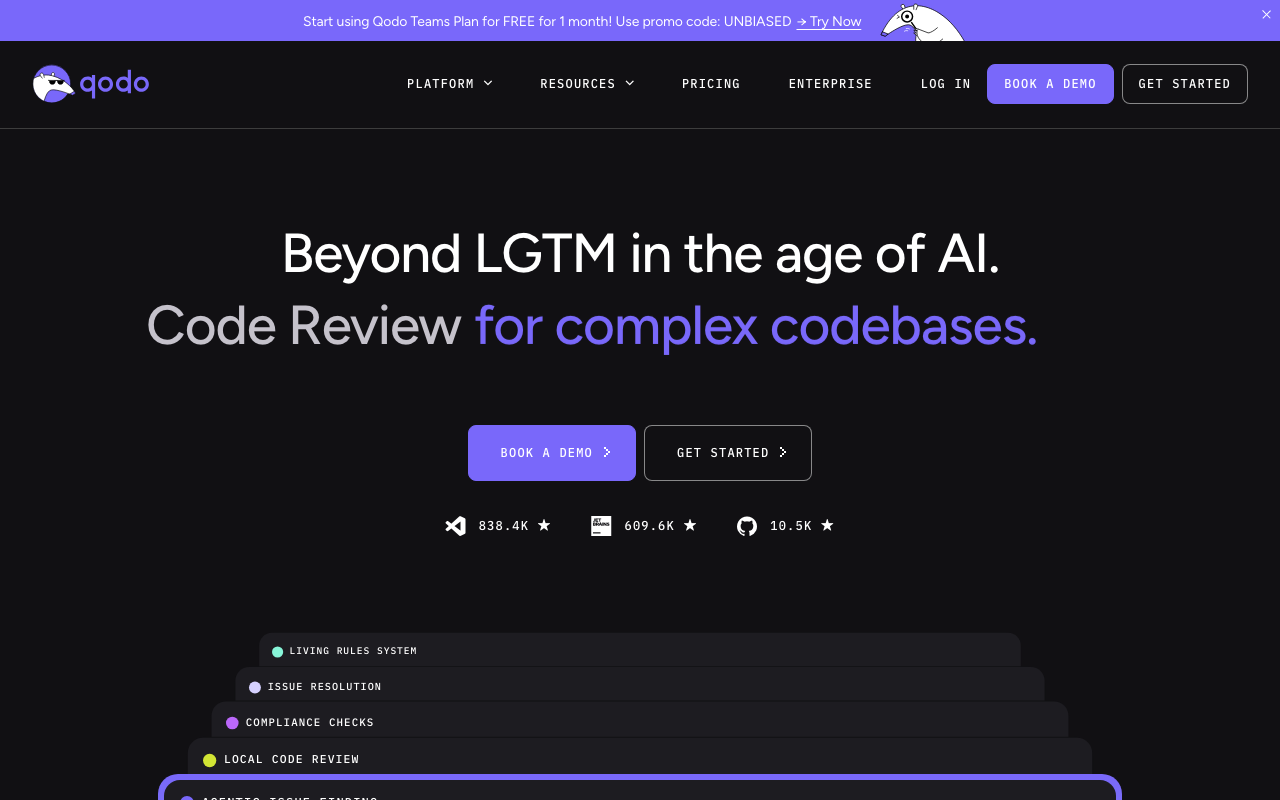
The platform consists of two main products that work together:
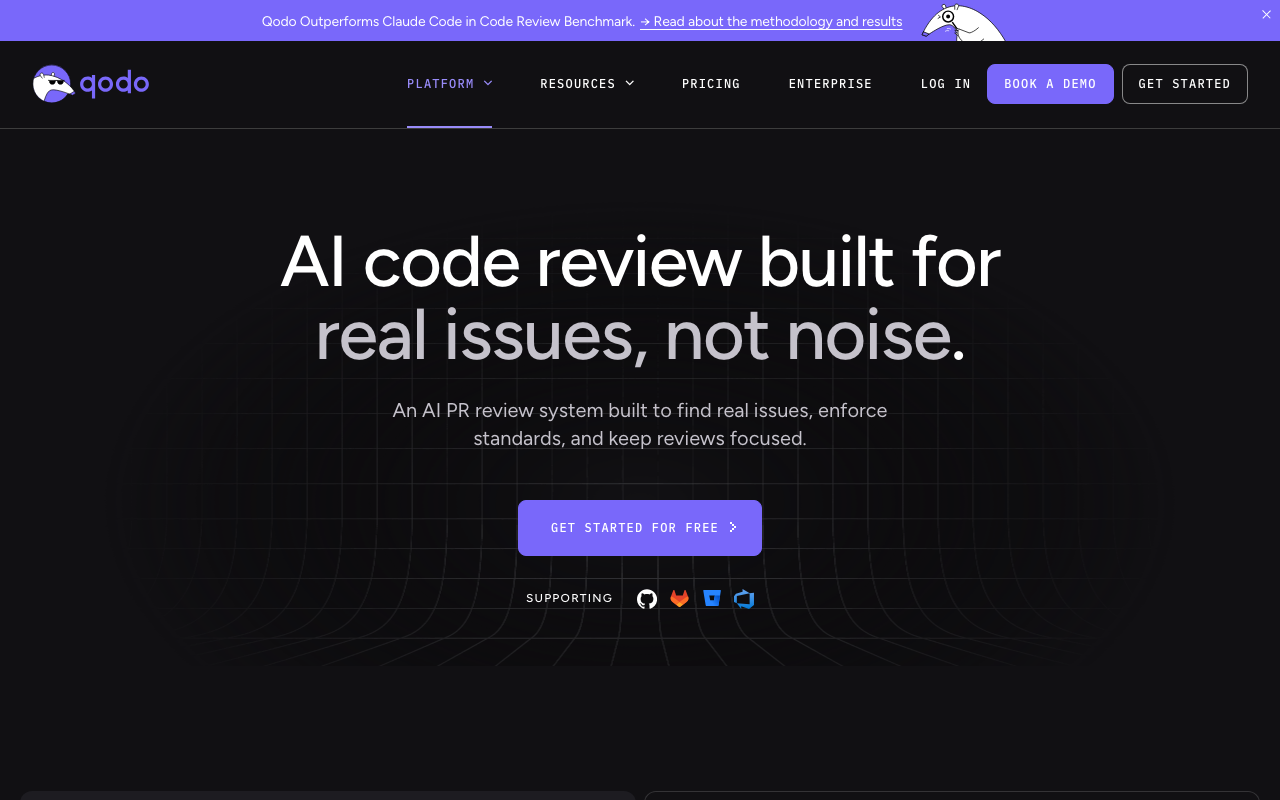
Qodo Merge is the PR review product. When a pull request is opened on GitHub, GitLab, Bitbucket, or Azure DevOps, Qodo Merge automatically analyzes the diff using a multi-agent architecture. Specialized agents evaluate bugs, code quality, security vulnerabilities, and test coverage gaps simultaneously. The review is posted as line-level comments with a structured PR summary and walkthrough.
Qodo Gen is the broader AI coding assistant that spans the IDE and CLI. In VS Code and JetBrains IDEs, Qodo Gen provides code generation, chat-based assistance, and - most importantly - automated test generation via the /test command. The CLI tool extends these capabilities to terminal-based workflows, which is useful for CI/CD integration.
Both products are built on PR-Agent, Qodo’s open-source review engine available on GitHub. PR-Agent supports GitHub, GitLab, Bitbucket, Azure DevOps, CodeCommit, and Gitea, and can be self-hosted for free with your own LLM API keys. This open-source foundation is a meaningful differentiator - no other commercial AI code review tool offers this level of transparency.
Qodo raised $40 million in Series A funding in 2024 and was recognized as a Visionary in the Gartner Magic Quadrant for AI Code Assistants in 2025. With approximately 100 employees across Israel, the United States, and Europe, the company has built a substantial team behind the platform.
Key Features
Multi-Agent Code Review (Qodo 2.0)
Direct answer: Qodo 2.0 (February 2026) runs specialized agents in parallel on bugs, code quality, security and test coverage gaps instead of a single pass over the diff. Qodo reports 60.1% F1 and 56.7% recall from its own benchmark, and separately claimed #1 on Martian Code Review Bench at 64.3% (verified 2026-10-19). Both figures are self-published. No disinterested party has measured Qodo.
The architecture is real and the reasoning behind it is sound - parallel specialists beat one generalist pass on a diff, which is the same bet Anthropic’s Code Review makes with its logic, boundary-condition, API-misuse and auth-flaw agents plus a verification step. What is not established is the magnitude of the gain. Here is the provenance of every figure in circulation for this product class:
| Figure | What it is | Who published it |
|---|---|---|
| Qodo 60.1% F1, 56.7% recall | Qodo’s own comparative benchmark | Qodo |
| Qodo #1 at 64.3% on Martian | Qodo’s claim on a third-party leaderboard, 15 Mar 2026 | Qodo |
| CodeRabbit 51.2% F1 / 49.2% precision | Martian Code Review Bench, ~300,000 PRs, 3 Mar 2026. Martian sells model routing, not reviewers - the most neutral leaderboard available | Martian |
| Baz #1 on 790 PRs | A third self-declared winner on the same leaderboard | Baz |
| Greptile 82% | Greptile scoring Greptile on 50 PRs across 5 repos | Greptile |
| Greptile 45% | Augment’s re-run, an F-score, on a rebuilt answer key | Augment |
| DeepSource 84.51% F1 | DeepSource scoring DeepSource | DeepSource |
| Entelligence 47.2% aggregate F1, #1 | Entelligence winning its own benchmark | Entelligence |
Four vendors have each declared themselves #1 on Martian’s single leaderboard. That is the most useful fact on this page about benchmark claims. The precise thesis we stand behind: no party without a commercial stake has published a false-positive rate, precision figure or noise measurement for any shipping commercial AI code reviewer. SWE-PRBench and CR-Bench do publish false-positive data - Claude Sonnet 4.6 lowest at 0.227, Llama 3.3 70B highest at 0.417 on SWE-PRBench - but they measure bare models in fixed harnesses, not products you can buy.
Automated Test Generation
Test generation is what originally made CodiumAI stand out, and it remains Qodo’s most distinctive capability. The system analyzes code behavior, identifies untested logic paths, and generates complete unit tests - not stubs, but tests with meaningful assertions covering edge cases and error scenarios. Tests are produced in your project’s existing framework (Jest, pytest, JUnit, Vitest, and others). In the IDE, the /test command triggers generation for selected functions. During PR review, Qodo identifies coverage gaps and suggests tests that validate the specific changes being reviewed.
This creates a feedback loop that no other tool provides: Qodo finds an issue in review, then generates a test that catches that exact scenario. Review findings become immediately actionable rather than items on a backlog.
Behavior Coverage Analysis
Qodo goes beyond simple line coverage metrics. Its behavior coverage analysis maps the logical paths through your code and identifies which behaviors are untested. This is different from tools that only measure whether a line was executed during testing - Qodo evaluates whether the meaningful scenarios (null inputs, boundary conditions, error paths, concurrent access patterns) have been validated. This approach frequently surfaces edge cases that developers overlook even when line coverage numbers look healthy.
IDE Plugins for VS Code and JetBrains
Qodo’s IDE plugins bring code review and test generation directly into the development environment. Developers can review code locally before committing, generate tests for new functions, and get AI-assisted suggestions without leaving their editor. The plugins support multiple AI models including GPT-4o, Claude 3.5 Sonnet, and DeepSeek-R1. For privacy-conscious teams, Local LLM support through Ollama keeps all code processing on your own machines.
CI/CD and CLI Integration
The CLI tool provides agentic quality workflows in the terminal, allowing developers to run reviews, generate tests, and enforce quality standards as part of automated pipelines. This is particularly useful for pre-commit hooks and CI/CD gates where you want automated quality checks before code reaches the main branch.
Broadest Platform Support
Qodo supports GitHub, GitLab, Bitbucket, and Azure DevOps for PR review - one of the broadest platform ranges in the AI code review market. Through the open-source PR-Agent, coverage extends to CodeCommit and Gitea as well. For organizations running heterogeneous Git infrastructure, this eliminates the platform compatibility evaluation entirely.
Context Engine for Multi-Repo Intelligence
Available on the Enterprise plan, the context engine builds awareness across multiple repositories. It understands how changes in one repo might affect services in another - critical for microservice architectures where API changes, shared library updates, or configuration modifications can have cascading effects. The engine also learns from pull request history, improving suggestion relevance over time.
Pros and Cons
What Qodo Does Well
Test generation is genuinely unique. No other AI code review tool automatically generates unit tests as part of the review workflow. This is not a minor feature difference - it fundamentally changes what a code review tool can do. When Qodo identifies that a function does not handle null input, it also generates a test that exercises that exact scenario. Users on G2 consistently highlight that Qodo produces “great unit tests in seconds, sometimes with edge cases not considered, finding bugs before the end-user does.”
Strong self-reported benchmark numbers - with the attribution attached. Qodo reports 60.1% F1 and 56.7% recall from its own benchmark and claimed #1 on Martian Code Review Bench at 64.3% (verified 2026-10-19). Both are Qodo’s figures. That is not a reason to dismiss them, but it is not a measured advantage either, and we will not present it as one. Every vendor in this category that has published a benchmark has won it.
Open-source foundation provides transparency and flexibility. PR-Agent is fully open source, meaning teams can inspect exactly how their code is analyzed, contribute improvements, and self-host in air-gapped environments. This is a hard requirement for regulated industries in finance, healthcare, and government - and Qodo is the only commercial AI review tool that meets it through an open-source core.
Broadest platform support. Supporting GitHub, GitLab, Bitbucket, Azure DevOps, CodeCommit, and Gitea (via PR-Agent) means Qodo works with virtually any Git hosting provider. Most competitors are limited to GitHub and GitLab only.
Gartner Visionary recognition. Being named a Visionary in the Gartner Magic Quadrant for AI Code Assistants in 2025 provides meaningful third-party validation. Combined with $40 million in Series A funding, Qodo has institutional credibility that smaller competitors lack.
Where Qodo Falls Short
Pricing is cheap on subscription and hard to forecast. The flat fee of roughly $30 per month covers up to 30 users, which undercuts CodeRabbit at $24 per developer, Codacy Team at $18 per developer yearly and Copilot Business at $19 per user by a wide margin at team scale (verified 2026-10-19). The problem is the other half of the bill: Qodo publishes no credits-per-review figure, so you cannot forecast credit consumption from published data. Above 30 users you are in a quote-only conversation with no published rate card.
The credit system has two sharp edges. Credits are $0.012 each, pooled across the team and with no rollover (verified 2026-10-19). Pooling is better than Greptile’s per-author credits for teams with uneven contribution, but it means one engineer can drain the team allocation. No rollover means a quiet month is money lost. And because Qodo does not publish credits consumed per review, a 2,500-credit pack cannot be converted into a review count without measuring.
There is no free tier at all now. The free allowance went from 75 PR reviews per month to 30 and then to nothing. What remains is a 14-day trial with unlimited reviews and no card (verified 2026-10-19). Unlimited reviews inside the window actually makes it a better evaluation instrument than a monthly cap did, but there is no soft landing: when it ends you are paying or you have no reviewer.
IDE plugin performance can lag. Some users on G2 report slow performance with the IDE plugin on larger codebases. For developers who rely on the IDE extension for interactive test generation, responsiveness issues can be frustrating.
Brand confusion from the CodiumAI transition. The rebrand from CodiumAI to Qodo still causes confusion. Some developers searching for CodiumAI do not realize it is now Qodo, and some marketplace listings and documentation still reference the old name.
Learning curve across multiple surfaces. Qodo spans PR review, IDE plugin, CLI tool, test generation, and the context engine. Mastering all of these capabilities takes longer than single-purpose tools that do one thing well.
Pricing
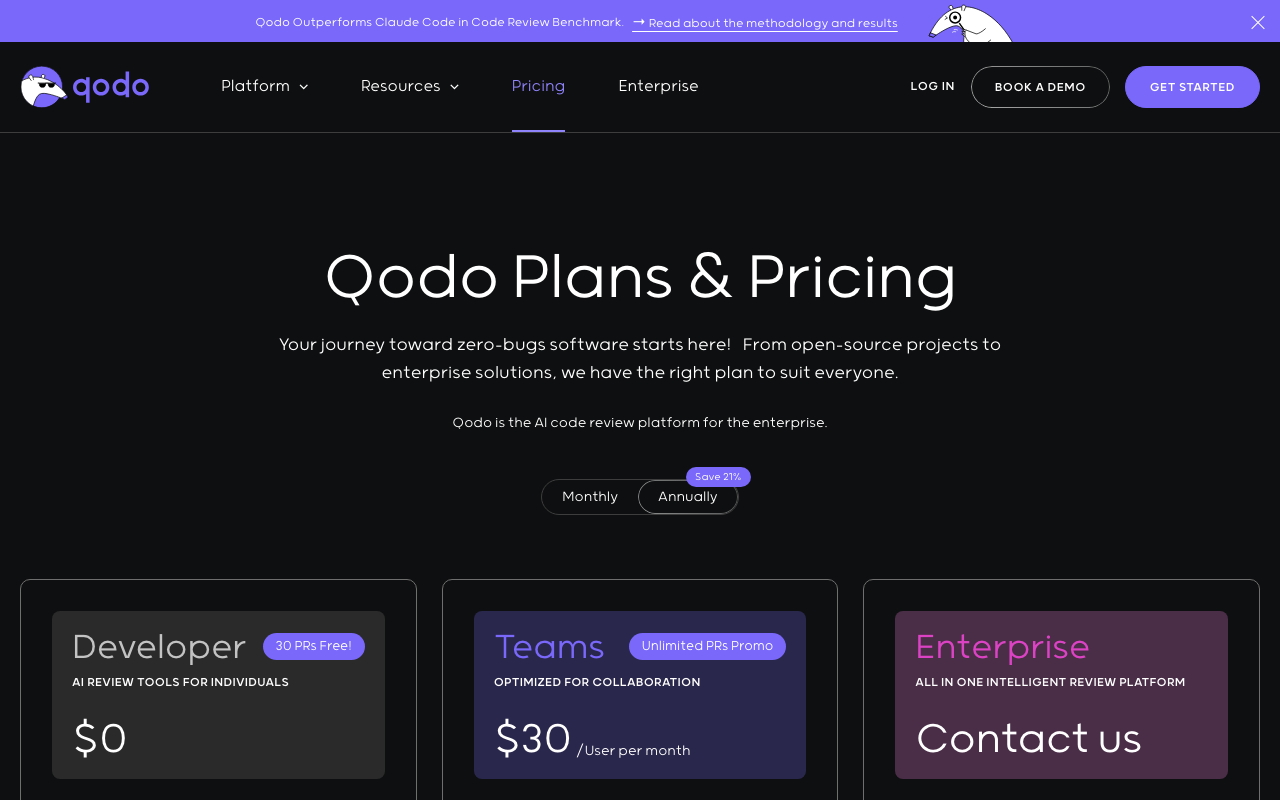
Direct answer: Qodo charges a flat team fee of roughly $30 per month covering up to 30 users, plus credits at $0.012 each, pooled across the team with no rollover, in packs of 2,500 / 5,000 / 20,000 (verified 2026-10-19). There is no permanent free tier - a 14-day trial with unlimited reviews and no card. Enterprise is quote-only. On-prem and VPC deployment are available.
| Line item (verified 2026-10-19) | Cost | Notes |
|---|---|---|
| Team subscription | ~$30/month flat | Up to 30 users, not per seat |
| Credits | $0.012 each | Pooled across the team. No rollover. |
| Credit packs | 2,500 / 5,000 / 20,000 | - |
| Credits consumed per review | Not published | The biggest forecasting gap in Qodo’s pricing |
| Trial | 14 days, unlimited reviews, no card | No permanent free tier |
| Enterprise | Quote only | Context engine, SSO, dashboard, on-prem, VPC |
| Compliance | SOC 2, GDPR | Vendor-stated on Qodo’s own pages, not retrieved reports |
This section previously described a per-seat model. It listed Teams at $30/month flat for up to 30 users annual and $38 monthly with 2,500 credits per user, and a free Developer plan at 30 PR reviews and 250 credits per month. Those figures are not in Qodo’s current published pricing and are corrected here. The per-seat framing is worth calling out specifically because it inverts the conclusion: on the real model, Qodo has the cheapest subscription in this market rather than one of the most expensive.
One genuinely notable item for small regulated teams: on-prem and VPC are available at this price point. CodeRabbit gates self-hosting behind 500 or more seats, and Semgrep’s Network Broker and Snyk Broker are tunnels to the vendor’s cloud rather than on-prem deployments. Qodo’s combination of flat fee, on-prem option, SOC 2 and GDPR is scarce - though note those compliance claims are vendor statements, not reports we retrieved.
How Does Qodo’s Pricing Compare?
Direct answer: At 20 developers, Qodo’s subscription is roughly $30 per month in total against $480 for CodeRabbit Essentials, $360 for Codacy Team, $380 for Copilot Business and $600 for Greptile Pro (all verified 2026-10-19). Qodo is the cheapest subscription in this market by an order of magnitude at team scale. Its variable credit cost is the offset, and it is not publicly modellable.
| Tool (verified 2026-10-19) | Billing model | Cost at 20 devs | Free option | Test generation |
|---|---|---|---|---|
| Qodo | Flat team fee + pooled credits | ~$30/mo + credits at $0.012 | None - 14-day trial | Yes |
| PR-Agent | Self-hosted, MIT since 23 Apr 2026 | $0 licence + LLM spend | Yes, self-host | No |
| Codacy | Per dev, $18/mo yearly ($21 monthly) | $360/mo | Developer tier free forever | No |
| GitHub Copilot | Per user, monthly only since 1 June 2026 | $380/mo Business | Copilot Free - no code review | No |
| CodeRabbit | Per PR creator, $24 annual / $30 monthly | $480/mo Essentials (1 repo) | Public repos only | No |
| Greptile | Per dev who received a review, $30 | $600/mo + $1/credit overage | Starter: 1 active dev, 50 credits | No |
| Sourcery | Per seat, $12 annual | $240/mo Pro | OSS repos only | No |
| Tabnine | Unverifiable | Unverifiable | Unknown | No |
Three corrections in that table. Codacy Team is $18/dev/mo yearly ($21 monthly), not $15. Copilot has no annual billing since 1 June 2026, and code review is included from Pro at $10 - only Copilot Free lacks it. And Tabnine was acquired by Tricentis, announced 30 July 2026; its pricing page now redirects to a Tricentis contact form, so every per-seat figure for it is unverified and we will not quote one.
Greptile is worth a line of its own because its unit is unusual: a “seat” is any developer who received a review, credits are per author and do not pool, and an Apex-depth review costs 10 credits rather than 1. That is the structural opposite of Qodo’s pooled model.
Real-World Usage
Test Generation Quality
Qodo’s test generation is the feature that most directly impacts daily workflows. In practice, the generated tests are surprisingly good for common patterns - standard CRUD operations, utility functions, and API endpoint handlers receive tests with meaningful assertions, edge case coverage, and proper mocking of dependencies. The tests use your project’s existing framework conventions and follow the patterns already present in your test suite.
Where test generation falls short is with complex business logic, deeply nested dependencies, and code that requires significant setup or external service mocking. In these cases, Qodo produces a useful starting point - a test skeleton with the right structure and some valid assertions - but developers still need to fill in domain-specific details. This is a realistic expectation for any AI-powered test generation tool in 2026, and Qodo handles it better than anything else on the market.
The /test command in the IDE is the most practical way to use test generation. Select a function, run /test, and Qodo produces a test file within seconds. For teams bootstrapping test coverage on legacy codebases, this workflow can generate dozens of tests per day with moderate human refinement.
PR Review Depth
Qodo Merge’s multi-agent review produces thorough, structured feedback. Each PR receives a summary describing what changed, the risk level, and which files are most affected. Line-level comments include explanations of the issue, the potential impact, and suggested fixes. The multi-agent architecture means different types of issues - bugs, security vulnerabilities, style violations, and missing tests - are analyzed by specialized agents rather than a single general-purpose model.
Review turnaround is typically under 5 minutes for standard PRs. Larger diffs with many files take longer, but the structured summary helps reviewers triage findings quickly. The ability to interact with Qodo in PR comments - asking follow-up questions, requesting alternative implementations, or generating tests for specific code paths - adds a conversational dimension that static review tools lack.
The practical limitation is no longer a free-tier cap, because there is no free tier (verified 2026-10-19). Reviews are unlimited during the 14-day trial, which makes the trial a better evaluation instrument than the old 30-review monthly allowance was - you can push real sprint volume through it. After the trial, review volume is metered against pooled credits and Qodo publishes no credits-per-review figure, so the only way to know what a sprint costs is to run one and measure.
Who Should Use Qodo
Teams with low test coverage that want AI-generated tests to bootstrap their testing practice. Qodo’s test generation produces framework-appropriate tests with meaningful assertions and edge case coverage. For teams that know they need better tests but cannot dedicate the engineering time to write them manually, Qodo offers the fastest path to improved coverage.
Organizations in regulated industries - finance, healthcare, government - where code cannot leave the corporate network. Qodo’s open-source PR-Agent and Enterprise air-gapped deployment options allow full self-hosting. No other commercial AI code review tool offers this level of deployment flexibility.
Teams using Bitbucket or Azure DevOps that are frustrated by the GitHub-centric focus of most AI review tools. Qodo is one of the few tools that provides full-featured review support across all four major platforms.
Mid-size engineering teams (5 to 50 developers) that want a single platform for code review, test generation, and quality enforcement rather than managing multiple specialized tools. The combination of PR review, IDE plugin, CLI tool, and context engine covers the full development workflow.
Teams that find Qodo’s self-reported accuracy credible enough to try. Qodo reports 60.1% F1 and claimed #1 on Martian Code Review Bench at 64.3% (verified 2026-10-19). Both are Qodo’s own figures, four vendors have each claimed #1 on that leaderboard, and no disinterested party has measured any shipping commercial reviewer’s false-positive rate. Run the trial on your own repositories and judge from that, not from the number.
Who Should Look Elsewhere
Teams that need a fixed, forecastable bill. Qodo’s subscription is cheaper, but credits are pooled, non-rolling and have no published per-review rate. If finance needs a number that holds for 12 months, CodeRabbit at $24 or $48 per developer per month or Codacy Team at $18 per developer per month yearly are the easier lines to defend (verified 2026-10-19).
Teams wanting the deepest codebase-aware review. Greptile indexes your entire codebase for context-aware analysis and scored itself an 82% bug catch rate in its own benchmark (Greptile’s own 50-PR evaluation, not independently validated; Augment’s re-run on the same five repositories scored Greptile 45% after rebuilding the answer key - verified 2026-10-18). If deep semantic understanding of your full codebase is the priority, Greptile goes further than Qodo.
Solo developers who need a free tier. Qodo has none as of 2026-10-19 - only a 14-day trial. CodeRabbit’s free tier is free forever but covers public repositories only, with 1 summary-only review per hour on private repos. For free review on private code the realistic options are self-hosted PR-Agent under MIT or Kodus under AGPLv3.
Alternatives to Qodo
GitHub Copilot
GitHub Copilot is an AI coding assistant with code review as a secondary feature. Reviews complete in about 30 seconds and are deeply integrated into the GitHub experience, but review depth is shallower than Qodo’s multi-agent approach. Both of the numbers usually set against each other here are vendor-produced, so we are not going to stage that comparison: Qodo’s 60.1% F1 is Qodo’s own benchmark, and Martian - the one leaderboard published by a party with no reviewer to sell - ranks Copilot 4th while Qodo claims #1 on it. Copilot has no test generation and no non-GitHub platform support, and its 300-file / 20,000-line PR cap was removed on 27 August 2026, which invalidates any Copilot evaluation run before September 2026 (verified 2026-10-19). Best for teams already paying for Copilot who want basic review with minimal friction. See our full Qodo vs GitHub Copilot comparison.
Diffblue
Diffblue is the closest competitor to Qodo’s test generation capability. Diffblue Cover generates unit tests for Java code using symbolic analysis rather than LLMs, producing deterministic, regression-proof tests. It is Java-only, which limits its audience, but for Java shops, the test quality is consistently high. Diffblue focuses exclusively on testing with no PR review capabilities. Best for Java teams that want deterministic test generation. See our Qodo vs Diffblue comparison.
CodeRabbit
CodeRabbit is the most widely adopted AI code review tool with over 2 million connected repositories. It focuses exclusively on PR review with 40+ built-in linters, natural language configuration, and a more generous free tier than Qodo. CodeRabbit costs $24/dev/mo on Essentials annual ($30 monthly) and $48 on Team, against Qodo’s flat ~$30/month for up to 30 users - so CodeRabbit is substantially more expensive at team scale, not 20% less (verified 2026-10-19). Its free tier covers public repositories only now, and Essentials links just 1 repository. No test generation. Best for teams that want the most mature, widely-used PR review experience at a competitive price. See our Qodo vs CodeRabbit breakdown.
Tabnine
Tabnine focuses on AI code completion with some review capabilities. Tricentis acquired Tabnine, announced 30 July 2026, and Tabnine’s pricing page now redirects to a Tricentis contact form - so every per-seat figure for it, including the $12 this page used to quote, is unverified and we will not state one (verified 2026-10-19). Its strength was completion speed rather than review depth. See our Qodo vs Tabnine comparison.
Codacy
Codacy bundles PR review, SAST, software composition analysis, secrets detection, coverage tracking and quality gates across 40+ languages. The Developer tier is free forever for individuals and IDE-focused; Team starts at $18/dev/mo billed yearly ($21 monthly) for up to 30 devs and is free for open source (verified 2026-10-19). One structural catch: Codacy’s AI Reviewer is cloud-and-GitHub-only while GHES requires Codacy Self-hosted, so GHES customers structurally cannot get it. Codacy does not offer test generation, but its security and dependency coverage fills gaps that Qodo does not address. Best for teams that want code review combined with security scanning at the lowest price in this list.
Other Alternatives
Sourcery focuses on code quality and refactoring suggestions, primarily for Python teams. See our Qodo vs Sourcery comparison. Cody by Sourcegraph provides full-codebase search and context-aware assistance. See our Qodo vs Cody comparison.
For a broader overview, see our best AI code review tools roundup.
Final Verdict
Qodo occupies a unique position in the AI code review market. It is the only tool that combines automated PR review with proactive test generation, and the Qodo 2.0 multi-agent architecture delivers the highest benchmark accuracy available. The open-source PR-Agent foundation, broadest platform support, and air-gapped deployment options make it the most versatile choice for enterprise teams with diverse infrastructure requirements.
The tradeoffs are real, though. The flat fee of roughly $30 per month for up to 30 users makes Qodo the cheapest subscription here, but the credit system is pooled, non-rolling and has no published per-review rate, so the real bill is not forecastable from published data (verified 2026-10-19). There is no free tier at all - a 14-day trial, then you pay. And above 30 users Qodo is quote-only with no published enterprise rate card.
Direct answer: Choose Qodo if you want generated tests alongside review, you are under 30 users, you need on-prem or VPC at a small-team price, or you are on Bitbucket or Azure DevOps (verified 2026-10-19). Look elsewhere if you need a forecastable fixed bill, a permanent free tier, or more than 30 users without a sales conversation.
Choose Qodo if: you want AI-generated tests alongside PR review, you need on-premises or VPC deployment without a 500-seat minimum, your team uses Bitbucket or Azure DevOps, or your headcount is comfortably under 30.
Look elsewhere if: you need a fixed forecastable bill (try CodeRabbit or Codacy), you want full-codebase indexing (try Greptile, accepting that its 82% is self-reported), or you need a permanent free tier - in which case self-hosted PR-Agent under MIT is the honest answer, since Qodo has no free tier and CodeRabbit’s covers public repos only.
Qodo is not the cheapest AI code review tool, and it is not the simplest. But for teams that value the combination of review accuracy, test generation, platform flexibility, and deployment control, it is the most complete option in 2026 - and nothing else on the market covers as much ground in a single product.
How we verified this
Checked on 2026-10-19 against Qodo’s published pricing and product documentation plus our own verified fact table. Six claims in this review were stale or mis-attributed.
What we corrected on this pass:
- Qodo does not price per seat. The published model is a flat team fee of roughly $30 per month covering up to 30 users, plus credits at $0.012 each, pooled across the team with no rollover, in packs of 2,500 / 5,000 / 20,000. The previous version described $30/month flat for up to 30 users annual and $38 monthly with 2,500 credits per user. That inverted the conclusion: Qodo has the cheapest subscription in this market, not one of the most expensive.
- There is no permanent free tier. The previous version described a free Developer plan with 30 PR reviews and 250 credits per month. Current: a 14-day trial with unlimited reviews and no card.
- The 60.1% F1 and 56.7% recall figures are Qodo’s own benchmark, not an independent result. Qodo also claimed #1 on Martian Code Review Bench at 64.3% on 15 March 2026. Both are now attributed. Four vendors have each declared themselves #1 on Martian’s single leaderboard.
- Codacy Team is $18/dev/mo yearly ($21 monthly) across 40+ languages, not $15 across 49.
- Tabnine prices removed. Tricentis acquired Tabnine, announced 30 July 2026, and its pricing page redirects to a Tricentis contact form, so no per-seat figure for it is verifiable.
- Copilot facts corrected. Code review is included from Pro at $10 - only Copilot Free lacks it. Annual billing was retired entirely on 1 June 2026. The 300-file / 20,000-line PR cap was removed on 27 August 2026, which invalidates pre-September-2026 Copilot evaluations.
What we could NOT verify, named explicitly:
- Credits consumed per review. Qodo does not publish it. This is the single biggest gap in forecasting Qodo and we will not estimate it. Measure during the trial.
- Whether annual billing exists for the flat team fee, and at what discount.
- Qodo’s Enterprise price. Quote-only. The roughly $45 per user per month figure in circulation is unverified.
- Any independent measurement of Qodo’s review quality. The precise claim: no party without a commercial stake has published a false-positive rate, precision figure or noise measurement for any shipping commercial AI code reviewer. SWE-PRBench and CR-Bench publish false-positive data for bare models in fixed harnesses - not products you can buy.
- Test generation quality at scale. Qodo’s generated tests read well on CRUD, utility functions and endpoint handlers in our hands-on use, and weaker on complex business logic with heavy mocking. That is an impression, not a measurement. No benchmark measures AI-generated test quality for any shipping reviewer, so nobody can give you a number here.
- Qodo’s SOC 2 and GDPR claims. Vendor statements on Qodo’s own pages, not reports we retrieved. Verify against the trust centre rather than a comparison table - and note that “HIPAA certified” is not a real certification scheme; HIPAA requires a signed BAA, which SOC 2 alone does not satisfy.
- Per-language accuracy. No vendor publishes per-language precision or recall, and Qodo publishes no language list at all. SWE-PRBench, CR-Bench, CRBugBench and c-CRAB have zero language breakouts.
Carried from the prior pass (2026-10-18), not re-checked today: Qodo’s $40M Series A and 2025 Gartner Visionary placement; the February 2026 Qodo 2.0 release; PR-Agent’s move to The-PR-Agent/pr-agent at v0.48.0; Augment’s Greptile re-run at 45% F on a rebuilt answer key; and the Martian Code Review Bench figures dated 3 March 2026.
Our method is on our standards page.
Further Reading
 Gitar
GitarComments are not enough
Gitar applies the fix, validates it in CI, and clears the queue.
See it on your repo Read our independent Gitar reviewFrequently Asked Questions
Is Qodo worth it in 2026?
Yes for teams under 30 users who want review and test generation in one tool (verified 2026-10-19). Qodo charges a flat team fee of roughly $30 per month covering up to 30 users, plus credits at $0.012 each that are pooled across the team and do not roll over - so at 20 developers the subscription line is about $30, not $600. That makes it the cheapest subscription in this market rather than an above-average one, which is how earlier versions of this page described it. The variable is credit consumption, and Qodo publishes no credits-per-review figure, so measure during the 14-day trial. There is no permanent free tier. For comparison, CodeRabbit Essentials is $24 per developer per month and Codacy Team is $18 per developer per month yearly.
Is Qodo the same as CodiumAI?
Yes. Qodo is the new name for CodiumAI. The company rebranded in 2024 to reflect its expansion from a test generation tool into a full AI code quality platform. All CodiumAI products, accounts, and integrations were migrated to Qodo automatically. The underlying technology, team, and product capabilities remained the same. The rebrand also resolved persistent name confusion with VSCodium, an unrelated open-source VS Code fork.
What is the difference between Qodo Gen and Qodo Merge?
Qodo Gen is the overall AI coding assistant experience that spans the IDE, CLI, and Git integrations. It includes code generation, chat-based assistance, and test creation via the /test command. Qodo Merge is specifically the PR review product that analyzes pull requests for bugs, security issues, code quality problems, and test coverage gaps. Both are included in all Qodo plans. Qodo Gen focuses on helping you write and test code during development, while Qodo Merge reviews code after you open a pull request.
Does Qodo generate unit tests automatically?
Yes. Automated test generation is Qodo's most distinctive feature. During PR review, Qodo identifies untested code paths and generates complete unit tests with meaningful assertions covering edge cases and error scenarios. In the IDE, the /test command triggers test generation for selected functions. Tests are produced in your project's existing testing framework - Jest, pytest, JUnit, Vitest, and others. This proactive coverage gap detection and test creation is unique in the AI code review market.
Is Qodo free?
No. Qodo has no permanent free tier as of 2026-10-19. What it offers is a 14-day trial with unlimited reviews and no credit card required, after which the flat team fee of roughly $30 per month for up to 30 users applies, plus credits at $0.012 each. Earlier versions of this page described a free Developer plan with 30 PR reviews and 250 credits per month, and before that the market quoted 75 reviews per month; neither is in Qodo current published pricing. For genuinely free AI review, the open-source route is PR-Agent, relicensed to MIT on 23 April 2026 and self-hostable with your own LLM keys, or Kodus under AGPLv3.
What languages does Qodo support?
Qodo supports all major programming languages including JavaScript, TypeScript, Python, Java, Go, C++, C#, Ruby, PHP, Kotlin, and Rust. The AI-powered review engine can analyze code in virtually any language since it uses large language models for semantic understanding rather than language-specific rule sets. Test generation quality is strongest for languages with mature testing ecosystems like Python (pytest), JavaScript (Jest), Java (JUnit), and TypeScript (Vitest).
Does Qodo work with GitLab and Bitbucket?
Yes. Qodo supports GitHub, GitLab, Bitbucket, and Azure DevOps for PR review. This is one of the broadest platform support ranges in the AI code review market. The open-source PR-Agent foundation extends coverage even further to CodeCommit and Gitea. For teams using non-GitHub platforms, Qodo is one of the few AI review tools that provides full-featured support without compromises.
Is Qodo open source?
Qodo's commercial platform is proprietary, but its core review engine is built on PR-Agent, which is fully open source and available on GitHub. PR-Agent can be self-hosted with your own LLM API keys on GitHub, GitLab, Bitbucket, Azure DevOps, CodeCommit, and Gitea. This open-source foundation allows teams to inspect the review logic, contribute improvements, and run the tool in air-gapped environments without sending code to external services.
How does Qodo compare to GitHub Copilot for code review?
Qodo is a dedicated quality platform; Copilot bundles review into a broader assistant (verified 2026-10-19). Be careful with the benchmark framing: the 60.1 percent F1 figure for Qodo is Qodo own self-published benchmark, and Qodo separately claimed the number one spot on Martian Code Review Bench at 64.3 percent - also self-declared, on a leaderboard where four vendors have each claimed first place. Nobody disinterested has compared the two. On price, Qodo is a flat roughly $30 per month for up to 30 users while Copilot Business is $19 per user per month and monthly-only since GitHub retired annual billing on 1 June 2026. Copilot code review is included from Copilot Pro at $10, and only Copilot Free lacks it.
Can Qodo be self-hosted?
Yes. Teams can self-host the open-source PR-Agent for free using Docker with their own LLM API keys, covering the core PR review functionality. For full platform self-hosting - including the context engine, analytics dashboard, and enterprise features - the Enterprise plan offers on-premises and air-gapped deployment options. This makes Qodo one of the most flexible AI code review tools for organizations with strict data sovereignty requirements in regulated industries like finance, healthcare, and government.
What is Qodo 2.0?
Qodo 2.0 shipped in February 2026 with a multi-agent review architecture: instead of a single pass over the diff, specialized agents work in parallel on bug detection, code quality, security and test coverage gaps, and the context engine was extended to read pull request history alongside codebase context. On the accuracy claim, attribution matters: the 60.1 percent F1 and 56.7 percent recall figures come from Qodo own benchmark, not an independent one (verified 2026-10-19). Qodo also claimed first place on Martian Code Review Bench at 64.3 percent. Four vendors have each declared themselves number one on that single leaderboard, which is the clearest available signal about how much any one benchmark claim is worth.
How does Qodo's credit system work?
Credits cost $0.012 each, are pooled across the whole team rather than allocated per seat, and do not roll over between cycles (verified 2026-10-19). Packs come in 2,500, 5,000 and 20,000 credits. Pooling is a genuine advantage over Greptile, where credits attach to the developer who received the review and explicitly do not pool, so a heavy contributor burns overage while light contributors leave allowance unused. The downside is that nothing stops one person draining the team allocation, and no rollover means a quiet month is money lost. Qodo does not publish a credits-per-review figure, so the only honest way to forecast is to buy one pack and measure a month of real volume.
Explore More
Tool Reviews
 Qodo Review
 Codacy Review
Free Newsletter
Stay ahead with AI dev tools
Weekly insights on AI code review, static analysis, and developer productivity. No spam, unsubscribe anytime.
Join developers getting weekly AI tool insights.
Related Articles
CodeRabbit Pricing: Free, Pro, and Enterprise Plans
CodeRabbit pricing verified 2026-10-19 - Essentials $24, Team $48, Advanced $72 per dev, what the free tier no longer covers, and real cost at 5 to 200 devs.
February 19, 2026
reviewGitar Review 2026: The AI Code Review Platform Sonar Just Bought
In-depth Gitar review covering features, the Sonar acquisition, code migration automation, real production results from Uber, pricing, and how it compares to CodeRabbit and Qodo Merge in 2026.
June 20, 2026
reviewClaude Code Review: Setup, Pricing, and Verdict
We tested Anthropic's Claude Code Review on 20+ PRs. Multi-agent PR analysis, setup walkthrough, pricing breakdown, and comparison with CodeRabbit.
March 16, 2026