Qodo Merge Review: Is AI Pull Request Review Worth It in 2026?
Qodo Merge review covering features, pricing, open source vs Pro, pros and cons, and whether AI PR review is worth it for your team.
Published:
Quick Verdict
Qodo Merge is one of the most feature-rich AI pull request review tools available in 2026, and the only major option backed by a fully open-source core. Built on the PR-Agent engine, Qodo Merge automatically generates PR descriptions, posts structured review comments, suggests code improvements, and identifies test coverage gaps - all within minutes of a pull request being opened. The February 2026 release of Qodo 2.0 introduced a multi-agent review architecture that achieved the highest F1 score (60.1%) among eight leading AI code review tools in comparative benchmarks.
The open-source angle is what makes Qodo Merge genuinely interesting. You can self-host PR-Agent for free with your own LLM API keys and get the core review experience without paying a subscription. The managed Qodo Merge Pro adds enterprise features like the context engine, SOC 2 compliance, and priority support at $19/user/month.
Bottom line: Qodo Merge is a strong choice for teams that value open-source transparency, multi-platform support, and structured PR review. If you also want AI test generation, Qodo’s broader platform (including Qodo Gen) is the most complete option available. If you only need PR review and want faster feedback with lower noise, CodeRabbit at $24/user/month or CodeAnt AI starting at $24/user/month are worth evaluating as alternatives.
For a broader look at the full Qodo platform including test generation and IDE features, see our complete Qodo AI review.
What Is Qodo Merge?
Qodo Merge is the pull request review product within the Qodo platform (formerly CodiumAI). It automates the PR review workflow by analyzing diffs, generating structured descriptions, posting line-level code suggestions, and flagging bugs, security issues, and missing test coverage. The product evolved from PR-Agent, an open-source tool that Qodo built and continues to maintain on GitHub.
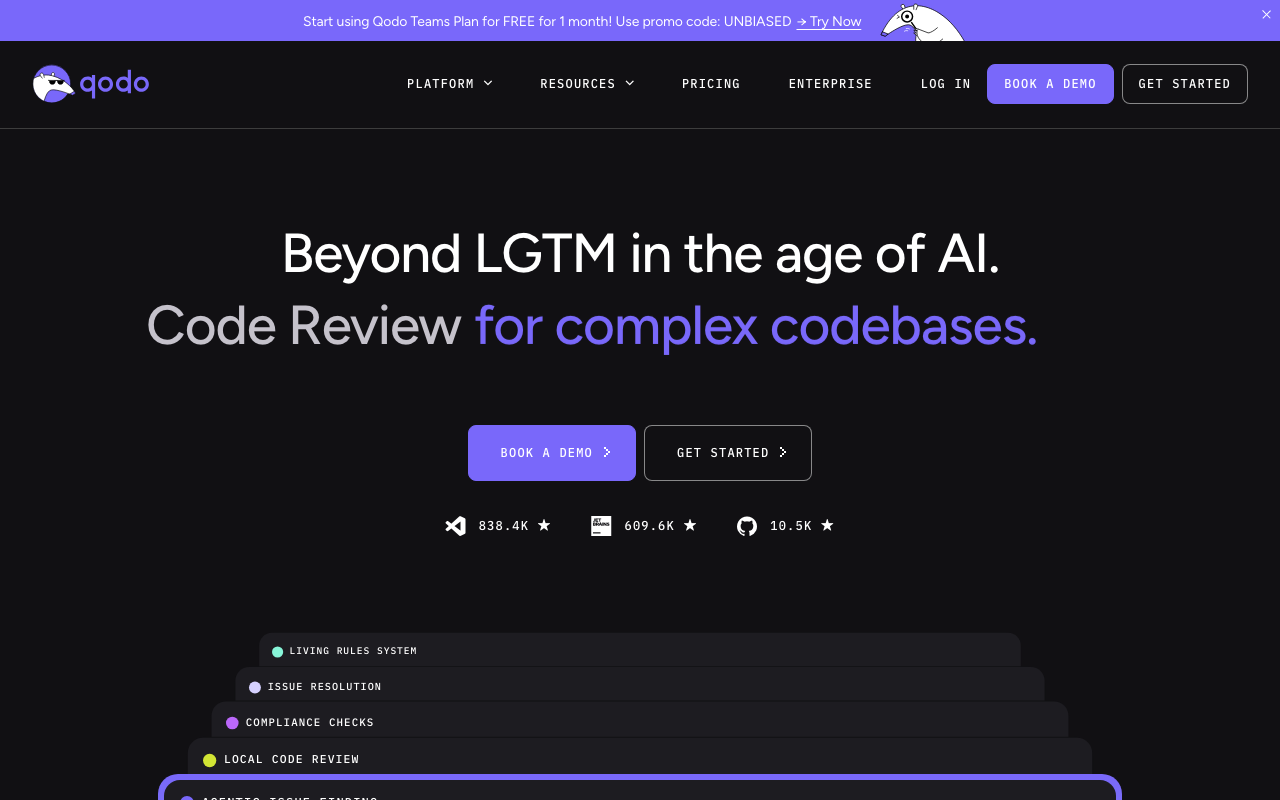
The history matters for context. CodiumAI launched in 2022 as an AI test generation tool, then expanded into PR review with PR-Agent in 2023. The company rebranded from CodiumAI to Qodo in 2024 as it grew into a full code quality platform. PR-Agent became Qodo Merge on the commercial side, though the open-source project retains the PR-Agent name and remains independently usable.
Today, Qodo Merge exists in two forms:
PR-Agent (Open Source) - The free, self-hostable version available on GitHub under the Apache 2.0 license. It supports GitHub, GitLab, Bitbucket, Azure DevOps, CodeCommit, and Gitea. Teams run it via Docker with their own LLM API keys (OpenAI, Anthropic, or any OpenAI-compatible API). The core review commands - describe, review, improve, and test suggestions - are all included in the open-source version.
Qodo Merge Pro (Commercial) - The managed, hosted version that adds enterprise features on top of PR-Agent. This includes the context engine for multi-repo intelligence, SOC 2 compliance, SSO, priority support, analytics dashboards, and managed infrastructure so teams do not need to operate their own servers. Qodo Merge Pro is part of the broader Qodo subscription, which also includes Qodo Gen for IDE-based assistance and test generation.
This dual model - open-source core with a commercial layer - is unique in the AI code review market. No other major competitor offers a fully functional, self-hostable review engine alongside a managed product.
Key Features
Automatic PR Descriptions
When a pull request is opened, Qodo Merge generates a structured description that includes a summary of changes, the type of PR (bug fix, feature, refactoring, tests), and a file-by-file walkthrough explaining what changed and why. This saves developers the time of writing detailed PR descriptions manually and ensures that reviewers have consistent, comprehensive context before they start reading code.
The generated descriptions use a standardized format with sections for the PR type, a high-level summary, and a changes walkthrough table. For teams that struggle with inconsistent or missing PR descriptions, this feature alone can improve review efficiency significantly.
Structured Code Review
The review command analyzes the diff and posts categorized feedback covering bugs, security issues, code quality concerns, and potential performance problems. Each comment includes the specific file and line, a description of the issue, the estimated severity, and a suggested fix where applicable.
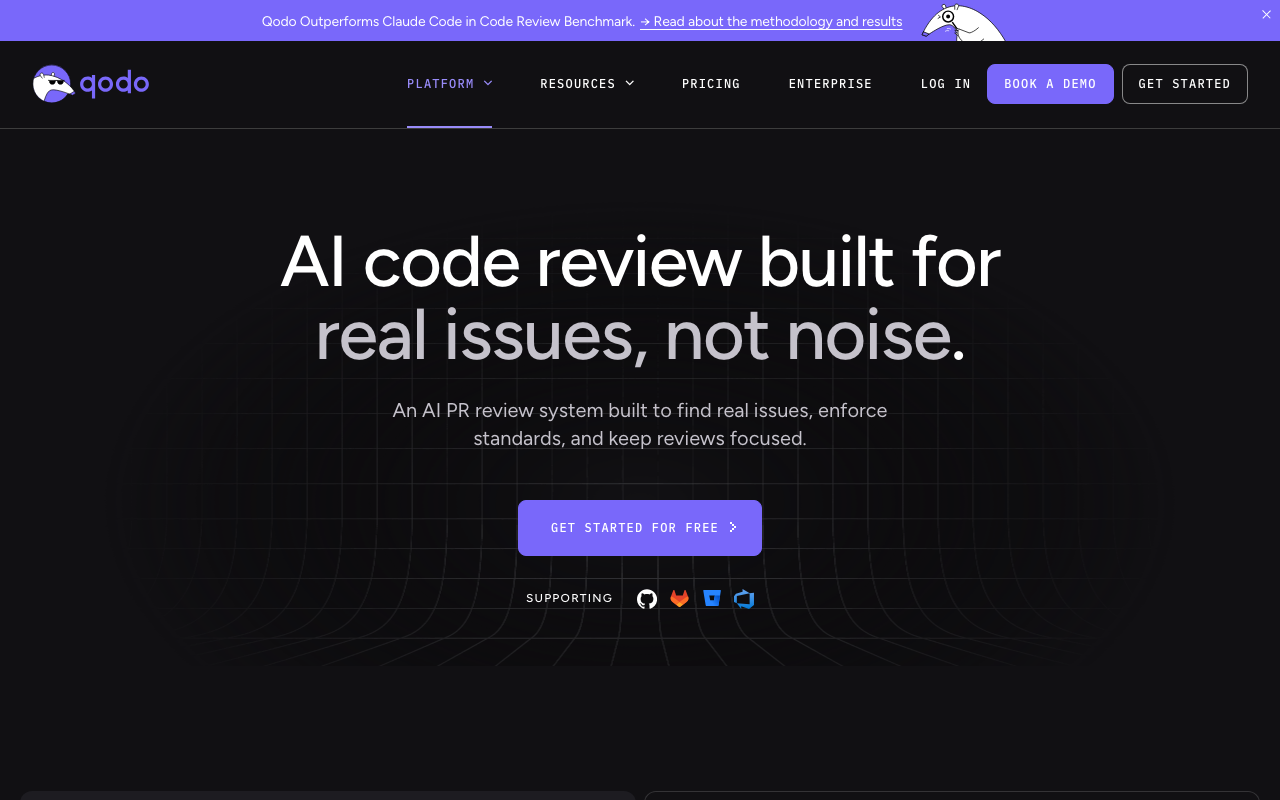
With Qodo 2.0’s multi-agent architecture released in February 2026, the review process uses specialized agents working in parallel. One agent focuses on bug detection, another on security analysis, a third on code quality best practices, and a fourth on test coverage gaps. This specialization means each type of issue is evaluated by an agent with tuned prompts and criteria rather than a single general-purpose model trying to catch everything at once.
Code Improvement Suggestions
The improve command goes beyond flagging problems - it suggests concrete code changes. These suggestions appear as inline comments with the proposed replacement code, making it easy for developers to evaluate and apply improvements directly. Common suggestions include more efficient algorithms, better error handling patterns, cleaner variable naming, and idiomatic language usage.
Unlike some competitors that only point out what is wrong, Qodo Merge’s improvement suggestions provide the actual replacement code alongside an explanation of why the change is beneficial. This reduces the cognitive load on developers who would otherwise need to figure out the fix themselves.
Test Suggestions
During PR review, Qodo Merge identifies code paths that lack test coverage and recommends specific test scenarios. These are not full test implementations - that is handled by Qodo Gen - but rather structured suggestions describing what should be tested, what edge cases to consider, and what assertions to include.
For example, if a PR adds a new API endpoint, Qodo Merge might suggest testing for invalid input handling, authentication failures, rate limiting behavior, and response format validation. This bridges the gap between code review and test planning, making it harder for untested scenarios to slip through the review process.
CI Feedback Integration
Qodo Merge can analyze CI/CD pipeline results and correlate test failures with the specific code changes in the pull request. When a CI build fails, Qodo Merge identifies which changes likely caused the failure and suggests fixes. This is particularly useful for large PRs where a test failure could be caused by any of dozens of changed files - Qodo Merge narrows the investigation to the most probable cause.
Multi-Platform Support
Qodo Merge supports GitHub, GitLab, Bitbucket, and Azure DevOps natively. Through the open-source PR-Agent, coverage extends to CodeCommit and Gitea. This is one of the broadest platform ranges in the AI code review market. Most competitors either focus exclusively on GitHub or offer limited support for other platforms. For organizations that use Bitbucket, Azure DevOps, or self-hosted GitLab, Qodo Merge is one of the few AI review tools that provides full-featured support without platform-specific limitations.
Open Source PR-Agent vs Qodo Merge Pro
Understanding the difference between the free and paid versions is critical for making the right buying decision. Here is a detailed comparison.
| Feature | PR-Agent (Free OSS) | Qodo Merge Pro |
|---|---|---|
| PR descriptions | Yes | Yes |
| Code review | Yes | Yes |
| Code suggestions | Yes | Yes |
| Test suggestions | Yes | Enhanced |
| GitHub support | Yes | Yes |
| GitLab support | Yes | Yes |
| Bitbucket support | Yes | Yes |
| Azure DevOps support | Yes | Yes |
| Self-hosting | Docker with own API keys | Managed infrastructure |
| Multi-agent review (2.0) | No - single pass | Yes |
| Context engine | No | Yes |
| SOC 2 compliance | No | Yes |
| SSO/SAML | No | Yes |
| Priority support | Community GitHub only | 2-business-day SLA |
| Analytics dashboard | No | Yes |
| Model flexibility | Any OpenAI-compatible API | Managed model selection |
| Cost | LLM API costs only | $19/user/month (Teams) |
The open-source PR-Agent is genuinely useful on its own. Teams that are comfortable running Docker containers and managing their own LLM API keys can get the core review experience - descriptions, review comments, and code suggestions - at no cost beyond API usage (typically a few cents per review with GPT-4o). This makes PR-Agent one of the most cost-effective AI review options for budget-conscious teams.
The managed Qodo Merge Pro is worth the upgrade for teams that need enterprise compliance, do not want to manage infrastructure, or want the multi-agent review architecture introduced in Qodo 2.0. The context engine, which builds awareness across multiple repositories, is particularly valuable for microservice architectures where changes in one repo can affect services in another.
Pros and Cons
What Qodo Merge Does Well
The open-source foundation is a genuine differentiator. PR-Agent is the only fully open-source AI code review engine from a major commercial vendor. Teams can inspect exactly how their code is analyzed, contribute improvements, and run the tool in air-gapped environments without sending code to external services. This is a hard requirement for organizations in regulated industries like finance, healthcare, and government - and Qodo is the only option that meets it through an open-source core.
Structured, categorized review output is easy to parse. Qodo Merge’s reviews are organized by category - bugs, security, quality, testing - with clear severity labels. This structure makes it faster for developers to triage findings compared to tools that present a flat list of comments. The standardized PR description format also brings consistency to teams with varied documentation habits.
Broadest platform support in the market. Supporting GitHub, GitLab, Bitbucket, Azure DevOps, CodeCommit, and Gitea (via PR-Agent) means Qodo Merge works with virtually any Git hosting provider. This eliminates the platform compatibility question that disqualifies many competitors for non-GitHub teams.
Highest benchmark accuracy with Qodo 2.0. The multi-agent architecture achieved the highest overall F1 score (60.1%) among eight AI code review tools in comparative testing, with a recall rate of 56.7%. For teams that prioritize catching real issues over speed or price, this measurable accuracy advantage matters.
Integration with the broader Qodo ecosystem. When combined with Qodo Gen for test generation and the IDE plugins for in-editor assistance, Qodo Merge becomes part of a complete quality workflow. No other tool covers PR review, test generation, and IDE assistance in a single platform.
Where Qodo Merge Falls Short
Higher false positive rate than competitors. At approximately 25%, Qodo Merge’s false positive rate is notably higher than CodeRabbit’s 15%. This means roughly one in four review comments flags something that is not actually a problem. High false positive rates erode developer trust over time and can lead to teams ignoring AI review comments entirely.
Slower review latency. Reviews take 2-4 minutes compared to CodeRabbit’s 90 seconds and GitHub Copilot’s 30 seconds. While this is fast enough for most workflows, teams that open many small PRs throughout the day will feel the difference. The multi-agent architecture adds thoroughness but at the cost of speed.
The credit system adds unnecessary complexity. Standard operations consume 1 credit, but premium models like Claude Opus use 5 credits and Grok 4 uses 4 credits per request. Credits reset every 30 days from your first message, not on a calendar schedule. This variable consumption makes monthly costs harder to predict, especially for teams experimenting with different model options.
Free tier was recently reduced. The free plan dropped from 75 to 30 PR reviews per month. For small teams processing 8-10 PRs per week, 30 monthly reviews runs out by mid-sprint. This pushes more teams toward the paid plan than was previously necessary.
TOML-based configuration is less intuitive. Qodo Merge uses TOML configuration files, which require developers to learn the specific syntax and available options. CodeRabbit’s natural language configuration - where you write plain English instructions - is significantly more accessible and lowers the barrier to customization.
No built-in linters. Unlike CodeRabbit’s 40+ deterministic linters that catch style violations and known anti-patterns with zero false positives, Qodo Merge relies entirely on LLM-based analysis. This means it misses the deterministic layer of review that catches straightforward issues without any AI uncertainty.
Pricing
Qodo Merge is sold as part of the broader Qodo platform. There is no standalone Qodo Merge subscription - the pricing tiers include access to all Qodo products (Merge, Gen, IDE plugins, and CLI).
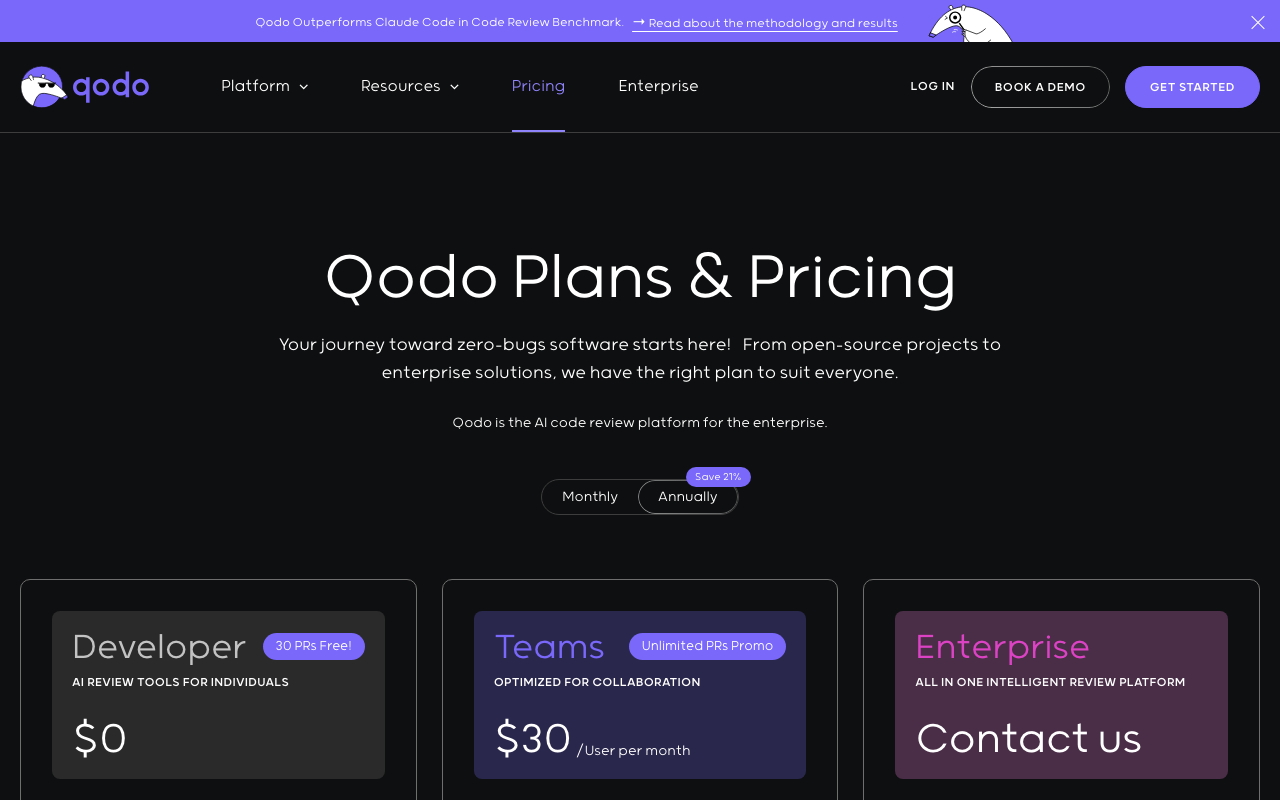
Developer (Free) - 30 PR reviews per month, 250 credits for IDE and CLI interactions. Includes the full review experience with describe, review, and improve commands. Community support via GitHub. Suitable for individual developers and evaluation purposes.
Teams ($19/user/month) - Unlimited PR reviews (current limited-time promotion), 2,500 credits per user per month. Standard private support, no data retention, and access to the multi-agent review architecture. This is the plan most teams will need for production use.
Enterprise (Custom pricing) - Everything in Teams plus the context engine for multi-repo intelligence, enterprise dashboard, user-admin portal with SSO, on-premises or air-gapped deployment, and priority support with a 2-business-day SLA.
Self-Hosted PR-Agent (Free) - For teams that want to avoid subscription costs entirely, the open-source PR-Agent can be deployed via Docker with your own LLM API keys. The only ongoing cost is LLM API usage, which typically runs $0.02 to $0.10 per review depending on diff size and model choice. This option requires teams to manage their own infrastructure and does not include the multi-agent architecture or enterprise features.
How Does Qodo Merge Pricing Compare?
| Tool | Price | What You Get |
|---|---|---|
| PR-Agent (OSS) | Free + API costs | Core PR review, self-hosted |
| Qodo Merge Pro | $19/user/month | Multi-agent review, managed hosting, SOC 2 |
| CodeRabbit Pro | $24/user/month | 40+ linters, natural language config, auto-fix |
| CodeAnt AI Basic | $24/user/month | PR review, SAST, secret detection |
| CodeAnt AI Premium | $40/user/month | Adds IaC security, DORA metrics, compliance |
| GitHub Copilot Business | $19/user/month | Code completion + basic review, GitHub only |
| Greptile Cloud | $30/seat/month | Full codebase indexing, 50 reviews included |
Qodo Merge Pro at $19/user/month is price-competitive with GitHub Copilot Business and cheaper than CodeRabbit Pro and CodeAnt AI. However, the comparison is not purely about price - CodeRabbit includes 40+ deterministic linters and auto-fix suggestions, and CodeAnt AI bundles SAST scanning and secret detection that Qodo does not offer. The self-hosted PR-Agent option makes Qodo the cheapest viable AI review tool for teams willing to manage their own infrastructure.
For a deeper look at Qodo’s pricing tiers and how they compare across team sizes, see our Qodo pricing breakdown.
Real-World Usage
Setting Up PR-Agent
The most common entry point for Qodo Merge is deploying the open-source PR-Agent as a GitHub Action. The setup involves adding a workflow YAML file to your repository, configuring your LLM API key as a repository secret, and specifying which PR-Agent commands to trigger on pull request events. The entire process takes 10-15 minutes for someone comfortable with GitHub Actions.
Once deployed, PR-Agent runs automatically on every new or updated pull request. It posts the PR description, review comments, and improvement suggestions as separate comments on the PR. Developers can interact with it by commenting commands like /review, /improve, or /describe to trigger specific analyses on demand.
For teams using GitLab, Bitbucket, or Azure DevOps, PR-Agent provides alternative deployment methods including a standalone Docker container that listens for webhooks. The setup is more involved than the GitHub Action approach but well-documented in the PR-Agent repository.
Review Quality in Practice
In day-to-day use, Qodo Merge’s review output is thorough and well-structured. The categorized feedback makes it easy to scan for high-severity issues first, then work through quality and style suggestions. The PR description generation is consistently helpful - it produces descriptions that are more detailed than what most developers write manually, which improves reviewer understanding.
The code improvement suggestions are actionable more often than not. Common patterns include replacing verbose conditional logic with guard clauses, adding null checks before accessing nested properties, using more specific types instead of broad generics, and extracting repeated logic into helper functions. The suggestions include the actual replacement code, which reduces friction compared to tools that only describe the problem.
Where Qodo Merge’s review quality is less impressive is in catching subtle cross-file dependencies and architectural issues. A change that breaks an implicit contract between two services, or a modification that invalidates cached data in another part of the system, is less likely to be caught. This is where tools like Greptile, which indexes the entire codebase for context-aware review, have an edge.
The Test Suggestion Workflow
Qodo Merge’s test suggestions are one of its more underappreciated features. During review, it identifies functions and code paths that lack test coverage and posts structured recommendations for what to test. These suggestions describe the scenario, the expected behavior, and the edge cases to consider.
The workflow becomes particularly powerful when combined with Qodo Gen. After Qodo Merge identifies a testing gap in a PR, a developer can switch to their IDE, select the function, and use the /test command to generate complete test implementations. This review-to-test pipeline is seamless in a way that no other tool replicates.
Who Should Use Qodo Merge
Teams that want open-source AI review. If your organization requires the ability to inspect, modify, and self-host your code review tooling, Qodo Merge is the only commercially-backed option with a fully open-source core. This is particularly relevant for security-conscious organizations, regulated industries, and teams with strict data sovereignty requirements.
Organizations using non-GitHub platforms. If your team runs GitLab, Bitbucket, Azure DevOps, CodeCommit, or Gitea, Qodo Merge provides full-featured support where most competitors either do not work or offer limited functionality. This is a practical differentiator that eliminates entire categories of alternatives.
Budget-conscious teams willing to self-host. The open-source PR-Agent with your own API keys is the cheapest way to get AI-powered PR review. If you have the DevOps capacity to manage a Docker container and are comfortable with LLM API billing, you can get quality review for pennies per PR.
Teams that want review plus test generation. If you plan to use both Qodo Merge for PR review and Qodo Gen for test generation, the combined platform offers a workflow that no competitor matches. The review-to-test pipeline - where Merge identifies gaps and Gen fills them - is genuinely unique.
Mid-size engineering teams (10-50 developers) that want structured, consistent review output across all pull requests. The standardized PR descriptions and categorized review comments bring consistency to teams where review quality varies between individual reviewers.
Who Should Look Elsewhere
Teams that prioritize speed and low noise. If false positives frustrate your developers and review speed matters more than thoroughness, CodeRabbit delivers faster feedback (90 seconds) with a lower false positive rate (15% versus 25%). The natural language configuration also makes it easier to tune review behavior without learning TOML syntax.
Teams that need security scanning bundled with review. If you want SAST, secret detection, and IaC security alongside PR review, CodeAnt AI bundles all of these at $24-$40/user/month. Qodo Merge does not include dedicated security scanning beyond what the AI identifies during review.
Solo developers seeking a generous free tier. Qodo Merge’s free plan caps at 30 PR reviews per month, which is insufficient for active individual developers. CodeRabbit’s free tier covers unlimited public and private repos with rate limits rather than hard caps, offering more flexibility for solo use.
Alternatives to Qodo Merge
CodeRabbit
CodeRabbit is the most widely adopted AI code review tool with over 2 million connected repositories. It focuses on PR review with 40+ built-in linters, natural language configuration, one-click auto-fix suggestions, and a generous free tier. Review latency averages 90 seconds, and the false positive rate is approximately 15%. Pro pricing is $24/user/month. CodeRabbit lacks test generation and an open-source core, but delivers a more polished, lower-friction review experience. See our full Qodo vs CodeRabbit comparison.
GitHub Copilot
GitHub Copilot bundles code review with its broader AI coding assistant at $19/user/month for Business. Reviews complete in about 30 seconds and are deeply integrated into the GitHub experience, but review depth is shallower than Qodo Merge’s multi-agent approach. Copilot is limited to GitHub only - no GitLab, Bitbucket, or Azure DevOps support. Best for teams already invested in the GitHub ecosystem that want basic review alongside code completion. See our Qodo vs GitHub Copilot breakdown.
CodeAnt AI
CodeAnt AI is a Y Combinator-backed platform that bundles AI PR review with SAST, secret detection, IaC security, and DORA engineering metrics. The Basic plan at $24/user/month includes line-by-line PR feedback, auto-fix suggestions, and 30+ language support. The Premium plan at $40/user/month adds infrastructure-as-code security, compliance reports, and engineering dashboards. CodeAnt AI does not offer test generation or an open-source core, but its security coverage and engineering analytics fill gaps that Qodo Merge does not address. Best for teams that want code review combined with security scanning in a single tool.
Other Options
For a comprehensive overview of all the tools in this space, see our best AI PR review tools roundup. We also cover Qodo’s full pricing in a dedicated breakdown.
Final Verdict
Qodo Merge occupies a distinctive position in the AI pull request review market. It is the only tool backed by a fully open-source core, it supports more Git platforms than any competitor, and its multi-agent review architecture delivers the highest benchmark accuracy available. The self-hosted PR-Agent option makes it the most cost-effective path to AI-powered review for teams willing to manage their own infrastructure.
The tradeoffs are real. A 25% false positive rate means one in four comments flags a non-issue. Review latency at 2-4 minutes lags behind CodeRabbit and GitHub Copilot. The credit system is harder to predict than flat per-user pricing. And the free tier’s 30-review monthly cap pushes small teams toward the paid plan faster than they might expect.
Choose Qodo Merge if: you want open-source transparency in your review tooling, your team uses Bitbucket or Azure DevOps, you need air-gapped or self-hosted deployment, you want the review-to-test-generation pipeline with Qodo Gen, or you prioritize benchmark detection accuracy above speed and polish.
Look elsewhere if: you want the fastest, lowest-noise review experience (try CodeRabbit), you need security scanning bundled with review (try CodeAnt AI), or you want zero-setup GitHub-native review (try GitHub Copilot).
Qodo Merge is not the simplest AI review tool, and it is not the fastest. But it is the most transparent, the most platform-flexible, and - when paired with the broader Qodo platform - the most complete option for teams that want AI-powered code quality from PR review through test generation. For teams that value openness and flexibility over polish and speed, Qodo Merge is a strong choice in 2026.
Frequently Asked Questions
Is Qodo Merge worth it in 2026?
For teams that want structured AI pull request review with automatic PR descriptions, code suggestions, and test recommendations, Qodo Merge delivers solid value. The open-source PR-Agent version is completely free to self-host with your own LLM API keys, which makes it one of the most cost-effective options for budget-conscious teams. The paid Pro version at $19/user/month adds features like SOC 2 compliance, a context engine, and managed hosting. If your primary need is PR review without test generation, alternatives like CodeRabbit at $24/user/month or CodeAnt AI starting at $24/user/month offer comparable depth with additional capabilities like built-in linters or SAST scanning.
What is the difference between Qodo Merge and PR-Agent?
PR-Agent is the open-source foundation that powers Qodo Merge. It is available on GitHub under the Apache 2.0 license and can be self-hosted using Docker with your own LLM API keys. Qodo Merge is the commercial, managed version of PR-Agent that adds enterprise features like the context engine for multi-repo intelligence, SOC 2 compliance, priority support, SSO, and a managed hosting infrastructure so you do not need to run your own servers. The core review logic - PR descriptions, code suggestions, and review comments - is the same in both versions.
Is PR-Agent really free and open source?
Yes. PR-Agent is fully open source under the Apache 2.0 license and available on GitHub. You can clone it, run it with Docker, and connect it to your own OpenAI, Anthropic, or other LLM API keys. The only cost is the LLM API usage, which typically runs a few cents per review depending on the size of the diff. PR-Agent supports GitHub, GitLab, Bitbucket, Azure DevOps, CodeCommit, and Gitea. Self-hosting PR-Agent gives you the core review functionality without paying for the Qodo Merge subscription.
How does Qodo Merge compare to CodeRabbit?
CodeRabbit is a dedicated AI code review tool at $24/user/month with 40+ built-in linters, natural language configuration, and a generous free tier covering unlimited public and private repos. Qodo Merge focuses on structured PR review with automatic descriptions, review comments, code suggestions, and test recommendations. CodeRabbit has faster review latency (around 90 seconds versus 2-4 minutes for Qodo Merge), a lower false positive rate (approximately 15% versus 25%), and more mature learning from feedback. Qodo Merge's advantage is its open-source foundation, broader platform support including Azure DevOps, and integration with Qodo's test generation capabilities.
Does Qodo Merge generate tests automatically?
Qodo Merge itself does not generate full unit tests. What it does is provide test suggestions as part of its PR review - identifying untested code paths and recommending what tests should be written. Full automated test generation is handled by Qodo Gen (formerly Qodo Cover) through the IDE plugin and CLI, which produces complete test files with assertions and edge case coverage. The two products complement each other: Merge identifies testing gaps during review, and Gen creates the actual test code.
What platforms does Qodo Merge support?
Qodo Merge supports GitHub, GitLab, Bitbucket, and Azure DevOps for PR review. Through the open-source PR-Agent, coverage extends to CodeCommit and Gitea as well. This is one of the broadest platform support ranges in the AI code review market, and it makes Qodo Merge particularly attractive for organizations running non-GitHub platforms where many competing tools have limited or no support.
Can I self-host Qodo Merge?
You can self-host PR-Agent, the open-source version of Qodo Merge, for free using Docker with your own LLM API keys. This gives you the core PR review functionality including automatic descriptions, review comments, and code suggestions. For full enterprise self-hosting with the context engine, analytics dashboard, SSO, and managed infrastructure, the Qodo Enterprise plan offers on-premises and air-gapped deployment options at custom pricing.
How fast is Qodo Merge at reviewing pull requests?
Qodo Merge typically delivers reviews within 2 to 4 minutes of a pull request being opened or updated. This is slower than some competitors - CodeRabbit averages around 90 seconds and GitHub Copilot completes reviews in about 30 seconds. The longer review time is partly due to Qodo's multi-agent architecture, where specialized agents analyze bugs, security, code quality, and test coverage simultaneously. For most teams, the 2-4 minute window is fast enough to provide feedback before developers context-switch to another task.
What are the main drawbacks of Qodo Merge?
The main drawbacks are a higher false positive rate (approximately 25%) compared to competitors like CodeRabbit (15%), slower review latency at 2-4 minutes versus under 2 minutes for alternatives, a credit-based pricing system that adds complexity, and a free tier that was recently reduced from 75 to 30 PR reviews per month. The TOML-based configuration is also less intuitive than the natural language configuration offered by tools like CodeRabbit.
How does Qodo Merge's multi-agent architecture work?
Introduced with Qodo 2.0 in February 2026, the multi-agent architecture replaces the single-pass AI review with specialized agents working in parallel. One agent focuses on bug detection, another on code quality best practices, a third on security analysis, and a fourth on test coverage gaps. Each agent has tuned prompts and evaluation criteria for its domain. The results are aggregated into a structured review with categorized findings. This approach achieved the highest overall F1 score (60.1%) among eight AI code review tools in comparative benchmarks.
Does Qodo Merge work with GitHub Actions?
Yes. Qodo Merge can be set up as a GitHub Action that triggers on pull request events. The open-source PR-Agent provides official GitHub Action configuration examples that run the review as part of your CI pipeline. You configure your LLM API key as a repository secret, specify which PR-Agent commands to run (describe, review, improve), and the action executes automatically on every new or updated pull request. This is the most common deployment method for teams self-hosting PR-Agent.
Is Qodo Merge better than GitHub Copilot for code review?
Qodo Merge provides deeper, more structured PR review than GitHub Copilot. Qodo's multi-agent architecture achieved a 60.1% F1 score in benchmarks versus Copilot's lower detection rate. Qodo also supports GitLab, Bitbucket, and Azure DevOps, while Copilot is limited to GitHub. However, Copilot reviews complete in about 30 seconds compared to Qodo's 2-4 minutes, and Copilot's $19/user/month price includes code completion and chat alongside review. If review depth and multi-platform support matter most, Qodo Merge wins. If speed and bundled AI features matter more, Copilot is the better choice.
Explore More
Tool Reviews
 Qodo Review
 CodeAnt AI Review
Free Newsletter
Stay ahead with AI dev tools
Weekly insights on AI code review, static analysis, and developer productivity. No spam, unsubscribe anytime.
Join developers getting weekly AI tool insights.
Related Articles
Checkmarx Pricing in 2026: Plans, Per-Developer Costs, and Enterprise Quotes
Checkmarx pricing decoded - per-developer costs ($40-70+/dev/year), SAST/DAST/SCA bundle pricing, total cost of ownership, and enterprise negotiation tips.
March 13, 2026
reviewCodacy Pricing in 2026: Free, Team, and Business Plans Compared
Codacy pricing in 2026 - free Developer plan, Team at $18/dev/month, Business custom pricing, ROI calculation, and competitor comparisons.
March 13, 2026
reviewCodacy Review 2026: Is It Worth It for Your Team?
In-depth Codacy review covering features, pricing, pros and cons, and real-world performance. Find out if Codacy is worth it for your team.
March 13, 2026