Best AI Code Review Tools for Pull Requests in 2026
11 best AI PR review tools compared. Features, pricing, and real-world performance for CodeRabbit, Qodo, GitHub Copilot, and more.
Published:
Last Updated:
Direct answer
CodeRabbit Essentials at $24 per developer per month is the best general-purpose AI PR reviewer of the 11 here, and Sourcery Pro at $12 is the cheapest. Greptile at $30 wins on cross-file bugs. Copilot code review is included from Copilot Pro at $10, not Business. CodeRabbit’s free tier no longer covers private repositories, so the free options for private code are PR-Agent self-hosted (MIT) and Greptile Starter for 1 developer. Verified 2026-10-19.
Why AI PR review tools matter in 2026
Pull request review remains one of the slowest steps in modern software development. The figures everyone repeats - 6 to 12 hours a week spent reviewing, 24 to 48 hours of idle time before a first review - are attributed around the web to Google and Microsoft research, and we could not trace either to a primary publication (checked 2026-10-19). So we measured the second one.
Across 2,189 human-authored merged PRs in 12 repositories, pulled from the GitHub GraphQL API on 2026-10-18 with bots and self-reviews excluded, time from open to first review was p50 8.7 hours, p75 66 hours, p90 212 hours and p99 1,300 hours. The median beats the folklore figure; the tail is far worse than it. The number that actually matters: the median PR spends 52.7 percent of its open-to-merge life waiting for the first human, while first-review-to-merge is only 6.7 hours at p50 and first-approval-to-merge is 1.1 hours. Full method and limits are in pull request review time. The only caveat worth repeating here is that only merged PRs are in frame, which biases latency downward.
That waiting half is the entire opportunity an AI PR reviewer addresses. It does not make human reviewing faster. It removes the wait for the first response.
AI PR review tools attack this bottleneck directly. They analyze code changes the moment a pull request is opened and leave structured feedback within minutes - catching bugs, flagging security issues, and suggesting improvements before a human reviewer even opens the diff. The best tools go far beyond what traditional linters can do. They understand code context across files, recognize logic errors, and generate explanations in plain language that make it easy to understand why a change is problematic.
But not all AI PR review tools are equal. Some produce so many false positives that developers disable them within a week. Others generate vague, generic comments that add no value. The difference between the best and worst tools is enormous, and picking the wrong one can actually slow your team down rather than speeding it up.
This guide covers the 11 best AI PR review tools available in 2026, ranked by actual review quality, developer experience, and value for money. If you are looking for a broader comparison that includes static analysis and security-focused tools, see our best AI code review tools guide.
Disclosure: Gitar is our AI code review category partner and is labelled as such below. Partners get a guaranteed entry in relevant lists, never a rating, a rank, or the removal of a criticism. See our sponsorship policy.
Quick comparison: all 11 tools at a glance
Direct answer: Cheapest paid is Sourcery Pro at $12 per seat annually. CodeRabbit Essentials is $24, Greptile Pro $30, Gitar Core $20, Codacy Team $18. Only three tools here have a usable free tier for private code: Greptile Starter (1 active developer), Codacy Developer (IDE-focused) and self-hosted PR-Agent under MIT. CodeRabbit is free on public repositories only. Verified 2026-10-19.
Every price below is the vendor’s own published figure read on 2026-10-19, on the cheapest annual plan unless noted.
| Tool | Free tier (verified 2026-10-19) | Price per user/mo | Best for | Languages | Platforms |
|---|---|---|---|---|---|
| CodeRabbit | Public repos only. Private gets 1 summary-only review/hour | $24 Essentials, $48 Team, $72 Advanced | Overall AI PR review | 30+ | GitHub, GitLab, Azure DevOps, Bitbucket |
| Gitar (partner) | 14-day trial, free for OSI-licensed public repos | $20 Core, $40 Pro, both capped at 50 users | Fixing and validating AI-generated PRs | 10+ | GitHub, GitLab SaaS and self-managed, Bitbucket, Azure DevOps. No GHES |
| Qodo Merge | No permanent free tier, 14-day trial | ~$30/mo flat up to 30 users, plus credits at $0.012 | PR review + test suggestions | 10+ | GitHub, GitLab, Bitbucket |
| GitHub Copilot | Copilot Free exists but excludes code review | $10 Pro, $19 Business, $39 Enterprise, monthly only | Teams already on GitHub Copilot | Most languages | GitHub.com only. No GHES |
| Sourcery | Free for open source | $12 Pro, $24 Team | Python-focused teams | 4 | GitHub, GitLab |
| Panto | Free for open source | $15 | All-in-one review + SAST | 30+ | GitHub, GitLab, Bitbucket, Azure DevOps |
| Greptile | Yes - Starter, 1 active dev, 50 credits/mo | $30 Pro, 50 credits included, $1 per extra | Context-aware codebase reviews | 12+ | GitHub, GitLab, Bitbucket incl. Data Center, Gitea, Perforce |
| Bito AI | 14-day Professional trial, no card | $12 Team annual ($15 monthly), $20 Professional ($25) | AI review assistant | 20+ | GitHub, GitLab, Bitbucket |
| What The Diff | Yes, limited | $29/repo | Non-technical PR summaries | Most languages | GitHub, GitLab |
| Codacy | Developer tier free forever (IDE-focused). Free for open source | $18 Team yearly ($21 monthly), up to 30 devs | Multi-language code quality | 40+ | GitHub, GitLab, Bitbucket. GHES cannot get the AI Reviewer |
| DeepSource | Public repos analysed free, up to $50 AI credit | ~$24, plus AI review metered separately | Low-noise static analysis | 16 | GitHub, GitLab, Bitbucket |
Three tools that belong in your evaluation but not in this ranking, and why. Anthropic Code Review reached GA on 15 October 2026 but requires a Claude Team or Enterprise org, is GitHub-only, and never approves or blocks a PR - it is a different product shape, and it is unavailable to orgs using zero data retention, the HIPAA configuration or CMEK (verified 2026-10-19). Cursor Bugbot stopped being a standalone product: the $40/seat plan was removed effective at each customer’s first renewal after 8 June 2026, and it now bills purely by usage from the Premium plan ($30/mo) upward at roughly $1.00 to $1.50 per review. Gemini Code Assist is excluded because its free tier status is genuinely unclear - one source says it stopped serving requests on 18 June 2026 and another still advertises it, and Google’s docs describe at least 100 PR reviews a day on a GitHub app install, which would be the most generous free offer in the market if it still exists. We would rather leave it out than guess.
Which AI PR review tools work with GitLab, Bitbucket and Azure DevOps?
Direct answer: CodeRabbit and Panto are the only two here covering all four major platforms. GitHub Copilot code review is GitHub.com only and does not support GitHub Enterprise Server, while Anthropic Code Review does. Gitar does not support GHES either, per its own platform matrix. Greptile is the only tool in this market documenting Perforce. Codacy’s AI Reviewer is structurally unavailable to GHES customers. Verified 2026-10-19.
| Tool | GitHub.com | GitHub Enterprise Server | GitLab | Bitbucket | Azure DevOps |
|---|---|---|---|---|---|
| CodeRabbit | Yes | Yes | Yes | Yes | Yes |
| Panto | Yes | Not documented | Yes | Yes | Yes |
| Gitar (partner) | Yes | No - listed as unsupported in Gitar’s own platform matrix | Yes, SaaS and self-managed including Free | Yes, Cloud and Data Center | Yes, Services and Server |
| GitHub Copilot | Yes | No | No | No | No |
| Anthropic Code Review | Yes, incl. GHEC with data residency | Yes | No | No | No |
| Greptile | Yes | Not documented | Yes | Yes, incl. Data Center. Also Gitea and Perforce (P4) with P4 Code Review | No |
| Qodo Merge | Yes | Not documented | Yes | Yes | No |
| PR-Agent | Yes | Self-hosted | Yes | Yes | Yes |
| Codacy | Yes | Self-hosted only, and the AI Reviewer is cloud-and-GitHub-only, so GHES customers structurally cannot get it | Yes | Yes | No |
| Sourcery | Yes | Not documented | Yes | No | No |
| DeepSource | Yes | Not documented | Yes | Yes | No |
A correction we are flagging loudly because it runs against our own commercial interest. An earlier version of this page described Gitar as supporting GitHub Enterprise Server with a partial-support marker. Gitar’s own matrix at docs.gitar.ai/connecting-code/platform-support lists GHES as unsupported (verified 2026-10-18). We had rounded an ambiguous secondary source up in our paid sponsor’s favour, which is the worse direction to be wrong, and it is corrected here and on the Gitar tool page.
One CI gotcha that will bite anyone running a required AI-review check behind a merge queue, regardless of tool. GitHub’s merge-queue merge_group event is separate from pull_request and push. If your required review job triggers only on pull_request, the merge queue stalls permanently - GitHub’s own docs state that status checks “will not be triggered… The merge will fail as the required status check will not be reported.” Add merge_group to the trigger list.
Detailed tool reviews
1. CodeRabbit - Best overall AI PR review tool
CodeRabbit is the most widely installed AI code review app on GitHub, with over 2 million repositories connected and millions of pull requests reviewed. It uses large language models to analyze every pull request and leave structured, actionable feedback directly in the PR - not generic suggestions, but specific inline comments tied to the exact lines where issues exist.
What makes it stand out. CodeRabbit generates a full PR walkthrough - a structured summary of what changed, why it matters, and how each file was modified. Then it leaves inline comments on specific lines where it finds bugs, security issues, or improvements. The natural language instruction system lets you configure review behavior in plain English through a .coderabbit.yaml file, which means every developer on the team can understand and modify the review rules without learning a DSL or writing YAML rules.
In practice, CodeRabbit catches null safety issues, missing error handling, race conditions, and security vulnerabilities consistently across languages. Its suggested fixes are applicable without modification in most cases, which saves real time compared to tools that only describe the problem without offering a solution.
Key strengths:
- PR walkthrough generation with file-by-file breakdown
- Inline code suggestions that can be applied with one click
- Natural language configuration via
.coderabbit.yaml - 40+ built-in linters complement AI analysis with deterministic rules
- Supports GitHub, GitLab, Azure DevOps, and Bitbucket
Pricing (verified 2026-10-19): The free tier covers public repositories only - the pricing page reads “free reviews forever for public repositories”, and a free account gets 1 summary-only private PR review per hour plus 3 IDE and 3 CLI reviews per hour. Paid tiers were renamed in September 2026: Pro became Essentials at $24/dev/mo annual ($30 monthly), Pro Plus became Team at $48 ($60), and a new Advanced tier sits at $72. Prices did not change, only the names. Lite and Pro Legacy were retired on 8 June 2026. Overage is $0.25 per reviewed file. CodeRabbit raised a $143M Series C at a $1.5B valuation on 12 August 2026 and shipped Agentic Change Management, Triage, Change Stack and a Security Agent the same day.
Limitations. Does not track technical debt over time, enforce quality gates, or provide coverage metrics. Three constraints most comparisons omit, all verified 2026-10-19: Essentials covers exactly 1 linked repository (Team 5, Advanced 10, Enterprise 20), which for a six-service team is what decides your tier rather than the seat price. Max files per review is 150 on Free and Essentials, 300 on Team and above. And SSO, audit logs and API access are Enterprise-only - so if your security team requires SSO, CodeRabbit’s real entry price is a custom quote, not $24. Self-hosting requires 500+ seats. The 5 / 8 / 10 / 12 hourly review limits degrade to 1 per hour under fair-usage, which for Essentials triggers at 30 and 60 reviews per rolling 7 days. For compliance-heavy environments you still need a tool like SonarQube or Codacy alongside it.
On review quality numbers. The only near-neutral measurement of CodeRabbit is the Martian Code Review Bench, which put it at 51.2% F1 and 49.2% precision across roughly 300,000 PRs in March 2026 - near-neutral because Martian sells model routing, not a reviewer. Entelligence’s own benchmark scored CodeRabbit at 46.0% on Cal.com, but Entelligence sells a reviewer and wins its own benchmark. Both numbers are better evidence than any vendor’s self-assessment, and neither is a false-positive rate.
For head-to-head comparisons, see CodeRabbit vs Qodo, CodeRabbit vs GitHub Copilot, CodeRabbit vs Sourcery, and CodeRabbit vs Greptile.
2. Gitar - Best for PRs your AI agent wrote
Category partner - see our disclosure.
Gitar answers a question the rest of this list mostly ducks: what do you do when the PR queue is full of code an agent wrote and nobody has read? Instead of adding another reviewer voice, Gitar commits the fix itself, runs your CI to prove the fix works, and escalates only what fails. Sonar acquired the company in May 2026, five weeks after it left stealth.
What makes it stand out. The fix-and-validate loop. Most tools on this page end at “here is a suggestion.” Gitar ends at “here is a commit and a green CI run.” It also treats CI noise as part of review: repeated build failures get deduplicated, flaky tests get retried, and infrastructure failures get separated from genuine code problems, so the signal that reaches a human is smaller and truer.
Under the hood it runs static analysis first and uses those results to constrain what the LLM is allowed to claim. That is a structural answer to the “confidently wrong” suggestions that make teams switch these tools off, rather than a prompt-engineering one, and it is why the tool says less about style than the pure-LLM reviewers on this page.
Key strengths:
- Applies fixes as commits and validates them against CI, not just inline comments
- CI failure deduplication and flaky test retry
- Hybrid static analysis + LLM design reduces hallucinated findings
- Agent-agnostic: built to validate Claude Code, Cursor, Codex, Devin, and Copilot output
- Migration automation across repositories on Enterprise plans
Pricing (verified 2026-10-19): Core $20/user/month annual ($25 monthly), Pro $40 ($50), Enterprise custom. 14-day trial with no card, and OSI-licensed public repos get Pro free. Auto-applied fixes are Pro-only. The rate card now sits at sonarsource.com/plans-and-pricing/gitar/ post-acquisition. Gitar is one of only 3 vendors in this market that publishes an enterprise rate card at all - the other 12 of 15 we checked are quote-only.
Limitations. No permanent free tier for private repos, and both self-serve plans cap at 50 users, which rules Gitar out above that headcount without an Enterprise conversation. Language coverage (10+) is narrower than CodeRabbit’s. It does not support GitHub Enterprise Server - Gitar’s own platform matrix lists GHES as unsupported (verified 2026-10-18), and an earlier version of this page got that wrong in Gitar’s favour. The product is mid-integration into Sonar’s platform, so expect positioning to keep shifting.
And the limitation that matters most, stated the same way we would state it for any other vendor: Gitar has no published third-party benchmark. A 2026-09-07 update to Sonar’s trust centre added a Gitar SOC 2 Type 2 report and a signed ISO 27001:2022 certificate, so the compliance side is documented. Review quality is not. Sonar’s own material is candid that a green CI build is evidence, not proof that a fix is correct - which is the right framing, and worth holding Gitar to. Operationally the loop is: fix, commit, run CI, commit only on green, with automatic follow-up repair if its own fix breaks the build; low-confidence findings fall back to thread suggestions rather than commits.
3. Qodo Merge - Best for PR review with test generation
Qodo Merge (formerly CodiumAI PR-Agent) combines AI-powered pull request review with automatic test suggestion - a combination no other tool on this list offers. It analyzes your code changes and generates test cases that cover the new or modified logic, which helps teams maintain coverage without the manual effort of writing every test by hand.
What makes it stand out. Qodo Merge provides three core PR capabilities: automated review comments that flag issues, PR descriptions that summarize changes in a structured format, and AI-generated test suggestions for the changed code. The test generation feature is the real differentiator. When you open a PR that adds a new function or modifies existing logic, Qodo Merge suggests unit tests that cover the happy path, edge cases, and error scenarios. These suggestions are not always production-ready, but they give reviewers a starting point and frequently catch untested branches.
The PR-Agent relationship changed and most pages have not caught up. PR-Agent was relicensed to MIT on 23 April 2026 and transferred to independent community governance under The-PR-Agent org (verified 2026-10-19). Qodo remains a sponsor, not the owner. The repo is The-PR-Agent/pr-agent at 13.4k stars, v0.48.0 shipped 2026-10-16, and the LICENSE on main is MIT even though Qodo’s blog still says Apache 2.0. So yes, you can self-host for free - but you are self-hosting a community project, not a Qodo product.
Key strengths:
- AI-generated test suggestions alongside code review
- Structured PR description generation
- PR-Agent available for self-hosting under MIT, with independent governance
- Supports GitHub, GitLab, and Bitbucket
- Interactive chat within PR comments
- On-prem and VPC deployment available; SOC 2 and GDPR
Pricing (verified 2026-10-19): There is no permanent free tier, only a 14-day trial with unlimited reviews. Qodo prices as a flat team fee of roughly $30/mo for up to 30 users plus credits at $0.012 each, pooled across the team, with packs of 2,500 / 5,000 / 20,000 and no rollover. Self-hosted PR-Agent is free under MIT.
Limitations: Test suggestions sometimes produce overly simplistic or framework-specific boilerplate. Language support (10+ languages) is narrower than CodeRabbit’s 30+. The review comments tend to be less detailed than CodeRabbit’s on complex, multi-file changes. Qodo claimed the #1 spot on the Martian Code Review Bench at 64.3% F1 on 15 March 2026 - note that Baz also claimed #1 on 790 PRs, and Martian’s own 3 March run had CodeRabbit at 51.2%. Four self-declared winners on one leaderboard is a reason to discount all four claims. One configuration correction while we are here: Qodo Merge has no “confidence threshold” setting. The published key is [review_agent].inline_comments_severity_threshold, a severity rank of 1 to 3, alongside comments_location_policy and per-tier comments_routing.
For a detailed comparison, see CodeRabbit vs Qodo and Qodo vs GitHub Copilot.
4. GitHub Copilot Code Review - Best for GitHub-native teams
GitHub Copilot now includes a code review feature that analyzes pull requests directly within GitHub. For teams already paying for GitHub Copilot, this is the lowest-friction option available - there is no additional app to install, no webhook to configure, and no separate vendor to manage.
What makes it stand out. GitHub Copilot Code Review is built directly into the GitHub PR experience. You can request a review from “Copilot” the same way you request one from a human teammate. It leaves inline comments on specific lines, suggests fixes, and can be invoked on individual files or the entire diff. Because it runs within GitHub’s own infrastructure, there are no data residency concerns about sending code to a third-party service.
The integration is seamless. Copilot’s review comments look and behave exactly like human review comments - you can reply to them, resolve them, or dismiss them using the same workflow your team already knows.
Key strengths:
- Zero setup for existing GitHub Copilot subscribers
- Inline comments with suggested fix diffs
- No third-party data transfer - runs on GitHub infrastructure
- Supports most languages GitHub recognizes
- Familiar PR review workflow with no new UI to learn
Pricing (verified at source 2026-10-19): Code review is included on Copilot Pro at $10/month, Pro+ at $39, Max at $100, and with a Business ($19) or Enterprise ($39) license. GitHub’s documentation states it plainly: this is available on the Copilot Pro, Copilot Pro+ and Copilot Max plans, and with a Copilot Business or Copilot Enterprise license. Only Copilot Free is excluded. If you have read elsewhere that code review requires Pro+ at $39, that is wrong - including in an earlier version of our own coverage, which we have corrected.
Billing changed on 1 June 2026: Copilot retired annual billing entirely. Monthly is the only option, and existing annual subscribers drop to Copilot Free at expiry unless they move to monthly. Premium requests were replaced by AI Credits at $0.01. Included AI credits were cut on 1 September 2026 when the promotional June-to-August allowance ended - the standard is now 1,900 Business and 3,900 Enterprise, drops of 36.7 and 44.3 percent. Credits pool enterprise-wide, expire monthly, and paid overage is on by default for organisations.
The hidden cost nobody can model for you. Since 1 June 2026, code review on private repositories consumes GitHub Actions minutes in addition to Copilot AI credits, and GitHub publishes no per-review figure, so this component is genuinely unmodellable (verified 2026-10-19). For reference, Actions Linux 2-core is $0.006/min, arm64 $0.005, Windows $0.010, macOS $0.062, with 2,000 to 50,000 included minutes by plan.
Limitations: GitHub.com only - no GitLab, no Bitbucket, and no GitHub Enterprise Server, which Anthropic Code Review does support. Review depth is shallower than dedicated tools like CodeRabbit and Greptile. It does not generate PR walkthroughs. No natural language configuration for custom review rules. Two notes for anyone citing benchmarks or designing controls around it: the 300-file / 20,000-line PR cap was removed on 27 August 2026, which invalidates any Copilot evaluation run before September 2026, and Copilot can submit an approving review that satisfies a required-approval rule the same way a teammate’s approval would (off by default, configurable at enterprise, org or repo level). If you treat a single required approval as a separation-of-duties control, that setting weakens it.
For more details, see CodeRabbit vs GitHub Copilot and Qodo vs GitHub Copilot.
5. Sourcery - Best for Python teams
Sourcery is an AI-powered code quality tool built with Python as its primary focus. While it has expanded to support JavaScript, TypeScript, and Go, its Python analysis remains the deepest of any tool on this list - it understands Python idioms, detects anti-patterns specific to the language, and suggests Pythonic refactoring that goes beyond what general-purpose AI reviewers can offer.
What makes it stand out. Sourcery does not just flag problems - it rewrites your code. When it detects a nested loop that could be replaced with a list comprehension, or a series of if-elif statements that would be cleaner as a dictionary lookup, it shows you the refactored version inline. These suggestions are consistently Pythonic and practical, not academic transformations that trade readability for cleverness.
The tool also provides a code quality score for every function and file, tracking complexity, method length, and nesting depth. This makes it easy to spot the most problematic areas of your codebase at a glance.
Key strengths:
- Deep Python refactoring with idiomatic suggestions
- Code quality scoring with complexity metrics
- IDE integration (VS Code and JetBrains) for real-time feedback
- PR review comments on GitHub and GitLab
- Supports Python, JavaScript, TypeScript, and Go
Pricing (verified 2026-10-19): Free for open-source projects. Pro at $12/seat/month and Team at $24, both billed annually, with a 14-day org-wide trial and a card required only on conversion. At $12 Sourcery Pro is the cheapest paid AI reviewer on this list.
Limitations: Limited to 4 languages - Python, JavaScript, TypeScript, and Go. No Bitbucket or Azure DevOps support. Security analysis is minimal compared to dedicated SAST tools. Not suitable as a primary review tool for polyglot teams.
For a comparison with CodeRabbit, see CodeRabbit vs Sourcery.
6. Panto - Best all-in-one platform at $15/developer/month
Panto bundles AI-powered PR review, static analysis, SAST security scanning, secret detection, and IaC scanning into a single tool. While most AI PR review tools focus exclusively on code review feedback, Panto provides a consolidated platform that replaces what would otherwise require three or four separate tools.
What makes it stand out. The core value proposition is breadth at an affordable price. The $15/developer/month Teams plan covers AI code review with inline PR feedback, more than 30,000 static analysis checks per PR, SAST scanning across 30+ languages, secret detection for accidentally committed API keys, and IaC and open-source license scanning. Open-source projects get the same feature set for free.
The AI engine generates PR summaries, leaves inline comments with fix recommendations, and supports chat-style interactions directly within PRs through PR Chat. Jira and Confluence integration lets a review reference the ticket behind a change. It integrates with all four major git platforms - GitHub, GitLab, Bitbucket, and Azure DevOps.
Key strengths:
- Bundles code review, static analysis, SAST, secrets detection, and IaC scanning
- All four major git platforms supported including Azure DevOps
- Aggressive pricing at $15/developer/month, free for open source
- Jira and Confluence context awareness
- 30+ language support
Pricing (verified 2026-10-19): Free for open-source projects. Teams plan at $15/developer/month for unlimited private repositories with the full security suite. Enterprise adds self-hosted deployment, SSO, and compliance reporting at custom pricing.
Limitations: Newer platform with a smaller community than established tools. Documentation and third-party integrations are still maturing. Enterprise pricing is not publicly listed. Two things to verify before you commit, both checked at source on 2026-10-18: Panto’s own SOC 2 audit is still underway, so the Enterprise tier sells compliance reporting rather than a completed Panto SOC 2 report - ask for the current status in writing. And the widely-circulated figure of “Greptile 11 false positives per PR versus CodeRabbit 2” is Panto’s own, produced from 17 PRs classified by o3-mini. We could not open a primary Panto page carrying that exact pair, so we label it reported, not confirmed - and a competitor-published FP comparison on 17 PRs is not a basis for a purchasing decision in either direction.
7. Greptile - Best for codebase-aware reviews
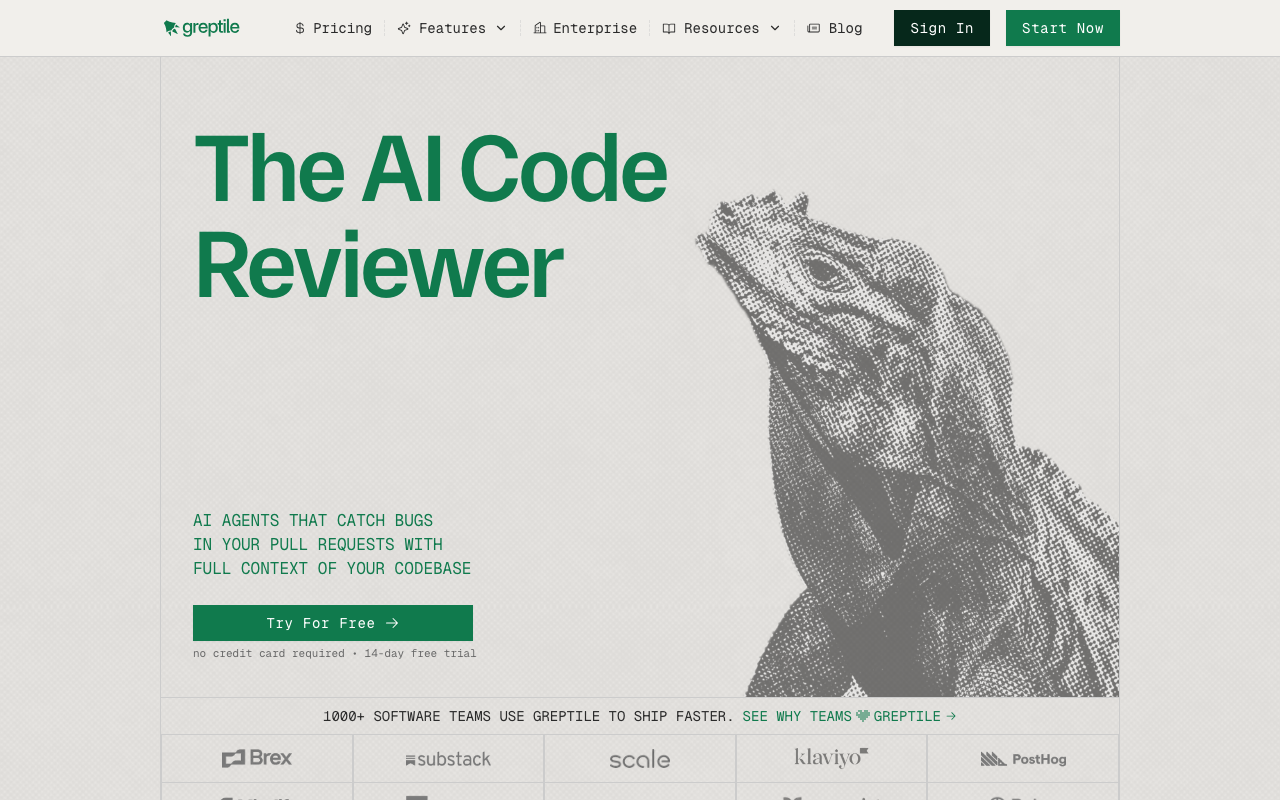
Greptile takes a fundamentally different approach to AI code review. Before reviewing any pull request, it indexes your entire codebase to build a semantic understanding of how all components connect. This means it catches issues that require cross-file or cross-package context - bugs that neither rule-based tools nor context-limited AI reviewers can detect.
What makes it stand out. Greptile’s full-codebase indexing enables it to find bugs that span multiple files. In practice, this means it can detect when a PR changes a function signature in one module but a caller in a different module still passes the old argument format. It can flag when a new API endpoint bypasses the authentication middleware that every other endpoint uses. These are the kinds of issues that typically slip through both automated tools and human review because they require understanding the broader system architecture.
Greptile also learns your team’s coding conventions after indexing and flags deviations - which is particularly valuable for onboarding new developers.
Key strengths:
- Full-codebase semantic indexing before review
- Cross-file and cross-package bug detection
- Convention learning and enforcement
- Natural language Q&A about your codebase
- API access for building custom workflows
Pricing (verified 2026-10-19): There is a free tier - Starter, free for 1 active developer with 50 credits a month, plus a 14-day Pro trial. Pro is $30/seat/month with 50 credits included and $1 per extra credit. Two billing mechanics decide your real bill: a “seat” is any developer who received a review, not anyone you add to the org, and credits are per author and do not pool, which is the most common billing surprise on this tool. Apex depth costs 10 credits per review. Greptile publishes startup terms: 50 percent off pre-Series A under $2M revenue, one month free, and special pricing for YC companies. It raised a $25M Series A led by Benchmark in September 2025 at roughly a $180M valuation - some 2026 coverage misdates that round.
Limitations: Initial indexing takes significant time on large repositories. Higher review latency than lighter tools. Language support (12+ languages) is narrower than alternatives, and Greptile’s own documented claim of “all languages supported” is unfalsifiable. No Azure DevOps support.
On its benchmark, because Greptile’s 82% figure is quoted everywhere. That 82% is Greptile scoring Greptile on an internal 50-PR, 5-repo evaluation that was never independently validated. Augment Code re-ran the same repositories and scored Greptile at 45% - and that is an F-score, 45% precision and 45% recall, not a catch rate. Augment also did not reuse Greptile’s answer key: it states that it expanded and corrected the golden comments by reviewing each PR manually. So part of the 82-versus-45 gap is a different answer key rather than pure self-dealing. Report it that way; neither number is independent, and Augment’s review assets were acquired by Harness on 8 October 2026, so that re-run now sits inside a company that sells DeepSource.
For a detailed comparison, see CodeRabbit vs Greptile.
8. Bito AI - Best AI code review assistant
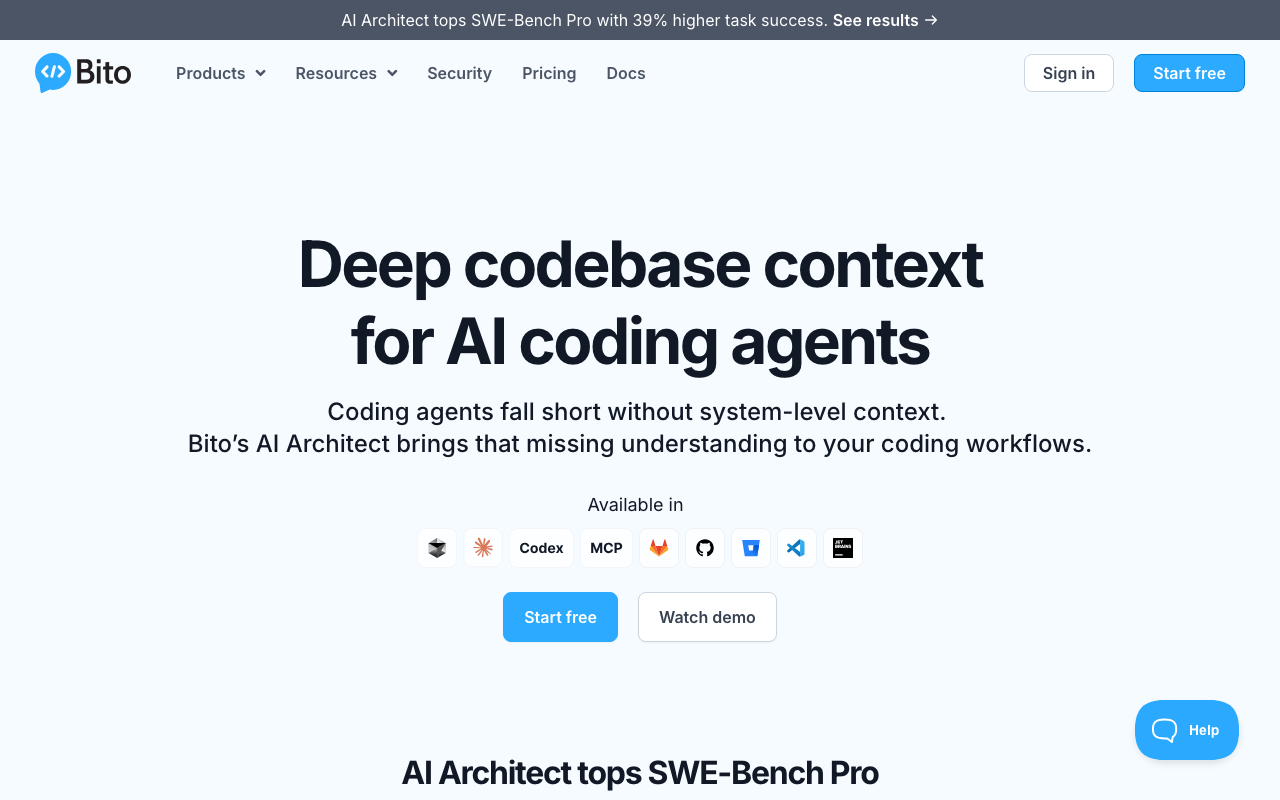
Bito AI is an AI-powered developer tool that includes PR review alongside IDE assistance, code explanation, and documentation generation. Its review functionality integrates with GitHub, GitLab, and Bitbucket to analyze pull requests and provide feedback on code quality, potential bugs, and security concerns.
What makes it stand out. Bito combines PR review with a broader AI assistant experience. Beyond reviewing code changes, it can explain complex code sections, generate documentation, and help developers understand unfamiliar parts of the codebase. The PR review feature analyzes diffs and leaves comments about potential issues, performance concerns, and best practice violations.
Bito also offers an IDE extension that provides real-time AI assistance as you write code, which means developers get feedback before they even open a pull request. This shift-left approach can reduce the number of issues that make it to the PR stage.
Key strengths:
- Combined PR review and IDE assistance
- Code explanation and documentation generation
- Supports GitHub, GitLab, and Bitbucket
- 20+ language support
- IDE extensions for VS Code and JetBrains
Pricing (verified 2026-10-19): Team at $12/dev/month annual ($15 monthly) and Professional at $20 ($25), with a 14-day Professional trial and no card required. Note the usage mechanic that most listings omit: 5,000 lines per seat, then $5 per additional 1,000 lines.
Limitations: PR review depth is shallower than dedicated tools like CodeRabbit. The broad feature set means no single capability is as deep as specialized alternatives. Cross-file context awareness is limited compared to Greptile.
For a comparison, see CodeRabbit vs Bito.
9. What The Diff - Best for PR summaries
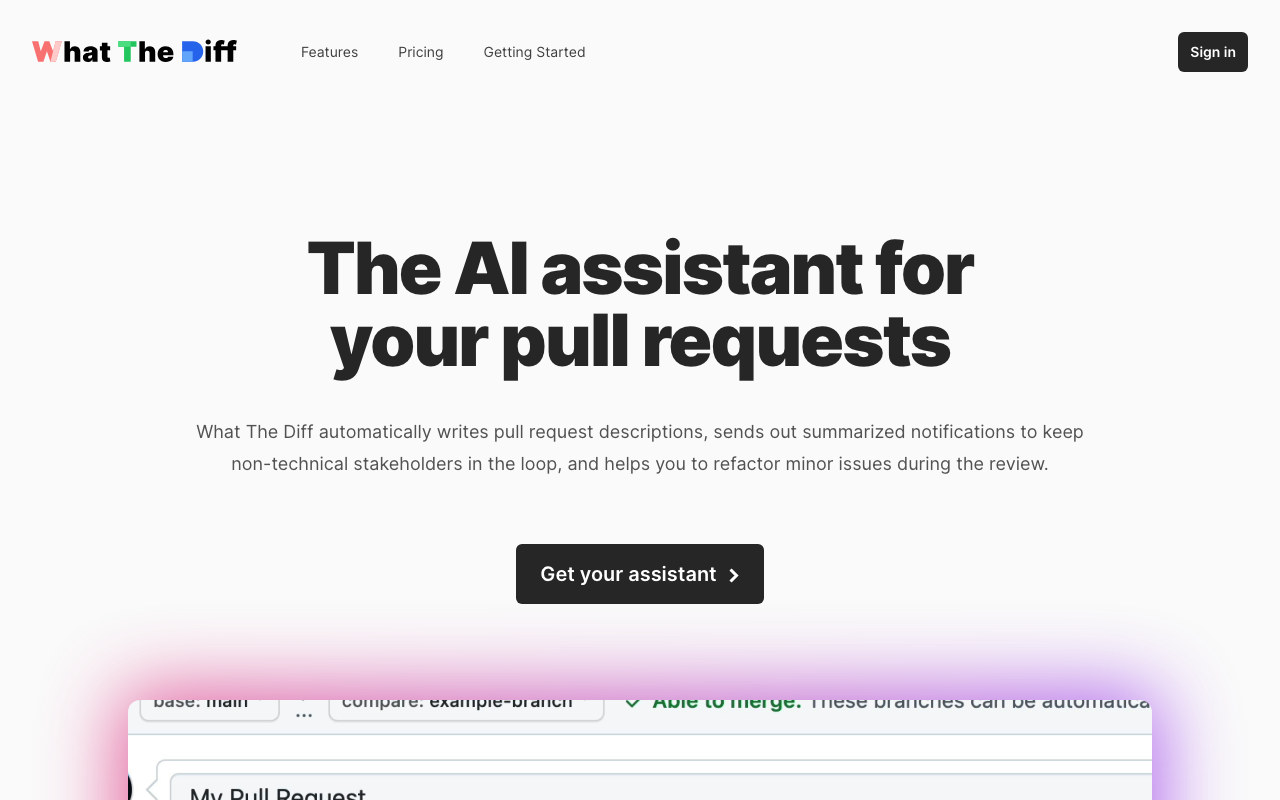
What The Diff takes a narrower approach than other tools on this list. Rather than trying to find bugs or suggest code improvements, it focuses on generating human-readable summaries of what changed in a pull request and why. This makes it particularly valuable for teams where non-technical stakeholders need to understand code changes - product managers, QA engineers, and technical writers who review PRs without reading every line of code.
What makes it stand out. What The Diff generates plain-language summaries of pull requests that explain the business impact of code changes, not just the technical details. When a developer opens a PR that refactors the payment processing module, What The Diff produces a summary like “Updated the payment flow to retry failed charges up to 3 times before marking the transaction as failed” rather than “Modified PaymentService.processCharge() to add retry logic.”
It can also generate changelogs automatically from merged PRs, which saves teams the manual effort of writing release notes.
Key strengths:
- Plain-language PR summaries for non-technical stakeholders
- Automatic changelog generation from merged PRs
- Simple setup with minimal configuration
- Works with most programming languages
- GitHub and GitLab support
Pricing: Free tier with limited PR reviews per month. Paid plans start at $29/repo/month.
Limitations: Does not find bugs, security issues, or suggest code improvements. Per-repo pricing becomes expensive for teams with many repositories. Limited platform support - no Bitbucket or Azure DevOps. Not a replacement for actual code review - it complements other tools.
10. Codacy - Best multi-language automated review platform
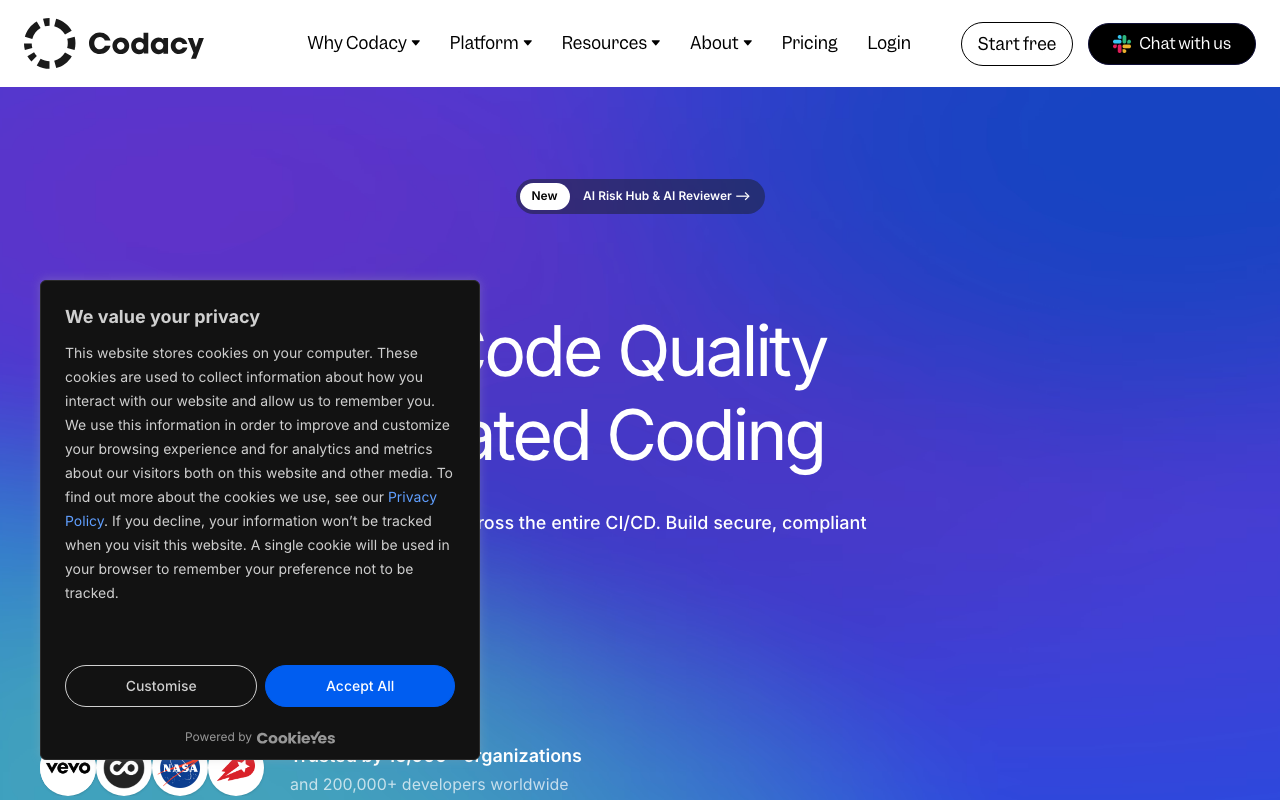
Codacy is an established code quality platform supporting 40+ programming languages - the widest coverage of any tool on this list. It combines automated code review with security scanning, code coverage tracking, and quality metrics in a single dashboard. While it is not primarily an AI tool, its automated PR feedback and broad language support make it a practical choice for polyglot teams.
What makes it stand out. Codacy’s breadth is its defining feature. It runs dozens of open-source analysis engines under the hood - ESLint for JavaScript, Pylint for Python, PMD for Java, and many more - and presents their findings in a unified interface. This means you get language-specific analysis quality without managing each tool individually.
The platform also tracks code quality trends over time, showing whether your codebase is improving or degrading across metrics like complexity, duplication, and coverage. Quality gate enforcement lets you block merges that introduce new issues or drop below coverage thresholds.
Key strengths:
- 40+ language support - widest coverage on this list
- Unified dashboard aggregating multiple analysis engines
- Quality gate enforcement on PRs
- Code coverage tracking and trend analysis
- GitHub, GitLab, and Bitbucket support
Pricing (verified 2026-10-19): The Developer tier is free forever but IDE-focused rather than PR-focused. Team starts at $18/dev/month billed yearly ($21 monthly) and covers up to 30 developers; Business is custom-quoted. Free for open source.
Limitations: Not an AI-native tool - analysis is primarily rule-based. Review comments are less contextual and nuanced than LLM-powered alternatives. Can be noisy on initial setup before rules are tuned. UI can feel overwhelming for small teams that just want PR feedback. And one structural gap worth knowing before an enterprise evaluation: the Codacy AI Reviewer is cloud-and-GitHub-only while GitHub Enterprise Server requires Codacy Self-hosted, so GHES customers structurally cannot get the AI Reviewer (verified 2026-10-19).
11. DeepSource - Best for low false positive analysis
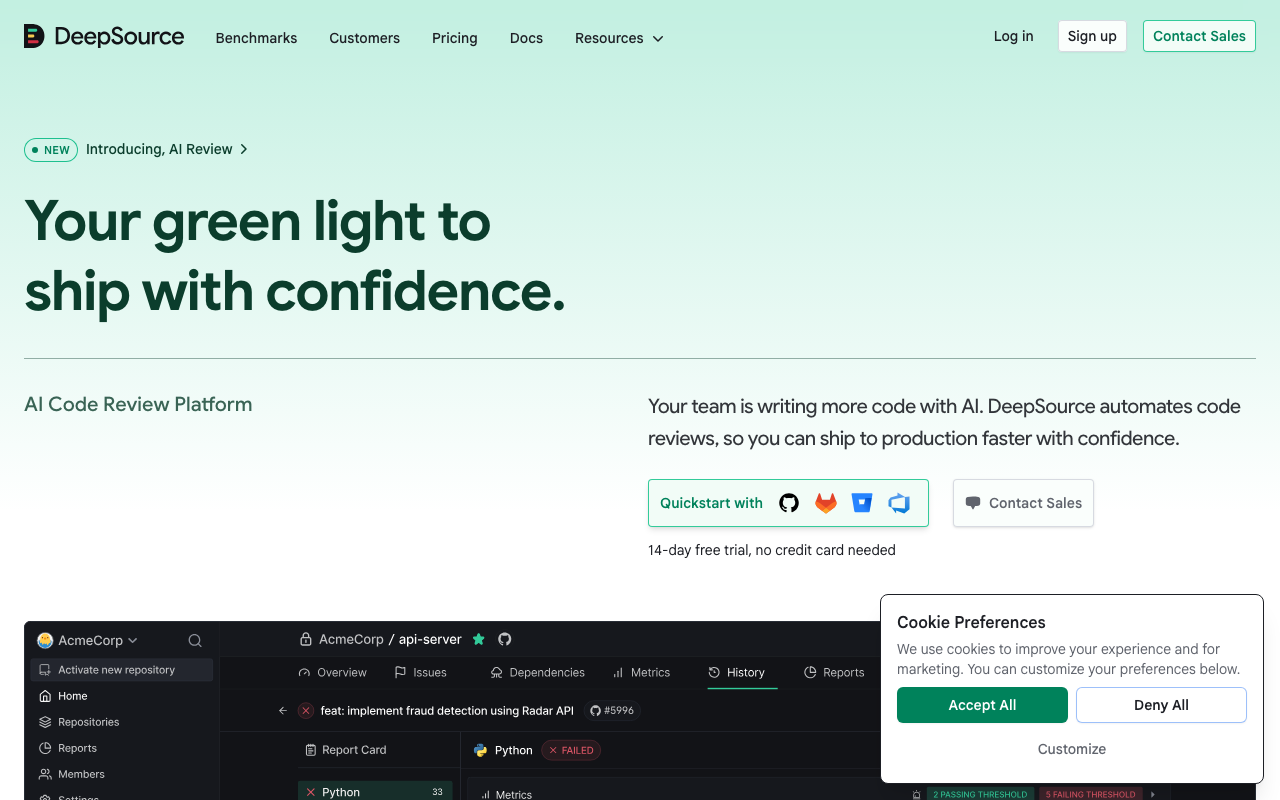
DeepSource is a static analysis platform that markets a sub-5% false positive rate. That is a vendor claim, not a measured figure, and nobody outside DeepSource has reproduced it (verified 2026-10-19) - an earlier version of this page called it the lowest rate of any tool here, which asserted more than we can support. It analyzes pull requests for bugs, security vulnerabilities, anti-patterns, and performance issues, running deterministic static analysis over 5,000+ rules and 30+ languages before the AI agent sees the code, and its Autofix feature can automatically generate fix PRs.
Ownership changed. Harness acquired DeepSource on 9 September 2026, when it had 6,000+ customers (verified 2026-10-19). Harness has made 15 acquisitions in total including Codecov, ShiftLeft and, on 8 October 2026, Augment Code’s Cosmos, Auggie CLI and Code Context Engine. Price the roadmap risk into any multi-year commitment.
What makes it stand out. False positives are the primary reason developers ignore automated review tools. If a tool flags 20 issues but 8 of them are wrong, developers stop reading the comments entirely. DeepSource is aggressively selective about what it reports, and in our own use it is among the least noisy tools on this list - but note that DeepSource also published its own benchmark scoring itself at 84.51% F1 and a competitor at 36.19%, and separately published a piece arguing that every AI code review vendor benchmarks itself and wins while omitting its own 84.51%. Judge the tool on a trial, not on either number.
The Autofix feature automatically generates pull requests that resolve detected issues, which reduces the manual effort of fixing findings to a single click. DeepSource also tracks code health metrics over time and provides a dashboard showing quality trends across your repositories.
Key strengths:
- Deterministic static analysis runs before the AI layer does
- Autofix generates fix PRs automatically
- Code health metrics and trend tracking
- Supports 16 languages including Python, Go, Java, JavaScript, and Rust
- GitHub, GitLab, and Bitbucket support
Pricing (verified 2026-10-19): Public repositories are analysed free, with up to $50 of bundled AI review credit. The Team seat is roughly $24/dev/month, and AI review is billed separately at $8 per 10,000 processed lines on Standard or $15 per 10,000 on Advanced, offset by a $100 annual AI credit per user. That separate metering is the number most comparison tables miss and it changes the real cost of the seat materially.
Limitations: Language support (16 languages) is narrower than Codacy’s 49 or CodeRabbit’s 30+. Not an LLM-based reviewer - it does not generate natural language explanations or PR summaries. Focus is on static analysis rather than semantic code understanding.
How to choose the right AI PR review tool
Direct answer: Decide on four verifiable criteria, not on accuracy claims. Platform coverage (only CodeRabbit and Panto do all four major platforms; Copilot and Gitar both lack GHES). Billing unit (per seat, per received review, per line, or per KB). Hard caps (CodeRabbit Essentials covers 1 repo; Gitar caps at 50 users; Codacy Team at 30 devs). Compliance artifacts. Then trial it and count findings yourself. Verified 2026-10-19.
Selecting the right tool depends on your team’s specific needs. Here are the key factors to consider.
Team size and budget. Solo developers and small open-source teams should start with CodeRabbit’s free tier if the repository is public, or self-hosted PR-Agent if it is private - CodeRabbit’s free tier stopped covering private repos (verified 2026-10-19). Mid-size teams of 5 to 50 developers get the best value from CodeRabbit Essentials at $24/user/month, Panto at $15/developer/month, or Sourcery Pro at $12 if you are Python-heavy. Watch the caps rather than the headline price: Gitar’s self-serve plans stop at 50 users, Codacy Team stops at 30, Qodo’s flat fee covers up to 30, and CodeRabbit Essentials covers exactly 1 linked repository. Those ceilings, not the per-seat number, are what force a tier change for most growing teams.
Primary programming languages. If your team primarily writes Python, Sourcery offers the deepest language-specific analysis at $12/seat/month. For polyglot teams, CodeRabbit (30+ languages) or Codacy (40+) provide the broadest coverage. Be aware that no vendor publishes per-language precision or recall for its own product, and SWE-PRBench, CR-Bench, CRBugBench and c-CRAB all have zero language breakouts (verified 2026-10-19), so “supports your language” is a capability claim and never a quality claim. Use capability data instead: CodeRabbit publishes a full language-to-linter map covering 50+ tools including Squawk for Postgres migrations, Verilator and zizmor - with notable gaps, including no Python type checker and neither Error Prone nor SpotBugs for Java. Greptile’s “all languages supported” is unfalsifiable. Qodo, Gitar, Cursor Bugbot, Anthropic and Copilot publish no language list at all.
What you need beyond code review. If you want PR review plus security scanning, Panto bundles SAST, secrets detection, and IaC security at $15/developer/month. If you want review plus test generation, Qodo Merge is the only tool offering both. If you need PR summaries for non-technical stakeholders, What The Diff specializes in that use case.
Platform requirements. GitHub Copilot code review is GitHub.com only, with no GitHub Enterprise Server support. Sourcery supports GitHub and GitLab. CodeRabbit and Panto are the only tools here supporting all four major platforms including Azure DevOps. If you are on GHES specifically, your options narrow sharply: Gitar does not support it, Copilot code review does not support it, and Codacy’s AI Reviewer structurally cannot reach it - while Anthropic Code Review does support it (all verified 2026-10-19). See the platform matrix above.
Issue-tracker integration, if that is what you are actually buying. “Integrates with Jira” almost never means what procurement thinks it means. Of the tools we checked, only 3 document the ability to create or update an issue: CodeRabbit (chat.integrations.jira.usage), Semgrep (severity-gated auto-ticketing, Jira Cloud only) and Snyk (a manual button plus two API endpoints). Documented read-only or undocumented: PR-Agent, Qodo Merge, GitHub Copilot, Cursor Bugbot, Graphite and Anthropic. No product in this market routes individual findings by CODEOWNERS (verified 2026-10-19), so per-team finding routing is middleware you build.
For a more comprehensive comparison including static analysis and security-focused tools, see our best AI code review tools guide. If you want to learn how to integrate these tools into your development workflow, read our guide on how to automate code review.
Final recommendations
Direct answer: CodeRabbit Essentials at $24 for most teams, Sourcery Pro at $12 for Python-heavy teams, Greptile Pro at $30 for cross-file bugs, Panto at $15 if you want SAST bundled in, and self-hosted PR-Agent under MIT if code cannot leave your network. If you already pay for Copilot, you already have code review at the Pro tier for $10 - turn it on before buying anything. Verified 2026-10-19.
For most teams, CodeRabbit is the best starting point. Review quality is consistently high across languages, it supports all four major git platforms, and at $24 per developer per month on Essentials it is mid-market on price. Two things to check first: the free tier only covers public repositories now, and Essentials covers exactly 1 linked repository - so a multi-service team is really pricing Team at $48.
If your team is already paying for GitHub Copilot, enable Copilot code review first - it requires zero additional setup and it is included from Copilot Pro at $10, so for most Copilot customers it is already paid for. Then evaluate whether you need a more capable dedicated tool. Do not do this if you are on GitHub Enterprise Server; Copilot code review does not support it.
For teams that want a single platform covering code review and security, Panto at $15/developer/month bundles AI review, SAST, secrets detection and IaC scanning into one subscription. Ask about its SOC 2 status in writing before an enterprise purchase - the audit was still underway when we checked on 2026-10-18.
Python-focused teams should seriously evaluate Sourcery at $12/seat/month billed annually. Its Python-specific refactoring suggestions are unmatched by any general-purpose tool here, and it is the cheapest paid option on this page.
For teams working on large, interconnected codebases where cross-file bugs are a recurring problem, Greptile at $30/seat/month is worth it for full-codebase awareness - and contrary to what most listings say, it does have a free Starter tier for 1 active developer, so you can evaluate it before paying. Just budget for the credit model: credits are per author and do not pool.
And the honest closing caveat, which is the most useful sentence on this page. We cannot tell you which of these catches the most bugs, because no party without a commercial stake has published a false-positive rate, precision figure or noise measurement for any shipping commercial AI code reviewer (verified 2026-10-19). Greptile scored Greptile at 82%; Augment’s re-run scored it 45%. DeepSource scored itself 84.51% F1. Entelligence wins its own benchmark. Qodo, Baz, Macroscope, Propel, Tenki, CodeAnt and Panto all publish benchmarks they win. The least conflicted number available is the Martian Code Review Bench, because Martian sells model routing rather than a reviewer, and it put CodeRabbit at 51.2% F1 and 49.2% precision. Pick on platform coverage, billing unit, caps and compliance - all four of which are verifiable - then run a two-week trial and count the findings yourself. An imperfect AI reviewer you keep enabled beats a better one you switch off.
How we verified this
Date of this pass: 2026-10-19. We take no affiliate revenue on anything on this page. Gitar is a paid category partner and is labelled as such; it gets a guaranteed entry, never a rank, a rating or the removal of a criticism - and this pass removed an error that favoured it.
What we checked, and where. Every price, tier name, seat cap, credit allowance, line allowance and free-tier limit was read off the vendor’s own published pricing page, not from a comparison site. Platform support was checked against each vendor’s own platform or integration matrix rather than a marketing bullet, which is how we found that Gitar lists GitHub Enterprise Server as unsupported and that Greptile documents Perforce. Entitlement questions were settled against primary vendor documentation, which is how we corrected Copilot code review to being included from Copilot Pro at $10. Licence facts were checked against the LICENSE file on the default branch, which is how we established PR-Agent is MIT on main despite Qodo’s blog saying Apache 2.0. Benchmark figures were traced to whoever published them.
What is our own measurement. The latency figures in the opening section are ours: 2,189 human-authored merged PRs across 12 repositories, harvested from the GitHub GraphQL API on 2026-10-18 with bot authors and reviewers and self-reviews excluded. Open-to-first-review p50 8.7h / p75 66h / p90 212h / p99 1,300h, median PR spending 52.7 percent of its open-to-merge life waiting for a first human, first-approval-to-merge 1.1h at p50. Method and limits in pull request review time. Only merged PRs are in frame, which biases latency downward.
What we could NOT verify, named specifically.
- Any independent false-positive rate for any tool on this list. Every figure in circulation belongs to a party with a commercial stake.
- Panto’s 11-versus-2 false-positives-per-PR figure. We could not open a primary Panto page carrying that exact pair. Its stated methodology is 17 PRs classified by o3-mini. Labelled reported, not confirmed.
- Panto’s SOC 2 status. The audit was still underway when we checked on 2026-10-18.
- Enterprise pricing for Panto, Greptile, CodeRabbit and DeepSource. All quote-only. Only 3 of the 15 enterprise tiers we checked across this market publish a rate card - Snyk, Gitar and Entelligence.
- The per-review cost of GitHub Actions minutes consumed by Copilot code review on private repos. GitHub confirms the consumption but publishes no per-review figure, so it is unmodellable.
- Gemini Code Assist’s free tier. Contradictory sources; excluded from the tables rather than guessed at.
- GHES support for Panto, Greptile, Qodo Merge, Sourcery and DeepSource. Marked “not documented” rather than “no” - absence of published evidence is not the same as a vendor denial, and for procurement those are different findings.
- The commonly cited “6 to 12 hours per week reviewing” figure. Attributed to Google and Microsoft research across the web; we could not reach a primary source.
Carried from a prior pass, not freshly re-checked on 2026-10-19. The qualitative strengths and weaknesses in each tool write-up, the review-latency ranges per tool (1 to 5 minutes, 3 to 10 for Greptile), the language counts other than Codacy’s, and the ranking order are carried forward from earlier versions of this page. They reflect our hands-on use rather than a measurement taken on this date.
Corrections applied in this pass. We corrected CodeRabbit’s free tier, which no longer covers private repositories, and applied the September 2026 rename of Pro to Essentials and Pro Plus to Team. We added the Essentials single-repo cap, the 150/300 file caps, and the fact that SSO, audit logs and API are Enterprise-only. We corrected Copilot code review entitlement to Pro at $10 and added that annual billing was retired entirely on 1 June 2026, that Copilot Free excludes review, that private-repo reviews consume Actions minutes, and that the 300-file cap was removed on 27 August 2026. We corrected Sourcery Pro from $10 to $12. We corrected Codacy Team from $15 to $18 yearly and its language count from 49 to 40+, and added the GHES AI Reviewer gap. We corrected Bito to Team $12/$15 and Professional $20/$25 with the 5,000-line-per-seat mechanic. We corrected Qodo from a $19 seat and a free tier to a roughly $30 flat team fee plus pooled credits with no permanent free tier, and reassigned PR-Agent’s ownership to independent MIT governance as of 23 April 2026. We added Greptile’s free Starter tier, which an earlier version said did not exist, plus the per-author non-pooling credit model. We corrected DeepSource to roughly $24 per seat plus separately metered AI review, relabelled its sub-5% false positive rate as a vendor claim, and added its acquisition by Harness on 9 September 2026. We corrected Gitar’s GHES support from partial to unsupported - against our own commercial interest - and added that it has no published third-party benchmark. We removed the unsourced Google and Microsoft review-time statistics and replaced them with our own measurement.
Further Reading
- Will AI Replace Code Reviewers? What the Data Actually Shows
- 7 Best CodeRabbit Alternatives for AI Code Review in 2026
- Best AI Tools for Developers in 2026 - Code Review, Generation, and Testing
- CodeRabbit Pricing in 2026: Free Tier, Pro Plans, and Enterprise Costs
- Best Code Review Tools for JavaScript and TypeScript in 2026
- Greptile Pricing in 2026 - Plans, Per-Seat Cost, and How It Compares
- Ito Review 2026: The Code Reviewer That Actually Runs Your App
 Gitar
GitarComments are not enough
Gitar applies the fix, validates it in CI, and clears the queue.
See it on your repo Read our independent Gitar reviewFrequently Asked Questions
What is an AI PR review tool?
An AI PR review tool is software that uses large language models or machine learning to automatically analyze pull requests and leave feedback. These tools comment on code changes in real time, identifying bugs, security vulnerabilities, performance issues, and style violations. They integrate directly with GitHub, GitLab, or Bitbucket and run automatically when a PR is opened or updated, providing a first pass of review before human reviewers look at the code.
Can AI PR review tools replace human code reviewers?
No. AI PR review tools are best used as a complement to human review, not a replacement. They excel at catching mechanical issues like null pointer dereferences, missing error handling, security vulnerabilities, and style inconsistencies. However, they cannot evaluate architecture decisions, verify business logic correctness, or assess whether code meets product requirements. The most effective workflow is letting the AI handle the first pass so human reviewers can focus on higher-level design and logic concerns.
Which AI PR review tool has the best free tier?
It depends on whether your repository is public. CodeRabbit is free forever on public repositories, but as of 2026-10-19 its free tier no longer covers private repos at all - a free account gets one summary-only private PR review per hour plus three IDE and three CLI reviews per hour. For private code, PR-Agent is the strongest free option: it was relicensed to MIT on 23 April 2026 under independent community governance, so you can self-host it at any team size and pay only your own model bill. Greptile has a free Starter tier for 1 active developer with 50 credits a month, which most listings still say does not exist. Codacy's Developer tier is free forever but IDE-focused rather than PR-focused. Sourcery is free for open source. Note that Copilot Free specifically excludes code review.
How long does an AI PR review take?
Most AI PR review tools complete their analysis within 1 to 5 minutes of a pull request being opened. Lightweight tools like CodeRabbit and Sourcery typically finish in under 2 minutes. Tools that perform deeper analysis, such as Greptile with its full-codebase indexing, may take 3 to 10 minutes depending on the size of the change and repository. GitHub Copilot Code Review generally responds within 1 to 5 minutes depending on the complexity of the diff.
What is the difference between AI PR review and static analysis?
Static analysis tools like SonarQube and Semgrep use predefined rules to detect known patterns of bugs and vulnerabilities. AI PR review tools like CodeRabbit and Qodo Merge use large language models to understand code semantics, catching logic errors, suggesting improvements, and generating human-readable explanations that rule-based tools cannot provide. Many modern platforms combine both approaches for the broadest coverage.
Are AI PR review tools safe to use with proprietary code?
Reputable AI PR review tools implement strong data security practices. CodeRabbit, Codacy, and Qodo Merge are SOC 2 compliant and do not store your source code after analysis. GitHub Copilot Code Review processes code within GitHub's existing infrastructure. Self-hosted options like PR-Agent keep all data on your own servers. Always review a tool's data handling policy before connecting proprietary repositories, especially regarding whether code is sent to third-party LLM providers.
Do AI PR review tools support monorepos?
Yes, most AI PR review tools support monorepos, though performance varies. CodeRabbit and Greptile handle monorepos well because they analyze cross-file dependencies. Codacy and DeepSource support monorepo configurations but may require additional setup for project boundaries. For very large monorepos with more than 500,000 lines of code, Greptile is the strongest option due to its full-codebase indexing approach.
How much do AI PR review tools cost?
Self-serve pricing runs from free to $72 per developer per month (verified 2026-10-19). Sourcery Pro is the cheapest paid option at $12 per seat annually, then Bito Team at $12, Panto at $15, Codacy Team at $18, Gitar Core at $20, CodeRabbit Essentials at $24, Greptile Pro at $30, CodeRabbit Team at $48 and CodeRabbit Advanced at $72. Qodo prices differently - a flat team fee of roughly $30 per month for up to 30 users plus credits at $0.012 each, pooled across the team with no rollover. GitHub Copilot code review is included from Copilot Pro at $10 per month, not from the $19 Business seat as many pages still claim, and Copilot is monthly-only since it retired annual billing on 1 June 2026. Enterprise tiers are quote-only at 12 of the 15 vendors we checked.
What languages do AI PR review tools support?
Language support varies significantly. CodeRabbit supports 30+ languages including TypeScript, Python, Go, Java, C++ and Rust, and publishes a full language-to-linter map covering 50+ tools - with notable gaps, including no Python type checker and neither Error Prone nor SpotBugs for Java. GitHub Copilot code review supports most languages GitHub recognizes but publishes no list. Sourcery covers Python, JavaScript, TypeScript and Go. Greptile claims all languages supported, which is unfalsifiable, and documents 12+. Codacy covers 40+, the widest here. The important caveat: no vendor publishes per-language precision or recall for its own product, and SWE-PRBench, CR-Bench, CRBugBench and c-CRAB all have zero language breakouts (verified 2026-10-19). So a language list tells you about capability, never about quality. Qodo, Gitar, Cursor Bugbot, Anthropic and Copilot publish no language list at all.
Can I use multiple AI PR review tools on the same repository?
Yes, and many teams do. A common pattern is to pair a general AI reviewer like CodeRabbit with a security-focused tool like DeepSource or Codacy. Each tool posts its own PR comments, so there is no conflict. The main downside is comment noise - if two tools flag the same issue with different phrasing, reviewers waste time reading duplicate feedback. Most teams find that one primary AI reviewer plus one static analysis or security scanner is the sweet spot.
How do I set up an AI PR review tool?
Most AI PR review tools can be set up in under 10 minutes. You typically install a GitHub App or GitLab integration, grant repository access, and the tool starts reviewing PRs automatically on the next opened pull request. CodeRabbit, Qodo Merge, and What The Diff all follow this pattern. GitHub Copilot Code Review requires a Copilot subscription and can be enabled in repository settings. No server infrastructure or CI pipeline changes are needed for cloud-hosted tools.
What is the best AI PR review tool for Python projects?
Sourcery is the strongest choice for Python-heavy teams. It was built specifically for Python and provides deep refactoring suggestions, complexity analysis, and style improvements tailored to Python idioms. CodeRabbit is a strong general-purpose alternative that also handles Python well. For Python teams that want security-focused review alongside code quality, pairing Sourcery with DeepSource gives excellent coverage.
Explore More
Tool Reviews
 CodeRabbit Review
 Qodo Review
 Sourcery Review
 GitHub Copilot Code Review Review
 Panto Review
 Greptile Review
 Bito AI Review
 What The Diff Review
 Codacy Review
 DeepSource Review
Free Newsletter
Stay ahead with AI dev tools
Weekly insights on AI code review, static analysis, and developer productivity. No spam, unsubscribe anytime.
Join developers getting weekly AI tool insights.
Related Articles
34 Automated Code Review Tools Compared (2026)
34 automated code review tools compared across AI PR reviewers, static analysis, linters, security scanners, and code quality platforms with pricing.
February 10, 2026
best-ofBest AI Code Review Tools in 2026 - Expert Picks
16 AI code review tools tested on TypeScript, Python, Go, and Java codebases. Features, pricing, detection quality, and false positive rates compared.
February 10, 2026
best-of28 Best AI Developer Productivity Tools (2026)
28 AI developer productivity tools across code generation, review, testing, documentation, project management, and DevOps with pricing comparison.
February 11, 2026