CodiumAI Alternatives: Best AI Testing Tools
Explore the best CodiumAI (now Qodo) alternatives for AI test generation, code review, and quality analysis with pricing and honest comparisons.
Published:
CodiumAI Is Now Qodo: What Changed and Why It Matters
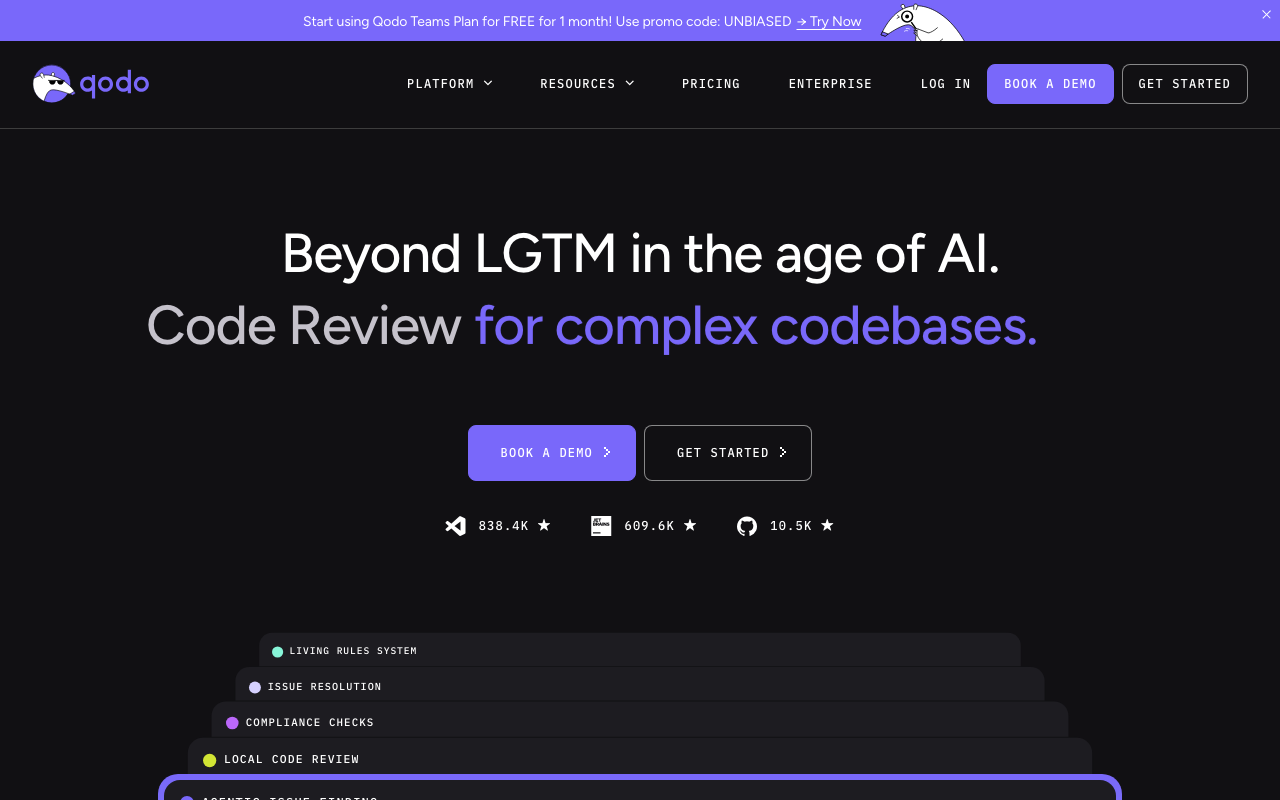
If you are searching for CodiumAI alternatives, the first thing you need to know is that CodiumAI rebranded to Qodo in 2024. The company, founded by Itamar Friedman and Dedy Kredo, originally launched as an AI test generation tool - and a good one. CodiumAI’s ability to analyze code behavior, identify untested logic paths, and generate meaningful unit tests with edge case coverage set it apart from generic AI coding assistants that could produce basic test scaffolding at best.
The rebrand to Qodo reflected a significant expansion in scope. What was once a focused test generation tool became a full-spectrum code quality platform spanning PR code review, IDE plugins, CLI tooling, and a context engine for multi-repo intelligence. In February 2026, Qodo released version 2.0 with a multi-agent code review architecture that achieved the highest F1 score (60.1%) in comparative benchmarks against seven other leading AI code review platforms. The company was also recognized as a Visionary in the 2025 Gartner Magic Quadrant for AI Code Assistants.
The open-source PR-Agent remains the foundation of Qodo’s review engine, supporting GitHub, GitLab, Bitbucket, and Azure DevOps. The product is available at three tiers: a free Developer plan with 30 PR reviews and 250 credits per month, a Teams plan at $30/month flat for up to 30 users, and a custom-priced Enterprise plan with SSO, on-premises deployment, and air-gapped installations.
This guide covers ten alternatives that address different needs - whether you want deeper test generation, cheaper pricing, broader security scanning, or a different approach to AI-assisted code quality. Not all of these tools are direct replacements for CodiumAI’s test generation capabilities. Some are complementary tools that fill gaps Qodo does not address, and some take an entirely different approach to the same problem.
Why Look for CodiumAI (Qodo) Alternatives
Despite Qodo’s strong feature set, several practical reasons drive teams to explore alternatives.
The rebrand itself caused confusion. Some developers still search for “CodiumAI” without realizing the product is now Qodo. Others confuse CodiumAI with Codeium (now Windsurf), which is an entirely different company offering a free AI code completion IDE. This naming confusion has led teams to evaluate both products without understanding they serve different purposes. For a detailed breakdown of the differences, see our CodiumAI vs Codium comparison.
Test generation is no longer the sole focus. As Qodo expanded into PR review, IDE plugins, and multi-repo intelligence, some teams feel the test generation capabilities - the original reason they adopted CodiumAI - have received less attention relative to the newer features. Teams that primarily need AI-powered test generation may prefer a tool that remains laser-focused on that problem.
Pricing increased while the free tier shrank. Qodo’s free tier was reduced from 75 PR reviews per month to 30, and the credit system adds complexity that competitors avoid. The Teams plan at $30/month flat for up to 30 users is above average for the AI code review category. Teams on tight budgets may find better value elsewhere, especially if they do not need the full breadth of Qodo’s platform.
No built-in SAST or security scanning. While Qodo excels at code review and test generation, it does not include static application security testing, secret detection, or Infrastructure-as-Code scanning. Teams with security requirements need to pair Qodo with a separate security tool, adding cost and complexity.
Credit system complexity. Qodo uses a credit-based system where standard operations cost 1 credit but premium models like Claude Opus cost 5 credits per request. Credits reset every 30 days from the first message sent, not on a calendar schedule. This variable pricing can make costs unpredictable, particularly for teams evaluating different AI models.
IDE plugin performance concerns. Some users on G2 report slow performance with Qodo’s IDE plugin on larger codebases, which can create frustration during interactive development sessions where responsiveness matters.
The alternatives below span dedicated test generation tools, AI code review platforms, security-focused analyzers, and all-in-one code quality solutions. Each addresses specific gaps in Qodo’s offering or takes a fundamentally different approach to improving code quality.
Quick Comparison Table
| Tool | Type | Free Tier | Starting Price | Test Generation | Best For |
|---|---|---|---|---|---|
| GitHub Copilot | AI dev platform | Yes | $10/month | Yes (chat-based) | GitHub-native teams wanting one AI tool |
| Diffblue Cover | Java test generation | No | Custom | Yes (dedicated) | Enterprise Java test automation |
| CodeRabbit | AI PR review | Yes | $24/user/month | No | Dedicated, low-noise PR review |
| Tabnine | AI code assistant | Yes | $12/user/month | Limited | Privacy-first AI coding with on-prem |
| Sourcegraph Cody | AI coding assistant | Yes | $9/user/month | Yes (chat-based) | Large codebase context and search |
| Testim (Tricentis) | Test automation | No | Custom | Yes (visual + AI) | End-to-end test automation |
| Sourcery | AI review + refactoring | Yes (OSS) | $12/user/month | No | Python teams and code quality |
| DeepSource | Code quality + AI review | Yes | $30/user/month | No | Low false positive static analysis |
| SonarQube | Static analysis | Yes | Free / EUR 30/mo | No | Enterprise quality gates and compliance |
| Codacy | Code quality + security | Yes | $15/user/month | No | All-in-one quality, SAST, SCA, and secrets |
1. GitHub Copilot - Best All-in-One AI Development Platform
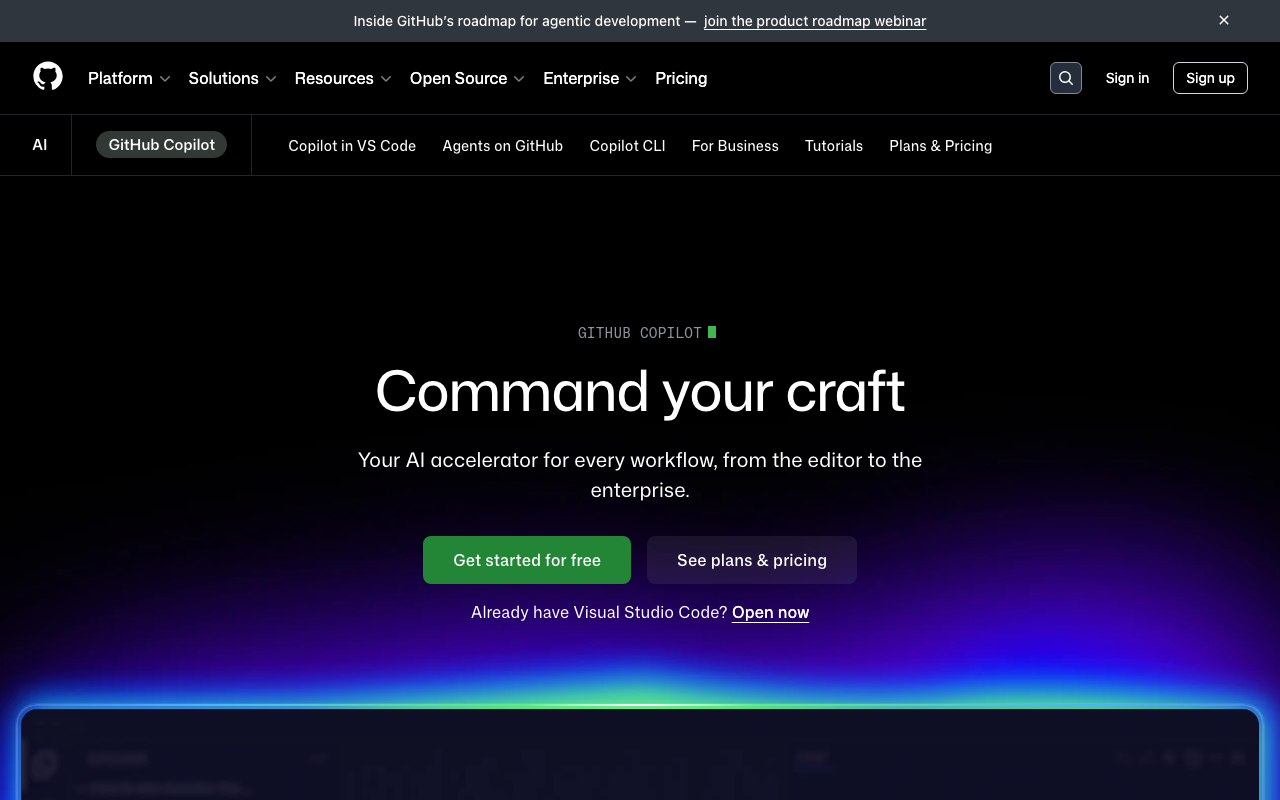
GitHub Copilot is the most widely adopted AI development tool in the world, and it has evolved well beyond code completion into a full platform that includes code review, test generation, and an autonomous coding agent. For teams that used CodiumAI primarily for test generation and want a single tool that also handles code completion and review, Copilot is the most natural replacement - especially if your team already uses GitHub.
Test generation capabilities. Copilot generates tests through chat commands (/tests) and inline suggestions in the IDE. It supports most popular testing frameworks including Jest, pytest, JUnit, and Mocha. While the test output is competent for straightforward functions, it does not match Qodo’s dedicated coverage gap detection or systematic edge case identification. Copilot’s tests tend to cover the happy path well but may miss boundary conditions and error scenarios that Qodo’s purpose-built engine catches.
Code review. Copilot’s agentic code review architecture, launched in early 2026, uses tool-calling to read relevant files and trace cross-file references. It supports multi-model selection including GPT-5.4, Claude Opus 4, and Gemini 3 Pro. With over 60 million code reviews processed, it is the most battle-tested AI review system available. For a deeper comparison, see our CodiumAI vs Copilot analysis.
Where it beats Qodo. Native GitHub integration means zero setup for GitHub users. The autonomous coding agent can implement features and fix bugs end-to-end. Code review is included with existing Copilot subscriptions at no extra cost. Multi-model support gives teams flexibility.
Where Qodo wins. Qodo’s dedicated test generation engine produces more thorough tests with better edge case coverage. Qodo supports GitHub, GitLab, Bitbucket, and Azure DevOps, while Copilot is GitHub-only. Qodo’s open-source PR-Agent allows self-hosting. For more on this matchup, see our Qodo vs GitHub Copilot comparison.
Pricing. Free tier with 2,000 completions and 50 premium requests. Pro at $10/month (300 premium requests). Pro+ at $39/month (1,500 premium requests). Business at $19/user/month. Enterprise at $39/user/month.
Best for: Teams already on GitHub who want a single AI platform covering code completion, review, and basic test generation without adding another vendor.
2. Diffblue Cover - Best for Enterprise Java Test Generation
Diffblue Cover is the most direct alternative to CodiumAI’s test generation capabilities, particularly for Java projects. Unlike Qodo and most other AI tools that use large language models for test generation, Diffblue uses reinforcement learning to write JUnit tests that are guaranteed to compile, run, and produce meaningful assertions. This deterministic approach eliminates the hallucination risk that comes with LLM-based test generation.
How it works. Diffblue analyzes Java bytecode at runtime, observes method behavior, and generates JUnit tests that exercise real execution paths. The reinforcement learning model has been trained specifically on Java testing patterns, which means it understands framework conventions, mocking strategies, and assertion best practices at a level that general-purpose LLMs cannot match.
Where it beats Qodo. For Java projects, Diffblue produces higher-quality tests with fewer manual corrections needed. The deterministic approach means tests always compile and run - there is no reviewing AI-generated code for syntax errors or nonsensical assertions. Diffblue integrates into CI/CD pipelines to maintain test coverage automatically as code changes, and its tests do not require human review before merging.
Where Qodo wins. Qodo supports dozens of languages while Diffblue is Java-only. Qodo combines test generation with code review in a single platform. Qodo’s free tier makes it accessible for evaluation, while Diffblue requires enterprise pricing conversations. Qodo’s LLM-based approach can generate more creative edge case scenarios, even if some require manual adjustment.
Pricing. Custom enterprise pricing only. No free tier or self-service plan. Diffblue targets large enterprises with significant Java codebases.
Best for: Enterprise Java teams that need deterministic, CI/CD-integrated test generation at scale without the unpredictability of LLM-based output.
3. CodeRabbit - Best Dedicated AI Code Review
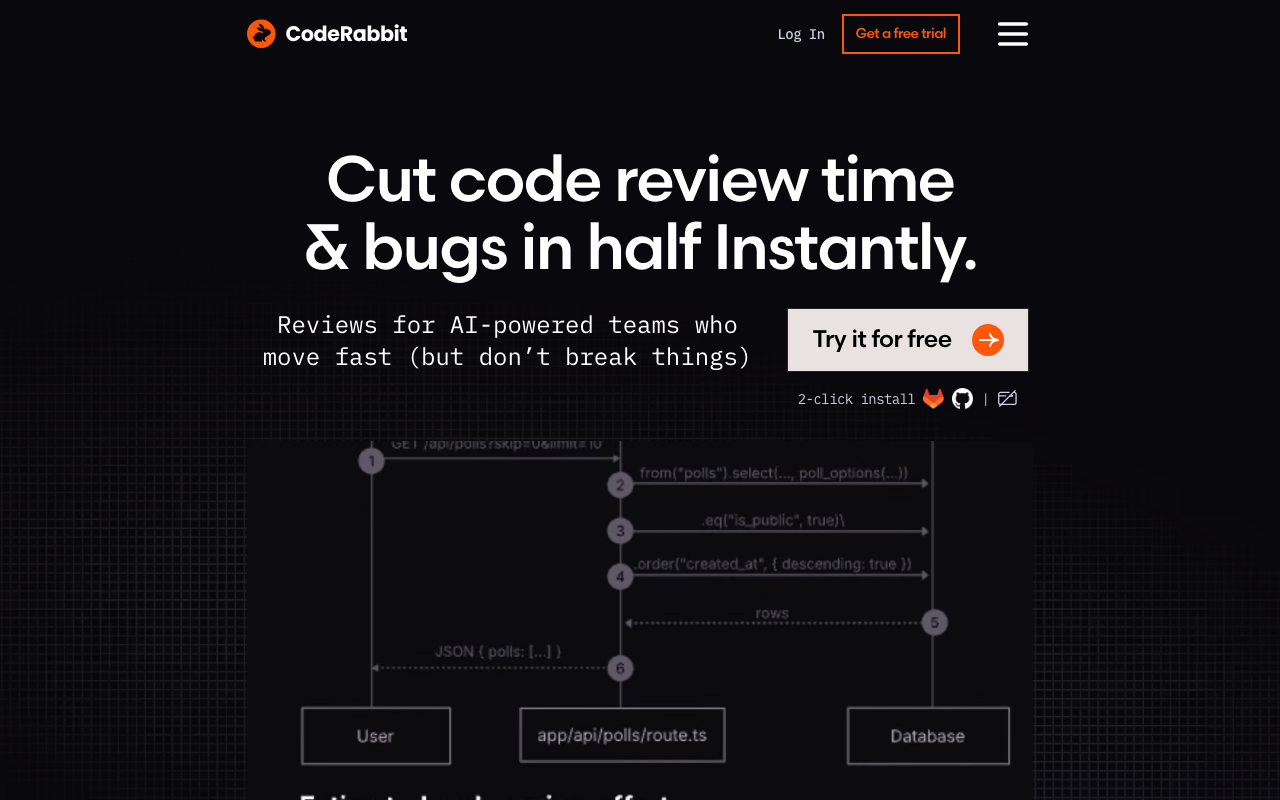
CodeRabbit is the most widely adopted dedicated AI code review tool, with over 2 million connected repositories and 13 million pull requests reviewed. While it does not offer test generation - making it an incomplete CodiumAI replacement on its own - it provides deeper, more configurable PR review than Qodo’s review capabilities.
Key strengths. CodeRabbit delivers contextual PR reviews with 40+ built-in linters, natural language review customization, learnable preferences that adapt to your team’s patterns, and a generous free tier with unlimited public and private repositories. Reviews complete in 2-4 minutes with low false positive rates. For a detailed head-to-head, see our Qodo vs CodeRabbit comparison.
Where it beats Qodo. CodeRabbit’s review-only focus means more polished review output with richer walkthrough summaries. The free tier is more generous for teams that primarily need review. CodeRabbit’s 40+ built-in linters provide deterministic checks alongside AI analysis. In independent benchmarks, CodeRabbit’s signal-to-noise ratio outperformed most competitors, producing only 2 false positives in testing versus higher rates from tools that attempt deeper analysis.
Where Qodo wins. Qodo combines review with test generation - a capability CodeRabbit does not offer. Qodo’s open-source PR-Agent allows full self-hosting with local LLMs. Qodo’s multi-agent architecture achieved a higher F1 score (60.1%) in benchmark testing. Both support four major Git platforms.
Pricing. Free tier with unlimited repos (rate-limited). Pro at $24/user/month. Enterprise with custom pricing.
Best for: Teams that want the best possible AI code review experience and are willing to use a separate tool for test generation.
4. Tabnine - Best for Privacy-First AI Coding
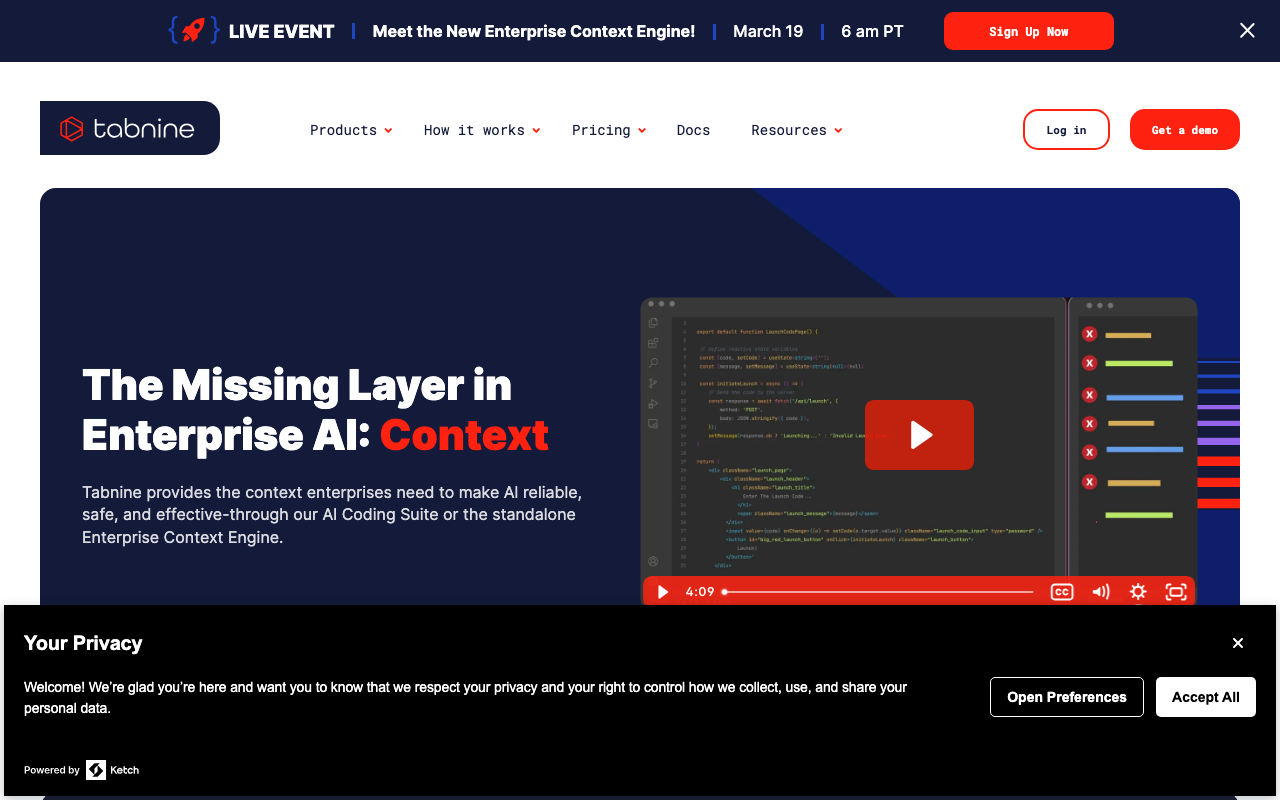
Tabnine is an AI code assistant that competes with CodiumAI on the IDE experience side rather than test generation. Its primary differentiator is a zero-data-retention policy and the option for fully on-premises deployment - critical for teams in regulated industries that cannot send code to third-party servers. For a detailed comparison, see our Qodo vs Tabnine analysis.
Key strengths. Tabnine provides AI code completion, chat-based assistance, and code generation across 30+ languages. Its enterprise deployment options include on-premises, VPC, and air-gapped installations with support for private AI models trained on your organization’s codebase. Tabnine never stores or trains on customer code.
Where it beats Qodo. Tabnine’s privacy guarantees are stronger and more established. On-premises deployment is available at all enterprise tiers, not just the highest plan. The zero-data-retention policy is backed by SOC 2 Type II certification. Tabnine’s code completion is its core strength and has been refined over years of development.
Where Qodo wins. Qodo’s test generation and PR code review capabilities have no equivalent in Tabnine. Qodo’s multi-agent review architecture provides deeper analysis of code changes. Qodo supports four Git platforms for PR review while Tabnine operates primarily in the IDE.
Pricing. Free tier (basic completions). Dev at $12/user/month. Enterprise at $39/user/month with on-premises options.
Best for: Enterprise teams that need an AI coding assistant with strict data privacy, on-premises deployment, and zero data retention - but do not need dedicated test generation.
5. Sourcegraph Cody - Best for Large Codebase Context
Sourcegraph Cody is an AI coding assistant built on top of Sourcegraph’s code intelligence platform. Its primary advantage is deep codebase context - Cody understands your entire codebase through Sourcegraph’s code graph, which means its suggestions, test generation, and explanations account for cross-file dependencies, internal APIs, and organizational coding patterns. For a related comparison, see our Qodo vs Cody analysis.
Key strengths. Cody can generate tests with full awareness of your codebase’s testing patterns, import conventions, and utility functions. It supports multiple AI models including Claude, GPT, and Gemini. The underlying Sourcegraph code search and intelligence platform provides capabilities no other AI assistant can match for navigating and understanding large, complex codebases.
Where it beats Qodo. Cody’s codebase-wide context means generated tests are more likely to use existing test utilities, follow established patterns, and reference real helper functions rather than inventing mock structures. For teams with large monorepos or complex microservice architectures, this context awareness is transformative.
Where Qodo wins. Qodo’s dedicated test generation engine is more systematic about coverage gap detection and edge case identification. Qodo’s PR review via PR-Agent is more mature and supports more Git platforms. Qodo’s free tier is easier to access without requiring Sourcegraph infrastructure.
Pricing. Free tier (limited usage). Pro at $9/user/month. Enterprise at $19/user/month.
Best for: Teams with large, complex codebases that need AI assistance grounded in deep understanding of their code architecture and patterns.
6. Testim (Tricentis) - Best for End-to-End Test Automation
Testim, acquired by Tricentis, is a test automation platform that takes a fundamentally different approach from CodiumAI. While Qodo generates unit tests from code analysis, Testim focuses on end-to-end and functional test automation using AI-powered visual testing, self-healing locators, and codeless test creation.
Key strengths. Testim’s AI-powered smart locators adapt when UI elements change, reducing test maintenance burden. The platform supports both codeless test creation (for QA teams) and code-based testing (for developers). Integration with Tricentis’s broader testing suite provides capabilities spanning API testing, performance testing, and test data management.
Where it beats Qodo. Testim covers end-to-end and UI testing - an entirely different testing layer that Qodo does not address. Self-healing tests dramatically reduce maintenance costs for web applications with frequently changing UIs. The codeless test creation interface makes test authoring accessible to non-developers.
Where Qodo wins. Qodo generates unit tests from code analysis, which runs faster and catches issues earlier in the development cycle. Qodo integrates directly into the PR workflow, while Testim operates in a separate testing pipeline. Qodo’s AI code review capabilities have no equivalent in Testim.
Pricing. Custom pricing only. Testim targets mid-size to enterprise teams and does not publish pricing.
Best for: QA teams and organizations that need AI-powered end-to-end test automation for web applications, particularly those already using Tricentis tools.
7. Sourcery - Best for Python Teams on a Budget
Sourcery is an AI code review and refactoring tool that excels at making good code better, particularly in Python. While it does not offer test generation, its focus on code quality, readability, and idiomatic patterns makes it a strong complement or alternative for teams that used CodiumAI primarily for code quality improvement rather than test generation. See also our Qodo vs Sourcery comparison.
Key strengths. Sourcery understands idiomatic Python at a level no other AI review tool matches - list comprehensions, context managers, dataclasses, generator expressions. Custom coding guidelines via .sourcery.yaml ensure reviews enforce team-specific standards. The learning capability adapts to team preferences over time, reducing noise with each review cycle.
Where it beats Qodo. Sourcery’s Python refactoring suggestions are deeper and more actionable. At $12/user/month for Pro, it is significantly cheaper than Qodo’s $30/month flat for up to 30 users Teams plan. The free tier for open-source projects has no feature restrictions.
Where Qodo wins. Qodo generates tests while Sourcery does not. Qodo supports four Git platforms while Sourcery supports GitHub and GitLab only. Qodo’s multi-agent review architecture provides deeper bug detection across all languages.
Pricing. Free for open-source repos. Pro at $12/user/month. Team at $24/user/month (analytics, security scanning).
Best for: Python-heavy teams that want affordable AI code review with exceptional refactoring quality and do not need dedicated test generation.
8. DeepSource - Best for Low-Noise Static Analysis with AI Review
DeepSource combines traditional static analysis with AI-powered code review, offering 5,000+ analysis rules and a sub-5% false positive rate that is the lowest in the industry. For teams that used CodiumAI alongside a separate static analysis tool, DeepSource can consolidate both needs - though it does not offer test generation. For more details, see our Qodo vs DeepSource comparison.
Key strengths. Every PR gets scored across five dimensions - Security, Reliability, Complexity, Hygiene, and Coverage - giving reviewers a structured snapshot of code quality. Autofix AI generates context-aware fixes for nearly all detected issues. DeepSource Agents autonomously observe code changes and take proactive action to secure code.
Where it beats Qodo. DeepSource’s sub-5% false positive rate means virtually every finding is actionable - significantly less noise than Qodo’s review output. The 5,000+ static analysis rules provide deterministic coverage that Qodo’s AI-only approach cannot match. Autofix AI generates ready-to-merge fixes with one click.
Where Qodo wins. Qodo generates tests while DeepSource does not. Qodo supports Azure DevOps while DeepSource supports GitHub, GitLab, and Bitbucket. Qodo’s open-source PR-Agent allows full self-hosting with local LLMs.
Pricing. Free for individual developers. Team at $30/user/month. Enterprise with custom pricing.
Best for: Teams that want comprehensive static analysis combined with AI review and minimal false positives, and are willing to forgo test generation.
9. SonarQube - Best for Enterprise Quality Gates and Compliance
SonarQube is the industry standard for static code analysis, used by over 7 million developers across 400,000+ organizations. It operates in a fundamentally different category from CodiumAI - where Qodo uses AI for contextual review and test generation, SonarQube applies 6,500+ deterministic rules across 35+ languages with the deepest quality gate enforcement in the market.
Key strengths. SonarQube’s quality gates define pass/fail criteria that block merges when code quality degrades. The rule database is the deepest available, with each rule including documentation, compliant and non-compliant examples, and CWE/OWASP mappings. SonarLint IDE integration creates a shift-left experience where developers catch issues before committing.
Where it beats Qodo. SonarQube’s 6,500+ rules dwarf anything Qodo’s AI-only approach can cover. Quality gate enforcement is more robust and auditable. Language support spans 35+ languages including legacy languages like COBOL and ABAP. The free Community Build provides meaningful analysis at no cost. Compliance reporting satisfies enterprise audit requirements.
Where Qodo wins. Qodo generates tests while SonarQube does not. Qodo’s AI review catches semantic and contextual issues that rule-based analysis misses. Qodo’s review output is conversational and actionable, while SonarQube’s findings can be verbose on large codebases.
Pricing. Community Build: Free (self-hosted). Cloud Free: up to 50K LOC. Cloud Team: from EUR 30/month. Developer Edition: from approximately $2,500/year. Enterprise: from approximately $20,000/year.
Best for: Enterprise teams that need deterministic analysis, quality gate enforcement, compliance reporting, and long-term technical debt tracking across large, multi-language codebases.
10. Codacy - Best All-in-One Alternative with Built-In Security Scanning
Codacy is a code quality and security platform used by more than 15,000 organizations that bundles static analysis, SAST, SCA, secrets detection, and coverage tracking into a single product. It does not generate tests, but it closes the gap Qodo leaves open - built-in security scanning - which makes it a strong complement to Qodo rather than a straight swap.
Key strengths. One Pro subscription at $15/user/month covers what would otherwise be several tools: quality analysis across 49 languages, SAST and SCA, secrets detection, duplication detection, and coverage reporting, all enforced through configurable quality gates on pull requests. Codacy Guardrails, a free IDE extension for VS Code, Cursor, and Windsurf, scans AI-generated code before it ever reaches a PR.
Where it beats Qodo. Codacy includes SAST, SCA, and secrets detection that Qodo lacks entirely. Quality gates give you enforceable pass/fail policy on every PR instead of advisory comments. Dashboards and trend tracking give engineering leadership a view of quality over time, and the $15/user/month price undercuts Qodo’s $30/month flat for up to 30 users Teams plan.
Where Qodo wins. Qodo generates tests while Codacy does not. Qodo’s AI review is more conversational and better at reasoning about intent, where Codacy’s findings are largely rule-driven. Qodo’s open-source PR-Agent allows self-hosting with local LLMs, while Codacy reserves self-hosted deployment for its Business tier.
Pricing. Developer: free (Guardrails IDE extension). Pro at $15/user/month with unlimited users and scans. Business with custom pricing, adding DAST, self-hosted deployment, SSO/SAML, and audit logs.
Best for: Teams that want to consolidate code quality analysis, security scanning, and coverage reporting into a single vendor with enforceable quality gates.
Detailed Comparison Table
| Feature | Qodo (CodiumAI) | GitHub Copilot | Diffblue | CodeRabbit | Tabnine | Cody | Testim | Sourcery | DeepSource | SonarQube | Codacy |
|---|---|---|---|---|---|---|---|---|---|---|---|
| AI Test Generation | Yes (core) | Yes (chat) | Yes (RL) | No | Limited | Yes (chat) | Yes (E2E) | No | No | No | No |
| AI Code Review | Yes | Yes | No | Yes | No | No | No | Yes | Yes | Limited | Yes |
| Static Analysis | No | No | No | 40+ linters | No | No | No | No | 5,000+ rules | 6,500+ rules | Yes (49 languages) |
| Security Scanning | No | Basic | No | Basic | No | No | No | Basic | Yes | Yes | Yes (SAST, SCA, secrets) |
| Free Tier | Yes (30 PRs) | Yes (50 reqs) | No | Yes (unlimited) | Yes | Yes | No | Yes (OSS) | Yes | Yes | Yes (IDE) |
| Self-Hosted | Yes (PR-Agent) | No | Yes (enterprise) | Enterprise only | Yes | Yes | No | No | Enterprise | Yes | Business only |
| GitHub | Yes | Yes | Yes | Yes | Yes | Yes | Yes | Yes | Yes | Yes | Yes |
| GitLab | Yes | No | No | Yes | Yes | Yes | No | Yes | Yes | Yes | Yes |
| Bitbucket | Yes | No | No | Yes | No | No | No | No | Yes | Yes | Yes |
| Azure DevOps | Yes | No | No | Yes | No | No | No | No | No | Yes | No |
Choosing the Right CodiumAI Alternative
If your primary need is test generation…
Go with Diffblue Cover if you work in Java and want deterministic, CI/CD-integrated test generation. Go with GitHub Copilot if you want test generation bundled with code completion and review in a single tool. Stay with Qodo if you need multi-language test generation with the deepest coverage gap detection. For a broader look at the category, see our guide to the best AI test generation tools.
If your primary need is AI code review…
Go with CodeRabbit for the most polished dedicated review experience with the lowest noise. Go with GitHub Copilot for native GitHub integration without adding another tool. Go with Qodo if you want review combined with test generation in a single platform. See also our Qodo vs CodeRabbit and CodiumAI vs Copilot comparisons.
If your primary need is security scanning…
Go with Codacy for code review bundled with SAST, SCA, and secrets scanning at $15/user/month. Go with SonarQube for the deepest rule-based security analysis with compliance reporting. Go with DeepSource for static analysis with AI review and the lowest false positive rate.
If your primary need is privacy and self-hosting…
Go with Qodo’s open-source PR-Agent for self-hosted AI review with local LLMs. Go with Tabnine for on-premises AI coding assistance with zero data retention. Go with SonarQube Community Build for free self-hosted static analysis. See our Qodo alternatives guide for more self-hosting options.
If your primary need is affordability…
Go with Sourcery at $12/user/month for the cheapest dedicated AI review. Go with GitHub Copilot Pro at $10/month if you need one seat with test generation. Go with SonarQube Community Build or Sourcery for open-source repos at no cost.
Final Recommendations
CodiumAI - now Qodo - remains one of the most compelling AI code quality platforms available. Its unique combination of test generation and PR code review, open-source PR-Agent foundation, Gartner Visionary recognition, and support for all four major Git platforms make it a strong default choice. The question is whether your specific needs are better served by a more focused tool.
For teams that loved CodiumAI for test generation and feel the rebrand to Qodo shifted focus away from testing: evaluate Diffblue Cover for Java projects or GitHub Copilot for multi-language test generation as part of a broader AI platform. Neither matches Qodo’s dedicated test generation depth across all languages, but they bring different strengths.
For teams that want better code review than Qodo provides: CodeRabbit delivers more polished, lower-noise reviews with 40+ built-in linters and learnable preferences. Pair it with Qodo’s test generation for the best of both worlds.
For teams that need security scanning alongside review: Codacy at $15/user/month bundles SAST, SCA, secrets detection, and quality gates with PR review. This addresses a gap that Qodo does not fill.
For enterprise teams with strict compliance requirements: SonarQube is the industry standard for deterministic analysis and quality gate enforcement. Pair it with Qodo for AI review and test generation, or with CodeRabbit for dedicated AI review.
For budget-conscious teams: Start with Qodo’s free tier for test generation and basic review, add Sourcery at $12/user/month for Python-focused quality, or use SonarQube Community Build for free static analysis. GitHub Copilot Pro at $10/month is the cheapest way to get AI test generation, review, and code completion in one tool.
The most effective approach for most teams is not replacing Qodo entirely but understanding which specific gap you are trying to fill. If it is deeper review, add CodeRabbit. If it is security, add Codacy or SonarQube. If it is Java-specific test generation, add Diffblue. Qodo’s test generation remains genuinely differentiated, and the open-source PR-Agent gives you a free review engine that no competitor can match on deployment flexibility.
Further Reading
 Gitar
GitarComments are not enough
Gitar applies the fix, validates it in CI, and clears the queue.
See it on your repo Read our independent Gitar reviewFrequently Asked Questions
What happened to CodiumAI?
CodiumAI rebranded to Qodo in 2024 as the company expanded beyond its original test generation focus into a full-spectrum code quality platform. The product still offers its core AI test generation capabilities, but now also includes agentic PR code review, IDE plugins, CLI tooling, and a context engine for multi-repo intelligence. The open-source PR-Agent remains available on GitHub. If you are searching for CodiumAI, you will find the same team and technology under the Qodo name.
Is Qodo the same as CodiumAI?
Yes. Qodo is the rebranded name for CodiumAI. The company changed its name in 2024 to reflect its evolution from a test generation tool into a broader code quality platform. All of CodiumAI's features - including AI test generation, PR review via PR-Agent, and IDE plugins - are now part of the Qodo product. The founding team, technology, and open-source projects remain the same.
What is the best free alternative to CodiumAI?
GitHub Copilot Free offers 2,000 code completions and 50 premium requests per month with basic test generation capabilities at no cost. Sourcery provides free AI code review for open-source repositories. SonarQube Community Build is a free self-hosted static analysis platform. For test generation specifically, Copilot's built-in test generation through chat commands is the most accessible free option, though it lacks the depth of Qodo's dedicated test generation engine.
Which CodiumAI alternative is best for automated test generation?
Diffblue Cover is the strongest alternative for pure automated test generation, particularly for Java projects. It uses reinforcement learning rather than LLMs to generate unit tests that achieve high coverage without hallucination risks. For multi-language test generation, GitHub Copilot can generate tests through chat commands across most popular languages, though the output requires more manual review than Diffblue or Qodo.
How does GitHub Copilot compare to CodiumAI for testing?
GitHub Copilot can generate tests through chat commands and inline suggestions, but its test generation is not its primary strength - it is a general-purpose AI coding assistant. CodiumAI (now Qodo) was built from the ground up for test generation, with dedicated coverage gap detection, edge case identification, and framework-aware test scaffolding. Copilot is better for teams that want a single AI tool covering coding, review, and basic testing. Qodo is better for teams that prioritize deep, comprehensive test generation.
What is the cheapest CodiumAI alternative?
Sourcery Pro at $12/user/month is the cheapest dedicated AI code review tool for private repositories. Codacy at $15/user/month is the cheapest option that bundles review with SAST, SCA, and secrets detection. GitHub Copilot Pro at $10/month is the cheapest entry point if you only need one seat. For free options, SonarQube Community Build and Sourcery for open-source repos provide no-cost code quality analysis.
Can I self-host a CodiumAI alternative?
Yes. Qodo's own open-source PR-Agent can be fully self-hosted via Docker or GitHub Actions with your own LLM API keys, making the review engine free to run on your own infrastructure. SonarQube Community Build is free to self-host for static analysis. Diffblue Cover offers on-premises deployment for enterprise customers. These options are ideal for teams in regulated industries that cannot send source code to third-party services.
Does CodiumAI work with GitLab and Bitbucket?
Yes. Qodo (formerly CodiumAI) supports GitHub, GitLab, Bitbucket, and Azure DevOps through its PR-Agent foundation - the broadest platform support in the AI code review market. Among alternatives, SonarQube also supports all four platforms. GitHub Copilot is limited to GitHub only. Sourcery supports GitHub and GitLab. CodeRabbit supports all four platforms.
What is the difference between CodiumAI and Codium (the IDE)?
CodiumAI (now Qodo) is an AI-powered code quality platform focused on test generation and code review, founded by Itamar Friedman and Dedy Kredo in Israel. Codium (or Codeium) is a separate company offering a free AI code completion IDE, founded by Varun Mohan. Despite the similar names, they are entirely different products from different companies with no affiliation. For a detailed breakdown, see our guide on CodiumAI vs Codium.
Which CodiumAI alternative is best for Java projects?
Diffblue Cover is the standout choice for Java test generation. It uses reinforcement learning to generate JUnit tests that compile, run, and achieve meaningful coverage without LLM hallucination risks. SonarQube is the best option for Java static analysis with thousands of Java-specific rules. For AI-powered code review on Java projects, CodeRabbit and GitHub Copilot both provide strong Java support.
What is the best CodiumAI alternative for security testing?
Codacy is the best alternative for teams that want AI code review combined with security scanning. Its Pro plan at $15/user/month bundles PR review, SAST, SCA, and secrets detection, with DAST available on the Business tier. For dedicated security analysis, SonarQube and DeepSource both provide strong SAST capabilities. Qodo itself does not include built-in SAST, so teams with security requirements should consider pairing it with a dedicated security tool.
How do CodiumAI alternatives compare for enterprise use?
For enterprise deployments, SonarQube is the industry standard with 6,500+ rules, quality gate enforcement, and compliance reporting trusted by 400,000+ organizations. Qodo offers enterprise features including SSO, on-premises deployment, and air-gapped installations through its Enterprise plan. Codacy offers self-hosted deployment, SSO/SAML, and audit logs on its Business tier. Diffblue Cover is the enterprise standard for Java test generation with CI/CD integration and deterministic test output.
Explore More
Tool Reviews
 Qodo Review
 Codacy Review
Free Newsletter
Stay ahead with AI dev tools
Weekly insights on AI code review, static analysis, and developer productivity. No spam, unsubscribe anytime.
Join developers getting weekly AI tool insights.
Related Articles
8 Best CodeRabbit Alternatives for AI Code Review in 2026
Looking beyond CodeRabbit? Compare 8 top AI code review alternatives with real features, pricing, honest pros/cons, and team recommendations.
February 17, 2026
alternatives10 Best GitHub Copilot Alternatives for Code Review (2026)
GitHub Copilot lacks deep code review. Compare 10 alternatives with better PR analysis, security scanning, and review automation. Includes pricing tips.
February 26, 2026
alternativesQodo AI Alternatives: 11 Best AI Test Gen Tools
Compare 11 Qodo alternatives for AI test generation and code review. Real pricing, feature comparisons, and honest trade-offs for each tool.
March 3, 2026