DeepSource vs Qodana: Code Quality Platforms Compared (2026)
DeepSource vs Qodana - false positive rates, AI autofix, JetBrains IDE consistency, pricing, language support, and which code quality platform fits.
Published:
Last Updated:
Quick Verdict
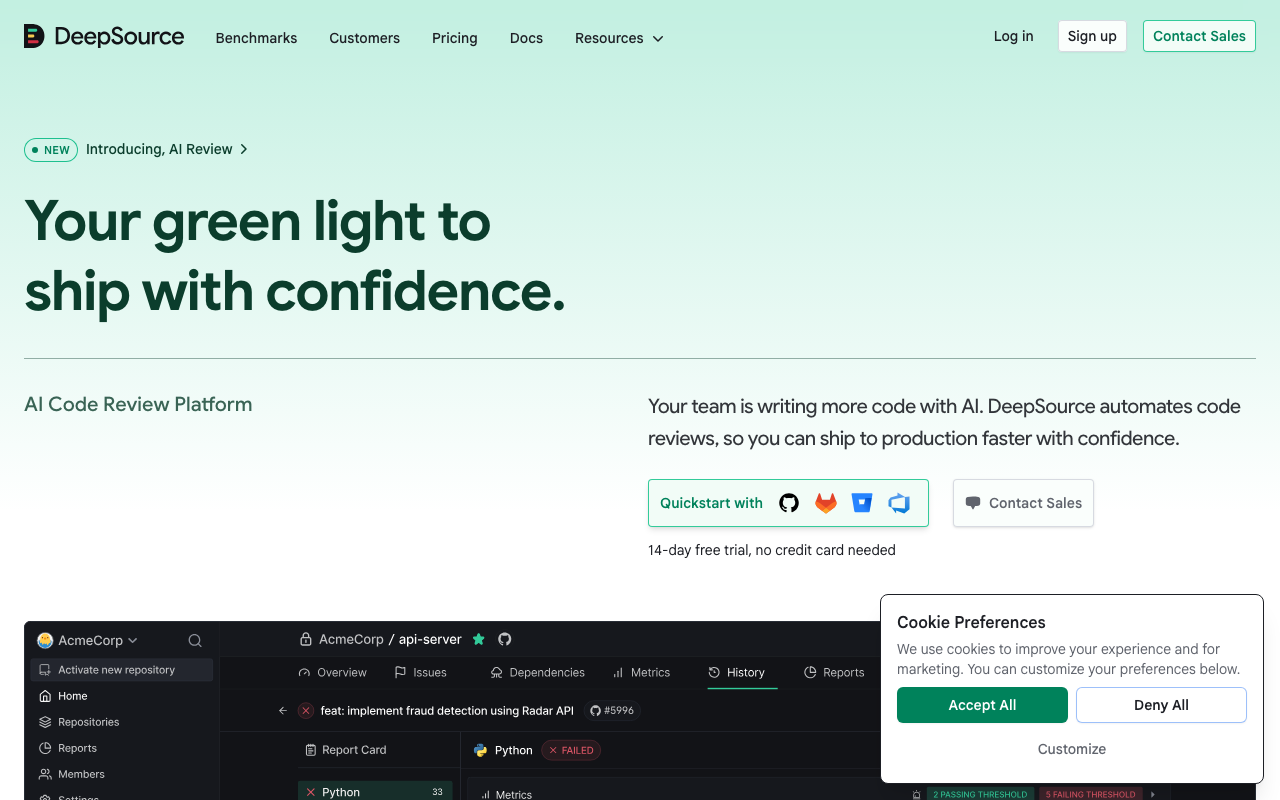
DeepSource and Qodana are both code quality platforms that bring static analysis into CI/CD pipelines - but they come from fundamentally different philosophies, serve different audiences, and are not really competing for the same buyer in most cases.
DeepSource is a modern AI code review and static analysis platform. It combines 5,000+ analysis rules with an industry-leading sub-5% false positive rate, LLM-powered Autofix AI that generates working code fixes, and structured AI code review across five quality dimensions on every pull request. Its February 2026 pricing restructuring pushed the Team plan to $24/user/month, reflecting its repositioning as a premium AI-enabled platform rather than a static analysis commodity.
Qodana is JetBrains’ code quality platform built on the IntelliJ inspection engine. Its defining feature is IDE consistency - it runs the exact same 3,000+ inspections in your CI/CD pipeline that your developers see in IntelliJ IDEA, WebStorm, PyCharm, and GoLand. It has no AI capabilities whatsoever, but at $6/contributor/month for the Ultimate tier, it is the most affordable paid code quality platform on the market by a significant margin.
Choose DeepSource if: your team wants minimal false positives, AI-powered automated remediation, structured PR report cards across five quality dimensions, or security scanning aligned to OWASP Top 10 and SANS Top 25. The $24/user/month Team plan bundles all of these capabilities including bundled AI credits.
Choose Qodana if: your developers use JetBrains IDEs and you want perfect consistency between IDE inspections and CI/CD analysis, your budget is constrained and $6/contributor/month matters, you work with Azure DevOps (DeepSource does not support it), or your primary focus is JVM languages where the IntelliJ engine provides exceptional depth.
For most teams that are not already committed to the JetBrains ecosystem, DeepSource is the more compelling platform in 2026. Its AI capabilities, lower false positive rate, and automated remediation represent a genuine advance over deterministic-only analysis. Qodana wins primarily on price and the unique IDE-consistency value for JetBrains shops.
At-a-Glance Comparison
| Dimension | DeepSource | Qodana |
|---|---|---|
| Vendor | DeepSource Inc. | JetBrains |
| Primary focus | AI code review + static analysis | IDE-consistent static analysis |
| Analysis rules | 5,000+ | 3,000+ IntelliJ inspections |
| Languages (GA) | 16 | 60+ (depth varies by language) |
| False positive rate | Sub-5% (industry-leading) | Low for JVM; variable for others |
| AI code review | Five-dimension PR report cards | None |
| LLM-powered autofix | Autofix AI (context-aware, near-universal) | None - rule-based Quick-Fix only |
| Autonomous agents | DeepSource Agents (agentic security) | None |
| SAST | Yes (OWASP Top 10, SANS Top 25) | Basic (Ultimate); taint analysis (Ultimate Plus) |
| Secrets detection | 30+ services | Not a primary feature |
| SCA (dependency scanning) | No | License compliance checking |
| Code coverage tracking | Yes (code health dashboards) | Yes (Ultimate tier) |
| Quality gates | Supported | Yes - configurable |
| IDE integration | VS Code, IntelliJ, PyCharm | JetBrains IDEs (identical inspection results) |
| Git platforms | GitHub, GitLab, Bitbucket | GitHub, GitLab, Bitbucket, Azure DevOps |
| CI/CD systems | Webhook-based (any CI) | Docker-based (GitHub Actions, GitLab CI, Azure Pipelines, Jenkins, TeamCity, CircleCI) |
| Self-hosted | Enterprise plan (custom) | Available (custom pricing) |
| Free tier | Open Source plan (public repos, 1,000 runs/month) | Community tier (limited inspections, 30-day history) |
| Paid pricing | $24/user/month (Team) | $6/contributor/month (Ultimate); $15 (Ultimate Plus) |
| Trial | Available | 60 days, no credit card required |
What Is DeepSource?
DeepSource began as a static analysis startup focused on one problem: reducing the noise that makes developers distrust code quality tools. Its sub-5% false positive rate became its signature differentiator, and user reviews consistently confirm that unlike SonarQube or Codacy, DeepSource findings are almost always worth acting on.
Over the past two years, DeepSource has transformed into a full AI code review platform. The February 2026 pricing restructuring - replacing old plans with an Open Source tier for public repos and a Team plan at $24/user/month for commercial teams - reflects this repositioning. The Team plan is no longer just static analysis; it bundles AI code review with five-dimension PR report cards, Autofix AI that generates working code fixes for nearly all detected issues, security scanning aligned to OWASP Top 10 and SANS Top 25, secrets detection for 30+ services, and bundled AI credits.
The platform supports 16 languages at GA level: Python, JavaScript, TypeScript, Go, Java, Ruby, Rust, C#, PHP, Scala, Dart, Shell, SQL, Docker, Terraform, and Ansible. Beta support covers C/C++, Swift, and Kotlin. Analysis runs automatically on every pull request via webhook integration with GitHub, GitLab, and Bitbucket - no CI/CD configuration required.
DeepSource Agents, launched in 2025, represent the platform’s push into agentic AI. Agents observe every line written in the codebase, reason about changes with full context, and take autonomous action to secure code - including creating pull requests and managing CVEs. This moves DeepSource from passive analysis to proactive code security in a way that no deterministic static analysis tool can match.
For full details, see our DeepSource review and DeepSource pricing guide.
What Is Qodana?
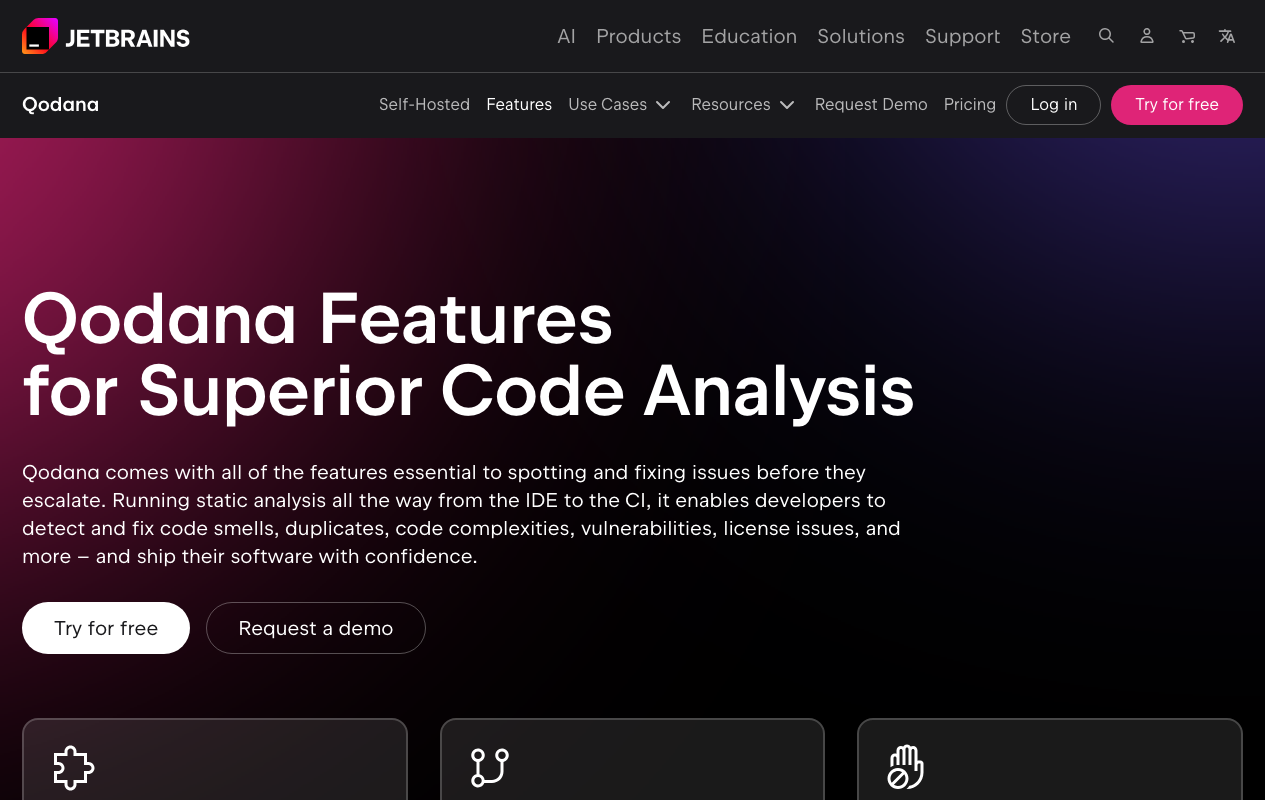
Qodana is JetBrains’ answer to a problem that frustrated JetBrains IDE users for years: the inspections that caught issues in IntelliJ IDEA, WebStorm, and PyCharm had no equivalent in the CI/CD pipeline. Code that looked clean locally could pass IDE inspections and still fail pipeline quality checks using a different tool like SonarQube - because the two tools ran entirely different rule engines.
Qodana eliminates this gap by running the exact same IntelliJ inspection engine in CI/CD. The 3,000+ inspections that developers see in their IDE are the same ones that run in the pipeline. When Qodana flags an issue in a pull request, a developer can open their IDE, navigate to the same location, and see the same finding - with the same explanation and the same suggested fix. This consistency builds trust in the quality process and reduces the cognitive overhead of context-switching between development and review environments.
Qodana runs as a Docker container in your CI/CD pipeline, making it compatible with any build system. JetBrains provides pre-built integrations for GitHub Actions, GitLab CI/CD, Azure Pipelines, Jenkins, TeamCity, and CircleCI. The Ultimate tier at $6/contributor/month (minimum 3 contributors) is the most affordable paid code quality platform on the market, making enterprise-grade analysis accessible to teams where cost is a primary constraint. The Ultimate Plus tier at $15/contributor/month adds taint analysis for OWASP Top 10, SSO/SAML, and unlimited historical data retention.
Qodana has no AI capabilities - no AI code review, no LLM-powered autofix, no autonomous agents. It is a deterministic static analysis platform, and its feature set reflects that. Teams that want both Qodana’s IDE consistency and AI-powered review need to pair it with a separate tool.
Feature-by-Feature Breakdown
Analysis Depth and False Positive Rate
This is the dimension that most directly affects day-to-day developer experience, and it is where the tools diverge most sharply.
DeepSource’s sub-5% false positive rate is its most consistently praised feature. The platform applies a sophisticated post-processing framework that filters irrelevant results before they reach developers. Across G2 and Capterra reviews, users repeatedly cite that DeepSource findings are nearly always worth investigating, in contrast to tools that generate so much noise that developers start ignoring findings entirely. This signal quality drives higher adoption within teams - developers who trust a tool actually act on its findings rather than dismissing them as background noise.
DeepSource’s 5,000+ rules cover code quality, security vulnerabilities, performance issues, and anti-patterns across all 16 GA languages. The rule database has been built specifically to prioritize actionable findings over comprehensive coverage - a deliberate trade-off that favors developer trust over raw rule count.
Qodana’s precision depends heavily on the language. For JVM languages (Java, Kotlin, Groovy, Scala), the IntelliJ inspection engine has been refined over more than 20 years of JetBrains IDE development, and the precision is exceptional - comparable to or better than any other tool. For JavaScript and TypeScript (via the WebStorm engine), Python (via PyCharm), and Go (via GoLand), precision is also strong because dedicated JetBrains linters power those inspections. For other languages in Qodana’s 60+ language list, the depth and precision of analysis varies considerably. The 60-language claim requires scrutiny - Ruby, Rust, Dart, and others receive meaningful but significantly shallower coverage than the JVM tier.
For teams working primarily in JVM languages, Qodana’s analysis depth rivals DeepSource’s. For teams working in Python, JavaScript, or Go, both tools offer strong coverage. For teams working across a heterogeneous language stack, DeepSource’s consistent 16-language depth often wins over Qodana’s variable 60-language breadth.
AI Capabilities
This is the starkest difference between the two tools, and it matters enormously for how teams experience code quality analysis in 2026.
DeepSource has a comprehensive AI capability stack:
AI Code Review with Five-Dimension Report Cards. Every pull request receives a structured report card evaluating code across Security, Reliability, Complexity, Hygiene, and Coverage. This structured approach lets developers and reviewers quickly understand the overall quality of a change rather than parsing through dozens of individual findings. The AI component detects issues that static analysis rules cannot catch - architectural concerns, semantic errors, missing edge case handling, and logic problems that are correct syntactically but wrong functionally.
Autofix AI. This is DeepSource’s most distinctive feature. Rather than just identifying problems, Autofix AI generates context-aware fixes for nearly all detected issues. The system analyzes not just the problematic code but surrounding context - imports, related functions, project-specific coding patterns - to produce idiomatic fixes that fit the existing codebase. Developers can apply fixes with a single click. DeepSource is also introducing Iterative Fix Refinement, allowing developers to provide feedback at the diff level and request improved fixes on the spot. Teams report 30-40% reduction in manual remediation workload.
DeepSource Agents. These represent the cutting edge of autonomous code security. Agents observe every line written in the codebase, reason about changes with all available context (including a graph of code and third-party dependencies, organizational memory, and historical patterns), and take autonomous action - creating pull requests, managing CVE responses, and proactively securing code before issues are even reported. This is not a feature Qodana offers at any tier or price point.
Qodana has zero AI capabilities. There is no AI code review, no LLM-powered autofix, no intelligent triage, and no autonomous agents. Qodana’s Quick-Fix suggestions are rule-based - they mirror the fix suggestions available in JetBrains IDEs, which are deterministic pattern-based corrections. This is not a criticism of Qodana’s design philosophy; it is a deterministic static analysis tool and is excellent at what it does. But teams that want AI-powered analysis alongside rule-based inspection need to either choose DeepSource or pair Qodana with a dedicated AI review tool like CodeRabbit.
The AI gap between DeepSource and Qodana is the primary reason the pricing gap exists. DeepSource at $24/user/month is not just “more expensive static analysis” - it is a qualitatively different product category that bundles AI code review, automated remediation, and autonomous agents alongside traditional static analysis.
Security Scanning
DeepSource provides meaningful security coverage on its Team plan. Security vulnerability detection is aligned to OWASP Top 10 and SANS Top 25, covering injection, authentication flaws, cryptographic weaknesses, and other common vulnerability categories across all 16 GA languages. Secrets detection covers 30+ services - AWS credentials, API keys, database passwords, authentication tokens. DeepSource Agents extend security coverage to autonomous CVE management and proactive threat response. The security reporting includes Issue Distribution, Issues Prevented, and Maintainability Index metrics.
Qodana’s security offering is tier-dependent and language-limited. The Ultimate tier ($6/contributor/month) includes basic security vulnerability detection, but taint analysis - the technique that traces user input through code to detect injection vulnerabilities like SQL injection and XSS - is only available on the Ultimate Plus tier ($15/contributor/month). Critically, taint analysis in Qodana covers only Java, Kotlin, PHP, and Python. Teams working in JavaScript, TypeScript, Go, or other languages do not get taint analysis even on the Ultimate Plus tier. There is no meaningful secrets detection in Qodana.
For security-conscious teams, DeepSource’s Team plan provides better security coverage than Qodana Ultimate, and comparable but broader coverage than Qodana Ultimate Plus (since DeepSource covers more languages). However, neither tool provides the comprehensive security platform coverage of Codacy (SAST + SCA + DAST + secrets), Semgrep (deep cross-file taint analysis), or Snyk Code (SAST + SCA with reachability analysis). For teams where security scanning is the primary driver, a dedicated security tool may be warranted in addition to either DeepSource or Qodana.
IDE Integration and Developer Experience
Qodana’s IDE integration is uniquely powerful for JetBrains users. The guarantee that IDE inspections and CI/CD pipeline analysis produce identical results is not just a convenience feature - it changes the nature of the quality feedback loop. Developers who see a Qodana finding in a CI/CD pipeline can immediately understand it because they have already seen the same inspection in their IDE. There is no translation step, no “but it looked fine locally” confusion, and no divergence between what is enforced and what is visible during development. JetBrains IDE users can also view Qodana Cloud results directly within their IDE, creating a seamless workflow from detection to investigation to fix.
DeepSource’s IDE integration is conventional but effective. VS Code, IntelliJ IDEA, and PyCharm plugins provide real-time feedback as developers write code, surfacing issues before they reach the PR stage. The IDE experience complements the cloud analysis but is not its core differentiator. For teams already using VS Code as their primary editor - which describes most JavaScript, TypeScript, and Python developers - DeepSource’s IDE integration is perfectly adequate without offering the same seamless consistency that Qodana provides JetBrains users.
For non-JetBrains users, Qodana’s IDE consistency advantage disappears. A team using VS Code gets almost no benefit from Qodana’s core differentiating feature. The analysis still runs in CI/CD and provides valuable findings, but the consistency guarantee only applies when developers are using JetBrains IDEs. For VS Code-centric teams, DeepSource’s IDE integration is comparable or better, particularly given the real-time AI-powered feedback.
Git Platform and CI/CD Support
Qodana has broader platform support. It integrates with GitHub, GitLab, Bitbucket, and Azure DevOps - plus Jenkins, TeamCity (JetBrains’ own CI system), CircleCI, and other CI/CD systems. Azure DevOps support is a meaningful differentiator because several major DeepSource competitors, including Codacy and DeepSource itself, do not support it.
DeepSource supports GitHub, GitLab, and Bitbucket but not Azure DevOps. For teams on Microsoft’s DevOps stack, this is a hard blocker. DeepSource’s webhook-based integration model works with any CI/CD system for triggering analysis, but the native pull request integration that enables PR decoration, inline comments, and quality gate status checks requires one of the three supported Git platforms.
If your team is on Azure DevOps, Qodana is the better choice between these two tools. SonarQube is the other primary option with deep Azure DevOps integration, but Qodana’s price advantage over SonarQube’s commercial editions is significant.
Configuration and Management
DeepSource configuration is repository-centric and developer-friendly. A .deepsource.toml file in the repository root specifies which analyzers to enable, which files to exclude, and how to configure analysis behavior. This configuration lives alongside the code, is version-controlled, and is reviewed as part of normal code review. Setup is minimal - the platform detects the tech stack and suggests appropriate analyzers. Unlike SonarQube, there is no server infrastructure, no scanner to install in CI pipelines (analysis is cloud-hosted), and no complex initial configuration. Time from signup to first analysis is under 10 minutes.
Qodana configuration uses a qodana.yaml file in the repository root that specifies which linter to use, which inspections to enable or disable, baseline settings, and quality gate thresholds. The configuration is clear and version-controlled. Because Qodana runs as a Docker container, CI/CD pipeline configuration is required - but JetBrains provides ready-made templates for all major CI systems. Teams using TeamCity get the tightest native integration. Teams using other CI systems add a few lines to their pipeline configuration using JetBrains’ provided actions and templates.
A notable Qodana configuration advantage is the baseline feature. For teams adopting code quality tooling on legacy projects with thousands of existing issues, Qodana’s baseline distinguishes pre-existing problems from newly introduced ones. This prevents the common failure mode where a tool’s findings are so overwhelming on day one that teams give up on adoption. DeepSource has similar capabilities, but Qodana’s baseline has been refined specifically for this scenario and is particularly well-executed.
Pricing Comparison
DeepSource Pricing
| Plan | Price | What You Get |
|---|---|---|
| Free (Individual) | $0 | Individual developers - public and private repos, basic static analysis, limited features |
| Open Source | $0 | Open-source organizations - unlimited public repos, 1,000 PR reviews/month, 1,000 formatting runs/month, AI features pay-as-you-go |
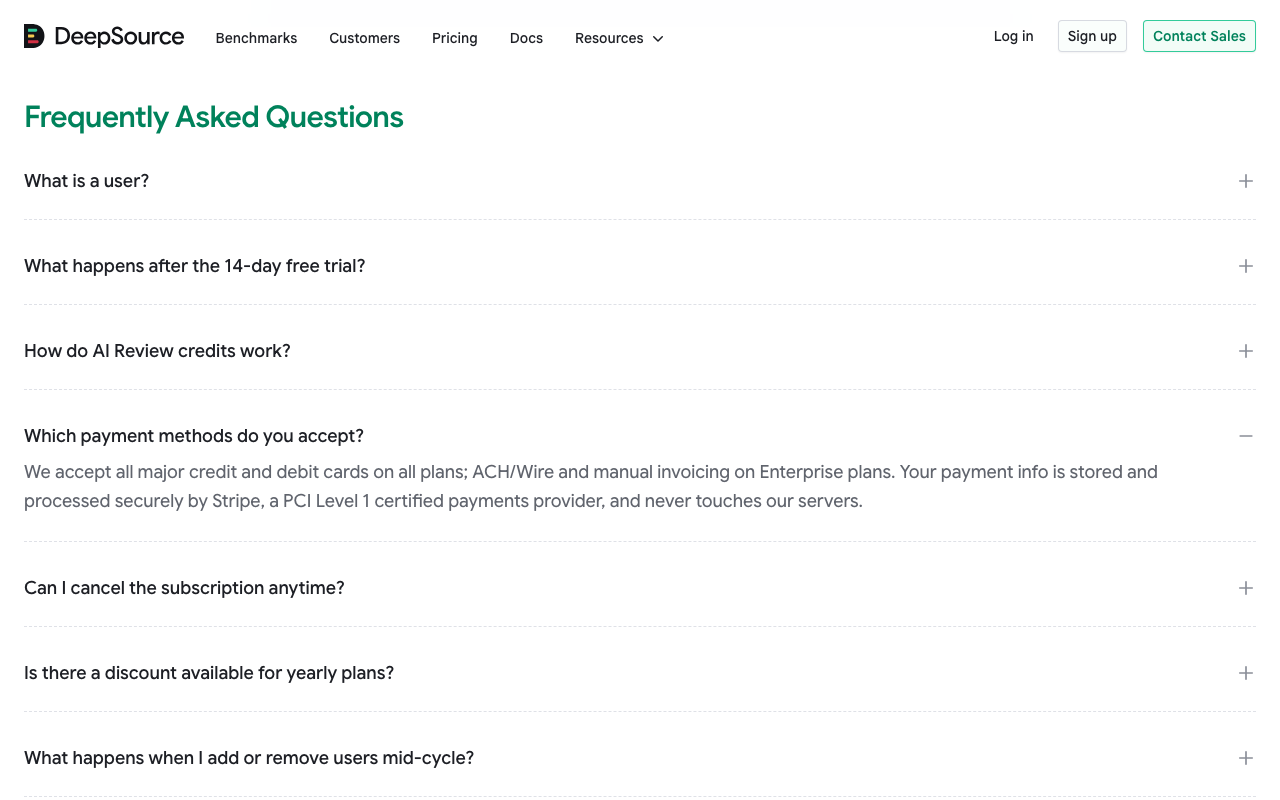
| Team | $24/user/month | All features - AI code review, Autofix AI, security scanning (OWASP, SANS), secrets detection, code health dashboards, bundled AI credits ($120/user/year), priority support |
| Enterprise | Custom | Everything in Team + self-hosted, SSO/SCIM, airgapped deployment, dedicated account manager, custom SLA |
DeepSource uses committer-based billing - you pay only for users who actually push code to analyzed repositories, not every seat in your organization. This can significantly reduce actual costs for teams where a subset of members are active contributors versus read-only stakeholders.
For a detailed DeepSource pricing breakdown, see our DeepSource pricing guide.
Qodana Pricing
| Plan | Price | What You Get |
|---|---|---|
| Community | $0 | Community-edition linters only, subset of languages (Java, Python, C, C++, C#, Go), limited inspections, 30-day history |
| Ultimate | $6/contributor/month (min. 3) | Full IntelliJ engine with 3,000+ inspections, 60+ languages, security detection, license compliance, coverage analysis, Quick-Fix, FlexInspect, 180-day history |
| Ultimate Plus | $15/contributor/month (min. 3) | Everything in Ultimate + taint analysis (OWASP Top 10, Java/Kotlin/PHP/Python only), advanced license audit, SSO/SAML, public API, unlimited history |
| Self-Hosted | Custom | Custom pricing - contact JetBrains sales |
Qodana’s active-contributor pricing counts anyone who made commits to analyzed projects within the past 90 days. The 60-day free trial with no credit card required is among the most generous in the market.
Side-by-Side Cost at Scale
| Team Size | Qodana Ultimate (Annual) | DeepSource Team (Annual) | Cost Difference |
|---|---|---|---|
| 5 devs | $360 | $1,440 | DeepSource 4x more expensive |
| 10 devs | $720 | $2,880 | DeepSource 4x more expensive |
| 20 devs | $1,440 | $5,760 | DeepSource 4x more expensive |
| 50 devs | $3,600 | $14,400 | DeepSource 4x more expensive |
| 100 devs | $7,200 | $28,800 | DeepSource 4x more expensive |
The fourfold price difference is consistent and significant. But the cost comparison is only meaningful when contextualized by capability. Qodana at $6/contributor/month buys you excellent deterministic static analysis with JetBrains IDE consistency and no AI capabilities. DeepSource at $24/user/month buys you static analysis plus AI code review, Autofix AI, DeepSource Agents, and bundled AI credits. If your team does not need AI capabilities, Qodana is almost certainly the better value. If your team wants AI-powered remediation and review, Qodana does not offer those capabilities at any price point.
An important comparison point: DeepSource at $24/user/month versus Qodana Ultimate Plus at $15/contributor/month. At $15/contributor/month, Qodana adds taint analysis and SSO. DeepSource at $24/user/month includes AI code review, Autofix AI, Agents, and security scanning across more languages. The $9/month premium for DeepSource over Qodana Ultimate Plus buys significantly more capability for teams that can use it.
Use Cases - When to Choose Each
When Qodana Makes More Sense
JetBrains-centric development teams. If your developers spend their days in IntelliJ IDEA, WebStorm, PyCharm, GoLand, or Rider, Qodana’s IDE-consistency advantage is genuine and meaningful. The ability to investigate and fix CI/CD findings directly in the familiar IDE, with identical inspection results and the same Quick-Fix suggestions, removes significant friction from the code quality workflow. No other tool provides this guarantee. DeepSource’s IDE plugins are useful but do not offer the same native consistency.
Budget-constrained teams needing serious analysis. A 10-developer team pays $720/year for Qodana Ultimate versus $2,880/year for DeepSource Team. If budget is tight and the primary requirement is solid static analysis - not AI-powered review or automated remediation - Qodana delivers enterprise-grade analysis at a price that is difficult to argue against. The 60-day free trial allows thorough evaluation before any financial commitment.
JVM-heavy engineering organizations. Java, Kotlin, and Groovy teams get the deepest analysis available anywhere from Qodana, reflecting JetBrains’ two-decade heritage in JVM development tooling. The 3,000+ IntelliJ inspections for JVM languages surpass most competitors in both breadth and precision. Teams with large Java or Kotlin codebases will notice the difference in analysis quality relative to tools that treat JVM languages as second-class citizens.
Organizations on Azure DevOps. If your Git platform is Azure DevOps, Qodana is one of the few code quality tools that integrates natively. DeepSource does not support Azure DevOps. For organizations committed to Microsoft’s DevOps stack, Qodana is the more practical choice between these two tools.
Teams that want to try before committing financially. Qodana’s 60-day trial with no credit card required allows teams to run the full Ultimate tier in production conditions for two months before any billing conversation. This is a generous evaluation window that removes the pressure to make a decision within the typical two-week trial period.
When DeepSource Makes More Sense
Teams frustrated with false positive noise from other tools. If your developers have started ignoring static analysis findings because there are too many irrelevant results, DeepSource’s sub-5% false positive rate is the most compelling argument for switching. The platform was built from the ground up to maximize signal-to-noise ratio, and its precision is consistently cited as the primary reason teams switch from SonarQube, Codacy, or Code Climate.
Teams that want automated remediation. Autofix AI is a genuine productivity multiplier. When DeepSource identifies an issue, it does not just describe the problem - it generates a contextually appropriate, idiomatic fix ready to apply with a single click. For teams dealing with significant technical debt or maintaining codebases with recurring pattern violations, automated remediation reduces manual effort meaningfully. Qodana’s Quick-Fix suggestions are rule-based and more limited. If automating the resolution of findings matters as much as the findings themselves, DeepSource is the clear choice.
Teams that want AI-powered PR review. The five-dimension PR report cards (Security, Reliability, Complexity, Hygiene, Coverage) provide a structured quality summary that goes beyond what static analysis rules can detect. The AI component identifies architectural concerns, logic errors, and missing edge cases that deterministic rules miss. Teams that have moved toward AI-assisted development with GitHub Copilot or Cursor will find DeepSource’s AI code review provides meaningful oversight of AI-generated code. Qodana provides no equivalent capability.
Security-conscious teams working outside JVM languages. DeepSource’s OWASP Top 10 and SANS Top 25 security scanning covers all 16 GA languages. Qodana’s taint analysis is restricted to Java, Kotlin, PHP, and Python even on the Ultimate Plus tier. JavaScript, TypeScript, and Go teams get better security coverage from DeepSource than from Qodana at any tier.
Teams not invested in the JetBrains ecosystem. For teams using VS Code, Neovim, or other non-JetBrains editors, Qodana’s primary differentiator is irrelevant. The IDE consistency advantage disappears when developers are not using JetBrains IDEs. For VS Code-centric teams, DeepSource provides a better overall experience - better IDE integration, AI capabilities, and lower false positive rates - without the JetBrains-specific benefits Qodana offers.
Alternatives Worth Considering
If neither DeepSource nor Qodana matches your requirements precisely, these alternatives are worth evaluating.
SonarQube remains the industry standard for enterprise code quality. Its 6,500+ rules across 35+ languages, the most mature quality gate system in the market, and the free Community Build for self-hosted deployment make it the default consideration for large engineering organizations. SonarQube’s analysis depth per language is exceptional, particularly with the dedicated rule set for Java (900+ rules), JavaScript, Python, and C#. The tradeoff is operational overhead - SonarQube requires server infrastructure, database management, and CI/CD integration, making it more complex to adopt than cloud-hosted alternatives. See our SonarQube vs DeepSource comparison and SonarQube vs Qodana comparison for detailed breakdowns.
Codacy occupies the middle ground between DeepSource and Qodana in terms of capabilities and pricing. At $15/user/month, it includes static analysis across 49 languages, SAST, SCA (dependency vulnerability scanning), secrets detection, DAST on the Business plan, and AI-powered PR review. Codacy’s AI Guardrails IDE extension is the only tool that scans AI-generated code in real time in VS Code, Cursor, and Windsurf. For teams that need an all-in-one security platform alongside code quality analysis, Codacy’s four-pillar security coverage (SAST + SCA + DAST + secrets) is difficult to match. See our DeepSource vs Codacy comparison for a detailed breakdown.
CodeAnt AI ($24-40/user/month) is a Y Combinator-backed AI code health platform that bundles AI PR reviews, SAST, secrets detection, IaC security, and DORA metrics engineering dashboards in a single tool. It supports 30+ languages and, notably, all four major Git platforms including Azure DevOps - making it a viable alternative for organizations on Microsoft’s DevOps stack who want AI-powered review. The Basic plan at $24/user/month competes directly with DeepSource’s Team plan; the Premium plan at $40/user/month adds SAST, IaC security, and compliance reporting comparable to Codacy’s Pro tier.
CodeRabbit is worth adding alongside either DeepSource or Qodana as a complementary AI review layer. Where DeepSource and Qodana provide rule-based static analysis, CodeRabbit uses large language models to understand code semantics, provide conversational PR review feedback, generate PR summaries, and offer context-aware suggestions that deterministic tools cannot produce. Teams using Qodana in particular may find that adding CodeRabbit covers the AI review gap that Qodana does not address. See our CodeRabbit vs DeepSource comparison for details.
Semgrep is the most powerful option for teams where security scanning is the primary concern. The open-source CLI provides cross-file taint analysis and custom rule authoring at zero cost. The Semgrep AppSec Platform (free for up to 10 contributors) adds SCA with reachability analysis, secrets detection with validation, and AI-powered triage. For teams that want deeper security analysis than either DeepSource or Qodana provides, Semgrep paired with either tool covers the security gap without replacing the code quality functionality.
Final Recommendation
The DeepSource vs Qodana comparison ultimately comes down to two questions: Does your team use JetBrains IDEs, and do you want AI capabilities?
If your team is on JetBrains IDEs and budget is a primary constraint: Qodana Ultimate at $6/contributor/month is the right answer. You get the full IntelliJ inspection engine with 3,000+ inspections, perfect IDE-CI/CD consistency, and quality gate enforcement at a price no competitor matches. The AI gap is real but can be addressed by adding a dedicated AI review tool like CodeRabbit without breaking the overall budget.
If your team uses VS Code, mixed editors, or non-JetBrains tooling: DeepSource is the stronger choice. Qodana’s defining advantage - IDE consistency - does not apply to your team. DeepSource’s sub-5% false positive rate, Autofix AI, and AI code review across five dimensions provide meaningfully better developer experience and productivity than Qodana’s deterministic-only approach. The $24/user/month cost is higher, but it buys a qualitatively different product.
If you are on Azure DevOps: Qodana is the better option between these two tools. DeepSource does not support Azure DevOps, and Qodana’s native Azure Pipelines integration makes it the practical choice.
If security scanning is your primary driver: Neither tool is the best option on its own. DeepSource’s OWASP/SANS scanning is better than Qodana’s, but both tools should be paired with a dedicated security tool like Semgrep or Snyk Code for comprehensive security coverage. Codacy’s all-in-one security platform (SAST + SCA + DAST + secrets) is worth evaluating if security is driving the purchasing decision.
For small teams (under 10) watching the budget: Qodana’s price advantage is difficult to dismiss. $720/year for 10 developers versus $2,880/year for DeepSource is a real difference for early-stage companies. Qodana’s 60-day free trial lets you validate the value before committing. If Qodana’s analysis quality meets your needs, the cost savings are significant enough to put toward other development tools.
For growing teams (10-50) that have moved toward AI-assisted development: DeepSource’s AI capabilities become more valuable as your team generates more code through tools like GitHub Copilot, Cursor, or Claude. Autofix AI reduces the remediation burden that scales with team size, and the five-dimension AI code review provides oversight of AI-generated code that static analysis rules alone cannot provide. The $24/user/month is justified when AI review and automated remediation replace manual review time.
The bottom line: Qodana wins on price and JetBrains ecosystem integration. DeepSource wins on AI capabilities, false positive rate, and developer experience for non-JetBrains users. Neither is the wrong choice - they serve genuinely different audiences, and understanding which audience you belong to makes the decision straightforward.
Frequently Asked Questions
Is DeepSource better than Qodana?
It depends on your team's priorities. DeepSource is better for teams that want AI-powered code review with structured five-dimension PR report cards, automated remediation through Autofix AI, and a sub-5% false positive rate that minimizes developer noise. Qodana is better for teams invested in JetBrains IDEs who need IDE-consistent analysis in CI/CD, budget-conscious teams who want the cheapest paid code quality platform at $6/contributor/month, and organizations working across 60+ languages including deep JVM coverage. If AI capabilities and signal quality matter most, choose DeepSource. If cost and JetBrains ecosystem integration matter most, choose Qodana.
How much does Qodana cost compared to DeepSource?
Qodana is significantly cheaper. The Qodana Ultimate tier costs $6/contributor/month (minimum 3 contributors), and Ultimate Plus costs $15/contributor/month. DeepSource's Team plan costs $24/user/month with annual billing. For a 20-developer team, Qodana Ultimate costs $1,440/year versus DeepSource's $5,760/year - a fourfold difference. However, DeepSource includes AI code review with bundled AI credits at $24/user/month, while Qodana offers no AI-powered review at any tier. The price difference largely reflects DeepSource's AI capabilities versus Qodana's deterministic-only approach.
Does Qodana have AI code review?
No. Qodana does not offer AI-powered code review at any tier. It is a deterministic static analysis platform that runs the IntelliJ inspection engine with 3,000+ rule-based inspections. Quick-Fix suggestions are rule-based, not AI-generated. Qodana does not have equivalents to DeepSource's AI code review with five-dimension PR report cards, LLM-powered Autofix AI, or DeepSource Agents for autonomous code security. Teams that want AI-powered code review alongside static analysis should choose DeepSource or pair Qodana with a dedicated AI review tool like CodeRabbit.
Which tool has fewer false positives?
DeepSource has a measurably lower false positive rate. DeepSource markets a sub-5% false positive rate and this is consistently confirmed by user reviews on G2 and Capterra - developers report that nearly every DeepSource finding is worth acting on. Qodana's false positive characteristics depend heavily on the language and inspection set. For JVM languages where the IntelliJ engine has decades of refinement, Qodana's precision is high. For other languages, the noise level varies more. Teams switching from other tools to DeepSource for signal quality reasons consistently report fewer distractions from irrelevant findings.
Does DeepSource support more languages than Qodana?
No. Qodana supports 60+ languages while DeepSource supports 16 at GA level (Python, JavaScript, TypeScript, Go, Java, Ruby, Rust, C#, PHP, Scala, Dart, Shell, SQL, Docker, Terraform, Ansible) with beta support for C/C++, Swift, and Kotlin. However, raw language counts can be misleading. DeepSource's coverage depth within its 16 GA languages is strong and consistent. Qodana's 60+ language claim masks significant variation - JVM languages receive world-class coverage while other languages may receive much shallower analysis. Teams working in exotic or niche languages may find Qodana's breadth useful, while teams in mainstream languages are better served by DeepSource's depth.
Which tool is better for JetBrains IDE users?
Qodana is substantially better for JetBrains IDE users. Qodana's defining feature is that it runs the exact same IntelliJ inspection engine in CI/CD that developers use in IntelliJ IDEA, WebStorm, PyCharm, GoLand, Rider, and other JetBrains IDEs. The results are guaranteed to be identical between the IDE and the pipeline, eliminating the frustrating discrepancy where code looks clean locally but fails pipeline checks. DeepSource has IDE plugins for VS Code, IntelliJ IDEA, and PyCharm that provide real-time feedback, but the IDE experience is supplementary to the cloud analysis rather than the core differentiator. For JetBrains-centric teams, Qodana's IDE consistency is genuinely unique.
Does DeepSource work with Azure DevOps?
No. DeepSource supports GitHub, GitLab, and Bitbucket but does not integrate with Azure DevOps. Qodana does support Azure DevOps along with GitHub, GitLab, Bitbucket, Jenkins, TeamCity, and CircleCI, making it the more flexible choice for organizations on Microsoft's DevOps stack. Teams using Azure DevOps who want a code quality platform should consider Qodana or alternatives like SonarQube, both of which support Azure Pipelines natively.
Which tool is better for security scanning?
DeepSource provides better security scanning than Qodana at most tiers. DeepSource includes OWASP Top 10 and SANS Top 25 security scanning on its Team plan ($24/user/month), plus secrets detection for 30+ services and DeepSource Agents for autonomous code security. Qodana's security analysis depends heavily on the tier: the Ultimate tier ($6/contributor/month) provides basic security vulnerability detection, but taint analysis covering OWASP Top 10 is only available on the Ultimate Plus tier ($15/contributor/month) and only for Java, Kotlin, PHP, and Python. For teams prioritizing security scanning, DeepSource's Team plan provides broader security coverage than Qodana Ultimate but comparable coverage to Qodana Ultimate Plus at a higher price point.
What are the best alternatives to both DeepSource and Qodana?
The main alternatives include SonarQube, which provides the deepest rule coverage (6,500+ rules), strongest quality gate enforcement, and a free self-hosted Community Build. Codacy offers an all-in-one platform combining code quality, SAST, SCA, DAST, and secrets detection at $15/user/month. CodeAnt AI ($24-40/user/month) bundles AI PR review, SAST, IaC security, and DORA metrics in a single platform with Azure DevOps support. CodeRabbit is worth adding alongside either tool for AI-powered PR review. Semgrep is an excellent free open-source alternative for security-specific scanning. For a comprehensive overview, see our best code quality tools guide.
Can I use DeepSource and Qodana together?
Technically yes, but there is significant overlap in static analysis coverage and running both would generate duplicate findings for most issues. A more strategic pairing would be to use Qodana for its unique IDE-consistency value and add DeepSource's Autofix AI capabilities specifically for automated remediation, or vice versa. A better approach for most teams is to choose one static analysis platform based on their primary priorities and pair it with a complementary tool - for example, Qodana for analysis plus CodeRabbit for AI review, or DeepSource for analysis plus Semgrep for deeper security scanning.
Which tool is better for open-source projects?
Qodana's Community tier and the generous 60-day trial make it accessible for open-source evaluation, but the Community tier is quite limited in practice. DeepSource's Open Source plan provides stronger free coverage for public repositories - unlimited team members, unlimited public repos, and 1,000 pull request reviews per month, with AI Review and Autofix available on a pay-as-you-go basis. For open-source projects, DeepSource's Open Source plan is more practically useful than Qodana's Community tier, which restricts both the languages available and the inspection set significantly.
How quickly can I set up DeepSource vs Qodana?
Both tools can be set up in under 15 minutes, but through different approaches. DeepSource setup involves connecting your GitHub, GitLab, or Bitbucket repository and adding a .deepsource.toml configuration file to your repository root. Analysis begins on the next pull request. Qodana runs as a Docker container in your CI/CD pipeline - you add a qodana.yaml configuration file and a few lines to your CI configuration using JetBrains' provided GitHub Actions, GitLab CI, Azure Pipelines, or Jenkins templates. Qodana has a more involved initial CI/CD setup but integrates tightly with TeamCity and JetBrains ecosystem tools without any additional configuration.
Explore More
Tool Reviews
 DeepSource Review
 JetBrains Qodana Review
Related Articles
- I Reviewed 32 SAST Tools - Here Are the Ones Actually Worth Using (2026)
- SonarQube Pricing in 2026: Community, Developer, Enterprise, and Cloud Costs Explained
- 13 Best Code Quality Tools in 2026 - Platforms, Linters, and Metrics
- Best Code Review Tools for JavaScript and TypeScript in 2026
- 12 Best Free Code Review Tools in 2026 - Open Source and Free Tiers
Free Newsletter
Stay ahead with AI dev tools
Weekly insights on AI code review, static analysis, and developer productivity. No spam, unsubscribe anytime.
Join developers getting weekly AI tool insights.
Related Articles
Checkmarx vs Veracode: Enterprise SAST Platforms Compared in 2026
Checkmarx vs Veracode - enterprise SAST, DAST, SCA, Gartner positioning, pricing ($40K-250K+), compliance, and when to choose each AppSec platform.
March 13, 2026
comparisonCodacy Free vs Pro: Which Plan Do You Need in 2026?
Codacy Free vs Pro compared - features, limits, pricing, and when to upgrade. Find the right Codacy plan for your team size and workflow.
March 13, 2026
comparisonCodacy vs Checkmarx: Developer Code Quality vs Enterprise AppSec in 2026
Codacy vs Checkmarx - developer code quality vs enterprise AppSec, pricing ($15/user vs $40K+), SAST, DAST, SCA, compliance, and when to choose each.
March 13, 2026