Free SonarQube Alternatives: Open Source Options
Discover the best free SonarQube alternatives for code quality and security. Open source tools, free tiers, and budget options compared.
Published:
Why look for free SonarQube alternatives
SonarQube has been the default code quality platform for over 17 years, and for good reason. Its 6,500+ rules, quality gate enforcement, and technical debt tracking set the standard for static analysis. But SonarQube’s free offering - the Community Build (formerly Community Edition) - has limitations that push many teams to look elsewhere.
If you have already explored the broader landscape of SonarQube alternatives or reviewed SonarQube pricing in detail, you know that the paid editions start at $2,500/year for the Developer Edition and climb quickly from there. For solo developers, open-source maintainers, startups, and budget-conscious teams, those numbers are hard to justify - especially when capable free tools exist.
What makes the Community Build limiting
The free SonarQube Community Build is a real static analysis engine with real value. It runs the same core analyzer as the paid editions and includes 5,000+ rules across 30+ languages. But three missing features make it impractical for modern development workflows:
No branch analysis. You can only scan a single branch, typically main. This means issues are discovered after code has been merged rather than during pull request review when fixes are cheapest.
No pull request decoration. There are no inline comments on pull requests showing findings in context. Developers have to leave their PR workflow, navigate to the SonarQube dashboard, and manually correlate findings with their changes.
No security hotspot review. Advanced security analysis features like security hotspot workflows are reserved for paid editions.
Beyond feature gaps, the self-hosting requirement adds cost that is not on the price tag. You need to provision a PostgreSQL database, configure JVM heap settings (8 GB minimum for production), manage Elasticsearch indices, and handle upgrade cycles. For a “free” tool, the operational overhead is substantial.
This guide covers 10 alternatives that provide meaningful code analysis at zero cost - whether through open-source licensing, free tiers for small teams, or free plans for public repositories.

1. Semgrep - Best free SAST platform
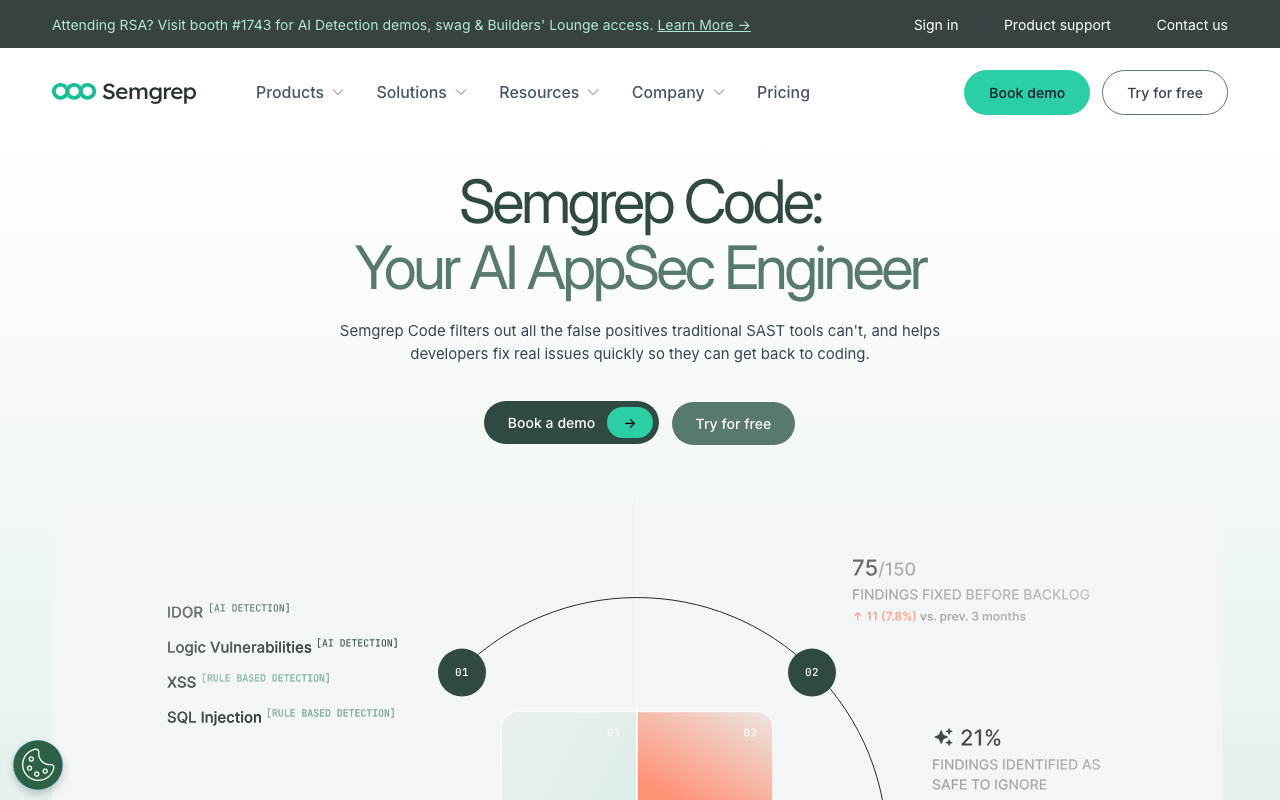
Semgrep is the strongest free alternative to SonarQube for teams that prioritize security scanning. Its free tier includes the full platform - SAST, SCA with reachability analysis, and secrets detection - for up to 10 contributors. For a detailed comparison, see our Semgrep vs SonarQube breakdown.
What you get for free:
- Full SAST scanning with cross-file taint analysis across 30+ languages
- 20,000+ Pro rules covering OWASP Top 10, CWE, and common vulnerability patterns
- SCA with reachability analysis that filters noise from unused vulnerable dependencies
- Secrets detection to catch hardcoded credentials
- Semgrep Assistant for AI-powered triage that reduces false positives by 20-40%
Why developers prefer it: Semgrep rules use syntax that looks like the source code being analyzed. Writing a custom rule takes minutes, not days. The scan speed is extraordinary - a median of 10 seconds in CI pipelines compared to SonarQube’s 2-10 minute scans.
# Example: detecting hardcoded passwords in Python
rules:
  - id: hardcoded-password
    pattern: password = "..."
    message: "Hardcoded password detected"
    severity: ERROR
    languages: [python]
Limitations: Semgrep is a security-focused tool. It does not provide code quality metrics, code smell detection, duplication analysis, complexity tracking, or quality gate enforcement. If you rely on SonarQube for code quality as well as security, Semgrep only covers half the picture.
Best for: Teams of 10 or fewer developers who need production-grade security scanning without paying for it.
2. ESLint, Pylint, and PMD - Language-specific linters
These three tools are fully open source, completely free, and collectively cover the languages where SonarQube is most commonly used. They do not replace SonarQube’s breadth, but within their respective ecosystems, they are arguably deeper.
ESLint (JavaScript/TypeScript): The industry-standard linter for JavaScript and TypeScript with hundreds of built-in rules plus thousands more via plugins. Virtually every professional JavaScript project uses ESLint. It integrates with every major editor and CI system, and its plugin ecosystem (eslint-plugin-security, eslint-plugin-react, typescript-eslint) extends its reach well beyond basic linting. For a direct comparison, see SonarQube vs ESLint.
Pylint (Python): A comprehensive Python linter that checks for errors, enforces coding standards, detects code smells, and provides refactoring suggestions. Pylint’s type inference catches bugs that simpler linters miss, and its module-level analysis detects import issues and circular dependencies. Combined with Ruff for formatting and speed, Pylint gives Python teams strong coverage.
PMD (Java, Apex, and more): An extensible cross-language analyzer with 400+ rules focused on common programming flaws, unused code, overcomplicated expressions, and copy-paste detection via CPD (Copy/Paste Detector). PMD supports Java, JavaScript, Apex, Visualforce, and several other languages. For details, read our SonarQube vs PMD comparison.
What you get for free: Everything. These are fully open-source tools with no licensing restrictions, no contributor limits, and no feature gates. You get the complete analysis engine and full rule sets.
Limitations: Each tool only covers one language or language family. None of them provide a unified dashboard, cross-language reporting, quality gate enforcement, or trend tracking over time. You need to manage configurations separately and aggregate results manually. There is no built-in security vulnerability scanning comparable to SonarQube’s SAST capabilities.
Best for: Teams working primarily in a single language who want deep, free, production-grade linting without needing a platform.
3. CodeFactor - Free for public repos
CodeFactor is a cloud-hosted code quality platform that provides free analysis for unlimited public repositories. It supports 15+ languages and delivers findings directly in your pull request workflow.
What you get for free:
- Unlimited public repository scanning
- Automated PR reviews with inline code annotations
- Quality metrics dashboard with code grade (A through F)
- Support for 15+ languages including JavaScript, Python, Java, Ruby, Go, and C#
- Integration with GitHub, GitLab, and Bitbucket
Why it works as a SonarQube replacement: CodeFactor’s code grading system provides a simpler alternative to SonarQube’s quality gates. Each repository gets a letter grade based on code quality metrics, and the dashboard highlights files with the most issues. For open-source projects that need basic quality tracking without SonarQube’s infrastructure overhead, CodeFactor delivers meaningful value at zero cost.
Limitations: The free plan is limited to public repositories only. Private repo support starts at $7.49/month for 10 private repos. Rule depth is shallower than SonarQube’s, particularly for Java. No SAST security scanning, no SCA, and no custom rule authoring.
Best for: Open-source maintainers who want code quality visibility without self-hosting anything.
4. DeepSource - Free tier for individuals
DeepSource offers a free tier for individual developers that includes access to all analyzers, Autofix AI, and core code quality features. Its sub-5% false positive rate means the issues it flags are almost always worth fixing. For a deeper look at how it stacks up, see SonarQube vs DeepSource.
What you get for free:
- Full access to all language analyzers (16 languages at GA)
- Autofix AI for one-click remediation of detected issues
- Five-dimension PR report cards covering Security, Reliability, Complexity, Hygiene, and Coverage
- Public and private repository support
- GitHub and GitLab integration
Why it appeals to developers: DeepSource’s low false positive rate means developers trust its findings. Every issue that surfaces is likely a genuine problem worth addressing, which avoids the alert fatigue that plagues teams running SonarQube on large codebases. The Autofix feature generates context-aware fixes, reducing manual remediation effort.
Limitations: The free tier is limited to a single user. Teams of two or more need the Team plan at $30/user/month, which is more expensive than most alternatives. Language support (16 languages) is narrower than SonarQube’s 35+. No DAST or container scanning.
Best for: Solo developers or individual contributors who want a high-signal code quality tool at no cost.
5. Codacy - Free for small teams
Codacy provides a free plan covering up to 5 repositories with code quality analysis across 49 languages. It is the most direct SonarQube replacement on this list in terms of feature breadth - covering code quality, duplication, complexity, and coverage tracking under one roof.
What you get for free:
- Scanning for up to 5 repositories
- Code patterns and quality analysis across 49 languages
- Duplication detection and complexity metrics
- PR-level feedback on GitHub, GitLab, and Bitbucket
- Code coverage integration
Why it works as a SonarQube replacement: Codacy mirrors SonarQube’s all-in-one approach more closely than any other free option. You get quality rules, duplication detection, coverage tracking, and PR feedback - the same core capabilities that teams use SonarQube for, without provisioning any infrastructure. The 49-language support actually exceeds SonarQube’s 35+.
Limitations: The 5-repository limit is restrictive for teams with microservice architectures or monorepo setups that span many projects. Advanced features like SAST, SCA, secrets detection, and quality gates require the Pro plan at $15/user/month. See our Codacy vs SonarQube comparison for detailed differences.
Best for: Small teams with 5 or fewer repos who want SonarQube-like breadth without self-hosting.
6. SonarCloud - Free for public repos
SonarCloud is SonarSource’s own cloud-hosted service, and its free tier for public repositories addresses many of the Community Build’s limitations. If you want to stay in the SonarQube ecosystem without paying for the Developer Edition, SonarCloud’s free tier is the closest path. Our SonarQube vs SonarCloud comparison covers the nuances in depth.
What you get for free:
- Unlimited public repository analysis
- Branch analysis and pull request decoration (not available in Community Build)
- Security hotspot review
- Quality gates with configurable thresholds
- Same rule engine as SonarQube Server editions
- GitHub, GitLab, Azure DevOps, and Bitbucket integration
Why it matters: SonarCloud’s free tier for public repos includes branch analysis and PR decoration - the exact features that make the self-hosted Community Build impractical for team workflows. If your project is open source, SonarCloud gives you a near-complete SonarQube experience at zero cost.
Limitations: Only available for public repositories. Private repo analysis requires paid plans starting at approximately $14/month for 100K lines of code. LOC-based pricing applies to paid tiers, carrying the same unpredictability as SonarQube Server. Not self-hostable, so compliance-sensitive teams may have concerns about code leaving their infrastructure.
Best for: Open-source projects that want full SonarQube capabilities without paying or self-hosting.
7. CodeQL - Free semantic analysis for open source
CodeQL is GitHub’s semantic code analysis engine that treats code as queryable data. It performs deep vulnerability detection by modeling code as a database and running queries that trace data flow across functions and files. For a detailed comparison of how it differs from Semgrep, see Semgrep vs CodeQL.
What you get for free:
- Full semantic SAST for public repositories on GitHub
- Deep taint analysis tracing data flow across function and file boundaries
- 2,000+ community-maintained security queries
- Support for 10+ languages including C/C++, Java, JavaScript, Python, Go, Ruby, and C#
- Automated scanning via GitHub Actions with zero configuration via default setup
Why it excels at security: CodeQL’s query language lets security researchers write analysis rules at a level of precision that pattern-matching tools cannot match. Where Semgrep matches code patterns, CodeQL reasons about data flow semantics. This makes it particularly strong for detecting complex injection vulnerabilities, authentication bypass patterns, and insecure deserialization chains.
Limitations: Free only for public repos. Private repo scanning requires GitHub Advanced Security at $49/committer/month, making it one of the more expensive options for private code. CodeQL is purely a security tool with no code quality, code smell, or maintainability analysis. Scan times are significantly slower than Semgrep (minutes rather than seconds) because of the deeper analysis.
Best for: Open-source projects on GitHub that need deep security analysis beyond pattern matching.
8. Ruff - Fastest Python linter
Ruff is a Python linter and formatter written in Rust that runs 10-100x faster than traditional Python linting tools. It implements 800+ rules from Flake8, Pylint, pycodestyle, isort, pydocstyle, and other Python tools in a single binary. For Python-only teams, Ruff replaces the code quality half of SonarQube with dramatically better performance.
What you get for free:
- 800+ lint rules covering style, correctness, and best practices
- Auto-fix support for most rules
- Built-in import sorting (replaces isort)
- Built-in code formatting (replaces Black)
- First-party editor integrations for VS Code, Neovim, and others
- Full compatibility with pyproject.toml and ruff.toml configuration
Why developers love it: Ruff scans an entire codebase in milliseconds where Pylint and Flake8 take seconds to minutes. This speed difference transforms linting from a CI-only check into something developers run continuously in their editor without any perceived delay. The consolidation of multiple tools (Flake8, isort, Black, pycodestyle) into a single binary eliminates configuration sprawl and version compatibility headaches.
Limitations: Python only. No security vulnerability scanning - you need to pair Ruff with Bandit or Semgrep for SAST coverage. No web dashboard, quality gates, or trend tracking. No code duplication detection. Ruff is a command-line tool, not a platform.
Best for: Python teams who want blazing-fast linting and formatting at zero cost.
9. Qodana - Free Community tier, cheapest paid upgrade
Qodana is JetBrains’ code quality platform, and it is the closest structural match to SonarQube on this list - a server-side analysis engine that runs in CI and enforces quality gates. The Community tier is free, and when you outgrow it the Ultimate plan is $6/contributor/month, the cheapest paid upgrade among SonarQube’s serious competitors.
What you get on the free Community tier:
- Community-edition linters for Java, Python, C, C++, C#, and Go
- CI/CD integration with GitHub Actions, GitLab CI, Jenkins, TeamCity, and Azure DevOps
- 30 days of historical data
- Baseline inspection reporting
Why it is relevant here: Qodana runs the same inspections that IntelliJ IDEA, PyCharm, and Rider run in the editor. If your team is already on JetBrains IDEs, findings in CI match what developers see locally, which eliminates the “the pipeline disagrees with my IDE” arguments that plague mixed toolchains. No other free alternative here offers that alignment.
The upgrade path: Ultimate at $6/contributor/month (three-contributor minimum) unlocks 60+ languages, the full 3,000+ inspection engine, security vulnerability detection, license compliance, quality gate enforcement, and 180 days of history. Ultimate Plus at $15/contributor/month adds taint analysis for the OWASP Top 10 and SSO/SAML. For a 10-person team, Ultimate runs $60/month against SonarQube Developer Edition’s roughly $210/month at 100K LOC.
Limitations: The free Community tier is genuinely limited - community-edition linters only, six languages, and no quality gate enforcement. Most teams that take Qodana seriously end up paying. The three-contributor minimum also means solo developers pay for three seats.
Best for: Teams already standardised on JetBrains IDEs, and any team that wants SonarQube-style quality gates at the lowest paid price point available.
10. SpotBugs and Bandit - Specialized open-source analyzers
Two fully open-source tools deserve mention for teams working in Java or Python who want targeted analysis that complements general-purpose linters.
SpotBugs (Java): The spiritual successor to FindBugs, SpotBugs performs bytecode analysis on compiled Java code to find real bugs - null pointer dereferences, infinite recursive loops, resource leaks, and concurrency issues. Because it analyzes bytecode rather than source code, it catches issues that source-level linters miss. SpotBugs is completely free, actively maintained, and integrates with Maven, Gradle, Eclipse, and IntelliJ.
Bandit (Python): A security-focused static analyzer designed specifically to find common security issues in Python code. Bandit checks for SQL injection, hardcoded passwords, use of insecure functions, and other OWASP-relevant vulnerabilities. It is maintained by the PyCQA community and integrates easily into CI pipelines.
Best for: Java teams (SpotBugs) and Python teams (Bandit) who want specialized analysis that goes deeper than general linters in their respective languages.
Comparison table: free SonarQube alternatives at a glance
| Tool | License / Free Tier | Languages | Code Quality | Security (SAST) | PR Decoration | Dashboard |
|---|---|---|---|---|---|---|
| Semgrep | Free (10 contributors) | 30+ | No | Yes | Yes | Yes |
| ESLint | Open source (MIT) | JS/TS | Yes | Limited | Via CI | No |
| Pylint | Open source (GPL) | Python | Yes | No | Via CI | No |
| PMD | Open source (BSD) | Java, JS, Apex | Yes | Limited | Via CI | No |
| CodeFactor | Free (public repos) | 15+ | Yes | No | Yes | Yes |
| DeepSource | Free (1 user) | 16 | Yes | Yes | Yes | Yes |
| Codacy | Free (5 repos) | 49 | Yes | Pro plan | Yes | Yes |
| SonarCloud | Free (public repos) | 30+ | Yes | Yes | Yes | Yes |
| CodeQL | Free (public repos) | 10+ | No | Yes | Yes (GitHub) | Via GitHub |
| Ruff | Open source (MIT) | Python | Yes | No | Via CI | No |
| SpotBugs | Open source (LGPL) | Java | Yes | Limited | Via CI | No |
| Bandit | Open source (Apache) | Python | No | Yes | Via CI | No |
| Qodana | Free tier / $6/contributor/mo | 60+ (paid) | Yes | Yes (paid) | Yes | Yes |
When to stay with SonarQube Community Build
The free alternatives listed above are genuinely capable, but SonarQube Community Build still makes sense in certain scenarios:
You need the deepest rule set available. SonarQube’s 5,000+ rules in the Community Build (6,500+ across paid editions) remain unmatched in breadth per language, especially for Java, C#, and JavaScript. No free alternative matches this depth across multiple languages simultaneously.
You already have the infrastructure. If your team already runs SonarQube on existing infrastructure with established DevOps processes, the marginal cost of keeping it running is low. The migration effort of switching tools may exceed the cost savings.
You need quality gate enforcement. SonarQube’s quality gate system - blocking merges when code fails defined thresholds for coverage, duplication, or issue density - is more sophisticated than what most free alternatives offer. Replicating this with CI-based checks using linters requires manual configuration.
Compliance and audit requirements. Regulated industries often need to demonstrate a consistent code quality process to auditors. SonarQube’s historical tracking and reporting capabilities provide documentation that ad-hoc linter configurations do not.
For teams where these scenarios do not apply, combining 2-3 free tools typically provides equivalent or better coverage than SonarQube Community Build with less infrastructure overhead.
Recommended free tool stacks
Instead of trying to find a single free tool that replicates everything SonarQube does, most teams get better results by combining focused tools. Here are three recommended stacks based on different needs.
Security-first stack (zero cost)
- Semgrep for SAST and secrets detection (free for 10 or fewer contributors)
- Language-specific linter (ESLint, Pylint, or PMD) for code quality
- Codecov or Coveralls free tier for coverage tracking
This stack gives you security scanning that exceeds SonarQube’s Community Build capabilities, plus code quality enforcement through your language’s native linter. The trade-off is managing three separate tools and aggregating results manually.
Python-focused stack (zero cost)
- Ruff for linting and formatting (replaces Flake8, isort, Black, and parts of Pylint)
- Bandit for security vulnerability detection
- Semgrep for cross-file taint analysis and advanced SAST
This combination gives Python teams faster, deeper analysis than SonarQube provides for Python specifically. Ruff handles code quality at extraordinary speed, Bandit catches Python-specific security issues, and Semgrep adds cross-file security analysis.
Java-focused stack (zero cost)
- PMD for code quality rules and copy-paste detection
- SpotBugs for bytecode-level bug detection
- Semgrep for SAST and vulnerability scanning
- Checkstyle for coding standard enforcement
This stack covers Java analysis from four angles - code quality, runtime bugs, security vulnerabilities, and style enforcement. Combined, these tools provide deeper Java analysis than SonarQube Community Build, though without a unified dashboard.
All-in-one budget stack (paid)
- Qodana Ultimate ($6/contributor/month) for code quality, security detection, and quality gate enforcement
For teams that want a single platform without assembling multiple tools, Qodana provides the closest equivalent to a paid SonarQube experience at a fraction of the cost. Check our best code quality tools guide for more options.
Final recommendations
If you are an open-source maintainer: Use SonarCloud’s free tier for public repos. It gives you the full SonarQube experience - branch analysis, PR decoration, quality gates - at zero cost.
If you are a solo developer or small team (10 or fewer): Start with Semgrep’s free tier for security scanning and your language’s native linter (ESLint, Pylint, PMD) for code quality. This combination provides better security coverage than SonarQube Community Build with less infrastructure overhead.
If you are a Python team: Ruff plus Bandit gives you faster and deeper Python-specific analysis than SonarQube. Add Semgrep for cross-file security analysis.
If you are a Java team: PMD plus SpotBugs covers quality and bug detection comprehensively. Add Semgrep or CodeQL for security scanning.
If you want one tool instead of many: Qodana Ultimate at $6/contributor/month bundles code quality, security detection, and quality gates into a single platform that is substantially cheaper than SonarQube’s paid editions.
If none of these fit: The broader SonarQube alternatives guide covers 15 tools across all price ranges, and our best code quality tools roundup covers the full landscape.
The days when SonarQube Community Build was the only serious free option for code quality are over. The tools listed here provide genuine, production-grade analysis that can match or exceed SonarQube’s free offering in their respective focus areas. The key is choosing the right combination for your language, team size, and workflow rather than looking for a single free tool that does everything.
Further Reading
 Gitar
GitarComments are not enough
Gitar applies the fix, validates it in CI, and clears the queue.
See it on your repo Read our independent Gitar reviewFrequently Asked Questions
What is the best free alternative to SonarQube?
Semgrep is the strongest free SonarQube alternative for security scanning, offering full SAST, SCA, and secrets detection free for up to 10 contributors. For code quality analysis, SonarQube's own Community Build remains the deepest free option with 5,000+ rules across 30+ languages. CodeQL is the best free option specifically for open-source projects on GitHub, providing deep semantic security analysis at no cost.
Is SonarQube Community Edition really free?
Yes, SonarQube Community Build (formerly Community Edition) is free to download and self-host with no licensing fees. However, it has significant limitations: no branch analysis, no pull request decoration, no security hotspot review, and reduced language support. You also need to provision and maintain your own server infrastructure, which carries indirect costs for compute, storage, and engineering time.
Can I replace SonarQube with ESLint or Pylint?
ESLint and Pylint can replace some of SonarQube's functionality within their respective languages. ESLint covers JavaScript and TypeScript linting, while Pylint handles Python. However, they lack cross-language support, security vulnerability detection, code duplication analysis, complexity metrics, quality gate enforcement, and dashboard reporting. They work best as part of a larger toolchain rather than as standalone SonarQube replacements.
Is CodeQL free to use?
CodeQL is free for public repositories on GitHub and for academic research. For private repositories, CodeQL requires a GitHub Advanced Security license, which is only available on GitHub Enterprise plans at $49/committer/month. The CodeQL CLI can be used locally for free on open-source projects, but commercial use on private code requires a license.
What free tools can replace SonarQube for security scanning?
Semgrep (free for up to 10 contributors), CodeQL (free for public repos), and Bandit (free Python security scanner) are the strongest free options for security scanning. Semgrep provides cross-file taint analysis and 20,000+ rules. CodeQL uses a semantic query language for deep vulnerability analysis. For a broader security stack at zero cost, you can combine Semgrep for SAST with Trivy for container and dependency scanning.
Is DeepSource free?
DeepSource offers a free tier for individual developers working on both public and private repositories. The free plan includes access to all analyzers, Autofix AI, and core code quality features but is limited to a single user. Teams of two or more require the Team plan at $30/user/month. For open-source projects, DeepSource is free regardless of team size.
What is the difference between SonarQube Community Build and SonarCloud free tier?
SonarQube Community Build is a self-hosted platform you run on your own servers with no per-user licensing fees. SonarCloud is SonarSource's cloud-hosted service that offers a free tier for public repositories only. SonarCloud's free tier includes features missing from Community Build such as branch analysis and PR decoration, but it only works with public repos. Community Build works with any repository but lacks those workflow features.
Can I use Ruff as a SonarQube replacement for Python?
Ruff can replace SonarQube's Python linting and code quality rules, and it does so 10-100x faster. Ruff implements 800+ rules from Flake8, Pylint, pycodestyle, isort, and other Python tools. However, Ruff is a linter and formatter only. It does not provide security vulnerability scanning, code duplication detection, quality gate enforcement, or a web dashboard. For full SonarQube replacement on Python projects, you would pair Ruff with Semgrep or Bandit for security.
Are free code quality tools good enough for production?
Yes, many free code quality tools are production-ready. ESLint is used by virtually every professional JavaScript project. Semgrep's free tier uses the same engine as its paid plans. SonarQube Community Build runs the same core analysis as the Enterprise edition. The main limitations of free tools are around workflow integration (PR decoration, branch analysis) and team management features (SSO, role-based access), not analysis quality.
What is the best free code quality tool for Java?
For Java, SonarQube Community Build provides the deepest free analysis with 600+ Java-specific rules covering bugs, code smells, and vulnerabilities. PMD is a strong open-source alternative with 400+ rules and a focus on common programming flaws. SpotBugs (the successor to FindBugs) performs bytecode analysis to find real bugs. Combining SonarQube Community Build with PMD and SpotBugs gives comprehensive free Java analysis.
How do I migrate from SonarQube to free tools?
Start by identifying which SonarQube features you actively use - code quality rules, security scanning, coverage tracking, or quality gates. Replace each with the appropriate free tool: Semgrep for security rules, ESLint or Pylint for language-specific linting, Codecov or Coveralls for coverage tracking, and GitHub Actions for quality gate enforcement via CI checks. Run both SonarQube and the replacement tools in parallel for 2-4 weeks to verify coverage before decommissioning.
Is Codacy free for open source?
Yes, Codacy offers a free plan that includes up to 5 repositories. For open-source projects, this covers basic code quality scanning across 49 languages with PR-level feedback. The free tier includes code patterns, duplication detection, and complexity analysis. Teams that need more than 5 repositories or advanced features like SAST, SCA, and quality gates need the Pro plan at $15/user/month.
What is the cheapest paid alternative to SonarQube?
Qodana by JetBrains is the cheapest paid alternative at $6/contributor/month with a free Community tier. Codacy at $15/user/month is the most direct SonarQube replacement at a lower price point. All three are significantly cheaper than SonarQube's paid editions, which start at approximately $2,500/year for the Developer Edition.
Explore More
Tool Reviews
 SonarQube Review
 Semgrep Review
 JetBrains Qodana Review
Free Newsletter
Stay ahead with AI dev tools
Weekly insights on AI code review, static analysis, and developer productivity. No spam, unsubscribe anytime.
Join developers getting weekly AI tool insights.
Related Articles
8 Best CodeRabbit Alternatives for AI Code Review in 2026
Looking beyond CodeRabbit? Compare 8 top AI code review alternatives with real features, pricing, honest pros/cons, and team recommendations.
February 17, 2026
alternatives10 Best GitHub Copilot Alternatives for Code Review (2026)
GitHub Copilot lacks deep code review. Compare 10 alternatives with better PR analysis, security scanning, and review automation. Includes pricing tips.
February 26, 2026
alternativesQodo AI Alternatives: 11 Best AI Test Gen Tools
Compare 11 Qodo alternatives for AI test generation and code review. Real pricing, feature comparisons, and honest trade-offs for each tool.
March 3, 2026