Best Free Snyk Alternatives for Vulnerability Scanning in 2026
Discover the best free Snyk alternatives for vulnerability scanning. Compare Trivy, Grype, Semgrep, CodeQL, and more open source security tools.
Published:
Why look for free Snyk alternatives
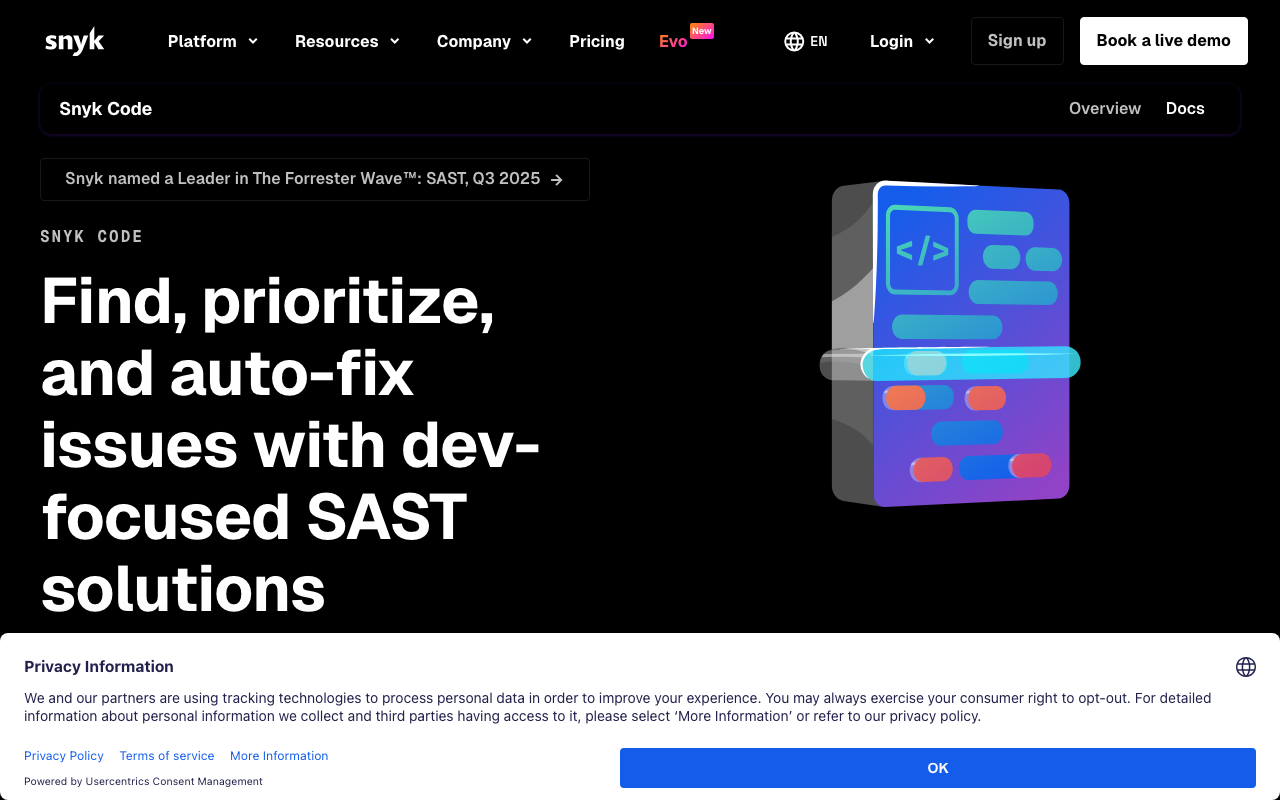
Snyk has earned its reputation as one of the most developer-friendly security platforms available. It covers four major areas of application security - SCA through Snyk Open Source, SAST through Snyk Code, container scanning through Snyk Container, and infrastructure as code analysis through Snyk IaC - all wrapped in a polished developer experience with IDE integrations, PR checks, and automated fix suggestions.
But Snyk’s free tier has real limitations that push teams toward alternatives.
The free tier caps usage at 5 users with restricted scan frequency. For a team of three working on a side project, this is workable. For a growing startup with 8 developers, a DevOps engineer, and a QA lead, you have already exceeded the free tier before writing your first security policy. The jump from free to the Team plan at $25 per developer per month is not trivial - a 10-person team faces a $3,000 annual bill just for the entry-level paid tier, scaling to $7,500 for 25 developers.
Scan frequency limits create blind spots. The free tier restricts how many tests you can run per month. If your team pushes multiple pull requests per day across several repositories, you will burn through the monthly allocation quickly. This means some PRs ship without security scans, which defeats the purpose of having a security tool in your pipeline. Free open source alternatives like Trivy and Semgrep have no scan caps whatsoever - you can run them on every commit, every PR, and every nightly build without hitting a paywall.
Feature gates lock critical capabilities behind paid tiers. Advanced reporting, custom policies, SSO, and extended API access all require paid plans. For teams that need to demonstrate security compliance for SOC 2 audits or customer security questionnaires, the free tier’s basic reporting is insufficient. Meanwhile, tools like OWASP Dependency-Check generate detailed HTML and JSON reports out of the box with no license restrictions.
Vendor lock-in concerns are legitimate. When your entire security pipeline depends on a single vendor’s free tier, any pricing change, feature restructuring, or policy update can disrupt your workflow overnight. Open source tools are immune to this - Trivy’s Apache 2.0 license and Semgrep’s LGPL-2.1 license guarantee that the core scanning capabilities remain free and available regardless of what the companies behind them decide about their commercial offerings.
If you have already evaluated the broader Snyk alternatives landscape and decided that cost is your primary driver, this guide focuses specifically on free and open source options that can replace Snyk’s functionality without a line item on your budget.
The free alternatives
1. Trivy - Best all-in-one open source scanner
Trivy, maintained by Aqua Security, is the closest thing to a free Snyk replacement that exists in a single tool. It covers vulnerability scanning for container images, filesystem dependencies, Git repositories, and Kubernetes clusters. It scans infrastructure as code files for misconfigurations. It generates Software Bills of Materials (SBOMs). It detects hardcoded secrets. And it does all of this as a single binary with zero external dependencies, completely open source under the Apache 2.0 license.
Where Snyk splits its capabilities across four separate products (Snyk Open Source, Snyk Code, Snyk Container, and Snyk IaC), Trivy bundles equivalent functionality into one CLI tool. Run trivy image your-app:latest to scan a container image. Run trivy fs . to scan your project directory for dependency vulnerabilities. Run trivy config . to analyze Terraform, CloudFormation, Dockerfile, and Kubernetes manifests for misconfigurations. Run trivy sbom . to generate a CycloneDX or SPDX SBOM.
Trivy’s vulnerability database updates automatically from multiple sources including the National Vulnerability Database (NVD), GitHub Security Advisories, and distribution-specific databases for Alpine, Red Hat, Ubuntu, Debian, and others. The database can be downloaded for offline use, which makes Trivy suitable for air-gapped environments where cloud-based tools like Snyk cannot operate.
For a deeper comparison of how Trivy stacks up against Snyk feature by feature, see Snyk vs Trivy.
Best for: Teams that want a single free tool covering container scanning, SCA, IaC analysis, and SBOM generation without paying anything.
Limitations: Trivy does not perform SAST (scanning your own source code for vulnerabilities like SQL injection or XSS). For that, you need to pair it with Semgrep, CodeQL, or Bandit. Trivy also lacks a web dashboard - results are CLI output, JSON, or SARIF files that you integrate into your own reporting.
Pricing: Completely free and open source. No usage limits, no contributor caps, no feature gates.
2. Grype - Best for fast container vulnerability scanning
Grype, built by Anchore, is a focused vulnerability scanner for container images and filesystems. While Trivy tries to do everything, Grype does one thing exceptionally well - matching software packages against known vulnerability databases with speed and accuracy.
Grype scans container images by pulling and analyzing their layers, identifying installed OS packages and application dependencies, and matching them against vulnerability feeds from NVD, GitHub Advisories, Alpine SecDB, Red Hat OVAL, and other sources. It supports package formats across the ecosystem - APK, DEB, RPM, npm, pip, Maven, Go modules, Ruby gems, Rust crates, and more.
The standout feature is speed. Grype is consistently one of the fastest vulnerability scanners available, completing full container image scans in seconds rather than minutes. For CI/CD pipelines where scan time directly impacts developer feedback loops, this matters. Grype also pairs naturally with Syft, another Anchore tool that generates SBOMs - run syft to create the SBOM, then grype to scan it for vulnerabilities.
Best for: Teams that need fast, reliable container and dependency vulnerability scanning without the broader scope of Trivy. Grype’s focused design means fewer false positives from misconfiguration scanning or secret detection that may not be relevant to every team.
Limitations: Grype does not scan IaC files, does not perform SAST, and does not detect secrets. It is purely a vulnerability matcher. For comprehensive coverage, combine it with other tools.
Pricing: Completely free and open source under the Apache 2.0 license.
3. Semgrep OSS - Best free SAST engine
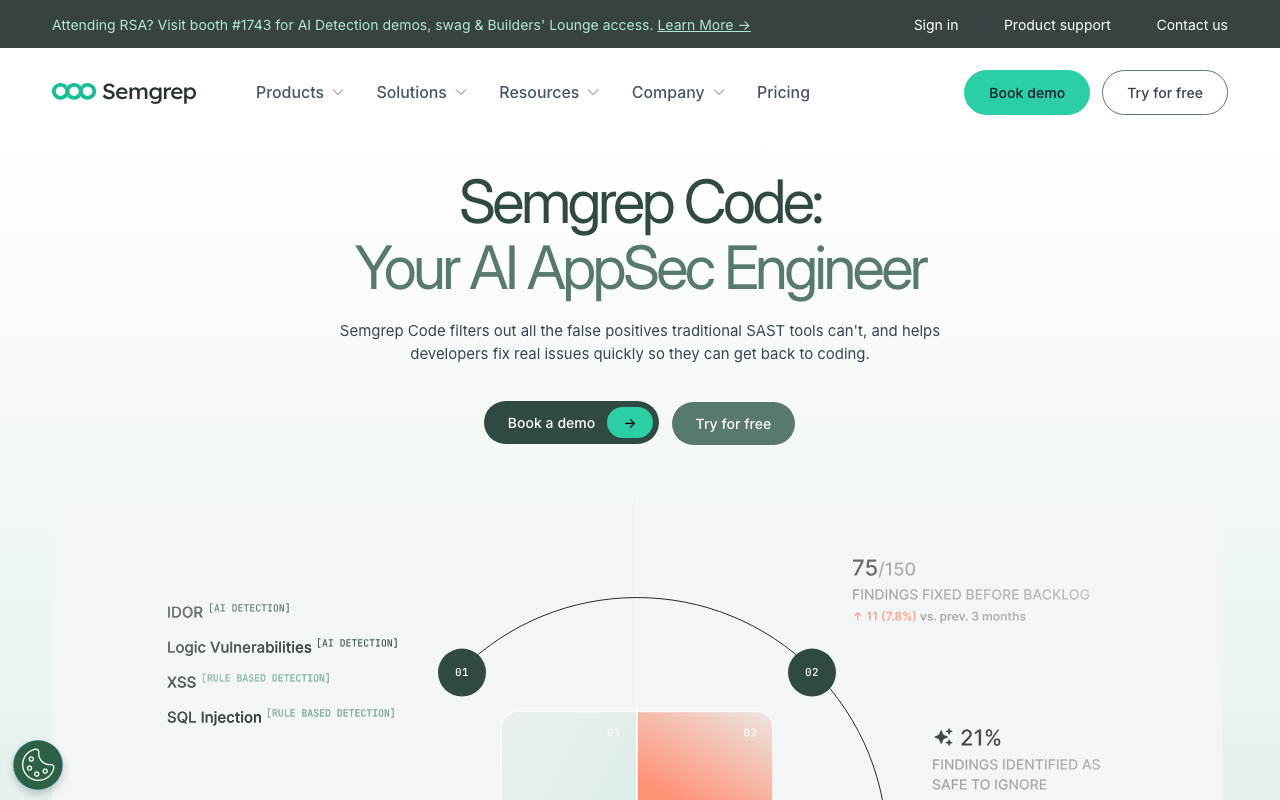
Semgrep is the leading open source SAST engine, and its free tier is arguably the most capable free static analysis offering available in 2026. The open source CLI includes the full scanning engine with support for 30+ languages, 3,000+ community and Semgrep-maintained rules covering OWASP Top 10, CWE categories, and framework-specific security patterns.
What makes Semgrep stand out among free SAST tools is its rule syntax. Rules are written in YAML using a pattern language that mirrors the target code. A rule to catch SQL injection in Python looks like the Python code it matches, not like an abstract specification in a proprietary query language. This means developers - not just security engineers - can write, read, and modify rules. When Semgrep flags something and you disagree, you can edit the rule. When you discover a security pattern specific to your codebase, you can codify it as a rule and share it across your organization.
The Semgrep Registry hosts thousands of rules organized by language, framework, and vulnerability category. You can start scanning with a curated ruleset like --config=p/owasp-top-ten and have meaningful findings within minutes of installation. For a head-to-head comparison with Snyk Code, see Snyk vs Semgrep.
The free cloud platform (Semgrep Cloud) extends the OSS engine with a web dashboard, CI/CD integration through GitHub Actions and GitLab CI, and cross-file analysis for up to 10 contributors. This cross-file analysis is significant because it enables taint tracking across function boundaries - tracing user input from an HTTP endpoint through multiple function calls to a database query and flagging missing sanitization along the entire path.
Best for: Development teams that want transparent, customizable SAST scanning with no usage limits. Semgrep OSS is the best free Snyk Code replacement.
Limitations: The OSS engine performs single-file analysis only. Cross-file taint analysis, supply chain scanning, and secrets detection require the cloud platform (free for 10 contributors or fewer, then $35/contributor/month). No container scanning or IaC analysis.
Pricing: OSS engine is free under LGPL-2.1 with no limits. Cloud platform free for up to 10 contributors.
4. CodeQL and GitHub Advanced Security - Best for GitHub-hosted projects
CodeQL is GitHub’s semantic code analysis engine, and it is free for all public repositories on GitHub. For open source projects, this makes it one of the most powerful free SAST tools available - CodeQL performs deep interprocedural analysis with taint tracking, data flow analysis, and control flow analysis that rivals enterprise SAST tools costing tens of thousands of dollars.
CodeQL works by building a relational database from your source code, then running queries against that database to find vulnerability patterns. The query language is powerful enough to express complex security conditions that simpler pattern-matching tools miss. GitHub maintains a library of CodeQL queries covering common vulnerability categories across JavaScript, TypeScript, Python, Java, C, C++, C#, Go, Ruby, Kotlin, and Swift.
GitHub Advanced Security bundles CodeQL with Dependabot (free SCA scanning that automatically opens PRs to update vulnerable dependencies) and secret scanning (detecting accidentally committed API keys, tokens, and credentials). For public repositories, this entire bundle is free. For private repositories, GitHub Advanced Security costs $49 per committer per month.
For teams already using GitHub, enabling CodeQL requires adding a workflow file to your repository. Dependabot requires a dependabot.yml configuration file. Secret scanning activates with a toggle in repository settings. The entire setup takes under 30 minutes and runs automatically on every push and pull request. For a detailed comparison, see Snyk vs CodeQL.
Best for: Open source projects and teams with public repositories on GitHub who want enterprise-grade SAST, SCA, and secret scanning at zero cost.
Limitations: CodeQL scans are slower than Semgrep or Snyk Code - full scans on large repositories can take 10-30 minutes. CodeQL is GitHub-exclusive (no GitLab or Bitbucket support). For private repositories, the $49/committer/month price is expensive. The query language has a steep learning curve for writing custom queries.
Pricing: Free for public repositories. $49/committer/month for private repositories via GitHub Advanced Security.
5. OWASP Dependency-Check - Best free SCA tool
OWASP Dependency-Check is the longest-standing free SCA tool in the ecosystem. Maintained by the OWASP Foundation since 2012, it scans project dependencies against the National Vulnerability Database (NVD) to identify known CVEs in your open source libraries.
Dependency-Check supports Java (Maven, Gradle), .NET (NuGet), Python (pip), Ruby (Bundler), Node.js (npm), Go, and several other ecosystems. It produces detailed HTML, JSON, CSV, and XML reports that include CVE identifiers, CVSS scores, affected versions, and links to vulnerability advisories. For teams that need to generate compliance documentation or pass security audits, these built-in reports are more detailed than what Snyk’s free tier provides.
The tool integrates into build systems through plugins for Maven, Gradle, Ant, Jenkins, and SBT. For CI/CD pipelines, you can set a CVSS threshold that fails the build if any dependency exceeds a specified severity score. This acts as a basic quality gate for dependency security without requiring a paid platform.
Best for: Teams that need dependency vulnerability scanning with detailed reporting for compliance purposes. OWASP Dependency-Check is particularly strong for Java and .NET ecosystems.
Limitations: The NVD database can have delays in publishing new CVEs compared to Snyk’s curated database. False positive rates are higher than Snyk because Dependency-Check lacks reachability analysis - it flags every CVE in a dependency regardless of whether your code actually uses the vulnerable function. No SAST, container scanning, or IaC analysis.
Pricing: Completely free and open source under the Apache 2.0 license.
6. Bandit - Best free Python SAST
Bandit is the standard Python security linter, maintained by the OpenStack Security Project (now under PyCQA). It performs AST-based analysis of Python source code to find common security issues including hardcoded passwords, use of insecure functions (eval, exec, pickle), SQL injection, shell injection, weak cryptography, and insecure HTTP configurations.
Bandit is laser-focused on Python. It does not try to support 30 languages or scan containers. Instead, it provides deep, Python-specific security analysis with low false positive rates because every check is tailored to Python idioms and common vulnerability patterns in the Python ecosystem.
Installation is a single pip install bandit command, and running it against a project is as simple as bandit -r ./src. It integrates into CI/CD pipelines as a single command, into pre-commit hooks through the pre-commit framework, and into IDEs through editor plugins. For Python-heavy teams, Bandit provides immediate value with zero configuration.
Best for: Python development teams that want targeted, low-noise SAST without the overhead of configuring a multi-language scanning platform.
Limitations: Python only. No SCA, no container scanning, no IaC analysis. The rule set is focused on common patterns and does not include the deep taint analysis that tools like Semgrep or CodeQL provide. Bandit does not track data flow across function boundaries.
Pricing: Completely free and open source.
7. npm audit and yarn audit - Best for JavaScript projects
Every JavaScript developer already has a free vulnerability scanner installed - it ships with their package manager. Running npm audit or yarn audit scans your project’s dependency tree against the GitHub Advisory Database (for npm) or the npm advisory database and reports known vulnerabilities with severity ratings, affected versions, and remediation guidance.
npm audit can also automatically fix vulnerabilities with npm audit fix, which updates dependencies to patched versions when non-breaking updates are available. This is the closest free equivalent to Snyk’s automated fix PRs for the JavaScript ecosystem.
For more aggressive fixes that may include major version bumps, npm audit fix --force attempts to resolve all vulnerabilities even if it requires breaking changes. This should be used with caution and testing, but it provides a path to zero known vulnerabilities in your dependency tree.
Best for: JavaScript and TypeScript projects that need basic dependency vulnerability scanning without installing any additional tools. npm audit and yarn audit are the lowest-friction SCA options available.
Limitations: JavaScript/Node.js ecosystem only. No SAST, no container scanning, no IaC analysis. The vulnerability database may lag behind Snyk’s curated database for newly disclosed CVEs. No centralized dashboard or cross-project reporting. Cannot scan lock files from other ecosystems.
Pricing: Free - included with npm (since v6) and yarn.
8. DeepSource - Best free tier for small teams
DeepSource offers a genuinely useful free tier that goes beyond what most commercial tools provide without payment. The free plan includes unlimited analysis for public repositories and supports up to 5 users on private repositories. It covers SAST, code quality analysis, and some security scanning across Python, JavaScript, TypeScript, Go, Java, Ruby, Rust, C, C++, and several other languages.
What sets DeepSource apart from pure SAST tools is its focus on auto-fixing. DeepSource Autofix generates automatic fix suggestions for many detected issues, including some security findings. This is similar to Snyk’s automated fix PRs but applies to source code vulnerabilities rather than dependency updates. The free tier includes this capability, which is unusual among free security tools.
DeepSource reports a sub-5% false positive rate, which is the lowest in the industry. For teams that have experienced alert fatigue from noisy scanners, this signal quality is a significant advantage even on the free tier.
Best for: Small teams (5 or fewer developers on private repos) that want combined SAST and code quality analysis with automated fix suggestions at zero cost.
Limitations: The 5-user limit on private repositories is restrictive for growing teams. Security rule depth is not as comprehensive as dedicated SAST tools like Semgrep or CodeQL. No container scanning, no IaC analysis, and limited SCA capabilities.
Pricing: Free for public repos (unlimited) and private repos (up to 5 users). Paid plans start at $12/user/month.
9. CodeAnt AI - Best value paid alternative
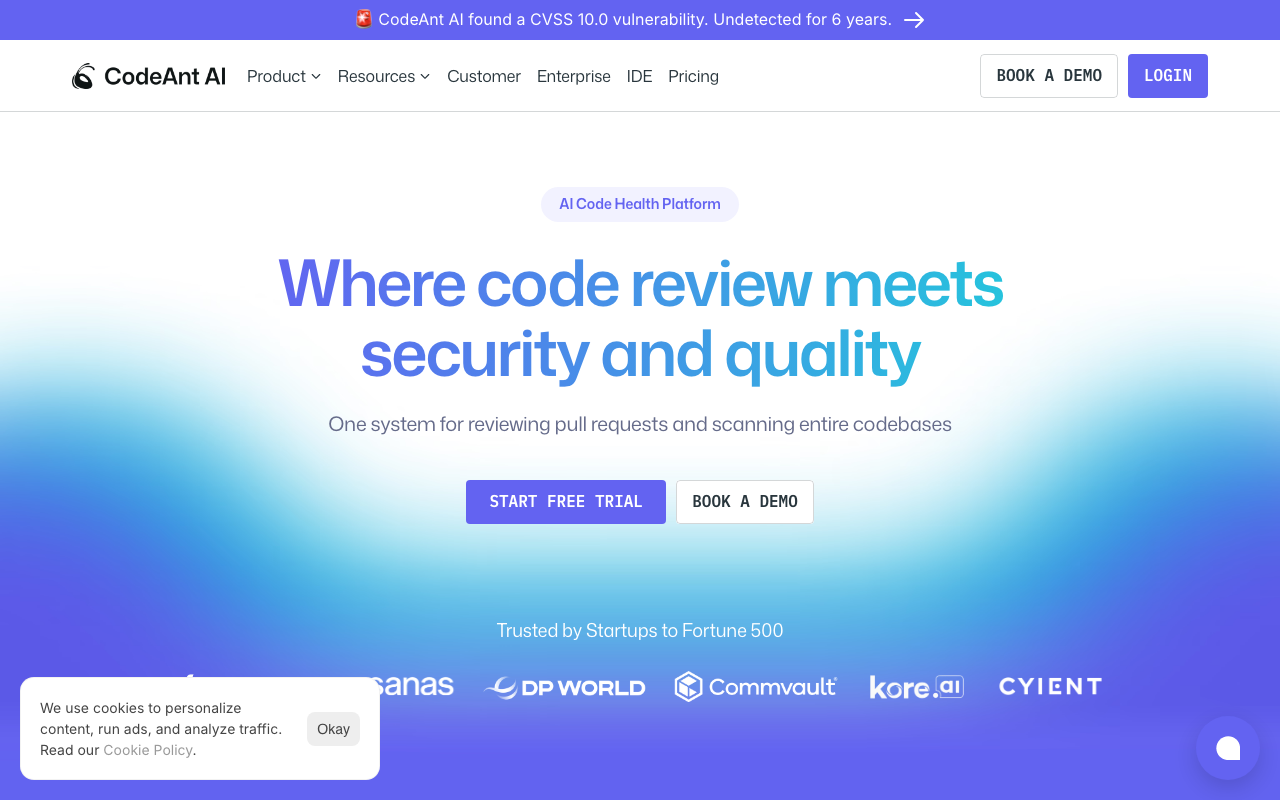
CodeAnt AI is not free, but at $24 to $40 per user per month, it deserves mention for teams that have outgrown free tools and want a single platform that consolidates what would otherwise require three or four separate open source tools. CodeAnt AI bundles SAST, SCA, secrets detection, code quality analysis, and AI-powered code review into one platform.
The reason to consider CodeAnt AI alongside free tools is the management overhead equation. Running Semgrep OSS for SAST, Trivy for containers, OWASP Dependency-Check for SCA, and Bandit for Python-specific analysis gives you comprehensive free coverage - but also means maintaining four tool configurations, four CI/CD integrations, four sets of output formats, and no unified dashboard. CodeAnt AI consolidates this into a single integration that scans on every PR and surfaces findings in one interface.
CodeAnt AI also includes DORA metrics tracking and dead code detection, which are capabilities that no free security tool provides. For teams that care about engineering productivity alongside security, this bundling adds value beyond pure vulnerability scanning.
Best for: Teams of 5 to 50 developers that have tried free tools and want to consolidate into a single affordable platform without jumping to enterprise pricing. For more on SAST tool options at every price point, see our comprehensive guide.
Pricing: $24/user/month (Growth plan) to $40/user/month (Premium plan). Not free, but significantly cheaper than Snyk’s Team plan at $25/dev/month when you factor in that CodeAnt AI includes capabilities that would require multiple Snyk products.
Comparison table
| Tool | Type | SCA | SAST | Containers | IaC | Languages | Free Limit |
|---|---|---|---|---|---|---|---|
| Trivy | Scanner | Yes | No | Yes | Yes | N/A (deps) | Unlimited |
| Grype | Scanner | Yes | No | Yes | No | N/A (deps) | Unlimited |
| Semgrep OSS | SAST | No | Yes | No | No | 30+ | Unlimited |
| CodeQL (GHAS) | SAST + SCA | Yes | Yes | No | No | 12+ | Public repos |
| OWASP Dep-Check | SCA | Yes | No | No | No | 8+ ecosystems | Unlimited |
| Bandit | SAST | No | Yes | No | No | Python only | Unlimited |
| npm/yarn audit | SCA | Yes | No | No | No | JS/TS only | Unlimited |
| DeepSource | SAST + quality | Limited | Yes | No | No | 12+ | 5 users (private) |
| CodeAnt AI | SAST + SCA + AI | Yes | Yes | No | No | 30+ | None (paid) |
| Snyk (free) | Full platform | Yes | Yes | Yes | Yes | 10-12 | 5 users, limited scans |
Recommended free tool stacks
Rather than trying to find a single free tool that replaces Snyk entirely, the practical approach is combining tools that complement each other. Here are three stacks depending on your primary tech stack and needs.
Stack 1: Full coverage (SAST + SCA + containers + IaC)
- Semgrep OSS for SAST - scans your source code for security vulnerabilities
- Trivy for container scanning, IaC analysis, and SBOM generation
- OWASP Dependency-Check or Dependabot for SCA
This combination covers all four areas that Snyk addresses. Total cost: $0. The trade-off is managing three separate tools and three sets of outputs.
Stack 2: JavaScript/TypeScript focus
- Semgrep OSS with the
p/javascriptandp/typescriptrulesets for SAST - npm audit for dependency vulnerability scanning
- Trivy if you deploy containers
This is the lightest-weight stack for JavaScript teams. npm audit is already installed, Semgrep adds SAST coverage, and Trivy handles container security if needed.
Stack 3: Python focus
- Bandit for Python-specific SAST
- Semgrep OSS with
p/pythonrules for broader pattern matching - pip-audit for Python dependency vulnerability scanning
- Trivy for container and IaC scanning
Python teams benefit from running both Bandit and Semgrep because they catch different categories of issues. Bandit is tuned specifically for Python idioms, while Semgrep covers cross-language patterns and framework-specific rules for Django and Flask.
When to stay with Snyk
Free tools are not always the right answer. Here are situations where staying with Snyk - or choosing a paid alternative - makes more sense.
You need automated fix pull requests for dependencies. Snyk’s standout SCA feature is generating pull requests that update vulnerable dependencies to patched versions with context about what changed. Dependabot provides a basic version of this, but Snyk’s fix PRs include compatibility analysis and upgrade guidance that Dependabot does not. If your team relies on automated remediation rather than manual dependency updates, Snyk provides genuine value.
You need a unified security dashboard across all repositories. Managing findings from three or four separate tools across 20+ repositories becomes a coordination challenge. Snyk’s unified dashboard shows all vulnerabilities across all projects in a single view with filtering, prioritization, and trend tracking. No combination of free tools replicates this without significant custom integration work.
Compliance reporting is a hard requirement. If your customers or auditors require formal vulnerability reports, Snyk’s reporting capabilities on paid tiers save significant time compared to manually aggregating outputs from multiple free tools.
Your team exceeds 10 developers and needs centralized policy management. At scale, defining and enforcing consistent security policies across repositories requires a platform. Free tools handle scanning well but lack the policy layer that platforms like Snyk, Semgrep Team tier, or CodeAnt AI provide.
For a comprehensive look at Snyk’s paid alternatives beyond just free options, see our full Snyk alternatives guide. For a breakdown of what Snyk’s paid tiers actually cost at different team sizes, see Snyk pricing. And for specific tool comparisons, we have covered Snyk vs Semgrep, Snyk vs Trivy, Snyk vs Dependabot, Snyk vs CodeQL, and Snyk vs Aqua Security in dedicated posts.
Final recommendations
If you are evaluating free Snyk alternatives, start with your most pressing need rather than trying to replace the entire Snyk platform at once.
For container security: Install Trivy. It takes five minutes, scans faster than Snyk Container, and has no usage limits. If you also use Terraform or Kubernetes manifests, Trivy covers IaC scanning as well.
For SAST: Install Semgrep OSS. Run it with the OWASP Top 10 ruleset on your codebase and evaluate the findings. If you are on GitHub with public repositories, also enable CodeQL for deeper interprocedural analysis at no cost.
For SCA: If you use JavaScript, start with npm audit - it is already there. For other ecosystems, OWASP Dependency-Check provides the broadest coverage. Enable Dependabot on GitHub for automated fix PRs.
For Python projects specifically: Add Bandit alongside Semgrep for the best free Python security coverage available.
When free tools hit their limits: If managing multiple tools becomes a burden or you need centralized dashboards and policy management, CodeAnt AI at $24 to $40 per user per month provides the most value per dollar before jumping to enterprise-grade pricing.
The free security tooling ecosystem in 2026 is strong enough that cost alone should never prevent a team from implementing vulnerability scanning. The tools listed here are not inferior alternatives reluctantly used by teams that cannot afford Snyk - they are production-grade scanners used by some of the largest engineering organizations in the world. The question is not whether free tools are good enough. The question is whether the management overhead of running multiple free tools exceeds the cost of a paid platform that consolidates them.
Frequently Asked Questions
What are the best free alternatives to Snyk?
The best free alternatives to Snyk are Trivy (container, IaC, and SBOM scanning), Grype (fast vulnerability scanning for container images and filesystems), Semgrep OSS (open source SAST with 3,000+ rules), CodeQL via GitHub Advanced Security (free for public repositories), and OWASP Dependency-Check (free SCA for dependency vulnerabilities). Combining two or three of these tools covers the majority of Snyk's feature set at zero cost.
Can I replace Snyk entirely with free tools?
For most teams, yes. Combining Semgrep OSS for SAST, Trivy for container and IaC scanning, and OWASP Dependency-Check or npm audit for SCA covers the four core areas Snyk addresses. The gaps are in unified dashboards, automated fix pull requests, curated vulnerability databases with prioritization, and enterprise support - features that paid tools provide. For teams under 10 developers, the free combination works well. Larger teams often benefit from at least one paid platform for centralized management.
Is Snyk free tier enough for small teams?
Snyk's free tier covers up to 5 users with limited scan frequency. It includes SCA, SAST (Snyk Code), container scanning, and IaC scanning - but with restrictions on the number of tests per month and limited reporting. For solo developers or very small teams doing occasional scans, the free tier may suffice. However, teams that need frequent CI/CD scanning, more than 5 contributors, or detailed reporting will hit the limits quickly and face either upgrading to the $25/dev/month Team plan or switching to free open source alternatives that have no usage caps.
What is the best free vulnerability scanner for containers?
Trivy by Aqua Security is the best free vulnerability scanner for containers. It scans container images, filesystems, Git repositories, and Kubernetes clusters for known CVEs, misconfigurations, secrets, and license issues. Trivy is completely open source under the Apache 2.0 license, scans offline without sending data externally, and integrates with all major CI/CD platforms. Grype by Anchore is a strong second option, offering faster scan times and a simpler interface focused specifically on vulnerability matching.
How does Trivy compare to Snyk Container?
Trivy and Snyk Container both scan container images for OS and application-level vulnerabilities. Trivy is completely free and open source with no usage limits, while Snyk Container's free tier is capped at limited scans per month. Trivy also covers IaC scanning and SBOM generation, which require separate Snyk products (Snyk IaC and manual SBOM export). Snyk Container's advantages are its curated vulnerability database with prioritization, automated base image upgrade recommendations, and integration into Snyk's unified dashboard. For teams that need unlimited container scanning without vendor lock-in, Trivy is the better choice.
Is Semgrep really free?
Semgrep's open source engine (Semgrep OSS) is completely free under the LGPL-2.1 license for both personal and commercial use. It includes the full CLI scanner, 3,000+ community and Semgrep-maintained rules, and supports 30+ languages. The free tier of the Semgrep platform (Semgrep Cloud) extends this with a web dashboard, CI/CD integration, and cross-file analysis for up to 10 contributors. Beyond 10 contributors, the Team tier starts at $35/contributor/month. The OSS engine alone - without the cloud platform - has no contributor limits and is free forever.
What free tools can replace Snyk's SCA scanning?
For SCA (Software Composition Analysis), the best free alternatives to Snyk Open Source are OWASP Dependency-Check (open source, supports Java, .NET, Python, Ruby, Node.js, and Go), npm audit and yarn audit (built into JavaScript package managers), pip-audit for Python, and GitHub Dependabot (free for all GitHub repositories). OWASP Dependency-Check uses the NVD database and produces detailed reports. Dependabot not only scans for vulnerabilities but also automatically opens pull requests to update vulnerable dependencies, which is the closest free equivalent to Snyk's automated fix PRs.
What is the difference between SAST and SCA?
SAST (Static Application Security Testing) scans your own source code for security vulnerabilities like SQL injection, cross-site scripting, and hardcoded credentials. SCA (Software Composition Analysis) scans your third-party dependencies and open source libraries for known CVEs. You typically need both: SAST catches bugs your team introduces, while SCA catches vulnerabilities inherited from your supply chain. Snyk bundles both (Snyk Code for SAST and Snyk Open Source for SCA). Free alternatives handle them separately - Semgrep or CodeQL for SAST, and OWASP Dependency-Check or Trivy for SCA.
Is CodeQL free to use?
CodeQL is free for open source projects on GitHub and for academic research. For private repositories, CodeQL is available through GitHub Advanced Security, which costs $49 per committer per month. GitHub Advanced Security is included for free with GitHub Enterprise Cloud for public repositories. The CodeQL CLI can also be used for free for research and open source development. For private commercial codebases, the $49/committer/month price makes it expensive at scale, but for teams with public repositories or small private repos on GitHub Enterprise, it provides powerful SAST at no extra cost.
What is the best free security tool for Python projects?
For Python projects, the best free security tools are Bandit (Python-specific SAST that catches common security issues like hardcoded passwords, SQL injection, and use of insecure functions), Semgrep OSS (with extensive Python and Django/Flask framework rules), and pip-audit (SCA tool that checks installed Python packages against the PyPI vulnerability database). Combining Bandit for Python-specific SAST with pip-audit for SCA and Semgrep for broader pattern matching gives comprehensive security coverage for Python projects at zero cost.
How do I set up free vulnerability scanning in CI/CD?
Most free vulnerability scanners integrate into CI/CD with minimal configuration. Trivy runs as a single binary - add a step to your GitHub Actions workflow with aquasecurity/trivy-action. Semgrep provides an official GitHub Action at semgrep/semgrep-action that scans on every pull request. OWASP Dependency-Check has plugins for Maven, Gradle, and a CLI for other ecosystems. Bandit installs via pip and runs as a single command. For GitHub repositories, enabling Dependabot requires only a dependabot.yml configuration file. Most teams can set up a complete free scanning pipeline in under an hour.
Are free vulnerability scanners reliable enough for production use?
Yes, many free vulnerability scanners are battle-tested in production by thousands of organizations. Trivy is used by the Kubernetes project itself and is the default scanner in several container registry platforms. Semgrep OSS powers security scanning at companies like Dropbox, Slack, and Snowflake. CodeQL is used internally at GitHub to scan all public repositories. OWASP Dependency-Check has been maintained since 2012 and is recommended by OWASP for SCA. These tools are reliable for production use. The trade-off versus paid tools is typically in dashboard quality, automated remediation, and enterprise support - not in scanning accuracy.
Should I use one free tool or combine multiple?
Combining multiple free tools is almost always better than using a single tool. No single free tool covers all four areas that Snyk addresses (SAST, SCA, container scanning, and IaC scanning). A practical free stack is Semgrep OSS for SAST, OWASP Dependency-Check or Dependabot for SCA, Trivy for container and IaC scanning, and Bandit or language-specific linters for targeted analysis. The downside of this approach is managing multiple tools, dashboards, and configurations. Paid platforms like CodeAnt AI (starting at $24/user/month) consolidate these capabilities into a single platform if the management overhead becomes too much.
Explore More
Tool Reviews
 Snyk Code Review
 Semgrep Review
 CodeAnt AI Review
Related Articles
- I Reviewed 32 SAST Tools - Here Are the Ones Actually Worth Using (2026)
- Snyk vs CodeQL: Free SAST Tools Compared (2026)
- Best AI Code Review Tools in 2026 - Expert Picks
- 13 Best Code Quality Tools in 2026 - Platforms, Linters, and Metrics
- Free SonarQube Alternatives: Best Open Source Code Quality Tools in 2026
Free Newsletter
Stay ahead with AI dev tools
Weekly insights on AI code review, static analysis, and developer productivity. No spam, unsubscribe anytime.
Join developers getting weekly AI tool insights.
Related Articles
CodiumAI Alternatives: Best AI Tools for Automated Testing in 2026
Explore the best CodiumAI (now Qodo) alternatives for AI test generation, code review, and quality analysis with pricing and honest comparisons.
March 13, 2026
alternativesFree SonarQube Alternatives: Best Open Source Code Quality Tools in 2026
Discover the best free SonarQube alternatives for code quality and security. Open source tools, free tiers, and budget options compared.
March 13, 2026
alternativesQodo AI Alternatives: 10 Best AI Test Generation Tools in 2026
Compare 10 Qodo alternatives for AI test generation and code review. Real pricing, feature comparisons, and honest trade-offs for each tool.
March 13, 2026