SonarQube Community vs Enterprise: Comparison
SonarQube Community vs Enterprise compared - features, security, branch analysis, language support, pricing, and which edition fits your team.
Published:
Quick Verdict
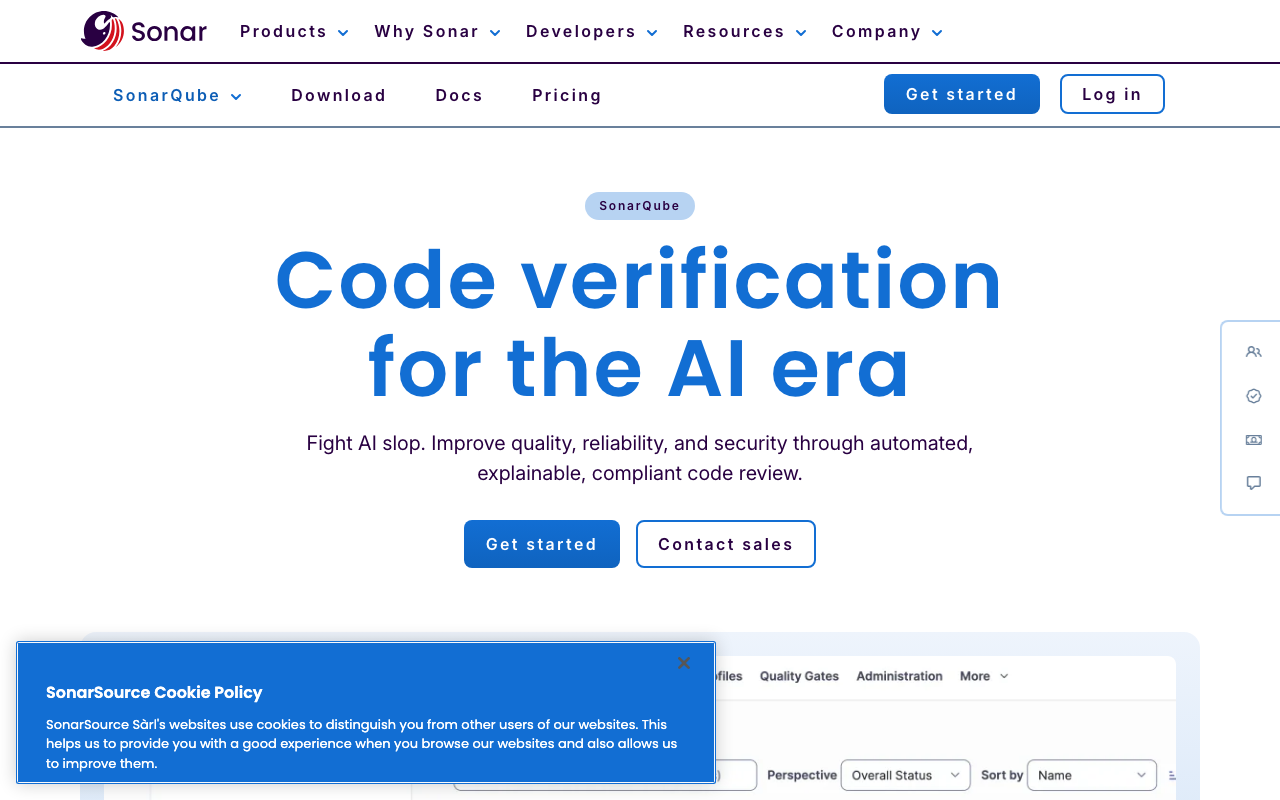
SonarQube is the most widely deployed static analysis platform in the industry, with over 7 million developers relying on it. Its self-hosted product line spans four editions - Community Build, Developer, Enterprise, and Data Center - with the gap between Community and Enterprise representing the widest jump in features, capabilities, and cost.
The Community Build is free and open source. It gives you 20+ language analyzers, basic quality gates, and CI/CD integration, but it can only analyze a single main branch. There is no branch analysis, no PR decoration, no taint analysis, no portfolio management, and no compliance reporting. It is a useful evaluation tool, but its limitations make it impractical for teams that use modern pull request workflows.
The Enterprise Edition sits two tiers above Community. It includes everything from the Developer Edition (branch analysis, PR decoration, taint analysis, secrets detection) plus portfolio management, security compliance reporting, parallel report processing, legacy enterprise language support, project transfer, and the Advanced Security add-on. Enterprise pricing starts at approximately $16,000-$20,000/year for 1 million lines of code, not including infrastructure costs.
If you need branch analysis and PR decoration, you do not need Enterprise - the Developer Edition at approximately $2,500/year for 100K LOC provides those features. Enterprise is justified when you manage multiple projects across teams, require regulatory compliance reporting, need legacy language analysis, or want portfolio-level visibility into organizational code health.
For a breakdown of all four editions, see our SonarQube pricing guide. For a comparison between Community and Developer specifically, see our SonarQube Community vs Developer guide.
SonarQube Community Build: What You Get for Free
The Community Build - formerly called Community Edition - is SonarQube’s open-source offering. It requires no license key, no trial activation, and no usage limits. You download it, install it on your own server, connect a PostgreSQL database, and run code analysis.
Language support: The Community Build includes analyzers for 20+ languages - Java, JavaScript, TypeScript, Python, C#, Go, Kotlin, Ruby, PHP, Scala, HTML, CSS, XML, and infrastructure-as-code formats including Terraform, Kubernetes YAML, Docker, and CloudFormation. This covers the vast majority of modern tech stacks. For a full assessment of the platform, see our SonarQube review.
Analysis rules: You get access to over 5,000 deterministic rules covering bugs, code smells, security vulnerabilities, and security hotspots. These are the same rules used by the commercial editions - the analysis engine does not use a reduced rule set. Java has 900+ rules, Python has 500+, JavaScript/TypeScript has 400+, and every supported language has substantial depth.
Quality gates: The Community Build supports quality gate enforcement on your main branch. You define conditions - minimum code coverage, zero new critical bugs, duplication thresholds, technical debt ratios - and the platform evaluates every analysis against those conditions.
CI/CD integration: You can integrate the SonarScanner into any CI/CD system - GitHub Actions, GitLab CI, Jenkins, Azure Pipelines, CircleCI, Bitbucket Pipelines, and others. The scanner sends code to your SonarQube instance and reports the quality gate result back to the pipeline.
What Community Build Cannot Do
The limitations of the Community Build are significant enough that they shape the entire decision about whether to use it or upgrade.
No branch analysis. The Community Build analyzes only a single main branch. It cannot analyze feature branches or pull requests. This means issues are detected only after code has been merged - the exact opposite of the shift-left philosophy that modern development teams practice. For more on whether the free edition is viable for your team, see is SonarQube free.
No PR decoration. Without branch analysis, there is no PR decoration. SonarQube cannot post inline comments, quality gate status, or issue summaries on your pull requests in GitHub, GitLab, Bitbucket, or Azure DevOps.
No taint analysis. The Community Build includes basic pattern-matching security rules but lacks data-flow-based taint analysis. Taint analysis traces data from untrusted inputs (user forms, API requests, file uploads) through the application to dangerous sinks (SQL queries, HTML output, system commands). Without it, injection vulnerabilities like SQL injection, XSS, and command injection may go undetected.
No secrets detection. The automated detection of hardcoded credentials, API keys, tokens, and passwords in source code is not available in the Community Build.
No SonarLint connected mode. SonarLint (SonarQube for IDE) works standalone with Community Build, but connected mode - which synchronizes the IDE with the server to enforce the same rules and quality profiles in real time - requires the Developer Edition or higher.
No portfolio management. There is no way to aggregate quality metrics across multiple projects for organizational visibility.
No compliance reporting. Security findings cannot be mapped to compliance frameworks like OWASP Top 10, CWE Top 25, SANS Top 25, or PCI DSS.
Fewer languages. C, C++, Objective-C, Swift, T-SQL, COBOL, ABAP, PL/SQL, PL/I, RPG, VB6, and Apex are not available.
SonarQube Enterprise Edition: Full Feature Set
The Enterprise Edition is the third tier in SonarQube’s lineup, sitting above Community and Developer. It includes everything from the Developer Edition and adds capabilities designed for organizations with complex, multi-project environments and regulatory requirements.
Everything from Developer Edition
Before covering what is exclusive to Enterprise, it is important to understand what the Developer Edition brings - since Enterprise builds on top of it.
Branch analysis and PR decoration. Analyze every feature branch and pull request. SonarQube posts quality gate status, new issues, coverage changes, and duplication metrics directly in PRs on GitHub, GitLab, Bitbucket, and Azure DevOps. This is the most impactful upgrade over Community Build.
Taint analysis. Data-flow-based security analysis that tracks untrusted input through your application to detect injection vulnerabilities. This catches vulnerabilities that pattern-matching rules miss - cross-method and cross-file data flows where the input source and the dangerous sink are in different parts of the codebase.
Secrets detection. Automated detection of 400+ patterns of hardcoded credentials, including API keys, database passwords, cloud access tokens, private keys, and service account credentials.
SonarLint connected mode. Synchronize your IDE plugin with the SonarQube instance so developers see the exact same rules and quality profiles while writing code, catching issues before they are committed.
Additional languages. C, C++, Objective-C, Swift, T-SQL, PL/SQL, and ABAP.
Enterprise-Exclusive Features
These capabilities are only available in the Enterprise Edition and above. They are what differentiate Enterprise from Developer and justify the significant price increase.
Portfolio management. Aggregate code quality metrics, technical debt, security findings, and reliability data across all projects in your organization into unified dashboards. Engineering leadership can track which projects are improving, which are degrading, and where the most critical issues exist. For organizations managing 10, 50, or 100+ projects, portfolio management transforms SonarQube from a per-project tool into an organizational governance platform.
Security compliance reporting. Map security findings to regulatory frameworks - OWASP Top 10, CWE Top 25, SANS Top 25, and PCI DSS. Generate compliance reports that demonstrate security posture to auditors, compliance officers, and regulators. This is a hard requirement for organizations in finance, healthcare, government, and defense industries.
Legacy enterprise languages. COBOL, RPG, VB6, PL/I, and Apex analyzers are exclusive to Enterprise Edition. Organizations maintaining mainframe codebases, legacy financial systems, or Salesforce applications need Enterprise as the minimum tier.
Parallel report processing. Enterprise Edition can process multiple analysis reports concurrently, reducing queue times when many projects are analyzed simultaneously. For organizations with CI/CD pipelines that trigger dozens of analyses in parallel, this prevents bottlenecks.
Project transfer. Move projects between SonarQube instances, including their full analysis history. This is useful during organizational restructuring, instance consolidation, or when separating business units.
Advanced Security add-on. Available exclusively for Enterprise Edition and above, this add-on extends security capabilities with software composition analysis (SCA) for open-source dependency scanning, SBOM generation in CycloneDX and SPDX formats, and malicious package detection. SCA is a capability that competitors like Snyk, Semgrep, and Codacy include in their base products.
Executive dashboards. Higher-level reporting views designed for engineering managers and executives who need organizational visibility without project-level detail.
Feature-by-Feature Comparison Table
| Feature | Community Build | Enterprise Edition |
|---|---|---|
| Price | Free | ~$16,000-$20,000/year (1M LOC) |
| Deployment | Self-hosted | Self-hosted |
| Languages | 20+ | 35+ (including legacy) |
| Analysis rules | 5,000+ | 6,500+ |
| Quality gates | Main branch only | All branches |
| Branch analysis | No | Yes |
| PR decoration | No | Yes (GitHub, GitLab, Bitbucket, Azure DevOps) |
| Taint analysis | No | Yes |
| Secrets detection | No | Yes (400+ patterns) |
| SonarLint connected mode | No | Yes |
| Portfolio management | No | Yes |
| OWASP/CWE/PCI DSS reporting | No | Yes |
| SCA (dependency scanning) | No | Yes (Advanced Security add-on) |
| SBOM generation | No | Yes (CycloneDX, SPDX) |
| Parallel report processing | No | Yes |
| Project transfer | No | Yes |
| C/C++ support | No | Yes |
| COBOL/ABAP/RPG | No | Yes (Enterprise exclusive) |
| AI CodeFix | No | Yes |
| AI Code Assurance | No | Yes |
| High availability | No | No (requires Data Center Edition) |
| Support | Community forums | Direct SonarSource support |
Language Support Differences
Language coverage is one of the most concrete differences between the editions. The Community Build covers most modern languages, but teams working in specific technology stacks will find gaps that only commercial editions fill.
Community Build Languages (20+)
Java, JavaScript, TypeScript, Python, C#, Go, Kotlin, Ruby, PHP, Scala, HTML, CSS, XML, Flex, Terraform, Kubernetes YAML, Docker, CloudFormation, Azure Resource Manager, and Ansible.
This covers the vast majority of cloud-native, web, and mobile development stacks. If your organization works exclusively in these languages, the language limitation of the Community Build is not a factor.
Developer Edition Additions
C, C++, Objective-C, Swift, T-SQL, PL/SQL, and ABAP. These additions are critical for teams doing embedded development (C/C++), iOS development (Swift/Objective-C), or working with database-heavy applications (T-SQL, PL/SQL).
Enterprise Edition Additions
COBOL, RPG, VB6, PL/I, and Apex. These are legacy enterprise languages that exist primarily in mainframe environments (COBOL, RPG, PL/I), legacy Windows applications (VB6), and Salesforce ecosystems (Apex). If your organization does not maintain code in these languages, the Enterprise language additions provide no value over Developer Edition.
The language question is straightforward: check what languages your codebases use, see which edition covers them all, and that determines your minimum required tier.
Branch Analysis: The Most Critical Gap
The absence of branch analysis in the Community Build is the single most impactful limitation in the entire SonarQube edition comparison. It shapes everything else.
Modern development workflows revolve around pull requests. Developers create feature branches, push code, open PRs, receive feedback, and merge after approval. Every code quality tool that participates in this workflow needs to analyze the feature branch and report results before the merge happens. That is the entire point of shift-left quality enforcement.
Without branch analysis, SonarQube Community Build can only tell you about problems after they are already in your main branch. The quality gate runs on main, not on the PR. By the time you see the issue, it is already merged, potentially deployed, and significantly more expensive to fix. The feedback loop is broken.
Enterprise Edition includes branch analysis, but so does Developer Edition. If branch analysis is the primary reason you are considering an upgrade from Community Build, the Developer Edition at approximately $2,500/year for 100K LOC is the right target - not Enterprise at $16,000-$20,000/year. Upgrade to Enterprise only when you need the additional capabilities on top of branch analysis.
For an alternative approach entirely, SonarQube Cloud (formerly SonarCloud) includes branch analysis in its free tier for up to 50,000 lines of code.
Security Features: Community vs Enterprise
Security is an area where the gap between Community and Enterprise is especially wide.
Community Build Security
The Community Build includes basic security rules - pattern-matching detection of common vulnerabilities like SQL injection, XSS, and insecure cryptographic usage. These rules check for specific code patterns that are known to be insecure. They are useful but limited because they cannot follow data flow across methods, classes, or files. A SQL injection vulnerability where the user input enters in one method and reaches the SQL query three method calls later will not be detected.
Enterprise Edition Security
Enterprise Edition provides a comprehensive security analysis stack.
Taint analysis is the cornerstone. It traces data flow from sources (user input, HTTP requests, file reads, database results) through the application to sinks (SQL queries, HTML output, system commands, file writes). Every path between an untrusted source and a dangerous sink is flagged as a potential vulnerability. This catches the real-world injection attacks that pattern matching misses.
Secrets detection scans for 400+ patterns of hardcoded credentials. API keys, database passwords, cloud access tokens, SSH private keys, JWT signing secrets, and service account credentials are detected in source code, configuration files, and infrastructure-as-code templates.
Security compliance reporting maps findings to OWASP Top 10, CWE Top 25, SANS Top 25, and PCI DSS. For organizations undergoing security audits or operating in regulated industries, these reports demonstrate compliance posture without manual mapping of findings to framework categories.
Advanced Security add-on provides SCA (software composition analysis) for open-source dependency vulnerability scanning, SBOM generation in CycloneDX and SPDX formats for supply chain transparency, and malicious package detection. This is a significant addition because the Community Build has zero SCA capability - it does not scan your dependency manifests at all.
For teams where security is a primary concern, the jump from Community to Enterprise is substantial. The Community Build’s security analysis is surface-level, while Enterprise provides the depth needed for production application security. For a broader view of how SonarQube stacks up against dedicated security tools, see our SonarQube alternatives guide.
Pricing: What the Gap Actually Looks Like
The cost difference between Community Build and Enterprise Edition is not just the license fee. Self-hosted SonarQube requires infrastructure regardless of edition, but the total cost picture changes dramatically when you add the license.
Community Build Total Cost
| Cost Component | Annual Estimate |
|---|---|
| License fee | $0 |
| Server hosting (cloud instance) | $600 - $1,800 |
| PostgreSQL database | $600 - $3,600 |
| DevOps maintenance (5-10 hrs/month) | $6,000 - $15,000 |
| Total | $7,200 - $20,400 |
The Community Build is free, but it still costs money to operate because it is self-hosted. A modest cloud server runs $50-$150/month, a managed database adds $50-$300/month, and the DevOps time for upgrades, monitoring, backup, and troubleshooting adds 5-10 hours per month at standard engineering rates.
Enterprise Edition Total Cost
| Cost Component | Annual Estimate |
|---|---|
| License fee (1M LOC) | $16,000 - $20,000 |
| Server hosting (higher specs needed) | $1,200 - $6,000 |
| PostgreSQL database (larger) | $1,200 - $6,000 |
| DevOps maintenance (10-15 hrs/month) | $12,000 - $27,000 |
| Total | $30,400 - $59,000 |
Enterprise Edition requires more server resources due to additional analyzers, parallel report processing, and portfolio management. The DevOps maintenance burden is also higher because Enterprise installations are typically more complex - more projects, more integrations, more users, and stricter uptime requirements.
The Developer Edition Middle Ground
For many organizations, the Developer Edition at approximately $2,500/year for 100K LOC is the sweet spot. It provides the most impactful features that Community lacks - branch analysis, PR decoration, taint analysis, and secrets detection - without the Enterprise price tag. Total cost of ownership for Developer Edition typically falls in the $12,000-$25,000/year range when including infrastructure. For detailed pricing breakdowns across all tiers, see our SonarQube pricing guide.
Who Should Use Which Edition
Stay on Community Build If
You are evaluating SonarQube for the first time. The Community Build lets you understand the platform, configure quality profiles, and test analysis on your codebase without any financial commitment. Use it as a proof of concept, not as a permanent solution.
You are a solo developer or hobbyist. If you work alone, do not use pull request workflows, and just want a quality dashboard for your main branch, the Community Build delivers genuine value. The 5,000+ rules will surface real issues.
You have no budget and accept the limitations. Some teams use the Community Build in production knowing that single-branch analysis is a compromise. It is better than no static analysis at all, but understand what you are leaving on the table.
Upgrade to Developer Edition If
You use pull request workflows. This is the determining factor. If your team creates branches, opens PRs, and merges through a review process, branch analysis and PR decoration are not optional - they are essential for integrating code quality into your workflow. Developer Edition is the minimum viable edition for modern development teams.
You need security scanning beyond basic patterns. Taint analysis and secrets detection in the Developer Edition provide meaningfully deeper security analysis than the Community Build’s pattern matching.
Your budget does not justify Enterprise. At approximately $2,500/year for 100K LOC, the Developer Edition delivers 80% of the value gap between Community and Enterprise at roughly 15% of the Enterprise price.
Upgrade to Enterprise Edition If
You manage many projects across multiple teams. Portfolio management becomes essential when you have 10+ projects and need organizational visibility into code health across business units.
You have regulatory compliance requirements. OWASP Top 10, CWE Top 25, and PCI DSS reporting is exclusive to Enterprise. If auditors require these reports, Enterprise is a hard requirement.
You maintain legacy codebases. COBOL, ABAP, RPG, PL/I, and VB6 analyzers are exclusive to Enterprise. If these languages are in your technology stack, there is no lower-tier option.
You need SCA and SBOM generation. The Advanced Security add-on for dependency scanning and software bill of materials is only available on Enterprise and above.
You are a large enterprise with strict governance needs. Project transfer, parallel processing, and executive dashboards support the operational requirements of large organizations.
Consider a Modern Alternative
Before committing to the self-hosting overhead and per-LOC pricing of SonarQube Enterprise, it is worth evaluating whether a cloud-native platform could meet your needs at lower cost and complexity.
Codacy offers an integrated platform combining code quality analysis, SAST, SCA, secrets detection, coverage tracking, and quality gates. The Pro plan is $15/user/month and includes unlimited scans, an AI reviewer for pull requests, and dashboards across 49 languages. The Business plan adds DAST scanning, SSO/SAML, audit logs, and a self-hosted deployment option for teams that need it.
The pricing model difference is significant. SonarQube Enterprise charges per lines of code, which means costs scale with codebase size regardless of team size. Codacy charges per user, which means costs scale with team size regardless of codebase size. For a 20-person team with a 1M LOC codebase, SonarQube Enterprise costs approximately $16,000-$20,000/year in license fees alone, before infrastructure, while Codacy Pro for the same team is $3,600/year with nothing to host.
Codacy also removes the self-hosting burden on its default plans. There is no server to provision, no database to maintain, no upgrades to manage, and no DevOps time to allocate. Quality, security, and dependency scanning arrive in one product rather than requiring SonarQube plus separate tools for SCA and AI code review.
For teams that do not have legacy language requirements (COBOL, ABAP, RPG) or strict data sovereignty constraints, a cloud-native platform like Codacy can cover most of what SonarQube Enterprise is bought for at a fraction of the total cost.
SonarQube Cloud as an Alternative Path
Before paying for SonarQube Enterprise self-hosted, consider whether SonarQube Cloud (formerly SonarCloud) could satisfy your requirements. SonarQube Cloud uses the same analysis engine and rule set as self-hosted SonarQube but eliminates all infrastructure management. For a detailed comparison, see our SonarQube vs SonarCloud guide.
The Cloud Free tier includes branch analysis and PR decoration for up to 50,000 lines of code - features that require at least the Developer Edition on self-hosted. The Enterprise Cloud plan adds taint analysis, SCA, compliance reporting, and portfolio views with custom pricing. For organizations without air-gapped environments or strict data sovereignty requirements, SonarQube Cloud can provide Enterprise-level functionality without self-hosting overhead.
Common Misconceptions
”Community Build is enough for small teams”
This depends entirely on whether the team uses pull requests. A small team that works on a single branch and deploys from main can use the Community Build productively. A small team that uses feature branches and PRs - which is most teams in 2026 - will find the Community Build frustrating because issues are only surfaced after the merge. Small teams that want branch analysis at zero cost should consider SonarQube Cloud Free instead.
”You need Enterprise for any real security scanning”
Not entirely accurate. The Developer Edition includes taint analysis and secrets detection, which are the two most impactful security upgrades over the Community Build. Enterprise adds compliance reporting and SCA, which are important for regulated industries but not strictly necessary for application security. Many teams operate effectively with Developer Edition security capabilities.
”Enterprise Edition is only for large companies”
Enterprise Edition is for organizations that need its specific features, regardless of size. A 15-person company maintaining a COBOL mainframe application needs Enterprise for language support. A 500-person company using only modern languages with no compliance requirements might be perfectly served by Developer Edition. The decision is feature-driven, not size-driven.
”The free Community Build is the same as SonarQube Cloud Free”
These are meaningfully different products. Community Build is self-hosted, analyzes only the main branch, has no PR decoration, and requires you to manage infrastructure. SonarQube Cloud Free is SaaS, includes branch analysis and PR decoration, supports 30 languages, and handles all infrastructure automatically. For most teams, Cloud Free is the strictly superior free option.
Migration Path: Community to Enterprise
If you are currently on the Community Build and considering Enterprise, the upgrade path is straightforward.
Direct upgrade on the same instance. You can apply an Enterprise Edition license key to your existing SonarQube installation. All project data, quality profiles, analysis history, and user configurations are preserved. The Enterprise features become available immediately.
Consider the stepping stones. Jumping from Community to Enterprise is a significant cost increase. Evaluate whether the Developer Edition at approximately $2,500/year for 100K LOC addresses your needs first. Most teams upgrading from Community want branch analysis and PR decoration, which are Developer Edition features. Upgrade to Enterprise only when you need portfolio management, compliance reporting, or legacy language support specifically.
Infrastructure upgrades may be needed. Enterprise Edition requires more server resources than Community Build - more CPU for parallel processing, more memory for additional analyzers, and more disk for expanded analysis data. Plan for infrastructure upgrades alongside the license change.
Final Recommendation
The SonarQube Community vs Enterprise decision is straightforward once you understand the feature tiers.
Start with the Community Build if you are evaluating SonarQube or have zero budget. Accept that it is limited to single-branch analysis and use it as a proof of concept. For expanded coverage of what you get for free, see is SonarQube free.
Upgrade to Developer Edition when you need branch analysis, PR decoration, and taint analysis. This is the most common and cost-effective upgrade path. It bridges the majority of the gap between Community and Enterprise at a fraction of the price. For specifics on this step, see our SonarQube Community vs Developer comparison.
Upgrade to Enterprise Edition when you need portfolio management, compliance reporting, legacy language support, SCA, or SBOM generation. These are Enterprise-exclusive features with no workaround at lower tiers.
Consider cloud-native alternatives if self-hosting overhead, per-LOC pricing, or the feature-gating model does not align with your team’s needs. Codacy at $15/user/month combines code quality analysis, SAST, SCA, and secrets detection in a single platform. SonarQube Cloud provides the same analysis engine without self-hosting. Both paths eliminate the infrastructure burden that every self-hosted SonarQube edition carries.
For more SonarQube comparisons, see our guides on SonarQube alternatives, SonarQube pricing, and SonarQube vs SonarCloud.
Further Reading
- Snyk vs CodeQL: Free SAST Tools Compared (2026)
- Best AI Code Review Tools in 2026 - Expert Picks
- 13 Best Code Quality Tools in 2026 - Platforms, Linters, and Metrics
- 12 Best Free Code Review Tools in 2026 - Open Source and Free Tiers
- I Reviewed 32 SAST Tools - Here Are the Ones Actually Worth Using (2026)
 Gitar
GitarComments are not enough
Gitar applies the fix, validates it in CI, and clears the queue.
See it on your repo Read our independent Gitar reviewFrequently Asked Questions
What is the difference between SonarQube Community and Enterprise Edition?
SonarQube Community Build is the free, open-source edition that supports 20+ languages with basic quality gates and single-branch analysis. SonarQube Enterprise Edition adds branch analysis, PR decoration, taint analysis, secrets detection, portfolio management across projects, security compliance reporting (OWASP Top 10, CWE Top 25, PCI DSS), support for legacy enterprise languages (COBOL, ABAP, PL/SQL, RPG, VB6), parallel report processing, project transfer between instances, and the Advanced Security add-on with SCA and SBOM generation. The Community Build is suitable for basic evaluation, while Enterprise is designed for organizations with multiple projects, regulatory requirements, and centralized governance needs.
How much does SonarQube Enterprise Edition cost?
SonarQube Enterprise Edition uses per-lines-of-code pricing. It starts at approximately $16,000-$20,000/year for 1 million lines of code and scales upward based on codebase size. This does not include infrastructure costs for self-hosting - server hardware or cloud instances, PostgreSQL database, DevOps administration time, and backup systems typically add $5,000-$30,000/year depending on deployment scale. For organizations that need high availability, the Data Center Edition with custom pricing is the next tier above Enterprise.
Is SonarQube Community Edition free?
Yes, the SonarQube Community Build is completely free and open source under the LGPL v3 license. There is no license fee, no usage limits, and no trial period. However, you must provide your own server infrastructure to run it, which costs $50-$150/month minimum on cloud providers. The free edition has significant feature limitations including no branch analysis, no PR decoration, no taint analysis, no portfolio management, and fewer supported languages than commercial editions.
Does SonarQube Community Edition support branch analysis?
No. SonarQube Community Build does not support branch analysis. It can only analyze a single main branch. This means issues are only detected after code has been merged, not during the pull request review process. Branch analysis requires the Developer Edition or higher. Alternatively, SonarQube Cloud (formerly SonarCloud) includes branch analysis in its free tier for up to 50,000 lines of code.
What languages does SonarQube Enterprise add over Community?
SonarQube Enterprise Edition supports all 35+ languages available across the SonarQube product line. Beyond the 20+ languages in the Community Build, Enterprise adds C, C++, Objective-C, Swift, T-SQL (available from Developer Edition), plus legacy enterprise languages exclusive to Enterprise - COBOL, ABAP, PL/SQL, PL/I, RPG, VB6, and Apex. Organizations maintaining legacy codebases in these languages must use Enterprise Edition as the minimum tier.
Is SonarQube Enterprise Edition worth the price?
SonarQube Enterprise Edition is worth the price for organizations managing 10+ projects across multiple teams that need portfolio management, regulatory compliance reporting, support for legacy enterprise languages, and centralized governance. However, if you only need branch analysis and PR decoration, the Developer Edition at approximately $2,500/year for 100K LOC provides those features at a fraction of the cost. Evaluate whether your organization truly requires the Enterprise-exclusive features before committing to the higher price.
Can I upgrade from SonarQube Community to Enterprise without losing data?
Yes. Upgrading from the Community Build to any commercial edition on the same SonarQube Server instance preserves all existing data, including project configurations, quality profiles, historical analysis results, and user settings. You apply an Enterprise Edition license key to your existing installation and the additional features become available immediately. However, upgrading directly from Community to Enterprise is uncommon - most organizations step through the Developer Edition first unless they specifically need Enterprise-exclusive features like portfolio management or legacy language support.
What security features does SonarQube Enterprise have that Community lacks?
SonarQube Enterprise Edition includes taint analysis for tracking data flow from untrusted inputs to dangerous sinks, secrets detection for 400+ credential patterns, security compliance reporting aligned to OWASP Top 10, CWE Top 25, SANS Top 25, and PCI DSS, plus the Advanced Security add-on that provides SCA (software composition analysis), SBOM generation in CycloneDX and SPDX formats, and malicious package detection. The Community Build has basic pattern-matching security rules but lacks data-flow analysis and compliance reporting entirely.
Does SonarQube Community Edition support pull request decoration?
No. SonarQube Community Build does not support pull request decoration. PR decoration - where SonarQube posts inline comments, quality gate status, and issue summaries directly in your pull requests on GitHub, GitLab, Bitbucket, or Azure DevOps - requires the Developer Edition or higher. Without PR decoration, developers must check the SonarQube web interface separately to see analysis results, which adds friction to the code review workflow.
What is SonarQube portfolio management and which edition includes it?
Portfolio management is a feature exclusive to SonarQube Enterprise Edition and above. It aggregates code quality metrics, technical debt, security findings, and reliability data across multiple projects into unified dashboards. Engineering leadership can view which projects are improving or degrading, track quality trends at the organizational level, and identify where the most critical issues exist. This is essential for organizations managing dozens or hundreds of projects across multiple business units.
Should I skip Developer Edition and go straight to Enterprise?
For most organizations, starting with the Developer Edition is the more cost-effective path. Developer Edition at approximately $2,500/year for 100K LOC provides the most impactful upgrades over Community - branch analysis, PR decoration, taint analysis, and secrets detection. Only upgrade to Enterprise if you specifically need portfolio management across many projects, regulatory compliance reporting, legacy language support (COBOL, ABAP, RPG), or the Advanced Security add-on for SCA and SBOM. Going straight to Enterprise without needing those features means paying 6-8x more than necessary.
What are alternatives to SonarQube Enterprise Edition?
Cloud-native alternatives to SonarQube Enterprise include Codacy ($15/user/month for code quality, SAST, SCA, and secrets detection), CodeRabbit (AI-powered PR review with a free tier and paid plans from $12/user/month), Semgrep ($35/contributor/month for advanced SAST with 10,000+ rules), and DeepSource ($30/user/month with low false positive rates). These platforms eliminate the self-hosting overhead and per-LOC pricing model while providing comparable or superior analysis capabilities for modern tech stacks.
Explore More
Tool Reviews
 SonarQube Review
 Codacy Review
Free Newsletter
Stay ahead with AI dev tools
Weekly insights on AI code review, static analysis, and developer productivity. No spam, unsubscribe anytime.
Join developers getting weekly AI tool insights.
Related Articles
CodeRabbit vs Qodo: AI Code Review Tools Compared (2026)
CodeRabbit vs Qodo - we compare pricing, features, test generation, and review quality so you can pick the right AI reviewer for your team.
February 21, 2026
comparisonWhat Happened to CodiumAI? The Rebrand to Qodo Explained
CodiumAI rebranded to Qodo in 2024. Here's what changed, what stayed the same, and what it means for existing users and new buyers.
February 22, 2026
comparisonGitar vs Qodo: Workflow Automation or Test Generation?
Gitar vs Qodo compared on review architecture, test generation, self-hosting, migrations, CI ownership, and pricing. Which AI code quality platform fits your team.
August 12, 2026