10 Best Code Climate Alternatives for Code Quality
Moving beyond Code Climate? Compare 10 alternatives for code quality, maintainability analysis, and engineering productivity. Pricing and migration tips.
Published:
Last Updated:
Why teams move away from Code Climate
Code Climate was a pioneer in cloud-based code quality analysis. When it launched in 2011, it was one of the first platforms to offer automated maintainability grading, test coverage tracking, and code quality metrics through a simple GitHub integration. For years, it was the default choice for Ruby, JavaScript, and Python teams that wanted quick visibility into code health without running infrastructure.
But the landscape has shifted dramatically since then. The sunsetting of Code Climate Velocity, the emergence of AI-powered code review tools, and the expansion of competitors into security scanning and behavioral analysis have left Code Climate Quality as a narrower product in a broader market. After reviewing G2 and Gartner comparisons, developer forum discussions, and migration stories, five pain points come up repeatedly.
Velocity is gone and Quality has stalled
Code Climate Velocity - the engineering metrics product that tracked DORA metrics, cycle time, deployment frequency, and team throughput - was sunset. This was a significant loss for teams that relied on the combined Quality plus Velocity workflow to correlate code health with delivery performance. Teams that subscribed to both products lost half their investment overnight and now need a separate tool like LinearB or Jellyfish for engineering metrics.
The Quality product itself continues to operate, but the pace of updates has slowed noticeably. Feature requests sit unanswered in forums. The rule set has not expanded to match competitors. And the founding team’s departure to build Qlty signals where the innovation energy has moved. For teams evaluating long-term tool investments, this trajectory raises legitimate concerns about the product’s future.
No security scanning of any kind
Code Climate Quality focuses exclusively on maintainability - complexity, duplication, and structural issues. It does not perform SAST (Static Application Security Testing), SCA (Software Composition Analysis), DAST (Dynamic Application Security Testing), or secrets detection. In 2026, most teams need at least basic security scanning integrated into their code quality workflow. Running Code Climate for quality and a separate tool for security means two dashboards, two configurations, and two sources of PR comments.
Every major competitor on this list - SonarQube, Codacy, DeepSource, Semgrep, Snyk Code - includes security analysis alongside code quality. Teams switching from Code Climate consistently cite the lack of security coverage as a primary motivation.
Limited language support compared to alternatives
Code Climate Quality supports approximately 15-16 languages. That was competitive in 2015, but modern platforms have expanded significantly. Codacy covers 49 languages, SonarQube supports 35+, and Qlty orchestrates 70+ analysis plugins across 40+ languages. Teams working with Go, Rust, Kotlin, Swift, or less common languages often find that Code Climate has no coverage or shallow coverage for their stack.
For polyglot teams running microservices in multiple languages, incomplete coverage means either accepting blind spots or running multiple tools - which defeats the purpose of having a centralized quality platform.
No AI-powered analysis or review
Code Climate’s analysis is entirely rule-based. It does not use AI or machine learning to understand code semantics, generate fix suggestions, or provide contextual review feedback. In 2026, AI-powered code review has moved from novelty to expectation. Tools like CodeRabbit generate senior-developer-quality review comments in minutes. DeepSource uses AI to produce context-aware autofix suggestions. Even traditional tools like SonarQube have added AI CodeFix capabilities.
Code Climate provides no AI-powered features - no automated fix suggestions, no contextual review comments, no intelligent triage of findings. For teams that want to leverage AI to accelerate code review and reduce manual remediation effort, Code Climate requires supplementing with additional tools.
The maintainability model feels simplistic
Code Climate’s A-F grading system was innovative when it launched. But the underlying model - primarily based on cyclomatic complexity, duplication, and file length - has not evolved to incorporate modern code quality research. It does not account for cognitive complexity (how hard code is to understand, not just how many branches it has), change coupling (which files tend to change together), knowledge distribution (bus factor risks), or architectural fitness.
Newer tools like CodeScene incorporate behavioral analysis and research-backed metrics. Qlty orchestrates dozens of specialized analyzers per language. Even SonarQube has expanded its quality model to include cognitive complexity, security hotspots, and reliability metrics. Code Climate’s model, while still useful, feels like a snapshot of 2014 best practices.
Quick comparison: all alternatives at a glance
| Tool | Type | Free Tier | Starting Price | Languages | Best For |
|---|---|---|---|---|---|
| SonarQube | Static analysis + quality gates | Yes | $30/month (Cloud) | 35+ | Enterprise rule depth and compliance |
| Codacy | Code quality + security | Yes | $15/user/month | 49 | Closest all-in-one replacement |
| DeepSource | Code quality + AI review | Yes (individual) | $30/user/month | 16 GA | Low false positive analysis + autofix |
| CodeRabbit | AI code review | Yes (unlimited repos) | $24/user/month | 30+ | AI-powered PR review |
| Qlty | Code health + linting | Yes (CLI) | $15/contributor/month | 40+ | Natural Code Climate successor |
| CodeScene | Behavioral code analysis | Yes (OSS) | EUR 18/author/month | 20+ | Tech debt prioritization |
| Qodana | Code quality | Yes | $6/contributor/month | 60+ | Budget-friendly analysis |
| Semgrep | Security scanning (SAST) | Yes (10 contributors) | $35/contributor/month | 30+ | Custom security rules |
| Snyk Code | Security platform | Yes (limited) | $25/dev/month | 19+ | Full-stack security |
| LinearB | Engineering metrics | Yes | Contact sales | N/A | Velocity replacement |
Pricing comparison: real numbers for a 20-person team
Understanding what you will actually pay matters more than list prices. Here is what each alternative costs for a typical 20-developer team on annual billing.
| Tool | Monthly Cost (20 devs) | Annual Cost | What’s Included |
|---|---|---|---|
| Code Climate Quality | ~$300/month | ~$3,600/year | Maintainability grading, coverage tracking |
| SonarQube Cloud | ~$200-600/month | ~$2,400-7,200/year | LOC-based pricing, quality gates, security |
| Codacy | $300/month | $3,600/year | Quality + SAST + SCA + DAST + AI review |
| DeepSource | $600/month | $7,200/year | Quality + AI review + autofix |
| CodeRabbit | $480/month | $5,760/year | AI code review only |
| Qlty | $300/month | $3,600/year | 70+ analyzers, maintainability grading |
| CodeScene | ~EUR 360/month | ~EUR 4,320/year | Behavioral analysis, hotspot detection |
| Qodana | $120/month | $1,440/year | IntelliJ inspections, quality gates |
| Semgrep | $700/month | $8,400/year | Deep SAST, custom rules, AI triage |
| Snyk Code | $500/month | $6,000/year | SAST + SCA + container + IaC scanning |
| LinearB | Contact sales | Contact sales | DORA metrics, workflow automation |
The standout value picks are Qodana at $1,440/year (60% less than Code Climate) and Codacy at $3,600/year (same price as Code Climate but with dramatically more features). Qlty matches Code Climate’s price while providing broader analysis coverage and maintainability grading that directly replaces Code Climate’s core value proposition.
1. SonarQube - Best for Enterprise Rule Depth
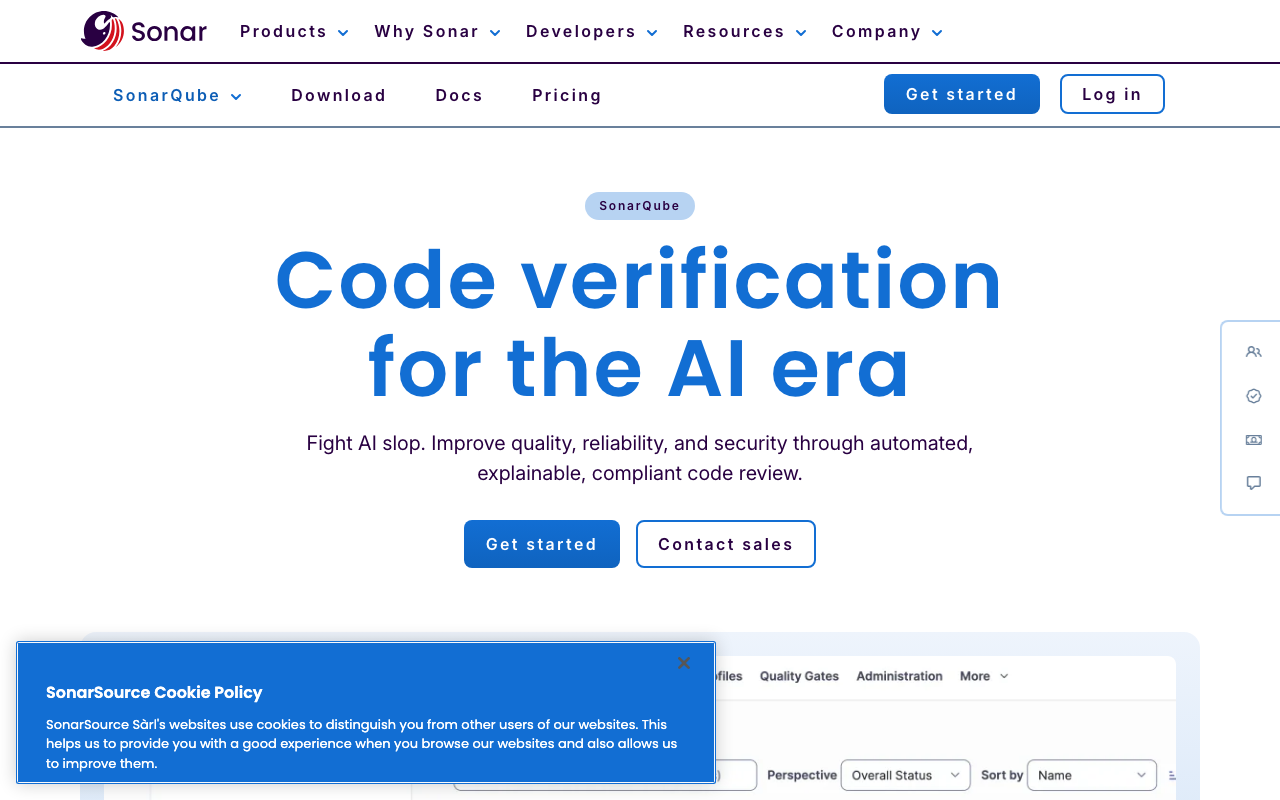
SonarQube is the industry standard for static code analysis. With 6,500+ rules across 35+ languages, quality gate enforcement, and compliance reporting for OWASP, CWE, and SANS, it provides analysis depth that Code Climate cannot match. Where Code Climate gives you an A-F grade based on a handful of metrics, SonarQube gives you granular findings with severity levels, estimated remediation time, and trend tracking over time.
How it compares to Code Climate. Code Climate’s maintainability analysis covers complexity, duplication, and file structure. SonarQube covers all of that plus bugs, security vulnerabilities, security hotspots, code smells, and reliability issues. The quality gate system in SonarQube is far more sophisticated - you can define conditions that block PR merges based on coverage percentage, new bug count, duplication thresholds, security vulnerability severity, and custom metrics. Code Climate’s quality checks are binary pass/fail with limited configurability.
The quality gate system is the standout feature. SonarQube quality gates let engineering teams enforce measurable standards. You define conditions like “new code must have 80% coverage, zero critical bugs, and zero security vulnerabilities” and the gate blocks merges that violate these conditions. This enforcement mechanism converts code quality from a suggestion into a requirement. Code Climate provides PR-level feedback but lacks this level of enforcement granularity.
Security analysis fills Code Climate’s biggest gap. SonarQube includes SAST scanning that covers injection vulnerabilities, authentication issues, cryptographic weaknesses, and more. The security hotspot review workflow helps teams evaluate potential security issues in context rather than treating every finding as a confirmed vulnerability. Code Climate has zero security analysis, so any switch to SonarQube immediately expands your coverage.
Self-hosted deployment provides data sovereignty. For organizations in regulated industries or with strict data residency requirements, SonarQube Server runs entirely on your infrastructure. Code Climate is cloud-only, which is a non-starter for teams that cannot send source code to third-party servers.
Pricing. Free Community Build (limited - no branch analysis or PR decoration). SonarQube Cloud Free tier (50K LOC). Cloud Team from EUR 30/month. Developer Edition from approximately $2,500/year (self-hosted). Enterprise Edition from approximately $20,000/year. Pricing scales with lines of code, not seats.
Best for: Enterprise teams needing deep rule coverage, quality gate enforcement, compliance reporting, and self-hosted deployment options. Teams migrating from Code Climate who want a significant upgrade in analysis depth and security coverage.
Limitations: Self-hosting requires DevOps investment (PostgreSQL, JVM management, Elasticsearch). LOC-based pricing can be unpredictable. The Community Build is too limited for teams using PR workflows. The UI feels dated compared to newer tools. AI capabilities (AI CodeFix) are less mature than dedicated AI review tools.
2. Codacy - Best All-in-One Replacement
Codacy is the most direct replacement for Code Climate if you want a single platform that covers code quality, security scanning, and AI-powered review at the same price point. At $15/user/month, it matches Code Climate’s pricing while providing SAST, SCA, DAST, secrets detection, AI code review, and coverage tracking across 49 languages - a dramatically broader feature set.
How it compares to Code Climate. Think of Codacy as Code Climate with security scanning, AI review, and triple the language support bolted on at the same price. Code Climate gives you maintainability grades and coverage tracking for 15 languages. Codacy gives you all of that plus vulnerability scanning, dependency checking, secrets detection, and AI-powered review suggestions for 49 languages. The migration from Code Climate to Codacy is one of the smoothest because Codacy covers everything Code Climate does and more.
AI-powered review adds a layer Code Climate cannot match. Codacy’s AI Reviewer combines pattern-matching with LLM-powered suggestions to provide contextual feedback on pull requests. It identifies not just rule violations but also logic issues, naming inconsistencies, and potential performance problems. Code Climate’s feedback is entirely rule-based, limited to complexity and duplication findings. For teams that want their quality tool to also function as an AI code reviewer, Codacy provides both in one subscription.
Security scanning is comprehensive for a generalist platform. Codacy covers SAST (static analysis for vulnerabilities), SCA (dependency vulnerability scanning), DAST (dynamic testing of running applications), and secrets detection. While none of these capabilities match dedicated security tools like Semgrep or Snyk in depth, they provide coverage that is infinitely better than Code Climate’s zero security features. For teams that need “good enough” security scanning integrated into their quality workflow, Codacy delivers.
49-language support covers virtually any stack. Where Code Climate leaves gaps for Go, Rust, Kotlin, Swift, and other modern languages, Codacy provides analysis for all of them. The platform uses multiple analysis engines per language rather than a single engine, which generally produces more comprehensive findings than a monolithic approach.
Pricing. Free tier available (Codacy Guardrails VS Code extension for individuals). Pro plan $15/user/month. Business plan (custom pricing, includes self-hosted option). Self-hosted deployment available on Business plan at approximately 2.5x the hosted license cost.
Best for: Teams that want the simplest migration path from Code Climate with a significant feature upgrade. Small to mid-size teams that want quality, security, and AI review in a single affordable platform.
Limitations: False positive rates on legacy codebases can be high - expect to spend time configuring rules and ignore patterns when onboarding large projects. AI review capabilities are useful but do not match dedicated tools like CodeRabbit. SAST depth does not match dedicated security platforms like Semgrep or Snyk. Support responsiveness on non-Business plans can be slow.
3. DeepSource - Best for Signal Quality and Autofix
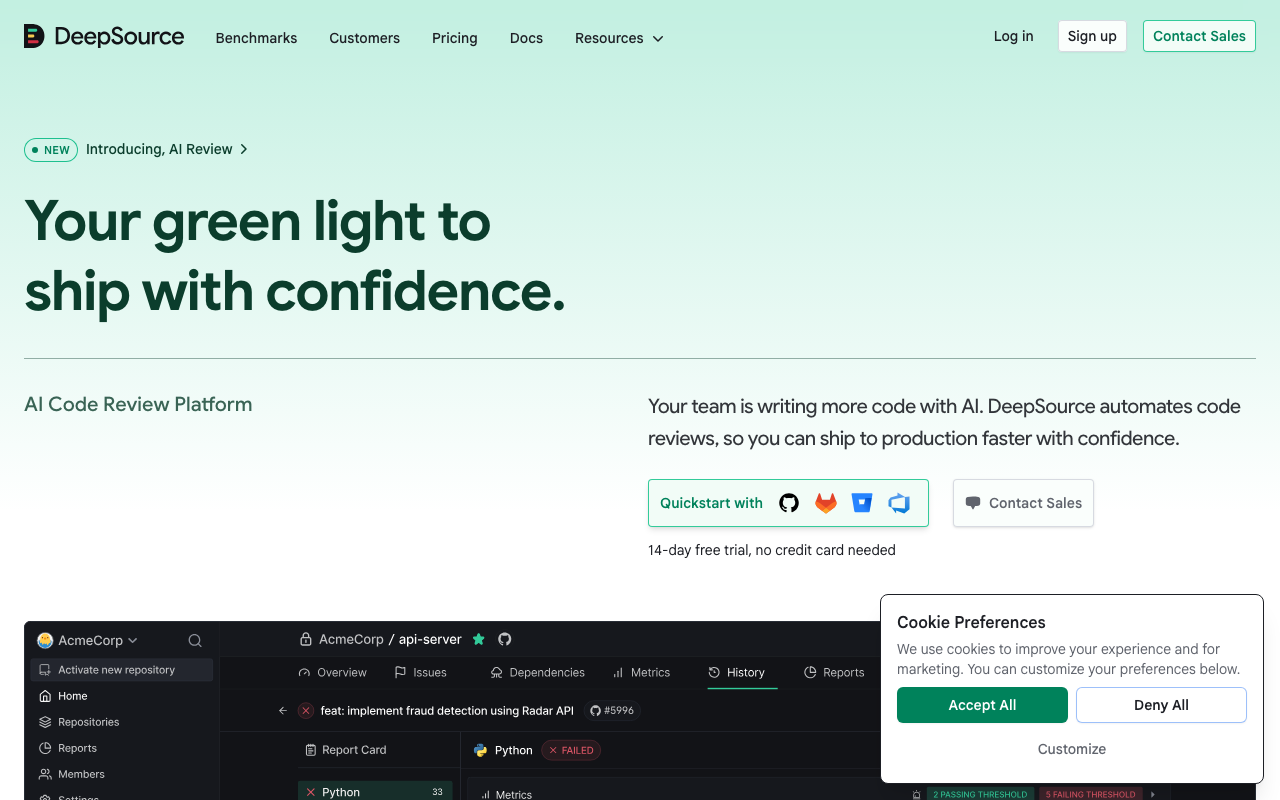
DeepSource addresses one of the most fundamental problems in code quality tooling: finding actionability. Its sub-5% false positive rate means nearly every issue it surfaces is worth fixing. The platform provides 5,000+ rules, AI code review with five-dimension PR report cards, and Autofix AI that generates context-aware fixes for the majority of detected issues.
How it compares to Code Climate. Code Climate flags complexity, duplication, and structural issues - but many teams report that a significant percentage of findings feel low-priority or obvious. DeepSource takes a quality-over-quantity approach, surfacing fewer findings but ensuring each one is genuinely actionable. The five-dimension report card (Security, Reliability, Complexity, Hygiene, Coverage) provides structured feedback that is more useful than Code Climate’s single maintainability grade. And Autofix AI goes a step further by generating ready-to-merge fixes, turning passive analysis into active remediation.
The five-dimension report card replaces the A-F model. Code Climate grades files on a single maintainability scale. DeepSource evaluates every PR across five dimensions - Security, Reliability, Complexity, Hygiene, and Coverage - and scores each one. This multidimensional view gives reviewers a more nuanced understanding of a PR’s quality impact. A change might be clean on security and reliability but introduce significant complexity, and the report card makes that immediately visible.
Autofix AI converts findings into fixes. This is the feature that most differentiates DeepSource from Code Climate’s passive analysis model. When DeepSource identifies an issue, it does not just flag it - it generates a context-aware fix that accounts for the surrounding code, existing patterns, and project conventions. Teams report that Autofix reduces manual refactoring workload by 30-40%. Code Climate identifies issues; DeepSource identifies and fixes them.
Coverage tracking with quality context. Both Code Climate and DeepSource track test coverage, but DeepSource integrates coverage data into its five-dimension scoring. A PR that increases complexity while decreasing coverage gets a clearly negative score, making the trade-off visible. Code Climate reports coverage as a standalone metric without this integrated quality context.
Pricing. Free for individuals. Open Source plan (free, public repos). Team plan $30/user/month. Enterprise plan custom pricing. The Team plan is double Code Climate’s price, which is the main barrier for budget-conscious teams.
Best for: Teams frustrated with false positives and low-quality findings from Code Climate. Teams that want automated fix generation to reduce manual remediation. Organizations that value signal quality over finding volume.
Limitations: Language support covers 16 languages at GA - significantly fewer than Code Climate’s 15-16 and far fewer than alternatives like Codacy (49) or SonarQube (35+). At $30/user/month, it costs twice as much as Code Climate. No DAST capability. Some languages (C/C++, Swift, Kotlin) remain in beta. Custom rule authoring is not available.
4. CodeRabbit - Best AI-Powered Code Review
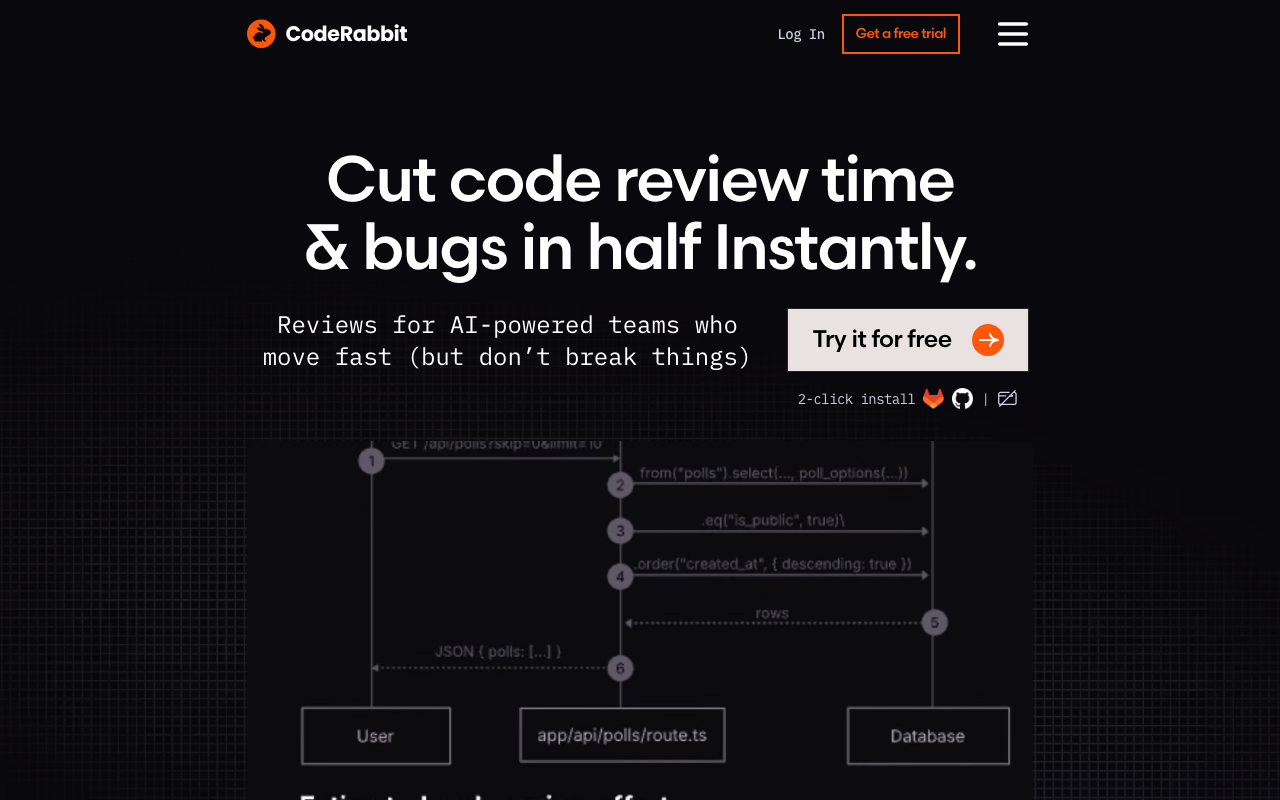
CodeRabbit is the most widely adopted AI code review tool, with 2M+ repositories connected and 13M+ PRs reviewed. It uses large language models to understand code semantics - not just pattern matching - and generates review comments that read like feedback from a senior developer who knows your codebase. Reviews land in 2-4 minutes with inline comments, auto-fix suggestions, and structured PR summaries.
How it compares to Code Climate. These are fundamentally different tools. Code Climate performs static analysis against a rule set and reports maintainability issues. CodeRabbit performs AI-powered semantic code review and provides contextual feedback. Code Climate might tell you a method has high cyclomatic complexity. CodeRabbit might tell you the method has a subtle race condition, an edge case that is not handled, or that the algorithm could be simplified using a standard library function. The analysis operates on a different level entirely.
Natural language instructions replace rule configuration. Code Climate requires understanding its configuration format to adjust rules, severity levels, and thresholds. CodeRabbit lets you define review standards in plain English. Instructions like “always check that API endpoints validate authentication tokens” or “flag React components that do not handle error states” work directly. This accessibility means every developer on the team can contribute to review standards, not just those who understand static analysis configuration.
Learnable preferences reduce noise over time. CodeRabbit tracks which suggestions your team accepts and which they dismiss. Over weeks, the tool learns your team’s coding style and preferences, generating increasingly relevant feedback. This adaptive behavior does not exist in Code Climate’s static rule-based model. The more you use CodeRabbit, the better it gets. Code Climate’s analysis quality is fixed.
The free tier is genuinely useful. CodeRabbit’s free plan covers unlimited public and private repositories with rate-limited reviews. This is more generous than Code Climate’s free tier, which is limited to open-source repositories. Teams can evaluate CodeRabbit comprehensively before committing to a paid plan.
Pricing. Free (unlimited public and private repos, rate-limited). Pro $24/user/month. Enterprise custom pricing. CodeRabbit also supports Azure DevOps, which Code Climate does not.
Best for: Teams that want AI-powered review quality that goes far beyond static analysis. Organizations where code review is a bottleneck and automated senior-developer-level feedback would accelerate delivery. Teams that want review standards defined in natural language rather than rule configuration files.
Limitations: CodeRabbit is a review tool only. It does not provide maintainability grading, coverage tracking, quality gates, or static analysis dashboards. At $24/user/month for review-only functionality, it costs more per feature than Code Climate’s all-in-one approach. Most teams use CodeRabbit alongside a static analysis tool - pairing it with Qlty, SonarQube, or Codacy is a common pattern.
5. Qlty - The Natural Code Climate Successor
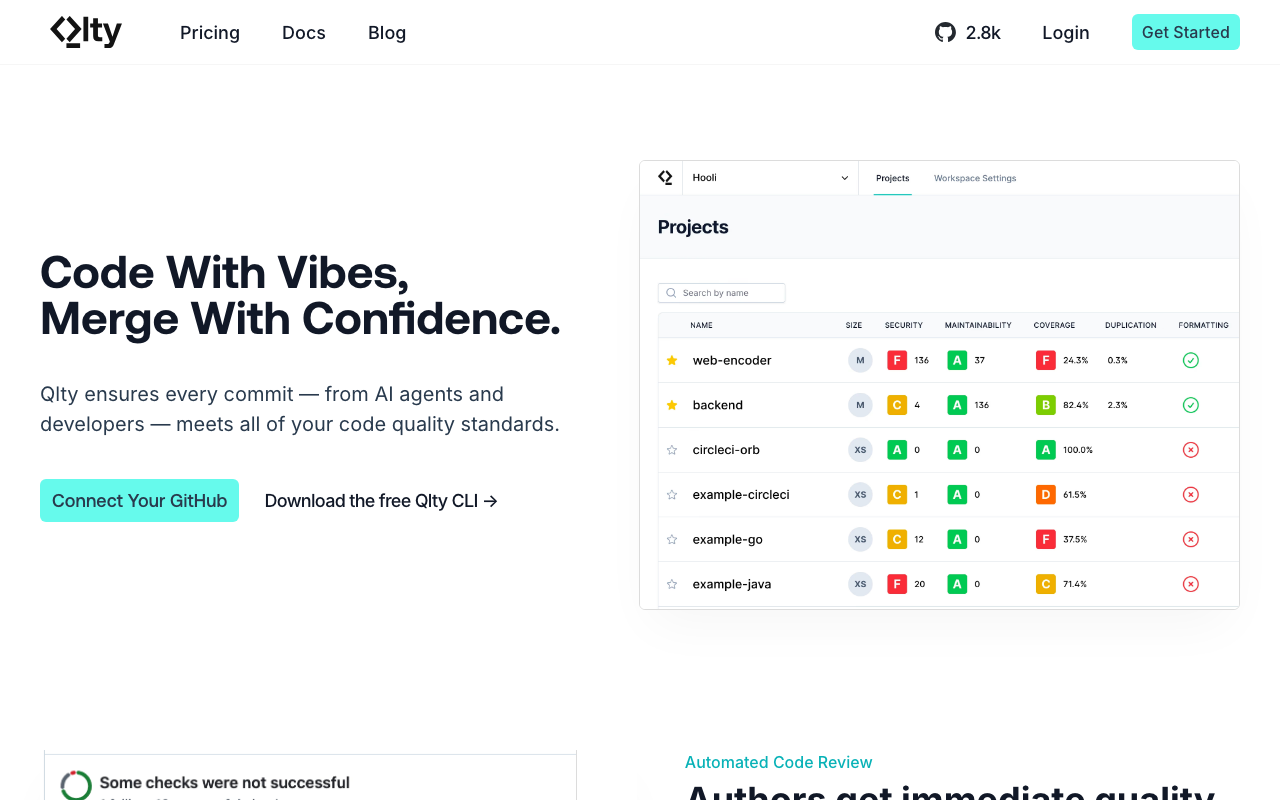
Qlty deserves special attention in this comparison because it was built by the Code Climate team. After Code Climate’s founding team moved on, they created Qlty as the next evolution of the code quality platform concept. It packages 70+ static analysis tools into a unified CLI covering 40+ languages with 20,000+ code quality rules. The free CLI is completely unrestricted for commercial use, and the Cloud platform adds maintainability grading, technical debt quantification, and quality gate enforcement.
How it compares to Code Climate. Qlty is what Code Climate would look like if it were rebuilt from scratch in 2025. The A-F maintainability grading system carries forward, but the underlying analysis is dramatically deeper. Instead of Code Climate’s single analysis engine, Qlty orchestrates 70+ purpose-built analysis tools - ESLint, Pylint, RuboCop, PHPStan, Clippy, and many more. This means you get the analysis quality of the best tool for each language, not a single vendor’s implementation across all languages.
Breadth of analysis tool coverage is unmatched. This is Qlty’s defining differentiator. For a Python file, Qlty runs Pylint, Ruff, and other Python-specific analyzers. For TypeScript, it runs ESLint with appropriate plugins. For Rust, it runs Clippy. Each language gets analyzed by tools that the community considers best-in-class for that language, rather than a generic multi-language engine. For teams working across many languages, the per-language analysis quality is noticeably better than Code Climate’s approach.
Git-aware incremental analysis solves the onboarding problem. One of Code Climate’s pain points is that importing a legacy project generates a flood of findings that overwhelm developers and erode trust in the tool. Qlty addresses this by defaulting to incremental analysis - only new issues in changed code are flagged. Existing issues are tracked but not surfaced in PR reviews. Teams can address legacy debt gradually through planned remediation rather than being confronted with thousands of findings on day one.
The maintainability grading feels familiar. Teams migrating from Code Climate will recognize the A-F grading system immediately. Qlty’s grades are based on the same conceptual model - complexity, duplication, and code structure - but the underlying analysis is powered by more tools and more rules. The grades translate quality data into language that non-technical stakeholders understand, preserving the communication benefit that made Code Climate’s grading popular in the first place.
Technical debt quantification with remediation time estimates. Qlty translates every finding into estimated remediation hours, giving engineering leaders data to justify quality investments. A dashboard that says “this module has 40 hours of technical debt concentrated in 5 files” is more actionable than Code Climate’s “this module has a D grade.”
Pricing. Free tier (unlimited repos, 250 analysis minutes/month). Team $15/contributor/month. Enterprise $36/contributor/month. The free tier is more generous than Code Climate’s, and the paid tier matches Code Climate’s price while providing significantly broader analysis coverage.
Best for: Teams that want the most natural migration from Code Climate. Organizations that value maintainability grading and want it backed by deeper analysis. Polyglot teams working in 5+ languages that need best-in-class analysis per language.
Limitations: Qlty lacks AI-powered review suggestions - it is analysis and grading only, with no contextual PR comments from an AI reviewer. Security scanning coverage is narrower than dedicated tools like Semgrep or Snyk. The analysis minutes model on the free and Team tiers adds a variable cost dimension that can be hard to predict for teams with high commit volumes.
6. CodeScene - Best for Behavioral Analysis and Tech Debt Strategy
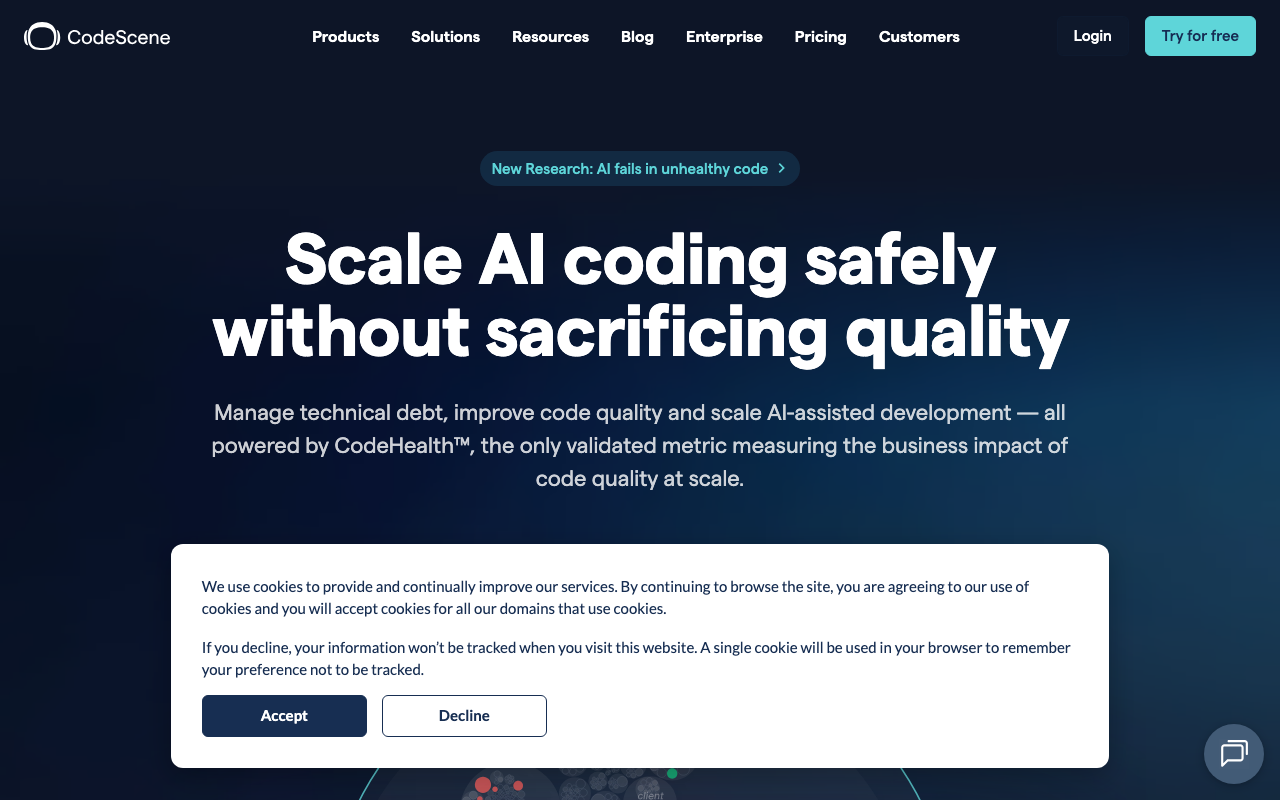
CodeScene takes a fundamentally different approach to code quality. Where Code Climate and most tools on this list analyze your code as static text, CodeScene also analyzes how your team interacts with the code over time. It mines Git history to identify hotspots (complex code that changes frequently), knowledge silos (files where only one developer has expertise), and coordination bottlenecks (areas where multiple teams create merge conflicts).
How it compares to Code Climate. Code Climate tells you that a file has high complexity. CodeScene tells you that a high-complexity file is also a hotspot that three developers modify every sprint and where only one person truly understands the code. The first observation is useful. The second is actionable - it tells you exactly where refactoring will have the greatest impact on delivery speed, bug rates, and team resilience. CodeScene reveals risks that are completely invisible to tools like Code Climate that only analyze code structure.
Hotspot detection prioritizes refactoring for maximum ROI. Not all technical debt is equally costly. A complex file that no one touches is low priority. A complex file that changes weekly and causes frequent bugs is a hotspot that actively slows down your team. CodeScene’s hotspot detection - based on research by Dr. Adam Tornhill - combines complexity metrics with change frequency data from Git history to surface the files where investing in refactoring will deliver the greatest return. Code Climate treats all complexity equally, which makes prioritization harder.
Knowledge distribution mapping reveals organizational risk. CodeScene identifies files and modules where only one developer has expertise (bus factor = 1). When that developer goes on vacation, changes teams, or leaves the company, work on those files stalls. This organizational risk directly impacts delivery speed but is completely invisible to static analysis tools. No other tool in this comparison provides this capability.
CodeHealth trends connect quality to delivery outcomes. CodeScene tracks its CodeHealth metric (1-10 scale based on 25+ research-backed factors) over time and correlates it with delivery metrics like lead time and defect rates. This data helps engineering leaders make the case for refactoring sprints by showing concrete evidence that quality improvements lead to faster delivery. Code Climate provides grade trends but without the delivery performance correlation.
AI-powered refactoring suggestions. CodeScene generates AI-powered refactoring suggestions for its identified hotspots, helping developers reduce complexity in the files that matter most. The suggestions are targeted at the specific patterns causing the hotspot - not generic complexity reduction advice.
Pricing. Free for open-source projects. Standard EUR 18/author/month. Pro EUR 27/author/month. Enterprise custom pricing. The Standard tier is comparable to Code Climate’s pricing while providing a fundamentally different and complementary type of analysis.
Best for: Engineering leaders who need data to justify quality investment to stakeholders. Teams experiencing delivery slowdowns from accumulated technical debt who need to prioritize refactoring efforts. Organizations concerned about knowledge silos and bus factor risks.
Limitations: CodeScene is not a traditional static analysis scanner. It does not replace Code Climate’s maintainability grading with equivalent file-level grades. Security scanning is not part of the platform. The learning curve is steeper because behavioral analysis introduces concepts (hotspots, knowledge distribution, temporal coupling) that developers may not be familiar with. AI refactoring is limited to approximately 6 languages. Best used as a complement to a static analysis tool, not a standalone replacement.
7. Qodana - Best Budget-Friendly Alternative
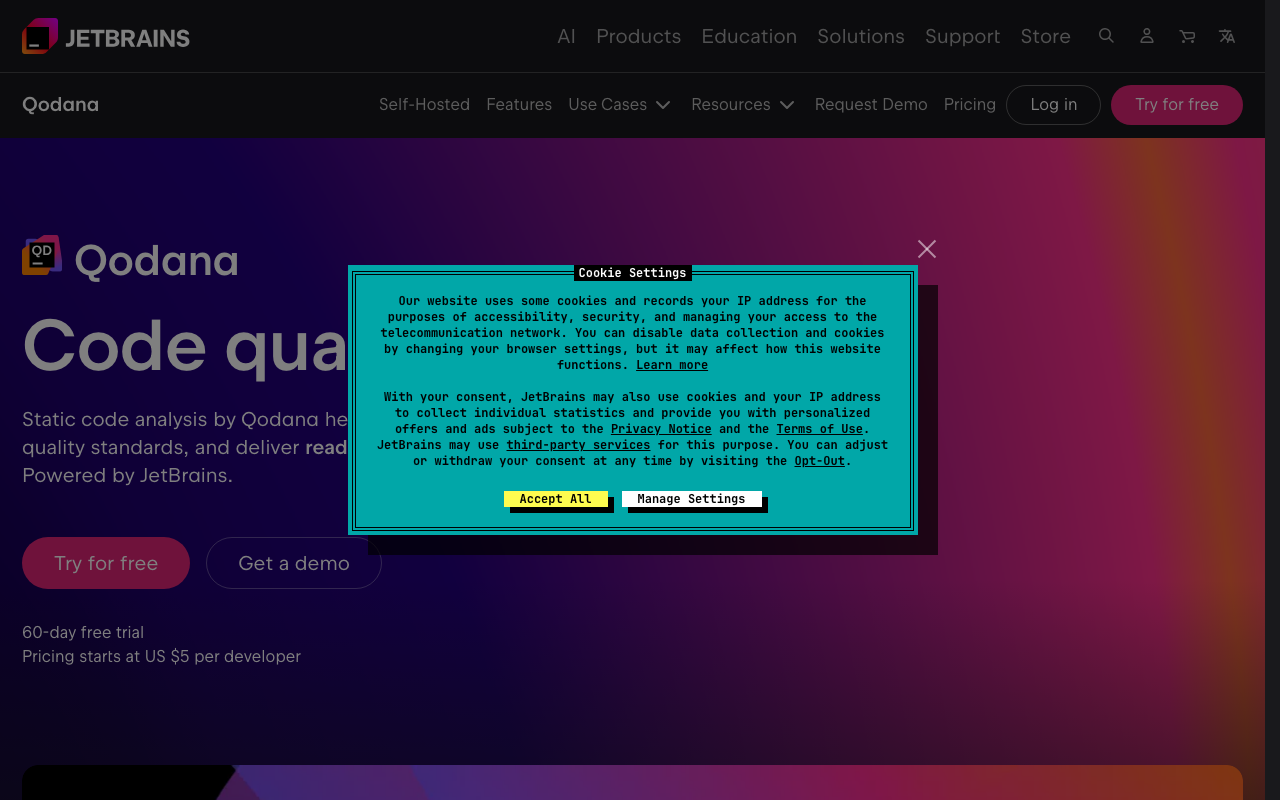
Qodana runs 3,000+ IntelliJ inspections in your CI/CD pipeline at the lowest price point of any tool in this comparison: $6/contributor/month for the Ultimate tier. For a 20-developer team, that is $120/month versus $300/month for Code Climate - a 60% cost reduction. The defining feature is IDE-pipeline consistency: results in JetBrains IDEs match exactly what the pipeline reports, eliminating the frustrating discrepancies that occur when IDE analysis and CI analysis use different engines.
How it compares to Code Climate. Both tools provide code quality analysis with PR-level feedback, but Qodana brings three advantages: more inspections (3,000+ versus Code Climate’s smaller rule set), lower price ($6/contributor/month versus ~$15/user/month), and IDE consistency for JetBrains users. Code Climate’s advantage is its simpler onboarding and the A-F grading system that Qodana lacks.
IDE-pipeline consistency solves a real developer frustration. If you have ever fixed an issue flagged by your CI scanner only to find a different issue in your IDE, you understand why this matters. Qodana uses the same IntelliJ inspection engine that powers JetBrains IDEs, so the rules, severity levels, and findings are identical in both environments. Developers see and fix issues in their editor before they commit, and the CI pipeline confirms the same set of rules. Code Climate cannot provide this consistency because it uses its own analysis engine that does not integrate with any IDE.
JVM language depth exceeds most competitors. For Java, Kotlin, Scala, and Groovy, Qodana’s inspection depth is exceptional. The IntelliJ platform has invested decades in JVM language analysis. If your team primarily works in JVM languages and uses JetBrains IDEs, Qodana provides analysis quality that exceeds Code Climate and rivals tools costing 3-5x more.
Broad language support beyond JVM. Despite its JetBrains roots, Qodana supports 60+ languages - significantly more than Code Climate’s 15-16. Python, JavaScript, TypeScript, PHP, Go, Ruby, and many other languages are supported through IntelliJ’s multi-language inspection framework.
Quality gate enforcement is built in. Qodana supports quality gates that can block PR merges based on finding severity, count, and type. Code Climate provides PR feedback but its quality gate enforcement is more limited. Qodana’s gates integrate naturally with JetBrains-native CI/CD (TeamCity) and also work with GitHub Actions, GitLab CI, Jenkins, and other platforms.
Pricing. Free Community tier (limited inspections). Ultimate $6/contributor/month. Ultimate Plus $15/contributor/month. A 60-day free trial of the full Ultimate tier lets you evaluate comprehensively before committing.
Best for: Budget-conscious teams that want to reduce costs while improving analysis quality. JetBrains IDE users who want perfect IDE-to-pipeline consistency. JVM-heavy teams (Java, Kotlin, Scala, Groovy) that need deep language-specific analysis.
Limitations: No AI-powered review capabilities. Analysis depth varies significantly by language outside the JVM ecosystem - mainstream languages are well-covered but niche languages may have shallow inspection sets. Smaller community and ecosystem compared to SonarQube or Codacy. No DAST, SCA, or secrets detection. Teams using VS Code or other non-JetBrains editors will not benefit from the IDE consistency feature.
8. Semgrep - Best for Custom Security Rules
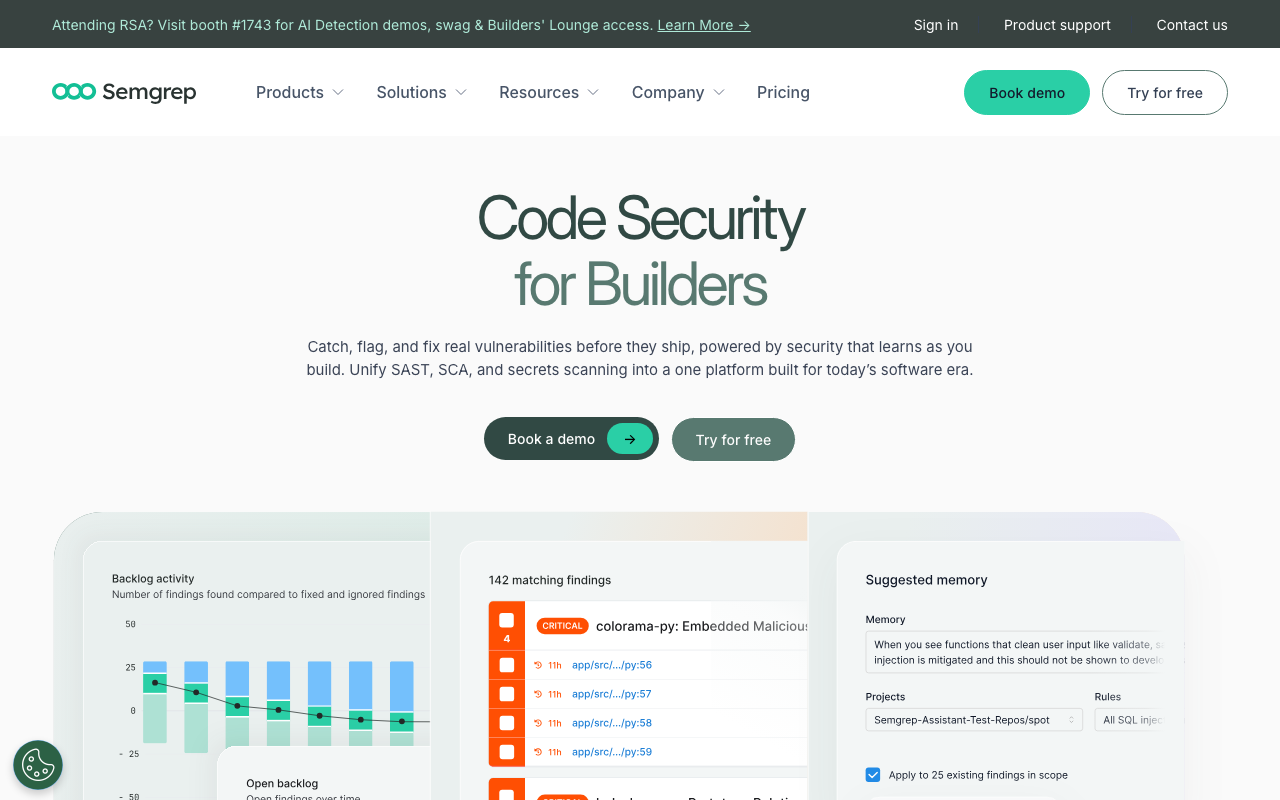
Semgrep is a fundamentally different type of tool than Code Climate. Where Code Climate focuses on maintainability metrics, Semgrep focuses on security vulnerability detection with a custom rule engine that lets developers write detection patterns in syntax that mirrors the source code being scanned. It ships 20,000+ Pro rules and its cross-file dataflow analysis catches complex vulnerabilities that simpler tools miss.
How it compares to Code Climate. These tools do not overlap significantly. Code Climate analyzes maintainability - complexity, duplication, structure. Semgrep analyzes security - injection vulnerabilities, authentication flaws, cryptographic weaknesses, and custom security policies. If you are leaving Code Climate and security scanning is your primary unmet need, Semgrep fills that gap comprehensively. But you would still need a separate tool for maintainability analysis, coverage tracking, and code quality grading.
The custom rule engine is the defining feature. No other tool makes it as easy to write custom detection rules. Semgrep rules use syntax that mirrors the source code being scanned - a Python developer writes rules that look like Python, a Java developer writes rules that look like Java. Rules that take hours in traditional SAST tools take minutes in Semgrep. This is essential for teams with organization-specific security policies, internal API usage patterns, or framework-specific best practices that generic rule sets do not cover.
Cross-file dataflow analysis catches complex vulnerabilities. Semgrep Pro tracks how data flows across multiple files and functions, catching vulnerabilities like second-order SQL injection where tainted input enters through one file and reaches a query in another. This analysis catches vulnerabilities that single-file scanners miss entirely. The median scan time remains at 10 seconds in CI even with cross-file analysis enabled, which means it does not slow down your pipeline.
Semgrep Assistant reduces alert fatigue. The AI-powered assistant analyzes findings and provides context on whether they represent real risks or false positives, reducing triage workload by 20-40% on day one. For teams that have experienced alert fatigue with other tools, this automated triage is a significant quality-of-life improvement.
Free for up to 10 contributors. Semgrep’s Team tier is free for teams of up to 10 contributors. This makes it one of the most accessible security scanning options for small teams, and it is the easiest way to add security analysis when leaving Code Climate.
Pricing. Free open-source engine (single-file analysis only). Team $35/contributor/month (free up to 10 contributors). Enterprise custom pricing. The Team tier includes cross-file analysis, Pro rules, and Semgrep Assistant.
Best for: Teams leaving Code Climate whose primary unmet need is security scanning. Organizations with custom security policies that need enforceable detection rules. Small teams (under 10 contributors) that can use the free tier.
Limitations: Semgrep is security-only. No code quality metrics, maintainability grading, coverage tracking, or technical debt management. At $35/contributor/month for the full platform, it is more than double Code Climate’s price while covering a completely different domain. You need to pair it with a code quality tool to fully replace Code Climate’s functionality. No AI code review, DAST, or SCA in the base product.
9. Snyk Code - Best for Full-Stack Security
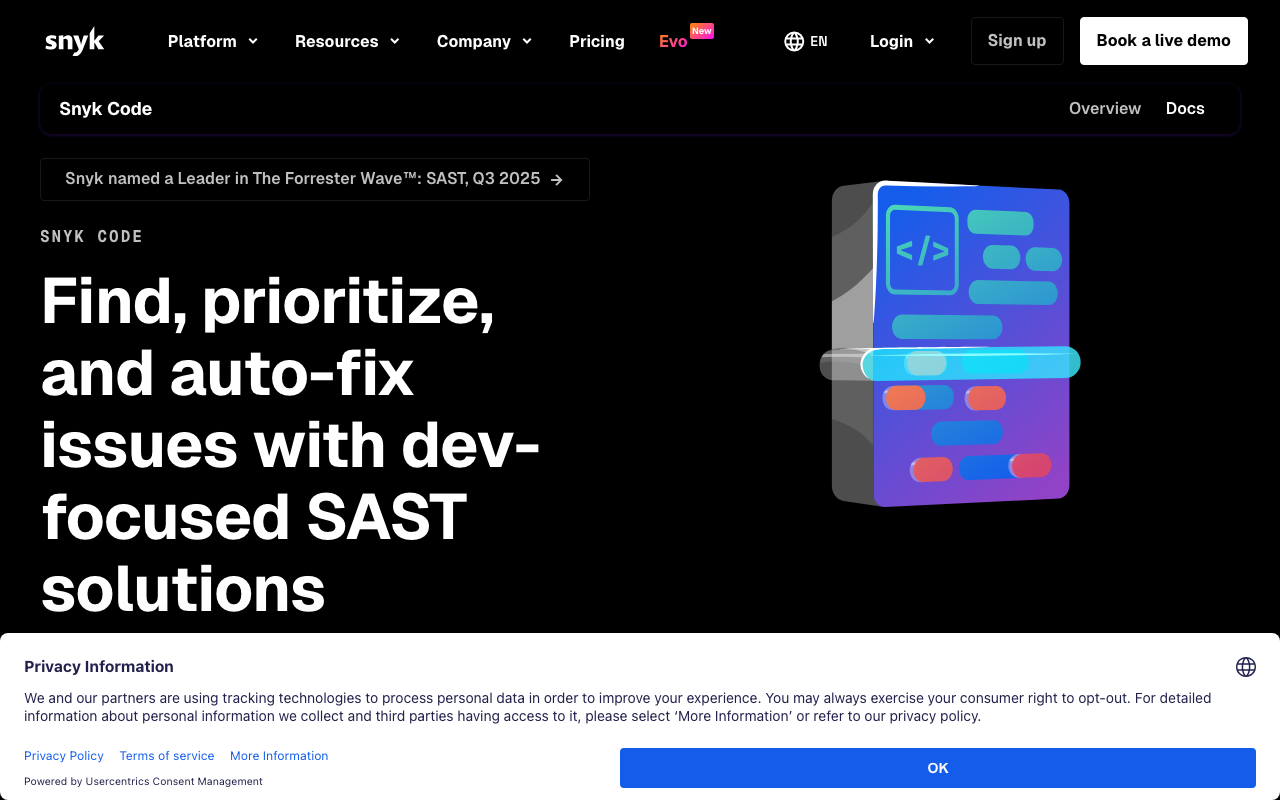
Snyk Code is the most comprehensive developer-first security platform, covering SAST, SCA, container security, IaC scanning, and cloud security in a single subscription. Named a Gartner Magic Quadrant Leader for Application Security Testing, Snyk has established itself as the default choice for teams that prioritize security alongside code quality.
How it compares to Code Climate. Like Semgrep, Snyk Code fills the security gap that Code Climate leaves entirely open. But Snyk goes further than any other tool on this list in security breadth - it covers your application code (SAST), your dependencies (SCA with reachability analysis), your Docker containers, your Terraform/CloudFormation infrastructure, and your Kubernetes configurations. If you are leaving Code Climate and want to add comprehensive security coverage, Snyk provides the broadest protection in a single platform.
The DeepCode AI engine performs interfile dataflow analysis. Snyk’s SAST engine traces how potentially dangerous data moves through your application across multiple files and functions. It is trained on over 25 million data flow cases from open-source projects. When it finds a vulnerability, it generates an AI-powered fix suggestion trained on curated human remediation patterns. This means you get the vulnerability report and a ready-to-apply fix in the same workflow.
SCA with reachability analysis eliminates dependency noise. Most SCA tools flag every known CVE in your dependency tree, including vulnerabilities in code paths your application never calls. Snyk’s reachability analysis determines whether your application actually uses the vulnerable functions, dramatically reducing false positives. The vulnerability database updates within 24 hours of new CVE disclosures, and Snyk automatically generates PRs to upgrade affected dependencies.
Container and IaC scanning cover your infrastructure. Snyk Container analyzes Docker images for vulnerabilities in base images and installed packages. Snyk IaC scans Terraform, CloudFormation, Kubernetes manifests, and ARM templates for misconfigurations. This full-stack security coverage means your entire deployment pipeline is protected - something that neither Code Climate nor most code quality tools address.
Pricing. Free tier (100 SAST tests/month, 400 SCA tests). Team $25/dev/month (minimum 5 developers). Enterprise custom pricing (approximately $670-$900/dev/year for large teams). The free tier is useful for evaluation but too limited for production use.
Best for: Teams that need comprehensive security coverage across code, dependencies, containers, and infrastructure. Organizations in regulated industries where security scanning is a compliance requirement. Teams that want AI-powered vulnerability remediation.
Limitations: Snyk is security-only. No code quality metrics, maintainability grading, coverage tracking, or technical debt management. At $25/dev/month, it costs significantly more than Code Climate while addressing a different problem. The minimum 5-developer requirement on the Team plan locks out very small teams. Enterprise pricing can be expensive at scale ($67K-$90K for 100 developers). You need a separate tool for the code quality and maintainability features that Code Climate provides.
10. LinearB - Best Velocity Replacement
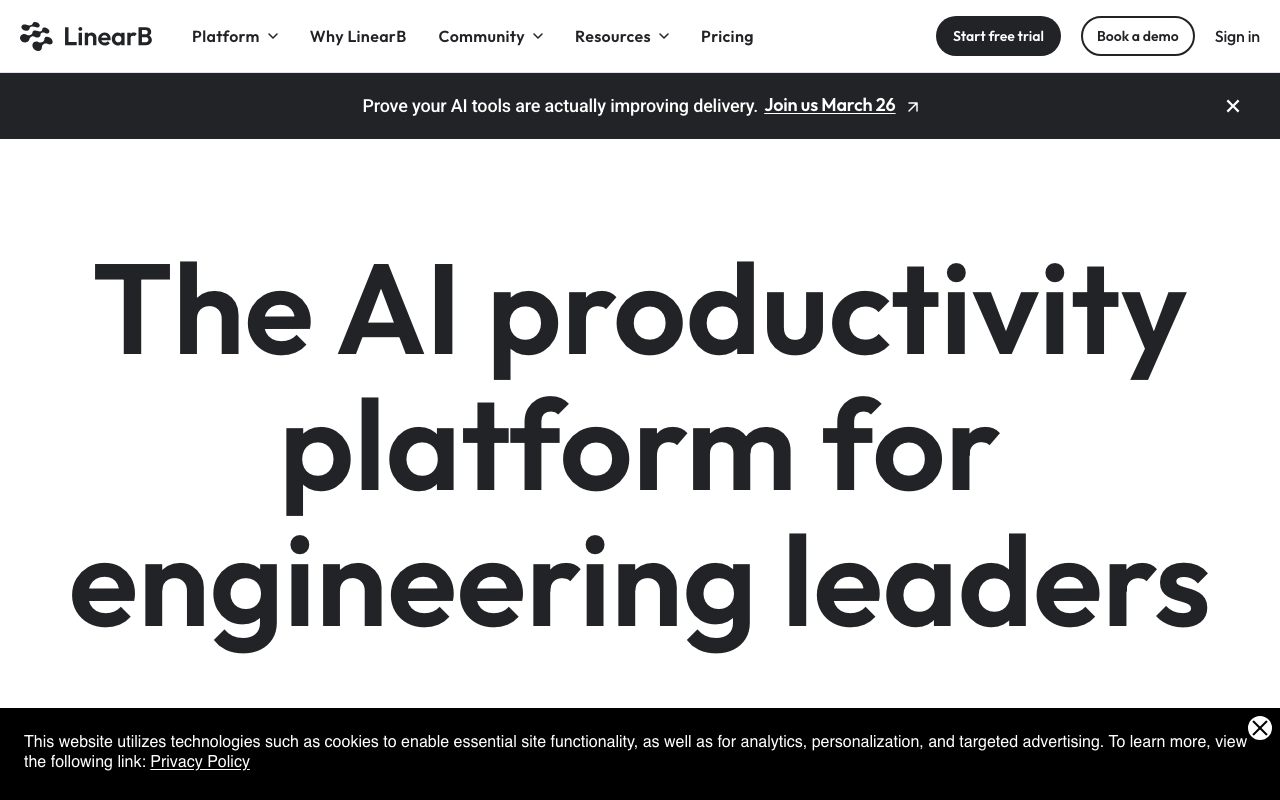
LinearB is included in this comparison specifically because it replaces the Code Climate Velocity functionality that was sunset. While the other tools on this list replace Code Climate Quality’s code analysis features, LinearB replaces the engineering metrics and team productivity capabilities that many Code Climate users relied on.
How it compares to Code Climate Velocity. Code Climate Velocity tracked DORA metrics (deployment frequency, lead time, change failure rate, mean time to recovery), cycle time breakdowns, and team throughput. LinearB provides all of these metrics plus additional workflow automation capabilities. It tracks the full software delivery lifecycle from issue creation to deployment, breaking down cycle time into coding time, review time, merge time, and deploy time. This granularity helps engineering leaders identify exactly where bottlenecks occur.
DORA metrics with industry benchmarks. LinearB tracks the four DORA metrics and benchmarks your team’s performance against industry standards. You can see whether your deployment frequency puts you in the “elite” or “low” performer category according to the DORA research. Code Climate Velocity provided similar metrics but without the industry benchmarking context that makes the numbers meaningful.
Workflow automation addresses bottlenecks. Beyond metrics, LinearB provides gitStream - an automation framework that applies custom rules to pull requests. You can automatically assign reviewers based on code ownership, label PRs by type, route critical changes to senior developers, and enforce review policies. This automation capability was not part of Code Climate Velocity and addresses a key bottleneck that metrics alone cannot solve.
Developer experience tracking. LinearB tracks developer experience metrics including wait time (how long PRs wait for review), rework rate (how often changes get sent back for revision), and context switching frequency. These metrics help engineering leaders understand not just delivery speed but also developer satisfaction and productivity.
Investment allocation visibility. LinearB categorizes engineering work into new features, maintenance, bug fixes, and technical debt, giving leaders visibility into how their team’s effort is allocated. This was a popular feature in Code Climate Velocity that LinearB has expanded with more granular categorization and trend tracking.
Pricing. Free tier available with limited features. Paid plans require contacting sales for pricing. LinearB’s pricing is typically based on team size and scales with the number of developers being tracked.
Best for: Teams that relied on Code Climate Velocity for engineering metrics and need a replacement for DORA metrics, cycle time tracking, and team productivity analysis. Engineering leaders who need data to justify process improvements and demonstrate delivery performance to stakeholders.
Limitations: LinearB is metrics-only. It does not analyze code quality, security, or maintainability. It does not replace any of Code Climate Quality’s analysis features. You need a separate code quality tool alongside LinearB to fully replace the Code Climate Quality plus Velocity combination. Pricing is not publicly transparent, which makes budgeting harder.
Migration guide: moving from Code Climate
Migrating from Code Climate requires planning, but the process is straightforward because Code Climate’s feature set is narrower than most alternatives. Here is a practical step-by-step approach.
Step 1: Audit what you actually use in Code Climate
Before selecting a replacement, document which Code Climate features your team actively relies on. Many teams pay for Code Climate but only use a subset of its capabilities.
Maintainability grading. Do engineering leaders reference the A-F grades in planning discussions? If so, you need a replacement that provides equivalent grading - Qlty and CodeScene both provide health scoring systems. If the grades go unread, any tool with quality metrics will suffice.
Test coverage tracking. Is Code Climate your primary coverage reporting tool? If yes, verify that your replacement integrates with your coverage framework (Codecov, Coveralls, or framework-native reporters). Most alternatives support coverage tracking, but the integration setup varies.
PR-level feedback. Does your team actively read and act on Code Climate’s PR comments? If so, evaluate whether the replacement’s PR feedback is equal or better quality. Run both tools in parallel to compare.
Quality checks. Are PRs blocked on Code Climate findings? If so, you need a replacement with quality gate enforcement. SonarQube, Qodana, and Qlty all provide this.
Velocity metrics. If your team used Code Climate Velocity, you need a separate replacement. LinearB is the most direct successor. Jellyfish and Sleuth are alternatives worth evaluating.
Step 2: Choose your replacement based on primary need
Based on your audit, here is a decision guide:
- Need maintainability grading plus security: Codacy ($15/user/month) or SonarQube (from $30/month Cloud)
- Need the closest Code Climate experience: Qlty ($15/contributor/month) - built by the Code Climate team
- Need AI-powered review: CodeRabbit ($24/user/month) plus Qlty or Codacy for static analysis
- Need to minimize cost: Qodana ($6/contributor/month)
- Need behavioral analysis and tech debt strategy: CodeScene (EUR 18/author/month)
- Need Velocity replacement: LinearB (contact sales)
Step 3: Run the new tool in parallel for 2-4 weeks
Do not remove Code Climate until you have confirmed the replacement works for your team. Running both tools simultaneously lets you compare finding quality, verify CI/CD integration reliability, assess developer adoption, and identify feature gaps you did not anticipate.
Most alternatives can be installed alongside Code Climate without conflicts. They integrate through separate GitHub Apps or CI pipeline steps and post separate PR comments. The parallel period is essential for building team confidence in the new tool.
Step 4: Migrate configurations
Code Climate uses a .codeclimate.yml configuration file that defines which engines to run, which patterns to ignore, and which severity thresholds to enforce. This configuration needs to be translated to your new tool’s format.
For Qlty: Uses .qlty.toml configuration. The plugin-based architecture maps closely to Code Climate’s engine model. Many of the same underlying tools (ESLint, RuboCop, Pylint) are available in both.
For Codacy: Configuration is managed through the web dashboard or .codacy.yml file. Codacy provides a migration guide for teams coming from other tools, and their support team can help translate configurations.
For SonarQube: Uses quality profiles (rule sets) and quality gates (enforcement conditions). The configuration model is different from Code Climate’s engine-based approach - SonarQube uses a centralized profile rather than a repository-level config file. Most teams find SonarQube’s default Sonar Way profile is a reasonable starting point.
For Qodana: Uses qodana.yaml configuration. If your team uses JetBrains IDEs, the inspection profiles can be shared between the IDE and the CI pipeline.
For CodeRabbit: Uses .coderabbit.yaml or web dashboard settings. Review instructions can be defined in natural language, which means translating Code Climate rules into CodeRabbit instructions is more about describing intent than mapping configurations.
Step 5: Communicate and decommission
Switching analysis tools affects every developer’s daily workflow. Announce the change with specific reasoning - which Code Climate pain points you are addressing and what improvements the team should expect. Provide documentation or a brief walkthrough of the new tool’s PR comments, dashboard, and configuration.
Once the team is comfortable and all critical workflows are migrated, remove the Code Climate GitHub App, delete the .codeclimate.yml configuration file from your repositories, and cancel the subscription.
Which alternative should you choose?
The right Code Climate alternative depends on what problem you are solving. Here is a decision framework based on the most common migration scenarios.
You want the most natural migration
Choose Qlty. Built by the Code Climate team, it provides the same conceptual model (maintainability grading, code health metrics) backed by dramatically deeper analysis. The A-F grading will be familiar, the pricing is identical ($15/contributor/month), and the transition requires the least conceptual change. Qlty is Code Climate’s spiritual successor and the most seamless migration path.
You want more features at the same price
Choose Codacy. At $15/user/month - the same as Code Climate - Codacy provides code quality analysis, SAST, SCA, DAST, secrets detection, AI code review, and coverage tracking across 49 languages. It is the strongest value proposition for teams that want to upgrade without increasing spend. The migration is straightforward because both tools are cloud-based platforms with GitHub integration.
You want the lowest possible cost
Choose Qodana. At $6/contributor/month, it costs 60% less than Code Climate while providing 3,000+ IntelliJ inspections and quality gate enforcement. If your team uses JetBrains IDEs, the IDE-pipeline consistency is a bonus feature that no other tool provides. The savings compound at scale - a 50-developer team saves $5,400/year compared to Code Climate.
You want to add security scanning
Choose Semgrep plus Qlty or Codacy standalone. If you want security as an add-on to code quality, Codacy covers both in a single subscription. If you want best-in-class security depth, pair Semgrep (free for up to 10 contributors) with Qlty (for maintainability grading) to cover both quality and security at a reasonable combined cost.
You want AI-powered code review
Choose CodeRabbit. If your primary frustration with Code Climate is that its feedback is too shallow and rule-based, CodeRabbit’s AI-powered review provides a fundamentally different experience. Pair it with Qlty or Qodana for static analysis to cover both AI review and maintainability metrics.
You want to understand and prioritize tech debt
Choose CodeScene. If Code Climate’s A-F grades told you that code was bad but did not help you decide what to fix first, CodeScene’s hotspot detection and behavioral analysis provide the prioritization framework you need. It identifies the specific files where refactoring will have the greatest impact on delivery speed and reliability.
You want deep enterprise analysis
Choose SonarQube. If you are outgrowing Code Climate and need enterprise-grade analysis with 6,500+ rules, compliance reporting, quality gate enforcement, and self-hosted deployment options, SonarQube is the industry standard. The increased complexity and cost are justified for teams with compliance requirements and established DevOps practices.
You need to replace Code Climate Velocity
Choose LinearB. It is the most direct replacement for Velocity’s engineering metrics, providing DORA metrics, cycle time breakdowns, and team productivity analysis with additional workflow automation capabilities that Velocity never had.
You want the best possible analysis quality regardless of cost
Choose DeepSource for code quality combined with Semgrep for security and CodeRabbit for AI review. This three-tool stack provides sub-5% false positive analysis (DeepSource), deep security scanning with custom rules (Semgrep), and AI-powered review that catches semantic issues (CodeRabbit). Total cost is approximately $89/user/month - significantly more than Code Climate but covering a vastly broader set of capabilities with best-in-class depth in each area.
Conclusion
Code Climate played an important role in making automated code quality accessible to development teams. Its A-F grading system, simple setup, and GitHub integration set a standard that influenced every tool on this list. But the market has moved significantly beyond what Code Climate offers today.
The sunsetting of Velocity, the absence of security scanning, the limited language support, and the lack of AI-powered analysis have created gaps that newer tools fill comprehensively. Whether you need the familiar maintainability grading of Qlty, the all-in-one breadth of Codacy, the enterprise depth of SonarQube, or the AI-powered review of CodeRabbit, there is an alternative that addresses your specific needs.
The most important step is identifying your primary pain point. If you are leaving Code Climate because it lacks security scanning, a tool like Codacy or Semgrep solves that problem directly. If you are leaving because the analysis feels too shallow, SonarQube or DeepSource provides dramatically deeper coverage. If you want the same experience but better, Qlty is the clearest successor.
Run your chosen replacement in parallel with Code Climate for 2-4 weeks before committing. Compare finding quality, developer experience, and workflow integration on your actual codebase. The right tool is the one that your team actually reads and acts on - not the one with the longest feature list.
Further Reading
- 13 Best Code Quality Tools in 2026 - Platforms, Linters, and Metrics
- 10 Best Codacy Alternatives for Code Quality in 2026
- 10 Best DeepSource Alternatives for Code Quality (2026)
- 15 Best SonarQube Alternatives in 2026 (Free & Paid)
- Best Code Review Tools for JavaScript and TypeScript in 2026
- 15 Best VS Code Alternatives (We Tested Them All)
 Gitar
GitarComments are not enough
Gitar applies the fix, validates it in CI, and clears the queue.
See it on your repo Read our independent Gitar reviewFrequently Asked Questions
What is the best Code Climate alternative?
The best Code Climate alternative depends on your primary need. SonarQube is the strongest choice for enterprise rule depth with 6,500+ rules and compliance reporting. Codacy offers the closest feature parity with code quality, security scanning, and AI review at $15/user/month. Qlty - built by the Code Climate team itself - is the most natural successor for code health metrics and maintainability grading. CodeScene is best for teams that want behavioral analysis and tech debt prioritization based on how developers actually interact with code.
Is Code Climate still maintained?
Code Climate Quality is still an active product and continues to provide maintainability analysis, test coverage tracking, and code quality grading. However, Code Climate Velocity - the engineering metrics product that tracked DORA metrics and team productivity - was sunset. The founding team moved on to build Qlty, a new code quality platform. Many teams are evaluating alternatives due to the reduced investment in the Quality product, the loss of Velocity, and the availability of more modern tools with AI-powered analysis and deeper security scanning.
What does Code Climate do?
Code Climate Quality analyzes source code for maintainability issues including complexity, duplication, and structural problems, assigning A-F grades to files and repositories. It also tracks test coverage percentages and integrates with CI/CD pipelines to provide PR-level feedback. Code Climate Velocity was a separate product that tracked engineering metrics like DORA metrics, cycle time, and team throughput - but Velocity has been sunset. The Quality product still operates but has a narrower focus compared to modern all-in-one code quality platforms.
How much does Code Climate cost?
Code Climate Quality is free for open-source repositories. Paid plans for private repositories start at approximately $15/user/month. Compared to alternatives, this is on par with Codacy ($15/user/month) and Qlty ($15/contributor/month), cheaper than DeepSource ($30/user/month) and Semgrep ($35/contributor/month), and more expensive than Qodana ($6/contributor/month). However, Code Climate's feature set is narrower than most alternatives at the same price point, lacking security scanning, AI review, and custom rule authoring.
Can I migrate from Code Climate to SonarQube?
Yes, migration from Code Climate to SonarQube is straightforward. Both tools analyze code quality, but SonarQube provides significantly deeper analysis with 6,500+ rules versus Code Climate's more limited rule set. SonarQube adds quality gate enforcement, security vulnerability detection, and compliance reporting that Code Climate lacks. The main trade-off is complexity - SonarQube requires self-hosting infrastructure or a SonarQube Cloud subscription, and initial setup takes more effort than Code Climate's simple GitHub integration. Run both tools in parallel for 2-4 weeks before fully migrating.
What is the best free alternative to Code Climate?
The best free Code Climate alternatives are SonarQube Community Build (free, self-hosted, 6,500+ rules but no branch analysis), Qlty CLI (free for commercial use, 70+ analysis plugins, 40+ languages), and Qodana Community (free, 3,000+ IntelliJ inspections). Each covers different aspects of what Code Climate provides. Qlty is the most natural replacement since it was built by the Code Climate team and provides similar maintainability grading. SonarQube offers the deepest rule coverage. Qodana is ideal for JetBrains IDE users.
Is Qlty the same as Code Climate?
Qlty is not the same product as Code Climate, but it was built by the same founding team after they moved on from Code Climate. Qlty is the spiritual successor that reimagines Code Climate's approach to code quality with deeper analysis, broader language support (40+ languages via 70+ plugins), and a modern architecture. It provides similar A-F maintainability grading but backed by more analysis tools and rules. Teams familiar with Code Climate will find Qlty's conceptual model immediately recognizable.
Does Code Climate have security scanning?
No, Code Climate Quality does not include any security scanning capabilities. It focuses exclusively on maintainability metrics like complexity, duplication, and structural issues. This is one of the primary reasons teams migrate away from Code Climate in 2026. Alternatives like Codacy ($15/user/month) include SAST, SCA, DAST, and secrets detection alongside code quality analysis. Teams that need security scanning alongside Code Climate must add a separate tool like Semgrep or Snyk.
What happened to Code Climate Velocity?
Code Climate Velocity - the engineering metrics product that tracked DORA metrics, cycle time, deployment frequency, and team throughput - was sunset. Teams that relied on Velocity for engineering performance tracking need a separate replacement tool. LinearB is the most direct successor, providing DORA metrics, cycle time breakdowns, and workflow automation. Other alternatives include Jellyfish and Sleuth for engineering analytics and team productivity measurement.
How do I migrate from Code Climate to Codacy?
Migrating from Code Climate to Codacy is straightforward since both are cloud-based platforms with GitHub integration. Connect your repositories to Codacy, which will automatically detect languages and begin analysis without requiring a configuration file. Run both tools in parallel for 2-4 weeks to compare findings and verify integration. Codacy's Pro plan at $15/user/month matches Code Climate's price while adding SAST, SCA, DAST, secrets detection, AI review, and coverage tracking across 49 languages.
Which Code Climate alternative has the best AI features?
CodeRabbit offers the strongest AI-powered code review capabilities among Code Climate alternatives. It uses large language models to generate senior-developer-quality review comments on every pull request in 2-4 minutes, with natural language configuration instead of rule files. Codacy's AI Reviewer and AI Guardrails provide solid AI-powered analysis at a lower price point. DeepSource's Autofix AI generates context-aware fixes for detected issues. Code Climate itself has no AI features, making any of these alternatives a significant upgrade.
Can I use Code Climate with GitLab or Bitbucket?
Code Climate Quality primarily supports GitHub, with limited support for GitLab and Bitbucket. Most alternatives offer broader platform support. SonarQube supports GitHub, GitLab, Bitbucket, and Azure DevOps. Codacy, DeepSource, and CodeRabbit support GitHub, GitLab, and Bitbucket. Qlty currently focuses on GitHub integration. For teams using GitLab or Bitbucket as their primary platform, Codacy or SonarQube provide the most seamless integration experience.
Explore More
Tool Reviews
 SonarQube Review
 Codacy Review
 DeepSource Review
 CodeRabbit Review
 Qlty Review
 CodeScene Review
 JetBrains Qodana Review
 Semgrep Review
 Snyk Code Review
 LinearB Review
Free Newsletter
Stay ahead with AI dev tools
Weekly insights on AI code review, static analysis, and developer productivity. No spam, unsubscribe anytime.
Join developers getting weekly AI tool insights.
Related Articles
8 Best CodeRabbit Alternatives for AI Code Review in 2026
Looking beyond CodeRabbit? Compare 8 top AI code review alternatives with real features, pricing, honest pros/cons, and team recommendations.
February 17, 2026
alternatives10 Best GitHub Copilot Alternatives for Code Review (2026)
GitHub Copilot lacks deep code review. Compare 10 alternatives with better PR analysis, security scanning, and review automation. Includes pricing tips.
February 26, 2026
alternativesQodo AI Alternatives: 11 Best AI Test Gen Tools
Compare 11 Qodo alternatives for AI test generation and code review. Real pricing, feature comparisons, and honest trade-offs for each tool.
March 3, 2026