Qodo AI Alternatives: 11 Best AI Test Gen Tools
Compare 11 Qodo alternatives for AI test generation and code review. Real pricing, feature comparisons, and honest trade-offs for each tool.
Published:
Last Updated:
Direct answer
The strongest Qodo alternatives in 2026: CodeRabbit for dedicated PR review at $24/dev/mo annual, Codacy for review plus SAST and SCA at $18/dev/mo yearly, Sourcery for Python at $12/seat/mo, PR-Agent free and MIT-licensed since 23 April 2026, Kodus free under AGPLv3, and Diffblue Cover or EvoSuite for Java test generation. Only Qodo and Diffblue replace the test generation. Qodo itself is now a flat ~$30/month for up to 30 users. Verified 2026-10-19.
What changed about Qodo in 2026
Direct answer: Two things, and both weaken the case for leaving on price (verified 2026-10-19). Qodo no longer prices per seat - it charges a flat team fee of roughly $30 per month covering up to 30 users, plus credits at $0.012 each, pooled across the team with no rollover. And it no longer has a permanent free tier - a 14-day trial with unlimited reviews replaced it.
Earlier versions of this page described Qodo’s Teams plan as $30 per user per month and called it above the market average. On the published model that is wrong by a wide margin: at 20 developers Qodo’s subscription is about $30 a month against $480 for CodeRabbit Essentials and $360 for Codacy Team. If you were looking for a Qodo alternative because of price, re-check the arithmetic first.
What remains a genuine reason to look elsewhere is forecastability. Qodo publishes no credits-per-review figure, credits do not roll over, and the flat fee stops at 30 users - above which pricing is quote-only with no published rate card.
Why teams look for Qodo alternatives
Qodo (formerly CodiumAI) is one of the most innovative tools in the AI code quality space. Its combination of automated test generation and PR review in a single platform is unique, and its recognition as a Gartner Visionary in AI Code Assistants validates the approach. With support for GitHub, GitLab, Bitbucket, and Azure DevOps plus self-hosted deployment via the open-source PR-Agent, Qodo checks more boxes than most competitors.
But no tool is perfect for every team. After analyzing developer feedback across G2, Reddit, and engineering forums, several recurring reasons drive teams to evaluate qodo alternatives.
The credit system cannot be forecast from published data
Direct answer: Qodo’s credits cost $0.012 each, are pooled across the team and do not roll over, in packs of 2,500 / 5,000 / 20,000 (verified 2026-10-19). The structural problem is not the rate - it is that Qodo publishes no credits-per-review figure, so you cannot convert a pack into a review count without measuring a month of your own volume.
Pooling is genuinely better than Greptile’s model, where credits attach to the developer who received the review and explicitly do not pool, so a heavy contributor bills into overage while light contributors leave allowance unused. The downside is that one person can drain the team allocation, and no rollover means a quiet month is money lost. By contrast CodeRabbit’s usage charge is a simple $0.25 per reviewed file past the hourly limit, which is forecastable from headcount and repository count.
Competitors like CodeRabbit and GitHub Copilot use simpler per-seat billing without credit tracking.
The free tier is gone entirely
Direct answer: Qodo has no permanent free tier as of 2026-10-19. The allowance went from 75 PR reviews per month, to 30, to nothing. What exists is a 14-day trial with unlimited reviews and no card. CodeRabbit went the same direction on a different axis in 2026: its free tier is now public repositories only, with private repos getting 1 summary-only review per hour.
So “we need a free tier” is now a reason to leave both of them, not to switch between them. The genuinely free options on private code are self-hosted PR-Agent under MIT and Kodus under AGPLv3.
Test generation depth varies by language
Qodo’s test generation is strongest for Python, JavaScript, TypeScript, and Java. For these languages, it produces meaningful tests with edge case coverage, proper mocking, and framework-specific output (pytest, Jest, JUnit). For languages like Rust, PHP, and Kotlin, the generated tests are shallower and sometimes require significant manual adjustment. Teams working primarily in languages outside the top tier may find dedicated alternatives more effective.
Some teams need review without test generation
Not every team needs AI test generation bundled with their review tool. Teams that already have mature testing practices and comprehensive test suites primarily need deep PR review - catching logic errors, security issues, and architectural problems. For these teams, Qodo’s bundled approach means paying for capabilities they do not use, when a dedicated review tool like CodeRabbit or Sourcegraph Cody might provide deeper analysis at the same price point.
IDE plugin performance concerns
Several G2 reviewers report slow performance with Qodo’s IDE plugin, particularly on larger codebases. For developers who value responsiveness in their editor, this friction can outweigh the benefits of in-IDE test generation and review. Alternatives like Tabnine and Copilot prioritize low-latency IDE interactions.
For a deeper look at Qodo’s rebrand story, see our guide on the CodiumAI to Qodo transition.
Disclosure: Gitar is our AI code review category partner and is labelled as such below. Partners get a guaranteed entry in relevant lists, never a rating, a rank, or the removal of a criticism. See our sponsorship policy.
Quick comparison: all alternatives at a glance
| Tool | Primary strength | Test generation | Free tier (verified 2026-10-19) | Starting price (verified 2026-10-19) |
|---|---|---|---|---|
| Qodo (the baseline) | Review + test generation | Yes | None - 14-day trial, unlimited reviews | ~$30/mo flat, up to 30 users + credits at $0.012, pooled, no rollover |
| PR-Agent | Free self-hosted review | No | Yes - MIT since 23 Apr 2026 | $0 licence + LLM spend |
| Kodus | Free self-hosted review | No | Yes - AGPLv3, any team size | $10/dev/mo hosted ($8 annual); Community caps at 10 rules, 3 plugins |
| EvoSuite | Open-source Java tests | Yes (Java only) | Yes (OSS) | Free |
| Sourcery | Python-focused review | No | OSS repos only | $12/seat/mo annual, $24 Team |
| Codacy | All-in-one quality + security | No | Developer tier free forever (IDE) | $18/dev/mo yearly, $21 monthly |
| GitHub Copilot | Code generation + review | No | Copilot Free - no code review | $10/mo Pro (includes review), $19 Business, monthly only |
| Gitar (partner) | AI review that applies the fix | No | Trial, free for OSI-licensed public repos | $20/user/mo annual ($25 monthly), capped at 50 users |
| CodeRabbit | Deep AI PR review, 4 platforms | No | Public repos only | $24/dev/mo annual, $30 monthly; 1 linked repo on Essentials |
| Diffblue Cover | Java test generation | Yes (Java only) | No | Quote only |
| Sourcegraph Cody | Large-codebase analysis | No | Yes | Quote only |
| Testim | End-to-end test automation | Yes (E2E) | Yes | ~$450/mo |
| Katalon | No-code test platform | Yes (E2E + API) | Yes | Free community tier |
| Tabnine | Privacy-first completion | No | Unknown | Unverifiable - Tricentis acquired it 30 Jul 2026 |
Only two tools on that list replace what Qodo actually does. Diffblue Cover and EvoSuite generate tests, both Java-only. Everything else replaces the review half and leaves the testing half uncovered - which is the point most Qodo-alternatives roundups skip.
Detailed reviews
1. GitHub Copilot - Best for code generation with lightweight review
GitHub Copilot is the most widely adopted AI coding assistant, used by millions of developers for inline code completion, chat-based assistance, and increasingly for PR review. While it does not generate tests the way Qodo does, its code generation capabilities can scaffold test files faster than writing them manually, and the PR review feature provides surface-level analysis that catches obvious issues.
Why teams choose it over Qodo: Copilot’s IDE integration is faster and more responsive than Qodo’s plugin. The inline autocomplete is seamless in VS Code and JetBrains, and the Copilot Chat feature answers code questions without leaving the editor. For teams that primarily need code generation with basic review on top, Copilot delivers more overall value than Qodo’s narrower focus on testing and review.
The PR review feature has improved steadily, and Copilot Workspace adds higher-level project planning. Copilot is $10/month on Pro, $39 Pro+, $19/user/month Business and $39 Enterprise - and monthly is the only option since GitHub retired annual billing entirely on 1 June 2026 (verified 2026-10-19). Code review is included from Pro at $10; only Copilot Free lacks it. It lacks Qodo’s test generation and covers GitHub only for review. For a detailed breakdown, see our Qodo vs GitHub Copilot comparison.
Key strengths:
- Fastest inline code completion with deep IDE integration
- Copilot Workspace for project-level code planning
- Agent mode for multi-file changes
- Largest community and ecosystem of any AI coding tool
Limitations:
- PR review is shallow - no cross-file analysis or codebase indexing
- No dedicated test generation capability
- GitHub-only for PR review features
- Does not learn from your team’s review patterns
Pricing (verified 2026-10-19): Copilot Free - completions and chat, no code review. Pro $10/month, includes code review. Pro+ $39. Business $19/user/month with 1,900 included AI credits. Enterprise $39/user/month with 3,900. Monthly only since 1 June 2026; existing annual subscribers drop to Copilot Free at expiry. AI Credits $0.01 each, paid overage on by default for organizations. Private-repo reviews also consume GitHub Actions minutes and GitHub publishes no per-review figure, so that cost is unmodellable.
2. Diffblue Cover - Best for enterprise Java test generation

Diffblue Cover is the most mature AI test generation tool for Java. While Qodo generates tests across multiple languages as part of a broader quality platform, Diffblue focuses exclusively on Java and does it at a depth no other tool matches. It generates JUnit regression tests for entire codebases automatically, achieving 30-80% line coverage without human input. For Java-heavy enterprise teams, this level of automated coverage is transformational.
Why teams choose it over Qodo: Diffblue Cover does not just generate test scaffolding - it produces complete, production-ready regression tests that exercise real code paths. The tool runs against compiled bytecode, which means it can generate tests for complex Spring Boot applications, Hibernate entities, and Maven/Gradle projects without requiring source code parsing heuristics. The CI/CD integration automatically writes and maintains tests as code changes, preventing test suite decay.
For a detailed comparison, see our Qodo vs Diffblue Cover analysis.
Key strengths:
- Generates complete JUnit tests with 30-80% coverage automatically
- Bytecode analysis produces more accurate tests than source-level approaches
- CI/CD pipeline integration for continuous test maintenance
- All code stays on your infrastructure - no code sent to external services
Limitations:
- Java only - no support for any other language
- Enterprise pricing is not publicly listed and is substantial
- No code review capabilities - test generation only
- Requires compiled bytecode, adding a build step to the workflow
Pricing: Enterprise pricing requires sales engagement. Not publicly listed, but industry reports suggest starting in the tens of thousands per year range.
3. CodeRabbit - Best for deep AI-powered PR review
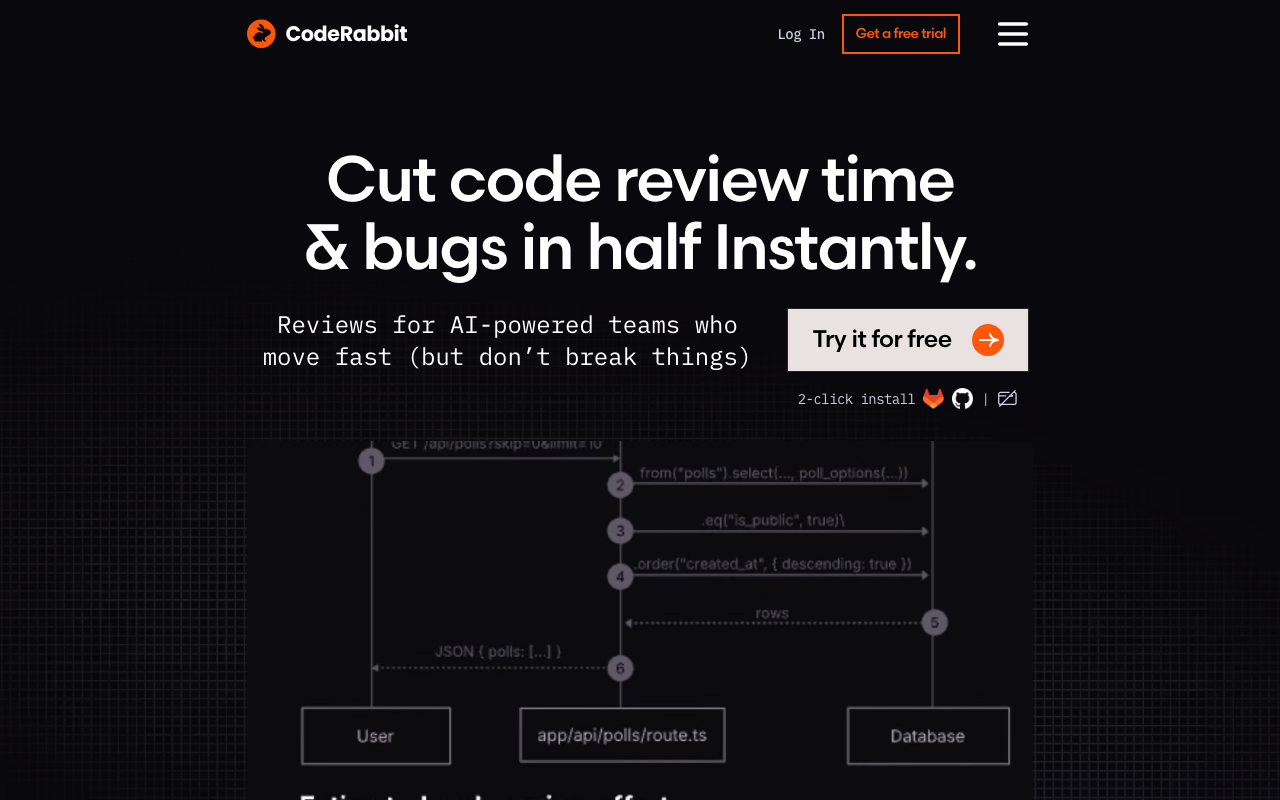
CodeRabbit is the most widely adopted AI code review tool with over 2 million connected repositories and 13 million+ PRs reviewed. While it does not generate tests, its PR review capabilities are significantly deeper than Qodo’s review component. CodeRabbit uses AST-based analysis combined with LLM reasoning to catch logic errors, architectural issues, and security vulnerabilities that surface-level tools miss entirely.
Why teams choose it over Qodo: CodeRabbit’s natural language configuration is its standout feature. Instead of writing regex rules, you describe what to watch for in plain English - “flag API endpoints without authentication middleware” or “warn when database queries are made inside loops.” The system learns from your team’s review patterns over time, reducing noise with each iteration.
Two 2026 corrections. CodeRabbit’s free tier covers public repositories only now - a free account on a private repo gets 1 summary-only review per hour plus 3 IDE and 3 CLI reviews per hour. And Essentials at $24/dev/mo annual links exactly 1 repository (Team 5, Advanced 10, Enterprise 20), so a multi-repo team pays $48 (both verified 2026-10-19). It is also not cheaper than Qodo at team scale: at 20 developers Essentials is $480 a month against Qodo’s roughly $30 flat fee. The trade-off is that you lose test generation entirely. For teams with mature testing practices, that trade-off makes sense. For a detailed breakdown, see our Qodo vs CodeRabbit comparison.
Key strengths:
- Cross-file analysis catches issues that line-level tools miss
- Natural language rule configuration eliminates DSL learning curves
- Learns from your team’s review patterns and coding conventions
- Supports GitHub, GitLab, Azure DevOps, and Bitbucket
Limitations:
- No test generation capability
- PR-focused only - no IDE autocomplete or code generation
- Large PRs (500+ files) can see slower review times
- Learning system needs several weeks to calibrate
Pricing (verified 2026-10-19): free on public repos only. Essentials $24/dev/mo annual ($30 monthly, 1 linked repo), Team $48 ($60, 5 repos, 300-file cap), Advanced $72 annual (10 repos), Enterprise quote-only (20 repos, SSO, audit logs, API, self-hosting at 500+ seats). Lite and Pro Legacy were retired on 8 June 2026. Overage $0.25 per reviewed file past the hourly limit; hourly limits 5 / 8 / 10 / 12 by tier, degrading to 1/hour under fair usage.
4. Gitar - Best for validating AI-generated code
Category partner - see our disclosure.
Gitar is the right swap if what you actually wanted from Qodo was fewer things to act on, not more tests to review. Where Qodo generates tests and suggestions for you to accept, Gitar applies the fix as a commit and runs your CI to prove it worked. Sonar acquired the company in May 2026.
It also has no credit system, which is the friction most teams cite when leaving Qodo. Pricing is flat per user: $20/month for reviews and CI failure analysis, $40/month for auto-applied fixes and merge blocking.
Strengths: Commits validated fixes rather than suggestions. Deduplicates repeated CI failures and retries flaky tests. Hybrid static-analysis-plus-LLM design produces fewer hallucinated findings than pure-LLM review. Built specifically to check output from Claude Code, Cursor, Codex, Devin, and Copilot. Enterprise plans automate cross-repo migrations.
Trade-offs: No test generation, so this is not a like-for-like Qodo replacement if tests are why you bought it - pair it with a dedicated generator. No permanent free tier for private repos, both self-serve plans stop at 50 users, and language coverage (10+) trails CodeRabbit. The Sonar integration is still in progress.
Best for: Teams whose PR queue is mostly agent-written code and whose bottleneck is applying fixes, not writing tests.
For the full head-to-head, including where Qodo’s test generation and air-gapped deployment win outright, see Gitar vs Qodo.
5. Tabnine - Best for privacy-first code completion
Tabnine differentiates on data privacy. It offers full on-premise deployment, trains models exclusively on permissive open-source code, and never stores or learns from your proprietary code. For teams in regulated industries - healthcare, finance, defense, and government - Tabnine’s privacy guarantees satisfy compliance requirements that cloud-dependent tools like Qodo fundamentally cannot meet.
Why teams choose it over Qodo: Tabnine’s self-hosted deployment means no code ever leaves your network. This is not just a preference - it is a hard requirement for organizations subject to HIPAA, FedRAMP, SOC 2 with specific data residency requirements, or internal security policies that prohibit sending code to third-party services. Qodo offers self-hosted deployment through PR-Agent and the Enterprise plan, but Tabnine’s privacy-first architecture extends to the code completion model itself, not just the review pipeline.
Tabnine’s prices are no longer verifiable. Tricentis acquired Tabnine, announced 30 July 2026, and its pricing page now redirects to a Tricentis contact form (verified 2026-10-19). The $9 Dev and $39 Enterprise figures that circulate, including in earlier versions of this page, cannot be confirmed and we are not restating them. If privacy-first self-hosting is the requirement, the verifiable options are Kodus under AGPLv3, PR-Agent under MIT, or SonarQube - whose AI CodeFix is documented to operate without outbound internet access, with Ollama, LiteLLM and vLLM named in the docs. For a detailed comparison, see our Qodo vs Tabnine analysis.
Key strengths:
- Full on-premise deployment keeps all code on your infrastructure
- Trained only on permissive open-source code - no IP concerns
- Cheapest per-seat pricing at $9/user/month
- Strong compliance story for regulated industries
Limitations:
- Code review capabilities are minimal
- No test generation
- Code generation quality is generally behind Copilot and Qodo
- IDE support has some gaps compared to market leaders
Pricing: Free tier with basic completions. Dev plan at $9/user/month. Enterprise at $39/user/month with self-hosted deployment.
6. Sourcegraph Cody - Best for large-codebase understanding
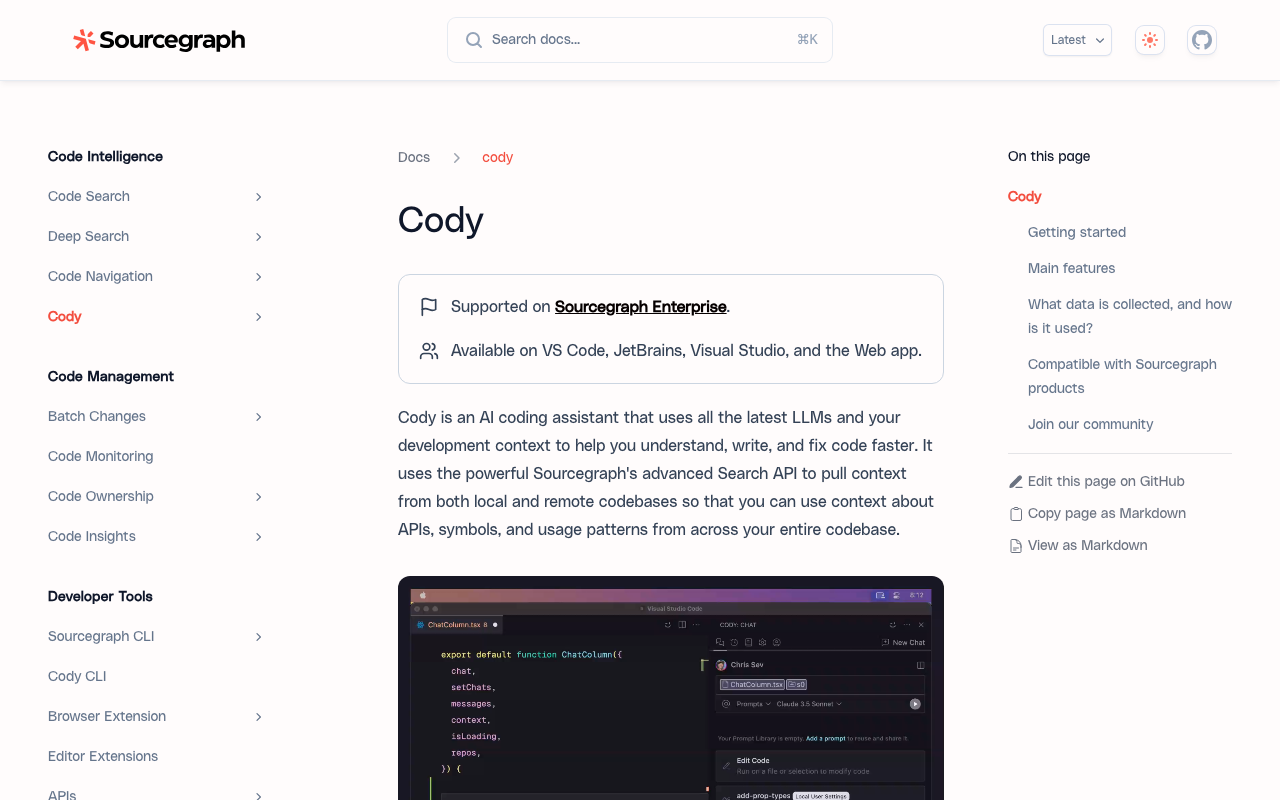
Sourcegraph Cody combines code search with AI assistance, leveraging Sourcegraph’s enterprise code search infrastructure to provide the deepest codebase awareness of any tool on this list. For monorepos with millions of lines, Cody can trace function calls through five layers of abstraction and explain the implications of changing a shared utility - something Qodo’s context engine can approximate only at the Enterprise tier.
Why teams choose it over Qodo: Cody’s advantage is Sourcegraph’s indexing infrastructure. It understands your entire codebase - every function, every consumer of every API, every implementation of every interface. When reviewing a PR, Cody can identify every caller of the changed code and flag potential breakages with references to specific files and line numbers. Qodo’s context engine (Enterprise only) provides some cross-repo awareness, but Cody’s depth is in a different class for truly large codebases.
The context engine automatically surfaces relevant code from across the entire repository into each conversation, giving the AI model the information it needs to provide accurate, repository-specific answers. This is fundamentally different from tools that only analyze the diff. For a detailed comparison, see our Qodo vs Cody analysis.
Key strengths:
- Deepest codebase understanding through Sourcegraph indexing
- Traces function calls and dependencies across massive repositories
- Supports multiple LLM backends (Claude, GPT-4, Gemini)
- Context engine surfaces relevant code automatically
Limitations:
- Full value requires Sourcegraph enterprise investment
- No test generation capability
- Enterprise pricing is opaque and typically high
- Setup complexity is higher than simpler tools
Pricing: Free tier for individual use. Enterprise pricing is custom and typically bundles with Sourcegraph’s code search platform.
7. Testim - Best for end-to-end test automation
Testim (now part of Tricentis) is an AI-powered end-to-end testing platform that approaches testing from a different angle than Qodo. While Qodo generates unit tests from code analysis, Testim creates and maintains UI-level functional tests using AI-driven element locators and self-healing test infrastructure. For teams whose testing gap is at the integration and E2E layer rather than unit testing, Testim solves a problem Qodo does not address.
Why teams choose it over Qodo: Qodo excels at unit test generation - testing individual functions and methods in isolation. Testim excels at testing how users interact with the application - form submissions, navigation flows, API integrations, and cross-browser behavior. These are complementary rather than competing capabilities, and many teams use both. But for teams where E2E test coverage is the priority, Testim delivers direct value that Qodo’s unit test generation cannot match.
Testim’s AI-driven smart locators identify UI elements using multiple attributes rather than brittle CSS selectors or XPaths. When the UI changes, Testim automatically updates element references, reducing the test maintenance burden that plagues traditional E2E frameworks like Selenium and Cypress.
Key strengths:
- AI-driven smart locators reduce test maintenance by auto-healing broken selectors
- Visual test editor allows non-technical team members to create tests
- Cross-browser and cross-device testing out of the box
- Integrates with CI/CD pipelines for continuous E2E validation
Limitations:
- No unit test generation - focuses exclusively on E2E and integration tests
- No code review capabilities
- Pricing is substantial - starts at approximately $450/month
- Steeper learning curve than code-level test generation tools
Pricing: Free tier with limited test runs. Professional plan starts at approximately $450/month. Enterprise pricing is custom.
8. Katalon - Best for no-code test automation
Katalon is a comprehensive test automation platform that covers web, API, mobile, and desktop testing with a visual interface that requires no coding expertise. For teams that need to scale testing beyond developers - involving QA engineers, product managers, and business analysts in the testing process - Katalon’s low-code approach fills a gap that developer-focused tools like Qodo cannot address.
Why teams choose it over Qodo: Katalon’s visual test recording and keyword-driven testing framework means non-developers can create and maintain tests. This is fundamentally different from Qodo, which generates code-level tests that require developer expertise to review, modify, and maintain. For organizations where the bottleneck is QA capacity rather than developer time, Katalon’s approach scales testing effort across a broader set of team members.
The platform also includes built-in AI features for test generation, self-healing tests, and smart wait strategies that reduce flaky test failures. Katalon Studio Community Edition is free with no restrictions, making it accessible for teams at any budget level.
Key strengths:
- Visual test recording and keyword-driven framework for non-developers
- Covers web, API, mobile, and desktop testing in one platform
- Free Community Edition with no usage restrictions
- Built-in AI for test maintenance and flaky test reduction
Limitations:
- Not an AI code review tool - no PR analysis
- No unit test generation from code analysis
- Enterprise features require paid plans
- Can feel heavyweight for teams that primarily need code-level testing
Pricing: Katalon Platform Free tier available. Premium starts at $208/month. Ultimate pricing is custom.
9. EvoSuite - Best free open-source Java test generator
EvoSuite is an open-source research tool that generates JUnit test suites for Java classes using search-based software testing techniques (evolutionary algorithms). It is entirely free, runs locally, and produces tests that maximize code coverage through intelligent exploration of the input space. For Java teams that want automated test generation without vendor lock-in or cloud dependencies, EvoSuite is the most accessible option available.
Why teams choose it over Qodo: EvoSuite is free, open source, and runs entirely on your machine. There are no credits to track, no usage limits, and no data leaving your network. The evolutionary algorithm approach means it can find edge cases that template-based generators miss, because it systematically explores the space of possible inputs rather than generating tests from patterns. For academic and research teams, EvoSuite’s extensive publication history provides transparency into how the tool works.
The trade-off is that EvoSuite generates tests optimized for coverage rather than readability. The generated test method names and assertions are functional but not human-friendly, and they often require cleanup before being committed to a production test suite. Qodo’s tests are more readable out of the box because they use LLM generation rather than search-based techniques.
Key strengths:
- Completely free and open source
- Evolutionary algorithm explores edge cases systematically
- Runs locally with no cloud dependency
- Strong academic foundation with peer-reviewed research
Limitations:
- Java only - no other language support
- Generated tests are optimized for coverage, not readability
- No code review capabilities
- Requires JVM configuration and can be slow on large classes
- Less actively maintained than commercial alternatives
Pricing: Free and open source (LGPL license).
10. Sourcery - Best for Python-focused code review
Sourcery focuses on code quality for Python with expanding support for JavaScript and TypeScript. It catches code smells, suggests refactoring opportunities, and enforces style consistency at the PR level. For Python-heavy teams (Django, Flask, FastAPI, data science), Sourcery’s deep understanding of Pythonic patterns produces more targeted suggestions than general-purpose tools like Qodo.
Why teams choose it over Qodo: Sourcery understands Pythonic idioms at a level that multi-language tools cannot match. It suggests list comprehensions over manual loops, flags mutable default arguments, catches common Django and Flask anti-patterns, and identifies opportunities to use context managers or generators. These are not generic code quality findings - they are Python-specific improvements that make code more idiomatic and maintainable.
The free tier covers open-source repositories. Sourcery Pro is $12 per seat per month billed annually, not the $10 that circulates, with Team at $24 (verified 2026-10-19). There is a 14-day org-wide trial with a card required only on conversion. Sourcery does not generate tests and its language support is narrower. One further note on the evidence: the “roughly 50% of Sourcery’s comments were noise” figure in circulation comes from a vendor-run evaluation, not a neutral one. Sourcery is also one of only two vendors in this market that publish a purchasing statement - Invoice billing on its Enterprise plan - the other being CodeRabbit Enterprise.
Key strengths:
- Deep understanding of Pythonic idioms and best practices
- Code quality scoring and trend tracking over time
- Generous free tier for individuals and open-source projects
- Refactoring suggestions include clear explanations
Limitations:
- Language support beyond Python is still maturing
- No test generation capability
- No cross-file analysis or codebase indexing
- Security scanning is limited
Pricing (verified 2026-10-19): free for open-source repos. Pro $12/seat/mo billed annually, Team $24/seat/mo. 14-day org-wide trial, card on conversion only. Enterprise adds SSO/SAML, self-hosting and Invoice billing.
11. Codacy - Best all-in-one code quality and security platform
Codacy bundles automated code review, SAST, software composition analysis, secrets detection, coverage tracking and quality gates into one platform covering 40+ languages. Team starts at $18/dev/mo billed yearly ($21 monthly) for up to 30 devs, with a free-forever Developer tier for individuals and free access for open source (verified 2026-10-19). The $15 figure in circulation, including in earlier versions of this page, is stale. It still covers capabilities that would otherwise require three or four separate tools.
Why teams choose it over Qodo: Codacy addresses a wider surface area than Qodo. Where Qodo combines review with test generation, Codacy combines review with security scanning, dependency analysis, secrets detection, duplication detection, and coverage reporting, all reported against configurable quality gates that can block a merge. For teams whose code health needs extend beyond review and testing into security and organizational reporting, Codacy covers more ground in a single integration.
The free Developer tier includes the Codacy Guardrails IDE extension for VS Code, Cursor, and Windsurf, which scans AI-generated code locally before it ever reaches a pull request - a useful evaluation path that costs nothing. The Pro plan adds the AI Reviewer for PRs, SAST and SCA, coverage tracking, and dashboards. Business pricing is custom and adds DAST, SSO, self-hosted deployment, and audit logs.
The trade-off is that Codacy does not generate tests at all, so it is a replacement for only half of what Qodo does. Its review comments are also more rule-grounded and less conversational than a purpose-built AI reviewer such as CodeRabbit.
Key strengths:
- Bundles review, SAST, SCA, secrets detection, and coverage in one platform
- Free IDE extension for evaluating the analysis before you buy
- 40+ languages supported, with GitHub, GitLab, and Bitbucket integration; free for open source
- Quality gates that block merges below your thresholds
- Self-hosted deployment available on the Business plan
Limitations:
- No test generation capability at all
- Review feedback is more rule-driven than conversational
- No Azure DevOps integration
- Configuring gates and rule sets across many repositories takes upfront effort
Pricing (verified 2026-10-19): Developer tier free forever (IDE-focused). Team from $18/dev/mo yearly, $21 monthly, up to 30 devs. Business quote-only. Free for open source. Catch: the AI Reviewer is cloud-and-GitHub-only while GHES requires Codacy Self-hosted, so GHES customers structurally cannot get it.
Pricing comparison
Understanding the real cost of each tool at different team sizes helps narrow the field quickly.
| Tool | 5 devs/month | 20 devs/month | 50 devs/month | Billing Model |
|---|---|---|---|---|
| Qodo | ~$30 flat + credits | ~$30 flat + credits | Quote required above 30 users | Flat team fee up to 30 users + credits at $0.012, pooled, no rollover |
| PR-Agent self-hosted | LLM only | LLM only | LLM only | Free, MIT since 23 Apr 2026 |
| GitHub Copilot Business | $95 | $380 | $950 | Per seat, monthly only; plus AI Credits and unmodellable Actions minutes |
| Diffblue Cover | Custom | Custom | Custom | Enterprise license |
| CodeRabbit Essentials | $120 | $480 | $1,200 | Per seat |
| Tabnine | Unverifiable | Unverifiable | Unverifiable | Acquired by Tricentis 30 Jul 2026 |
| Sourcegraph Cody | Custom | Custom | Custom | Enterprise license |
| Testim | ~$450 | ~$450+ | Custom | Platform license |
| Katalon | $0-$208 | $208+ | Custom | Platform license |
| EvoSuite | $0 | $0 | $0 | Free (OSS) |
| Sourcery Pro | $60 | $240 | $600 | Per seat, $12/mo annual |
| Codacy Team | $90 | $360 | Quote above 30 devs | Per dev, $18/mo yearly |
Key takeaway, corrected: Qodo is the cheapest paid subscription on this list below 30 users, not the most expensive - a flat fee of roughly $30 a month rather than $30 per seat (verified 2026-10-19). The previous version of this table priced Qodo per seat and reached the opposite conclusion. Above 30 users Qodo is quote-only, which is where the per-seat tools become comparable again.
What Qodo costs you instead is predictability: credits are pooled, non-rolling, and the per-review consumption rate is not published. If you need a number that holds for a 12-month budget, CodeRabbit at $24 or $48 per developer per month or Codacy Team at $18 per developer per month yearly are the defensible lines. If you need zero licence cost, self-hosted PR-Agent under MIT is. And if test generation is why you bought Qodo, only Diffblue Cover and EvoSuite replace it, both Java-only.
How to choose the right Qodo alternative
Decision framework by primary need
“I need deeper PR review without test generation”:
- CodeRabbit provides deep AI review at $24/dev/mo annual with cross-file analysis and natural-language rules in
.coderabbit.yaml- check the 1 linked repository limit on Essentials first (verified 2026-10-19) - Sourcegraph Cody is best for large codebases where full repository indexing adds significant value
“I need Java test generation at enterprise scale”:
- Diffblue Cover generates complete JUnit regression tests with 30-80% coverage automatically
- EvoSuite provides free, open-source Java test generation using evolutionary algorithms
“I need privacy-first code assistance”:
- Kodus (AGPLv3) and PR-Agent (MIT since 23 Apr 2026) self-host at any size with no licence cost; Tabnine also offered on-premise deployment but its pricing is unverifiable since the Tricentis acquisition on 30 July 2026
- Qodo’s own PR-Agent is open source and can be self-hosted
“I need code review plus security scanning in one tool”:
- Codacy bundles review, SAST, SCA, secrets detection and quality gates from $18/dev/mo yearly - not available as an AI Reviewer on GHES (verified 2026-10-19)
- See also our guide to the best AI code review tools
“I need Python-specific code quality improvements”:
- Sourcery understands Pythonic patterns at a depth multi-language tools cannot match
“I need end-to-end test automation, not unit tests”:
- Testim for AI-powered E2E testing with self-healing locators
- Katalon for no-code test automation accessible to non-developers
“I need the best overall AI coding assistant”:
- GitHub Copilot for code generation with lightweight review
- See our guide on the best AI test generation tools for a broader comparison
The layered approach
Most teams get the best results by combining tools from different categories rather than relying on a single platform:
- Code review layer - CodeRabbit or Codacy for deep PR analysis and issue detection
- Test generation layer - Diffblue Cover (Java) or Qodo’s open-source PR-Agent for automated test creation
- Code generation layer - GitHub Copilot or Tabnine for inline autocomplete and code assistance
This approach covers more ground than any single tool. The combined cost of CodeRabbit Essentials ($24/dev/mo annual) plus Copilot Business ($19/user/mo, monthly only) is $43 per developer per month (verified 2026-10-19). Against Qodo’s flat ~$30/month for up to 30 users that is a large premium at team scale, not the $13 per seat the previous version of this page implied - at 20 developers it is $860 a month against roughly $30 plus credits. The case for the layered approach is capability, not cost.
Should you switch from Qodo?
Direct answer: Probably not on price - Qodo’s flat ~$30/month for up to 30 users undercuts every per-seat alternative here (verified 2026-10-19). Switch if you need a forecastable bill, if you are above 30 users, if you need Java-depth test generation (Diffblue, EvoSuite) or if you want zero licence cost (PR-Agent under MIT, Kodus under AGPLv3). Qodo is still the only tool combining review and test generation.
Qodo remains the only tool that genuinely combines AI code review with test generation in a single platform. If both capabilities are important to your workflow and you value having them integrated, Qodo is still the right choice. The Qodo 2.0 multi-agent architecture, Gartner Visionary recognition, and broadest platform support (GitHub, GitLab, Bitbucket, Azure DevOps) make a strong case for staying.
Consider switching if:
- Your primary need is deep PR review, and you want the best review quality regardless of test generation - CodeRabbit is the stronger choice
- You work primarily in Java and need enterprise-scale test generation - Diffblue Cover goes deeper
- Data privacy is non-negotiable and you need fully self-hosted review - Kodus (AGPLv3) or PR-Agent (MIT) are the verifiable options; note Qodo already offers on-prem and VPC on its standard subscription
- You want review, SAST, dependency scanning, and quality gates in one platform - Codacy covers more security surface area
- You need Python-specific quality improvements - Sourcery at $12/seat/mo annual understands Pythonic patterns better
- You need a forecastable bill. Qodo’s credits are pooled, non-rolling, and the per-review rate is not published. CodeRabbit at $24 or $48 per developer per month and Codacy Team at $18 per developer per month yearly are defensible 12-month budget lines (verified 2026-10-19)
- You are above 30 users. The flat fee stops there and Qodo becomes quote-only with no published rate card
- You need zero licence cost. PR-Agent is MIT as of 23 April 2026 and Kodus is AGPLv3, both free to self-host
Stay with Qodo if:
- You value the unique combination of review and test generation in one tool
- You need the broadest Git platform support (especially Bitbucket or Azure DevOps)
- You want the option to self-host via PR-Agent
- Your team works across multiple languages and needs test generation for all of them
- You are under 30 users, where the flat fee makes Qodo the cheapest subscription in this market
- You need on-prem or VPC deployment without CodeRabbit’s 500-seat self-hosting minimum
For more detailed head-to-head comparisons, see our dedicated analyses: Qodo vs GitHub Copilot, Qodo vs CodeRabbit, Qodo vs Diffblue, Qodo vs Tabnine, and Qodo vs Cody.
How we verified this
Checked on 2026-10-19 against each vendor’s published pricing plus our own verified fact table. Nine price or tier claims on this page were stale, and the Qodo baseline itself had changed shape.
What we corrected on this pass:
- Qodo does not price per seat. The published model is a flat team fee of roughly $30 per month covering up to 30 users, plus credits at $0.012 each, pooled across the team with no rollover, in packs of 2,500 / 5,000 / 20,000. The previous version priced Qodo at $30/month flat for up to 30 users and concluded it was above market average - the opposite of what the published model implies.
- Qodo has no permanent free tier. The free Developer plan at 30 PR reviews and 250 credits per month is gone; what exists is a 14-day trial with unlimited reviews.
- CodeRabbit’s free tier is public-repo-only, and Essentials links exactly 1 repository (Team 5, Advanced 10, Enterprise 20). Lite and Pro Legacy were retired on 8 June 2026.
- Codacy Team is $18/dev/mo yearly ($21 monthly) across 40+ languages, not $15 across 49, with a free-forever Developer tier - and its AI Reviewer is unavailable on GHES.
- Sourcery Pro is $12/seat/mo annual, not $10.
- Copilot: code review is included from Pro at $10, only Copilot Free lacks it; annual billing was retired entirely on 1 June 2026; premium requests became AI Credits at $0.01; and private-repo reviews consume unpublished GitHub Actions minutes.
- Tabnine prices removed. Tricentis acquired Tabnine, announced 30 July 2026, and its pricing page redirects to a Tricentis contact form, so no per-seat figure is verifiable.
- PR-Agent and Kodus added as the genuinely free options. PR-Agent is MIT since 23 April 2026 at
The-PR-Agent/pr-agentv0.48.0 under independent community governance with Qodo as sponsor; Kodus is AGPLv3, free to self-host at any size, Community capped at 10 Kody Rules and 3 plugins. - Qodo’s “benchmark-leading F1” removed as a reason to stay. The 60.1% F1 is Qodo’s own benchmark and the #1-at-64.3% is Qodo’s own claim on Martian’s leaderboard.
What we could NOT verify, named explicitly:
- Credits consumed per Qodo review. Not published. This is the single biggest gap in comparing Qodo to a per-seat alternative, and we will not estimate it.
- Whether Qodo offers annual billing on the flat fee, and Qodo’s Enterprise price - quote-only. Same for CodeRabbit Enterprise, Diffblue Cover and Sourcegraph Cody.
- Tabnine’s current pricing, post-acquisition.
- Any independent review-quality comparison across these tools. The precise claim: no party without a commercial stake has published a false-positive rate, precision figure or noise measurement for any shipping commercial AI code reviewer. SWE-PRBench and CR-Bench publish false-positive data for bare models in fixed harnesses, not products you can buy. Every vendor benchmark in this category has been won by the vendor that ran it - Greptile at 82% on its own 50-PR run (Augment’s re-run scored 45% as an F-score on a rebuilt answer key), DeepSource at 84.51% F1 scoring itself, Entelligence winning its own benchmark, Qodo at 60.1%. Martian’s leaderboard is the most neutral, and four vendors have each declared themselves #1 on it.
- AI-generated test quality. No benchmark measures it for any shipping reviewer, so the size of Qodo’s and Diffblue’s advantage is unquantified.
- Kodus’s SOC 2 status. The badge exists; the documents behind it do not, and Kodus lists SOC 2 compliance as an Enterprise feature. Reported, not endorsed.
- Entelligence’s Git platform support, which it does not state anywhere - do not assume Bitbucket or Azure DevOps for it.
Sponsorship disclosure. Gitar appears in the comparison table above and is a paid sponsor of this site. That buys placement, not ranking. Gitar has no published third-party benchmark, which we note here exactly as we would for any other vendor, and Gitar does not support GitHub Enterprise Server per its own platform matrix. Sonar acquired Gitar in May 2026.
Carried from the prior pass (2026-10-18), not re-checked today: Qodo’s Gartner Visionary placement and the February 2026 Qodo 2.0 release; the 8 June 2026 CodeRabbit Lite sunset; the CodeRabbit 500-seat self-hosting threshold; Gitar’s published rate card and 50-user cap; and the Martian Code Review Bench figures dated 3 March 2026.
Our method, including how we handle sponsor coverage and vendor-funded benchmarks, is on our standards page.
Further Reading
- CodiumAI Alternatives: Best AI Tools for Automated Testing in 2026
- Best AI Code Review Tools for Pull Requests in 2026
- CodiumAI Review: AI-Powered Test Generation for VS Code
- CodiumAI vs Codium (Open Source): They Are NOT the Same
- CodiumAI vs GitHub Copilot: Which AI Coding Assistant Should You Choose?
 Gitar
GitarComments are not enough
Gitar applies the fix, validates it in CI, and clears the queue.
See it on your repo Read our independent Gitar reviewFrequently Asked Questions
What are the best Qodo alternatives in 2026?
The best Qodo alternatives in 2026 include GitHub Copilot (best for inline code generation plus lightweight review), Diffblue Cover (best for enterprise Java test generation), CodeRabbit (best for deep AI PR review), Tabnine (best for privacy-first teams), Sourcegraph Cody (best for large codebase understanding), Testim (best for end-to-end test automation), Katalon (best for no-code testing), EvoSuite (best free Java test generator), Sourcery (best for Python teams), and Codacy (best all-in-one code quality and security platform, from $18/dev/month yearly).
Is Qodo still called CodiumAI?
No. CodiumAI rebranded to Qodo in 2024 as the company expanded beyond its original test generation focus into a full-spectrum AI code quality platform. The product now includes PR review, IDE assistance, CLI tooling, and a multi-repo context engine alongside the original test generation capability. Some marketplace listings and documentation still reference the CodiumAI name, but all active development happens under the Qodo brand.
Is Qodo free to use?
Qodo has no permanent free tier as of 2026-10-19. It offers a 14-day trial with unlimited reviews and no credit card, then a flat team fee of roughly $30 per month covering up to 30 users, plus credits at $0.012 each that are pooled across the team and do not roll over, in packs of 2,500, 5,000 and 20,000. Earlier versions of this page described a free Developer plan with 30 PR reviews and 250 credits per month and a $30-per-user Teams plan; neither is in Qodo current published pricing. The flat fee makes Qodo the cheapest subscription in this market below 30 users, with the caveat that Qodo publishes no credits-per-review figure, so the usage half of the bill cannot be forecast from published data. Enterprise is quote-only.
How does Qodo compare to GitHub Copilot for code review?
Qodo generates tests alongside review findings, covers GitHub, GitLab, Bitbucket and Azure DevOps, and offers on-prem and VPC deployment; Copilot code review is GitHub-only (verified 2026-10-19). On depth, be careful with the numbers: Qodo 60.1 percent F1 is Qodo own benchmark and its number one claim at 64.3 percent on Martian Code Review Bench is also Qodo, on a leaderboard where four vendors have each claimed first place and where Martian ranks Copilot fourth. Nobody disinterested has compared them. Two Copilot facts worth having: code review is included from Copilot Pro at 10 dollars a month and only Copilot Free lacks it, and the 300-file PR cap was removed on 27 August 2026, which invalidates any Copilot evaluation run before September 2026.
What is the best free alternative to Qodo?
EvoSuite is the best completely free option for Java test generation - open source, generating JUnit tests with evolutionary algorithms. For free AI code review the picture changed in 2026 (verified 2026-10-19). PR-Agent is the strongest answer: relicensed to MIT on 23 April 2026, self-hostable with your own LLM keys, covering GitHub, GitLab, Bitbucket, Azure DevOps and Gitea. Kodus is AGPLv3 and free to self-host at any size. CodeRabbit free tier is now public repositories only - private repos get 1 summary-only review per hour. Copilot Free does not include code review at all; review starts at Copilot Pro at 10 dollars a month. Sourcery remains free for open-source repositories.
Can Qodo generate tests for any programming language?
Qodo supports test generation for JavaScript, TypeScript, Python, Java, Go, C++, C#, Ruby, PHP, Kotlin, and Rust. The depth of test generation varies by language - Python, JavaScript, TypeScript, and Java receive the most thorough coverage with framework-specific test output (pytest, Jest, JUnit). Some languages like Rust and PHP receive shallower test generation. For Java-specific test generation at enterprise scale, Diffblue Cover is a stronger specialized alternative.
Is Diffblue Cover better than Qodo for test generation?
Diffblue Cover is better than Qodo for Java-specific test generation at enterprise scale. It generates regression tests for entire Java codebases automatically, achieves 30-80% line coverage without human input, and integrates into CI/CD pipelines for continuous test maintenance. Qodo supports more languages and combines test generation with code review, making it more versatile. If your codebase is primarily Java and test generation is your top priority, Diffblue Cover is the stronger choice.
What is the best Qodo alternative for enterprise teams?
For enterprise teams, the best Qodo alternatives depend on the primary need. Diffblue Cover is ideal for large Java codebases needing automated regression testing. CodeRabbit offers enterprise-grade PR review with SOC 2 compliance and natural language rule configuration. Tabnine provides self-hosted deployment for teams with strict data privacy requirements. Codacy bundles PR review, SAST, SCA, secrets detection and quality gates from $18 per developer per month billed yearly, $21 monthly, for up to 30 devs (verified 2026-10-19) - though note its AI Reviewer is cloud-and-GitHub-only while GitHub Enterprise Server requires Codacy Self-hosted, so GHES customers structurally cannot get it. Most enterprise teams benefit from combining a review tool with a dedicated test generation tool.
Does CodeRabbit generate tests like Qodo?
CodeRabbit does not generate tests. It focuses exclusively on AI-powered PR review with cross-file analysis, natural language rule configuration, and auto-fix suggestions. If you need both code review and test generation, you would use CodeRabbit alongside a test generation tool like Diffblue Cover or EvoSuite, or stay with Qodo which bundles both capabilities in a single platform.
How much does Qodo cost compared to alternatives?
Qodo charges a flat team fee of roughly 30 dollars a month for up to 30 users plus pooled credits at 0.012 dollars each, which makes it the cheapest subscription here below 30 users rather than one of the most expensive (verified 2026-10-19). CodeRabbit Essentials is 24 dollars per developer per month annual, 30 monthly, with Team at 48 and Advanced at 72. GitHub Copilot is 10 to 39 dollars per user per month and monthly-only since 1 June 2026. Sourcery Pro is 12 dollars per seat per month annual. Codacy Team is 18 dollars per developer per month yearly, 21 monthly. Tabnine prices are unverifiable since Tricentis acquired it on 30 July 2026 and its pricing page now redirects to a contact form. PR-Agent and EvoSuite are free.
Can I self-host a Qodo alternative?
Yes. Qodo itself offers self-hosted deployment through its open-source PR-Agent and Enterprise plan. For alternatives, Tabnine offered full on-premise deployment for code completion, though Tricentis acquired it on 30 July 2026 and its pricing is no longer published. Diffblue Cover runs entirely on your infrastructure with no code leaving your network. EvoSuite is open source and can be run anywhere. Codacy offers a self-hosted deployment option on its Business plan. CodeRabbit also offers self-hosted enterprise deployment.
What replaced CodiumAI?
CodiumAI rebranded to Qodo - it was not replaced or discontinued. The product evolved from a focused test generation tool into a full code quality platform with PR review, IDE assistance, CLI tooling, and enterprise features. The core test generation capability that made CodiumAI popular is still available in Qodo and has been enhanced with the multi-agent review architecture introduced in Qodo 2.0 (February 2026).
Explore More
Tool Reviews
 Qodo Review
 Codacy Review
Related Articles
Free Newsletter
Stay ahead with AI dev tools
Weekly insights on AI code review, static analysis, and developer productivity. No spam, unsubscribe anytime.
Join developers getting weekly AI tool insights.
Related Articles
8 Best CodeRabbit Alternatives for AI Code Review in 2026
Looking beyond CodeRabbit? Compare 8 top AI code review alternatives with real features, pricing, honest pros/cons, and team recommendations.
February 17, 2026
alternatives10 Best GitHub Copilot Alternatives for Code Review (2026)
GitHub Copilot lacks deep code review. Compare 10 alternatives with better PR analysis, security scanning, and review automation. Includes pricing tips.
February 26, 2026
alternativesSourcery AI Alternatives: 10 Best Code Quality Tools in 2026
Compare 10 Sourcery alternatives for AI code review, Python linting, and code quality. Features, pricing, and honest recommendations.
March 17, 2026