Sourcery vs Codacy: AI Code Review Tools Compared (2026)
Sourcery vs Codacy compared - pricing, AI review depth, security features, language support, and which tool fits your team in 2026.
Published:
Last Updated:
Quick Verdict
Sourcery and Codacy are both solid code quality tools but they occupy different niches. Sourcery is a focused AI code review and refactoring platform that excels at Python - its $10/user/month Pro tier is one of the most affordable in the market, and its refactoring engine for Python is genuinely best-in-class. Codacy is a broader code quality and security platform that covers SAST, SCA, DAST, secrets detection, coverage tracking, quality gates, and AI-powered PR review at $15/user/month.
Choose Sourcery if: your team is primarily Python-focused, you want IDE-integrated real-time refactoring suggestions, and your primary goal is code quality and readability rather than security scanning.
Choose Codacy if: you want a single platform covering both code quality and security, your team spans multiple languages, you need quality gates and coverage tracking, or you want AI Guardrails for scanning AI-generated code in real time before it is committed.
The pricing story is nuanced. Sourcery Pro is cheaper at $10/user/month, but when you need Sourcery’s Team plan features (security scanning, analytics), the cost rises to $24/user/month - well above Codacy Pro’s $15/user/month, which includes security scanning from the start. For most teams that want both quality and security coverage, Codacy delivers more at a lower per-seat cost.
At-a-Glance Comparison
| Feature | Sourcery | Codacy |
|---|---|---|
| Primary focus | AI code review and Python refactoring | All-in-one code quality and security |
| Free tier | Yes - unlimited public repos, full features | Yes - AI Guardrails IDE extension |
| Pro pricing | $10/user/month | $15/user/month |
| Team/Enterprise | $24/user/month (Team) | Custom (Business) |
| AI PR review | Yes - AI inline comments | Yes - AI Reviewer (hybrid rule + AI) |
| IDE extension | Yes - VS Code, PyCharm | Yes - VS Code, Cursor, Windsurf (Guardrails) |
| Python analysis | Excellent - best-in-class refactoring | Good - Pylint and Bandit embedded |
| Language support | 30+ languages (Python-first) | 49 languages |
| SAST | Limited (Team plan) | Yes (Pro plan) |
| SCA (dependency scanning) | No | Yes (Pro plan) |
| DAST | No | Yes (Business plan, ZAP-powered) |
| Secrets detection | No | Yes (Pro plan) |
| Code coverage tracking | No | Yes (Pro plan) |
| Quality gates | No | Yes - customizable thresholds |
| Duplication detection | No | Yes |
| GitHub | Yes | Yes |
| GitLab | Yes | Yes |
| Bitbucket | No | Yes |
| Azure DevOps | No | No |
| Self-hosted | Enterprise (custom) | Business plan only (~2.5x cloud cost) |
| Custom coding rules | Yes - .sourcery.yaml | Yes - configurable per repo |
| Security compliance | Not publicly published | G2 Leader for Static Code Analysis |
| Jira integration | No | Yes - AI Reviewer uses Jira context |
| MCP integration | No | Yes - AI Guardrails uses MCP |
What Is Sourcery?
Sourcery is an AI-powered code review and refactoring platform that started as a Python engine and expanded to 30+ languages. Its defining characteristic is depth over breadth: rather than trying to catch every class of issue, Sourcery focuses on genuinely improving code quality through refactoring suggestions, code smell detection, and pattern-based improvements that experienced developers make manually.
Sourcery reviews every pull request opened on connected GitHub or GitLab repositories, posting inline comments with refactoring suggestions, code quality improvements, and bug catches. For Python, its analysis is materially deeper than any competing tool - it recognizes idiomatic Python patterns like list comprehensions, context managers, dataclasses, and generator expressions, and suggests transformations that align with Pythonic best practices:
# Sourcery catches verbose patterns like this...
result = []
for item in items:
    if item.is_active:
        result.append(item.name)

# ...and suggests idiomatic alternatives
result = [item.name for item in items if item.is_active]
# And simplifies unnecessary conditional returns
if condition:
return True
else:
return False
# Into the direct form
return conditionBeyond Python, Sourcery provides JavaScript and TypeScript analysis with reasonable coverage, plus limited support for other languages. The IDE extensions for VS Code and PyCharm deliver real-time refactoring suggestions as developers write code - a workflow advantage that no other AI review tool in this comparison provides.
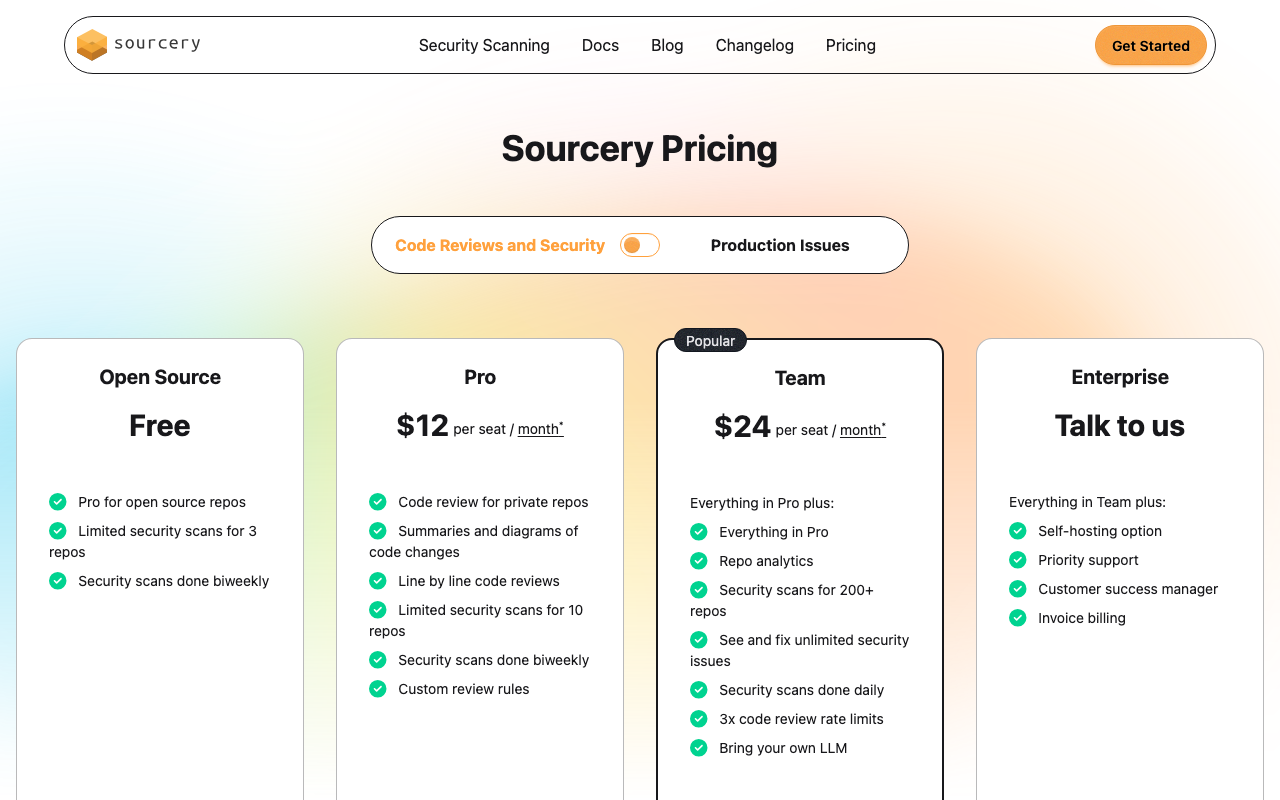
Sourcery’s pricing is aggressive: free for public repos, $10/user/month (Pro) for private repositories and custom coding guidelines, and $24/user/month (Team) for security scanning, analytics, and higher rate limits. This positions it as one of the most affordable options in the AI code review space, making it compelling for budget-conscious teams.
For a deeper look at Sourcery compared to other Python-specific tools, see Sourcery vs Ruff and Sourcery vs Pylint. For a comparison of Sourcery against another AI reviewer, the CodeRabbit vs Sourcery breakdown provides extensive head-to-head detail.
What Is Codacy?
Codacy is a cloud-native code quality and security platform trusted by over 15,000 organizations. Rather than specializing in one dimension of code health, Codacy packages code quality analysis, security scanning (SAST, SCA, DAST), secrets detection, coverage tracking, duplication detection, and AI-powered review into a single cloud-hosted platform at $15/user/month.
What distinguishes Codacy in 2026 is its pivot toward AI code governance. The platform centers three AI features around the reality that development teams now generate 30-70% of their code through AI assistants:
- AI Guardrails - a free IDE extension for VS Code, Cursor, and Windsurf that scans AI-generated code in real time and auto-remediates issues before they are committed
- AI Reviewer - a hybrid PR review engine that combines rule-based static analysis with context-aware AI reasoning, drawing on PR metadata and Jira tickets
- AI Risk Hub - an organizational dashboard (Business plan) for tracking AI code risk across teams
Codacy also benefits from a pipeline-less setup: connect your GitHub, GitLab, or Bitbucket repository, and analysis begins on the next pull request with no CI/CD configuration required. This makes it one of the fastest-to-onboard code quality platforms available.
For detailed breakdowns of Codacy’s pricing model, see Codacy Pricing. For alternatives to Codacy, see Codacy Alternatives. For Codacy compared to the most common competitor, see Codacy vs SonarQube.
Code Review Quality
AI Analysis Approach
Sourcery and Codacy take fundamentally different approaches to AI-powered code review.
Sourcery’s AI review combines a rules-based refactoring engine with LLM-powered analysis. For Python, JavaScript, and TypeScript, the rules-based layer applies deep pattern matching that understands language-specific idioms. For other supported languages, Sourcery relies primarily on its LLM layer. The result is inline comments on pull requests that are typically actionable and focused on code quality improvements rather than enforcement of style rules alone.
Sourcery’s reviews operate file by file rather than across the full pull request in context. This means it can identify improvements within each changed file but may miss cross-file issues - a broken interface introduced by modifying a shared utility, a race condition spanning two async modules, or an API contract violation that affects how a function is consumed three files away.
Codacy’s AI Reviewer takes a hybrid approach: deterministic rule-based analysis runs first (catching style violations, security patterns, complexity thresholds), then AI reasoning layers on top to provide context-aware feedback. Critically, the AI Reviewer reads PR metadata and optionally linked Jira tickets when generating its analysis. This means it can flag situations where a PR description promises business logic that the actual code does not implement - a qualitatively different kind of feedback than either linting or isolated AI analysis.
Codacy embeds multiple third-party analysis engines (ESLint for JavaScript, Pylint and Bandit for Python, PMD for Java, Gosec for Go, and dozens of others), so the static analysis layer beneath the AI review is broad. The depth per language depends on the embedded engine rather than a purpose-built rule set, which means Codacy catches common and impactful issues consistently but may not surface the subtlest language-specific anti-patterns.
Practical outcome: Sourcery produces fewer, higher-quality comments focused on making code better. Codacy produces broader coverage across more issue categories. Neither tool produces the depth of cross-file contextual analysis that dedicated AI reviewers like CodeRabbit provide, but both are meaningfully more useful than traditional linters running in isolation.
Python Analysis
This is Sourcery’s clearest advantage. Sourcery has the deepest Python refactoring analysis of any tool in this comparison. It understands:
- List comprehensions vs explicit loops
- Generator expressions for memory-efficient iteration
- Dataclass conversions from verbose class definitions
- Context manager adoption (replacing manual try/finally resource management)
- Conditional simplification (eliminating unnecessary if/else structures)
- Dictionary dispatch as an alternative to long if/elif chains
- f-string modernization from older formatting patterns
Codacy’s Python analysis is competent - it runs Pylint and Bandit, catches common bugs and security issues, and flags style violations. But it does not generate the same class of structural refactoring suggestions that Sourcery delivers for Python-heavy teams. The gap is noticeable in practice: a Python-first team using Sourcery receives actionable suggestions that teach idiomatic Python, while Codacy’s Python feedback focuses more on bug detection and security scanning.
If your team writes primarily Python and code quality improvement is the primary goal, Sourcery’s Python depth is a genuine differentiator. If Python is one of several languages in your stack and you want consistent analysis across the whole codebase, Codacy’s broader engine is the more practical choice.
Multi-Language Coverage
| Language | Sourcery | Codacy |
|---|---|---|
| Python | Excellent - best-in-class refactoring | Good (Pylint + Bandit) |
| JavaScript | Good | Good (ESLint-based) |
| TypeScript | Good | Good |
| Java | Limited | Good (PMD + SpotBugs) |
| Go | Limited | Good (Gosec) |
| C# | Limited | Good |
| Ruby | Limited | Good |
| PHP | Limited | Good |
| Kotlin | Limited | Good |
| Rust | Limited | Good |
| Scala | Not supported | Good |
| Dart | Not supported | Good (Dart Analyzer) |
| Elixir | Not supported | Good |
| Shell scripting | Not supported | Good |
| Terraform/IaC | Not supported | Good |
Codacy’s 49-language coverage is a practical advantage for any team with a mixed-language stack. A frontend (TypeScript), backend (Go or Java), and infrastructure (Terraform) setup gets consistent analysis across all layers from one Codacy Pro subscription. Sourcery covers the backend Python or the frontend TypeScript well, but provides minimal value on Go, Java, or infrastructure code.
Interactive Review Experience
Sourcery supports mention-based commands that give developers control over the review process: @sourcery-ai summary generates a PR summary, @sourcery-ai guide creates a review guide for human reviewers, @sourcery-ai resolve clears all Sourcery comments, and @sourcery-ai dismiss removes pending reviews. This interaction model reduces friction for busy maintainers who want selective AI assistance rather than a comprehensive review on every PR.
Codacy’s PR experience is less interactive but includes richer contextual feedback through the AI Reviewer. Developers receive inline comments from both the static analysis engine and the AI layer, with severity ratings, remediation guidance, and fix suggestions. The quality gate status (pass/fail) appears as a PR check, which can be configured as a required check in GitHub branch protection rules.
Neither tool offers the conversational back-and-forth that tools like CodeRabbit provide, where developers can reply to review comments, ask follow-up questions, and receive revised analysis.
Security Features
This is one of the most significant differentiators between the two tools, and Codacy has a decisive advantage.
Codacy’s Security Suite
Codacy Pro ($15/user/month) includes a comprehensive security scanning stack:
SAST (Static Application Security Testing) runs across all 49 supported languages, detecting injection flaws, authentication issues, cryptographic weaknesses, insecure data handling, and other vulnerability patterns. Results appear as inline PR comments with severity ratings and remediation guidance.
SCA (Software Composition Analysis) scans dependency manifests (package.json, requirements.txt, pom.xml, and others) to identify known CVEs in open-source packages. The SCA engine tracks your dependency tree and alerts teams when newly disclosed vulnerabilities affect their projects.
Secrets Detection scans every commit for accidentally committed credentials - API keys, database passwords, authentication tokens, and private certificates. This is particularly valuable for teams using AI coding assistants, which can reproduce credential patterns from training data.
DAST (Dynamic Application Security Testing) is available on the Business plan, powered by ZAP. Unlike SAST, which analyzes code statically, DAST tests running applications for runtime vulnerabilities by sending requests and analyzing responses. This catches authentication bypasses, configuration errors, and runtime injection attacks that static analysis cannot detect. No other code quality platform includes DAST at any comparable price point.
For a detailed look at how Codacy’s security compares against dedicated security tools, see Codacy vs SonarQube.
Sourcery’s Security Coverage
Sourcery’s security capabilities are more limited and primarily tied to the Team plan ($24/user/month):
Daily Security Scans on the Team plan scan up to 200+ repositories and provide unlimited security issue fixes. This is a supplemental capability layered on top of Sourcery’s code quality core rather than a purpose-built security engine.
Sourcery catches some security anti-patterns in Python (use of eval() on untrusted input, hardcoded secrets, insecure random number generation) but does not provide the structured, multi-dimension security coverage that Codacy delivers. There is no SCA, no DAST, and no dedicated secrets detection engine in Sourcery.
The bottom line on security: If your team needs security scanning alongside code quality review, Codacy is the stronger choice at $15/user/month versus Sourcery Team at $24/user/month. Sourcery Team’s security features do not match Codacy Pro’s security suite, and Sourcery Pro at $10/user/month has essentially no meaningful security scanning.
Teams with serious security requirements should evaluate dedicated security tools like Snyk Code, Semgrep, or Checkmarx in addition to - or instead of - either platform’s built-in security capabilities.
IDE Integration
Both tools provide IDE extensions, but the focus and capability differ significantly.
Sourcery IDE Extensions (VS Code, PyCharm)
Sourcery’s VS Code and PyCharm extensions are a genuine workflow differentiator. Rather than waiting for a PR to surface quality issues, Sourcery provides real-time refactoring suggestions as developers write code:
- Refactoring opportunities appear as highlighted suggestions inline
- Suggested code appears with a visual comparison of the original and improved version
- Suggestions can be applied with a single keyboard shortcut
- An integrated chat interface allows developers to ask questions about code, request explanations, and get refactoring suggestions for selected blocks
For Python developers in PyCharm especially, this real-time feedback loop is valuable - it catches refactoring opportunities before they accumulate as technical debt in PRs.
Codacy AI Guardrails (VS Code, Cursor, Windsurf)
Codacy Guardrails is a free IDE extension that takes a different approach: rather than suggesting improvements to human-written code, it specifically targets AI-generated code for real-time security and quality scanning.
The key capabilities:
- Silent real-time scanning of every line of code as it is written or generated
- Auto-fix capability - issues are detected and remediated before code is printed to the editor
- MCP (Model Context Protocol) integration that lets AI assistants view and fix Guardrails findings in bulk from the chat panel
- Available at zero cost to any developer, regardless of team plan
Guardrails is available for VS Code, Cursor, and Windsurf - the latter two being the AI-native editors that Sourcery does not cover. This is a meaningful advantage for teams that have adopted Cursor or Windsurf as their primary development environment.
Comparison: Sourcery’s IDE extension provides deeper refactoring feedback for human-written code. Codacy Guardrails specifically addresses the AI-generated code safety problem. Teams using AI coding assistants get more direct value from Guardrails; teams writing code manually get more refactoring value from Sourcery’s extensions.
Pricing Comparison
Plan Structure
| Plan | Sourcery | Codacy |
|---|---|---|
| Free | Full AI review for public repos | AI Guardrails IDE extension only |
| Pro/Entry Paid | $10/user/month (private repos, custom guidelines) | $15/user/month (unlimited scans, SAST, SCA, AI Reviewer, quality gates) |
| Team/Mid-Tier | $24/user/month (security scanning, analytics, 3x rate limits, bring-your-own-LLM) | N/A |
| Business/Enterprise | Custom (SSO, custom AI tuning, self-hosted, dedicated support) | Custom (DAST, AI Risk Hub, SSO, self-hosted, audit logs) |
| Annual discount | Yes (20% off) | Yes |
| Billing model | Per seat | Per active user |
Annual Cost at Scale
| Team Size | Sourcery Pro | Sourcery Team | Codacy Pro |
|---|---|---|---|
| 5 developers | $600/year | $1,440/year | $900/year |
| 10 developers | $1,200/year | $2,880/year | $1,800/year |
| 25 developers | $3,000/year | $7,200/year | $4,500/year |
| 50 developers | $6,000/year | $14,400/year | $9,000/year |
Pricing Analysis
Sourcery Pro at $10/user/month is the most affordable entry point in the AI code review market for private repositories. A team of 10 pays $1,200/year versus $1,800/year for Codacy Pro. This price advantage is real and meaningful for small teams on tight budgets.
However, the gap narrows or reverses when you need more capabilities. Sourcery Team at $24/user/month (which adds security scanning and analytics) costs $2,880/year for 10 developers, versus Codacy Pro at $1,800/year which already includes security scanning. If security features are in scope, Codacy provides more value per dollar at the comparable capability tier.
Codacy’s free tier is more limited. Sourcery’s free tier for public repositories is genuinely full-featured and one of the most generous in the market. Codacy’s free tier provides only the AI Guardrails IDE extension with no centralized repository analysis. For open-source maintainers, Sourcery is clearly the better option.
Both tools offer per-seat pricing that scales linearly with team size, avoiding the unpredictability of lines-of-code pricing models. Neither tool has usage-based overage charges that can produce billing surprises as codebases grow.
For a detailed breakdown of Codacy’s full pricing structure, see Codacy Pricing.
Platform and Integration Support
Git Platform Coverage
| Platform | Sourcery | Codacy |
|---|---|---|
| GitHub (cloud) | Yes | Yes |
| GitHub Enterprise (self-hosted) | Yes | Yes |
| GitLab (cloud) | Yes | Yes |
| GitLab Self-Managed | Yes | Yes |
| Bitbucket | No | Yes |
| Azure DevOps | No | No |
Codacy’s Bitbucket support is a meaningful differentiator for teams on that platform. Sourcery’s GitHub Enterprise and GitLab Self-Managed support (added in early 2025) is a meaningful differentiator for enterprise teams running their own source control infrastructure.
Neither tool supports Azure DevOps. Teams on Azure DevOps should consider CodeRabbit, SonarQube, or DeepSource as alternatives.
Project Management Integrations
Codacy’s AI Reviewer integrates with Jira, using ticket context when reviewing pull requests. This allows the AI to cross-reference the stated intent of a change (from the linked Jira ticket) against the actual implementation, flagging mismatches. This is a concrete capability that Sourcery does not offer.
Codacy also integrates with Slack for notifications and status updates. Sourcery has no project management or communication tool integrations.
CI/CD Integration
Both tools operate primarily through Git webhooks and do not require CI/CD pipeline changes for core functionality. Codacy’s pipeline-less approach means zero configuration is needed to start scanning pull requests. Sourcery similarly operates through GitHub App and GitLab integrations without requiring build pipeline modifications.
Codacy also provides a CLI tool and supports integration with GitHub Actions, GitLab CI, and Bitbucket Pipelines for teams that want to incorporate analysis into their build pipeline explicitly. This is useful for code coverage upload and advanced scanning configurations.
Quality Gates and Metrics
Codacy’s Quality Gates
One of Codacy’s strongest differentiators over Sourcery is its quality gate system. Teams can define thresholds for:
- Code coverage percentage (minimum coverage on new code)
- Issue count limits (maximum new issues per PR)
- Code complexity thresholds
- Duplication limits
When a pull request fails a quality gate, Codacy blocks the merge and posts the failing conditions as a required PR check. In GitHub, this integrates with branch protection rules to create a hard enforcement mechanism. This is the same quality gate concept that makes SonarQube popular in enterprise environments, implemented in Codacy’s lightweight cloud-native platform.
Sourcery does not offer quality gates or automated merge blocking. Its review output is advisory - it posts suggestions and comments, but there is no mechanism to require action on those suggestions before code can be merged.
Coverage and Duplication Tracking
Codacy tracks code coverage across the test suite, integrates with standard coverage report formats (Istanbul, pytest-cov, JaCoCo, and others), and displays coverage trends over time on the project dashboard. Teams can set minimum coverage thresholds as quality gate conditions and monitor which parts of the codebase have declining coverage.
Codacy also detects code duplication across the repository, identifies duplicated blocks, and tracks duplication percentages as a metric. This feeds into both dashboard reporting and quality gate conditions.
Sourcery provides a code quality score for files and PRs, but does not track test coverage or duplication detection. If coverage tracking and duplication analysis are important to your team’s quality process, Codacy is the only option between the two tools.
Dashboard and Reporting
Codacy’s centralized dashboard provides organization-wide visibility into code quality and security trends. Teams can track issue density, coverage changes, security vulnerability counts, and duplication percentages over time. The dashboard supports multi-repository views and generates reports suitable for engineering manager reviews.
Sourcery’s Team plan includes a repository analytics dashboard showing code quality trends and review activity. The analytics are useful for tracking improvement over time, but the scope is narrower than Codacy’s reporting - focused on review activity and quality scores rather than comprehensive security and coverage metrics.
Self-Hosted Deployment
Both tools offer self-hosted deployment, but it is not a first-class feature for either.
Sourcery’s Enterprise plan includes a self-hosted deployment option. Pricing is custom and requires direct contact with the sales team. The self-hosted option is primarily relevant for organizations with strict data residency requirements or compliance mandates that prevent source code from leaving the corporate network.
Codacy’s Business plan includes self-hosted deployment at approximately 2.5x the hosted license cost per seat. This premium pricing model suggests that self-hosted Codacy is positioned as an add-on for organizations that specifically require it, not as a primary deployment path.
Teams with strong self-hosted requirements should evaluate SonarQube, which has a free self-hosted Community Build and battle-tested on-premises deployment across enterprise environments. For AI-first code review with self-hosted options, CodeRabbit’s Enterprise plan includes a self-hosted option with more competitive pricing.
Use-Case Comparison
| Scenario | Better Choice | Why |
|---|---|---|
| Python-heavy team (80%+ Python) | Sourcery | Best-in-class Python refactoring engine |
| Polyglot team (3+ languages) | Codacy | 49-language coverage vs Sourcery’s Python-first depth |
| Need security scanning (SAST, SCA) | Codacy | Security suite included in Pro plan |
| Open-source maintainers | Sourcery | Full-featured free tier for public repos |
| AI-assisted development (Copilot, Cursor) | Codacy | AI Guardrails specifically targets AI-generated code |
| IDE-first workflow (PyCharm users) | Sourcery | Real-time PyCharm refactoring extension |
| IDE-first workflow (Cursor/Windsurf users) | Codacy | Guardrails supports Cursor and Windsurf |
| Quality gate enforcement | Codacy | Configurable thresholds with merge blocking |
| Coverage tracking | Codacy | Built-in coverage tracking; Sourcery has none |
| Bitbucket users | Codacy | Sourcery has no Bitbucket integration |
| Budget under $12/user/month | Sourcery Pro | $10/user/month is the most affordable paid tier |
| All-in-one quality + security platform | Codacy | SAST + SCA + DAST + quality + AI in one subscription |
| Jira integration for PR context | Codacy | AI Reviewer reads Jira tickets for context |
| Enterprise team on Azure DevOps | Neither | Both lack Azure DevOps support |
| Self-hosted on a budget | Neither - consider SonarQube | Both self-hosted options require premium tiers |
| Data science / ML team | Sourcery | Python depth, notebook-friendly refactoring |
Alternatives to Consider
If neither Sourcery nor Codacy matches your requirements precisely, these tools are worth evaluating:
CodeRabbit is the best dedicated AI code reviewer available in 2026. At $24/user/month, it provides deeper contextual PR review than either Sourcery or Codacy - reading cross-file dependencies, supporting natural language configuration, and adapting to team preferences over time. It supports GitHub, GitLab, Bitbucket, and Azure DevOps. It does not provide quality gates, coverage tracking, or security scanning, but pairs well with either Sourcery or Codacy. Compare the two in CodeRabbit vs Sourcery and CodeRabbit vs Codacy.
SonarQube is the depth-first alternative - 6,500+ analysis rules, the most mature quality gate enforcement in the market, Azure DevOps support, and a free self-hosted Community Build. It is more complex to operate than either Sourcery or Codacy, but provides deeper rule coverage per language and enterprise-grade compliance reporting. See Codacy vs SonarQube for a detailed comparison.
DeepSource is a strong mid-market alternative at $12/user/month (Team plan). It provides AI-powered Autofix, 5,000+ analysis rules across 16 languages, and HIPAA/SOC 2 compliance. Its false positive rate is among the lowest in the category. It lacks DAST and SCA but offers deeper auto-fix than either Sourcery or Codacy.
Semgrep is the choice for teams that want security-first analysis. It provides 10,000+ community rules and cross-file data flow analysis for injection vulnerability detection. It is the strongest SAST tool in the market at the code layer. Semgrep Pro starts at $35/contributor/month and works best alongside a code quality tool rather than as a standalone replacement.
Snyk Code covers security more comprehensively than any of the above if security is your primary concern - SAST with reachability analysis, SCA with detailed vulnerability intelligence, and container scanning. At $25/developer/month, it costs more than Codacy but provides deeper security coverage for teams where security is the dominant requirement.
When to Choose Sourcery
Choose Sourcery if:
- Python is your primary language. No other tool in this comparison or the broader market matches Sourcery’s Python refactoring depth. The idiomatic transformation suggestions are genuinely educational and improve code quality in ways that generic linters cannot replicate.
- IDE-integrated real-time feedback is important. Sourcery’s VS Code and PyCharm extensions catch refactoring opportunities as you write code. This tight feedback loop prevents quality issues from accumulating rather than catching them at PR time.
- Budget is a primary constraint. Sourcery Pro at $10/user/month is the most affordable way to get AI-powered code review for private repositories. For small teams where every dollar matters, this price advantage is real.
- You maintain open-source projects. The free tier for public repositories is fully featured and one of the most generous in the market.
- Your team uses GitHub or GitLab exclusively. Sourcery covers both platforms, including self-hosted instances. The Bitbucket/Azure DevOps gap does not apply to your workflow.
- Code quality and readability are your primary goals. If your main pain point is inconsistent code, accumulating technical debt, and non-idiomatic patterns - rather than security vulnerabilities or compliance - Sourcery addresses that directly and affordably.
When to Choose Codacy
Choose Codacy if:
- You want a single platform for code quality and security. Instead of assembling Sourcery for review plus a separate SAST tool plus a separate SCA tool plus a separate coverage tracker, Codacy covers all of these at $15/user/month.
- Your team generates significant code through AI assistants. Codacy’s AI Guardrails is specifically designed to catch security and quality issues in AI-generated code before it is committed. The free Guardrails extension and MCP integration address a real gap in AI-assisted workflows.
- You need quality gates and coverage tracking. These features are simply not available in Sourcery. If your quality process requires measurable thresholds that block non-compliant PRs, Codacy is the only option between the two tools.
- Your team spans multiple languages. Codacy’s 49-language coverage provides consistent analysis across polyglot stacks. Sourcery’s analysis depth drops noticeably outside of Python.
- Your team uses Bitbucket. Sourcery has no Bitbucket support. Codacy fully supports Bitbucket with PR decoration and quality gate enforcement.
- Predictable all-in pricing matters. Codacy Pro at $15/user/month includes security features that would require separate subscriptions alongside Sourcery. For teams that want to avoid vendor proliferation, Codacy simplifies the billing.
- You use Cursor or Windsurf as your editor. Codacy Guardrails supports these AI-native editors. Sourcery’s IDE extension covers VS Code and PyCharm but not Cursor or Windsurf.
Bottom Line
Sourcery and Codacy address related but distinct problems. Sourcery is the refactoring-focused AI reviewer that delivers the best Python analysis on the market at an affordable price. Codacy is the all-in-one code quality and security platform that eliminates the need for multiple separate tools.
For Python-first teams - data engineering teams, backend API teams, ML engineering teams - Sourcery’s refactoring engine delivers genuine value that Codacy’s embedded Pylint and Bandit cannot match. The $10/user/month Pro tier is one of the best values in developer tooling when Python quality is the primary goal. Pair it with Codacy Guardrails (free) for AI code scanning in the IDE, and you cover both layers economically.
For multi-language teams or teams that need security coverage, Codacy Pro at $15/user/month provides more total value. You get SAST, SCA, secrets detection, coverage tracking, quality gates, AI Guardrails, and AI Reviewer in a single subscription. Sourcery Team at $24/user/month provides fewer features at a higher price. The math clearly favors Codacy for teams that need this broader coverage.
The strongest combined approach for teams that can afford it: Sourcery Pro ($10/user/month) in the IDE for Python-focused real-time refactoring, plus Codacy Pro ($15/user/month) for repository-level security scanning, quality gates, and coverage tracking. At $25/user/month combined, you get Sourcery’s Python depth in the editor and Codacy’s security and quality infrastructure at the platform level. This is substantially cheaper than enterprise alternatives like SonarQube with a dedicated SAST tool, and covers more ground than either tool alone.
If you must choose one: Codacy is the safer investment for most teams because its coverage is broader and its security features are included at a lower cost than Sourcery’s comparable tier. Sourcery earns the nod only for teams where Python dominates the codebase, IDE-level refactoring is a high-priority workflow requirement, and security scanning can wait or is handled by another tool already in the stack.
Frequently Asked Questions
What is the main difference between Sourcery and Codacy?
Sourcery is an AI-first code review and refactoring tool that focuses on improving code quality at the pull request and IDE level. It started as a Python refactoring engine and is best known for its idiomatic refactoring suggestions and $10/user/month Pro tier. Codacy is a broader code quality and security platform that covers SAST, SCA, DAST, secrets detection, coverage tracking, and quality gates in addition to AI-powered PR review. If your primary need is refactoring-focused code review - especially for Python - Sourcery is the more focused tool. If you want a unified platform covering both code quality and security without assembling multiple vendors, Codacy provides more comprehensive coverage at $15/user/month.
Is Sourcery good for Python teams?
Yes, Sourcery is excellent for Python teams. It originated as a Python refactoring engine and has the deepest Python-specific analysis of any AI code review tool. Sourcery recognizes idiomatic Python patterns including list comprehensions, context managers, dataclasses, and generator expressions. It suggests transformations that align with Pythonic best practices, such as converting verbose loops to comprehensions or replacing manual resource management with context managers. The VS Code and PyCharm extensions provide real-time Python refactoring suggestions in the editor - a workflow advantage no other platform matches.
Does Codacy do AI code review?
Yes, Codacy provides AI-powered code review through its AI Reviewer feature, which is included in the Pro plan at $15/user/month. The AI Reviewer is a hybrid engine that combines deterministic, rule-based static analysis with context-aware AI reasoning. It draws on changed files, PR metadata, and optionally linked Jira tickets to produce feedback that goes beyond individual rule violations. Codacy also offers AI Guardrails - a free IDE extension for VS Code, Cursor, and Windsurf - that scans AI-generated code in real time before it is even committed. For pure AI review depth, dedicated tools like CodeRabbit provide more sophisticated analysis, but Codacy's AI features are meaningfully more advanced than traditional static analysis tools.
How much does Sourcery cost compared to Codacy?
Sourcery Pro costs $10/user/month for private repositories and custom coding guidelines. The Sourcery Team plan costs $24/user/month and adds security scanning, analytics, and higher rate limits. A free tier covers public repositories with full features. Codacy's Developer plan is free (IDE extension only). Codacy Pro costs $15/user/month with unlimited scans, AI Reviewer, SAST, SCA, secrets detection, coverage, and quality gates. Codacy Business is custom-priced and adds DAST, self-hosted deployment, SSO, and AI Risk Hub. For a 10-person team, Sourcery Pro costs $1,200/year versus Codacy Pro at $1,800/year. If you need Sourcery Team features, costs equalize at $2,880/year versus Codacy Pro's $1,800/year - making Codacy the better value at parity functionality.
Does Sourcery support Bitbucket or Azure DevOps?
No. Sourcery supports GitHub and GitLab only - both cloud-hosted and self-hosted instances. It does not integrate with Bitbucket or Azure DevOps. Codacy supports GitHub, GitLab, and Bitbucket but also lacks Azure DevOps support. For teams using Azure DevOps, neither Sourcery nor Codacy is an option. Teams on Bitbucket should choose Codacy, as Sourcery has no Bitbucket integration.
Which tool has better security features - Sourcery or Codacy?
Codacy has substantially better security features. Codacy Pro includes SAST, SCA (dependency scanning), and secrets detection. The Business plan adds DAST powered by ZAP. Sourcery Team includes security scanning for 200+ repositories with daily scans and unlimited security issue fixes, but this is a supplemental capability layered on top of its code quality core. Sourcery's security analysis is narrower in scope and does not match Codacy's multi-dimension security coverage. Teams with meaningful security requirements should choose Codacy or complement either tool with a dedicated security scanner like Snyk Code or Semgrep.
Can I use Sourcery and Codacy together?
Yes, using Sourcery and Codacy together is a viable strategy for Python-heavy teams that want both deep refactoring feedback and comprehensive security coverage. The recommended approach is Sourcery in the IDE (VS Code or PyCharm) for real-time Python refactoring suggestions while writing code, and Codacy on pull requests for security scanning, quality gates, and coverage tracking. The overlap in PR-level review is significant, so most teams would configure one or the other as the primary PR reviewer, not both simultaneously. The combined cost of $25/user/month ($10 Sourcery Pro + $15 Codacy Pro) is affordable relative to the coverage you get across code quality, refactoring, and security.
Does Codacy support more languages than Sourcery?
Yes, significantly more. Codacy supports 49 programming languages through its embedded analysis engines including JavaScript, TypeScript, Python, Java, C#, Go, PHP, Ruby, Scala, Kotlin, Dart, Elixir, Rust, and many others. Sourcery supports Python, JavaScript, TypeScript, Java, Go, C++, C#, Ruby, PHP, Kotlin, Rust, and Swift - approximately 30+ languages - but its deepest analysis is concentrated in Python. JavaScript and TypeScript receive solid coverage; other languages receive limited analysis compared to Sourcery's Python depth. For polyglot teams, Codacy's breadth is the practical advantage.
Which tool is easier to set up?
Both tools are straightforward to set up compared to self-hosted platforms like SonarQube. Codacy's pipeline-less approach is arguably simpler: connect your GitHub, GitLab, or Bitbucket repository, and Codacy begins scanning pull requests automatically within minutes, with no CI/CD configuration required. Sourcery requires installing the GitHub App or connecting your GitLab instance, then the tool reviews pull requests automatically. Both tools are SaaS-hosted with no infrastructure to manage. For IDE setup, Sourcery's VS Code and PyCharm extensions are one-click installs. Codacy's Guardrails extension for VS Code, Cursor, and Windsurf is equally simple. Neither tool has meaningful setup friction for most teams.
What is Codacy AI Guardrails?
Codacy AI Guardrails is a free IDE extension for VS Code, Cursor, and Windsurf that scans every line of code - both human-written and AI-generated - for security and quality issues in real time. What makes it distinctive is the auto-fix capability: issues are detected and remediated before code is printed to the editor. Using MCP (Model Context Protocol) integration, Guardrails works directly with AI coding assistants, allowing developers to view scan results and let their AI assistant fix flagged issues in bulk from the chat panel. It is available at zero cost to any developer, regardless of whether their team has a paid Codacy subscription. This is a meaningful differentiator for teams generating significant volumes of code through tools like GitHub Copilot, Cursor, or Windsurf.
Is Sourcery free for open-source projects?
Yes. Sourcery's free tier covers all public repositories with no feature restrictions, including AI code reviews on PRs, basic refactoring suggestions, and GitHub integration. There are no artificial limitations on the free tier for open-source work, making it one of the most generous free offerings in the AI code review space. Codacy's free Developer tier is limited to the AI Guardrails IDE extension for individual developers and does not include centralized repository analysis or PR integration. For open-source projects that want free PR review, Sourcery is the clear winner.
Which tool should I choose if I only need code quality - not security?
If your only concern is code quality and refactoring (not security scanning), Sourcery Pro at $10/user/month is the more focused and affordable choice. Its refactoring suggestions for Python and JavaScript are excellent, and the custom coding guidelines feature allows teams to enforce their own standards in version-controlled configuration. Codacy Pro at $15/user/month includes extensive security features (SAST, SCA, secrets detection) that you would be paying for but not using if security is not a priority. That said, Codacy's quality gate enforcement, coverage tracking, and duplication detection are more comprehensive than Sourcery's code quality metrics - so if your code quality needs extend beyond refactoring to include measurable gates and dashboards, Codacy offers more in that area too.
Explore More
Tool Reviews
 Sourcery Review
 Codacy Review
Related Articles
Free Newsletter
Stay ahead with AI dev tools
Weekly insights on AI code review, static analysis, and developer productivity. No spam, unsubscribe anytime.
Join developers getting weekly AI tool insights.
Related Articles
Checkmarx vs Veracode: Enterprise SAST Platforms Compared in 2026
Checkmarx vs Veracode - enterprise SAST, DAST, SCA, Gartner positioning, pricing ($40K-250K+), compliance, and when to choose each AppSec platform.
March 13, 2026
comparisonCodacy Free vs Pro: Which Plan Do You Need in 2026?
Codacy Free vs Pro compared - features, limits, pricing, and when to upgrade. Find the right Codacy plan for your team size and workflow.
March 13, 2026
comparisonCodacy vs Checkmarx: Developer Code Quality vs Enterprise AppSec in 2026
Codacy vs Checkmarx - developer code quality vs enterprise AppSec, pricing ($15/user vs $40K+), SAST, DAST, SCA, compliance, and when to choose each.
March 13, 2026