What Happened to CodiumAI? The Rebrand to Qodo Explained
CodiumAI rebranded to Qodo in 2024. Here's what changed, what stayed the same, and what it means for existing users and new buyers.
Published:
Last Updated:
The short answer
If you searched for CodiumAI and landed here, the answer is simple: CodiumAI rebranded to Qodo in 2024. It is the same company, the same product, and the same team - just under a new name. No acquisition happened. No product was discontinued. The transition was seamless for existing users, and the platform has continued to expand significantly since the rebrand.
This post covers the full story: why the rebrand happened, what changed, what stayed the same, how existing users were affected, and how Qodo has evolved since it stopped being called CodiumAI.
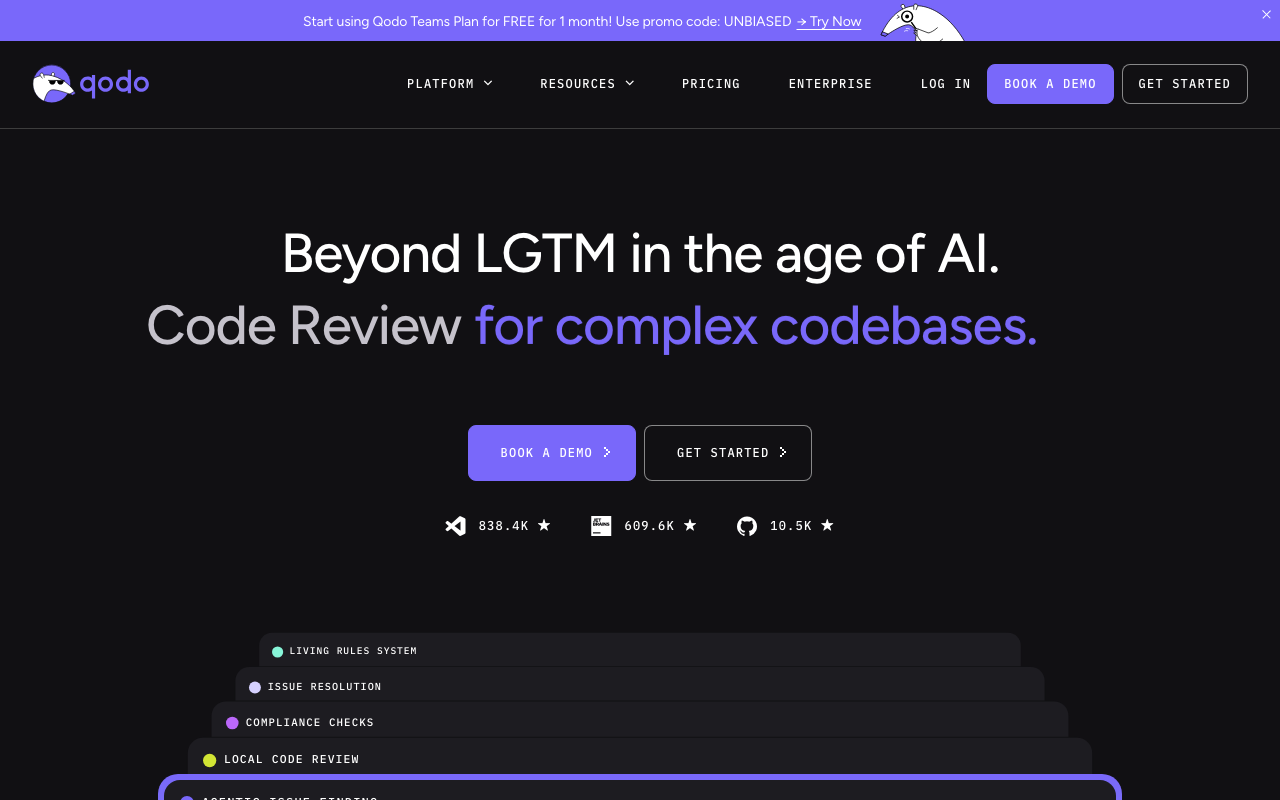
What was CodiumAI?
CodiumAI was an AI code quality startup founded in 2022 by Itamar Friedman and Dedy Kredo. The company launched with a specific and well-defined mission: use AI to generate meaningful unit tests, not just test stubs. Where early AI test tools would generate placeholder tests with empty assertions, CodiumAI’s IDE extension analyzed code behavior, identified edge cases and error scenarios, and produced tests with real assertions that would actually catch regressions.
This focus on test generation was a genuine product differentiation. The CodiumAI VS Code and JetBrains extensions became well-known in developer communities for the quality of their generated tests. The /test command - which could take a selected function and produce a full test suite covering happy paths, error paths, and boundary conditions - attracted a large user base that found the output meaningfully useful rather than requiring heavy manual editing.
The company also built and open-sourced PR-Agent, an AI code review bot for pull requests. PR-Agent ran on GitHub, GitLab, Bitbucket, Azure DevOps, and other platforms, posting automated code review comments on pull request diffs. This was a separate capability from the IDE test generation, but together they formed the foundation of what would become the Qodo platform.
By mid-2024, CodiumAI had a problem that was a good problem to have: it was a much bigger company than its name implied, building a much broader platform than “AI that generates tests.”
Why the rebrand happened
The decision to rebrand from CodiumAI to Qodo was driven by two distinct and compounding problems.
The name no longer fit the product
The CodiumAI name carried strong associations with test generation. That had been a feature, not a bug, in the early days when test generation was the product. But by 2024, the platform had expanded substantially. CodiumAI was building full agentic PR code review across four Git hosting platforms, a CLI tool for terminal-based quality workflows, an enterprise-grade context engine for multi-repo awareness, and a roadmap that pointed toward a comprehensive AI code quality platform spanning the entire development workflow.
A company named CodiumAI - with “Codium” suggesting code and “AI” following the standard AI startup naming convention - was underselling itself. Potential enterprise customers would evaluate the company and discover a platform that was more capable and more expansive than the name suggested, requiring a correction of expectations in every sales conversation.
The Qodo name was chosen to carry no specific product associations. It allowed the company to position the platform on its own terms without the legacy of a narrower identity.
Persistent confusion with an unrelated open-source project
The second driver was a name collision problem that had plagued the company since launch. Codium was also the name of a popular open-source project: an alternative binary distribution of VS Code with Microsoft’s telemetry removed, also known as VSCodium.
CodiumAI and VSCodium were completely unrelated - different organizations, different technologies, different purposes. But the name similarity created constant confusion. Developers searching for CodiumAI would find VSCodium in results. Developers looking for VSCodium would occasionally land on CodiumAI pages. Customer support regularly received inquiries from people who had confused the two. The confusion was compounded by the fact that both were associated with VS Code - CodiumAI via its VS Code extension, VSCodium as an alternative VS Code distribution.
No amount of SEO optimization or brand messaging fully solved a problem that was structural. The simplest fix was a new name. The Qodo rebrand eliminated the confusion entirely.
What changed after the rebrand
The brand and domain
The most visible changes were the name and the domain. The company became Qodo. The website moved from codium.ai to qodo.ai. The old domain was configured to redirect automatically, so any existing links or bookmarks continued to work without action from users.
The visual identity was refreshed alongside the name. New logos, updated documentation, and a redesigned website reflected the expanded platform positioning rather than the narrower test generation focus of the CodiumAI era.
Product naming
CodiumAI’s products were renamed and in some cases consolidated under the Qodo brand:
- The AI coding experience across IDE, CLI, and Git became Qodo Gen - the name covering Qodo’s AI assistance during active development.
- The automated test generation capability became Qodo Cover - keeping the same underlying functionality under a new product name.
- The PR review bot (built on the open-source PR-Agent foundation) became Qodo Merge - the commercial PR review product.
These renames were branding changes, not architectural changes. The same technology powered each product before and after. Developers who had been using the CodiumAI VS Code extension for test generation were now using the Qodo extension with Qodo Cover. The /test command, the edge case detection, and the framework-appropriate test output all continued to work exactly as before.
What did not change
The founding team, the engineering organization, and the core technology stack remained unchanged. Itamar Friedman and Dedy Kredo continued leading the company. The PR-Agent open-source repository was transferred to the qodo-ai organization on GitHub, but continued to be actively maintained and updated. Existing integrations - the GitHub App, the GitLab integration, the VS Code extension, the JetBrains plugin - all received updates to reflect the new branding but continued to function without requiring users to reinstall or re-authorize.
For most existing users, the experience of the rebrand was: the extension updated, the UI reflected the new Qodo name, and everything else continued working.
How Qodo has grown since the rebrand
The rebrand was not just a cosmetic change - it reflected and enabled a genuine expansion of the platform. Several significant developments have happened since CodiumAI became Qodo.
Qodo 2.0 and multi-agent review
In February 2026, Qodo released Qodo 2.0, which introduced a fundamental change to how PR review works. Rather than a single AI pass over a pull request diff, Qodo 2.0 deploys multiple specialized agents simultaneously: one focused on bug detection, one on code quality and maintainability, one on security analysis, and one on test coverage gap identification.
This multi-agent architecture produced a measurable outcome: Qodo 2.0 achieved the highest overall F1 score (60.1%) in comparative benchmarks across eight AI code review tools, with a recall rate of 56.7%. The Qodo 2.0 release would not have been possible, or would have been significantly slower to ship, without the organizational expansion that the rebrand enabled.
Series A funding and Gartner recognition
After the rebrand, Qodo raised $40 million in Series A funding - institutional validation of the broader platform vision. The company was also recognized as a Visionary in the Gartner Magic Quadrant for AI Code Assistants in 2025, a distinction that carries significant weight in enterprise software purchasing decisions and that reflects the platform’s maturity since the CodiumAI era.
Enterprise capabilities
The post-rebrand period saw the addition of the Enterprise context engine, which provides multi-repo intelligence for teams operating large microservice architectures. Enterprise features including SSO, audit logging, a user-admin portal, and SaaS-or-on-premises-or-air-gapped deployment options were added or significantly expanded. These capabilities positioned Qodo for enterprise sales in regulated industries - financial services, healthcare, government - where CodiumAI’s earlier positioning as a test generation tool had limited reach.
The difference between Qodo and Codium (VSCodium)
This distinction is worth stating directly because the old name confusion persists in search results.
Qodo (formerly CodiumAI) is a commercial AI code quality platform. It provides automated PR code review via Qodo Merge, AI test generation via Qodo Cover, an IDE extension for local code review and test generation, a CLI tool for terminal-based quality workflows, and an enterprise context engine for multi-repo intelligence. It is made by a company called Qodo (previously CodiumAI), founded in Israel in 2022.
VSCodium (also known as Codium) is an open-source binary distribution of Visual Studio Code. It is maintained by the community and distributed without Microsoft’s telemetry and proprietary components. It is a code editor, not an AI code review tool. It has no affiliation with Qodo or with the company formerly known as CodiumAI.
These are completely different products from different organizations. The Qodo rebrand was designed specifically to eliminate any remaining name confusion. If you are looking for an AI code review and test generation tool, you want Qodo. If you are looking for an open-source VS Code alternative, you want VSCodium.
Impact on existing users
The rebrand required essentially no action from existing CodiumAI users. The technical migration was handled by the Qodo team:
- Existing subscriptions continued without interruption
- The old codium.ai domain redirected to qodo.ai
- IDE extensions received Qodo-branded updates through normal update channels
- GitHub App integrations remained active under the new organization name
- Open-source PR-Agent users continued to receive updates from the qodo-ai GitHub organization
The credit system, billing cycles, and support channels all continued to function. Users on the free tier retained their monthly allocation. Users on paid plans were not charged anything additional for the migration.
The one area where users needed to pay attention was IDE extension updates. The VS Code extension transitioned from a CodiumAI-published extension to a Qodo-published extension. In most cases this happened automatically through VS Code’s extension update process. In some cases, particularly for users with auto-updates disabled, a manual reinstallation of the Qodo extension was required.
What to call it now
There is no universally right answer on whether to call it CodiumAI or Qodo in conversation, since both names will be understood by people familiar with the tool. In writing, particularly in content published after 2024, the correct name is Qodo. The company’s legal name, product names, and domain all reflect Qodo. When writing about the history, “formerly CodiumAI” or “previously known as CodiumAI” is accurate and helpful for readers who know the old name.
In documentation, job postings, and procurement processes, use Qodo. Using CodiumAI in these contexts creates confusion and may complicate vendor verification since the legal entity name changed.
Should you use Qodo?
If you are evaluating the platform because you heard about CodiumAI and want to know if it is still available, the answer is yes - it is available as Qodo, and it is more capable than it was under the CodiumAI name.
Qodo’s defining strengths are the same ones that made CodiumAI notable: automated test generation that produces meaningful tests rather than stubs, and a PR review bot (built on the open-source PR-Agent foundation) that covers GitHub, GitLab, Bitbucket, and Azure DevOps. After the rebrand, those strengths have been augmented by the Qodo 2.0 multi-agent review architecture, Gartner Visionary status, and enterprise-grade deployment options.
For a comprehensive review of the current platform, see the Qodo tool page. For head-to-head comparisons against the tools Qodo competes with most directly, the Qodo vs CodeRabbit comparison and Qodo vs GitHub Copilot comparison cover pricing, feature differences, and the specific scenarios where each tool wins in detail.
The free Developer plan provides 30 PR reviews and 250 IDE and CLI credits per month - enough to evaluate both the PR review quality and the test generation capability before making any purchasing decision.
Summary
CodiumAI rebranded to Qodo in 2024 for two reasons: the platform had grown significantly beyond the scope the CodiumAI name implied, and the name similarity with VSCodium (the open-source VS Code fork) created persistent market confusion. The rebrand involved renaming products (Qodo Gen, Qodo Cover, Qodo Merge), moving to the qodo.ai domain, and refreshing the brand identity.
Nothing of substance changed in the technology, team, or product capabilities. Existing users were migrated automatically. The open-source PR-Agent foundation continues to be maintained by the Qodo team on GitHub.
Since the rebrand, Qodo has expanded substantially - adding the multi-agent Qodo 2.0 review architecture, raising $40 million in Series A funding, achieving Gartner Visionary recognition, and building out enterprise deployment options. The platform in 2026 is materially more capable than CodiumAI was at the time of the rebrand, and the new name has allowed the company to position that broader platform without the constraints of its earlier identity.
If you were a CodiumAI user or evaluating CodiumAI, you are now working with Qodo. The product you are looking for is at qodo.ai.
Further Reading
- CodeRabbit vs Qodo: AI Code Review Tools Compared (2026)
- CodiumAI vs Codium (Open Source): They Are NOT the Same
- CodiumAI vs GitHub Copilot: Which AI Coding Assistant Should You Choose?
- Qodo vs Cody (Sourcegraph): AI Code Review Compared (2026)
- Qodo vs DeepSource: AI Code Review Tools Compared (2026)
 Gitar
GitarComments are not enough
Gitar applies the fix, validates it in CI, and clears the queue.
See it on your repo Read our independent Gitar reviewFrequently Asked Questions
Is CodiumAI the same as Qodo?
Yes. Qodo is the new name for CodiumAI. The company rebranded from CodiumAI to Qodo in 2024, keeping the same founding team, the same core technology, and the same products - just under a new name and identity. All existing CodiumAI accounts, subscriptions, and integrations were migrated automatically. The rebrand did not involve a change of ownership, an acquisition, or a product discontinuation. If you were using CodiumAI before the rebrand, you are now a Qodo customer.
When did CodiumAI rebrand to Qodo?
CodiumAI officially rebranded to Qodo in 2024. The company announced the new name alongside a broader repositioning of the platform from a test generation tool into a full-spectrum AI code quality platform. The rebrand was accompanied by product consolidation under the Qodo brand: the PR review product became Qodo Merge (later referred to as Qodo Gen for the overall AI coding experience), and the test generation capability became Qodo Cover. The domain moved from codium.ai to qodo.ai.
Why did CodiumAI rebrand to Qodo?
The rebrand served two purposes. First, CodiumAI was expanding significantly beyond its original focus on test generation - adding agentic PR code review, a CLI tool, an enterprise context engine, and multi-platform Git support. The name CodiumAI no longer reflected the breadth of the platform, and the company wanted a name that could carry a larger product vision. Second, CodiumAI faced persistent confusion with Codium - an open-source fork of VS Code (later renamed VSCodium). The name similarity caused ongoing search confusion and customer support friction. The Qodo rebrand solved both problems at once: a new name with broader scope and no confusion with an unrelated open-source project.
Is Qodo the same as Codium (the VS Code fork)?
No. Qodo (formerly CodiumAI) and Codium - the open-source VS Code fork also known as VSCodium - are completely unrelated products from different organizations. VSCodium is a community-maintained binary distribution of VS Code with Microsoft telemetry removed. Qodo is a commercial AI code quality platform providing PR review and test generation. The name similarity between CodiumAI and VSCodium was one of the primary drivers behind the CodiumAI rebrand to Qodo. As of 2024, there is no longer any name overlap: Qodo is an AI code review tool, and VSCodium is an open-source code editor.
What happened to CodiumAI's products after the rebrand?
CodiumAI's products were renamed and in some cases consolidated under the Qodo brand. The AI coding assistant and PR review capabilities became part of Qodo Gen - the name for Qodo's AI development experience across the IDE, CLI, and Git. The automated test generation capability became Qodo Cover. The PR review bot, previously known as PR-Agent (the open-source foundation) with CodiumAI branding, continued as Qodo Merge. None of the underlying products were discontinued. The technology, models, and integrations remained in place; only the product names and branding changed.
Do existing CodiumAI users need to do anything after the rebrand?
No. The migration from CodiumAI to Qodo was automatic for existing users. Subscriptions continued without interruption, existing IDE plugin installations received updates that reflected the new branding, and GitHub App integrations remained active. The old codium.ai domain redirected to qodo.ai. Existing customers did not need to re-sign up, re-authorize integrations, or move data. The only action that was eventually required was updating the IDE extension to the Qodo-branded version as updates were released, which happened through the normal extension update process in VS Code and JetBrains IDEs.
What is PR-Agent and how does it relate to CodiumAI and Qodo?
PR-Agent is the open-source AI code review engine that CodiumAI built and published on GitHub. It is the technical foundation underlying both the old CodiumAI platform and the current Qodo platform. PR-Agent supports GitHub, GitLab, Bitbucket, Azure DevOps, CodeCommit, and Gitea, and can be self-hosted for free. Qodo builds its commercial platform on top of PR-Agent, adding enterprise features like the context engine, SSO, audit logging, and managed infrastructure. After the rebrand, PR-Agent remains open source and continues to be maintained under the Qodo organization on GitHub. Teams that prefer self-hosting without a commercial subscription can still use PR-Agent directly.
Did CodiumAI's pricing change when it rebranded to Qodo?
Pricing evolved alongside the platform expansion, though the rebrand itself was not a pricing change event. After the rebrand and platform consolidation, Qodo settled on a free Developer tier (30 PR reviews and 250 credits per month), a Teams tier at $30/month flat for up to 30 users (annual billing), and a custom-priced Enterprise tier. One notable change in the free tier after the rebrand period was a reduction from 75 PR reviews per month to 30 PR reviews per month as the platform grew and infrastructure costs scaled. Paid plan pricing has remained stable at $30/month flat for up to 30 users for Teams. For current pricing details, see the full [Qodo tool review](/tool/qodo/).
Is Qodo still focused on test generation after the rebrand?
Yes. Test generation remains one of Qodo's defining capabilities and the feature that most clearly differentiates it from pure PR review tools. Under the CodiumAI name, the company was almost synonymous with AI test generation. After the rebrand to Qodo, test generation became one pillar of the broader platform rather than the sole focus. The capability now lives under the Qodo Cover name, still generates unit tests in popular frameworks like Jest, pytest, JUnit, and Vitest, and is still triggered via the /test command in the IDE extension. The expansion into PR code review (Qodo Merge and the multi-agent Qodo Gen review system) is what drove the rebrand, but test generation remains central to the platform.
How has Qodo evolved since the CodiumAI rebrand?
The rebrand marked the beginning of a significant expansion phase. Under the CodiumAI name, the company was primarily known for IDE-based test generation. Under Qodo, the platform expanded to include full agentic PR code review across GitHub, GitLab, Bitbucket, and Azure DevOps; a CLI tool for terminal-based quality workflows; an Enterprise context engine for multi-repo intelligence; and in February 2026, the Qodo 2.0 release introduced a multi-agent review architecture that achieved the highest overall F1 score (60.1%) in comparative benchmarks across eight AI code review tools. The company also raised $40 million in Series A funding and received recognition as a Gartner Visionary in the AI Code Assistants category in 2025.
Should I use Qodo or look for a CodiumAI alternative?
If you were looking for CodiumAI, Qodo is CodiumAI - same company, same technology, same team. There is no reason to look for a CodiumAI alternative specifically because of the rebrand. If you are evaluating AI code review tools more broadly, Qodo competes with CodeRabbit, Greptile, GitHub Copilot Code Review, Sourcery, and others. Qodo's unique strengths are its test generation capability (no other tool automatically generates unit tests as part of PR review), its open-source PR-Agent foundation, and its multi-agent review architecture that achieved top benchmark scores in 2026. See our comparison posts - [Qodo vs CodeRabbit](/blog/qodo-vs-coderabbit/) and [Qodo vs GitHub Copilot](/blog/qodo-vs-github-copilot/) - for detailed head-to-head analysis.
Where can I find CodiumAI's old documentation and resources?
CodiumAI's documentation has been migrated to qodo.ai. The old codium.ai domain redirects automatically to qodo.ai, so any bookmarked links should still work. The open-source PR-Agent repository on GitHub (originally published by CodiumAI) is now maintained under the qodo-ai GitHub organization. If you encounter a link to a CodiumAI resource that no longer works, search for the equivalent on qodo.ai or in the qodo-ai GitHub organization. Community resources like the CodiumAI Discord were migrated to Qodo-branded equivalents during the transition period.
Explore More
Tool Reviews
 Qodo Review
Free Newsletter
Stay ahead with AI dev tools
Weekly insights on AI code review, static analysis, and developer productivity. No spam, unsubscribe anytime.
Join developers getting weekly AI tool insights.
Related Articles
CodeRabbit vs Qodo: AI Code Review Tools Compared (2026)
CodeRabbit vs Qodo - we compare pricing, features, test generation, and review quality so you can pick the right AI reviewer for your team.
February 21, 2026
comparisonGitar vs Qodo: Workflow Automation or Test Generation?
Gitar vs Qodo compared on review architecture, test generation, self-hosting, migrations, CI ownership, and pricing. Which AI code quality platform fits your team.
August 12, 2026
comparisonQodo vs Cody (Sourcegraph): AI Code Review Compared (2026)
Qodo vs Cody compared on code review, codebase context, test generation, pricing, and enterprise fit. Which AI coding tool wins in 2026?
March 5, 2026