Qodo vs DeepSource: AI Code Review Tools Compared (2026)
Qodo vs DeepSource compared - AI test generation and PR review vs automated static analysis with AI autofix. Pricing, features, and which tool fits your team.
Published:
Last Updated:
Quick Verdict
Qodo and DeepSource are both positioned as automated code quality tools, but they approach the problem from opposite directions - and that distinction matters more than any feature checklist.
Qodo is an AI-native platform where artificial intelligence is the analysis engine. Its multi-agent architecture reads code semantically, detecting logic errors, contextual issues, and behavioral gaps that no predefined rule can identify. On top of that review capability, Qodo proactively generates unit tests for untested code paths during PR review - a capability unique in the market. When Qodo finds a logic error, it can generate the test that proves the error exists and prevents future regression.
DeepSource is a modern static analysis platform built for developer experience. Its 5,000+ analyser rules cover language-specific anti-patterns, security vulnerabilities, performance pitfalls, and code quality issues with a publicly claimed sub-5% false positive rate. Its defining workflow feature is AI-powered autofix: when the analyser identifies a violation, DeepSource generates a one-click code patch. Developers fix analyser findings faster because the fix is already written.
Choose Qodo if: your team needs AI-powered semantic review that catches logic errors and architectural issues beyond rule-matching, you want to improve test coverage through automated test generation, or your PRs involve complex business logic where understanding intent matters as much as catching violations.
Choose DeepSource if: your team wants high-volume, low-noise static analysis with automated remediation, you need a straightforward per-user pricing model significantly below Qodo’s cost, or you value broad language coverage with deep language-specific rule sets and CI/CD pipeline integration.
Many teams run both. The tools are more complementary than competitive. DeepSource handles the deterministic analysis and bulk autofix layer; Qodo handles the AI semantic review and test generation layer. The rest of this comparison will help you decide which fits your situation.
Why Compare Qodo and DeepSource
Both tools appear in evaluations for “automated code review” and “AI code quality” - but they represent genuinely different bets on what code quality automation should do.
Qodo, formerly CodiumAI, released Qodo 2.0 in February 2026 with a multi-agent review architecture that achieved the highest F1 score (60.1%) among eight AI code review tools tested. This positions Qodo as the current benchmark for AI-powered PR review quality, combining review accuracy with the unique capability of generating tests as part of the review process.
DeepSource has steadily expanded its analyser coverage and introduced AI autofix as its primary differentiator within the static analysis category. Founded in 2020 and used by organizations including Uber, Dropbox, and WeWork, DeepSource competes by offering SonarQube-level analysis depth with better developer experience and lower pricing. Its $12/active contributor/month pricing is among the most competitive in the quality analysis space.
The comparison is practically relevant because teams evaluating one often encounter the other, budget for code quality tooling is frequently shared across the two categories, and the right answer is genuinely context-dependent based on team size, test coverage maturity, and whether rule-based or AI-based analysis addresses the team’s primary gaps.
For related context, see our DeepSource alternatives guide, the Qodo vs CodeRabbit comparison, and the SonarQube vs DeepSource breakdown.
At-a-Glance Comparison
| Dimension | Qodo | DeepSource |
|---|---|---|
| Analysis approach | AI multi-agent semantic review | Deterministic static analysis + AI autofix |
| Rules / analysers | Multi-agent AI (no fixed rule count) | 5,000+ analyser rules across languages |
| False positive rate | Not published (AI-based, probabilistic) | Publicly claimed sub-5% |
| Languages | 10+ major modern languages | 15+ languages with deep per-language analysers |
| Free tier | 30 PR reviews + 250 IDE/CLI credits/month | Unlimited public repos, 1 private repo |
| Paid starting price | $30/user/month (Teams, annual) | $12/active contributor/month (Business, annual) |
| Test generation | Yes - automated, coverage-gap aware | No |
| AI autofix | Contextual suggestions | One-click deterministic patches |
| Quality gates | Advisory only | Configurable pass/fail on PRs |
| Security analysis | AI contextual detection | OWASP-mapped rules + dependency scanning |
| Dependency scanning | No | Yes - known CVE detection |
| Secrets detection | Limited | Yes - dedicated secrets analyser |
| PR decoration | Native inline comments | Native inline comments |
| CI/CD integration | App-based (no pipeline changes needed) | Deep CI/CD pipeline integration |
| IDE integration | VS Code, JetBrains | VS Code, JetBrains |
| Self-hosted | Enterprise plan (on-premises, air-gapped) | Business and Enterprise (self-hosted option) |
| Open-source core | Yes - PR-Agent on GitHub | Closed source |
| Setup time | Under 10 minutes | 15-20 minutes |
| Git platforms | GitHub, GitLab, Bitbucket, Azure DevOps | GitHub, GitLab, Bitbucket, Azure DevOps |
| Benchmark accuracy | 60.1% F1 score (highest among 8 tools) | Deterministic (no miss rate for matched rules) |
What Is Qodo?
Qodo (formerly CodiumAI) is an AI-powered code quality platform that combines automated PR code review with test generation. Founded in 2022 and backed by $40 million in Series A funding, the company was recognized as a Visionary in the Gartner Magic Quadrant for AI Code Assistants in 2025.
The February 2026 release of Qodo 2.0 introduced the multi-agent review architecture that defines its current capabilities. When a developer opens a pull request, specialized agents work concurrently on different aspects:
- A bug detection agent analyzes logic errors, null pointer risks, incorrect boundary conditions, and behavioral assumptions
- A code quality agent evaluates structure, cognitive complexity, and maintainability patterns
- A security agent looks for authorization gaps, missing input validation, insecure API configurations, and common vulnerability patterns
- A test coverage agent identifies which changed code paths lack test coverage and generates complete unit tests to address those gaps
This architecture achieved an overall F1 score of 60.1% in comparative benchmarks - the highest result among eight AI code review tools evaluated - with a recall rate of 56.7%.
The platform spans four interaction surfaces: a Git plugin for automated PR review, an IDE plugin for VS Code and JetBrains, a CLI plugin for terminal-based workflows, and an Enterprise context engine for multi-repo intelligence. The underlying PR-Agent foundation is open source on GitHub, allowing inspection of review logic and enabling air-gapped Enterprise deployments.
For a complete feature breakdown, see the Qodo review. For how Qodo compares to the AI code review market broadly, see our best AI code review tools guide.
What Is DeepSource?
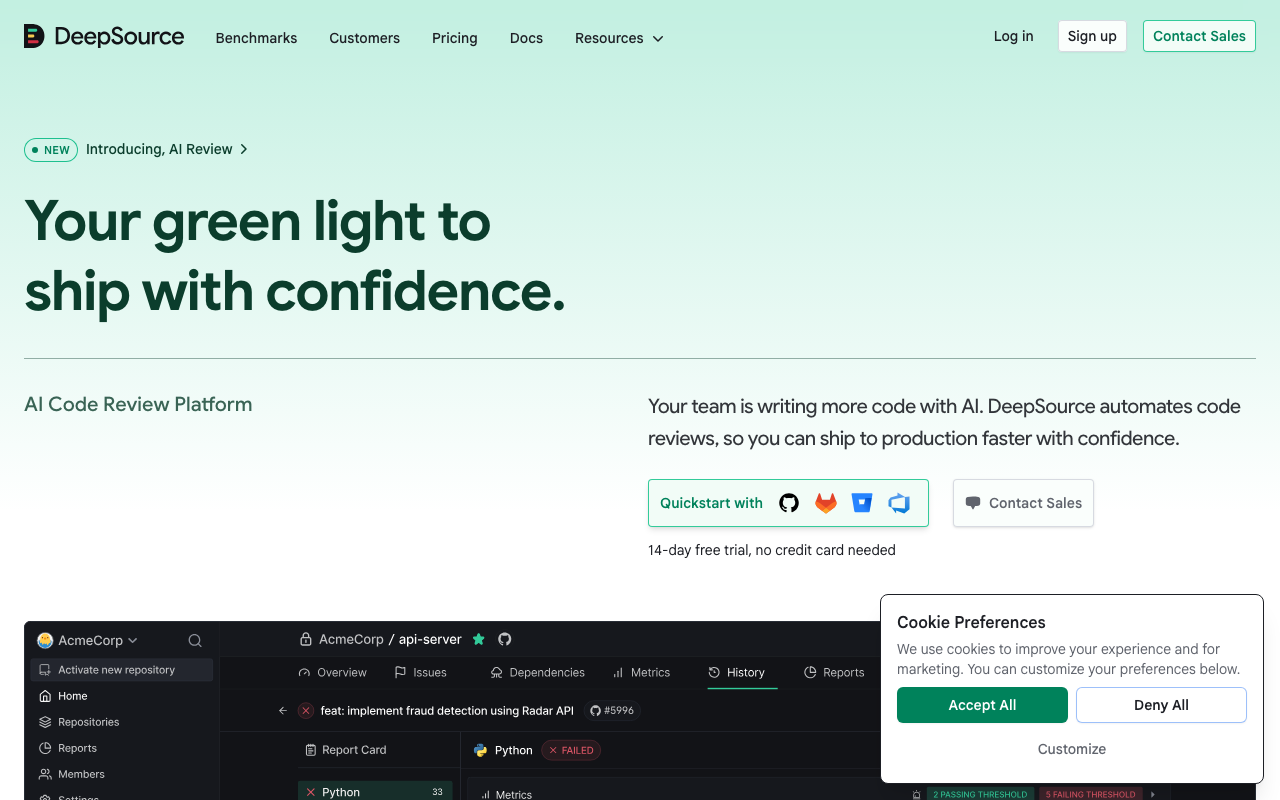
DeepSource is a cloud-native static code analysis platform focused on developer experience, low false positive rates, and automated remediation. Founded in 2020 and used by organizations including Uber, Dropbox, and WeWork, DeepSource has built a reputation for being easier to adopt and maintain than traditional static analysis platforms while providing comparable analytical depth.
The platform’s analysis is organized around language-specific analysers. Each analyser is a purpose-built ruleset for a specific language, covering anti-patterns, performance pitfalls, security vulnerabilities, style consistency, and type safety issues that are particular to that language’s ecosystem. Python’s analyser includes Django-specific security checks. JavaScript’s analyser covers React hook violations. Go’s analyser enforces idiomatic Go patterns. This specialization produces findings that feel relevant to the language rather than generic.
DeepSource’s AI autofix is its defining differentiator within the static analysis category. When an analyser identifies a finding, DeepSource’s AI generates a code patch that fixes the specific issue - adding the missing type annotation, removing the unused import, correcting the insecure pattern. Developers apply the fix with one click from the PR comment or DeepSource dashboard. For high-volume remediation of well-defined issues, this reduces the time spent on analyser findings from hours to minutes.
The platform includes a dedicated secrets analyser that detects hardcoded credentials, API keys, and tokens in commits before they reach production. Dependency analysis covers known CVEs in third-party packages across Python (PyPI), JavaScript (npm), and other ecosystems. These security capabilities are built in rather than requiring separate tool integration.
For a complete feature breakdown, see the DeepSource review. For pricing specifics, see our DeepSource pricing guide.
Feature-by-Feature Breakdown
Review Approach: AI Semantics vs Rule-Based Analysis
The most consequential difference between Qodo and DeepSource is the nature of their analysis - and understanding this shapes how you should think about everything else.
Qodo reads code the way an experienced engineer reads code. When a developer opens a PR that refactors an API endpoint, Qodo understands what the endpoint is supposed to do, compares the new implementation to the existing patterns in the codebase, and can identify issues like “this refactor removed the rate-limiting check present in every other endpoint.” It can detect that a new processPayment function handles the success path but silently swallows errors in the failure path. It can notice that a PR adds a new user-facing endpoint without adding the corresponding authorization middleware that every other endpoint uses. None of these findings map to a predefined rule - they require understanding intent.
DeepSource knows with certainty what your code violates. Its 5,000+ analyser rules define specific patterns: a function that never closes a file handle, a SQL query built through string concatenation, a React component that calls a hook conditionally. When any of these patterns appears, DeepSource flags it reliably. The same code always produces the same result. A finding from DeepSource’s SQL injection analyser rule is traceable, documentable, and reproducible - valuable properties for audit and governance.
The practical consequence is that these tools find largely different issues. Qodo catches logic errors, requirement mismatches, edge case gaps, and contextual security issues. DeepSource catches specific code pattern violations that humans frequently overlook or rationalize past. Running both produces substantially more findings than either tool alone, with minimal duplication.
One area where DeepSource’s deterministic approach creates a specific advantage: false positive rate. When DeepSource’s Python analyser flags an unused import, it is almost always correct - the import really is unused. Qodo’s AI findings require more developer judgment because the AI is reasoning about intent, which involves inference that can occasionally miss context the developer has. Teams with low tolerance for false positives sometimes prefer DeepSource’s controlled, predictable findings over AI-based review.
Test Generation - Qodo’s Key Differentiator
Test generation is what most sharply separates Qodo from every static analysis tool including DeepSource.
Qodo’s test generation is proactive and automated. When a developer opens a PR, Qodo’s test coverage agent identifies which code paths introduced by the PR lack test coverage and generates complete unit tests without being asked. In the IDE, the /test command triggers test generation for selected code - Qodo analyzes the function’s behavior, identifies edge cases and error conditions commonly missed by developers, and produces test files in the project’s testing framework. These tests include meaningful assertions that exercise specific behaviors, not placeholder stubs.
Consider a practical example: a developer opens a PR adding a validateSubscription function with four conditional branches based on subscription status. Qodo reviews the PR, sees that only one branch is tested, and generates tests for the remaining three branches - including edge cases like null subscription objects and expired plan states, with specific return value and exception assertions.
This creates a compounding improvement loop. Qodo finds a logic error in branch three. Then it generates a test that proves the error exists and would prevent future regression if it passes. The finding becomes actionable not just as a code change but as a permanent improvement to the test suite. No static analysis tool can close this loop because no static analysis tool generates tests.
DeepSource does not generate tests. Its autofix generates patches for existing analyser findings - not new test cases for untested code. If your team has been accumulating test coverage debt and wants a systematic way to address it, Qodo has a genuine capability that DeepSource simply does not offer.
For teams evaluating test coverage improvement specifically, this single difference may be the deciding factor. No amount of DeepSource’s other capabilities substitutes for having tests generated automatically during code review.
AI Autofix - DeepSource’s Key Differentiator
DeepSource’s AI autofix is the mirror image of Qodo’s test generation - a capability that defines DeepSource’s value within its category.
When DeepSource’s analyser identifies a finding, its AI generates a code patch that resolves that specific finding. The patch is precise: if the analyser flags a missing await before a Promise in a JavaScript function, the autofix adds the await at the exact location. If it flags an insecure direct object reference pattern, the autofix restructures the code to add the appropriate check. Developers see the proposed patch inline in the PR or in the DeepSource dashboard and apply it with one click.
The operational impact at scale is significant. For teams with legacy codebases containing thousands of static analysis findings, manually addressing each one is prohibitively time-consuming. DeepSource’s autofix makes bulk remediation practical - a developer can apply 50 autofix patches in the time it would take to manually fix five findings. Organizations that have adopted DeepSource report dramatically faster cleanup of analyser backlogs compared to manual remediation workflows.
Qodo’s suggestions are higher-level and more interpretive. Qodo’s review comments describe issues and suggest approaches, but the developer writes the fix. This is appropriate for the class of issues Qodo addresses - a logic error that requires understanding the business context cannot be auto-patched safely - but it means Qodo does not provide the operational efficiency of one-click remediation for well-defined issues.
For teams whose primary bottleneck is the time spent addressing a backlog of known code quality issues, DeepSource’s autofix is a more direct solution than Qodo’s advisory review comments.
Security Analysis
Both tools include security analysis, but at different levels of depth and formality.
DeepSource’s security analysis is rule-based and formally mapped. Its security analyser covers OWASP Top 10 vulnerability patterns - SQL injection, cross-site scripting, insecure deserialization, path traversal, and others - with findings traceable to CWE identifiers. The dedicated secrets analyser detects hardcoded API keys, OAuth tokens, database credentials, and private keys committed in code or configuration files. Dependency analysis scans for known CVEs in Python, JavaScript, and other ecosystems, flagging vulnerable package versions with severity ratings and upgrade recommendations.
This formal traceability - a finding mapped to OWASP A03:2021 Injection with CWE-89 SQL Injection - is valuable for teams with security compliance documentation requirements. DeepSource’s security findings provide the kind of evidence that satisfies a security audit.
Qodo’s security analysis is broader but contextual. Its AI agents catch authorization logic errors (an endpoint that bypasses middleware used by every other route), missing input validation (a function that uses user input in a database query without sanitization), and architectural security gaps (a new service that exposes sensitive data without applying the encryption patterns used elsewhere in the codebase). These contextual findings are real and important - they reflect how most production security bugs actually happen. But they do not map to formal security standards and cannot produce compliance documentation.
For teams with explicit security compliance requirements, DeepSource’s formally mapped findings are the more auditable option. For teams that want to catch the contextual security issues that rules miss, Qodo adds coverage that DeepSource cannot provide. For teams with serious security requirements, dedicated platforms like Semgrep or Snyk Code complement either tool with deeper security-specific coverage. See our best SAST tools guide for a full comparison.
Pricing Comparison
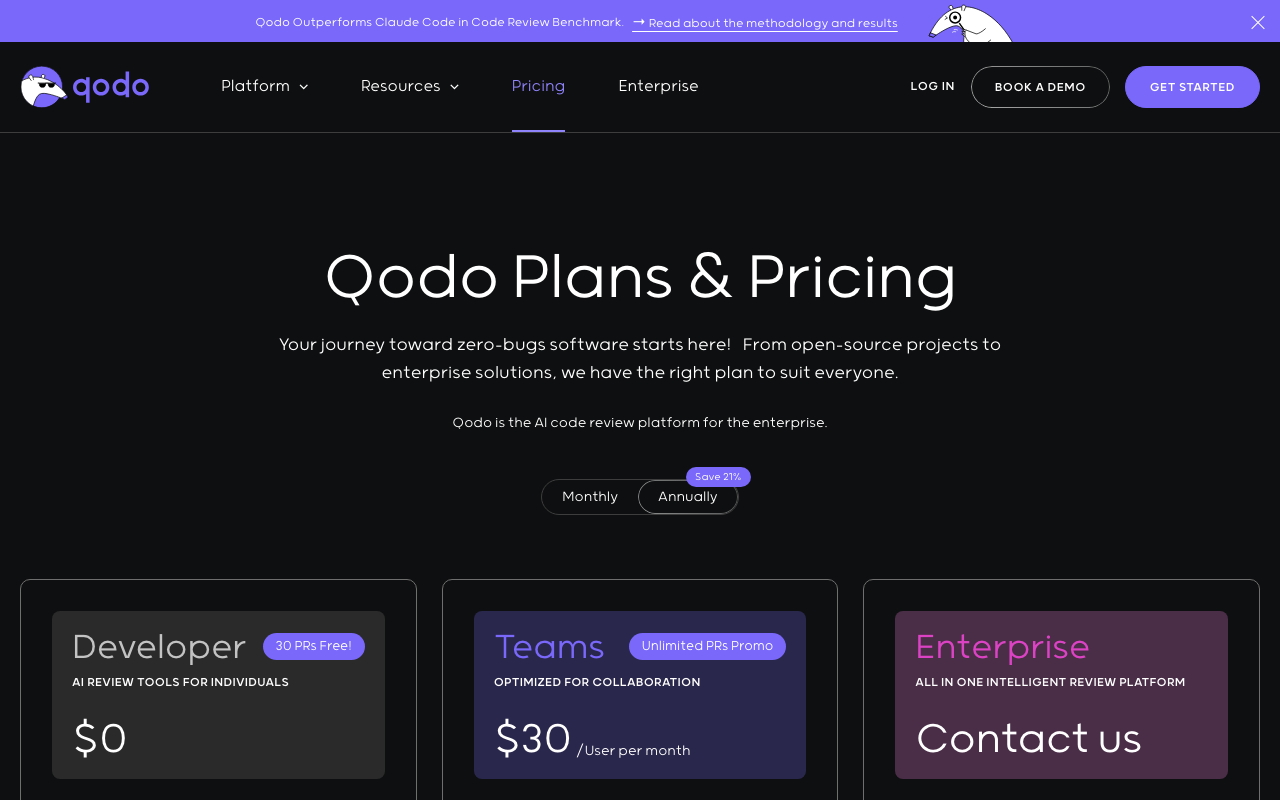
Qodo Pricing
| Plan | Price | Key Capabilities |
|---|---|---|
| Developer (Free) | $0 | 30 PR reviews/month, 250 IDE/CLI credits/month, community support |
| Teams | $30/user/month (annual) | Unlimited PR reviews (limited-time promo), 2,500 credits/user/month, no data retention, private support |
| Enterprise | Custom | Context engine, multi-repo intelligence, SSO, on-premises/air-gapped, 2-business-day SLA |
The credit system applies to IDE and CLI interactions. Standard operations cost 1 credit each; premium models like Claude Opus 4 cost 5 credits per request. Credits reset on a rolling 30-day schedule from first use.
The Teams plan currently includes unlimited PR reviews as a limited-time promotion. The standard allowance is 20 PRs per user per month. Teams with high PR volume should confirm current terms before committing to an annual contract.
DeepSource Pricing
| Plan | Price | Key Capabilities |
|---|---|---|
| Free | $0 | Unlimited public repos, 1 private repo, core analysers |
| Business | $12/active contributor/month (annual) | Unlimited private repos, all analysers, AI autofix, priority support |
| Enterprise | Custom | SSO, audit logs, advanced compliance features, SLAs, self-hosted option |
DeepSource’s pricing is based on active contributors - developers who commit code - rather than all users in the organization. Developers who only read code or manage repositories do not count toward the billing count. This active contributor model can produce meaningful savings for larger organizations where many stakeholders access the dashboard without committing code.
Side-by-Side Cost at Scale
The pricing difference between Qodo Teams ($30/user/month) and DeepSource Business ($12/active contributor/month) is substantial:
| Scenario | Qodo Teams | DeepSource Business |
|---|---|---|
| 5 developers | $150/month | $60/month |
| 10 developers | $300/month | $120/month |
| 20 developers | $600/month | $240/month |
| 50 developers | $1,500/month | $600/month |
| Both tools, 10 developers | - | $420/month combined |
DeepSource is 2.5x cheaper than Qodo at every team size. For budget-constrained teams, this is a meaningful consideration. The question is whether Qodo’s AI semantic review and test generation capabilities justify the premium. Teams actively working to improve test coverage or catch complex logic errors frequently find the Qodo investment straightforwardly justified. Teams that primarily need automated rule enforcement and autofix at scale find DeepSource’s lower cost more attractive.
The combined cost for a 10-developer team running both tools is approximately $420/month - comparable to Qodo alone at larger team sizes, and a natural escalation path.
Deployment and Data Sovereignty
Both tools offer self-hosted options, which separates them from many competitors that are cloud-only.
Qodo’s Enterprise plan supports on-premises deployment and fully air-gapped environments where code never leaves the customer’s infrastructure. The open-source PR-Agent foundation allows inspection and independent deployment. This combination - air-gapped deployment, open-source core, Enterprise SSO - makes Qodo one of the strongest options for regulated industries where AI code review would otherwise be unavailable.
DeepSource’s Enterprise plan includes a self-hosted deployment option. Organizations that cannot send code to external cloud services can deploy DeepSource on their own infrastructure. This is less mature than Qodo’s air-gapped option but covers the primary requirement for most regulated environments.
Both tools support SSO, role-based access control, and audit logging at their Enterprise tiers - standard requirements for enterprise security posture. For teams in defense, government, or strict financial services where data sovereignty is non-negotiable, confirming current self-hosted capabilities directly with each vendor is recommended before committing.
Language Support
DeepSource covers a broader set of languages with deeper per-language rule sets. Its analysers include Python, JavaScript, TypeScript, Go, Ruby, PHP, Java, Kotlin, Scala, Swift, Rust, C, C++, C#, and several others. Each analyser is built specifically for the language’s idioms - Python findings reflect Python-specific patterns, not generic analysis mapped to Python syntax.
Qodo supports JavaScript, TypeScript, Python, Java, Go, C++, C#, Ruby, PHP, Kotlin, and Rust - covering the languages where most active development happens in 2026. Its AI approach means analysis quality is not bound by the comprehensiveness of a hand-written rule set, but it also means there is no equivalent to DeepSource’s language-specific deep dives into framework-level patterns.
For polyglot organizations with legacy languages or niche technology stacks, DeepSource’s language coverage is an advantage. For most modern application development teams, both tools cover the relevant languages adequately.
IDE Integration
Both tools provide VS Code and JetBrains IDE integrations, but the integration experiences differ in purpose.
DeepSource’s IDE integration surfaces analyser findings from the most recent analysis run directly in the editor, allowing developers to see and address issues without switching to the dashboard. It is primarily a finding-review interface.
Qodo’s IDE plugin is a full review and test generation interface. Developers can trigger AI review of local changes before committing, use the /test command to generate tests for new functions, and interact with Qodo’s AI for suggestions. The plugin supports multiple AI models including GPT-4o, Claude 3.5 Sonnet, DeepSeek-R1, and local LLM support through Ollama for privacy-conscious teams.
The key distinction: DeepSource’s IDE integration is about efficient issue consumption; Qodo’s IDE plugin is about AI-assisted development including review and test generation. Both add value but serve different workflows.
Use Cases - When to Choose Each
When Qodo Makes More Sense
Teams with low test coverage that want to improve it systematically. Qodo’s automated test generation is the most practical mechanism available for closing test coverage gaps. If your team has an agreed need for better tests but struggles to prioritize writing them, Qodo converts the PR review process into a continuous test generation workflow. Every PR reviewed by Qodo adds tests to the codebase. Over time, coverage improves without dedicated sprint capacity.
Teams whose code involves complex business logic. When PRs touch payment processing, authorization flows, data transformation pipelines, or other logic-heavy code, AI-powered semantic review catches the class of errors that static rules cannot: silent failure modes, missing edge cases, architectural pattern violations, behavioral regressions introduced by refactoring.
Teams that want a conversational review experience. Qodo’s comments read like feedback from a senior engineer. Developers can respond in the PR thread, ask Qodo to explain a concern, or request an alternative implementation. This collaborative style is qualitatively different from rule-based findings and works better for junior developers learning from review.
Organizations needing both AI review and air-gapped deployment. Qodo’s Enterprise plan with air-gapped deployment makes modern AI code review available to regulated industries that cannot send code to third-party cloud services. This combination is rare in the market.
Teams evaluating AI code review tools that include test generation. No competing tool - CodeRabbit, GitHub Copilot, Greptile, or others - generates tests as part of the PR review workflow the way Qodo does. If test generation is a priority, Qodo is the choice without a close alternative.
When DeepSource Makes More Sense
Teams that want high-volume, low-noise automated analysis. DeepSource’s sub-5% false positive rate means developers spend less time dismissing irrelevant findings and more time acting on genuine issues. For teams fatigued by noisy analysis tools, DeepSource’s precision is a significant quality-of-life improvement.
Teams with a backlog of static analysis findings to remediate. DeepSource’s AI autofix makes bulk remediation practical. Applying 100 autofix patches to a legacy codebase is a task that takes hours with DeepSource and weeks manually. For teams inheriting codebases with accumulated quality debt, this is a major operational advantage.
Budget-constrained teams that still need strong static analysis. At $12/active contributor/month, DeepSource is among the most competitively priced quality analysis tools available. Teams that need meaningful static analysis coverage without Qodo’s $30/user/month investment should start with DeepSource.
Teams that need formal security findings for compliance documentation. DeepSource’s OWASP-mapped security analyser findings with CWE identifiers provide the traceability that security audits and compliance documentation require. Qodo’s AI security analysis does not produce equivalent formal evidence.
Polyglot teams or teams with less common language requirements. DeepSource’s language coverage and per-language analyser depth are advantages for organizations working in a broad range of languages.
When to Run Both
The most capable code quality setups use both tools with clearly defined roles.
DeepSource handles the deterministic layer: 5,000+ rule enforcement, AI autofix for efficient remediation, secrets detection, dependency vulnerability scanning, and formal security findings. It provides the quality baseline.
Qodo handles the intelligence layer: semantic PR review that catches logic errors and contextual issues, automated test generation that improves coverage, and the kind of actionable AI feedback that makes every PR a learning opportunity. It provides the improvement engine.
A combined workflow in practice:
- Developer writes code; DeepSource’s analysis runs on each push and highlights rule violations in the IDE or PR. Qodo’s IDE plugin is available for AI review and test generation on demand.
- Developer opens a PR; DeepSource’s analyser runs automatically and posts inline findings with AI autofix suggestions. Qodo’s multi-agent review runs in parallel and posts semantic review comments.
- Developer sees both sets of feedback: DeepSource’s specific rule violations with one-click patches, and Qodo’s contextual AI feedback with logic analysis and generated tests.
- Findings are addressed: autofix patches applied for DeepSource findings, code changes made for Qodo’s logic concerns, generated tests added to the PR.
- PR merges with both tools satisfied.
For a 10-developer team, running both costs approximately $420/month. For most teams, the combination catches more issues than either tool alone and addresses both the rule-enforcement and semantic-understanding dimensions of code quality.
Alternatives to Consider
If neither Qodo nor DeepSource fully fits your requirements, several alternatives deserve evaluation.
CodeRabbit is the most widely deployed dedicated AI code review tool with 13+ million PRs reviewed. Like Qodo, it provides AI-powered PR review but without test generation. It includes 40+ built-in deterministic linters and prices at $12-24/user/month - substantially below Qodo. For teams that want AI PR review without the test generation component, CodeRabbit is the primary alternative to Qodo. See our CodeRabbit vs DeepSource comparison for how CodeRabbit stacks up against DeepSource specifically.
SonarQube provides the deepest rule-based static analysis coverage available - 6,500+ rules across 35+ languages - plus quality gate enforcement that blocks PR merges on quantifiable conditions. It is more powerful than DeepSource for large enterprise codebases and compliance reporting but more complex to set up and operate. Teams that outgrow DeepSource should evaluate SonarQube. See our SonarQube vs DeepSource comparison.
Codacy is a cloud-native code quality platform that sits between DeepSource and SonarQube in feature depth. It provides broad language coverage, security analysis, and a quality gate mechanism with simpler setup than SonarQube. Teams that find SonarQube’s complexity excessive but want more enforcement capability than DeepSource currently provides should evaluate Codacy. See our DeepSource vs Codacy comparison.
CodeAnt AI is a newer entrant that combines static analysis with AI-powered autofix and code health metrics in a single platform. Priced at $24-40/user/month, it is positioned between DeepSource and Qodo in both price and capability philosophy. CodeAnt AI is worth evaluating for teams that want a single tool blending the automated rule-based analysis of DeepSource with AI-assisted remediation.
Semgrep is a lightweight, open-source static analysis tool with a powerful custom rule language. It is particularly strong for security-focused teams that need to enforce patterns specific to their codebase and policies. Less comprehensive than DeepSource out of the box but highly extensible. Our DeepSource vs Semgrep comparison covers this in depth.
For a full overview of the code quality tool landscape, see our best code quality tools guide and the best AI code review tools roundup.
Verdict - Which Should You Choose?
Qodo and DeepSource serve genuinely different needs. The decision comes down to what your team’s primary bottleneck is.
If your team’s primary challenge is catching logic errors, improving test coverage, and getting AI-powered semantic review that understands code intent, Qodo is the right choice. Its multi-agent architecture addresses the class of issues that static analysis cannot reach. Its test generation capability is unique - no competing tool proactively generates unit tests as part of the PR review workflow. At $30/user/month, it is priced at a premium, but the combined review-plus-testing capability is genuinely differentiated.
If your team’s primary challenge is automated rule enforcement, efficient remediation of a static analysis backlog, and maintaining consistent code quality at a cost-effective price, DeepSource is the right choice. Its sub-5% false positive rate produces findings developers trust and act on. Its AI autofix makes bulk remediation practical at scale. At $12/active contributor/month, it is one of the most affordable quality analysis platforms available.
If your team can invest in both, the combination is the strongest code quality setup available at a reasonable total cost. DeepSource provides the deterministic quality baseline and automated remediation layer. Qodo provides the AI intelligence layer and test generation capability. A 10-developer team can run both for approximately $420/month.
Practical recommendations by team profile:
-
Small teams (under 10 developers) starting with automated code quality: Begin with DeepSource’s free plan for private repository analysis - it is a meaningful starting point at no cost. Add Qodo’s free Developer plan (30 PR reviews/month) for AI review on your highest-priority work. Upgrade as volume demands.
-
Teams with test coverage gaps as the primary pain point: Qodo is the higher-priority investment. DeepSource does not generate tests; Qodo does. Address coverage with Qodo first, then add DeepSource for the rule enforcement layer when budget allows.
-
Teams with static analysis backlog as the primary pain point: DeepSource’s AI autofix is the most direct solution. The ability to apply autofix patches in bulk means a meaningful backlog can be addressed in days rather than months. Qodo’s advisory suggestions are valuable but do not provide the same remediation efficiency for well-defined issues.
-
Budget-constrained teams that want both AI review and static analysis: Start with DeepSource Business at $12/active contributor. Add Qodo’s free Developer plan for AI PR review on critical PRs. Upgrade Qodo to Teams when the 30 PR/month free tier is insufficient.
-
Enterprise teams with compliance requirements: Evaluate both at the Enterprise tier. DeepSource’s formally mapped security findings satisfy audit documentation requirements. Qodo’s air-gapped deployment option allows AI code review in environments where cloud-based analysis is prohibited. Run together for comprehensive coverage.
The bottom line is direct: Qodo and DeepSource are complementary tools that are stronger together than either is individually. If you must choose one, let your primary need guide the decision - test coverage improvement and AI semantic review chooses Qodo, automated rule enforcement and efficient remediation chooses DeepSource.
Frequently Asked Questions
Is Qodo better than DeepSource for code review?
Qodo and DeepSource excel at different things, so 'better' depends on your team's priorities. Qodo uses a multi-agent AI architecture that understands code semantically - it catches logic errors, architectural inconsistencies, and contextual issues that no predefined rule can detect. It also generates unit tests proactively during PR review, which is a capability no static analysis tool including DeepSource can match. DeepSource is stronger at deterministic rule-based analysis with a 5,000+ analyser rule set, sub-5% false positive rate, and automated AI autofix that resolves common issues without developer intervention. For AI-powered semantic review and test generation, Qodo wins. For automated, low-noise static analysis with autofix at scale, DeepSource is the stronger choice.
Does DeepSource use AI like Qodo does?
Yes, but in a fundamentally different way. DeepSource uses AI primarily for its autofix feature - when the static analyser identifies an issue, DeepSource's AI generates a fix that developers can apply with one click. This is powerful for high-volume, well-defined issue types like style violations, type annotation gaps, and common anti-patterns. Qodo's AI runs the entire review process: a multi-agent architecture where specialized agents simultaneously analyze logic errors, code quality, security, and test coverage gaps, then generate natural-language comments and tests. DeepSource's AI enhances a rule-based system; Qodo's AI is the core analysis engine. Both approaches are valuable, but they solve different problems.
How does DeepSource's autofix compare to Qodo's suggestions?
They operate at different levels of abstraction. DeepSource's autofix is deterministic and scoped to specific analyser findings - when it detects a missing type annotation or an unused variable, it generates a precise code patch that fixes exactly that issue. The fix is predictable, reviewable, and applies cleanly in most cases. One-click application makes it operationally efficient for bulk fixing of static analysis findings. Qodo's AI suggestions are contextual and broader - Qodo might suggest refactoring an entire authentication flow because it identifies a pattern mismatch with how the rest of the codebase handles auth, or it might suggest adding error handling for an edge case it discovered through semantic analysis. Qodo's suggestions are higher-level and more interpretive; DeepSource's autofix is lower-level and more precise. For teams with large backlogs of static analysis findings, DeepSource's autofix is the more efficient remediation mechanism.
What is DeepSource's false positive rate compared to Qodo?
DeepSource publicly claims a sub-5% false positive rate, which is significantly lower than many static analysis tools. This is achieved through careful tuning of its analyser rules and a feedback mechanism where developers can mark false positives, improving future analysis. Qodo does not publish false positive rates because its AI-based analysis is probabilistic rather than deterministic. AI code review tools generally have higher false positive rates than tuned static analysis tools, but Qodo's multi-agent architecture is specifically designed to reduce noise by having agents validate each other's findings. In practice, DeepSource's deterministic analysis is more predictable and controllable; Qodo's AI findings require more developer judgment but catch issues that rules cannot detect.
Can DeepSource generate tests like Qodo?
No. DeepSource does not generate unit tests. Its autofix capability generates code patches to fix analyser findings - missing type annotations, unused imports, common anti-patterns - but it does not proactively generate test cases for new code. Qodo's test generation is a unique differentiator: during PR review, Qodo identifies untested code paths in the changed code and generates complete unit tests in the project's testing framework (Jest, pytest, JUnit, Vitest, and others) with meaningful assertions. In the IDE, the /test command triggers targeted test generation for selected functions. If improving test coverage is a priority, Qodo has a capability DeepSource simply does not offer.
How much does DeepSource cost compared to Qodo?
DeepSource pricing is based on active contributors (developers who commit code). The Business plan costs $12/month per active contributor (billed annually), making it substantially cheaper than Qodo's Teams plan at $30/user/month. DeepSource offers a free plan covering unlimited public repositories and 1 private repository. Qodo's free Developer plan provides 30 PR reviews and 250 IDE/CLI credits per month. For a 10-developer team, DeepSource Business runs approximately $120/month versus Qodo Teams at $300/month. DeepSource's lower per-user cost reflects its focus on deterministic analysis; Qodo's higher price reflects the additional AI infrastructure required for multi-agent semantic review and test generation.
Which tool supports more programming languages - Qodo or DeepSource?
DeepSource supports a broader range of languages with deeper analysis depth in each. Its analyser coverage includes Python, JavaScript, TypeScript, Java, Go, Ruby, PHP, Rust, Swift, Kotlin, Scala, C, C++, C#, and several others, with language-specific analysers that apply thousands of rules tailored to each language's idioms and common pitfalls. Qodo supports the major modern languages - JavaScript, TypeScript, Python, Java, Go, C++, C#, Ruby, PHP, Kotlin, and Rust - covering most active codebases but without language-specific analyser depth. For polyglot teams or organizations with less common language requirements, DeepSource's language coverage is an advantage.
Does Qodo or DeepSource integrate better with CI/CD pipelines?
DeepSource integrates more deeply with CI/CD workflows through its dedicated integration with GitHub Actions, GitLab CI, CircleCI, and other systems, plus its CLI for local and pipeline analysis. The DeepSource dashboard provides PR-level issue reporting and autofix suggestions triggered automatically on every commit. Qodo integrates at the Git platform level as an app (GitHub Marketplace, GitLab integration) rather than at the CI pipeline level - it reviews PRs without requiring pipeline changes, which simplifies setup but reduces CI/CD-level control. DeepSource's webhook and CI integration model gives DevOps teams more control over when and how analysis runs. Qodo's app-based model is faster to set up and requires zero pipeline configuration.
Can Qodo and DeepSource run together on the same repository?
Yes, and the combination works well because the tools analyze different dimensions. DeepSource's deterministic analysis runs on every commit and PR, catching specific rule violations and applying autofix patches to well-defined issues. Qodo's AI agents run on the same PRs and provide contextual semantic feedback, logic error detection, and test generation. The two sets of comments appear separately on the PR. There is minimal overlap because DeepSource operates at the level of specific rule violations while Qodo operates at the level of code understanding and test coverage. Teams running both typically use DeepSource for the automated quality baseline and Qodo for the deeper AI review layer.
Is DeepSource good for security analysis compared to Qodo?
DeepSource has a dedicated Security analyser that covers OWASP Top 10 vulnerability patterns, common injection risks, insecure dependency configurations, and secrets detection. Its security rules are mapped to specific CWE identifiers where applicable, giving findings formal traceability. DeepSource also includes dependency vulnerability scanning that flags known CVEs in third-party packages. Qodo's security analysis is AI-driven and contextual - it catches authorization logic errors, missing input validation, and insecure patterns that emerge from the codebase's architecture - but its findings do not map to formal security standards and cannot generate compliance reports. For teams with formal security compliance requirements, DeepSource's mapped findings are more useful for documentation. For catching contextual security issues unique to your codebase, Qodo's AI approach adds coverage DeepSource cannot match.
Which tool is easier to set up - Qodo or DeepSource?
Both tools are significantly faster to set up than traditional static analysis platforms like SonarQube self-hosted. Qodo installs as a GitHub or GitLab app in under 10 minutes with no CI/CD pipeline configuration required. DeepSource setup typically takes 15-20 minutes and requires enabling the integration through the DeepSource dashboard and optionally adding CI pipeline steps, but it remains substantially simpler than tools requiring scanner installation and database provisioning. Both offer cloud-hosted SaaS models that eliminate infrastructure management. Qodo has a slight edge in raw setup speed due to its app-based model; DeepSource's setup is still fast by industry standards and provides more CI/CD integration options in return.
What alternatives should I consider besides Qodo and DeepSource?
For AI-powered PR review similar to Qodo, CodeRabbit ($12-24/user/month) is the most widely deployed alternative with 13+ million PRs reviewed, though it lacks test generation. For static analysis similar to DeepSource, SonarQube offers deeper rule coverage and quality gate enforcement, and Codacy provides similar cloud-native analysis with slightly different language focus. CodeAnt AI ($24-40/user/month) is a newer entrant that combines static analysis with AI-powered autofix and code health metrics, and is worth evaluating if you want a single tool that blends both approaches. For security-specific analysis, Semgrep and Snyk Code provide deeper security-focused coverage than either Qodo or DeepSource.
Explore More
Tool Reviews
 Qodo Review
 DeepSource Review
Related Articles
- Best AI Code Review Tools for Pull Requests in 2026
- Will AI Replace Code Reviewers? What the Data Actually Shows
- Best AI Code Review Tools in 2026 - Expert Picks
- Best AI Tools for Developers in 2026 - Code Review, Generation, and Testing
- Best Code Review Tools for Python in 2026 - Linters, SAST, and AI
Free Newsletter
Stay ahead with AI dev tools
Weekly insights on AI code review, static analysis, and developer productivity. No spam, unsubscribe anytime.
Join developers getting weekly AI tool insights.
Related Articles
Checkmarx vs Veracode: Enterprise SAST Platforms Compared in 2026
Checkmarx vs Veracode - enterprise SAST, DAST, SCA, Gartner positioning, pricing ($40K-250K+), compliance, and when to choose each AppSec platform.
March 13, 2026
comparisonCodacy Free vs Pro: Which Plan Do You Need in 2026?
Codacy Free vs Pro compared - features, limits, pricing, and when to upgrade. Find the right Codacy plan for your team size and workflow.
March 13, 2026
comparisonCodacy vs Checkmarx: Developer Code Quality vs Enterprise AppSec in 2026
Codacy vs Checkmarx - developer code quality vs enterprise AppSec, pricing ($15/user vs $40K+), SAST, DAST, SCA, compliance, and when to choose each.
March 13, 2026