CodiumAI vs GitHub Copilot: Which Should You Use?
CodiumAI (now Qodo) vs GitHub Copilot - test generation, PR review, code completion, pricing, and which AI tool fits your development workflow.
Published:
Quick verdict
CodiumAI - now rebranded to Qodo - and GitHub Copilot are fundamentally different tools built around different priorities. CodiumAI/Qodo is a specialized AI code quality platform focused on deep PR review and automated test generation. GitHub Copilot is a comprehensive AI coding assistant that bundles code completion, chat, code review, and an autonomous coding agent into one subscription. Comparing them directly is like comparing a precision instrument to a Swiss army knife - both are valuable, but they excel at different jobs.
If your primary need is deep code review and automated test generation, choose Qodo (CodiumAI). Its multi-agent review architecture achieved the highest F1 score (60.1%) in comparative benchmarks, and it is the only major tool that proactively generates unit tests as part of the review workflow. It supports GitHub, GitLab, Bitbucket, and Azure DevOps.
If you want an all-in-one AI coding platform, choose GitHub Copilot. Code completion with frontier models (GPT-4o, Claude Opus 4, Gemini), multi-model chat, built-in PR review, and an autonomous coding agent under one subscription starting at $10/month makes Copilot the most feature-complete option for general-purpose AI-assisted development.
If you want both, use them together. Many teams run Copilot for real-time code completion and chat in the IDE, alongside Qodo for automated PR review and test generation. The tools operate at different stages of the workflow and do not conflict.
For a detailed look at the CodiumAI rebrand, see our post on what happened to CodiumAI and the transition to Qodo.
CodiumAI is now Qodo - what you need to know
Before diving into the comparison, it is important to understand the naming situation. CodiumAI rebranded to Qodo in 2024. The company was not acquired, merged, or discontinued - it was the same founding team, the same technology, and the same products under a new name.
The rebrand happened for two reasons. First, CodiumAI had expanded far beyond its original focus on test generation. The platform now included agentic PR review, a CLI tool, an enterprise context engine, and multi-platform Git support. The CodiumAI name no longer reflected the breadth of the product. Second, CodiumAI was constantly confused with Codium (VSCodium), a completely unrelated open-source VS Code fork. The name overlap caused search confusion and customer support friction.
Under the Qodo brand, the products were consolidated. The PR review capability became Qodo Merge. The test generation capability became Qodo Cover. The broader AI development experience became Qodo Gen. The open-source PR-Agent foundation remained open source under the qodo-ai GitHub organization.
Throughout this post, “CodiumAI” and “Qodo” refer to the same tool. If you are researching CodiumAI, you are researching Qodo.
What is CodiumAI (Qodo)?
Qodo is an AI code quality platform that combines two capabilities most tools treat as separate problems: automated PR code review and automated test generation.
PR code review is powered by a multi-agent architecture (Qodo 2.0, released February 2026) that analyzes pull request diffs across multiple dimensions - code quality, security vulnerabilities, regression risk, and complexity. The review engine posts inline comments directly on PRs and generates summaries with walkthroughs. It supports GitHub, GitLab, Bitbucket, and Azure DevOps - the broadest platform coverage among AI code review tools.
Test generation is Qodo’s original differentiator from the CodiumAI era. The IDE plugin and CLI tool analyze code behavior, identify edge cases and error scenarios, and produce complete unit tests in frameworks like Jest, pytest, JUnit, and Vitest. During PR review, Qodo identifies untested logic paths introduced by new changes and suggests specific tests. No other mainstream AI code review tool proactively generates tests as part of the review workflow.
The platform also includes an enterprise context engine for multi-repo intelligence, custom review instructions, and an open-source foundation through PR-Agent that allows self-hosting and inspection of the review logic.
Qodo was recognized as a Gartner Visionary in the AI Code Assistants category in 2025 and raised $40 million in Series A funding.
What is GitHub Copilot?
GitHub Copilot is the most widely adopted AI coding assistant, with over 15 million developers. It is a comprehensive platform that covers the entire development lifecycle rather than specializing in one area.
Code completion uses frontier models - GPT-4o, Claude Opus 4, and Gemini - to provide inline suggestions as you type. Copilot’s completion quality benefits from billions of suggestions processed since 2022 and access to the most capable AI models available.
Multi-model chat is embedded in the IDE sidebar, letting you ask questions, debug issues, generate code, and get explanations. You can switch between models mid-conversation depending on the task - Claude Opus 4 for thorough analysis, GPT-4o for speed.
Code review is built into the GitHub pull request interface. Copilot posts review comments on diffs, suggests improvements, and generates PR summaries. The review capability has improved significantly but remains one feature within a larger platform rather than the core focus.
The coding agent can autonomously create branches, write code, run tests, and open pull requests from GitHub Issue descriptions. You assign an issue to Copilot and it works asynchronously without developer intervention.
Copilot’s pricing starts at $10/month for Pro (individuals) and scales to $19/user/month for Business and $39/user/month for Enterprise.
Feature comparison
| Feature | CodiumAI / Qodo | GitHub Copilot |
|---|---|---|
| Primary focus | Code review and test generation | All-in-one AI coding assistant |
| Code completion | IDE plugin with credits | Frontier models, unlimited on paid plans |
| PR code review | Multi-agent deep review (core feature) | Built-in review on GitHub (secondary feature) |
| Test generation | Proactive, automated, framework-aware | Prompt-driven via chat only |
| Chat assistant | IDE plugin with AI chat | Multi-model chat (GPT-4o, Claude, Gemini) |
| Coding agent | No general-purpose agent | Async agent from GitHub Issues |
| Git platform support | GitHub, GitLab, Bitbucket, Azure DevOps | GitHub only |
| IDE support | VS Code, JetBrains, CLI | VS Code, JetBrains, Neovim, Xcode |
| Free tier | 30 PR reviews + 250 credits/month | 2,000 completions + 50 premium requests/month |
| Paid price | $30/user/month (Teams) | $10/month (Pro), $19/user/month (Business) |
| Enterprise price | Custom | $39/user/month |
| Codebase awareness | Enterprise context engine | Knowledge bases (Enterprise only) |
| Open-source component | PR-Agent (self-hostable) | None |
| On-premise deployment | Enterprise (including air-gapped) | No |
| IP indemnity | Not specified | Business and Enterprise plans |
| Model selection | Multiple via credit system | GPT-4o, Claude Opus 4, Gemini |
Feature breakdown
Test generation
This is the single most important differentiator in the entire comparison. Test generation is where Qodo (CodiumAI) has a capability that GitHub Copilot simply does not match.
Qodo’s test generation works at two levels. In the IDE, the /test command takes selected code and produces a complete test suite covering happy paths, error conditions, boundary cases, and edge scenarios. The tests use your project’s actual testing framework - Jest for JavaScript, pytest for Python, JUnit for Java - and include meaningful assertions rather than empty placeholders. During PR review, Qodo detects untested logic paths introduced by new changes and suggests specific tests to fill coverage gaps.
GitHub Copilot can generate tests when you explicitly ask through chat or code completion. You describe what you want to test, and Copilot produces a response. This is useful but fundamentally different from Qodo’s proactive approach. Copilot does not autonomously scan your code for coverage gaps, identify edge cases, or generate tests as part of its review workflow.
For teams that prioritize improving test coverage systematically, Qodo is the purpose-built solution. For teams that occasionally need help writing specific tests, Copilot’s prompt-driven approach works but requires more manual effort.
Code completion
This is where GitHub Copilot has a clear and decisive advantage. Copilot uses frontier AI models - GPT-4o, Claude Opus 4, and Gemini - that have been trained on massive datasets and refined through years of usage at scale. The completion quality is consistently high across mainstream languages, handling everything from boilerplate to complex algorithm implementations.
Qodo’s IDE plugin includes code completion capabilities, but this is not the tool’s primary purpose. The completions operate on a credit system (250 credits per month on the free tier, 2,500 on Teams) and are not the focus of the platform’s development investment. For real-time, inline code suggestions as you type, Copilot is the significantly stronger tool.
If code completion is your main use case, Copilot wins without contest. Qodo is not trying to compete on code completion - it is focused on review and testing.
PR code review
Qodo leads in review depth and breadth. Copilot leads in integration with the broader development workflow.
Qodo’s multi-agent architecture (Qodo 2.0) analyzes pull requests from multiple angles simultaneously - code quality, security, regression risk, and complexity. The review engine posts detailed inline comments with specific suggestions, not just generic observations. It achieved the highest F1 score (60.1%) in comparative benchmarks across eight AI code review tools, meaning its reviews are both more accurate and more relevant than competitors.
Qodo also supports four major Git platforms - GitHub, GitLab, Bitbucket, and Azure DevOps. For teams not on GitHub, Qodo is one of the few AI review tools available.
GitHub Copilot’s code review is integrated directly into the GitHub pull request interface. It posts comments on diffs, suggests improvements, and generates PR summaries. The review has improved significantly since its initial launch, but it operates as one feature within a platform rather than the tool’s core capability. Copilot’s review is available only on GitHub - not on GitLab, Bitbucket, or Azure DevOps.
For teams that want the deepest possible AI code review with the broadest platform support, Qodo is the better choice. For teams that want AI review as part of a larger GitHub-native workflow, Copilot is more convenient.
IDE support
Both tools support VS Code and JetBrains IDEs. Qodo also offers a CLI tool for terminal-based workflows. GitHub Copilot extends to Neovim and Xcode, giving it broader IDE coverage for developers who use those editors.
| IDE | CodiumAI / Qodo | GitHub Copilot |
|---|---|---|
| VS Code | Yes | Yes |
| JetBrains | Yes | Yes |
| Neovim | No | Yes |
| Xcode | No | Yes |
| CLI | Yes | No (separate from Copilot) |
For most developers working in VS Code or JetBrains, both tools are equally accessible. Copilot wins if you need Neovim or Xcode support.
Language coverage
Qodo supports major languages including JavaScript, TypeScript, Python, Java, Go, C++, C#, Ruby, PHP, Kotlin, and Rust. Its test generation works best with languages that have well-established testing frameworks.
GitHub Copilot supports a broader range of languages through its frontier models and performs well with virtually any language that has meaningful representation in its training data. For mainstream development, both tools cover the same ground. Copilot has a slight edge with less common languages.
Pricing comparison
Qodo (CodiumAI) pricing
| Plan | Price | Key features |
|---|---|---|
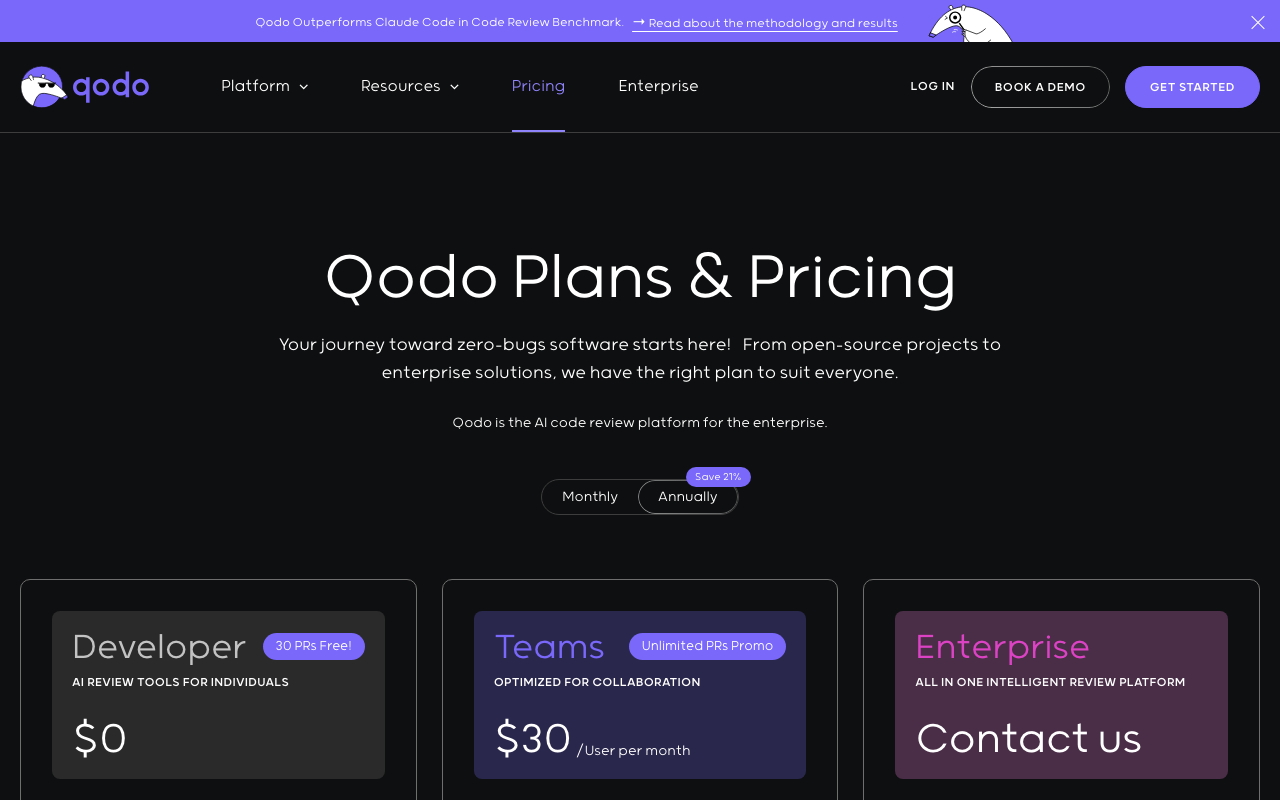
| Developer (Free) | $0 | 30 PR reviews, 250 IDE/CLI credits, community support |
| Teams | $30/user/month | Unlimited PR reviews (promo), 2,500 credits, no data retention |
| Enterprise | Custom | Context engine, SSO, air-gapped deployment, priority support |
GitHub Copilot pricing
| Plan | Price | Key features |
|---|---|---|
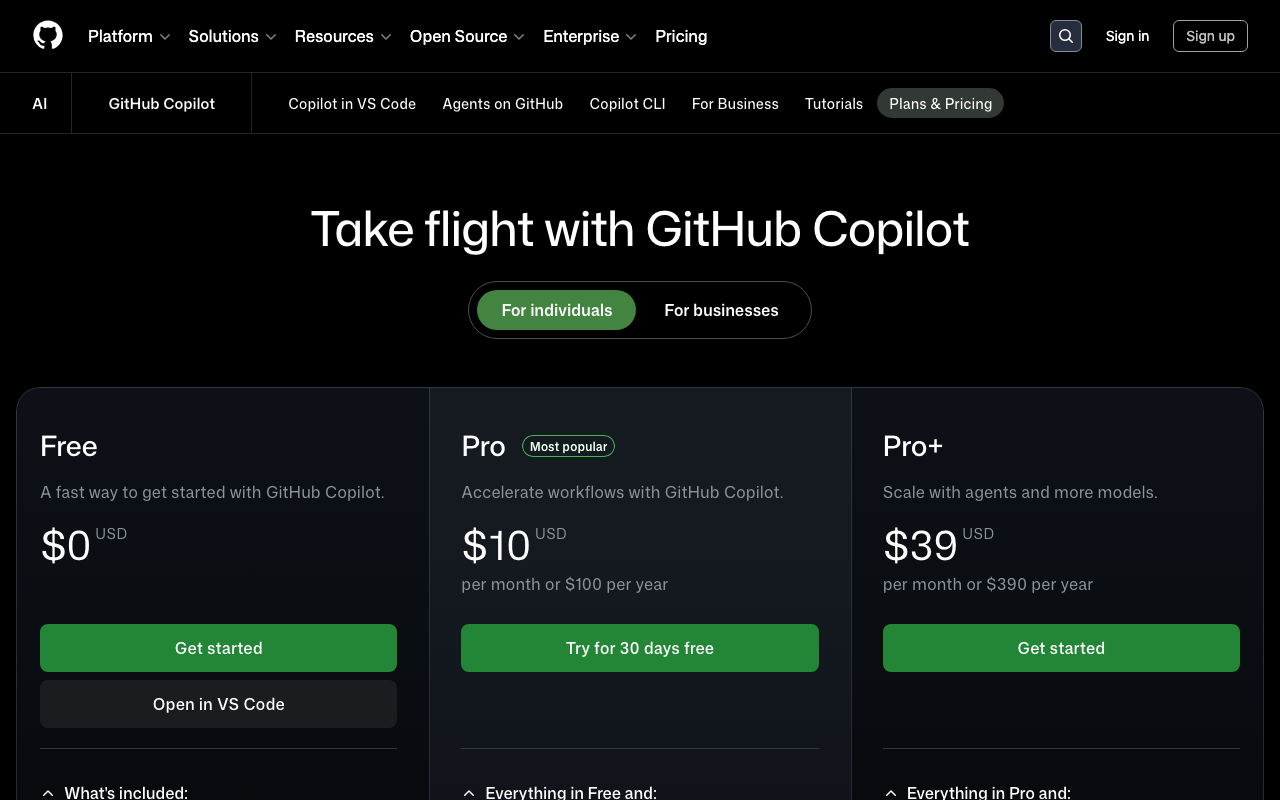
| Free | $0 | 2,000 completions, 50 premium requests/month |
| Pro | $10/month | Unlimited completions, 300 premium requests, code review |
| Pro+ | $39/month | 1,500 premium requests, all models |
| Business | $19/user/month | Admin controls, audit logs, IP indemnity |
| Enterprise | $39/user/month | Knowledge bases, custom models, SAML SSO |
Cost comparison by scenario
| Scenario | Copilot cost | Qodo cost | Notes |
|---|---|---|---|
| Solo dev, free | $0 | $0 | Different features - Copilot for completions, Qodo for review |
| Solo dev, paid | $10/month (Pro) | $30/month (Teams) | Copilot is 3x cheaper but lacks test generation |
| 10-person team | $190/month (Business) | $300/month (Teams) | Copilot is cheaper and broader; Qodo is deeper on review |
| Both tools, 10 people | $490/month total | Combined | Copilot Business + Qodo Teams for full coverage |
The pricing reflects the different positioning. Copilot is a broad platform at a competitive price. Qodo is a specialized tool at a premium that reflects its depth in code review and test generation. Teams that need both capabilities will often run both tools, accepting the combined cost as the price of covering the full workflow.
For detailed pricing analysis, see our posts on GitHub Copilot pricing and the Qodo tool review.
Use cases - when to choose each
Choose CodiumAI (Qodo) when
Test coverage is a team priority. If your organization measures and cares about test coverage, Qodo’s automated test generation is a capability no other tool in this comparison provides. It identifies untested paths, generates framework-appropriate tests, and integrates test suggestions into the PR review workflow. This is Qodo’s strongest use case and the reason many teams adopted CodiumAI in the first place.
You need deep, specialized code review. Qodo’s multi-agent review architecture was built specifically for code review depth. It analyzes PRs from multiple angles - quality, security, regression risk, complexity - and produces detailed inline feedback. If code review quality is more important to your team than having an AI that also writes code and answers questions, Qodo delivers more value per review.
Your team uses GitLab, Bitbucket, or Azure DevOps. Copilot’s code review works only on GitHub. If your repositories live on another platform, Qodo is one of the few AI review tools that supports all four major Git hosting services. This is often the deciding factor for organizations that are not on GitHub.
You want self-hosted or air-gapped deployment. Qodo’s Enterprise tier supports on-premises and air-gapped deployment. For regulated industries - financial services, healthcare, defense, government - this is a hard requirement that Copilot cannot satisfy for code review.
You value open-source transparency. Qodo’s review engine is built on PR-Agent, which is open source. You can inspect the review logic, self-host it, and customize it. Copilot is entirely proprietary.
Choose GitHub Copilot when
Code completion is your primary need. Copilot’s inline suggestions powered by frontier models are the best in the market for general-purpose code completion. If your developers measure productivity by how often they accept AI completions and how accurate those suggestions are, Copilot delivers the most value.
You want a single tool for the entire workflow. Code completion, multi-model chat, code review, PR summaries, and an autonomous coding agent under one subscription eliminates the need for multiple tools. If managing fewer vendor relationships matters to your organization, Copilot’s breadth is a major advantage.
Your team lives on GitHub. Copilot’s native integration with GitHub Issues, Pull Requests, and Actions creates a seamless workflow. The coding agent that autonomously works from Issues, the built-in PR review, and the knowledge bases that index your repositories all work best within the GitHub ecosystem.
Budget is a concern. Copilot Pro at $10/month or Business at $19/user/month is significantly cheaper than Qodo Teams at $30/month flat for up to 30 users, and Copilot covers more use cases at that price. If your team cannot justify spending on multiple AI tools, Copilot’s per-dollar feature coverage is hard to beat.
You need a coding agent. Copilot’s async coding agent can autonomously create branches, write code, run tests, and open PRs from issue descriptions. Qodo has no equivalent general-purpose coding agent. For teams that want to delegate routine implementation tasks to AI, this is a significant capability gap.
Alternatives to consider
The CodiumAI vs GitHub Copilot comparison does not cover every option. Several other tools deserve consideration depending on your priorities.
CodeRabbit is the closest direct competitor to Qodo for AI code review. It provides real-time PR review with auto-fixes, one-click suggestions, and learnable review profiles. CodeRabbit is strong on review automation but does not include Qodo’s test generation capability. See our Qodo vs CodeRabbit comparison for details.
Tabnine is the privacy-first AI coding assistant with on-premise, VPC, and air-gapped deployment options. Its models are trained exclusively on permissively licensed code. If data sovereignty is your primary concern for code completion, Tabnine is the strongest option. See our GitHub Copilot vs Tabnine comparison.
Sourcegraph Cody provides codebase-aware AI assistance with deep code graph understanding. It excels at questions that require understanding how code connects across a large codebase. Cody does not focus on PR review or test generation but is strong on contextual code understanding.
Greptile indexes your entire repository and reviews each pull request against that full-codebase context, which makes it strong at catching cross-file bugs and architectural problems rather than line-level style issues. It supports GitHub and GitLab. For teams that want review depth without Qodo’s test generation premium or Copilot’s all-in-one model, Greptile is worth evaluating.
For a broader overview, see our guide to the best AI code review tools and GitHub Copilot alternatives.
Final verdict
CodiumAI (Qodo) and GitHub Copilot are not truly competing for the same buyer. They overlap in the narrow space of AI-assisted code review, but their core value propositions target different needs entirely.
Qodo wins on review and testing depth. If your team’s priority is the deepest possible PR review combined with automated test generation - the two capabilities that originally defined CodiumAI - then Qodo is the purpose-built solution. Its multi-agent architecture produces more thorough reviews, its test generation is unmatched, and its support for GitHub, GitLab, Bitbucket, and Azure DevOps makes it the most platform-flexible review tool available. The open-source PR-Agent foundation adds transparency and self-hosting options that no proprietary tool can offer.
Copilot wins on breadth and integration. If your team wants a single AI platform that handles code completion, chat, code review, and autonomous task execution within the GitHub ecosystem, Copilot provides more capabilities per dollar than any competitor. At $10-19/user/month, it covers use cases that would require multiple separate tools to replicate.
The most productive setup for many teams is running both. Copilot handles real-time code completion and chat in the IDE. Qodo handles automated PR review and test generation after code is committed. There is no conflict because they operate at different stages of the workflow. The combined cost of approximately $49/user/month (Copilot Business plus Qodo Teams) is significant, but teams that adopt this approach report improvements in both coding speed and code quality.
If you must choose one, the decision comes down to your primary pain point. If your team writes code fast enough but struggles with review quality and test coverage, choose Qodo. If your team needs to write code faster and wants a general-purpose AI assistant, choose Copilot. If you are undecided, start with Copilot Pro at $10/month for its broader utility, then add Qodo’s free tier (30 PR reviews per month) to evaluate whether its review and testing depth justifies the additional investment.
For more comparisons involving these tools, see our posts on Qodo vs GitHub Copilot, Qodo vs CodeRabbit, and GitHub Copilot alternatives.
Frequently asked questions
Is CodiumAI the same as Qodo?
Yes. CodiumAI rebranded to Qodo in 2024. It is the same company, the same founding team, and the same core technology under a new name. The rebrand happened because the platform expanded beyond test generation and because the CodiumAI name caused confusion with Codium (VSCodium), an unrelated open-source VS Code fork. For the full story, see our post on the CodiumAI to Qodo rebrand.
Is CodiumAI better than GitHub Copilot for code review?
For dedicated code review, yes. Qodo’s multi-agent review architecture achieved the highest F1 score (60.1%) in comparative benchmarks across eight AI code review tools. GitHub Copilot includes code review as one feature within a broader platform, but it is not the tool’s primary focus. If your main goal is deep PR review with automated test generation, Qodo is the stronger choice.
Can CodiumAI (Qodo) generate tests automatically?
Yes. Automated test generation is one of Qodo’s defining capabilities. The IDE plugin’s /test command analyzes code, identifies edge cases, and produces complete unit tests in frameworks like Jest, pytest, JUnit, and Vitest. During PR review, Qodo identifies untested logic paths and suggests specific tests. Copilot can generate tests when prompted, but does not proactively detect coverage gaps.
Can GitHub Copilot generate unit tests?
GitHub Copilot can suggest test code through chat and completion when you explicitly ask. However, it does not autonomously analyze code behavior, identify untested paths, or generate tests as part of its review workflow. For proactive test coverage improvement, Qodo’s automated approach is more effective.
How much does CodiumAI (Qodo) cost compared to GitHub Copilot?
Qodo Teams costs $30/month flat for up to 30 users, not per seat. Copilot Pro is $10/month and Business is $19/user/month. Both have free tiers. Copilot is cheaper and broader. Qodo is more expensive but more specialized in review and testing. The right choice depends on whether you need a broad AI assistant or a deep code quality tool.
Does CodiumAI (Qodo) work with GitHub Copilot?
Yes. Many teams use both together. Copilot handles code completion and chat in the IDE. Qodo handles PR review and test generation after code is committed. They operate at different workflow stages and do not conflict.
Does CodiumAI (Qodo) support GitLab and Bitbucket?
Yes. Qodo supports GitHub, GitLab, Bitbucket, and Azure DevOps for PR review. Copilot’s code review works only on GitHub. For teams on non-GitHub platforms, Qodo is one of the few AI review tools available.
What is PR-Agent and how does it relate to CodiumAI?
PR-Agent is the open-source AI code review engine that CodiumAI built and published on GitHub. It is the technical foundation of Qodo’s commercial platform. Teams can self-host PR-Agent for free on GitHub, GitLab, Bitbucket, Azure DevOps, CodeCommit, and Gitea.
Which is better for enterprise teams?
Copilot Enterprise ($39/user/month) wins on breadth - code completion, chat, review, coding agent, knowledge bases, and SAML SSO. Qodo Enterprise wins on review depth, test generation, multi-platform Git support, and air-gapped deployment. Organizations on non-GitHub platforms must choose Qodo.
What happened to CodiumAI?
CodiumAI rebranded to Qodo in 2024. The company was not acquired or shut down. The rebrand reflected the platform’s expansion beyond test generation and resolved naming confusion with Codium (VSCodium). All products, technology, and team members carried over.
Is GitHub Copilot worth it over the free CodiumAI (Qodo) tier?
These tools serve different purposes. Copilot Pro at $10/month gives you code completion, chat, and a coding agent. Qodo’s free tier gives you 30 PR reviews and 250 credits for code review and test generation. They are not substitutes for each other - most teams benefit from using both.
What are alternatives to both CodiumAI and GitHub Copilot?
For AI code review, CodeRabbit and Greptile are strong alternatives. For AI coding assistants, Cursor and Tabnine are the main competitors. Each tool has different strengths depending on whether you prioritize review depth, code completion, privacy, or platform integration.
Further Reading
 Gitar
GitarComments are not enough
Gitar applies the fix, validates it in CI, and clears the queue.
See it on your repo Read our independent Gitar reviewFrequently Asked Questions
Is CodiumAI the same as Qodo?
Yes. CodiumAI rebranded to Qodo in 2024. It is the same company, the same founding team, and the same core technology under a new name. The rebrand happened because the company expanded beyond test generation into full-spectrum AI code quality - including agentic PR review, a CLI tool, and an enterprise context engine - and because the CodiumAI name caused persistent confusion with Codium (VSCodium), an unrelated open-source VS Code fork. All existing CodiumAI accounts and integrations were migrated automatically. If you search for CodiumAI today, you will find Qodo at qodo.ai.
Is CodiumAI better than GitHub Copilot for code review?
For dedicated code review, yes. Qodo (formerly CodiumAI) is a specialized code review and test generation platform. Its multi-agent review architecture achieved the highest F1 score (60.1%) in comparative benchmarks across eight AI code review tools. GitHub Copilot includes code review as one feature within a broader platform, but it is not the tool's primary focus. If your main goal is deep PR review with automated test generation, Qodo is the stronger choice. If you want an all-in-one AI coding assistant that also does code review, Copilot is more comprehensive.
Can CodiumAI (Qodo) generate tests automatically?
Yes. Automated test generation is one of Qodo's defining capabilities and what originally set CodiumAI apart from competitors. The IDE plugin's /test command analyzes selected code, identifies edge cases and error scenarios, and produces complete unit tests in frameworks like Jest, pytest, JUnit, and Vitest. During PR review, Qodo identifies untested logic paths and suggests tests for changes being reviewed. GitHub Copilot can generate tests when you prompt it through chat, but it does not proactively detect coverage gaps or generate tests as part of its review workflow.
Can GitHub Copilot generate unit tests?
GitHub Copilot can suggest test code through its chat and code completion features when you explicitly ask for tests. However, this is prompt-driven rather than proactive. You need to describe what you want tested, and Copilot generates a response. Qodo's approach is fundamentally different - it autonomously analyzes code behavior, identifies untested paths, and generates tests with meaningful assertions without requiring you to specify what to test. For teams that want AI to proactively improve test coverage, Qodo's automated approach is more effective.
How much does CodiumAI (Qodo) cost compared to GitHub Copilot?
Qodo's Teams plan costs $30/month flat for up to 30 users, not per seat (annual billing). Its free Developer tier includes 30 PR reviews and 250 IDE/CLI credits per month. GitHub Copilot costs $10/month for Pro, $19/user/month for Business, and $39/user/month for Enterprise. Both have free tiers. Copilot is cheaper per seat and covers more features - code completion, chat, code review, and a coding agent. Qodo is more expensive but more specialized in code review and test generation. The right choice depends on whether you need a broad AI assistant or a deep code quality tool.
Does CodiumAI (Qodo) work with GitHub Copilot?
Yes. Many teams use both tools together because they serve different parts of the workflow. Copilot handles real-time code completion and chat in the IDE while you write code. Qodo handles automated PR review and test generation after code is committed. There is no conflict because they operate at different stages. The combined cost for a team would be approximately $19/user/month for Copilot Business plus $30/month flat for up to 30 users for Qodo Teams, totaling $49/user/month per seat.
Does CodiumAI (Qodo) support GitLab and Bitbucket?
Yes. Qodo supports GitHub, GitLab, Bitbucket, and Azure DevOps for PR review, which is the broadest platform support among AI code review tools. Its open-source PR-Agent foundation also supports CodeCommit and Gitea. GitHub Copilot's code review works exclusively on GitHub. For teams on GitLab, Bitbucket, or Azure DevOps that need AI code review, Qodo is one of the strongest options available and Copilot is not an option at all for the review use case.
What is PR-Agent and how does it relate to CodiumAI?
PR-Agent is the open-source AI code review engine that CodiumAI built and published on GitHub. It is the technical foundation underlying Qodo's commercial platform. PR-Agent supports GitHub, GitLab, Bitbucket, Azure DevOps, CodeCommit, and Gitea, and can be self-hosted for free. Qodo builds on top of PR-Agent by adding enterprise features like the context engine, SSO, audit logging, and managed infrastructure. Teams that prefer self-hosting without a commercial subscription can use PR-Agent directly.
Which is better for enterprise teams - CodiumAI (Qodo) or GitHub Copilot?
It depends on your priorities. GitHub Copilot Enterprise ($39/user/month) wins on breadth - code completion, chat, code review, an autonomous coding agent, knowledge bases, and custom models within the GitHub ecosystem. Qodo Enterprise wins on depth of review and testing - multi-agent architecture, multi-repo context engine, air-gapped deployment, SSO, and a dedicated SLA. Organizations on non-GitHub platforms must choose Qodo. Organizations that want the deepest possible review and test generation should choose Qodo. Organizations that want a comprehensive AI coding platform should choose Copilot.
What happened to CodiumAI?
CodiumAI rebranded to Qodo in 2024. The company was not acquired, discontinued, or shut down. The rebrand was driven by two factors: the platform had expanded far beyond its original test generation focus into agentic PR review, CLI workflows, and enterprise tooling, and the CodiumAI name caused confusion with Codium (VSCodium), an unrelated open-source VS Code fork. All products, technology, and team members carried over. For the full story, see our post on the CodiumAI to Qodo rebrand.
Is GitHub Copilot worth it over the free CodiumAI (Qodo) tier?
These tools serve different purposes, so the comparison is not direct. Copilot Pro at $10/month gives you unlimited code completions, multi-model chat, a coding agent, and code review. Qodo's free tier gives you 30 PR reviews and 250 IDE/CLI credits per month for code review and test generation specifically. If you primarily need code completion and chat, Copilot Pro is worth the investment and Qodo's free tier will not replace it. If you primarily need code review and test generation, Qodo's free tier may be sufficient for a solo developer.
What are alternatives to both CodiumAI and GitHub Copilot?
For AI code review specifically, CodeRabbit is a strong alternative with real-time PR review and auto-fixes. Greptile offers repository-wide AI code review that reasons across files. Sourcegraph Cody provides codebase-aware AI assistance. For AI coding assistants, Cursor is the leading AI-native IDE with multi-file editing, and Tabnine offers privacy-first AI completions with on-premise deployment. Each tool has different strengths depending on whether you prioritize code review, code completion, privacy, or platform integration.
Should I switch from CodiumAI to GitHub Copilot?
Do not think of it as switching - these tools solve different problems and can run together. If you were using CodiumAI primarily for test generation and PR review, switching to Copilot would mean losing those specialized capabilities. Copilot's code review is improving but does not match Qodo's depth, and Copilot has no automated test generation equivalent. If you were using CodiumAI's IDE extension only for code completion, Copilot is the better choice for that specific use case. The most productive approach for many teams is running both: Copilot for code completion and chat, Qodo for review and testing.
Explore More
Tool Reviews
 Qodo Review
 GitHub Copilot Code Review Review
 Greptile Review
Free Newsletter
Stay ahead with AI dev tools
Weekly insights on AI code review, static analysis, and developer productivity. No spam, unsubscribe anytime.
Join developers getting weekly AI tool insights.
Related Articles
CodeRabbit vs Qodo: AI Code Review Tools Compared (2026)
CodeRabbit vs Qodo - we compare pricing, features, test generation, and review quality so you can pick the right AI reviewer for your team.
February 21, 2026
comparisonWhat Happened to CodiumAI? The Rebrand to Qodo Explained
CodiumAI rebranded to Qodo in 2024. Here's what changed, what stayed the same, and what it means for existing users and new buyers.
February 22, 2026
comparisonGitar vs Qodo: Workflow Automation or Test Generation?
Gitar vs Qodo compared on review architecture, test generation, self-hosting, migrations, CI ownership, and pricing. Which AI code quality platform fits your team.
August 12, 2026