Qodo vs CodeRabbit: AI Code Review Tools Compared (2026)
Qodo vs CodeRabbit - detailed comparison of pricing, review accuracy, test generation, platform support, and which tool is right for your team in 2026.
Published:
Last Updated:
Quick Verdict
Qodo and CodeRabbit are two of the strongest dedicated AI code review tools in 2026, and the choice between them is genuinely consequential - they make different tradeoffs that matter at scale.
Choose Qodo if: automated test generation is a priority, you need air-gapped or on-premises deployment without Enterprise pricing, you want the highest benchmark F1 score, or you use self-hosted Git infrastructure via PR-Agent.
Choose CodeRabbit if: you want the most affordable paid tier ($24/user/month vs $30/user/month), the most generous free plan for private repositories, natural language review configuration via .coderabbit.yaml, 40+ deterministic linters bundled with AI review, or the widest adoption and community support.
The key difference in practice: When Qodo finds an untested code path during review, it generates the unit tests. When CodeRabbit finds the same gap, it posts a comment describing what to test. Both tools are good at finding bugs. Only Qodo closes the loop automatically with generated tests.
This comparison covers review quality, test generation, pricing at every team size, platform support, enterprise security, configuration flexibility, and the exact scenarios where each tool wins.
At-a-Glance Comparison
| Feature | Qodo | CodeRabbit |
|---|---|---|
| Primary focus | AI code review + test generation | Dedicated AI code review |
| Benchmark F1 score | 60.1% (highest among 8 tools) | ~44% bug catch rate |
| Test generation | Yes - proactive, coverage-gap detection | No |
| Built-in linters | No dedicated linting layer | 40+ (ESLint, Pylint, Golint, etc.) |
| Free tier | 30 PR reviews + 250 credits/month | Unlimited public/private repos (rate-limited) |
| Pro/Teams pricing | $30/user/month | $24/user/month |
| Lite pricing | No equivalent | $12/user/month |
| Enterprise pricing | Custom | ~$30/user/month |
| GitHub support | Full | Full |
| GitLab support | Full | Full |
| Bitbucket support | Full | Full |
| Azure DevOps support | Full | Full |
| IDE extension | VS Code, JetBrains (review + test gen) | VS Code, Cursor, Windsurf (review) |
| Open-source core | Yes - PR-Agent on GitHub | No |
| Air-gapped deployment | Yes (Enterprise) | No |
| Self-hosted | Yes (Enterprise + open-source PR-Agent) | Yes (Enterprise only) |
| Natural language config | Yes (custom review instructions) | Yes - .coderabbit.yaml |
| Auto-fix suggestions | Limited | Yes - one-click commit |
| SOC 2 compliance | Yes | Yes (Type II) |
| Multi-repo context engine | Yes (Enterprise) | No |
| Jira/Linear integration | Yes | Yes (Pro+) |
| Slack integration | No | Yes (Pro+) |
| Learning from feedback | Limited | Yes - calibrates over time |
| Gartner recognition | Visionary (AI Code Assistants, 2025) | Strong peer reviews |
What Is Qodo?
Qodo (formerly CodiumAI) is an AI code quality platform that uniquely combines automated PR code review with test generation. Founded in 2022 by Itamar Friedman and Dedy Kredo, the company rebranded from CodiumAI to Qodo in 2024 as it expanded beyond its original test generation focus into a full-spectrum quality platform. Qodo raised $40 million in Series A funding and was recognized as a Visionary in the Gartner Magic Quadrant for AI Code Assistants in 2025 - institutional validation that few competitors can claim.
The February 2026 release of Qodo 2.0 was a genuine architectural shift. Rather than a single AI pass over a pull request diff, Qodo 2.0 deploys multiple specialized agents that work simultaneously: one agent for bug detection, one for code quality and maintainability, one for security analysis, and one for test coverage gap identification. This multi-agent collaboration achieved the highest overall F1 score (60.1%) in comparative benchmarks across eight AI code review tools, with a recall rate of 56.7% - meaning Qodo finds proportionally more real issues than any other tested solution.
The Qodo platform spans four components:
- Git plugin for automated PR reviews across GitHub, GitLab, Bitbucket, and Azure DevOps
- IDE plugin for VS Code and JetBrains, providing local review and on-demand test generation via the
/testcommand - CLI plugin for terminal-based quality workflows and CI/CD integration
- Context engine (Enterprise) for multi-repo intelligence that understands cross-service dependencies
The open-source PR-Agent foundation distinguishes Qodo from every proprietary competitor. Teams can inspect the review logic, self-host the core engine, and deploy in air-gapped environments where code never leaves their own infrastructure. For regulated industries - finance, healthcare, government, defense - this is often a non-negotiable requirement.
Key strengths:
- Highest benchmark F1 score of 60.1% among tested tools - Qodo 2.0’s multi-agent architecture finds more real issues
- Proactive test generation - no other tool automatically generates unit tests for coverage gaps found during review
- Open-source core via PR-Agent - inspect, fork, and self-host the review engine
- Air-gapped Enterprise deployment - code never leaves your infrastructure
- Broadest platform foundation - PR-Agent extends support to CodeCommit and Gitea beyond the standard four platforms
- Multi-repo context engine (Enterprise) - cross-service dependency awareness for microservice architectures
Limitations to consider:
- Higher per-user cost at $30/user/month vs CodeRabbit’s $24/user/month
- No built-in deterministic linting layer - relies on AI analysis without CodeRabbit’s 40+ bundled linters
- Limited learning from developer interactions - does not calibrate to team preferences as effectively as CodeRabbit
- Credit system complexity - premium models consume IDE/CLI credits faster than expected
- Free tier reduction - the previous 75 PR reviews/month was cut to 30, which is tighter for small teams
What Is CodeRabbit?
CodeRabbit is the most widely deployed dedicated AI code review tool in 2026, with over 2 million connected repositories and 13 million pull requests reviewed. It focuses exclusively on PR review without attempting to cover test generation or code completion - a deliberate specialization that allows it to go deep on the specific problem of automated code review. Over 500,000 developers and 9,000+ organizations use CodeRabbit, including a large open-source community that relies on the generous free tier.
What sets CodeRabbit apart from most AI review tools is the combination of AI-powered semantic analysis and 40+ deterministic linters. The AI engine analyzes the diff in context of the full repository, understanding callers, callees, shared types, and configuration files. The linting layer simultaneously runs ESLint, Pylint, Golint, RuboCop, and dozens of other framework-specific linters for zero-false-positive checks on style, naming, and known anti-patterns. This layered approach catches both subtle logic issues (AI) and concrete rule violations (linters) in a single review pass.
CodeRabbit’s natural language configuration via .coderabbit.yaml is one of the most accessible customization systems in the category. Teams write review instructions in plain English - no DSL, no regex, no complex rule files. Those instructions are version-controlled, self-documenting, and editable by engineers of any experience level. Combined with a learning feedback loop that calibrates to team preferences over time, CodeRabbit becomes more useful the longer it is deployed.
Key strengths:
- Most widely adopted - 2M+ connected repos, 13M+ PRs reviewed, battle-tested at scale
- Lower per-user cost at $24/user/month for Pro vs Qodo’s $30/user/month Teams
- Most generous free tier - unlimited public and private repos with full AI review features (rate-limited)
- 40+ built-in linters - deterministic zero-false-positive checks alongside AI analysis
- Natural language config -
.coderabbit.yamlwith plain-English review instructions - Learning feedback loop - calibrates review behavior to team preferences through developer interactions
- Auto-fix suggestions - one-click commit of AI-suggested fixes directly from the PR interface
- Jira and Linear integration - validates implementations against linked ticket requirements
- Slack notifications - built-in on Pro plan
Limitations to consider:
- No test generation - CodeRabbit posts comments identifying test gaps but does not generate the tests
- Lower benchmark recall - ~44% bug catch rate in testing vs Qodo’s 60.1% F1 score
- Verbosity on large PRs - can generate overwhelming numbers of comments without careful tuning
- Self-hosted requires Enterprise - Qodo’s open-source PR-Agent allows self-hosting without an Enterprise contract
- Support criticism - multiple users report difficulty reaching human support on lower tiers
Feature-by-Feature Deep Dive
Review Depth and Accuracy
This is the dimension where benchmark data most clearly separates the two tools, and the results favor Qodo.
Qodo 2.0’s multi-agent architecture was directly designed to improve this metric. By deploying specialized agents simultaneously rather than a single generalist AI pass, Qodo achieved an F1 score of 60.1% in comparative benchmarks across eight tools - the highest result, outperforming the next best solution by 9 percentage points. The recall rate of 56.7% means Qodo finds more real bugs per review than any other tested tool.
CodeRabbit’s review quality is strong in absolute terms but scores lower in direct comparison. In a 2026 independent evaluation of 309 pull requests, CodeRabbit scored 1 out of 5 on completeness and 2 out of 5 on depth - meaning it reliably catches syntax errors, security patterns, and style violations but more frequently misses intent mismatches, cross-service dependencies, and subtle logic errors. Its measured bug catch rate of approximately 44% is notably lower than Qodo’s 60.1% F1 score.
The practical quality gap by review type:
| Review dimension | Qodo 2.0 | CodeRabbit |
|---|---|---|
| Bug detection recall | 56.7% (benchmark highest) | ~44% catch rate |
| Security vulnerability detection | Multi-agent - strong cross-file tracing | Strong - AI + 40+ linters layered |
| Logic error identification | Strong - multi-agent collaboration | Moderate - single AI pass |
| Code style and convention checks | AI-based, configurable | Deterministic linters + AI - more reliable |
| Cross-file dependency analysis | Strong - context engine | Good - full-repo context |
| Race condition detection | Moderate | Moderate |
| Missing error handling | Strong | Strong |
| False positive risk | Lower (multi-agent precision) | Higher on large PRs (verbosity) |
However, the quality comparison is not purely one-directional. CodeRabbit’s 40+ bundled linters provide a deterministic check layer that Qodo does not have. For style consistency, naming conventions, and known anti-patterns that should never appear in production code, linters provide zero-false-positive certainty that AI alone cannot match. The practical effect: CodeRabbit is less likely to miss a simple ESLint rule violation. Qodo is more likely to find a subtle logic bug that spans multiple files.
For teams whose biggest review quality concern is catching subtle bugs and architectural issues, Qodo’s benchmark advantage is meaningful. For teams whose biggest concern is consistent enforcement of coding standards and style rules, CodeRabbit’s linting layer adds reliable value.
Test Generation - Qodo’s Defining Advantage
Test generation is the functional difference that most clearly separates Qodo from CodeRabbit, and it has no equivalent in CodeRabbit at all.
When Qodo reviews a PR and identifies a function without adequate test coverage, it does not just comment “consider adding tests for this.” It generates the tests - complete unit test files with meaningful assertions, edge case coverage, and error scenario handling, in your project’s testing framework.
The generation process works as follows:
- Qodo’s coverage-gap agent identifies code paths in the diff that lack corresponding tests
- It analyzes the function signature, parameter types, return values, and control flow
- It produces tests for the happy path, error paths, boundary conditions, and edge cases specific to the code’s domain
- The generated tests appear as PR suggestions or in the IDE via the
/testcommand, ready to review and commit
What Qodo Cover generates for a typical function:
- Valid input with expected output (happy path)
- Null and undefined input handling
- Empty string / empty array / zero value edge cases
- Boundary values (minimum, maximum, off-by-one)
- Type mismatch inputs
- Domain-specific edge cases (for financial functions: negative values, rounding behavior; for auth functions: expired tokens, revoked credentials)
These are not placeholder tests with // TODO: implement. They contain real assertions that would fail if the code were broken.
Realistic quality assessment by code complexity:
| Code type | Test generation quality | Editing time typically needed |
|---|---|---|
| Simple utility functions | High - often usable as-is | 5-10 minutes |
| Data transformation and mapping logic | Good - correct structure, minor value tweaks | 10-15 minutes |
| Business logic with multiple branches | Moderate - covers main paths, may miss domain nuances | 15-25 minutes |
| Code with external service dependencies | Fair - mocking setup often needs manual adjustment | 20-35 minutes |
| Complex async or concurrent code | Variable - timing edge cases may be missed | 30+ minutes |
The time savings are material even when tests need editing. Writing a unit test from scratch for a moderately complex function takes 30-45 minutes. Editing a Qodo-generated test takes 10-20 minutes. Over a sprint with 20+ functions changed, the cumulative savings run to hours.
CodeRabbit’s response to test coverage gaps is a review comment pointing out the gap and suggesting what to test. This is useful documentation but requires a developer to act on it manually. For teams with test coverage as a known pain point, the difference between a comment and an actual generated test is the difference between acknowledging a problem and making progress on it.
If your team has solid test coverage (above 70-80%) and disciplined testing practices, this advantage is smaller - Qodo Cover adds incremental value. If your team is staring at 30-50% coverage with a backlog of “write tests” tickets that never get prioritized, Qodo’s test generation is a fundamentally different capability than anything CodeRabbit offers.
Platform and Integration Support
Both Qodo and CodeRabbit support all four major Git hosting platforms, which means platform coverage is not a meaningful differentiator between these two specific tools.
| Platform | Qodo | CodeRabbit |
|---|---|---|
| GitHub | Full support | Full support |
| GitLab | Full support | Full support |
| Bitbucket | Full support | Full support |
| Azure DevOps | Full support | Full support |
| CodeCommit | Via open-source PR-Agent | No |
| Gitea | Via open-source PR-Agent | No |
For teams on CodeCommit or Gitea, Qodo’s open-source PR-Agent extends support that CodeRabbit cannot match. For the vast majority of teams on the standard four platforms, both tools work equally well.
Where integration differences do matter:
- Jira and Linear - both tools integrate for ticket validation during review, but CodeRabbit links ticket requirements to implementation accuracy more explicitly on its Pro plan
- Slack - CodeRabbit includes Slack notifications on its Pro plan; Qodo does not have a native Slack integration
- IDE support - Qodo’s IDE plugin for VS Code and JetBrains includes test generation; CodeRabbit’s VS Code/Cursor/Windsurf extension focuses on pre-PR review only
- CI/CD - both tools work alongside existing pipelines; Qodo’s CLI plugin enables terminal-based quality workflows that CodeRabbit does not offer
Configuration and Customization
CodeRabbit’s natural language configuration is the most accessible system in the AI code review category.
Teams write review instructions in plain English in a version-controlled .coderabbit.yaml file:
# .coderabbit.yaml
reviews:
  instructions:
    - "Flag any API endpoint missing rate limiting"
    - "Warn when database queries are executed inside loops"
    - "Require error boundaries around all async operations"
    - "Check that user-facing strings use the i18n translation helper"
    - "Flag direct DOM manipulation in React components"
    - "Ensure all new environment variables have fallback defaults"
    - "Verify payment-related functions use Decimal, never float"
These instructions are self-documenting - a new team member reads the file and immediately understands team conventions. They are version-controlled, so changes to review standards go through the standard PR process. They require no DSL, no regex knowledge, and no complex configuration syntax.
CodeRabbit also learns from developer interactions. When a developer dismisses a comment type, or asks for a different framing, CodeRabbit calibrates. Over weeks of use, the tool’s feedback becomes more aligned with team preferences without requiring explicit configuration updates.
Qodo’s custom review instructions are configured through PR-Agent settings and applied alongside the built-in multi-agent analysis. Teams can define project-specific standards, security requirements, and architectural guidelines. The configuration is functional and meaningful but operates as structured settings rather than natural language instructions, making it somewhat less flexible for expressing nuanced, domain-specific conventions.
For teams with standard coding practices, Qodo’s configuration is adequate. For teams with domain-specific conventions that are hard to express in toggle-based settings, CodeRabbit’s natural language approach has a practical advantage.
Pricing Comparison
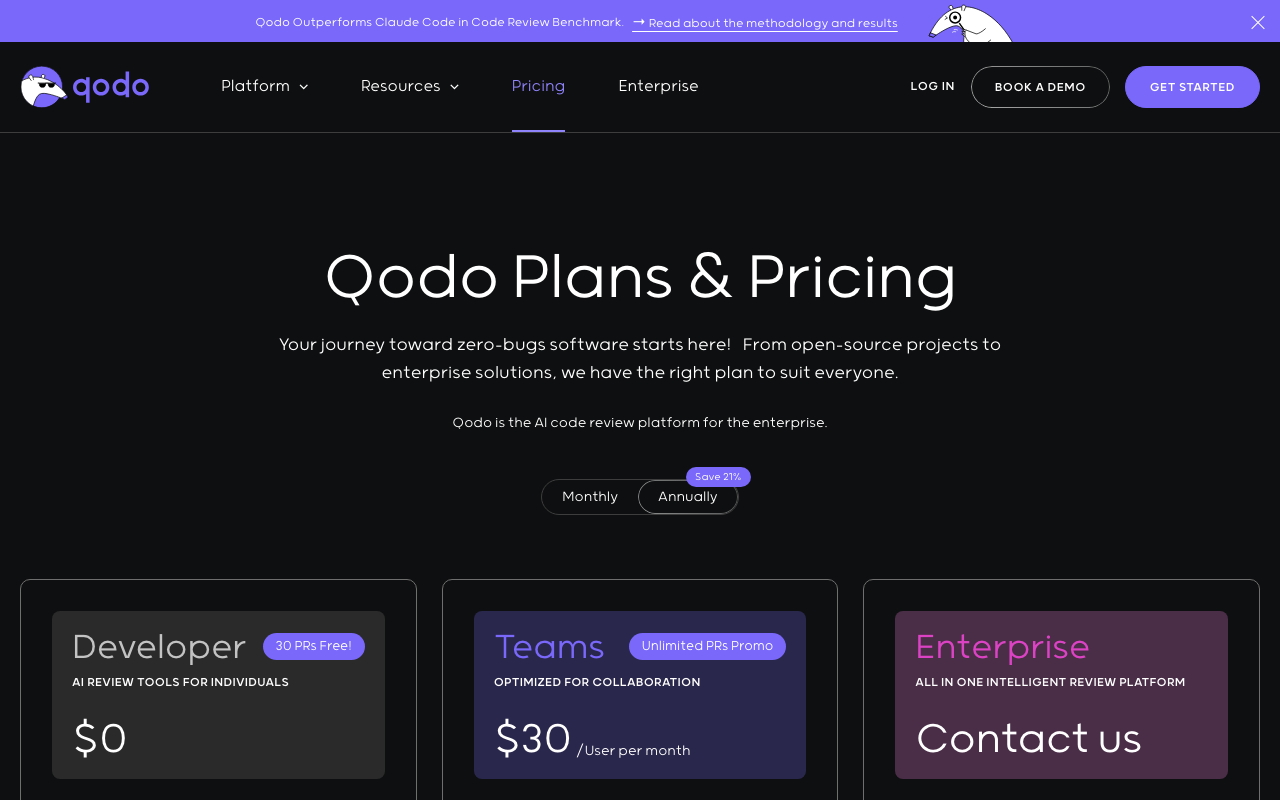
CodeRabbit is less expensive at every comparable tier.
| Plan | Qodo | CodeRabbit |
|---|---|---|
| Free tier | 30 PR reviews + 250 credits/month | Unlimited repos, rate-limited (4 reviews/hour) |
| Entry paid tier | $30/user/month (Teams) | $12/user/month (Lite) |
| Full-featured tier | $30/user/month (Teams) | $24/user/month (Pro) |
| Enterprise | Custom | ~$30/user/month (500+ user minimum) |
| Annual vs monthly savings | ~21% savings on annual | ~20% savings on annual |
| Free trial | Free tier available | 14-day Pro trial, no credit card |
Annual cost comparison by team size:
| Team size | Qodo Teams (annual) | CodeRabbit Pro (annual) | Annual savings with CodeRabbit |
|---|---|---|---|
| 5 engineers | $1,800/year | $1,440/year | $360 |
| 10 engineers | $3,600/year | $2,880/year | $720 |
| 25 engineers | $9,000/year | $7,200/year | $1,800 |
| 50 engineers | $18,000/year | $14,400/year | $3,600 |
| 100 engineers | $36,000/year | $28,800/year | $7,200 |
Important nuances on the pricing comparison:
Qodo’s $30/user/month Teams plan bundles both PR review and test generation. If you compare Qodo to a hypothetical combination of CodeRabbit ($24/user/month) plus a separate test generation tool, the pricing gap narrows or reverses depending on what test generation tool you would otherwise need. Qodo’s pricing makes more sense when valued as a bundled platform rather than compared to CodeRabbit alone.
CodeRabbit also offers a Lite tier at $12/user/month that Qodo has no equivalent to. For teams that need more than the free tier’s rate limits but do not need the full Pro feature set, CodeRabbit’s Lite plan is a meaningful intermediate step.
Qodo’s credit system adds complexity to the free and Teams tiers. Standard IDE and CLI operations cost 1 credit each, but premium models cost significantly more: Claude Opus 4 costs 5 credits per request, Grok 4 costs 4 credits per request. The 250 credits/month on the free tier and 2,500 credits/month on Teams can run out faster than expected if your team uses premium models regularly. Credits reset on a rolling 30-day schedule from first use, not on a calendar month - which adds further unpredictability.
For detailed CodeRabbit pricing breakdowns including ROI calculations, see our CodeRabbit pricing guide.
Developer Experience
CodeRabbit is designed for minimal setup friction. Install the GitHub App (or GitLab/Bitbucket/Azure DevOps equivalent), authorize repository access, and reviews begin on the next PR automatically. No indexing step, no per-developer configuration, no build system changes. Setup typically takes under five minutes.
The review interaction model is polished. Comments appear inline on the PR exactly where a human reviewer would leave them. Developers reply using @coderabbitai in natural language - asking for clarifications, requesting alternative implementations, or explaining why a flagged pattern is intentional. One-click fix suggestions let developers accept AI-suggested fixes directly from the PR interface without switching to an IDE.
Qodo’s developer experience spans the PR and the IDE, which creates more touchpoints but also more workflow integration. The PR review experience is comparable to CodeRabbit in structure - inline comments with explanations and a PR summary and walkthrough. The IDE plugin for VS Code and JetBrains is where Qodo adds experience depth that CodeRabbit does not attempt: in-editor test generation via /test, local code review before committing, and AI-assisted suggestions while actively writing code.
The CLI plugin adds a third touchpoint for teams that prefer terminal-based workflows, enabling quality enforcement without leaving the command line.
One experience difference worth noting: Qodo’s free tier credit reset (rolling 30 days from first use) is less predictable than CodeRabbit’s rate-limit model (4 reviews per hour). Teams on Qodo’s free tier can hit credit limits unexpectedly mid-cycle, while CodeRabbit’s rate limits are more transparent - you know exactly how many reviews you can run per hour.
Security and Compliance
Both tools are enterprise-ready from a compliance perspective, but with meaningful differences for the most security-sensitive deployments.
| Security feature | Qodo | CodeRabbit |
|---|---|---|
| SOC 2 compliance | Yes | Type II |
| Code storage | Not stored after analysis | Not stored after analysis |
| Air-gapped deployment | Yes (Enterprise) | No |
| Self-hosted | Yes (Enterprise + PR-Agent) | Enterprise only |
| SSO/SAML | Enterprise plan | Enterprise plan |
| Audit logs | Enterprise plan | Enterprise plan |
| Custom AI models | Yes (multiple including local via Ollama) | Yes (Enterprise) |
| Training on customer code | No - opt-out by default | No - opt-out by default |
| Open-source core for auditability | Yes - PR-Agent | No |
The critical difference for regulated industries is air-gapped deployment. CodeRabbit’s self-hosted option requires the Enterprise plan with a 500+ seat minimum and starting prices around $15,000/month. Qodo’s Enterprise air-gapped deployment also requires an Enterprise contract, but Qodo’s open-source PR-Agent allows teams to self-host the core review engine without an Enterprise contract at all - a significant advantage for smaller organizations in regulated industries that need full data sovereignty without the Enterprise price tag.
For financial services firms, healthcare organizations, government agencies, and defense contractors where code cannot leave the organization’s infrastructure, Qodo’s air-gapped Enterprise plus the self-hostable PR-Agent option represents a more accessible path than CodeRabbit’s Enterprise-only self-hosting.
When to Choose Qodo
Choose Qodo in these scenarios:
Your team has significant test coverage debt and wants AI to close the gap. If you have been saying “we need better test coverage” for months without meaningful progress, Qodo Cover’s proactive test generation addresses the problem directly. No other tool in the category - including CodeRabbit - generates tests automatically as part of the review workflow. If your coverage is below 50% and the “write tests” tickets are not getting prioritized, Qodo is purpose-built for this problem.
You need air-gapped or self-hosted deployment without paying Enterprise pricing. The open-source PR-Agent allows any team to self-host Qodo’s core review engine with zero vendor dependency. For organizations with data sovereignty requirements that cannot justify the Enterprise minimum commitment, this is often the decisive factor.
You want the highest benchmark review accuracy. Qodo 2.0’s 60.1% F1 score and 56.7% recall rate represent the current best among tested tools. If your codebase handles security-sensitive logic, financial calculations, or complex concurrent systems where missing a bug in review carries real cost, the benchmark advantage is meaningful.
You use CodeCommit, Gitea, or need Git hosting platform flexibility. PR-Agent’s extended platform support covers hosting environments that neither CodeRabbit nor most other AI review tools reach.
You want a multi-component platform under one subscription. PR review, test generation, IDE plugin, and CLI tool under one $30/user/month plan simplifies vendor management compared to purchasing separate tools for each capability.
You need a multi-repo context engine. On the Enterprise plan, Qodo’s context engine builds awareness across services for microservice architectures where cross-repo dependency changes matter.
For a broader look at how Qodo compares to the full market, see our analysis in best AI code review tools and our Qodo vs GitHub Copilot comparison.
When to Choose CodeRabbit
Choose CodeRabbit in these scenarios:
Price efficiency is important. At $24/user/month (Pro) vs Qodo’s $30/user/month (Teams), CodeRabbit costs 20% less per seat. For a 50-person team, that is $3,600/year in savings. The Lite tier at $12/user/month has no Qodo equivalent, making CodeRabbit accessible at intermediate budget levels.
You want the most generous free tier for private repositories. CodeRabbit’s free plan covers unlimited public and private repositories with full AI review features (rate-limited). Qodo’s free tier provides 30 reviews per month. For teams evaluating tools or small teams with modest PR volume, CodeRabbit’s free tier goes further.
Deterministic linting coverage matters alongside AI review. CodeRabbit’s 40+ bundled linters run alongside the AI analysis, providing zero-false-positive enforcement of style rules, naming conventions, and known anti-patterns. For teams that want coding standards enforced consistently without relying purely on probabilistic AI, this deterministic layer is a meaningful addition.
You want a review tool that learns your team’s preferences. CodeRabbit’s feedback-driven calibration means the tool gets measurably better over weeks of use as it learns which comment types your team values and which it dismisses. Qodo’s learning loop is less developed.
You value natural language configuration over structured settings. Writing review rules as plain English in .coderabbit.yaml is more accessible and more expressive than toggle-based configuration. Teams with complex, domain-specific conventions benefit from CodeRabbit’s approach.
You want auto-fix suggestions with one-click commit. CodeRabbit provides AI-generated fix suggestions that can be committed directly from the PR interface. Qodo’s review comments are more observational and require manual implementation of suggested changes.
Your test coverage is already solid. If your team maintains 70%+ coverage and has strong testing practices, Qodo’s primary differentiator provides less marginal value. CodeRabbit delivers better-priced review for teams where test generation is not the bottleneck.
For context on what alternatives exist beyond these two tools, see our CodeRabbit alternatives guide and best AI code review tools roundup.
Use Case Decision Matrix
| Scenario | Recommended Tool | Primary Reason |
|---|---|---|
| Team with low test coverage (under 50%) | Qodo | Automated test generation directly addresses the gap |
| Open-source project maintainer | CodeRabbit | Free unlimited public repo access |
| Budget-constrained team | CodeRabbit | $24/user/month vs $30/user/month, plus Lite at $12 |
| Regulated industry with air-gap requirement | Qodo | Air-gapped Enterprise + self-hostable PR-Agent |
| Highest benchmark review accuracy | Qodo | 60.1% F1 score vs ~44% catch rate |
| Deterministic linting enforcement | CodeRabbit | 40+ linters bundled at no extra cost |
| Natural language config customization | CodeRabbit | Plain-English .coderabbit.yaml instructions |
| Multi-repo microservice architecture | Qodo | Enterprise context engine for cross-repo analysis |
| Teams already at 70%+ test coverage | CodeRabbit | Test generation less critical, CodeRabbit cheaper |
| Fast evaluation/POC with private repos | CodeRabbit | Unlimited private repos on free tier |
| IDE-based test generation while coding | Qodo | VS Code/JetBrains plugin with /test command |
| Auto-fix suggestions in PR | CodeRabbit | One-click commit of AI-generated fixes |
| Learning tool that adapts over time | CodeRabbit | Feedback-driven calibration to team preferences |
| Teams using CodeCommit or Gitea | Qodo | PR-Agent extends to non-standard platforms |
| Enterprise on Azure DevOps | Either | Both tools support Azure DevOps equally |
Head-to-Head: Scenarios That Reveal the Difference
Scenario 1: A developer opens a PR adding a new payment processing function.
Qodo identifies that the function handles float arithmetic instead of Decimal types (if that rule is configured), detects three code paths lacking test coverage, and generates unit tests for positive amounts, negative amounts, zero, and invalid inputs - plus flags the float issue as a security-sensitive concern. The developer merges with both a code fix and new tests.
CodeRabbit identifies the same float issue (via both AI and potentially a linter rule), posts a comment explaining why Decimal is necessary for financial calculations, and suggests the developer add tests for the identified edge cases. The code fix is addressed; the tests go on the backlog.
Scenario 2: A team evaluating tools before paying any money.
CodeRabbit is installed on all private repositories in under five minutes, no credit card required, with full AI review features (rate-limited). The team can evaluate real review quality across unlimited PRs until they hit the hourly rate limit.
Qodo’s free tier allows 30 PR reviews per month - enough for thorough evaluation of review quality and test generation, but tighter if the team is running many small PRs during evaluation.
Scenario 3: An organization in financial services needing on-premises deployment.
Qodo’s Enterprise plan offers air-gapped deployment. The open-source PR-Agent also allows self-hosting the core review engine without an Enterprise contract. Code never leaves the organization’s infrastructure.
CodeRabbit requires the Enterprise plan for self-hosting, with a 500+ seat minimum and starting prices around $15,000/month. For smaller regulated-industry teams, this minimum creates a significant barrier.
Scenario 4: A team wants to enforce that all database queries use parameterized inputs.
CodeRabbit adds one line to .coderabbit.yaml: “Flag any database query that does not use parameterized input.” Every future PR is checked against this rule in plain English, exactly as stated.
Qodo configures a custom review instruction through its settings, which is functional but expressed as structured configuration rather than natural language. Both approaches work; CodeRabbit’s is more accessible for non-senior engineers who did not write the original rule.
Alternatives to Consider
If neither Qodo nor CodeRabbit is the right fit, several alternatives address specific needs.
Greptile takes a fundamentally different approach by indexing your entire codebase upfront and using full-codebase context for every review. In independent benchmarks, Greptile achieved an 82% bug catch rate - significantly higher than both Qodo’s 60.1% F1 and CodeRabbit’s ~44% catch rate. The tradeoff: Greptile only supports GitHub and GitLab, has no free tier, and offers no test generation. For teams on GitHub or GitLab that prioritize absolute review depth above all else and do not need test generation, Greptile is the strongest alternative.
GitHub Copilot code review is part of the Copilot platform at $19/user/month (Business), which also includes code completion, chat, and an autonomous coding agent. For GitHub-only teams that want a single AI platform across the full development workflow, Copilot’s bundled value at $19/user/month is compelling. It does not offer test generation in the same automated way as Qodo, and review depth benchmarks below Qodo 2.0.
Sourcery focuses on Python-first code quality with strong refactoring suggestions. At $24/user/month, it matches CodeRabbit Pro pricing while covering fewer languages. For Python-heavy teams wanting deep refactoring analysis, Sourcery is a niche option worth evaluating.
SonarQube and Codacy are rule-based static analysis platforms with strong multi-language support. They complement rather than replace AI code review - many teams run SonarQube for deterministic quality gates and either Qodo or CodeRabbit for contextual AI review. If your team needs SAST capabilities alongside code review, adding SonarQube to either tool is a common pattern.
For the full market picture, see our best AI code review tools roundup, best free code review tools, and state of AI code review in 2026.
Verdict: Which Should You Choose?
The Qodo vs CodeRabbit decision is genuinely not one-size-fits-all, and the right answer depends on which capability gap you are trying to close.
Qodo is the right choice when test generation is the priority. If your team has low test coverage, if your testing backlog is growing faster than it is being addressed, or if you want AI to proactively close coverage gaps rather than just document them - Qodo is the only tool in this comparison that solves that problem. The 60.1% F1 benchmark score is also a real advantage for teams where review accuracy is measured and tracked. The $30/user/month pricing and credit system complexity are the costs of that capability.
CodeRabbit is the right choice for most teams optimizing on review value per dollar. At $24/user/month (or $12/user/month on Lite), with the most generous free tier in the market, 40+ bundled linters, natural language configuration, auto-fix suggestions, and a feedback-driven learning loop - CodeRabbit delivers strong, practical review value at a lower cost than Qodo. The ~44% bug catch rate is a real limitation compared to Qodo’s 60.1%, but for the majority of PRs - routine features, bug fixes, refactors - CodeRabbit catches the issues that matter at a price that is easier to justify.
The clearest recommendation by team profile:
-
Teams with test coverage below 50%: Start with Qodo. The test generation capability addresses your highest-priority problem. Review quality is also the best benchmarked in the market.
-
Small teams and open-source projects: Start with CodeRabbit’s free tier. Unlimited private and public repos at no cost, with full AI review features. Upgrade when you hit rate limits.
-
Mid-size teams (10-50 engineers) focused on review quality and budget: CodeRabbit Pro at $24/user/month is the default recommendation. Unless test coverage is a specific bottleneck, you get better value per dollar with lower per-seat cost, deterministic linting, and a more accessible configuration system.
-
Enterprise teams in regulated industries: Evaluate both. Qodo’s air-gapped deployment and open-source PR-Agent provide unique compliance advantages. CodeRabbit’s Enterprise plan is solid but requires a larger minimum commitment. The right answer depends on your deployment requirements and minimum seat count.
-
Teams wanting both test generation and best-in-class review: Run both. CodeRabbit Pro ($24/user/month) for PR review quality and Qodo’s IDE plugin for in-editor test generation. Combined cost is $54/user/month - a real investment, but the capabilities are genuinely complementary with no workflow conflict.
For the most up-to-date pricing details, see our CodeRabbit pricing guide. For a perspective on these tools from the CodeRabbit side of the comparison, see our CodeRabbit vs Qodo post.
Frequently Asked Questions
Is Qodo better than CodeRabbit for AI code review?
It depends on what you need. Qodo 2.0 achieved the highest overall F1 score (60.1%) in comparative benchmarks among eight tested tools, which means it finds more real issues per review. CodeRabbit counters with a broader feature set at a lower price ($24/user/month vs Qodo's $30/user/month), 40+ built-in linters, natural language configuration via .coderabbit.yaml, and a more generous free tier. Qodo's unique advantage is automated test generation - it is the only tool in this comparison that proactively generates unit tests for coverage gaps found during review. For pure PR review quality on a benchmark basis, Qodo edges ahead. For overall value, customizability, and pricing, CodeRabbit is the stronger case for most teams.
What is the difference between Qodo Merge and CodeRabbit?
Qodo Merge is Qodo's PR review product - one component of the broader Qodo platform that also includes test generation (Qodo Cover), an IDE plugin, and a CLI tool. CodeRabbit is a dedicated AI code review tool that focuses exclusively on PR review with 40+ built-in linters and natural language configuration. The key functional differences: Qodo produces test generation alongside review, uses a multi-agent architecture that achieved a 60.1% F1 benchmark score, and supports self-hosted deployment at lower cost than CodeRabbit. CodeRabbit offers more granular customization, lower pricing, a more generous free tier, and faster review turnaround (under 4 minutes vs Qodo's similar range).
Does Qodo generate unit tests automatically?
Yes. Automated test generation is Qodo's most distinctive feature and the capability that CodeRabbit does not offer. During PR review, Qodo identifies untested code paths introduced by the changes and generates complete unit tests - not stubs, but tests with meaningful assertions covering edge cases and error scenarios. In the IDE via the /test command, developers can generate tests for selected functions on demand. Tests are produced in your project's existing testing framework (Jest, pytest, JUnit, Vitest, etc.). This proactive coverage gap detection and test generation is unique in the AI code review market.
How much does Qodo cost compared to CodeRabbit?
Qodo's Teams plan costs $30/user/month (annual billing). Its free Developer plan includes 30 PR reviews and 250 IDE/CLI credits per month. CodeRabbit's Pro plan costs $24/user/month (annual billing). CodeRabbit's free plan covers unlimited public and private repositories with rate limits. For a 10-person team, CodeRabbit costs $2,880/year vs Qodo's $3,600/year - a $720 annual difference. CodeRabbit is the more affordable option at every team size. The premium Qodo charges is justified if you need test generation or air-gapped deployment; it is harder to justify if you only need PR review.
Does Qodo support Azure DevOps?
Yes - this is one of Qodo's genuine competitive advantages. Qodo supports GitHub, GitLab, Bitbucket, and Azure DevOps for PR review, making it one of the broadest-platform AI code review tools available. CodeRabbit also supports all four of these platforms (GitHub, GitLab, Bitbucket, and Azure DevOps), so platform support is not a differentiator between these two specific tools. Both tools cover the full range of major Git hosting providers. If you need Azure DevOps support, both are valid options - platform coverage should not be the deciding factor between Qodo and CodeRabbit.
Can I use Qodo and CodeRabbit at the same time?
Yes. Some teams run both - CodeRabbit for its lower false positive rate, natural language configuration, and 40+ linters, and Qodo's IDE extension for in-editor test generation while writing code. The tools operate at complementary points in the workflow. The combined cost would be $54/user/month ($24 for CodeRabbit Pro + $30 for Qodo Teams), which is significant. Most teams will find that choosing one tool is the practical approach. If you need test generation and high review accuracy simultaneously and budget is not a constraint, running both makes sense.
Is CodeRabbit free for private repositories?
Yes. CodeRabbit's free plan covers unlimited public and private repositories with AI-powered PR summaries, review comments, and basic analysis. Rate limits apply: 3 back-to-back reviews and 4 reviews per hour per developer. This makes CodeRabbit one of the most generous free offerings in the AI code review space for private repositories. Qodo's free Developer plan is more limited for private repo use - 30 PR reviews per month with 250 IDE and CLI credits. For small teams evaluating tools without cost, CodeRabbit's free tier is the more flexible starting point.
What is Qodo 2.0 and how does it improve code review?
Qodo 2.0 was released in February 2026 and introduced a multi-agent code review architecture that fundamentally changed how reviews are generated. Instead of a single AI pass over the diff, specialized agents collaborate simultaneously: one focused on bug detection, one on code quality and maintainability, one on security analysis, and one on test coverage gaps. This multi-agent approach achieved the highest overall F1 score (60.1%) among eight AI code review tools tested in comparative benchmarks, with a recall rate of 56.7%. The architecture also expanded the context engine to analyze pull request history alongside codebase context, improving suggestion relevance over time.
Does CodeRabbit have an IDE extension?
Yes. CodeRabbit launched a free IDE extension in May 2025 for VS Code, Cursor, and Windsurf. The extension provides real-time inline review comments on staged and unstaged changes before a PR is even opened. This shift-left capability catches issues at the earliest point in the workflow. Qodo also has IDE extensions for VS Code and JetBrains that go further - they include in-editor test generation through the /test command, not just review comments. For teams that want AI assistance during active code writing, Qodo's IDE plugin is more feature-rich. For teams that primarily want pre-PR review checks, both extensions address that need.
Which AI code review tool has the best free tier - Qodo or CodeRabbit?
CodeRabbit has the more generous free tier overall. It offers unlimited public and private repositories with AI summaries, inline review comments, and basic analysis - with no repository or team size cap. Rate limits apply (3 back-to-back reviews, 4 per hour) but these are sufficient for most small teams. Qodo's free Developer plan provides 30 PR reviews and 250 IDE/CLI credits per month, with the credit limit resetting on a 30-day rolling basis from first use rather than a calendar schedule. For open-source projects, CodeRabbit's unlimited public repo support is the clear winner. For small private teams evaluating AI review, both tiers are workable but CodeRabbit's unlimited repo access is the more flexible starting point.
Is Qodo open source?
Qodo's commercial platform is not open source, but its core review engine is built on PR-Agent, which is open source and hosted on GitHub. PR-Agent supports GitHub, GitLab, Bitbucket, Azure DevOps, CodeCommit, and Gitea, and can be self-hosted with complete control over data and configuration. This open-source foundation is a meaningful differentiator for regulated industries and security-conscious teams - you can inspect exactly what the review logic does and run it in air-gapped environments. CodeRabbit is entirely proprietary. For teams with transparency requirements or air-gapped deployment needs, Qodo's open-source foundation is a deciding factor.
What does CodeRabbit's 40+ linter integration mean in practice?
CodeRabbit bundles deterministic linting alongside its AI-powered review. The 40+ built-in linters include ESLint for JavaScript, Pylint for Python, Golint for Go, RuboCop for Ruby, and many others covering language-specific style and quality rules. These linters provide zero-false-positive checks for naming conventions, known anti-patterns, and style consistency. The practical effect is a layered review: probabilistic AI analysis catches subtle logic issues and architectural concerns, while deterministic linting catches concrete rule violations. Qodo's review relies primarily on its AI analysis without this linting layer. For teams that want both semantic AI review and deterministic rule enforcement in one tool, CodeRabbit's linting integration is a meaningful advantage that Qodo does not match.
Which tool is better for enterprise teams - Qodo or CodeRabbit?
Both serve enterprise teams well with SOC 2 compliance, self-hosted deployment options, SSO, and audit capabilities. Qodo's Enterprise advantages include air-gapped deployment (code never leaves your infrastructure), the open-source PR-Agent foundation for full auditability, a context engine for multi-repo intelligence, and a 2-business-day SLA. CodeRabbit's Enterprise advantages include a lower starting price ($30/user/month vs custom Qodo Enterprise pricing), a dedicated customer success manager, compliance and audit logs, and VPN connectivity. For regulated industries with strict data sovereignty requirements (defense, finance, healthcare), Qodo's air-gapped Enterprise deployment is often the deciding factor. For enterprises primarily wanting deep customization and lower cost, CodeRabbit Enterprise is the stronger value.
Explore More
Tool Reviews
 Qodo Review
 CodeRabbit Review
Related Articles
Free Newsletter
Stay ahead with AI dev tools
Weekly insights on AI code review, static analysis, and developer productivity. No spam, unsubscribe anytime.
Join developers getting weekly AI tool insights.
Related Articles
Checkmarx vs Veracode: Enterprise SAST Platforms Compared in 2026
Checkmarx vs Veracode - enterprise SAST, DAST, SCA, Gartner positioning, pricing ($40K-250K+), compliance, and when to choose each AppSec platform.
March 13, 2026
comparisonCodacy Free vs Pro: Which Plan Do You Need in 2026?
Codacy Free vs Pro compared - features, limits, pricing, and when to upgrade. Find the right Codacy plan for your team size and workflow.
March 13, 2026
comparisonCodacy vs Checkmarx: Developer Code Quality vs Enterprise AppSec in 2026
Codacy vs Checkmarx - developer code quality vs enterprise AppSec, pricing ($15/user vs $40K+), SAST, DAST, SCA, compliance, and when to choose each.
March 13, 2026