Sourcery vs DeepSource: AI Code Review Tools Compared (2026)
Sourcery vs DeepSource compared - pricing, Python support, static analysis depth, AI review, autofix, and which tool fits your team in 2026.
Published:
Last Updated:
Quick verdict
Sourcery and DeepSource are both AI-assisted code quality tools, but they approach the problem from very different angles. Sourcery is a refactoring-first AI reviewer with exceptional Python expertise and real-time IDE integration, starting at $10/user/month. DeepSource is a comprehensive static analysis platform with 5,000+ rules, a sub-5% false positive rate, AI code review with structured report cards, and Autofix AI, priced at $24/user/month for the Team plan.
If your team works primarily in Python and values real-time IDE feedback and automated refactoring suggestions, Sourcery offers genuine value that DeepSource does not replicate. Its VS Code and PyCharm extensions, deep understanding of Python idioms, and affordable Pro tier at $10/user/month make it a compelling choice for Python-focused developers.
If your team needs comprehensive static analysis with the industry’s lowest false positive rate, AI-powered automated remediation, and security scanning aligned with OWASP and SANS standards, DeepSource is the stronger platform. The structured five-dimension PR report cards, Autofix AI, and support for 16 languages including Infrastructure-as-Code tools like Terraform and Docker justify the higher price.
For most teams choosing between the two, the decision comes down to whether Python refactoring quality or comprehensive static analysis depth matters more - and whether your workflow is IDE-first or PR-first.
At-a-glance comparison
| Feature | Sourcery | DeepSource |
|---|---|---|
| Primary strength | Python refactoring, AI code quality | Comprehensive static analysis, AI review |
| Analysis rules | Focused rule engine | 5,000+ rules |
| False positive rate | Moderate (benchmark: ~50% noise) | Sub-5% (industry-leading) |
| AI code review | Yes - inline PR comments | Yes - five-dimension report cards |
| Autofix | Refactoring suggestions (apply in IDE) | Autofix AI (LLM-powered, context-aware) |
| Free tier | Yes - full features on public repos | Yes - individual developers and open source |
| Pro / entry paid pricing | $10/user/month | $24/user/month (Team plan) |
| Team pricing | $24/user/month | $24/user/month |
| GitHub support | Yes | Yes |
| GitLab support | Yes | Yes |
| Bitbucket support | No | Yes |
| Azure DevOps support | No | No |
| Languages (GA) | Python, JS, TS + 30+ others | 16 languages including IaC |
| Python analysis depth | Excellent (best-in-class) | Strong (framework-aware) |
| Infrastructure-as-Code | No | Yes - Terraform, Docker, Ansible |
| Security scanning | Limited (Team plan) | OWASP Top 10, SANS Top 25 |
| Secrets detection | Basic | 30+ services |
| IDE extension | VS Code, PyCharm | VS Code, IntelliJ, PyCharm |
| Code health dashboards | Yes (Team plan) | Yes |
| PR summary generation | Yes | Yes |
| Self-hosted deployment | Enterprise only | Enterprise only |
| Custom coding guidelines | Yes (Pro+) | Yes |
| Configuration file | .sourcery.yaml | .deepsource.toml |
| Agentic AI capabilities | No | DeepSource Agents |
| Committer-based billing | Per seat | Per active contributor |
What is Sourcery?
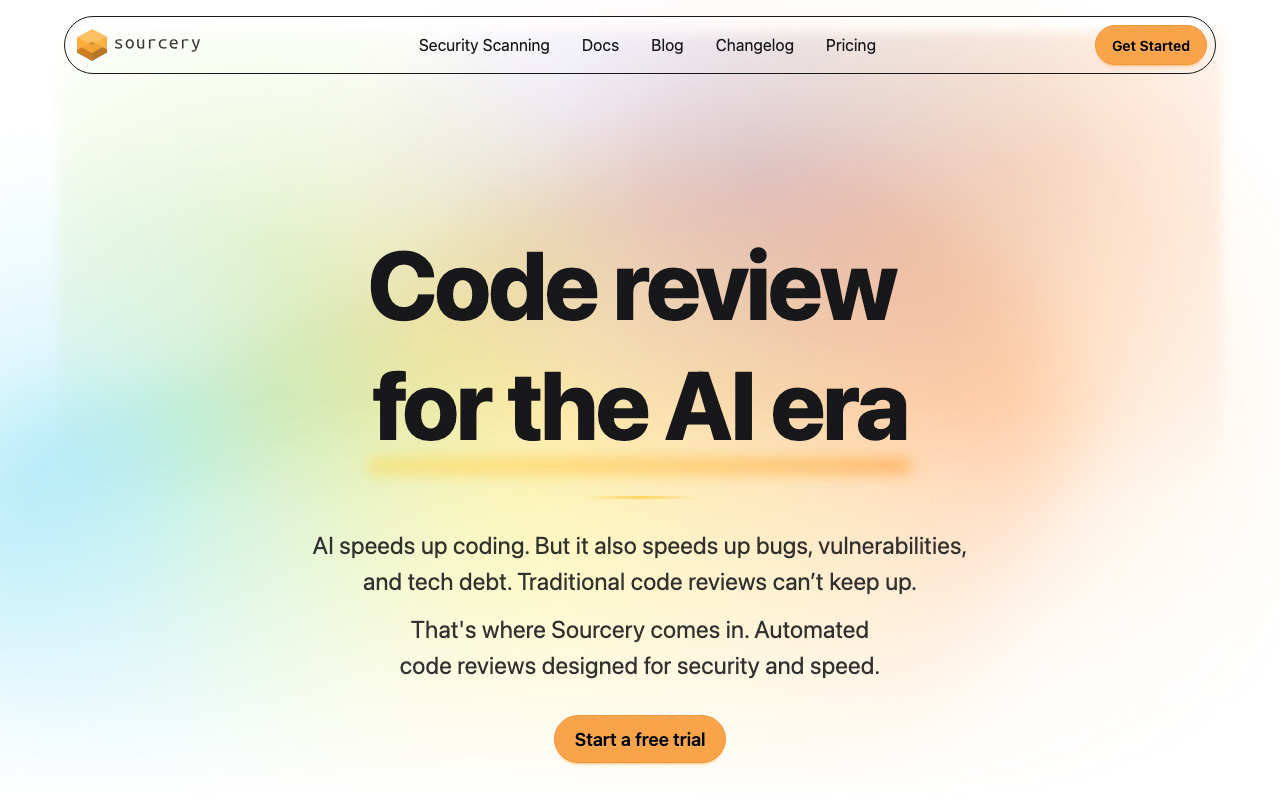
Sourcery is an AI code review and refactoring platform that originated as a Python-focused refactoring engine and expanded into broader code quality analysis. Its defining characteristic is deep Python expertise - Sourcery understands Python idioms at a level no other AI reviewer matches, and translates that understanding into actionable, specific suggestions for improving code structure and readability.
Sourcery reviews every pull request on connected GitHub or GitLab repositories, posting inline comments that identify code quality issues, refactoring opportunities, and potential bugs. Unlike tools that focus primarily on bug detection or security scanning, Sourcery’s philosophy centers on making good code better. It identifies patterns that work but could be more idiomatic - loops that should be comprehensions, verbose conditionals that can be simplified, classes that would benefit from becoming dataclasses.
The VS Code and PyCharm extensions are a key differentiator. Sourcery provides real-time refactoring suggestions as developers write code, catching quality issues before they ever reach a pull request. This immediate feedback loop is something DeepSource’s IDE extensions do not match for Python-specific refactoring patterns.
Sourcery also offers custom coding guidelines through a .sourcery.yaml configuration file, PR summary generation, interactive PR commands (like @sourcery-ai guide and @sourcery-ai resolve), and visual diagrams to explain complex code changes. The Team plan adds repository analytics, security scanning, and a “bring your own LLM” option for teams with specific model preferences.
Who Sourcery is built for: Python-heavy development teams, open-source maintainers, small teams on a budget, and developers who want IDE-integrated refactoring feedback rather than purely PR-level review.
What is DeepSource?
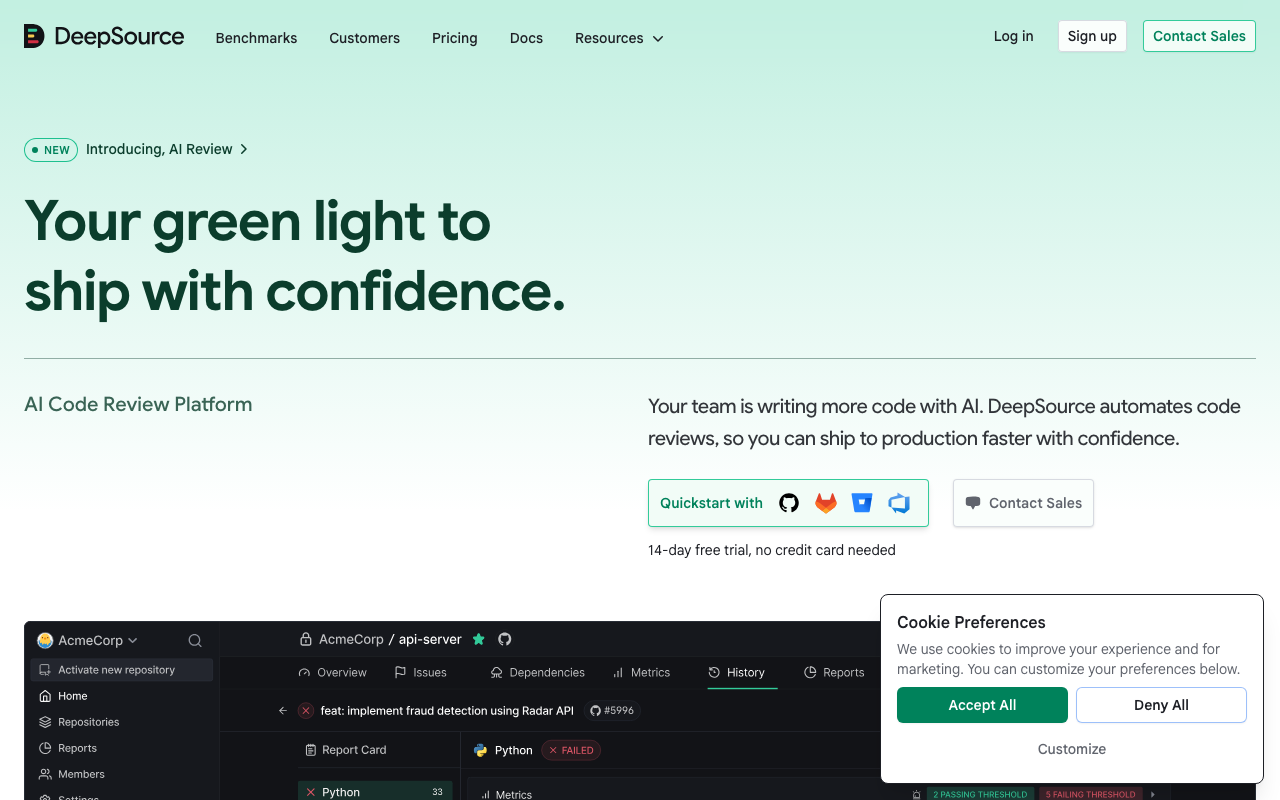
DeepSource is an AI-native code analysis platform that has evolved from a static analysis startup into a comprehensive AI code review and remediation system. Its foundational commitment is precision - its sub-5% false positive rate is the feature that drives the strongest user loyalty, because when DeepSource flags an issue, developers can trust it is worth investigating.
DeepSource runs 5,000+ analysis rules on every commit and pull request, then applies a sophisticated post-processing framework that filters findings through both explicit and implicit signals before surfacing results to developers. This filtering step is what separates DeepSource from competitors that generate overwhelming noise: the engine may internally detect more potential issues, but only surfaces the ones with high confidence of being genuine problems.
AI code review runs in parallel with static analysis on every PR, examining code through five structured dimensions: Security, Reliability, Complexity, Hygiene, and Coverage. Each PR receives a report card that communicates overall quality at a glance - particularly valuable for code reviewers who need to assess PR readiness without parsing dozens of individual findings.
Autofix AI is DeepSource’s most powerful feature. When DeepSource identifies an issue, it does not just describe the problem - it generates a context-aware fix that analyzes imports, related functions, and project-specific patterns to produce changes that look like they were written by a team member. The new Iterative Fix Refinement feature lets developers provide feedback at the diff level and regenerate improved fixes, creating a collaborative loop between developer and AI.
DeepSource Agents, launched in 2025, take capabilities further by observing every code change with full codebase context and taking autonomous action - creating pull requests, managing CVEs, and remediating security issues without waiting to be asked.
Who DeepSource is built for: Teams frustrated with noisy static analysis tools, engineering organizations needing security scanning aligned with OWASP/SANS standards, teams wanting automated remediation rather than just detection, and developers working with IaC tools like Terraform and Docker alongside application code.
How each tool works
Sourcery’s review process
Sourcery integrates with GitHub or GitLab through an app installation. When a PR is opened, the analysis engine examines the diff at the file level, applying both its rules-based static analysis and its AI layer to identify quality issues and refactoring opportunities. It combines a deterministic refactoring rule engine (particularly deep for Python) with LLM-powered analysis for broader code quality feedback.
Results appear as inline PR comments, each with a clear explanation of what the issue is, why the suggested change improves the code, and what the improved version looks like. Sourcery also generates a PR walkthrough that helps reviewers understand the overall change and produces visual diagrams for complex modifications.
In the IDE, the VS Code and PyCharm extensions surface suggestions in real time as code is written. Python refactoring suggestions appear as code actions that developers can apply with a single click. The integrated chat interface allows asking questions about code, requesting explanations, or getting on-demand refactoring suggestions for selected blocks.
Configuration is managed through a .sourcery.yaml file in the repository root, where teams specify Python version, enable or disable specific rules, set quality thresholds, and define custom coding guidelines.
# Example .sourcery.yaml configuration
version: "1"
python:
  version: "3.11"
refactorings:
  skip:
    - replace-interpolation-with-fstring  # team prefers .format()
    - use-walrus-operator  # not yet comfortable with walrus operator
  include:
    - all
rules:
  quality_threshold: B
DeepSource’s review process
DeepSource connects directly to your GitHub, GitLab, or Bitbucket repository. After adding a .deepsource.toml configuration file that specifies which analyzers to enable, analysis begins automatically on every commit and PR. The setup process takes under ten minutes with no server infrastructure required.
When a PR is opened, DeepSource’s analysis engine runs the appropriate analyzers from its 5,000+ rule database against changed code. The post-processing framework then filters findings before they reach developers. In parallel, the AI code review engine evaluates the PR across the five quality dimensions and generates the structured report card.
For issues detected, Autofix AI generates context-aware fixes that developers can apply with a single click. The fix generation analyzes the broader code context - imports, related functions, naming conventions used elsewhere in the project, and language idioms - to produce fixes that integrate naturally with the existing codebase.
# Example .deepsource.toml configuration
version = 1

[[analyzers]]
name = "python"
enabled = true

  [analyzers.meta]
  runtime_version = "3.x.x"
  django = true

[[analyzers]]
name = "javascript"
enabled = true

[[analyzers]]
name = "secrets"
enabled = true

[[analyzers]]
name = "terraform"
enabled = true
Feature-by-feature comparison
Python analysis depth
For Python-specific refactoring, Sourcery is best-in-class. No other AI review tool matches the depth and specificity of Sourcery’s Python refactoring suggestions. It catches patterns that general-purpose analysis tools treat as stylistically acceptable but experienced Python developers would refactor:
# Sourcery detects this pattern and suggests improvement
items_with_status = []
for item in all_items:
    if item.is_active:
        items_with_status.append(item.name)

# Sourcery suggests this idiomatic equivalent
items_with_status = [item.name for item in all_items if item.is_active]
# Sourcery catches this common verbosity pattern
def check_permission(user):
if user.is_admin:
return True
else:
return False
# And suggests this simplified form
def check_permission(user):
return user.is_admin# Sourcery also identifies context manager opportunities
f = open("data.json", "r")
data = json.load(f)
f.close()
# Suggested replacement using context manager
with open("data.json", "r") as f:
data = json.load(f)DeepSource’s Python analysis is thorough and framework-aware. The Python analyzer understands Django and Flask patterns, goroutine safety in concurrent code, and framework-specific anti-patterns that generic linters miss. Its 5,000+ rules include Python-specific checks for security vulnerabilities, performance issues, and maintainability problems. The false positive rate in Python analysis is consistently below 5%, meaning every finding surfaced is almost certainly real.
The practical difference: Sourcery catches more structural refactoring opportunities in Python and makes better suggestions for improving code readability. DeepSource catches more genuine bugs, security issues, and framework-specific problems with higher confidence. Teams that care most about “write Pythonic code” lean toward Sourcery. Teams that care most about “catch real bugs” lean toward DeepSource.
Static analysis depth
This is where DeepSource’s advantage is clearest. DeepSource’s 5,000+ analysis rules represent years of engineering investment in language-specific analysis across Python, JavaScript, TypeScript, Go, Java, Ruby, Rust, C#, PHP, Scala, Dart, Shell, SQL, Docker, Terraform, and Ansible. The rules span correctness issues, security vulnerabilities, performance problems, maintainability concerns, and code style.
Sourcery’s static analysis is more focused. Its rule engine is optimized for the code quality and refactoring use case rather than comprehensive bug detection. For Python, Sourcery has hundreds of specific rules. For other languages, the rule density drops significantly. Outside of Python and JavaScript/TypeScript, Sourcery’s static analysis is noticeably thinner.
The false positive comparison is meaningful. Independent benchmarks have found that approximately 50% of Sourcery’s comments can be classified as noise, with another 25% being bikeshedding - technically valid but unlikely to prevent a bug or improve maintainability in practice. DeepSource’s post-processing framework keeps its false positive rate below 5%. This behavioral difference affects how developers engage with each tool: developers read and act on DeepSource findings more consistently because they trust them.
DeepSource also covers Infrastructure-as-Code - Terraform, Docker, and Ansible at GA level alongside application code. This is increasingly important for full-stack teams managing cloud infrastructure in the same repositories as application code. Sourcery does not offer IaC analysis.
AI code review quality
Both tools have AI code review, but the implementation differs substantially.
Sourcery’s AI review generates inline PR comments that identify bugs, code quality issues, and refactoring opportunities. It produces PR summaries, review guides for human reviewers, and visual diagrams for complex changes. The interactive commands (@sourcery-ai resolve, @sourcery-ai summary, @sourcery-ai guide) give developers control over the review workflow. The AI layer is effective for catching high-level issues but can generate noise - particularly the bikeshedding suggestions mentioned in independent evaluations.
DeepSource’s AI review is structured through the five-dimension report card framework. Instead of an undifferentiated list of findings, each PR receives an organized assessment across Security, Reliability, Complexity, Hygiene, and Coverage. This structure helps reviewers quickly understand overall PR quality and focus attention on the most important dimensions.
The five-dimension report card format is particularly useful for:
- Code reviewers who need to assess PR readiness at a glance
- Engineering managers tracking quality trends across the team
- Junior developers who benefit from organized, categorized feedback rather than an unordered list
Automated remediation
Sourcery provides refactoring-focused suggestions that developers can apply directly in the IDE or via PR comments. In the VS Code and PyCharm extensions, refactoring suggestions are code actions that can be applied with a click. On PRs, Sourcery posts suggested code changes that developers can apply manually or merge directly.
DeepSource’s Autofix AI is more comprehensive for automated fix generation. It generates context-aware fixes for nearly all detected issues - not just a subset of refactoring patterns, but a broad range of bugs, security vulnerabilities, and code quality problems. The fix generation analyzes:
- Imports used elsewhere in the file
- Related functions and their patterns
- Naming conventions used across the project
- Language and framework idioms
This context-awareness means Autofix AI generates fixes that look like they were written by a team member, not generated by a template. The Iterative Fix Refinement feature allows developers to reject an initial fix and provide feedback, then regenerate an improved version - creating a collaborative loop that produces better outcomes for complex issues.
For teams that want automated remediation as a primary use case, DeepSource’s Autofix AI delivers measurably more coverage and context-awareness than Sourcery’s suggestion system.
Security scanning
DeepSource provides more comprehensive security coverage. Security scanning aligned with OWASP Top 10 and SANS Top 25 is included on the Team plan, covering common vulnerability classes including injection flaws, authentication issues, cryptographic weaknesses, insecure data handling, and hardcoded secrets. Secrets detection covers 30+ services. The sub-5% false positive rate applies to security findings as well, meaning security issues flagged by DeepSource are almost always genuine vulnerabilities.
DeepSource Agents add an autonomous security layer - they observe code changes, reason about security implications with full codebase context, and can proactively create PRs to remediate security issues before developers even notice them.
Sourcery’s security coverage is limited by design. The Team plan adds security scanning capabilities for up to 200+ repositories with daily scans and unlimited security issue fixes, but this is not Sourcery’s core strength. Its security analysis does not match the depth of standards-aligned OWASP/SANS coverage that DeepSource provides. Teams with serious security requirements should use DeepSource, or pair either tool with a dedicated security tool like Semgrep or Snyk Code.
Language and platform support
Sourcery markets 30+ language support, but Python, JavaScript, and TypeScript are the languages with deep analysis. For other languages, the coverage is functional but noticeably less comprehensive. This is not a dealbreaker for Python-focused teams, but it is a real limitation for polyglot organizations.
DeepSource’s 16 GA languages receive consistently deep analysis across the board. The list covers all major modern languages: Python, JavaScript, TypeScript, Go, Java, Ruby, Rust, C#, PHP, Scala, Dart, Shell, SQL, Docker, Terraform, and Ansible. The inclusion of Docker, Terraform, and Ansible at GA level is a meaningful advantage for platform engineering and DevOps teams.
Platform support is a key differentiator for some teams:
- Both tools support GitHub and GitLab (including self-hosted instances)
- DeepSource also supports Bitbucket - Sourcery does not
- Neither tool supports Azure DevOps - for that use case, consider CodeRabbit or SonarQube
For teams using Bitbucket, DeepSource is the only option between the two tools.
Pricing comparison
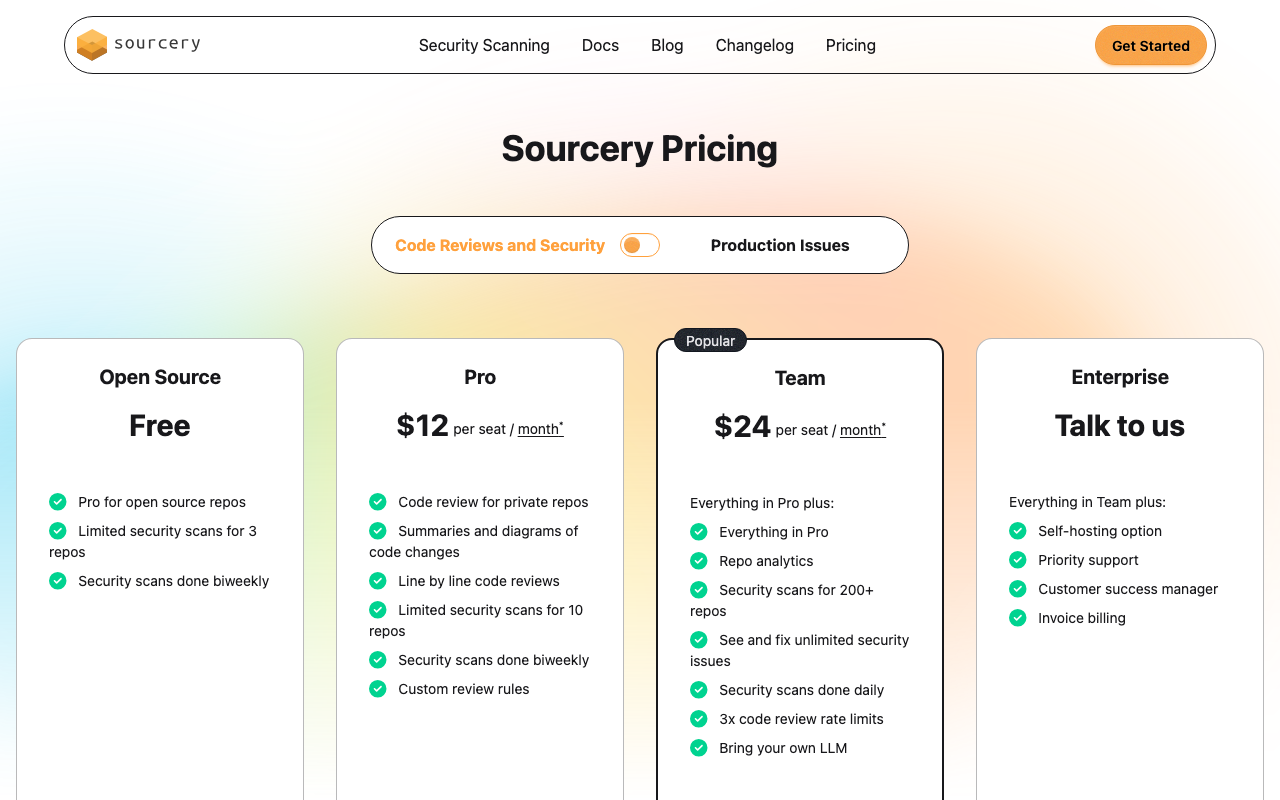
| Plan | Sourcery | DeepSource |
|---|---|---|
| Free (individuals) | Full features on public repos | Basic static analysis, public + private repos |
| Open Source / Free tier | Free - full features | Free - 1,000 analysis runs/month (public repos) |
| Pro / Entry paid | $10/user/month | $24/user/month (Team) |
| Team | $24/user/month | $24/user/month |
| Enterprise | Custom pricing | Custom pricing |
| Annual discount | 20% off | Available |
| Billing model | Per seat | Per active contributor |
| Self-hosted | Enterprise only | Enterprise only |
DeepSource uses committer-based billing, meaning you pay only for developers who actively push code to analyzed repositories. Sourcery charges per assigned seat. For large organizations with many developers who contribute infrequently, DeepSource’s committer-based model can be meaningfully cheaper in practice.
Annual cost comparison by team size:
| Team size | Sourcery Pro | Sourcery Team | DeepSource Team |
|---|---|---|---|
| 5 developers | $600/year | $1,440/year | $1,440/year |
| 10 developers | $1,200/year | $2,880/year | $2,880/year |
| 25 developers | $3,000/year | $7,200/year | $7,200/year |
| 50 developers | $6,000/year | $14,400/year | $14,400/year |
Sourcery’s Pro tier is significantly cheaper at $10/user/month versus DeepSource’s $24/user/month Team plan. For teams that only need private repo access, custom coding guidelines, and GitHub or GitLab integration, Sourcery Pro is one of the most affordable AI code review options available.
At the Team tier, both tools cost the same ($24/user/month). The question at this price point is what you get: Sourcery Team adds security scanning, analytics, and higher rate limits. DeepSource Team includes all features from launch - AI code review, Autofix AI, security scanning, code health dashboards, and bundled AI credits. For equivalent pricing, DeepSource Team delivers broader static analysis coverage, structured AI review, and more mature automated remediation.
The free tier comparison favors different workflows:
- Sourcery’s free tier covers all public repositories with full features and no restrictions - one of the most generous free tiers in the AI review space
- DeepSource’s free tier for individuals covers both public and private repos with basic analysis; the Open Source plan for organizations provides 1,000 analysis runs/month for public repos
For open-source maintainers, Sourcery’s free tier is more complete. For individual developers on private projects, DeepSource’s free tier for individuals is uniquely valuable.
Developer experience
IDE integration
Sourcery’s IDE experience is its strongest workflow advantage. The VS Code and PyCharm extensions provide real-time Python refactoring suggestions as you write code. Suggestions appear inline, with clear explanations of why the change improves the code. Developers can accept suggestions with a keyboard shortcut and see the improved code immediately. For Python developers, this tight feedback loop is genuinely useful and not replicated by DeepSource’s IDE extensions.
DeepSource’s IDE extensions (VS Code, IntelliJ IDEA, PyCharm) surface analysis findings in real time as code is written. This covers a broader range of issues across all 16 GA languages, but the Python-specific refactoring suggestions are not as nuanced as Sourcery’s. The IDE experience for DeepSource is solid for general quality and security issues; Sourcery’s is deeper for Python refactoring patterns.
PR review workflow
Sourcery’s interactive PR commands give developers fine-grained control over the review workflow:
@sourcery-ai summary- generates a PR summary@sourcery-ai guide- creates a review guide for human reviewers@sourcery-ai review- triggers a fresh review@sourcery-ai resolve- resolves all Sourcery comments@sourcery-ai dismiss- dismisses all pending reviews
This interaction model reduces friction and integrates naturally into GitHub and GitLab PR workflows.
DeepSource’s PR workflow is more automated and dashboard-driven. The five-dimension report card appears on every PR automatically. Autofix AI generates ready-to-apply corrections that developers can merge with a single click directly from the PR interface. The flow is less conversational than Sourcery’s interactive commands but more action-oriented - findings come with immediate fixes rather than just explanations.
Setup and configuration
Both tools have fast onboarding, but with different approaches.
Sourcery setup: Install the GitHub App or GitLab integration, and reviews begin on existing PRs immediately. Adding a .sourcery.yaml file is optional but recommended for custom guidelines. VS Code and PyCharm extensions are available from their respective marketplaces.
DeepSource setup: Connect the GitHub, GitLab, or Bitbucket integration, add a .deepsource.toml file to specify which analyzers to enable, and analysis begins. The configuration step is required but straightforward - adding a TOML file with the analyzers you want active. Setup to first analysis typically takes under 10 minutes.
For teams that want the absolute minimum configuration, Sourcery is slightly simpler. For teams comfortable with a one-time config file, DeepSource’s setup is equally fast.
Use-case comparison
| Scenario | Better choice | Why |
|---|---|---|
| Python-heavy team wanting refactoring | Sourcery | Best-in-class Python refactoring rules |
| Team frustrated by false positives | DeepSource | Sub-5% false positive rate by design |
| Real-time IDE refactoring feedback | Sourcery | VS Code/PyCharm extensions with Python depth |
| Comprehensive static analysis | DeepSource | 5,000+ rules across 16 GA languages |
| Best automated fix generation | DeepSource | Autofix AI with LLM-powered context-aware fixes |
| Security scanning (OWASP/SANS) | DeepSource | Standards-aligned security analysis |
| IaC teams (Terraform, Docker) | DeepSource | GA support for Terraform, Docker, Ansible |
| Small team, tight budget | Sourcery Pro | $10/user/month vs $24/user/month |
| Open source project | Sourcery | Full-featured free tier for public repos |
| Bitbucket users | DeepSource | Only option - Sourcery lacks Bitbucket |
| Mid-size team wanting AI review | DeepSource | Five-dimension report cards, Autofix AI |
| Agentic code security | DeepSource | DeepSource Agents for autonomous remediation |
| PR summary generation | Either | Both generate PR summaries |
| Enterprise self-hosted | Either | Both require Enterprise tier |
When to choose Sourcery
Choose Sourcery when:
Your team is primarily Python-focused. Sourcery’s refactoring engine has no equal for Python. It identifies complex structural improvements - converting loops to comprehensions, simplifying nested conditionals, applying dataclass patterns, replacing manual resource management with context managers - that no other AI reviewer matches. If 70%+ of your codebase is Python, Sourcery delivers targeted value that justifies the investment. For more on Python tooling, see Best Code Review Tools for Python.
Real-time IDE feedback is important to your workflow. Sourcery’s VS Code and PyCharm extensions catch quality issues before they reach a PR, reducing review cycle overhead. If your team writes code primarily in these IDEs and wants suggestions as they type rather than only after opening a PR, Sourcery’s IDE integration is deeper for Python refactoring than any alternative.
Budget is a primary constraint. Sourcery Pro at $10/user/month is one of the most affordable AI code review tools in the market. Teams that cannot justify $24/user/month for CodeRabbit Pro or DeepSource Team but want more than what free linters provide will find Sourcery Pro hits a real sweet spot.
You maintain open-source projects. Sourcery’s free tier covers all public repositories with full feature access - one of the most generous free tiers available. Interactive PR commands make it easy to manage review workflows on active open-source projects with multiple contributors.
You want custom coding guidelines in a version-controlled file. The .sourcery.yaml configuration allows teams to define project-specific standards that travel with the code and are enforced consistently on every PR.
See our Sourcery vs Ruff comparison and Sourcery vs Pylint comparison for more context on where Sourcery fits in the Python tooling ecosystem.
When to choose DeepSource
Choose DeepSource when:
Developer trust in findings is paramount. If your team has experienced alert fatigue from a noisy static analysis tool, DeepSource’s sub-5% false positive rate directly solves this problem. When developers trust that 95%+ of findings are real issues worth fixing, they engage with the tool consistently - and consistent engagement is what makes static analysis effective in practice.
Automated remediation matters more than refactoring suggestions. Autofix AI generates context-aware fixes for nearly all detected issues, not just a subset of refactoring patterns. Teams that have a backlog of code quality and security issues, and want a tool that finds and fixes them rather than just reporting them, will find DeepSource delivers more remediation value. Teams report 30-40% reductions in manual refactoring workload after adopting Autofix AI.
Security scanning is a core requirement. DeepSource’s OWASP Top 10 and SANS Top 25 aligned security analysis, plus secrets detection for 30+ services, provides meaningful security coverage alongside code quality. DeepSource Agents add autonomous security remediation capabilities that have no equivalent in Sourcery.
Your team uses Infrastructure-as-Code. DeepSource’s GA support for Terraform, Docker, and Ansible means you can analyze IaC configurations with the same tool, the same accuracy standards, and the same dashboard as your application code. For platform engineering teams or organizations managing cloud infrastructure in code, this integrated IaC analysis is a genuine advantage.
You use Bitbucket. Sourcery does not support Bitbucket. DeepSource does. If your organization uses Bitbucket for source control, DeepSource is the only option between the two tools.
You need structured AI feedback across multiple quality dimensions. The five-dimension PR report cards organize findings into Security, Reliability, Complexity, Hygiene, and Coverage. For teams that want to assess PR quality at a glance without parsing a flat list of findings, this structured approach is more actionable.
For more on the DeepSource ecosystem, see DeepSource Alternatives, DeepSource vs Codacy, and DeepSource Pricing.
Alternatives to consider
If neither tool is the right fit, several alternatives address similar needs.
CodeRabbit is the leading dedicated AI code review tool. It provides deeper contextual PR review than either Sourcery or DeepSource, with cross-file analysis that reads callers, consumers, and related files to understand system-wide impact. It supports GitHub, GitLab, Bitbucket, and Azure DevOps - broader platform coverage than either tool in this comparison. At $24/user/month (Pro), it is priced similarly to DeepSource Team. See our CodeRabbit vs Sourcery comparison and CodeRabbit vs DeepSource comparison.
SonarQube is the enterprise standard for static analysis with 6,500+ rules, 35+ languages, and a free Community Build for self-hosted deployment. It is more operationally intensive than DeepSource but provides broader language coverage, more mature quality gate enforcement, and the best enterprise ecosystem. See our SonarQube vs DeepSource comparison for a detailed breakdown.
Semgrep is the best choice for security-focused teams that need custom rule authoring. Its YAML-based rule syntax enables teams to write vulnerability detection logic tailored to their specific frameworks and patterns. Free for up to 10 contributors.
Codacy occupies similar market territory to DeepSource with cloud-hosted static analysis, GitHub/GitLab/Bitbucket support, and AI code review. It offers 49-language support and a comprehensive security suite including SAST, SCA, DAST, and secrets detection. The Pro plan at $15/user/month is cheaper than DeepSource Team. See our DeepSource vs Codacy comparison for a head-to-head evaluation.
Ruff is the fastest Python linter available, written in Rust and covering rules from Flake8, isort, pycodestyle, and 50+ plugins. It is free, runs in milliseconds, and is now a standard part of Python toolchains. Ruff and Sourcery complement each other rather than compete - Ruff handles fast deterministic linting while Sourcery handles deeper AI-assisted review. See our Sourcery vs Ruff comparison.
For a broader overview, see Best AI Code Review Tools and Best Code Quality Tools.
Bottom line
Sourcery and DeepSource are both useful AI code quality tools, but they serve different needs at different price points.
Sourcery earns the recommendation for Python-first teams that want real-time IDE refactoring feedback, automated suggestions that make code more idiomatic, and an affordable entry point at $10/user/month. Its deep Python expertise - converting loops to comprehensions, simplifying conditionals, applying modern Python patterns - is genuinely best-in-class and not replicated by any other AI reviewer. Open-source maintainers get all of this for free on public repositories.
DeepSource earns the recommendation for teams that prioritize signal quality and automated remediation. Its sub-5% false positive rate sets the industry standard for static analysis precision. Autofix AI generates context-aware fixes for nearly all issues - not just a curated subset - saving meaningful developer time on code quality and security issues. The five-dimension PR report cards, standards-aligned security scanning, and Infrastructure-as-Code support round out a platform that delivers comprehensive code quality and security coverage in a single tool at $24/user/month.
For teams where Python is the primary language and IDE feedback is valued: Sourcery is the more targeted investment, particularly on the Pro tier at $10/user/month.
For teams where comprehensive static analysis, low noise, and automated remediation are the priorities: DeepSource justifies its higher price with measurably better signal quality, broader language coverage, and more mature automated fix generation.
The strongest setup for Python-heavy teams with budget flexibility is using both tools together: Sourcery in the IDE for real-time Python refactoring as you write code, and DeepSource on PRs for comprehensive static analysis and AI-powered remediation. You get best-in-class Python refactoring feedback and industry-leading false positive control in a single workflow - at a combined cost of $34/user/month.
Frequently Asked Questions
What is the main difference between Sourcery and DeepSource?
Sourcery is an AI code review and refactoring tool that focuses primarily on code quality improvement and Python refactoring, with strong IDE integration via VS Code and PyCharm extensions. DeepSource is a comprehensive static analysis platform that combines 5,000+ rules with AI code review, Autofix AI, and security scanning across OWASP Top 10 and SANS Top 25 standards. Sourcery starts at $10/user/month for private repos; DeepSource's Team plan is $24/user/month. Sourcery is the better choice for teams that want deep Python refactoring and real-time IDE feedback. DeepSource is the better choice for teams that need comprehensive static analysis with minimal false positives, automated remediation, and structured AI review across more languages and security dimensions.
Is Sourcery good for Python?
Yes, Sourcery is one of the best tools available for Python development. It originated as a Python-focused refactoring engine and retains the deepest Python-specific analysis of any AI code review tool. Sourcery understands idiomatic Python patterns like list comprehensions, context managers, dataclasses, and generator expressions, and can suggest transformations that experienced Python developers make during manual reviews. The VS Code and PyCharm extensions provide real-time Python refactoring as you write code - a workflow no other AI reviewer matches. DeepSource also has strong Python support with framework-aware analysis for Django and Flask, but Sourcery's Python refactoring depth is best-in-class.
Does DeepSource have AI code review?
Yes, DeepSource added AI code review capabilities that run alongside its static analysis engine on every pull request. The AI review engine examines each PR through five dimensions: Security, Reliability, Complexity, Hygiene, and Coverage. Each PR receives a structured report card that communicates overall quality at a glance. DeepSource also has Autofix AI, which generates context-aware, idiomatic fixes for nearly all detected issues by analyzing not just the problematic code but also surrounding imports, related functions, and project-specific patterns. AI code review is available on the Team plan ($24/user/month) and above.
Which tool has a better false positive rate?
DeepSource has a measurably better false positive rate. The platform maintains a sub-5% false positive rate through a sophisticated post-processing framework that filters findings before surfacing them to developers. Sourcery is also relatively low-noise for a code review tool, but independent evaluations have identified that roughly 50% of Sourcery's comments can be noise, with another 25% categorized as bikeshedding - technically valid but low-value suggestions. DeepSource's precision-first approach means developers can trust virtually every finding surfaced, which drives higher adoption and consistent engagement with the tool.
How much does Sourcery cost compared to DeepSource?
Sourcery Pro costs $10/user/month for private repository support, custom coding guidelines, and GitHub and GitLab integration. The Sourcery Team plan is $24/user/month and adds security scanning, analytics, and higher rate limits. DeepSource's Team plan is also $24/user/month and includes AI code review, Autofix AI, security scanning, code health dashboards, and bundled AI credits. At the entry paid tier, Sourcery is significantly cheaper at $10/user/month versus DeepSource's $24/user/month. At the team tier, both tools cost the same - but DeepSource includes more comprehensive AI review, structured report cards, and a broader static analysis rule base.
Does Sourcery support Bitbucket and Azure DevOps?
No. Sourcery only integrates with GitHub and GitLab, including self-hosted versions of both platforms. It does not support Bitbucket or Azure DevOps. DeepSource supports GitHub, GitLab, and Bitbucket, but also lacks Azure DevOps support. If your team uses Azure DevOps, neither tool is directly compatible and you should consider alternatives like SonarQube or Snyk Code. If you use Bitbucket, DeepSource is the only option between the two.
Can Sourcery and DeepSource be used together?
Yes, using both tools together is a valid strategy for Python-heavy teams that want both real-time IDE feedback and comprehensive static analysis. The recommended setup is Sourcery in the IDE (VS Code or PyCharm) for real-time Python refactoring suggestions while writing code, and DeepSource on pull requests for static analysis with the sub-5% false positive rate, AI review, and Autofix AI. The combined cost ranges from $34/user/month (Sourcery Pro + DeepSource Team) to $48/user/month (Sourcery Team + DeepSource Team). For most teams, choosing one tool rather than running both is more practical.
Which tool is better for static analysis?
DeepSource is significantly stronger for static analysis. It maintains a database of 5,000+ analysis rules spanning Python, JavaScript, TypeScript, Go, Java, Ruby, Rust, C#, PHP, Scala, Dart, Shell, SQL, Docker, Terraform, and Ansible. Its post-processing framework delivers a sub-5% false positive rate that is industry-leading. Sourcery does perform static analysis as part of its code review, but its rule engine is much smaller and focused primarily on code quality and refactoring patterns rather than comprehensive bug detection, security analysis, and technical debt tracking. Teams needing rigorous static analysis should choose DeepSource.
Does DeepSource have IDE integration?
Yes, DeepSource offers IDE extensions for VS Code, IntelliJ IDEA, and PyCharm, providing real-time feedback as developers write code. The extensions surface findings from DeepSource's analysis engine inline as code is written, enabling shift-left quality enforcement before code reaches a PR. Sourcery also has VS Code and PyCharm extensions with real-time refactoring suggestions. Both tools cover IDE integration, but Sourcery's IDE experience is deeper for Python - particularly for complex refactoring suggestions like converting loops to comprehensions or simplifying conditionals.
Is DeepSource free?
DeepSource offers a free tier for individual developers that covers both public and private repositories with basic static analysis. There is also a free Open Source plan for organizations working on public repositories, which includes 1,000 analysis runs per month. The Team plan at $24/user/month is required for AI code review, Autofix AI, security scanning, and code health dashboards. Sourcery also offers a free tier covering public repositories with basic AI code review and refactoring suggestions, with no feature restrictions for open-source projects.
Which tool is better for security scanning?
DeepSource is significantly stronger for security scanning. It provides security vulnerability detection aligned with OWASP Top 10 and SANS Top 25 standards, plus secrets detection for 30+ services. DeepSource Agents can autonomously identify and remediate security issues, create pull requests, and manage CVEs. Sourcery's security coverage is more limited - its primary focus is code quality and refactoring. The Team plan adds security scanning capabilities for up to 200+ repositories, but the depth of coverage does not match DeepSource's standards-aligned security analysis. Teams with serious security requirements should choose DeepSource, or pair either tool with a dedicated SAST tool like Semgrep or Snyk Code.
What are the best alternatives to Sourcery and DeepSource?
The main alternatives depend on your primary use case. For the best AI-powered PR review, CodeRabbit is the leading option with cross-file contextual analysis, natural language configuration, and support for GitHub, GitLab, Bitbucket, and Azure DevOps. For comprehensive static analysis with self-hosted deployment, SonarQube is the industry standard with 6,500+ rules. For security-focused teams needing custom rule authoring, Semgrep is the strongest choice. For Python-specific linting at zero cost, Ruff is the fastest and most comprehensive free option. For teams wanting fewer false positives than SonarQube with cloud-hosted simplicity, Codacy is a viable alternative to DeepSource.
Explore More
Tool Reviews
 Sourcery Review
 DeepSource Review
Related Articles
- Best AI Code Review Tools for Pull Requests in 2026
- CodeRabbit Pricing in 2026: Free Tier, Pro Plans, and Enterprise Costs
- Will AI Replace Code Reviewers? What the Data Actually Shows
- Best AI Code Review Tools in 2026 - Expert Picks
- Best AI Tools for Developers in 2026 - Code Review, Generation, and Testing
Free Newsletter
Stay ahead with AI dev tools
Weekly insights on AI code review, static analysis, and developer productivity. No spam, unsubscribe anytime.
Join developers getting weekly AI tool insights.
Related Articles
Checkmarx vs Veracode: Enterprise SAST Platforms Compared in 2026
Checkmarx vs Veracode - enterprise SAST, DAST, SCA, Gartner positioning, pricing ($40K-250K+), compliance, and when to choose each AppSec platform.
March 13, 2026
comparisonCodacy Free vs Pro: Which Plan Do You Need in 2026?
Codacy Free vs Pro compared - features, limits, pricing, and when to upgrade. Find the right Codacy plan for your team size and workflow.
March 13, 2026
comparisonCodacy vs Checkmarx: Developer Code Quality vs Enterprise AppSec in 2026
Codacy vs Checkmarx - developer code quality vs enterprise AppSec, pricing ($15/user vs $40K+), SAST, DAST, SCA, compliance, and when to choose each.
March 13, 2026