DeepSource vs Snyk: Code Quality Platform vs Developer Security Platform (2026)
DeepSource vs Snyk - code quality vs security scanning, SAST, SCA, autofix, container and IaC scanning, pricing, and when to choose each.
Published:
Last Updated:
Quick Verdict
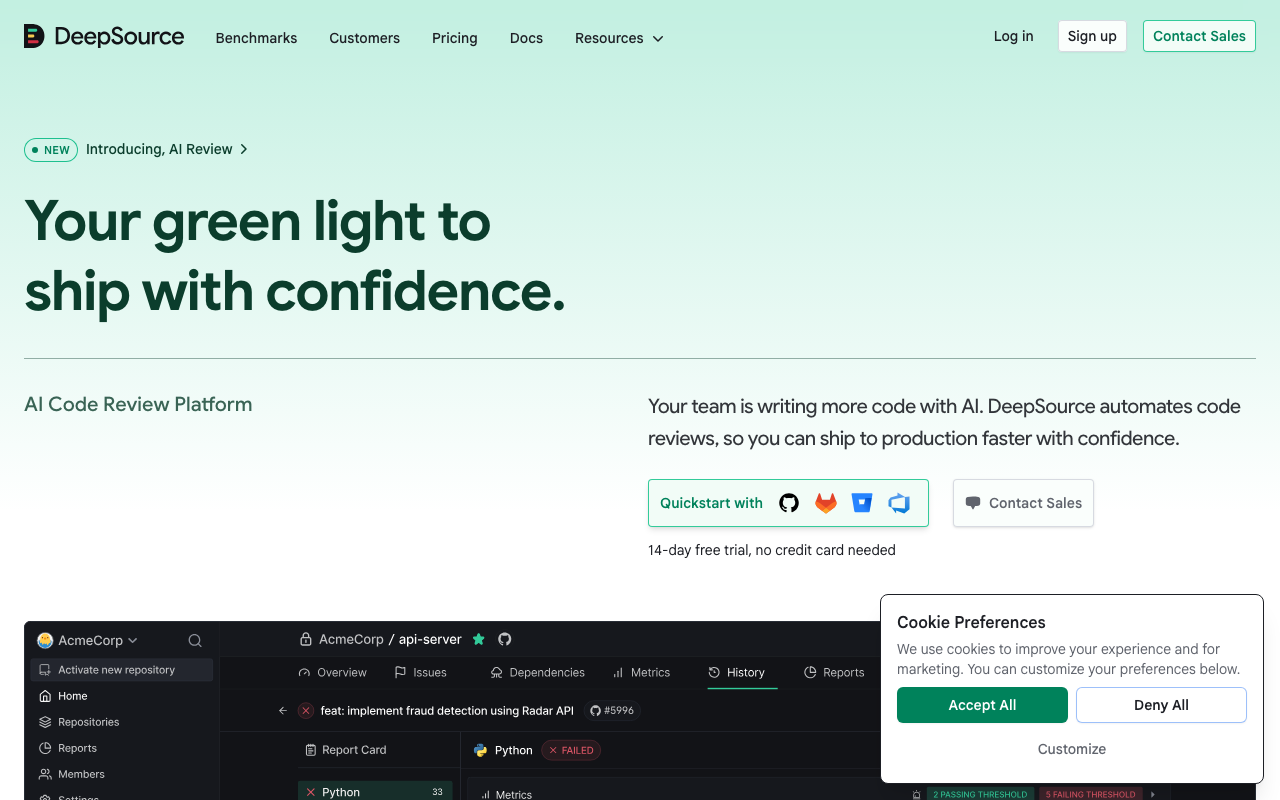
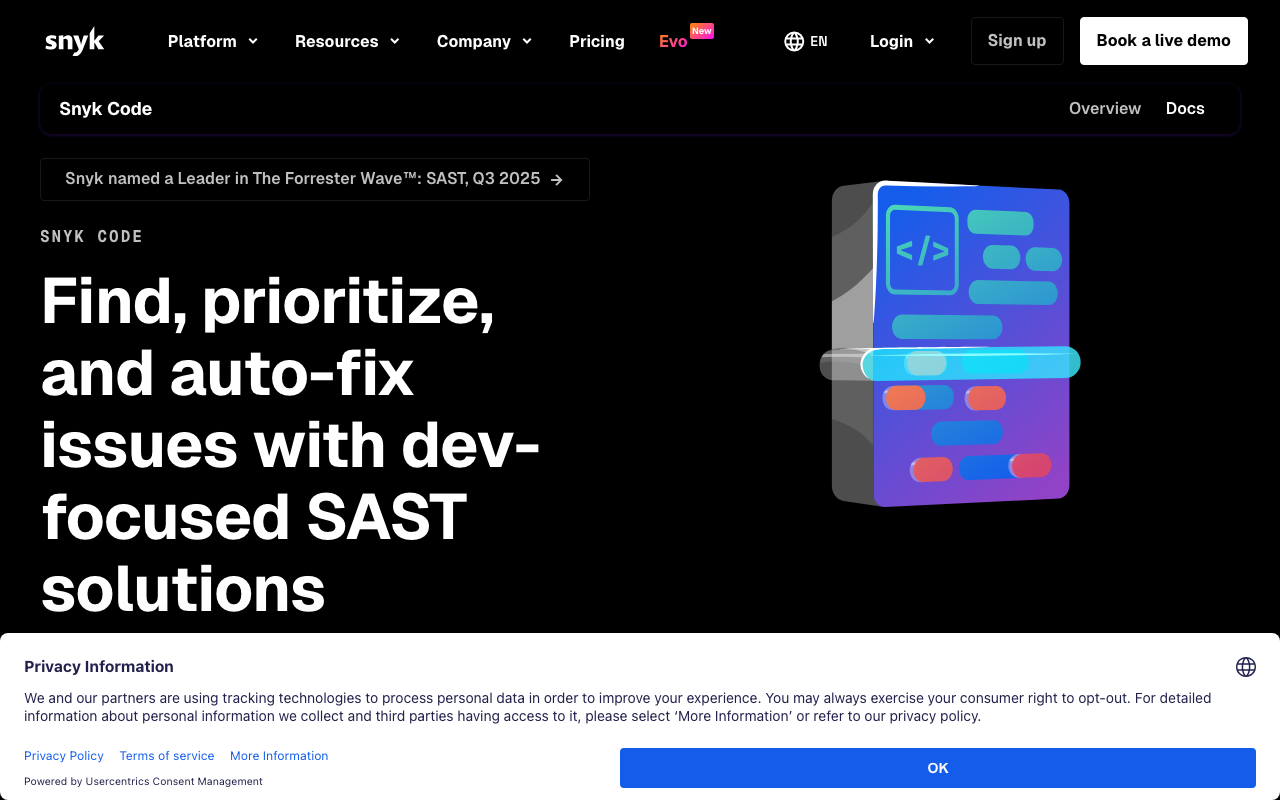
DeepSource and Snyk are not direct competitors. They solve fundamentally different problems and approach code analysis from opposite directions. DeepSource is a code quality platform that finds bugs, enforces coding standards, provides AI-powered code review with structured PR report cards, and generates automated fixes - with some security scanning included. Snyk is a developer security platform that finds vulnerabilities in your source code, scans open-source dependencies for CVEs, checks container images for known issues, and validates infrastructure as code for security misconfigurations. Comparing them head-to-head is like comparing a building inspector to a fire alarm system - both protect your project, but they examine entirely different things.
Choose DeepSource if: your primary concern is code quality - catching bugs with minimal false positives, getting structured AI-powered code review on every PR, and having automated fixes generated for detected issues. You want a tool that improves how developers write code day to day, with security scanning as a complementary feature rather than the core value proposition. You value a sub-5% false positive rate that ensures developers trust and act on every finding.
Choose Snyk if: your primary concern is security - finding vulnerabilities in your application code, scanning open-source dependencies for CVEs with reachability analysis, checking container images for known issues, and validating infrastructure as code before it reaches production. You need the deepest possible security coverage across your entire application stack, and code quality metrics like complexity, duplication, and maintainability are handled elsewhere or are secondary.
The real answer: Most serious engineering teams need both. DeepSource handles quality enforcement - the bugs, patterns, complexity, and standards that keep code maintainable and clean. Snyk handles security depth - the vulnerabilities, dependency risks, container issues, and IaC misconfigurations that keep code secure. They complement each other with almost zero overlap, and running both together costs less than most single-vendor enterprise security platforms.
At-a-Glance Feature Comparison
| Category | DeepSource | Snyk |
|---|---|---|
| Primary focus | Code quality + AI remediation | Application security |
| Code quality rules | 5,000+ rules across 16 GA languages | None |
| SAST | OWASP Top 10, SANS Top 25 (sub-5% FP rate) | DeepCode AI engine (19+ languages, interfile data flow) |
| SCA (dependency scanning) | No | Core strength - reachability analysis |
| Container scanning | No | Yes (Docker Hub, ECR, GCR, ACR) |
| IaC scanning | Terraform, Docker, Ansible (GA languages) | Yes (Terraform, CloudFormation, K8s, ARM) |
| Secrets detection | 30+ services | No (separate product area) |
| AI code review | Five-dimension PR report cards | No |
| Autofix | Autofix AI (LLM-powered, context-aware) | DeepCode AI Fix (security-focused) |
| Code health dashboards | Yes - longitudinal quality tracking | No |
| Complexity analysis | Yes | No |
| Technical debt tracking | Yes (maintainability scores) | No |
| Continuous monitoring | No | Yes - post-deployment CVE alerts |
| IDE integration | VS Code, IntelliJ, PyCharm | VS Code, JetBrains IDEs |
| Git platforms | GitHub, GitLab, Bitbucket | GitHub, GitLab, Bitbucket, Azure DevOps |
| Self-hosted | Enterprise plan only | Cloud only |
| Free tier | Free for individuals (public + private repos) | 100 SAST tests/month + SCA, container, IaC |
| Starting paid price | $30/user/month (Team) | $25/dev/month (Team, min 5 devs) |
| Gartner recognition | G2 High Performer | MQ Leader for AST (2025) |
| User base | 2,000+ teams | 4,500+ organizations |
Understanding the Comparison: Code Health vs Security-First
Before diving into features, it is worth understanding why these two tools exist and what each one optimizes for. This philosophical difference shapes everything - from how they analyze code to what they charge and who they serve best.
DeepSource’s philosophy is code health. The platform exists to make codebases cleaner, more maintainable, and easier to work with over time. Its defining characteristic is a sub-5% false positive rate - a commitment that every finding surfaced to a developer is almost certainly a real problem worth fixing. DeepSource achieves this through a sophisticated post-processing framework that applies multiple filtering passes to eliminate noise. The platform then goes further by generating context-aware automated fixes through Autofix AI, transforming it from a tool that finds problems into one that solves them. Security scanning is included (OWASP Top 10, SANS Top 25, secrets detection), but it is part of a broader code health mission rather than the primary focus.
Snyk’s philosophy is security-first. The platform exists to find and fix security vulnerabilities across your entire application stack - source code, open-source dependencies, container images, and infrastructure as code. Snyk’s defining characteristic is breadth of security coverage. No other developer-friendly tool covers as many security dimensions in a single platform. The DeepCode AI engine performs interfile data flow analysis trained on 25+ million data flow cases to catch complex vulnerabilities that simpler tools miss. Snyk does not care about code smells, naming conventions, or complexity metrics - it cares about whether your code, dependencies, and infrastructure are secure.
The practical implication is that these tools almost never overlap. A team running only DeepSource has strong code quality coverage with basic security scanning but no dependency vulnerability analysis, no container scanning, and limited IaC coverage. A team running only Snyk has comprehensive security coverage but no code quality enforcement - the codebase could be unmaintainable spaghetti code and Snyk would report a clean bill of health. This is why the most effective deployment is both tools running together, each covering the gap the other leaves.
What Is DeepSource?
DeepSource is an AI-native code quality platform that combines traditional static analysis with LLM-powered code review and automated remediation. Founded in 2019, it has built its reputation on the claim that matters most to developers: when DeepSource flags an issue, it is almost certainly real. With over 5,000 analysis rules and a false positive rate consistently below 5%, DeepSource addresses the single biggest complaint developers have with code analysis tools - too much noise and not enough signal.
How DeepSource Works
DeepSource connects directly to your GitHub, GitLab, or Bitbucket repository. After adding a .deepsource.toml configuration file that specifies which analyzers to enable, the platform automatically analyzes every commit and pull request. Results appear as PR comments with clear explanations and, where possible, ready-to-apply Autofix AI corrections.
The analysis engine applies relevant rules from its 5,000+ rule database, then runs a post-processing framework that filters findings through both explicit signals (rule confidence levels, code context, language-specific heuristics) and implicit signals (patterns learned from millions of analyses). This filtering step is what delivers the sub-5% false positive rate - the engine may detect more potential issues internally, but only surfaces the ones it has high confidence are genuine problems.
In parallel with static analysis, DeepSource’s AI code review engine examines each PR through a different lens. While static analysis catches known patterns and antipatterns, the AI review detects novel issues, provides architectural feedback, and evaluates code against higher-level quality criteria. Each PR receives a structured report card across five dimensions: Security, Reliability, Complexity, Hygiene, and Coverage.
Key Strengths of DeepSource
Sub-5% false positive rate. This is DeepSource’s signature differentiator. On Capterra, DeepSource holds a 4.8/5 overall rating, with users consistently citing the accuracy of findings as the primary reason they chose the platform over alternatives. When developers trust that flagged issues are real, they engage with the tool rather than learning to ignore it. This behavioral difference is what separates effective code analysis deployments from ones that get disabled after three months.
Autofix AI. When DeepSource identifies an issue, it does not just describe the problem - it generates a context-aware fix. The fix generation analyzes imports, related functions, coding patterns used elsewhere in the project, and language idioms to produce changes that look like they were written by a team member. The Iterative Fix Refinement feature lets developers provide feedback at the diff level and regenerate improved fixes on the spot. This transforms DeepSource from a tool that finds problems into one that solves them.
Five-dimension PR report cards. Rather than presenting a flat list of findings, DeepSource organizes feedback into five structured dimensions: Security, Reliability, Complexity, Hygiene, and Coverage. Each PR gets a report card that communicates overall quality at a glance, which is particularly valuable for code reviewers who need to quickly assess whether a PR is ready for merge.
DeepSource Agents. Launched in 2025, these agents observe every line written in the codebase, reason about changes with full codebase context, and take autonomous action to secure code. Agents access a comprehensive graph of code and third-party dependencies, organizational memory and historical patterns, and can create pull requests and manage CVEs. This represents DeepSource’s push from passive analysis toward proactive code security.
Zero-infrastructure setup. DeepSource is cloud-hosted by default. Connect your repository, add a configuration file, and analysis starts within minutes. No servers to provision, no databases to maintain, no JVM parameters to tune.
For a detailed breakdown of DeepSource’s pricing structure, see our DeepSource pricing guide. For alternatives to DeepSource, see DeepSource alternatives.
What Is Snyk?
Snyk (pronounced “sneak”) is a developer-first application security platform founded in 2015 by Guy Podjarny and Assaf Hefetz. Named a Leader in the 2025 Gartner Magic Quadrant for Application Security Testing, Snyk is used by over 4,500 organizations and has established itself as the dominant developer-first security solution in a market that includes heavyweights like Checkmarx and Veracode.
What makes Snyk uniquely powerful is its coverage across the entire application stack. Rather than focusing on a single security domain, Snyk bundles multiple products under one platform: Snyk Code for SAST, Snyk Open Source for SCA, Snyk Container for Docker and container image scanning, and Snyk IaC for Terraform and CloudFormation configurations.
Snyk’s Core Products
Snyk Code (SAST) is the static analysis product powered by the DeepCode AI engine. It performs interfile data flow analysis, tracing how tainted data moves through your application across multiple files and functions. Trained on over 25 million data flow cases from open-source projects, it supports 19+ languages and generates AI-powered fix suggestions trained on curated human remediation patterns. Snyk claims a 6.7x faster median scan time than SonarQube for security scans.
Snyk Open Source (SCA) was the company’s original product and remains its deepest capability. The platform maintains one of the most rapidly updated vulnerability databases in the industry, typically incorporating new CVEs within 24 hours of public disclosure. Reachability analysis determines whether vulnerable code paths in your dependencies are actually called by your application, dramatically reducing noise from irrelevant alerts.
Snyk Container analyzes Docker images for vulnerabilities in base images and installed packages. It integrates with Docker Hub, Amazon ECR, Google Container Registry, and Azure Container Registry. Container scanning runs automatically when images are built and provides recommendations for base image upgrades that fix the most vulnerabilities with the least disruption.
Snyk IaC scans Terraform, CloudFormation, Kubernetes manifests, and ARM templates for security misconfigurations. It catches issues like overly permissive IAM policies, unencrypted storage buckets, and exposed database ports before they reach production.
Key Strengths of Snyk
Security depth is unmatched for a developer-friendly tool. Snyk’s cross-file data flow analysis catches complex vulnerabilities like second-order SQL injection, prototype pollution, and deserialization attacks that require tracing data through multiple layers of your application. The AI auto-fix generates remediation code trained on human-written fixes, not generic patches.
Dependency scanning with reachability analysis is industry-leading. Most SCA tools flag every CVE in your dependency tree, creating overwhelming alert volumes. Snyk’s reachability analysis determines which vulnerable functions your application actually calls, reducing alert volume by 30-70% in typical projects. Automatic PR generation for dependency upgrades means fixes can be merged with one click.
Continuous monitoring catches post-deployment risks. Snyk monitors your deployed dependencies and container images for newly disclosed vulnerabilities, alerting you when a new CVE affects packages you already use in production. This continuous monitoring fills a gap that analysis-only tools do not address.
Fast scan times keep developer workflow intact. Snyk scans complete in seconds in most CI/CD pipelines. The IDE plugins provide near-instant feedback as developers write code.
For a detailed breakdown of Snyk’s pricing structure, see our Snyk pricing guide. For alternatives to Snyk, see Snyk alternatives.
Feature-by-Feature Breakdown
SAST Capabilities
This is the one area where DeepSource and Snyk have some overlap - both perform static application security testing. However, their approaches and strengths differ substantially.
DeepSource’s SAST is part of a broader code quality analysis engine that runs 5,000+ rules covering bugs, code smells, performance issues, style violations, and security vulnerabilities. The security rules align with OWASP Top 10 and SANS Top 25 standards. DeepSource’s key advantage is precision - its post-processing framework filters security findings through the same sub-5% false positive rate framework as its quality rules. When DeepSource flags a security vulnerability, it is almost certainly real.
Snyk Code’s SAST is exclusively security-focused and uses the DeepCode AI engine for deeper vulnerability detection. The engine performs interfile data flow analysis - tracing how tainted data moves through your application across multiple files and functions - which catches complex vulnerabilities that single-file analysis misses. Snyk Code supports 19+ languages, slightly more than DeepSource’s 16 GA languages, and its analysis is trained on 25+ million data flow cases from open-source projects.
The practical difference is depth vs precision. For a complex vulnerability like second-order SQL injection where user input flows through multiple files before reaching a database query, Snyk’s interfile data flow analysis is more likely to catch it. For simpler vulnerability patterns where the priority is ensuring that every flagged finding is worth investigating, DeepSource’s precision-first approach produces less noise and higher developer trust.
| SAST Dimension | DeepSource | Snyk Code |
|---|---|---|
| Analysis approach | Rule-based with post-processing filters | ML-powered interfile data flow analysis |
| Languages supported | 16 GA | 19+ |
| False positive rate | Sub-5% (industry-leading) | Moderate (rated 6.8/10 on G2) |
| Cross-file analysis | Limited | Yes - full interfile data flow tracing |
| Security standards | OWASP Top 10, SANS Top 25 | OWASP Top 10, CWE coverage |
| Code quality findings | Yes - bugs, smells, complexity, style | No - security only |
| AI-powered auto-fix | Autofix AI (LLM-based, context-aware) | DeepCode AI Fix (trained on human fixes) |
| Scan speed | Fast (cloud-hosted, no pipeline needed) | Very fast (6.7x faster than SonarQube) |
SCA and Dependency Scanning
This is the area of starkest differentiation between the two tools. DeepSource does not offer SCA at all, while Snyk’s SCA is one of the strongest in the industry.
DeepSource does not scan dependencies. There is no Software Composition Analysis capability in DeepSource. If your application uses a vulnerable version of a library, DeepSource will not detect it. Teams using DeepSource that need dependency scanning must pair it with a separate SCA tool like Snyk Open Source, Semgrep Supply Chain, or GitHub’s built-in Dependabot.
Snyk Open Source is purpose-built for dependency security. It scans your dependency manifests (package.json, requirements.txt, pom.xml, go.mod, and others) and traces the full dependency tree for known vulnerabilities. The platform’s vulnerability database updates within 24 hours of new CVE disclosures, and its reachability analysis determines whether vulnerable code paths are actually called by your application - reducing false positive alert volume by 30-70% in typical projects. When a vulnerable dependency is found, Snyk automatically generates a pull request with the minimum version upgrade needed to resolve the issue. For teams with hundreds of transitive dependencies, this level of automated remediation is transformative.
Why this matters. The majority of modern application code consists of open-source dependencies rather than custom code. A typical Node.js application may have 500-1,000 transitive dependencies in its dependency tree. Any of those packages could contain a vulnerability that affects your application. Ignoring dependency security is ignoring the majority of your attack surface. This is the single strongest argument for pairing DeepSource with Snyk rather than choosing one or the other.
Autofix and Remediation
Both tools offer automated fix generation, but they serve different purposes and use different approaches.
DeepSource’s Autofix AI is the more comprehensive remediation engine for code quality issues. When DeepSource identifies any issue - whether a security vulnerability, a code smell, a complexity problem, or a style violation - Autofix AI generates a context-aware fix. The engine analyzes not just the problematic code but surrounding context including imports, related functions, and project-specific coding patterns. DeepSource reports that Autofix AI can generate fixes for nearly all detected issues. The Iterative Fix Refinement feature adds a feedback loop where developers can provide direction and regenerate improved fixes at the diff level.
Snyk’s DeepCode AI Fix is focused exclusively on security vulnerabilities. When Snyk identifies a security issue, it generates a remediation suggestion trained on curated datasets of human-made fixes to vulnerable code. This training approach avoids the hallucination problems that can affect purely generative AI tools. For dependency vulnerabilities, Snyk goes further - it automatically opens pull requests with version upgrades that resolve the CVE. This automated PR generation for dependency fixes is a capability DeepSource cannot match because DeepSource does not scan dependencies.
The net assessment: DeepSource has broader autofix coverage across code quality and security. Snyk has deeper autofix coverage for security-specific remediation, particularly for dependency vulnerabilities where it generates complete upgrade PRs. Teams that value automated remediation of code quality issues lean toward DeepSource. Teams that value automated remediation of security vulnerabilities and dependency upgrades lean toward Snyk.
Developer Experience
Developer experience encompasses setup speed, daily workflow integration, interface design, and the overall friction of interacting with each tool.
Setup and onboarding. DeepSource can go from signup to first analysis in under 10 minutes. Connect your Git platform, add a .deepsource.toml configuration file, and analysis starts on every commit and PR. No server infrastructure is needed. Snyk’s setup is similarly fast - install the integration, connect repositories, and scanning begins. Snyk also supports CLI-based scanning for custom CI/CD workflows. Both tools are dramatically simpler to set up than self-hosted alternatives like SonarQube.
PR integration. Both tools post results directly to pull requests, but the character of feedback differs significantly. DeepSource posts structured five-dimension report cards (Security, Reliability, Complexity, Hygiene, Coverage) alongside inline comments with detailed explanations and one-click autofix buttons. The overall experience is quality-oriented - it helps developers understand the health of their change holistically. Snyk posts security-focused PR checks with vulnerability details, severity ratings, fix suggestions, and dependency upgrade recommendations. The overall experience is security-oriented - it tells developers whether their change introduces security risks.
IDE integration. DeepSource integrates with VS Code, IntelliJ IDEA, and PyCharm, providing real-time code quality feedback as developers write code. Snyk integrates with VS Code and JetBrains IDEs, providing real-time security feedback. Both enable shift-left development, but they surface different types of findings - DeepSource highlights quality issues and Snyk highlights security vulnerabilities.
Dashboard experience. DeepSource’s code health dashboards provide longitudinal quality tracking - issues prevented, coverage trends, maintainability scores, and quality metrics over time. These are designed for engineering managers who want to track whether code quality is improving or degrading. Snyk’s dashboard provides organization-wide security posture visibility - vulnerability trends, remediation progress, policy compliance, and risk scoring across all projects. These are designed for security teams and engineering leads who need to track the organization’s security risk.
Git platform support. Snyk has a notable advantage here: it supports GitHub, GitLab, Bitbucket, and Azure DevOps. DeepSource supports GitHub, GitLab, and Bitbucket but does not support Azure DevOps. For organizations in the Microsoft ecosystem, this gap makes DeepSource unavailable without workarounds.
CI/CD Integration
Both tools are designed to integrate smoothly into existing development workflows, but they do so at different points and for different purposes.
DeepSource’s CI/CD integration is primarily webhook-based. When connected to GitHub, GitLab, or Bitbucket, DeepSource automatically analyzes every commit and PR without changes to CI/CD pipelines. This “pipeline-less” approach is one of DeepSource’s strengths - there is nothing to configure in Jenkins, GitHub Actions, or GitLab CI. For teams that want explicit CI integration, the DeepSource CLI can be added to any CI system. Quality gates can block PR merges when configured thresholds are not met.
Snyk’s CI/CD integration is more extensive. Beyond webhook-based PR checks, Snyk integrates into Jenkins, GitHub Actions, GitLab CI, CircleCI, Azure Pipelines, and other CI/CD systems for comprehensive security scanning during the build process. Pipeline integration can be configured to break builds on critical findings or to report results without blocking deployments. Snyk’s CLI also enables scanning in any environment, including local development machines. The depth of CI/CD integration reflects Snyk’s DevSecOps positioning - security scanning as a required step in every pipeline.
The key difference is scope. DeepSource scans source code for quality and security issues. Snyk scans source code, dependency manifests, Docker images, and IaC templates - each requiring different integration points. A typical Snyk CI/CD integration includes SAST scanning of the code, SCA scanning of dependency files, container image scanning of Docker builds, and IaC scanning of Terraform or CloudFormation templates. This multi-dimensional scanning requires more pipeline configuration but provides coverage that DeepSource’s single-dimension source code scanning cannot match.
Container and IaC Scanning
This is an area where Snyk’s broader scope creates a clear advantage, though DeepSource offers partial coverage through its supported languages.
Snyk Container is a dedicated product for scanning Docker images and container configurations. It identifies vulnerabilities in base images and installed packages, integrates with all major container registries (Docker Hub, ECR, GCR, ACR), and provides recommendations for base image upgrades that fix the most vulnerabilities with the least disruption. For teams running containerized workloads - which includes most modern cloud deployments - container image scanning catches an entire class of vulnerabilities that source code analysis cannot detect.
Snyk IaC is a dedicated product for scanning infrastructure as code. It analyzes Terraform, CloudFormation, Kubernetes manifests, and ARM templates for misconfigurations and security issues. Common findings include overly permissive IAM policies, unencrypted storage buckets, publicly exposed databases, and missing logging configurations. These misconfigurations are among the most common causes of cloud security breaches.
DeepSource’s IaC coverage is more limited. DeepSource supports Terraform, Docker, and Ansible as GA languages, which means it can analyze these files through its static analysis engine. However, this is source-level analysis of configuration files rather than dedicated IaC security scanning. DeepSource does not scan container images, does not integrate with container registries, and does not provide the depth of IaC misconfiguration detection that Snyk’s purpose-built products offer.
The practical implication is clear. Teams deploying applications to cloud environments with containers, Kubernetes, and infrastructure as code need Snyk’s dedicated container and IaC scanning. DeepSource’s language-level support for Terraform and Docker files catches some issues but does not replace a dedicated IaC and container security solution.
Pricing Comparison
DeepSource and Snyk use different pricing models, but both follow a per-developer structure that scales linearly with team size.
DeepSource Pricing
| Tier | Price | Key Inclusions |
|---|---|---|
| Free | $0 | Individual developers, public + private repos, basic static analysis |
| Open Source | $0 | Public repos only, 1,000 analysis runs/month, metered AI features |
| Team | $30/user/month | All features: AI code review, Autofix AI, security scanning, code health dashboards, $10/month AI credits per contributor |
| Enterprise | Custom | Self-hosted deployment, SSO/SCIM, IP restrictions, dedicated account manager, SLA |
Snyk Pricing
| Tier | Price | Key Inclusions |
|---|---|---|
| Free | $0 | 100 SAST tests/month, 400 SCA tests, 300 IaC tests, 100 container tests, weekly cadence |
| Team | $25/dev/month (min 5, max 10 devs) | Unlimited scans, DeepCode AI auto-fix, SAST + SCA + Container + IaC, PR checks, Jira integration |
| Enterprise | Custom | SSO/SAML, custom policies, compliance reporting, full API access, premium support with SLA, reachability analysis |
Cost Comparison by Team Size
| Team Size | DeepSource Team | Snyk Team | Combined (Both) |
|---|---|---|---|
| 5 developers | $150/month ($1,800/year) | $125/month ($1,500/year) | $275/month ($3,300/year) |
| 10 developers | $300/month ($3,600/year) | $250/month ($3,000/year) | $550/month ($6,600/year) |
| 25 developers | $750/month ($9,000/year) | Custom (Enterprise) | Custom |
| 50 developers | $1,500/month ($18,000/year) | Custom ($35K-$47K/year) | Custom |
| 100 developers | $3,000/month ($36,000/year) | Custom ($67K-$90K/year) | Custom |
At the Team plan level, DeepSource is slightly more expensive per seat ($30 vs $25). However, the comparison is misleading because they deliver entirely different value. DeepSource’s $30/user/month covers code quality analysis, AI code review, Autofix AI, and basic security scanning. Snyk’s $25/dev/month covers SAST, SCA, container scanning, and IaC scanning. There is almost no overlap in what you are paying for.
Running both tools together is cost-effective compared to enterprise alternatives. For a 10-developer team, the combined cost of DeepSource Team plus Snyk Team is $6,600/year. This covers code quality, AI code review, automated remediation, SAST, SCA, container scanning, and IaC scanning. A single-vendor enterprise security platform from Checkmarx or Veracode would cost significantly more while providing less code quality coverage.
The free tiers serve different purposes. DeepSource’s free plan lets individual developers analyze both public and private repos with basic static analysis - useful for personal projects and initial evaluation. Snyk’s free tier provides 100 SAST tests/month plus SCA, container, and IaC scans with weekly cadence - useful for small projects and security baseline checks. Both free tiers are genuine tools, not crippled demos.
Enterprise pricing escalates differently. Snyk’s Enterprise pricing ($67K-$90K/year for 100 developers) reflects its position as a comprehensive security platform competing with Checkmarx and Veracode. DeepSource’s Enterprise pricing is custom but generally lower, reflecting its position as a code quality platform rather than an enterprise security vendor. Multi-year contracts with Snyk can yield 20-45% discounts.
Use Cases - When to Choose Each
Choose DeepSource When
Code quality enforcement is your primary goal. If your team’s biggest problem is code that works but is poorly written - high complexity, inconsistent patterns, duplicated logic, and growing technical debt - DeepSource directly addresses this. Its 5,000+ quality rules, sub-5% false positive rate, and Autofix AI systematically improve code health over time. Snyk will not help with any of these concerns because it focuses exclusively on security.
You want automated remediation for quality issues. DeepSource’s Autofix AI generates working fixes for nearly all detected issues, covering everything from security vulnerabilities to code smells and style violations. If your team has a backlog of quality issues and wants a tool that generates fixes rather than just reports, DeepSource delivers more remediation value for code quality concerns.
Developer trust in findings is paramount. If your team has experienced “alert fatigue” from noisy tools - where developers stop reading findings because too many are irrelevant - DeepSource’s sub-5% false positive rate directly solves this problem. The behavioral impact of high-accuracy findings is the difference between a tool that changes how developers write code and one that gets ignored.
You need structured AI-powered code review. DeepSource’s five-dimension PR report cards provide organized, actionable feedback that helps reviewers assess PR quality without parsing individual findings. Snyk does not offer code review capabilities at all - it only reports security issues.
Your security requirements are limited to source code vulnerabilities. If your application does not use many third-party dependencies, does not run in containers, and does not use infrastructure as code, DeepSource’s built-in security scanning (OWASP Top 10, SANS Top 25, secrets detection for 30+ services) may be sufficient. In this scenario, Snyk’s broader security capabilities add less incremental value.
Choose Snyk When
Application security is your primary concern. If your team’s biggest risk is security vulnerabilities - in your code, dependencies, containers, or infrastructure - Snyk provides the deepest and broadest developer-friendly security coverage available. No single alternative covers as many security dimensions in one platform. DeepSource’s security scanning is basic compared to Snyk’s interfile data flow analysis, reachability-based SCA, container scanning, and IaC security.
You need dependency vulnerability scanning. Modern applications often contain hundreds or thousands of open-source dependencies in their transitive dependency trees. Snyk Open Source scans these dependencies, identifies known CVEs, determines which vulnerabilities are actually reachable from your code, and generates pull requests with the minimum version upgrades needed to resolve issues. DeepSource cannot do any of this.
You run containerized workloads. If your application deploys in Docker containers to Kubernetes or cloud container services, Snyk Container scans your images for vulnerabilities in base images and installed packages. This catches an entire class of infrastructure-level vulnerabilities that source code analysis tools like DeepSource cannot detect.
You manage infrastructure as code. Snyk IaC scans Terraform, CloudFormation, Kubernetes manifests, and ARM templates for security misconfigurations before they reach production. Misconfigured cloud infrastructure is one of the leading causes of data breaches. DeepSource can analyze Terraform and Docker files at the source level, but it does not provide the depth of dedicated IaC security scanning that Snyk offers.
You need Azure DevOps support. Snyk integrates with Azure DevOps, while DeepSource does not. For organizations standardized on the Microsoft development stack, this makes Snyk the only option of the two.
You operate in a regulated industry. If your organization needs to demonstrate security compliance for SOC 2, HIPAA, PCI DSS, or similar standards, Snyk’s compliance reporting, custom security policies, and Enterprise-tier features provide the documentation and enforcement capabilities that auditors expect. DeepSource provides security rule alignment with OWASP and SANS but does not offer the same depth of compliance tooling.
Can You Use Both Together?
Yes - and this is one of the most effective tooling combinations available for development teams.
The overlap between DeepSource and Snyk is minimal. DeepSource covers code quality analysis, AI-powered code review, automated fix generation, code health tracking, and basic security scanning. Snyk covers deep security scanning across code, dependencies, containers, and infrastructure. The only area of meaningful overlap is SAST - both tools scan source code for security vulnerabilities. Even within SAST, the overlap is partial: DeepSource catches some vulnerability patterns that Snyk misses (because of its lower false positive rate) and Snyk catches complex multi-file vulnerabilities that DeepSource misses (because of its interfile data flow analysis).
The integration is straightforward. Both tools connect to the same Git repositories through webhooks or integrations. Both post PR checks. Configure your merge rules to require both DeepSource and Snyk checks to pass before a PR can merge. Developers see quality feedback from DeepSource and security feedback from Snyk on every PR, with no additional workflow changes needed.
The combined cost is competitive. For a 10-developer team, DeepSource Team ($3,600/year) plus Snyk Team ($3,000/year) totals $6,600/year. This covers code quality analysis, AI code review, automated remediation, SAST, SCA, container scanning, and IaC scanning. Achieving comparable coverage from a single vendor would require an enterprise-tier platform from Checkmarx, Veracode, or a combination of SonarQube Enterprise plus another security tool - all of which would cost significantly more.
When running both does not make sense. If your team is very small (under 5 developers), budget-constrained, and needs to pick one, choose based on your most urgent problem. If unmaintainable code is the bigger risk, start with DeepSource. If security vulnerabilities are the bigger risk, start with Snyk. Use the other tool’s free tier to get baseline coverage in the area you did not prioritize.
Alternatives to Consider
If neither DeepSource nor Snyk is the right fit, or if you want to explore complementary tools, several alternatives address similar needs.
SonarQube is the industry standard for enterprise static analysis with 6,500+ rules across 35+ languages. It covers both code quality and some security scanning in a single platform, making it a potential alternative to the DeepSource + Snyk combination. However, SonarQube requires self-hosted infrastructure (or its cloud offering), has a dated user interface, and its false positive rate is notably higher than DeepSource’s. The Community Build is free and open source with no contributor limits - the most accessible enterprise-grade quality tool available. See our Snyk vs SonarQube comparison for details.
Codacy provides code quality plus four-pillar security coverage (SAST, SCA, DAST, secrets) at $15/user/month. It occupies a middle ground between DeepSource and Snyk - broader security coverage than DeepSource at a lower price, but less security depth than Snyk and a higher false positive rate than DeepSource. For teams wanting a single tool that covers both quality and basic security, Codacy is worth evaluating. See our DeepSource vs Codacy and Codacy vs Snyk comparisons.
Semgrep is an open-source SAST engine with the most flexible custom rule authoring available. Its YAML-based rule syntax is readable by any developer, scans complete in seconds, and it offers supply chain security with reachability analysis. Semgrep is free for up to 10 contributors and is particularly strong for security-focused teams that want to write custom vulnerability detection rules. See our Snyk vs Semgrep comparison.
CodeRabbit is the leading AI-powered code review tool. It provides deeper, more conversational AI review feedback than DeepSource’s structured report cards. CodeRabbit does not replace static analysis or security scanning - it complements them. Many teams run CodeRabbit alongside DeepSource or Snyk for the best overall review experience.
For broader comparisons, see our guides on the best code quality tools and the best SAST tools.
Final Recommendation
DeepSource and Snyk are not competing products - they are complementary tools that solve different problems. DeepSource keeps your code clean, maintainable, and well-structured through precision-focused analysis with a sub-5% false positive rate, AI-powered code review, and automated remediation. Snyk keeps your code, dependencies, containers, and infrastructure secure through comprehensive security scanning with interfile data flow analysis, reachability-based SCA, and continuous monitoring.
If you must choose one, choose based on your most urgent problem. Is your codebase growing unmaintainable with increasing complexity, duplication, and technical debt? Choose DeepSource. Is your application exposed to security risks through vulnerable dependencies, unscanned containers, or misconfigured infrastructure? Choose Snyk.
If you can run both, run both. The combined deployment covers code quality, AI code review, automated remediation, SAST, SCA, container scanning, and IaC scanning at a cost that is competitive with single-vendor enterprise platforms. The overlap is minimal and the combined coverage is comprehensive.
Start with the free tiers. DeepSource’s free plan for individual developers and Snyk’s free tier with 100 SAST tests/month are both genuine tools that provide real value. Run both for two weeks on your most active repository. You will quickly see which findings surface problems your team actually cares about - and whether one tool or both deserves a paid upgrade.
The right choice is not which tool is objectively “better.” It is which problem - code quality or application security - your team needs solved most urgently. For most mature engineering organizations, the answer is both.
Frequently Asked Questions
Is DeepSource better than Snyk?
DeepSource and Snyk solve fundamentally different problems, so neither is universally better. DeepSource is a code quality platform with a sub-5% false positive rate, AI-powered code review with five-dimension PR report cards, and Autofix AI that generates working fixes for detected issues. Snyk is a developer security platform covering SAST, SCA with reachability analysis, container image scanning, and IaC security across Terraform, CloudFormation, and Kubernetes. Choose DeepSource if code quality, low false positive rates, and automated remediation are your primary concerns. Choose Snyk if comprehensive security scanning across your entire application stack is the priority. Most serious engineering teams benefit from using both.
Can I use DeepSource and Snyk together?
Yes, and this is one of the most effective combinations available for development teams. DeepSource handles code quality enforcement - detecting code smells, enforcing coding standards, providing AI-powered code review with structured PR report cards, and generating automated fixes through Autofix AI. Snyk handles deep security scanning across code, open-source dependencies with reachability analysis, container images, and infrastructure as code. The overlap between the two tools is minimal because they target fundamentally different concerns. Both tools post PR checks, so you can require both to pass before merging. The combined cost for a 10-developer team is approximately $6,600/year - less than most single-vendor enterprise platforms that attempt to cover both quality and security.
Does DeepSource have dependency scanning like Snyk?
No. DeepSource does not include SCA (Software Composition Analysis) for dependency vulnerability scanning. DeepSource focuses on analyzing your source code for quality issues, security vulnerabilities in application code (OWASP Top 10, SANS Top 25), and secrets detection across 30+ services. Snyk Open Source is one of the industry's leading SCA tools, featuring reachability analysis that determines whether vulnerable code paths in your dependencies are actually called by your application, automatic remediation PR generation, continuous post-deployment monitoring, and license compliance checking. Teams using DeepSource that need dependency scanning should pair it with Snyk Open Source or a similar SCA tool.
Does Snyk detect code smells and quality issues?
No. Snyk is exclusively a security platform. It does not detect code smells, measure code complexity, track duplication, enforce naming conventions, calculate maintainability scores, or estimate technical debt. Snyk focuses entirely on finding vulnerabilities in your code (SAST), dependencies (SCA), container images, and infrastructure as code. If your codebase is growing unmaintainable with increasing complexity and duplication but has no security vulnerabilities, Snyk will give it a clean bill of health. Teams that need code quality enforcement should pair Snyk with a quality tool like DeepSource, SonarQube, or Codacy.
How much does DeepSource cost compared to Snyk?
DeepSource's Team plan costs $30/user/month and includes all features - static analysis, AI code review, Autofix AI, security scanning, and code health dashboards. Snyk's Team plan costs $25/developer/month with a minimum of 5 developers and includes unlimited SAST, SCA, container scanning, and IaC scanning. For a 10-developer team, DeepSource costs $3,600/year and Snyk costs $3,000/year. Running both together costs $6,600/year for that same team. Both tools also offer free tiers - DeepSource provides a free plan for individual developers covering public and private repos, and Snyk offers 100 SAST tests/month plus SCA, container, and IaC scans at no cost.
Which tool has better autofix capabilities?
DeepSource has significantly more comprehensive autofix capabilities for code quality issues. Autofix AI uses large language models to analyze not just the problematic code but also surrounding context - imports, related functions, and project-specific coding patterns - to generate idiomatic fixes for nearly all detected issues. The Iterative Fix Refinement feature lets developers provide feedback at the diff level and regenerate improved fixes. Snyk's DeepCode AI Fix generates security-focused remediation suggestions trained on curated human-made fixes, which are effective for security vulnerabilities but do not cover code quality issues like complexity, style violations, or architectural concerns. For security fixes specifically, both tools are capable. For code quality fixes overall, DeepSource is substantially stronger.
Which tool has better SAST capabilities?
It depends on your priority. Snyk Code's SAST uses the DeepCode AI engine with interfile data flow analysis trained on 25+ million data flow cases, making it particularly strong at detecting complex multi-file vulnerabilities like second-order SQL injection, prototype pollution, and deserialization attacks. DeepSource's SAST covers OWASP Top 10 and SANS Top 25 with a sub-5% false positive rate, meaning security findings are almost always actionable. DeepSource supports 16 GA languages while Snyk Code supports 19+ languages. For pure security vulnerability depth - especially complex cross-file vulnerabilities - Snyk is deeper. For combined code quality and security analysis with minimal false positives, DeepSource provides broader value per finding.
Does Snyk scan containers and infrastructure as code?
Yes. Snyk Container analyzes Docker images and container configurations for known vulnerabilities in base images and installed packages, integrating with Docker Hub, Amazon ECR, Google Container Registry, and Azure Container Registry. Snyk IaC scans Terraform, CloudFormation, Kubernetes manifests, and ARM templates for security misconfigurations like overly permissive IAM policies, unencrypted storage, and exposed database ports. DeepSource supports Terraform, Docker, and Ansible as GA languages for static analysis, which provides some IaC coverage, but it does not perform container image scanning. For teams running containerized workloads, Snyk's container scanning is a significant advantage that DeepSource cannot match.
Which tool is better for a startup?
For most startups, the answer depends on what problem is more urgent. If code quality and maintainability matter most - keeping your codebase clean as the team scales - start with DeepSource. Its free plan covers individual developers on public and private repos, and the sub-5% false positive rate means less time wasted on noise when every developer hour counts. If security is the primary concern - especially if you handle financial, healthcare, or PII data - start with Snyk. Its free tier includes 100 SAST tests/month plus SCA, container, and IaC scans. The best approach for budget-conscious startups is to use both free tiers simultaneously to get baseline quality and security coverage at zero cost.
Does DeepSource support Azure DevOps?
No. DeepSource integrates with GitHub, GitLab, and Bitbucket but does not support Azure DevOps. Snyk supports all four major platforms - GitHub, GitLab, Bitbucket, and Azure DevOps. Teams standardized on Azure DevOps should choose Snyk for security scanning and consider SonarQube or Codacy for code quality analysis, as all three support Azure DevOps. This is a meaningful limitation for organizations in the Microsoft ecosystem.
Which tool has fewer false positives?
DeepSource has an industry-leading sub-5% false positive rate for code quality findings, which is consistently confirmed by users on G2, Capterra, and Reddit. Its post-processing framework applies multiple filtering passes to eliminate findings that are unlikely to be genuine issues. Snyk's false positive handling for security scanning is rated 6.8 out of 10 on G2, which is notably lower than its other scores. On legacy codebases with complex data flows, Snyk can generate significant volumes of findings requiring manual triage. However, the comparison is not entirely apples-to-apples - DeepSource surfaces code quality and security findings, while Snyk surfaces exclusively security findings. For the specific domain each tool covers, DeepSource delivers higher signal quality.
What are the best alternatives to DeepSource and Snyk?
The main alternatives depend on your needs. For code quality analysis, SonarQube offers 6,500+ rules across 35+ languages with free self-hosted deployment. Codacy provides code quality plus four-pillar security coverage at $15/user/month. For security scanning, Semgrep offers open-source SAST with custom rule authoring and supply chain security with reachability analysis. Checkmarx and Veracode provide enterprise-grade application security with broader language coverage. For AI-powered code review specifically, CodeRabbit is the leading dedicated AI review tool. Many teams combine a quality platform like DeepSource with a security platform like Snyk for comprehensive coverage.
Explore More
Tool Reviews
 DeepSource Review
 Snyk Code Review
Related Articles
- DeepSource vs Coverity: Static Analysis Platforms Compared (2026)
- I Reviewed 32 SAST Tools - Here Are the Ones Actually Worth Using (2026)
- Semgrep Pricing in 2026: Open Source vs Team vs Enterprise Costs
- Snyk Pricing in 2026: Free Plan, Team, Business, and Enterprise Costs Breakdown
- Veracode Pricing in 2026: Platform Costs, Per-App Pricing, and Enterprise Quotes
Free Newsletter
Stay ahead with AI dev tools
Weekly insights on AI code review, static analysis, and developer productivity. No spam, unsubscribe anytime.
Join developers getting weekly AI tool insights.
Related Articles
Checkmarx vs Veracode: Enterprise SAST Platforms Compared in 2026
Checkmarx vs Veracode - enterprise SAST, DAST, SCA, Gartner positioning, pricing ($40K-250K+), compliance, and when to choose each AppSec platform.
March 13, 2026
comparisonCodacy Free vs Pro: Which Plan Do You Need in 2026?
Codacy Free vs Pro compared - features, limits, pricing, and when to upgrade. Find the right Codacy plan for your team size and workflow.
March 13, 2026
comparisonCodacy vs Checkmarx: Developer Code Quality vs Enterprise AppSec in 2026
Codacy vs Checkmarx - developer code quality vs enterprise AppSec, pricing ($15/user vs $40K+), SAST, DAST, SCA, compliance, and when to choose each.
March 13, 2026