Qodo vs Tabnine: AI Coding Assistants Compared (2026)
Qodo vs Tabnine compared on code review, test generation, privacy, pricing, and deployment. Which AI coding assistant fits your team in 2026?
Published:
Last Updated:
Quick Verdict
Qodo and Tabnine address genuinely different problems. Qodo is a code quality specialist - its entire platform is built around making PRs better through automated review and test generation. Tabnine is a privacy-first code assistant - its entire platform is built around delivering AI coding help in environments where data sovereignty cannot be compromised.
Choose Qodo if: your team needs the deepest available AI PR review, you want automated test generation that proactively closes coverage gaps, you use GitLab or Azure DevOps alongside GitHub, or you want the open-source transparency of PR-Agent as your review foundation.
Choose Tabnine if: your team needs AI code completion as a primary feature, your organization requires on-premise or fully air-gapped deployment with battle-tested infrastructure, you work in a regulated industry (finance, healthcare, defense, government), or you need AI assistance across 600+ languages and IDEs like Eclipse and Visual Studio 2022.
The key difference in practice: Qodo reviews code and generates tests automatically - it actively improves the quality of what your team ships. Tabnine completes code as you write it with privacy guarantees no competitor can match. These are complementary capabilities, not competing ones, which is why teams sometimes run both.
Why This Comparison Matters
Qodo and Tabnine appear in the same procurement evaluations when organizations search for “enterprise AI coding tools” or “AI coding assistant with security controls.” But the surface-level similarity dissolves quickly under scrutiny. Understanding exactly where each tool excels prevents misallocation of budget and tool sprawl.
Qodo began as CodiumAI in 2022 with test generation as its founding purpose. It evolved into a full code quality platform, and the February 2026 release of Qodo 2.0 introduced a multi-agent review architecture that leads benchmarks with a 60.1% F1 score. The tool is recognized as a Visionary in the Gartner Magic Quadrant for AI Code Assistants 2025 and has raised $40 million in Series A funding.
Tabnine is one of the oldest AI coding assistants, founded in 2018 and trusted by enterprises in financial services, healthcare, defense, and government for years. It won the InfoWorld Technology of the Year Award 2025 for Software Development Tools. Its February 2026 launch of the Enterprise Context Engine represents a significant deepening of its organizational knowledge capabilities.
Both tools are mature, well-funded, and enterprise-ready. The comparison is not about which tool is better overall - it is about which tool is better for your specific situation.
For related context, see our Qodo vs GitHub Copilot comparison, our GitHub Copilot vs Tabnine comparison, and the best AI tools for developers in 2026.
At-a-Glance Comparison
| Dimension | Qodo | Tabnine |
|---|---|---|
| Primary focus | AI PR code review + test generation | AI code completion + privacy-first deployment |
| Code completion | No | Yes - core feature, all plans |
| PR code review | Yes - multi-agent, core feature | Yes - AI Code Review Agent (Enterprise only) |
| Test generation | Yes - proactive, coverage-gap detection (core) | Yes - AI Test Agent (Enterprise only) |
| Review benchmark | 60.1% F1 score (highest among 8 tested) | Not independently benchmarked |
| Context engine | Multi-repo PR intelligence (Enterprise) | Organizational knowledge graph (Enterprise) |
| Git platforms | GitHub, GitLab, Bitbucket, Azure DevOps | GitHub, GitLab, Bitbucket, Perforce (Context Engine) |
| IDE support | VS Code, JetBrains | VS Code, JetBrains, Eclipse, Visual Studio 2022, Android Studio |
| Open-source foundation | Yes - PR-Agent on GitHub | No |
| On-premise deployment | Yes (Enterprise) | Yes (Enterprise) |
| Air-gapped deployment | Yes (Enterprise) | Yes (Enterprise) |
| Zero data retention | Teams and Enterprise plans | All plans including free |
| IP-safe training data | Not specified | Yes - permissively licensed code only |
| IP indemnification | Not listed | Yes (Enterprise) |
| Free tier | 30 PR reviews + 250 IDE/CLI credits/month | Basic completions + limited chat |
| Paid starting price | $30/user/month (Teams) | $9/user/month (Dev) |
| Enterprise price | Custom | $39/user/month |
| Language support | 10+ major languages | 600+ languages |
| Gartner recognition | Visionary (2025) | Not listed |
| Company age | Founded 2022 (as CodiumAI) | Founded 2018 |
What Is Qodo?
Qodo (formerly CodiumAI) is an AI-powered code quality platform that combines automated PR review with test generation in a single product. Founded in 2022 and rebranded to Qodo as the platform expanded beyond its test-generation origins, the company raised $40 million in Series A funding in 2024 and earned Gartner Visionary recognition in 2025.
The platform covers four components working together: a Git plugin for PR reviews across GitHub, GitLab, Bitbucket, and Azure DevOps; an IDE plugin for VS Code and JetBrains that brings review and test generation directly into the development environment; a CLI plugin for terminal-based quality workflows; and a context engine (Enterprise) for multi-repo intelligence that detects cross-service impact.
The February 2026 Qodo 2.0 release introduced a multi-agent review architecture where specialized agents collaborate on bug detection, code quality analysis, security review, and test coverage gaps simultaneously. This architecture achieved the highest overall F1 score (60.1%) in comparative benchmarks across eight AI code review tools, with a recall rate of 56.7%.
Qodo’s open-source PR-Agent foundation is a meaningful differentiator. Teams can inspect the review logic, deploy in self-hosted or air-gapped environments, and benefit from community contributions - none of which is possible with fully proprietary tools.
For a complete feature breakdown, see the Qodo tool review.
What Is Tabnine?
Tabnine is one of the original AI code assistants, founded in 2018 and continuously evolved into a privacy-first AI coding platform. Where most AI coding assistants compete on model capability, Tabnine competes on trust - offering deployment flexibility, IP protection, and data sovereignty guarantees that no competitor can match.
The platform spans AI code completion (its founding capability), AI chat, an Enterprise Context Engine for organizational knowledge, an AI Code Review Agent, and an AI Test Agent. The Dev plan at $9/user/month provides AI completions powered by leading LLMs from Anthropic, OpenAI, Google, Meta, and Mistral. The Enterprise plan at $39/user/month is where Tabnine’s real differentiation lives: on-premise, VPC, and fully air-gapped deployment options, the Context Engine, and the AI agents for review and testing.
Tabnine supports over 600 programming languages and covers the broadest range of IDEs among major AI coding tools - including Eclipse and Visual Studio 2022, which most competitors have abandoned. For enterprise teams in regulated industries or with heterogeneous toolchains, these capabilities make Tabnine uniquely viable.
For a complete feature breakdown, see the Tabnine tool review.
Feature-by-Feature Breakdown
Code Review Depth and Accuracy
Code review is where the tools diverge most sharply in approach, depth, and market positioning.
Qodo’s multi-agent review architecture deploys specialized agents simultaneously for different review dimensions. A bug detection agent analyzes logic errors, null pointer risks, off-by-one errors, and incorrect assumptions. A code quality agent evaluates structure, complexity, and maintainability. A security agent identifies common vulnerability patterns. A test coverage agent identifies which changed code paths lack test coverage and can generate tests to fill those gaps. The outputs are aggregated into line-level comments with explanations, a PR summary, a walkthrough, and a risk level assessment.
In benchmark testing across eight AI code review tools, Qodo 2.0 achieved an F1 score of 60.1% - the highest result - with a recall rate of 56.7%. This means Qodo finds proportionally more real bugs than any other tool tested while maintaining competitive precision. This benchmark represents Qodo’s primary purpose as a business, and the investment in multi-agent architecture is concentrated entirely on improving review quality.
Tabnine’s AI Code Review Agent is available exclusively on the Enterprise plan and operates primarily as a policy enforcement system. Administrators configure review rules through the Admin UI - covering coding standards, security patterns, naming conventions, and architectural constraints - and the agent applies these rules automatically to each PR. This approach is valuable for organizations with strict internal standards that need consistent enforcement, but it is more rule-based than Qodo’s AI-driven detection of novel bugs and logic errors.
Tabnine has not published independent benchmarks for its Code Review Agent, and the feature is newer and less battle-tested than Qodo’s review engine. Users in forums and early reports note that the agent handles standard policy checks reliably but does not deliver the same depth of context-aware bug detection that Qodo’s purpose-built review architecture achieves.
The practical implication is significant: If your primary goal is catching bugs before they reach production, Qodo’s benchmark-validated accuracy is the right choice. If your primary goal is enforcing organizational coding standards consistently at scale in a privacy-controlled environment, Tabnine’s policy-driven agent fits that need well - even if it does not match Qodo’s raw detection depth.
Test Generation
Test generation is where Qodo’s founding purpose delivers its clearest advantage.
Qodo’s test generation is proactive and automated. In the IDE, the /test command generates complete unit tests for selected code - analyzing behavior, identifying edge cases and error conditions that are commonly missed, and producing test files in the project’s testing framework (Jest, pytest, JUnit, Vitest, and others). Tests contain meaningful assertions that exercise specific behaviors, not placeholder stubs. During PR review, Qodo proactively identifies code paths in changed files that lack test coverage and generates tests for those gaps without being explicitly asked.
This creates a powerful feedback loop: Qodo finds a bug, then generates a test that would have caught that bug. The review finding becomes immediately actionable as both a code fix and a testing improvement that prevents regression. Users consistently report that Qodo generates tests covering edge cases they would not have considered independently, and occasionally catches bugs in the process of generating those tests.
Tabnine’s AI Test Agent is available on the Enterprise plan and generates unit and integration tests based on existing code and the Context Engine’s understanding of your team’s testing patterns. Because the Context Engine indexes your repositories, Tabnine’s Test Agent can generate tests that match your organization’s testing conventions, framework preferences, and typical patterns more accurately than a tool without codebase awareness.
The difference is in posture: Qodo’s test generation is proactive - it seeks out gaps and fills them automatically. Tabnine’s Test Agent is more reactive - it generates tests when invoked, aligned to your existing patterns. For teams with an established testing culture who need tests that match internal conventions, Tabnine’s approach is appropriate. For teams trying to bootstrap a testing practice or close a coverage deficit systematically, Qodo’s proactive gap detection is more directly useful.
For a deeper discussion of automated test generation approaches, see our best AI code review tools roundup.
Code Completion and IDE Assistance
This is the dimension where the tools most clearly serve different purposes.
Tabnine’s code completion is a core, primary feature. Available on all plans from the free Basic tier upward, inline AI suggestions appear as you type across VS Code, JetBrains, Eclipse, Visual Studio 2022, and Android Studio. The Dev plan ($9/user/month) accesses leading LLMs from Anthropic, OpenAI, Google, Meta, and Mistral for high-quality suggestions. The Enterprise Context Engine (Enterprise plan) personalizes completions to your organization’s patterns, so suggestions match “how your team codes” rather than generic best practices.
For individual developers choosing between an AI code completion tool, Tabnine’s $9/month Dev plan is one of the most affordable ways to access multi-model AI completions with strong privacy guarantees. The completion quality on the Dev plan is competitive with GitHub Copilot, though the enterprise on-premise models are more restricted.
Qodo’s IDE plugin focuses on review and testing, not completion. The VS Code and JetBrains extensions bring Qodo’s review and test generation capabilities into the development environment for shift-left quality work - reviewing code before committing, generating tests, and getting AI improvement suggestions without opening a PR. The plugin supports multiple AI models including GPT-4o, Claude 3.5 Sonnet, and DeepSeek-R1, and offers Local LLM support through Ollama for teams that want fully offline IDE assistance.
But Qodo does not provide Tabnine-style inline code completion as you type. It is a quality tool that lives in the IDE, not a code generation assistant. Teams that want AI-powered completions must use a separate tool - Tabnine, GitHub Copilot, or another completion assistant.
For teams evaluating both tools, the absence of completion in Qodo and the absence of deep PR review in Tabnine’s lower tiers means they occupy distinct positions in the developer toolchain rather than competing for the same workflow slot.
Privacy and Deployment
Privacy and deployment flexibility are Tabnine’s defining advantages in the enterprise market, and the comparison here is nuanced.
Tabnine’s privacy architecture is built from first principles. Every architectural decision reflects the constraint that proprietary code must never leave the organization’s control:
- Zero data retention on all plans, including the free tier - code is processed in memory and discarded
- Models trained exclusively on permissively licensed open-source code, eliminating IP risk from training data contamination
- Four deployment options: Tabnine-hosted SaaS, single-tenant VPC, on-premise self-hosted in your data center, and fully air-gapped on-premise with zero internet connectivity
- The air-gapped option runs on Dell PowerEdge servers with NVIDIA GPUs inside your infrastructure, completely offline after initial installation
- IP indemnification on the Enterprise plan
This combination satisfies the strictest compliance requirements including FedRAMP, SOC 2, HIPAA, and defense industry regulations. No other mainstream AI coding assistant - not GitHub Copilot, not Gemini Code Assist, not Amazon Q Developer - offers air-gapped, on-premise deployment.
Qodo’s privacy and deployment options are strong but less comprehensive. The Teams plan includes no data retention. The Enterprise plan offers on-premises and air-gapped deployment through the full Qodo platform and the open-source PR-Agent foundation, plus SSO and enterprise dashboard controls. For teams with regulatory requirements around code review specifically, Qodo’s Enterprise deployment covers those needs.
The key difference is scope and maturity. Tabnine’s on-premise option is its primary selling point and has been developed and tested over years with enterprise customers in the most security-sensitive industries. Qodo’s on-premise option is a genuine enterprise capability but is secondary to the company’s focus on review quality and test generation depth.
For teams in regulated industries evaluating both tools, Tabnine’s deployment maturity and IP-safe training data provide stronger legal and compliance footing, particularly for the code completion use case. Qodo’s on-premise deployment is appropriate for regulated teams primarily focused on code review and testing workflows.
See our AI code review in enterprise environments guide and the state of AI code review in 2026 for more context on enterprise deployment considerations.
Context Engine and Codebase Awareness
Both tools offer Enterprise-tier context engines, but they serve different purposes.
Tabnine’s Enterprise Context Engine (launched February 2026) builds a continuously updated model of the organization’s entire software ecosystem. It indexes repositories from GitHub, GitLab, Bitbucket, and Perforce, plus documentation and engineering practices, to create an organizational knowledge graph. AI suggestions - completions, chat responses, and test generation - are informed by this graph, ensuring they align with your team’s specific patterns, naming conventions, and architectural decisions rather than generic best practices.
For large organizations where consistency across hundreds of developers is critical, the Context Engine provides measurable value: fewer style violations, faster onboarding for new developers, and suggestions that actually fit the codebase’s conventions. Perforce support is uniquely valuable for gaming and automotive companies where Perforce is standard.
Qodo’s context engine (Enterprise plan) focuses on multi-repo PR intelligence rather than completion personalization. It analyzes pull request history across multiple repositories, learns from past review patterns and team feedback, and understands how changes in one repository affect services in another. This cross-repo impact analysis is particularly valuable in microservice architectures where API changes in a shared library can break multiple downstream consumers.
The two context engines solve different problems. Tabnine’s Context Engine improves the quality and consistency of code you write. Qodo’s context engine improves the accuracy and depth of reviews on code you have already written. Neither replaces the other.
Platform and Integration Support
Qodo’s Git platform support is the broadest in the AI code review market. The PR review feature works across GitHub, GitLab, Bitbucket, and Azure DevOps. Through PR-Agent, it also supports CodeCommit and Gitea. This breadth is a hard requirement for organizations with heterogeneous Git infrastructure or those standardized on non-GitHub platforms.
Tabnine’s Enterprise Context Engine supports GitHub, GitLab, Bitbucket, and Perforce for codebase indexing. Perforce support is unique among AI coding tools and valuable for industries like gaming, automotive, and hardware where large binary assets require Perforce’s centralized version control. However, Tabnine does not provide AI PR review on Azure DevOps.
For IDE support, Tabnine has the broader coverage: VS Code, the full JetBrains family, Android Studio, Eclipse, and Visual Studio 2022. Qodo’s IDE plugin covers VS Code and JetBrains. Teams with developers using Eclipse or Visual Studio 2022 can only be served by Tabnine for code completion, not Qodo.
Pricing Comparison
Qodo Pricing
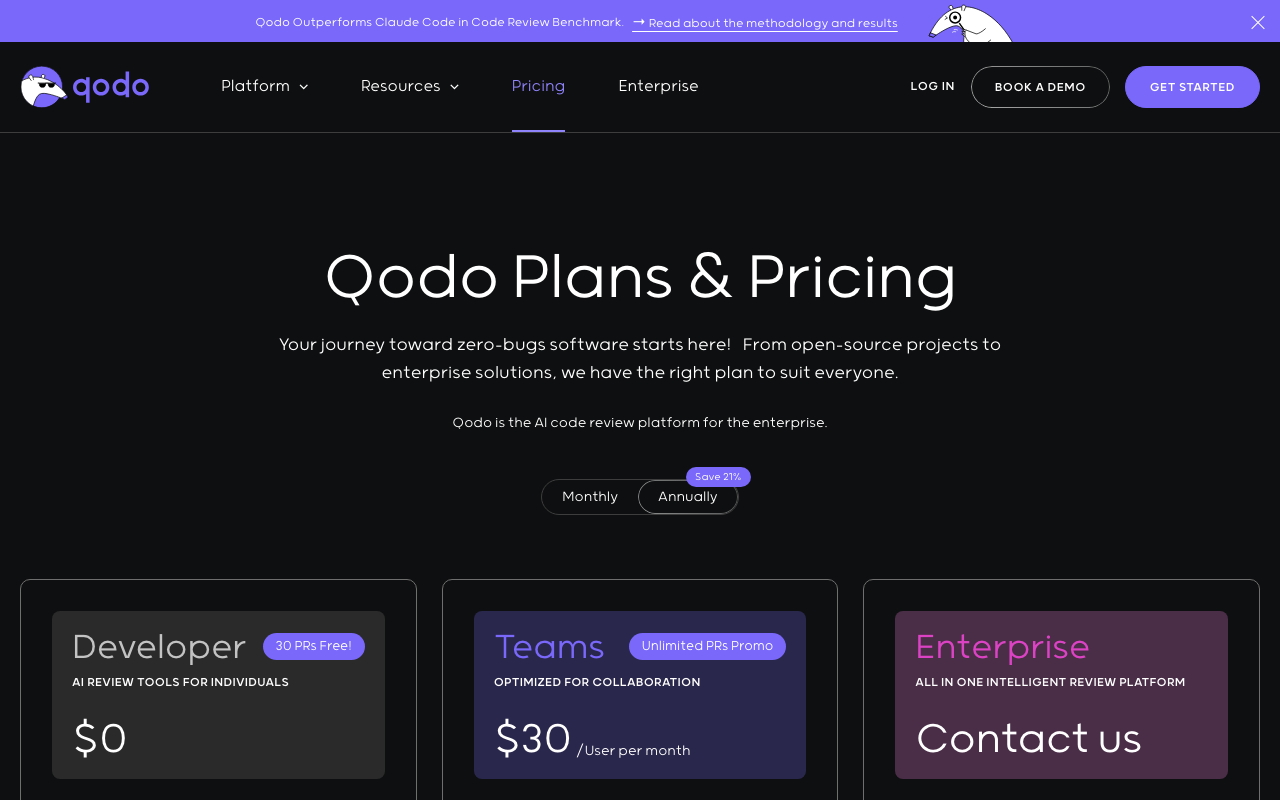
| Plan | Price | Key Capabilities |
|---|---|---|
| Developer (Free) | $0 | 30 PR reviews/month, 250 IDE/CLI credits/month, community support |
| Teams | $30/user/month | Unlimited PR reviews (limited-time promo), 2,500 credits/user/month, no data retention, private support |
| Enterprise | Custom | Context engine, multi-repo intelligence, SSO, on-premises/air-gapped deployment, 2-business-day SLA |
The credit system applies to IDE and CLI interactions. Most standard operations consume 1 credit. Premium models cost more: Claude Opus costs 5 credits per request, Grok 4 costs 4 credits. Credits reset on a 30-day rolling schedule from first use, not on calendar month boundaries.
Note: the Teams plan currently offers unlimited PR reviews as a limited-time promotion. The standard allowance is 20 PRs per user per month, so teams with high PR volume should confirm current terms before committing.
Tabnine Pricing
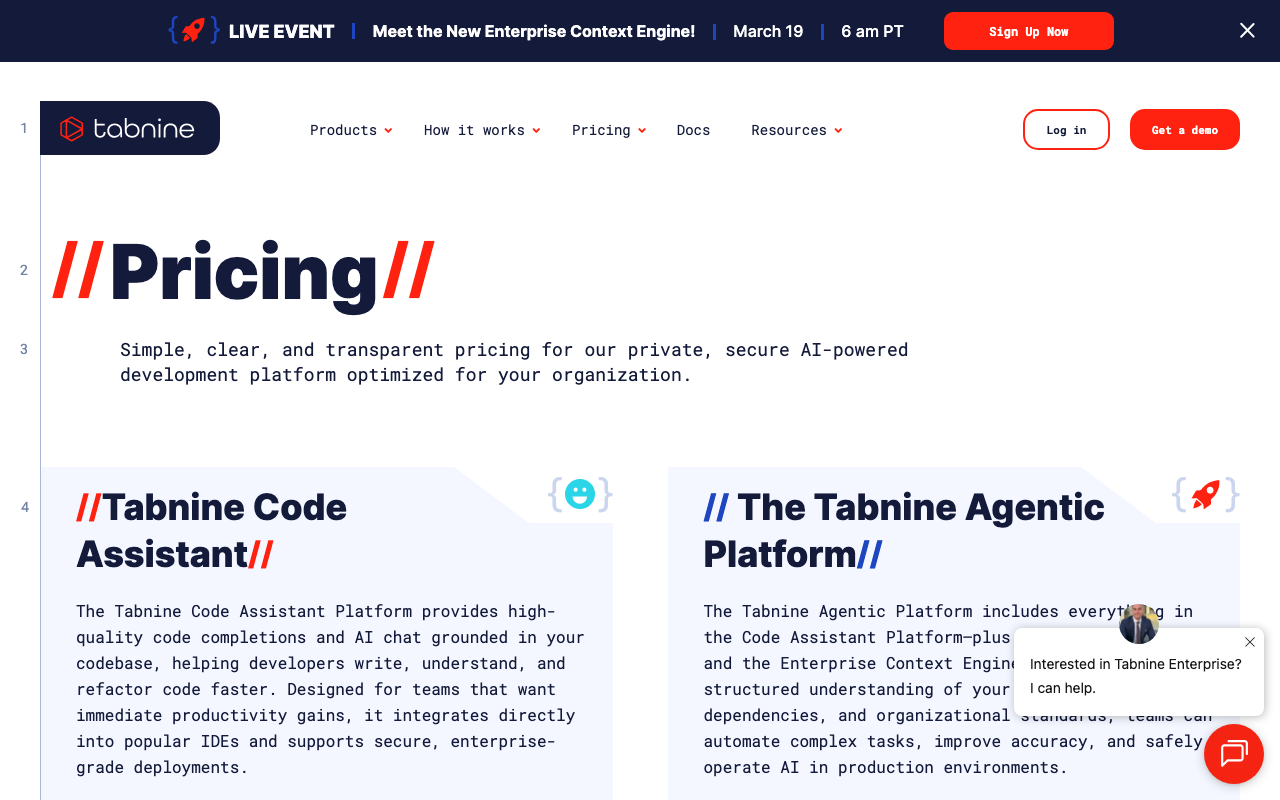
| Plan | Price | Key Capabilities |
|---|---|---|
| Basic (Free) | $0 | Basic AI completions, limited chat, all IDEs, zero data retention |
| Dev | $9/user/month | Advanced completions with top-tier LLMs, full AI chat, foundational agents, Jira integration |
| Enterprise | $39/user/month | Context Engine, on-premise/VPC/air-gapped deployment, Code Review Agent, Test Agent, model flexibility, SSO/SCIM, IP indemnity |
Tabnine has no mid-tier team plan equivalent to Qodo’s $30/user/month Teams offering. The gap between Dev ($9) and Enterprise ($39) is significant - teams that want the Context Engine, review agent, or on-premise deployment must jump to $39/user/month.
Side-by-Side Cost at Scale
| Team Size | Qodo Teams (Annual) | Tabnine Dev (Annual) | Tabnine Enterprise (Annual) |
|---|---|---|---|
| 5 developers | $1,800/year | $540/year | $2,340/year |
| 10 developers | $3,600/year | $1,080/year | $4,680/year |
| 25 developers | $9,000/year | $2,700/year | $11,700/year |
| 50 developers | $18,000/year | $5,400/year | $23,400/year |
For teams that need both code completion and deep PR review, the practical comparison is Tabnine Dev ($9) plus Qodo Teams ($30), totaling $39/user/month - identical to Tabnine Enterprise alone but with stronger review depth and test generation (Qodo) combined with better completion access (Tabnine Dev).
For teams that only need one capability - review or completion - the cost case is clearer. Tabnine Dev at $9/month is the most affordable path to quality AI completion with strong privacy. Qodo Teams at $30/month is the right investment for teams prioritizing review quality and test generation.
For context on related pricing, see our GitHub Copilot pricing guide and CodeRabbit pricing guide.
Use Cases - When to Choose Each Tool
When Qodo Makes More Sense
Teams with low test coverage who want to improve it systematically. Qodo’s proactive test generation finds coverage gaps and generates tests automatically - not in response to prompts, but as part of the review workflow. For teams that have been accumulating test debt and need a realistic path to improvement without dedicating engineering sprints to writing tests, Qodo provides a mechanism that no other tool replicates.
Organizations on GitLab, Bitbucket, or Azure DevOps that want AI code review. Qodo’s four-platform support and PR-Agent foundation make it one of very few dedicated AI code review tools that work outside GitHub. Tabnine does not offer PR review on Azure DevOps. For teams on Azure DevOps specifically, Qodo is one of the strongest available options.
Teams that prioritize review quality metrics over completion assistance. If the primary goal is catching bugs and improving code quality before merge, Qodo’s benchmark-validated 60.1% F1 score represents the current state of the art in tested AI code review tools. The multi-agent architecture produces review depth that Tabnine’s policy-based Code Review Agent does not match.
Open-source-conscious teams or teams with review transparency requirements. PR-Agent is publicly available and inspectable. For teams that need to audit what their AI review tool is actually doing with their code, Qodo’s open-source foundation is a genuine differentiator.
Teams in regulated industries that primarily need code review (not completion) with self-hosting. Qodo Enterprise’s on-premises and air-gapped deployment covers compliance requirements for the review and testing workflow. For the completion use case, Tabnine’s deployment story is more mature.
When Tabnine Makes More Sense
Regulated industry enterprises where code cannot leave the organization’s infrastructure. Financial services, healthcare, defense, and government organizations often face explicit prohibitions on cloud-based AI tools. Tabnine’s air-gapped deployment, running on Dell PowerEdge servers in your own data center with zero internet connectivity, satisfies these requirements for the full-stack AI coding experience. This is Tabnine’s defining use case.
Teams where AI code completion is the primary productivity lever. Inline completions as you type remain the most impactful daily productivity feature for most developers. Tabnine’s Dev plan at $9/user/month provides multi-LLM completion access with zero data retention. Qodo does not offer this capability at any price point.
Organizations with IP sensitivity requiring the strongest legal protection. Tabnine’s models trained exclusively on permissively licensed code, combined with zero data retention and IP indemnification on the Enterprise plan, provide a privacy and legal protection stack that no competitor can match. For software companies whose competitive advantage depends on proprietary algorithms, this combination matters.
Large teams using Eclipse, Visual Studio 2022, or Perforce. Tabnine’s IDE coverage and Perforce repository support serve legacy and heterogeneous enterprise toolchains that Qodo simply does not address. If your developers are on Eclipse or if your repositories are on Perforce, Tabnine is the only mainstream AI coding assistant that fits.
Teams needing organizational code consistency across hundreds of developers. The Enterprise Context Engine’s ability to learn and enforce organizational coding patterns makes Tabnine particularly valuable where consistency is a quality metric. Qodo’s context engine improves review depth; Tabnine’s Context Engine improves completion alignment with team standards.
The Test Generation Difference in Practice
Test generation deserves additional attention because it represents a qualitative difference in how teams experience each tool, not just a feature checkbox.
Consider a developer opening a PR that adds a new payment processing service. The service has a validateTransaction function with eight conditional branches covering valid transactions, insufficient funds, expired cards, invalid CVV, network timeouts, duplicate transactions, currency mismatches, and fraud flags.
With Tabnine’s AI Test Agent invoked, you can request tests and receive test stubs aligned with your organization’s testing framework and patterns - a solid starting point that respects your team’s conventions. The agent generates what you ask for, in your style.
With Qodo reviewing the same PR, you receive a line-level comment identifying that six of the eight conditional branches lack test coverage - plus Qodo generates eight unit tests, one per branch, using your project’s testing framework, with meaningful assertions validating return values and error types for each case. The tests are in a new file formatted according to your existing testing conventions, ready to commit. You did not ask for any of this - it happened as part of the review.
The difference is posture: Tabnine’s Test Agent responds to requests and respects your patterns. Qodo’s test generation is an autonomous reviewer that proactively identifies gaps and fills them. For teams trying to recover from test debt or enforce coverage standards on every PR, Qodo’s approach produces more consistent outcomes.
For further reading, see our how to automate code review guide and code review best practices article.
Security Considerations
Both tools address security from different angles.
Qodo’s security approach focuses on catching security vulnerabilities during code review. The multi-agent architecture includes a dedicated security agent that identifies common vulnerability patterns - SQL injection, XSS vectors, insecure deserialization, and similar issues - in PR diffs. Teams can also define custom review instructions that enforce security-specific coding rules. For automated security scanning beyond what review catches, pairing Qodo with a dedicated SAST tool like Semgrep or Snyk Code is the recommended approach.
Tabnine’s security approach focuses on securing the AI tool itself as part of your development workflow. Zero data retention prevents proprietary code exposure. IP-safe training data eliminates copyright contamination risk. Air-gapped deployment removes any possibility of code exfiltration. These are security properties of the tool, not analysis capabilities within the tool. Tabnine’s Code Review Agent can enforce security-relevant coding standards (such as flagging use of deprecated cryptographic functions), but it is not a substitute for dedicated security scanning.
For teams in security-sensitive environments, the two tools complement each other: Tabnine secures the code writing workflow, Qodo secures the code review workflow, and dedicated SAST tools handle vulnerability scanning. See our AI code review for security guide for a deeper treatment.
Alternatives to Consider
Neither Qodo nor Tabnine is the right answer for every team. Several alternatives are worth evaluating.
CodeRabbit is the most widely deployed dedicated AI code review tool, with over 2 million connected repositories and 13 million PRs reviewed. It focuses exclusively on PR review, uses AST-based analysis alongside AI reasoning, and includes 40+ built-in deterministic linters. At $12-24/user/month, it is less expensive than Qodo’s Teams plan and does not require Tabnine’s Enterprise commitment for on-premise features. CodeRabbit lacks test generation but excels at review quality. See our CodeRabbit vs Qodo comparison for a detailed breakdown.
GitHub Copilot provides code completion, chat, code review, and an autonomous coding agent under one subscription. At $19/user/month for Business, it undercuts both Qodo Teams and Tabnine Enterprise while covering more features - for teams on GitHub without strict privacy requirements. See our Qodo vs GitHub Copilot comparison and GitHub Copilot vs Tabnine comparison for detailed breakdowns of those specific matchups.
Greptile indexes your entire codebase and uses full-codebase context for every review, achieving an 82% bug catch rate in independent benchmarks - higher than Qodo’s F1 score. Greptile supports only GitHub and GitLab, has no free tier, and does not offer test generation. For teams on GitHub or GitLab that prioritize absolute review depth, Greptile is worth evaluating.
Amazon Q Developer is the best AI coding assistant for AWS-centric teams, with deep AWS service integration, code transformation capabilities, and security scanning. Its free tier is generous and the Pro plan at $19/user/month is competitively priced. Teams heavily invested in AWS infrastructure should evaluate Q Developer before committing to Tabnine’s Enterprise pricing.
For a comprehensive market view, see our best AI code review tools roundup and our best AI tools for developers guide.
Verdict - Which Should You Choose?
The Qodo vs Tabnine comparison resolves cleanly when you answer three questions about your team’s actual needs.
Do you primarily need code completion or code review? If your developers spend most of their AI tool interactions getting inline suggestions as they write - the classic autocomplete use case - Tabnine is the right tool. It does this well across 600+ languages and a wider range of IDEs, with pricing starting at $9/user/month. If your team’s primary AI investment is in reviewing pull requests and improving test coverage, Qodo is the right tool. It leads benchmarks on review accuracy and offers a test generation capability no other review tool matches.
Do you have strict data sovereignty requirements? If your organization’s code cannot be processed on any external infrastructure - whether due to regulation, contractual obligation, or security policy - Tabnine’s air-gapped deployment is the mature, battle-tested answer. Both tools offer on-premise deployment, but Tabnine has built its entire enterprise identity around this capability over years. If cloud-hosted processing with strong data retention policies is acceptable, both tools serve regulated requirements reasonably well.
Are you on GitHub only, or on multiple Git platforms? Qodo’s four-platform Git support (GitHub, GitLab, Bitbucket, Azure DevOps) is an important differentiator for organizations not standardized on GitHub. Tabnine’s Context Engine connects to GitHub, GitLab, Bitbucket, and Perforce for codebase indexing, but its PR review agent does not run on Azure DevOps.
Practical recommendations by team profile:
-
Solo developers and small teams without privacy constraints: Start with Tabnine Dev at $9/month for completion, add Qodo’s free tier (30 PR reviews/month) to evaluate whether automated review and test generation provide enough value to justify the Teams upgrade at $30/month.
-
Teams of 5-20 on GitHub focused on code quality improvement: Qodo Teams at $30/user/month delivers the deepest review quality and proactive test generation. Supplement with Tabnine Dev at $9/month or GitHub Copilot if you also want AI completions as you write.
-
Teams of 5-20 on GitLab or Azure DevOps: Qodo Teams is the strongest dedicated AI review option for your platform. Tabnine Dev handles completion alongside it if budget allows.
-
Enterprise teams in regulated industries (finance, healthcare, defense, government): Evaluate both Enterprise plans seriously. Tabnine Enterprise ($39/user/month) covers code completion, review policy enforcement, and test generation in a privacy-first, air-gapped environment. Qodo Enterprise adds deeper review accuracy, stronger test generation, and broader Git platform support. For organizations that need both capabilities to the highest standard, running both tools is justifiable - they serve different workflow stages without conflict.
-
Teams with Perforce, Eclipse, or Visual Studio 2022 requirements: Tabnine is the only mainstream AI coding assistant that serves these environments. Qodo is not a viable option for those specific tool integrations.
The bottom line: Qodo is the right investment when code quality improvement - catching bugs, closing coverage gaps, enforcing standards - is the primary metric. Tabnine is the right investment when privacy, deployment control, and AI assistance throughout the coding workflow are the primary metrics. For many enterprise teams, the answer is both - these tools complement each other more than they compete.
Frequently Asked Questions
Is Qodo better than Tabnine for code review?
For dedicated PR code review, Qodo is the stronger tool. Its multi-agent architecture in Qodo 2.0 achieved the highest F1 score (60.1%) among eight tested AI code review tools, with a recall rate of 56.7%. Tabnine's AI Code Review Agent - available only on the Enterprise plan at $39/user/month - is a newer capability that works well for policy enforcement and standards checking but lacks the benchmark validation and depth of Qodo's purpose-built review engine. If your team's primary need is deep, accurate PR review, Qodo wins. If you need code review bundled with on-premise deployment and full-stack AI assistance, Tabnine Enterprise covers that requirement.
Does Qodo generate tests automatically?
Yes. Test generation is Qodo's founding capability and strongest differentiator. Using the /test command in the IDE, Qodo analyzes code behavior, identifies untested logic paths and edge cases, and generates complete unit tests in your project's testing framework - Jest, pytest, JUnit, Vitest, and others. During PR review, Qodo proactively detects coverage gaps in changed code and generates tests to fill them without being asked. Tabnine also has an AI Test Agent on the Enterprise plan, but it operates more like a policy-guided generator rather than Qodo's proactive, coverage-gap-detection approach. For teams trying to improve test coverage systematically, Qodo's test generation is more mature and more automated.
Can Tabnine run on-premise while Qodo cannot?
Tabnine uniquely supports true on-premise and fully air-gapped deployment on its Enterprise plan ($39/user/month). The air-gapped option runs on Dell PowerEdge servers with NVIDIA GPUs inside your own data center with zero internet connectivity. Qodo does offer on-premises and air-gapped deployment on its Enterprise plan as well, through its open-source PR-Agent foundation and the full Qodo platform. Both tools can technically run on-premise, but Tabnine's deployment story is more mature and more broadly applicable as a full code assistant, while Qodo's focus remains on code review and test generation workflows. Teams evaluating on-premise options should evaluate both.
How much does Qodo cost compared to Tabnine?
Qodo's free Developer plan includes 30 PR reviews and 250 IDE/CLI credits per month. The Teams plan costs $30/user/month. Enterprise is custom-priced. Tabnine's Basic plan is free with limited completions and chat. The Dev plan costs $9/user/month. Enterprise costs $39/user/month with annual commitment. For teams that only need code review and test generation, Qodo's $30/user/month Teams plan competes against Tabnine's $39/user/month Enterprise plan - making Qodo cheaper if on-premise deployment is not required. For teams wanting AI code completion as a primary feature, Tabnine Dev at $9/user/month is significantly cheaper than adding Qodo on top.
Does Tabnine offer code completion while Qodo does not?
Correct. Code completion - inline AI suggestions as you type - is Tabnine's core, founding capability. All Tabnine plans include AI code completions, with the Dev and Enterprise plans providing access to top-tier LLMs from Anthropic, OpenAI, Google, Meta, and Mistral. Qodo's IDE plugin (for VS Code and JetBrains) does not provide traditional inline code completion. Qodo focuses on local code review, test generation, and quality analysis inside the IDE. If AI-powered code completion as you write is a priority, Tabnine is the right tool. Many teams use both: Tabnine for completion and Qodo for review and testing.
Which tool is better for enterprise teams in regulated industries?
Both tools support enterprise deployment in regulated environments, but with different strengths. Tabnine's Enterprise plan offers four deployment options including fully air-gapped on-premise that operates with zero internet connectivity, models trained exclusively on permissively licensed code, zero data retention on all plans, and IP indemnification. This combination is the strongest privacy stack among AI coding assistants. Qodo Enterprise also offers on-premise and air-gapped deployment through PR-Agent and the full platform, SSO, no data retention, and a 2-business-day SLA. Qodo additionally provides the broadest Git platform support (GitHub, GitLab, Bitbucket, Azure DevOps). For the most privacy-critical environments where code cannot touch any external service, Tabnine's deployment maturity is hard to beat. For regulated teams that also need deep code review and test generation across multiple Git platforms, Qodo Enterprise is the more specialized choice.
Does Qodo work with GitLab and Azure DevOps?
Yes. Qodo supports GitHub, GitLab, Bitbucket, and Azure DevOps for PR review - the broadest platform support in the AI code review market. This is built on Qodo's open-source PR-Agent foundation, which also supports CodeCommit and Gitea. Tabnine's Enterprise Context Engine connects to GitHub, GitLab, Bitbucket, and Perforce for codebase indexing and context-aware suggestions. Neither tool requires GitHub exclusively. For teams on Azure DevOps who want AI PR review, Qodo is one of the few dedicated options available. Tabnine does not offer PR review on Azure DevOps - only context indexing from supported platforms.
What is the Tabnine Enterprise Context Engine and how does it compare to Qodo's context engine?
Tabnine's Enterprise Context Engine (launched February 2026) builds a continuously updated model of your organization's entire software ecosystem - indexing repositories, documentation, engineering practices, and architectural patterns to create an organizational knowledge graph. AI suggestions are then aligned with your team's specific patterns and conventions. Qodo's context engine (Enterprise plan) also builds multi-repo awareness but focuses on understanding cross-service dependencies for PR review - analyzing how changes in one repository affect others in a microservice architecture. The tools serve different purposes: Tabnine's Context Engine improves code completion relevance and consistency across a large team, while Qodo's context engine improves PR review depth and cross-repo impact analysis. Both are Enterprise-only features.
Is Qodo open source?
Qodo's commercial platform is proprietary, but its core review engine is built on PR-Agent, an open-source project available on GitHub. PR-Agent can be self-hosted and supports GitHub, GitLab, Bitbucket, Azure DevOps, CodeCommit, and Gitea. Teams can inspect the review logic and deploy in air-gapped environments without sending code to external services. Tabnine's platform is entirely proprietary. For teams with transparency requirements or open-source philosophy, Qodo's PR-Agent foundation is a meaningful differentiator - no other commercial AI code review tool offers this level of auditability.
Can I use Qodo and Tabnine together in the same workflow?
Yes, and this combination makes practical sense for certain teams. Tabnine handles code completion in the IDE - inline suggestions as you type - which Qodo does not provide. Qodo handles automated PR review and proactive test generation, which Tabnine's agents address less thoroughly. The two tools operate at different workflow stages without direct conflict. The combined cost would be $9/user/month (Tabnine Dev) plus $30/user/month (Qodo Teams), totaling $39/user/month. For teams that value both strong privacy-aware code completion and deep PR review with test generation, the combination is worth evaluating. For teams with strict on-premise requirements, combining Tabnine Enterprise with Qodo Enterprise covers both deployment-secured completion and deployment-secured review.
Which tool has better free tier for evaluation?
Qodo's free Developer plan is more useful for evaluating code review and test generation specifically. It includes 30 PR reviews per month and 250 credits for IDE and CLI interactions - enough for a solo developer or small team to thoroughly assess review quality and test generation over several weeks. Tabnine's Basic free plan provides AI code completions and limited chat but does not include the Context Engine, Code Review Agent, Test Agent, or access to leading LLMs. The free tier showcases Tabnine's completion basics without revealing its enterprise strengths. If evaluating Tabnine seriously, the 14-day trial on the Dev plan ($9/user/month) gives a better picture. For evaluating code review and testing, Qodo's free tier is more demonstrative.
What is the verdict - should I choose Qodo or Tabnine?
Choose Qodo if your primary need is deep, accurate PR code review combined with automated test generation, if you are on GitLab, Bitbucket, or Azure DevOps, or if you want the open-source transparency of PR-Agent. Qodo's multi-agent architecture leads benchmarks, and its test generation capability is unique in the market. Choose Tabnine if your primary need is AI code completion with privacy guarantees, if you require on-premise or air-gapped deployment with mature infrastructure tooling, or if your team needs AI assistance across 600+ languages and multiple IDEs including Eclipse and Visual Studio 2022. Tabnine's privacy-first architecture and deployment flexibility are unmatched for regulated industries. For teams that want both capabilities, the tools complement each other well.
Explore More
Tool Reviews
 Qodo Review
 Tabnine Review
Related Articles
- Best AI Test Generation Tools in 2026: Complete Guide
- Best AI Tools for Developers in 2026 - Code Review, Generation, and Testing
- 10 Best GitHub Copilot Alternatives for Code Review (2026)
- What Happened to CodiumAI? The Rebrand to Qodo Explained
- CodiumAI vs Codium (Open Source): They Are NOT the Same
Free Newsletter
Stay ahead with AI dev tools
Weekly insights on AI code review, static analysis, and developer productivity. No spam, unsubscribe anytime.
Join developers getting weekly AI tool insights.
Related Articles
Checkmarx vs Veracode: Enterprise SAST Platforms Compared in 2026
Checkmarx vs Veracode - enterprise SAST, DAST, SCA, Gartner positioning, pricing ($40K-250K+), compliance, and when to choose each AppSec platform.
March 13, 2026
comparisonCodacy Free vs Pro: Which Plan Do You Need in 2026?
Codacy Free vs Pro compared - features, limits, pricing, and when to upgrade. Find the right Codacy plan for your team size and workflow.
March 13, 2026
comparisonCodacy vs Checkmarx: Developer Code Quality vs Enterprise AppSec in 2026
Codacy vs Checkmarx - developer code quality vs enterprise AppSec, pricing ($15/user vs $40K+), SAST, DAST, SCA, compliance, and when to choose each.
March 13, 2026