Qodo vs Diffblue: AI Test Generation Compared
Qodo vs Diffblue Cover compared on Java test generation, language support, CI/CD integration, pricing, and enterprise fit for 2026.
Published:
Last Updated:
Quick Verdict
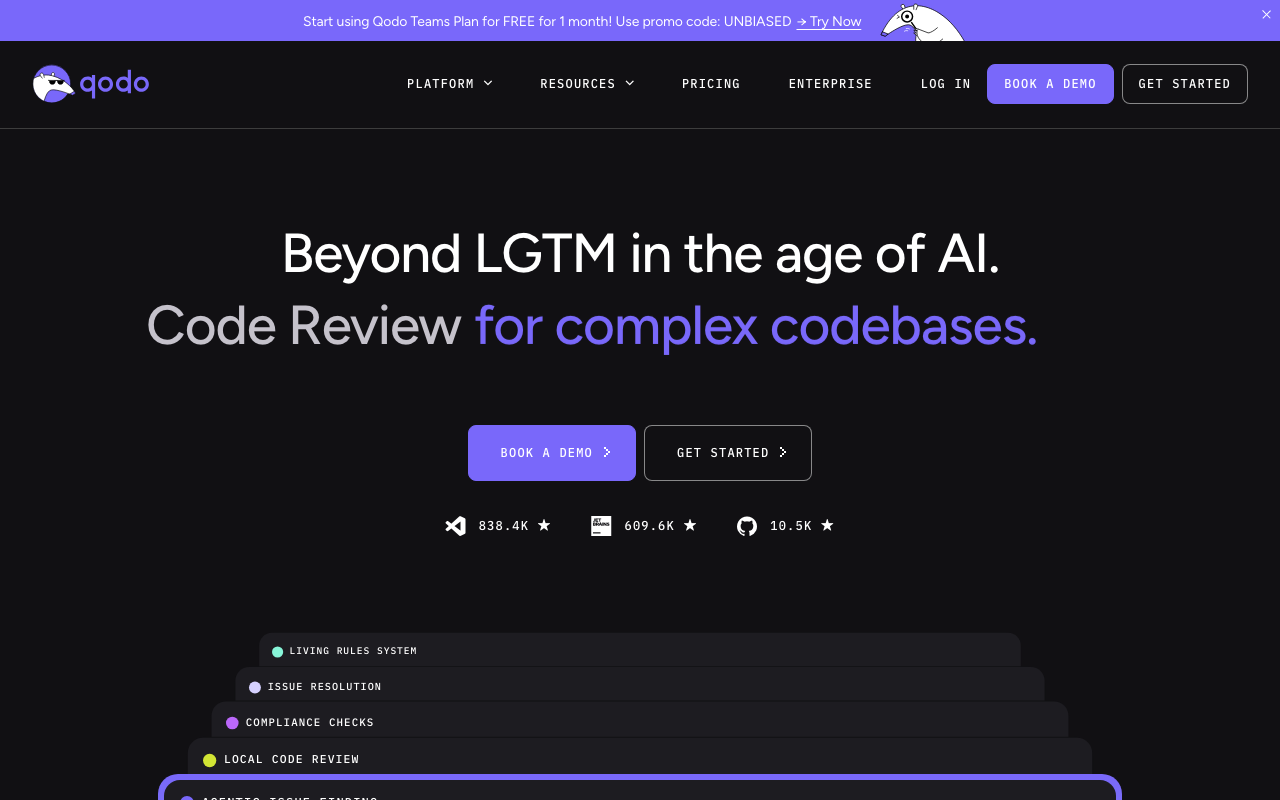
Qodo and Diffblue Cover address the same problem - generating unit tests automatically so developers do not have to write them by hand - but they approach it from fundamentally different angles. Qodo is a multi-language code quality platform that includes proactive test generation as one capability alongside PR code review. Diffblue Cover is a Java-exclusive test generation specialist built on symbolic AI and bytecode analysis, designed from the ground up for enterprise Java codebases.
Choose Qodo if: your team works across multiple languages (Python, JavaScript, TypeScript, Go, C# alongside Java), you want test generation integrated with PR code review in a single tool, you need a free tier for evaluation, or you want the deepest available AI code review paired with test generation.
Choose Diffblue Cover if: your codebase is 100% Java, you need bytecode-accurate regression test generation for refactoring safety in complex Spring Boot applications, and your organization has the enterprise procurement process for a directly-sold tool without a public free tier.
The key practical difference: Qodo generates tests by detecting coverage gaps during PR review and filling them proactively - it is part of the review workflow. Diffblue Cover generates tests by analyzing compiled Java bytecode as a CI pipeline step - it is part of the build workflow. These are different integration points for different development philosophies, and understanding which fits your team’s workflow is the most important factor in this comparison.
Why This Comparison Matters
Automated unit test generation has long been a holy grail in software engineering. Tests are universally acknowledged as essential, and yet test debt accumulates in virtually every codebase because writing tests is time-consuming and developers prioritize feature work. The promise of both Qodo and Diffblue Cover is the same: use AI to close that gap without requiring developer time.
Qodo’s roots go back to CodiumAI, founded in 2022 specifically to solve the test generation problem. The company evolved the platform to include PR code review, rebranded to Qodo, and in February 2026 launched Qodo 2.0 with a multi-agent review architecture that achieved the highest F1 score (60.1%) among eight tested AI code review tools. The company has raised $40 million in Series A funding and earned Gartner Visionary recognition in 2025.
Diffblue Cover is the commercial product of Diffblue, a company spun out of Oxford University in 2016. The tool is built on decades of research in formal verification and symbolic AI applied to Java code analysis. Diffblue Cover has been deployed in large enterprise Java environments - particularly in financial services and telecommunications - where Java is the standard language and refactoring safety is a primary concern.
The comparison is meaningful because organizations evaluating “AI test generation” encounter both products and need to understand whether Diffblue’s deep Java specialization is worth its limitations versus Qodo’s broader but less Java-specific approach.
For related context, see our best AI code review tools roundup and our best AI tools for developers guide.
At-a-Glance Comparison
| Dimension | Qodo | Diffblue Cover |
|---|---|---|
| Primary focus | AI PR review + multi-language test generation | AI unit test generation for Java exclusively |
| Language support | 10+ languages (Java, Python, JS, TS, Go, C#, etc.) | Java only |
| Test generation approach | Coverage gap detection during PR review + IDE /test command | Bytecode analysis, symbolic AI, CI pipeline step |
| PR code review | Yes - multi-agent, core feature | No |
| Testing frameworks | JUnit, pytest, Jest, Vitest, TestNG, and others | JUnit 4, JUnit 5 |
| Spring Boot support | Yes | Yes - deep specialization |
| Bytecode analysis | No - source-based | Yes |
| IDE integration | VS Code, IntelliJ IDEA (JetBrains) | IntelliJ IDEA |
| CI/CD integration | Git plugin (PR-triggered), CLI | CLI (pipeline step), automated commit |
| Git platforms | GitHub, GitLab, Bitbucket, Azure DevOps | GitHub, GitLab (via CLI) |
| Open-source foundation | Yes - PR-Agent | No |
| On-premise deployment | Yes (Enterprise) | Yes |
| Free tier | Yes - 30 PR reviews + 250 IDE credits/month | No publicly available free tier |
| Paid starting price | $30/user/month (Teams) | Not publicly listed - direct sales |
| Company founded | 2022 (as CodiumAI) | 2016 |
| Gartner recognition | Visionary 2025 | Not listed |
What Is Qodo?
Qodo (formerly CodiumAI) is an AI-powered code quality platform that combines automated PR review with proactive test generation in a single product. Founded in 2022 with test generation as its original purpose, the company expanded to include full PR code review and rebranded as the platform grew beyond its testing roots.
The platform operates through four connected components: a Git plugin for PR reviews across GitHub, GitLab, Bitbucket, and Azure DevOps; an IDE plugin for VS Code and IntelliJ IDEA that brings review and test generation directly into the development environment; a CLI plugin for terminal-based quality workflows; and an Enterprise context engine for multi-repo intelligence.
For test generation specifically, Qodo’s approach combines two mechanisms. The IDE plugin provides the /test command, which developers invoke on any function, method, or class to generate complete unit tests immediately. The PR review workflow identifies coverage gaps in changed code automatically - without being asked - and generates tests for those gaps as part of the PR review output. Both mechanisms produce tests with meaningful assertions for edge cases, error conditions, boundary values, and null handling that developers routinely miss.
The February 2026 Qodo 2.0 release formalized the multi-agent architecture, where specialist agents for bugs, code quality, security, and test coverage work simultaneously. This architecture achieved 60.1% F1 score in comparative benchmarks, the highest among eight tested AI code review tools.
For a complete feature breakdown, see the Qodo tool review.
What Is Diffblue Cover?
Diffblue Cover is an AI-powered unit test generation tool exclusively designed for Java. Spun out of Oxford University in 2016, Diffblue built its test generation capability on symbolic AI and formal verification research rather than large language models - a fundamentally different technical foundation than tools like Qodo that rely on LLM-based reasoning.
The core approach is bytecode analysis. Diffblue Cover compiles your Java project and analyzes the resulting bytecode to understand actual runtime behavior - not just what the source code appears to do, but what the JVM actually executes. Symbolic AI techniques then reason over possible execution paths to generate JUnit tests that cover the code’s real behavior precisely.
This approach excels in specific scenarios. For complex Spring Boot applications with deep dependency injection, bytecode analysis can correctly model Spring context behavior that confuses source-level AI tools. For legacy Java codebases being refactored, tests generated from bytecode analysis serve as accurate regression baselines - run them before and after the refactor to verify behavioral preservation. For enterprise Java teams running Java 8 through 21, Diffblue has invested specifically in Java framework compatibility in ways that general-purpose tools have not.
The product integrates with CI/CD pipelines through its CLI, which can be configured to run automatically on every build and commit generated tests back to the repository without manual developer intervention. The IntelliJ IDEA plugin provides the developer interface for examining and curating the generated tests.
Diffblue does not offer a public free tier or listed pricing. The product is sold enterprise-first through direct sales with annual agreements.
Feature-by-Feature Breakdown
Test Generation Approach and Quality
This is the core dimension of the comparison, and both tools produce high-quality tests - but the quality manifests differently.
Qodo’s test generation is LLM-powered and operates from source code. It understands semantic intent - what a function is supposed to do based on its name, documentation, parameter types, and surrounding code context. This semantic understanding allows Qodo to generate tests for edge cases that are conceptually meaningful: boundary values at the edges of valid input ranges, null and empty input handling, error propagation through exception paths, and combinations of inputs that expose conditional logic. The /test command generates tests in seconds for any selected code, and the PR review workflow continuously identifies and fills coverage gaps without developer action.
For Java specifically, Qodo generates JUnit 4 and JUnit 5 tests and handles common Java patterns including collections, generics, interface implementations, and Spring Boot service methods. However, Qodo approaches Java as one of ten-plus supported languages - its test generation is broad and strong, but Java is not its exclusive focus.
Diffblue Cover’s test generation is bytecode-based and operates from compiled output. It understands runtime behavior - what the code actually does when executed on the JVM. This produces tests with a different kind of quality: they are accurate to execution rather than intent. Diffblue-generated tests will correctly capture the behavior of complex Spring-managed beans because the tool analyzes how Spring actually wires them at runtime, not how it appears they should be wired from source. For legacy Java code with complex inheritance hierarchies, static initializers, and framework magic that is difficult to reason about from source alone, bytecode analysis produces more reliable tests.
The tradeoff is clear: Qodo’s tests are better at exploring the space of “what should this code handle” through semantic reasoning. Diffblue’s tests are better at capturing “what does this code actually do” through runtime analysis. For regression testing and refactoring safety, Diffblue’s runtime accuracy is a meaningful advantage. For proactively improving coverage by identifying untested scenarios, Qodo’s semantic approach surfaces cases that bytecode execution paths alone would not expose.
Language and Framework Support
Language support is the most significant limiting factor in this comparison for most teams.
Qodo supports over 10 programming languages - Java, Python, JavaScript, TypeScript, Go, C#, Ruby, PHP, Swift, and Kotlin, among others. In a modern polyglot engineering organization, where a web application might have a Python backend, TypeScript frontend, Go microservices, and Java data pipelines, Qodo covers the entire stack with a single tool and a single subscription. Test generation, code review, and IDE integration work consistently across all supported languages.
Diffblue Cover supports Java exclusively. This is not a limitation that will change - the bytecode analysis approach is fundamentally tied to the JVM. While Diffblue’s website notes some support for JVM languages adjacent to Java, the tool is designed, tested, and sold as a Java solution. Organizations with any meaningful non-Java code in their stack cannot apply Diffblue to that code.
For Java framework depth, Diffblue has invested significantly in Spring Boot, Spring Data, Spring Security, Hibernate, and other enterprise Java frameworks. The tool understands how to mock Spring beans correctly, how to handle Spring Boot test slices, and how to generate tests for Hibernate-managed entities without falling into common JPA testing pitfalls. This framework depth is genuinely valuable for large Spring Boot codebases and represents real engineering investment.
Qodo handles Spring Boot code well and understands Spring test conventions, but its Spring knowledge is breadth-oriented rather than depth-optimized. For teams with very complex Spring applications - custom autoconfiguration, multi-module enterprise applications, Spring Batch pipelines - Diffblue’s deeper Spring expertise may produce measurably better tests.
PR Code Review Integration
This is a capability that Qodo has and Diffblue Cover does not.
Qodo’s PR review is central to how test generation gets delivered. When a developer opens a pull request, Qodo’s Git plugin automatically reviews the changed code - identifying bugs, code quality issues, security concerns, and test coverage gaps. For each coverage gap found, Qodo generates tests and delivers them as part of the PR review output. The developer receives not just “this code path is untested” but the actual test code ready to commit.
This integration creates a workflow where test generation is embedded in the development review process rather than being a separate step. Tests are generated in context - they are aware of the PR’s specific changes, what was added or modified, and what baseline coverage looked like before. The review and the test generation reinforce each other: a bug finding prompts a test that would have caught it, and a coverage gap finding prompts a test that enforces the intended behavior.
Diffblue Cover has no PR review capability. It does not analyze pull requests, generate line-level comments, flag bugs, or participate in the code review workflow. Diffblue is a test generation engine that runs on compiled code - it operates in the CI pipeline or in the developer’s IDE, but not as a PR review participant. Teams using Diffblue still need a separate code review process - whether manual, or augmented by a dedicated review tool like CodeRabbit or Qodo itself.
For teams evaluating test generation tools, this difference has workflow implications beyond just the presence or absence of review features. Qodo’s test generation results are surfaced in the place where developers are already paying attention - the PR review - making them more likely to be acted on. Diffblue’s test generation runs as a background CI step, which can mean generated tests accumulate in automated commits without individual developers reviewing their quality.
CI/CD and Automation
Both tools support automation, but their automation philosophies differ.
Diffblue Cover’s CLI is designed for fully autonomous operation in CI/CD pipelines. Configure it as a pipeline stage, point it at a compiled Java project, and it generates JUnit tests and commits them to the repository without any human intervention. This “fire and forget” automation is appealing for large Java codebases where the goal is to maximize test coverage metrics without developer overhead. Jenkins, GitHub Actions, GitLab CI, and most other CI platforms can run the Diffblue CLI as a standard command.
The fully autonomous commit model has tradeoffs. Generated tests, while generally accurate, can produce false-positive tests that validate existing bugs rather than correct behavior - particularly in legacy code where the “behavior” being captured is itself incorrect. Teams running Diffblue in fully automated mode need a governance process for reviewing and curating generated tests before they become part of the official test suite.
Qodo’s CI integration works through the Git plugin - triggered by pull requests rather than builds. This means test generation happens in a human-review context: generated tests are surfaced as PR review suggestions that a developer examines and merges deliberately. The CLI plugin also supports terminal-based interactions for developers who prefer command-line workflows. Qodo does not operate in “autonomous commit” mode - it surfaces recommendations through the review workflow.
For teams that want maximum automation with minimum developer involvement, Diffblue’s autonomous mode is more aggressive. For teams that want generated tests reviewed before merging, Qodo’s PR-integrated approach builds that review into the process naturally.
Enterprise Features and Deployment
Both tools target enterprise customers, but their enterprise features reflect their different focuses.
Qodo Enterprise includes on-premises and air-gapped deployment (through the full Qodo platform and the open-source PR-Agent foundation), SSO/SAML integration, multi-repo context intelligence, a 2-business-day SLA, and no data retention. The open-source PR-Agent foundation is a genuine differentiator: enterprise teams can inspect the review and test generation logic, run the core engine themselves without proprietary cloud dependencies, and contribute to improvements. The four-platform Git support (GitHub, GitLab, Bitbucket, Azure DevOps) is essential for organizations not standardized on GitHub.
Diffblue Cover Enterprise includes on-premises deployment, which is important for financial services and other regulated industries where Java code cannot leave internal infrastructure. The bytecode analysis approach has a natural privacy advantage: unlike LLM-based tools that send source code to an AI API, Diffblue’s analysis runs locally or on-premise against compiled bytecode. This local execution model means no code ever leaves your infrastructure in the default on-premise deployment.
For teams in regulated industries specifically evaluating Java test generation, Diffblue’s local execution and on-premise deployment story is strong - not because it uniquely offers on-premise (Qodo does too), but because the bytecode analysis architecture means the AI processing itself happens locally rather than calling an external LLM API.
Pricing Comparison
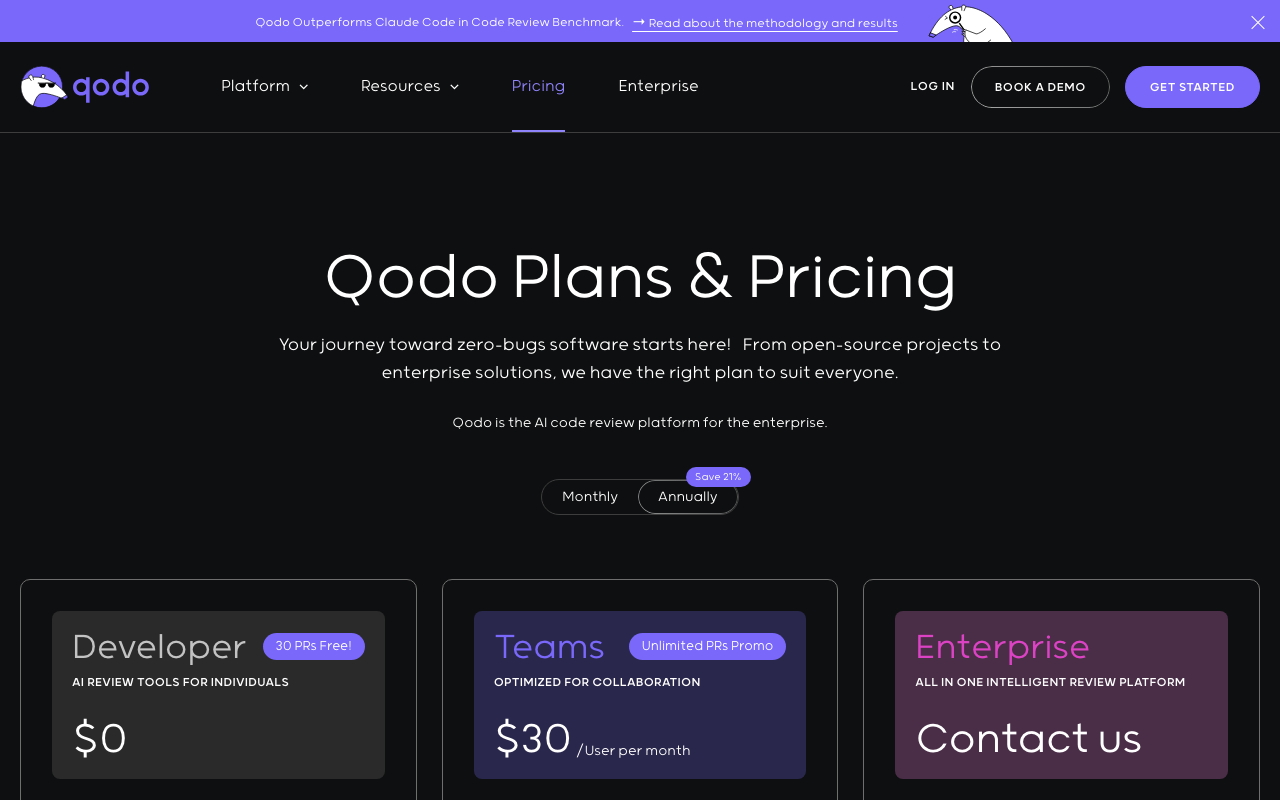
Qodo Pricing
| Plan | Price | Key Capabilities |
|---|---|---|
| Developer (Free) | $0 | 30 PR reviews/month, 250 IDE/CLI credits/month, community support |
| Teams | $30/user/month | Unlimited PR reviews (limited-time promo), 2,500 credits/user/month, no data retention, private support |
| Enterprise | Custom | Context engine, multi-repo intelligence, SSO, on-premises/air-gapped deployment, 2-business-day SLA |
Qodo’s pricing is publicly listed and self-serve. The free Developer tier allows meaningful evaluation over weeks on real projects before committing to a paid plan. The Teams plan at $30/month flat for up to 30 users covers both the PR review and test generation capabilities. Credits apply to IDE and CLI interactions, with most operations consuming 1 credit and premium models (Claude Opus at 5 credits, Grok 4 at 4 credits) consuming more.
Diffblue Cover Pricing
Diffblue Cover does not publish pricing on its website. The product is sold enterprise-first through direct sales with annual agreements. Based on available community reports and analyst sources, pricing is in the range of enterprise developer tooling - typically requiring a minimum annual commitment with per-developer licensing that scales based on team size and deployment configuration.
The absence of a public free tier or self-serve evaluation path has practical implications. Teams evaluating Diffblue Cover must initiate a sales process, participate in a proof-of-concept engagement, and obtain procurement approval before testing the tool in any real capacity. This contrasts sharply with Qodo’s model where a developer can start the free tier immediately.
Side-by-Side Cost Considerations
| Team Size | Qodo Teams (Annual est.) | Diffblue Cover |
|---|---|---|
| 5 developers | ~$1,800/year | Contact sales |
| 10 developers | ~$3,600/year | Contact sales |
| 25 developers | ~$9,000/year | Contact sales |
| 50 developers | ~$18,000/year | Contact sales |
For teams with Java-only codebases that have already decided to invest in dedicated test generation, the budget evaluation requires getting a Diffblue quote to compare against Qodo’s listed prices. For teams on a budget, or evaluating multiple tools before committing, Qodo’s transparent pricing and free tier provide a significant practical advantage.
For context on related pricing, see our GitHub Copilot pricing guide and CodeRabbit pricing guide.
Use Cases - When to Choose Each Tool
When Qodo Makes More Sense
Polyglot codebases with Java as one language among many. If your engineering organization writes Java services alongside Python data pipelines, TypeScript frontends, and Go microservices, Qodo provides unified test generation and code review across the entire stack. Diffblue simply cannot address non-Java code. A single Qodo subscription covers all developers regardless of language, while a Diffblue investment only benefits Java developers.
Teams that want test generation embedded in the PR review workflow. Qodo’s architecture delivers test generation where developers are already paying attention - the pull request. Generated tests appear alongside review findings and are directly actionable without switching tools or workflows. For teams where the bottleneck is not “generating tests” but “making sure tests get written as part of each PR,” Qodo’s integration point is the right design.
Teams with a free-tier evaluation requirement or limited initial budget. Qodo’s Developer plan (free, 30 PR reviews, 250 credits/month) allows thorough evaluation over weeks on real projects. Diffblue’s sales-gated evaluation process requires time and organizational commitment before any testing can happen. For smaller teams or startups evaluating AI development tools, Qodo’s frictionless start is a significant practical advantage.
Teams on GitLab, Bitbucket, or Azure DevOps who want PR review alongside test generation. Qodo supports all four major Git platforms. Diffblue’s CLI can run on any CI platform, but it does not provide PR review on any platform. For teams not on GitHub, Qodo provides both capabilities through a single platform.
Open-source-conscious teams or teams requiring review auditability. PR-Agent, Qodo’s core review engine, is publicly available and inspectable. Teams that need to understand what their AI tool does with their code, or that want to run the review engine without cloud dependencies, can do so with Qodo’s open-source foundation.
When Diffblue Cover Makes More Sense
Large Java monoliths or enterprise Java codebases with complex Spring Boot architecture. Diffblue’s bytecode analysis and deep Spring Boot specialization produce tests that correctly model Spring’s dependency injection, transaction management, and security configurations at runtime. For codebases where Spring framework complexity defeats LLM-based test generation - with custom autoconfiguration, complex bean lifecycle management, or deeply layered service architectures - Diffblue’s formal analysis approach may generate significantly better tests.
Teams prioritizing regression test generation for legacy Java refactoring projects. The classic Diffblue use case is: you have a large Java application you need to refactor or modernize, you have insufficient test coverage to refactor safely, and you need to generate regression tests quickly before starting the refactor. Diffblue’s bytecode analysis captures what the code currently does with runtime accuracy - exactly the behavior you need to preserve through the refactor. This is a specific, high-value use case where Diffblue’s approach is purpose-built.
Fully autonomous CI-integrated test generation with automatic commits. Diffblue’s CLI supports fully autonomous operation - run it in CI, generate tests, commit to the repository, no human interaction required. For organizations trying to systematically increase test coverage metrics across large Java codebases at scale, the fully automated mode maximizes throughput. Qodo generates tests through the PR review interaction rather than autonomously.
Teams with strict local execution requirements for AI tools. Diffblue’s bytecode analysis runs locally - the AI processing does not require sending code to an external LLM API. For regulated environments where any code-to-cloud data flow for AI processing is prohibited even with strong security controls, Diffblue’s local analysis model is architecturally simpler to approve.
The Test Generation Quality Question in Practice
Understanding how each tool performs in real Java development scenarios clarifies which belongs in your stack.
Consider a Java service class - a PaymentProcessingService with a Spring-managed repository dependency, a processPayment method that calls a payment gateway, handles success and failure responses, updates the database through JPA, publishes an audit event, and throws specific exceptions for validation failures.
With Qodo’s IDE plugin, you invoke /test on the processPayment method. Qodo reads the source code, understands the method’s intent from its name and parameter types, identifies that it has multiple conditional branches (success, failure, timeout, validation error), and generates JUnit 5 tests for each branch using Mockito to mock the repository and gateway dependencies. The tests are semantically reasonable - they test what the code is supposed to do. Within a PR review, if a change to this service leaves the timeout branch untested, Qodo flags it and generates a test for that specific gap.
With Diffblue Cover running as a CI step, the tool compiles the project, analyzes the PaymentProcessingService bytecode, and generates JUnit tests based on actual execution paths. Because it analyzes bytecode, it correctly captures how Spring wires the actual repository implementation at runtime, how the payment gateway client is instantiated, and what the actual return values are for each execution path. The generated tests are accurate to runtime behavior - if a validation method has a subtle runtime quirk that differs from its apparent source intent, Diffblue’s tests capture the actual behavior rather than the intended behavior.
Neither output is universally better. Qodo’s tests are more useful for catching the “I forgot to test the timeout case” gap. Diffblue’s tests are more useful for the “I refactored the payment service and need to verify I didn’t change its behavior” scenario. The right tool depends on which of these needs is more pressing for your team right now.
For further reading on testing practices, see our how to automate code review guide and code review best practices article.
Alternatives to Consider
If neither Qodo nor Diffblue Cover is the right fit, several alternatives are worth evaluating.
Snyk Code attacks a different part of the problem: it scans pull requests for security vulnerabilities and surfaces fixes in the IDE and in CI, with strong Java support. It does not generate tests, but for teams whose real gap is security coverage rather than coverage percentage it is a better use of the same budget than either Qodo or Diffblue.
CodeRabbit is the most widely deployed dedicated AI code review tool, with over 2 million connected repositories. It focuses on PR review quality using AST-based analysis and 40+ built-in linters, with pricing at $12-24/user/month. CodeRabbit does not provide test generation but leads on review thoroughness and can pair with a dedicated test generation tool. See our CodeRabbit vs Qodo comparison for a detailed breakdown.
GitHub Copilot at $19/user/month includes test generation capabilities alongside code completion, chat, and PR review for teams already in the GitHub ecosystem. Its test generation is invoked through chat and is less automated than either Qodo or Diffblue, but it covers Java and multiple other languages under a single subscription that many teams already pay for.
EvoSuite is a mature open-source Java test generation tool from Saarland University that predates the AI wave. It uses evolutionary algorithms to generate JUnit tests maximizing coverage. EvoSuite is free, well-documented, and effective for teams with constrained budgets. It lacks the LLM-based semantic understanding of Qodo and the commercial framework support of Diffblue, but it covers the core regression test generation use case for Java without cost.
Qodana is JetBrains’ code quality platform with deep Java integration and IntelliJ-powered static analysis. While not a test generation tool, it is worth mentioning for Java teams evaluating the broader code quality stack. See our CodeRabbit vs Qodana comparison for context on the static analysis space.
For a comprehensive view of the market, see our best AI code review tools roundup.
Security Considerations
Both tools handle security from different angles, and the considerations differ from typical AI coding tool security concerns.
Qodo’s security posture for test generation is consistent with its overall platform security: Teams and Enterprise plans have no data retention, Enterprise supports on-premise deployment, and the open-source PR-Agent foundation is inspectable. When generating Java tests, Qodo processes source code through its LLM pipeline - the same code that flows through its PR review workflow. Teams with strict code confidentiality requirements should evaluate the Enterprise on-premise option to keep all processing inside their infrastructure.
Diffblue Cover’s security posture has a structural advantage for teams concerned about code leaving their infrastructure: the bytecode analysis approach processes compiled JVM bytecode, and in on-premise configurations the entire analysis pipeline runs locally without external API calls. This means no Java source code - and no bytecode representations of proprietary logic - needs to transit to an external service in the default on-premise deployment. For regulated Java teams where even encrypted code-to-cloud transit is unacceptable, this architecture is genuinely simpler to approve.
For enterprise teams evaluating both tools on security grounds, the question is not which has better security policies but which architecture better satisfies your data governance constraints. Diffblue’s local bytecode analysis is architecturally simpler from a code confidentiality perspective. Qodo’s Enterprise on-premise deployment addresses the same concern but requires the Enterprise plan and a deployment process.
See our AI code review for security guide and AI code review in enterprise environments article for broader context on security considerations in AI code tools.
Verdict - Which Should You Choose?
The Qodo vs Diffblue Cover comparison comes down to three questions about your team’s actual situation.
Is your codebase Java-only, or does it include other languages? If any meaningful portion of your codebase is not Java - Python, JavaScript, TypeScript, Go, C# - Diffblue Cover is not viable as a complete solution. You would need Qodo or another multi-language tool for non-Java code anyway, and running two test generation tools is difficult to justify. For polyglot codebases, Qodo is the clear answer. For pure Java shops, the comparison becomes more nuanced.
Do you need test generation integrated with PR review, or as an autonomous CI step? Qodo’s approach embeds test generation in the PR review workflow - tests are surfaced as review suggestions in context. Diffblue’s approach runs tests generation autonomously in CI - tests are committed to the repository without individual PR review. If your development culture centers on thorough PR review and you want test generation to be a natural part of that process, Qodo fits. If you want to maximize test coverage metrics through fully automated CI-integrated generation with minimum developer friction, Diffblue’s autonomous model is more aggressive.
Can you evaluate without a sales process? Qodo’s free Developer tier allows immediate, frictionless evaluation. Diffblue requires a sales engagement. For teams that need to demonstrate value before budget commitment, or that are evaluating multiple tools in parallel, the friction difference is practically significant regardless of the tools’ relative technical merits.
Practical recommendations by team profile:
-
Java-only teams, large legacy codebase, major refactoring project coming: Evaluate Diffblue Cover seriously. The bytecode analysis and regression test generation accuracy for Java refactoring is purpose-built for this scenario. Get a quote and run a proof-of-concept against a realistic section of your codebase alongside Qodo’s free tier to compare output quality directly.
-
Java teams on Spring Boot with sufficient budget, prioritizing review quality: Qodo Teams at $30/month flat for up to 30 users provides PR review and test generation in a single product. The integration of review findings with test generation creates a virtuous cycle that improves code quality beyond just coverage metrics.
-
Polyglot teams with Java as one language among several: Qodo is the only viable choice of the two. Diffblue cannot cover your non-Java code.
-
Teams evaluating before committing budget: Start with Qodo’s free tier immediately. Initiate a Diffblue evaluation in parallel if your codebase is Java-only and you have the procurement bandwidth to run a sales process. The two evaluations in parallel give you the comparative data to make a grounded decision.
-
Teams wanting security coverage beyond test generation: Consider Snyk Code as a complement, adding vulnerability scanning on every pull request alongside whichever review tool you pick.
For most teams, Qodo is the more accessible starting point - immediate evaluation, transparent pricing, and broader language coverage. Diffblue Cover is the more compelling specialized tool for teams with a very specific Java-heavy profile and a use case where bytecode-accurate regression test generation justifies the enterprise procurement process.
Further Reading
- What Happened to CodiumAI? The Rebrand to Qodo Explained
- CodiumAI vs Codium (Open Source): They Are NOT the Same
- CodiumAI vs GitHub Copilot: Which AI Coding Assistant Should You Choose?
- Qodo vs CodeRabbit: AI Code Review Tools Compared (2026)
- Qodo vs Cody (Sourcegraph): AI Code Review Compared (2026)
 Gitar
GitarComments are not enough
Gitar applies the fix, validates it in CI, and clears the queue.
See it on your repo Read our independent Gitar reviewFrequently Asked Questions
Does Qodo generate tests for Java?
Yes. Qodo generates unit tests for Java projects using JUnit and similar Java testing frameworks. It identifies edge cases, uncovered conditional branches, and error paths in your code, then generates complete test methods with meaningful assertions. During PR review, Qodo automatically detects Java files in changed diffs that lack sufficient test coverage and generates tests for those gaps without being asked. The IDE plugin for VS Code and IntelliJ IDEA (JetBrains) also allows developers to invoke test generation directly on any selected Java method or class. Qodo is not Java-exclusive - the same capability works across Python, JavaScript, TypeScript, Go, C#, and other languages - which makes it a better fit for polyglot codebases.
Is Diffblue Cover only for Java?
Yes. Diffblue Cover is exclusively designed for Java. The product uses symbolic AI and formal reasoning to analyze Java bytecode and generate JUnit tests with a focus on regression coverage and refactoring safety. This deep specialization gives Diffblue outstanding performance on Java-specific patterns - Spring Boot services, Hibernate entities, complex inheritance hierarchies, and enterprise Java frameworks. But it cannot generate tests for Python, JavaScript, TypeScript, Go, C#, or any non-JVM language. Teams running polyglot stacks or even mixed JVM projects (Java alongside Kotlin or Scala) will find Diffblue's coverage incomplete. If your codebase is 100% Java, Diffblue's specialization is a meaningful advantage. If it is not, Qodo's multi-language support is essential.
How does Diffblue Cover integrate with CI/CD pipelines?
Diffblue Cover integrates directly into CI/CD pipelines through its command-line interface (CLI), which can run as a stage in Jenkins, GitHub Actions, GitLab CI, and similar pipelines. When triggered, the CLI analyzes the Java project, generates JUnit tests, and can be configured to commit those tests back to the repository automatically. This CI-first design was built for enterprise Java teams that want test generation to run continuously as part of automated build processes - not just when a developer manually invokes the tool. The IntelliJ IDEA plugin provides the developer-facing interface for examining and reviewing generated tests before committing. Qodo's CI integration works differently: the Qodo Git plugin runs on pull requests, generating tests as part of PR review feedback rather than as an autonomous CI step.
What is the pricing difference between Qodo and Diffblue Cover?
Qodo's pricing is publicly listed: the Developer plan is free with 30 PR reviews and 250 IDE credits per month, the Teams plan costs $30/month flat for up to 30 users, and Enterprise is custom-priced. Diffblue Cover does not publish pricing on its website. The product targets enterprise Java teams and is sold through direct sales with annual commitments. Independent community reports and analyst sources indicate Diffblue Cover pricing is in the range of enterprise software - typically $50-100+ per developer per year at minimum with costs scaling significantly for large teams. The lack of a self-serve free tier or publicly listed price is a meaningful difference: Qodo allows any developer to start immediately and evaluate the tool for free, while Diffblue requires a sales engagement before evaluation. Teams comparing the two should request a Diffblue quote alongside testing Qodo's free tier.
Does Diffblue Cover handle Spring Boot and enterprise Java frameworks?
Yes, and this is one of Diffblue Cover's strongest capabilities. The tool has been specifically engineered to handle the complexity of Spring Boot dependency injection, Spring Data repositories, Spring Security configurations, Hibernate entity mappings, and other enterprise Java framework patterns that make automated test generation difficult. Diffblue's symbolic AI approach analyzes bytecode rather than source text, allowing it to reason about actual runtime behavior in Spring-managed contexts rather than guessing from source structure alone. This bytecode-level analysis produces tests that correctly mock Spring beans, set up test contexts, and exercise service logic at the appropriate layer. Qodo's test generation also handles Spring Boot code but approaches it as one of many framework contexts rather than as a primary specialization.
Can Qodo review pull requests while Diffblue cannot?
Yes. PR code review is a core Qodo capability that Diffblue Cover does not provide. Qodo's multi-agent PR review system analyzes pull requests for bugs, code quality issues, security vulnerabilities, and test coverage gaps - then generates tests to address those gaps. This makes Qodo part of the code review workflow as well as the testing workflow. Diffblue Cover is exclusively a test generation tool with no PR review functionality. It analyzes existing code to generate regression tests but does not evaluate code quality, flag potential bugs, or provide line-level comments on changes. For teams that want both automated PR review and automated test generation in a single product, Qodo is the more complete solution. Teams that want the deepest possible Java test generation and have a separate code review workflow may find Diffblue a valuable complement.
Does Diffblue Cover require code to be compiled to generate tests?
Yes. Diffblue Cover analyzes compiled Java bytecode, not raw source code. This means your project must compile successfully before Diffblue can generate tests. In practice, this requirement means Diffblue is most effective on stable, compiling codebases - it is used primarily for generating regression tests on existing Java code rather than generating tests during active development on code that may not yet compile cleanly. Qodo analyzes source code directly and can generate tests or review incomplete code changes in PR diffs without requiring a full successful build. For teams generating tests on green-field code or mid-refactor, Qodo's source-based approach has a practical advantage. For teams running Diffblue as a CI step against stable builds, the bytecode approach provides runtime-accurate test generation.
Which tool generates better quality Java unit tests?
Both tools generate high-quality Java unit tests, but they optimize for different outcomes. Diffblue Cover, using bytecode-level symbolic AI, excels at generating regression tests that precisely cover actual runtime behavior - the tests are accurate to what the code does at runtime, not just what source structure suggests. This makes Diffblue's tests particularly reliable for refactoring safety: run the tests before and after a refactor to confirm behavior is preserved. Qodo's test generation focuses on coverage gap detection and edge case identification - it finds conditional branches that are not exercised and generates tests for boundary conditions, error paths, and null handling that developers often miss. For pure Java regression coverage depth, Diffblue is arguably the stronger specialist. For proactive identification of untested edge cases across a mixed-language codebase, Qodo's approach is more broadly applicable.
Is there a free version of Diffblue Cover?
Diffblue Cover does not offer a publicly available free tier. The product is sold directly to enterprise customers. Diffblue has offered limited free trial access in the past, but there is no permanent free plan comparable to Qodo's Developer tier (30 PR reviews and 250 IDE credits per month). This difference in go-to-market approach has practical implications: teams can start using Qodo immediately without budget approval, evaluate it over weeks on real code, and only commit to a paid plan after seeing results. Evaluating Diffblue Cover requires initiating a sales process, scheduling demos, and typically going through a proof-of-concept engagement. For smaller teams or teams without dedicated procurement processes, Qodo's self-serve model is a meaningful practical advantage regardless of the tools' relative technical merits.
Does Qodo work in IntelliJ IDEA for Java developers?
Yes. Qodo provides a native plugin for IntelliJ IDEA and the full JetBrains IDE family, including IntelliJ IDEA Ultimate and Community editions. Java developers can invoke test generation directly from the editor using the /test command, get inline code review feedback, and access Qodo's AI chat for code quality questions without leaving the IDE. The plugin supports Java testing frameworks including JUnit 4, JUnit 5, and TestNG. Diffblue Cover also provides an IntelliJ IDEA plugin that displays generated tests alongside the source code and allows developers to review, edit, and commit tests from within the IDE. Both tools support IntelliJ IDEA as the primary Java developer interface, though the specific capabilities and UX patterns differ.
What are the best alternatives if neither Qodo nor Diffblue fits my needs?
Several alternatives are worth evaluating depending on your specific requirements. Snyk Code adds security-focused scanning of pull requests with in-IDE fix suggestions, a strong option for teams wanting security coverage beyond test generation. CodiumAI (Qodo's original test generation focus, now part of the Qodo platform) remains available as part of the Qodo product. CodeRabbit ($12-24/user/month) is the most widely deployed dedicated PR review tool with 2 million connected repositories and is excellent for teams whose primary need is review quality rather than test generation. GitHub Copilot ($19/user/month) includes test generation capabilities alongside code completion and review for teams already in the GitHub ecosystem. For Java teams specifically, EvoSuite is a mature open-source Java test generation tool worth evaluating if budget is a constraint.
What is the verdict - should I choose Qodo or Diffblue Cover for Java test generation?
Choose Diffblue Cover if your codebase is 100% Java, you need bytecode-accurate regression test generation for refactoring safety, your team works heavily with Spring Boot and enterprise Java frameworks, and you have the budget and procurement process for an enterprise tool purchase. Diffblue's deep Java specialization produces tests with runtime accuracy that a general-purpose tool cannot match for complex Spring-managed applications. Choose Qodo if your codebase includes multiple languages beyond Java, you want test generation integrated with PR code review in a single tool, you need a free tier for evaluation or have a smaller budget, your team is on GitLab, Bitbucket, or Azure DevOps alongside GitHub, or you want the additional benefit of automated PR review catching bugs beyond just test gaps. Qodo's broader capability set and self-serve pricing make it the more accessible starting point for most teams.
Explore More
Tool Reviews
 Qodo Review
Related Articles
Free Newsletter
Stay ahead with AI dev tools
Weekly insights on AI code review, static analysis, and developer productivity. No spam, unsubscribe anytime.
Join developers getting weekly AI tool insights.
Related Articles
CodeRabbit vs Qodo: AI Code Review Tools Compared (2026)
CodeRabbit vs Qodo - we compare pricing, features, test generation, and review quality so you can pick the right AI reviewer for your team.
February 21, 2026
comparisonWhat Happened to CodiumAI? The Rebrand to Qodo Explained
CodiumAI rebranded to Qodo in 2024. Here's what changed, what stayed the same, and what it means for existing users and new buyers.
February 22, 2026
comparisonGitar vs Qodo: Workflow Automation or Test Generation?
Gitar vs Qodo compared on review architecture, test generation, self-hosting, migrations, CI ownership, and pricing. Which AI code quality platform fits your team.
August 12, 2026