Sourcery AI Review 2026: Is It Worth It for Python Developers?
In-depth Sourcery AI review covering features, pricing, pros, cons, and real-world usage. Find out if Sourcery is worth it for Python teams in 2026.
Published:
Quick verdict - solid for Python teams, not a universal winner
Sourcery AI is one of the better AI code review tools available for Python developers in 2026, and one of the most affordable. At $10/user/month for the Pro plan, it undercuts most competitors while delivering genuinely useful refactoring suggestions that improve code readability and enforce idiomatic Python patterns. Its learning capability - where review quality improves as the tool adapts to your team’s preferences - is a real differentiator that justifies the investment over time.
That said, Sourcery is not without significant limitations. Independent benchmarks suggest that roughly half of its review comments are actionable, with a quarter falling into bikeshedding territory and the rest being noise. It reviews files individually rather than analyzing cross-file dependencies, which means it misses architectural issues that span multiple modules. And its platform support is limited to GitHub and GitLab - no Bitbucket, no Azure DevOps.
The bottom line: If your team writes primarily Python and values code readability, Sourcery is worth the $10/user/month. If you need broader language depth, cross-file analysis, or support for platforms beyond GitHub and GitLab, look at CodeRabbit or CodeAnt AI instead.
What is Sourcery AI?
Sourcery is an AI-powered code review and refactoring platform that started life as a Python-specific refactoring engine and has since expanded to support over 30 programming languages. It integrates with GitHub and GitLab to automatically review pull requests, leaving inline comments with suggestions for improving code quality, catching potential bugs, and applying cleaner patterns.
What makes Sourcery distinct from the dozens of other AI code review tools on the market is its focus on refactoring rather than bug detection. While tools like CodeRabbit, DeepSource, and SonarQube prioritize catching defects and security vulnerabilities, Sourcery’s core mission is making good code better. It identifies opportunities to simplify logic, apply idiomatic language patterns, and reduce unnecessary complexity.
Sourcery was originally built for Python, and Python remains the language where its analysis is deepest. The tool understands idiomatic Python patterns - list comprehensions, context managers, generator expressions, dataclasses, f-strings - and can suggest transformations that align with PEP 8 and community best practices. For its other 30+ supported languages, Sourcery relies on its LLM-powered analysis layer, which provides solid but less specialized feedback.
Beyond PR review, Sourcery offers IDE extensions for VS Code and PyCharm with real-time refactoring suggestions and an integrated chat interface. It also generates PR summaries, creates review guides for human reviewers, and supports interactive commands like @sourcery-ai summary and @sourcery-ai guide that give developers control over the review process directly from their pull requests.
Key features that matter
AI-powered pull request reviews
Sourcery’s primary feature is automated PR review through GitHub and GitLab. When a pull request is opened on a connected repository, Sourcery analyzes the diff and leaves inline comments identifying code smells, potential bugs, style inconsistencies, and refactoring opportunities. Each comment includes a clear explanation of the issue, the rationale for the suggested change, and a concrete code snippet showing the improvement.
The reviews combine a rules-based static analysis engine with LLM-powered reasoning. For Python, JavaScript, and TypeScript, Sourcery applies its deeper rules-based refactoring analysis. For other languages, the LLM layer handles the bulk of the analysis. This hybrid approach means Python projects get meaningfully better coverage than projects in less-supported languages.
Python refactoring engine
This is Sourcery’s strongest feature and the primary reason Python teams choose it over general-purpose alternatives. The refactoring engine recognizes dozens of Python-specific transformation opportunities:
- Converting verbose for-loops to list comprehensions or generator expressions
- Replacing manual try/finally blocks with context managers
- Simplifying nested conditionals with early returns
- Suggesting f-strings instead of string concatenation or .format() calls
- Recommending dataclasses over verbose
__init__boilerplate - Identifying opportunities for walrus operators, dictionary unpacking, and structural pattern matching
Each suggestion includes a before-and-after code diff with an explanation of why the transformation improves the code. For developers learning Python or teams enforcing idiomatic standards, these suggestions are genuinely educational.
Custom coding guidelines
Teams can define their own coding standards through a .sourcery.yaml configuration file in the repository root. This goes beyond simple style rules to include architectural patterns, naming conventions, complexity thresholds, and project-specific anti-patterns. The configuration is version-controlled alongside the code, so standards travel with the repository and are enforced consistently across all PRs.
This feature is available on the Pro plan and above, and it is one of the more practical reasons to choose Sourcery over free linters. Writing custom Pylint plugins requires implementing Python checker classes. Sourcery’s YAML-based configuration is significantly more accessible for teams that want custom enforcement without the development overhead.
IDE integration
Sourcery provides VS Code and PyCharm extensions that deliver real-time refactoring suggestions as developers write code. Suggestions appear as code actions that can be applied with a single click. The extensions also include a chat interface for asking questions about code, requesting explanations, and getting on-demand refactoring for selected blocks.
The IDE experience is useful but lags behind the PR review experience in polish and depth. The chat interface works well for simple queries but does not match the contextual awareness of tools like GitHub Copilot or Cursor for in-editor AI assistance.
Learning and adaptation
When developers dismiss specific types of Sourcery suggestions, the tool learns to deprioritize those patterns in future reviews. This feedback loop means that the signal-to-noise ratio improves over time rather than remaining static. Teams consistently report that after two to three weeks of active use, the volume of unhelpful suggestions drops noticeably.
This is a genuine differentiator. Most AI code review tools produce the same distribution of useful and noisy comments indefinitely. Sourcery’s learning capability means the tool gets measurably better the longer you use it, which partially addresses the noise concerns raised in benchmarks.

Pros and cons
What Sourcery does well
Python refactoring quality is best-in-class. No other AI code review tool matches Sourcery’s depth on Python-specific patterns. The suggestions for comprehensions, context managers, dataclasses, and Pythonic idioms are consistently useful and educational. For Python-heavy teams, this alone can justify the subscription.
Pricing is aggressive. At $10/user/month for the Pro plan, Sourcery is one of the most affordable AI code review tools on the market. CodeRabbit charges $24/user/month, Qodo starts at $30/user/month, and GitHub Copilot ranges from $19-39/user/month. For small teams watching their budget, Sourcery delivers meaningful AI review capabilities at a fraction of the cost.
The free tier is genuinely useful. Open-source projects get full AI code reviews with no feature restrictions and no usage caps. For open-source maintainers, this is one of the best free offerings in the AI review space.
Self-hosted GitHub and GitLab support. Added in early 2025, this feature removed a major blocker for enterprise teams running their own source control infrastructure. Many competing tools only support cloud-hosted repositories.
The learning capability reduces noise over time. Unlike static tools, Sourcery adapts to your team’s preferences. Dismissed suggestions influence future review behavior, and teams consistently report improved signal-to-noise after a few weeks of use.
Where Sourcery falls short
Roughly half the comments are noise or bikeshedding. Independent benchmarks found that approximately 50% of Sourcery’s PR comments were not actionable, with another 25% being valid but nitpicky. This is a significant noise rate that can lead to developer fatigue if not managed through the learning capability and configuration.
File-by-file analysis misses cross-file issues. Sourcery reviews each file in a PR individually rather than understanding the full context of the change across files. This means it cannot catch broken interfaces, dependency issues, or architectural problems that span multiple modules - a limitation that tools like CodeRabbit and Greptile handle better.
No Bitbucket or Azure DevOps support. If your team uses either platform, Sourcery is simply not an option. This is a hard blocker for a significant portion of the enterprise market.
Some refactoring suggestions are controversial. Sourcery’s eagerness to convert loops to comprehensions and simplify conditionals does not always result in more readable code. Complex list comprehensions can be harder to understand than explicit loops, and some developers find Sourcery’s suggestions overly aggressive in pursuing conciseness at the expense of clarity.
IDE experience lags behind the PR review. While the VS Code and PyCharm extensions are functional, they do not match the polish or depth of dedicated coding assistants like GitHub Copilot or Cursor. The chat interface is basic compared to what developers have come to expect from AI coding tools in 2026.
Pricing breakdown
Sourcery uses a per-seat pricing model with four tiers. All paid plans offer a 20% discount for annual billing, and you only pay for developers who are assigned seats - not every contributor in the organization.
| Plan | Price | What you get |
|---|---|---|
| Free | $0 | Public repos, AI code reviews, basic refactoring, GitHub integration, VS Code and PyCharm extensions |
| Pro | $10/user/month | Private repos, advanced AI reviews, custom coding guidelines, GitHub and GitLab (including self-hosted), IDE chat |
| Team | $24/user/month | Everything in Pro plus analytics dashboard, security scanning (200+ repos), daily security scans, 3x rate limits, bring your own LLM |
| Enterprise | Custom | Everything in Team plus SSO/SAML, custom AI model tuning, self-hosted deployment, dedicated support, compliance features |
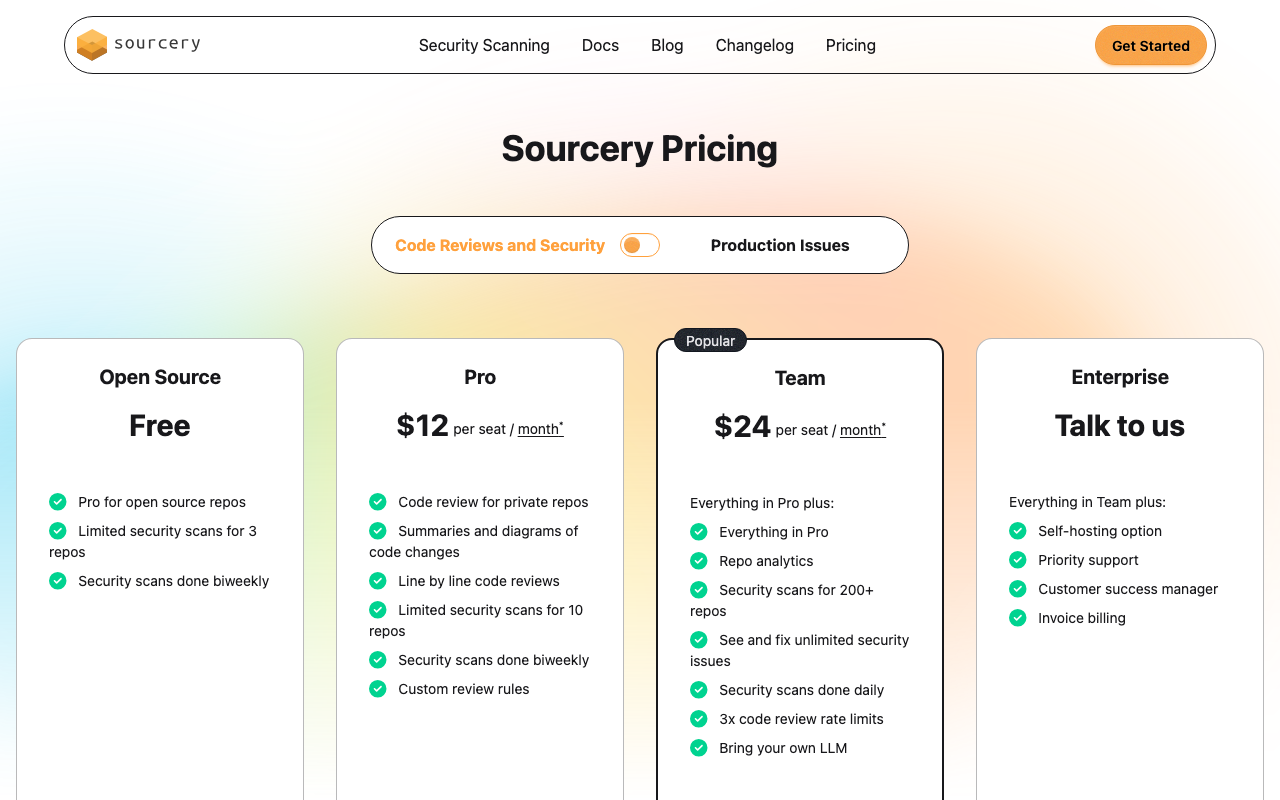
For a 10-person team, the annual cost breaks down to $1,200/year on Pro or $2,880/year on Team with the annual discount. Compare that to CodeRabbit at $2,880/year for its Pro plan, CodeAnt AI at $2,880-4,800/year, or SonarQube’s cloud plans which start even higher for equivalent team sizes.
The key pricing question is whether the Pro plan at $10/user/month gives you enough, or whether you need the Team plan’s security scanning and analytics at $24/user/month. For most Python teams focused purely on code quality, the Pro plan is sufficient. Teams that want to consolidate security scanning into the same tool should evaluate the Team plan against standalone security tools like Snyk or Semgrep.
Real-world usage - how Sourcery actually performs
Refactoring suggestions
Sourcery’s refactoring engine is genuinely impressive on Python code. In real-world usage across several Python repositories, it consistently identifies legitimate opportunities to simplify code. Examples include:
- Spotting a 12-line function with nested if/else blocks and suggesting a 4-line version using early returns and a dictionary lookup
- Identifying a manual file handling pattern and recommending a context manager
- Catching a verbose class with a custom
__init__,__repr__, and__eq__and suggesting a dataclass replacement - Recognizing a loop that builds a filtered list and suggesting a list comprehension with a conditional
These suggestions are not just syntactic transforms - they come with clear explanations of why the alternative is preferable, which makes them educational for junior developers and useful for enforcing team standards.
Where suggestions miss the mark
The noise problem is real. On a typical PR with 200-300 changed lines, Sourcery might leave 8-12 comments. Of those, expect 4-6 to be genuinely useful, 2-3 to be technically correct but not worth the effort to address, and 1-3 to be outright unhelpful. The bikeshedding comments are the most frustrating - suggestions to convert a perfectly readable three-line loop to a one-line comprehension, or to rename a variable that is already clear in context.
The file-by-file analysis limitation also shows up in practice. On PRs that refactor a shared utility module and update its callers across multiple files, Sourcery reviews each file in isolation. It might suggest changes to the utility that would break the callers, or flag “issues” in caller files that are actually correct given the utility changes in the same PR. This is where tools with full PR context like CodeRabbit have a clear advantage.
Speed and reliability
Sourcery reviews typically complete within 2-5 minutes of opening a PR, which is acceptable but not the fastest in the category. On large PRs with 20+ changed files, reviews can take longer. The tool is generally reliable - review failures are rare - but the lack of a retry mechanism means that occasional missed reviews require manually re-triggering via a PR comment.
Who should use Sourcery
Python-focused development teams
This is Sourcery’s sweet spot. If your team writes primarily Python - whether that is Django web applications, FastAPI microservices, data pipelines, or ML training code - Sourcery delivers more Python-specific value than any other AI code review tool. The refactoring suggestions are genuinely best-in-class for Python, and the $10/user/month price point makes it accessible for teams of any size.
Data scientists and ML engineers
Data science teams often write functional but non-idiomatic Python. Sourcery catches common patterns like unnecessary loops over DataFrames, overly complex conditional logic, and verbose boilerplate that could be simplified. It does not understand ML-specific concepts, but it keeps the surrounding Python code clean and maintainable.
Legacy code modernization
Teams inheriting older Python 2-era codebases or code written without modern Python idioms will find Sourcery particularly useful. Its suggestions systematically push code toward modern Python patterns - f-strings, type hints, dataclasses, walrus operators, structural pattern matching - which accelerates modernization without requiring developers to manually identify every opportunity.
Open-source maintainers
The free tier with full AI review capabilities on public repos makes Sourcery one of the best free tools available for open-source projects. The interactive PR commands (@sourcery-ai summary, @sourcery-ai guide) are especially useful for managing contributions from external developers.
Teams that should look elsewhere
If you need Bitbucket or Azure DevOps support, Sourcery is not an option. If cross-file analysis is critical for your codebase (large monorepos with tightly coupled modules), Sourcery’s file-by-file approach will miss important issues. If security scanning is your primary need, dedicated tools like Snyk or Semgrep provide far deeper coverage. And if you want a single platform covering code review, security, and engineering metrics, CodeAnt AI at $24-40/user/month bundles all of that together.
Alternatives to consider
Sourcery operates in a crowded market, and the right alternative depends on what you need most. Here is how the main options compare for Python teams.
Pylint
Pylint is the classic Python linter with 300+ built-in checks. It is completely free, runs locally, and catches a wide range of rule violations deterministically. Pylint does not provide AI-powered review or refactoring suggestions, but it is the most thorough rule-based Python analysis tool available. Most teams should run Pylint (or Ruff) alongside Sourcery, not instead of it.
Ruff
Ruff is the dominant Python linter in 2026 - a Rust-based tool that reimplements the rules from Pylint, Flake8, isort, Black, and a dozen other tools at 10-100x the speed. Ruff is not an AI tool. It is a deterministic linter and formatter that replaces the entire legacy Python linting toolchain. The recommended 2026 Python setup is Ruff for local linting and formatting, plus Sourcery for AI-assisted PR review.
Black
Black is a Python code formatter, not a code reviewer. It handles formatting only - line length, string quotes, trailing commas - with zero configuration. Black and Sourcery solve completely different problems and can (and should) be used together. In 2026, many teams have replaced Black with Ruff’s built-in formatter, which produces identical output.
DeepSource
DeepSource is a code quality platform that combines AI-powered analysis with automated fixes. It supports Python deeply and provides security scanning, quality dashboards, and autofix capabilities. At $24/user/month for the Business plan, DeepSource costs more than Sourcery Pro but offers broader analysis including security. DeepSource claims sub-5% false positive rates, which would make it significantly more accurate than Sourcery if the claim holds in practice.
CodeAnt AI
CodeAnt AI is a Y Combinator-backed platform that bundles AI PR review, SAST, secret detection, infrastructure-as-code security, and DORA metrics in a single tool. Pricing starts at $24/user/month for the Basic plan and $40/user/month for Premium with full security and metrics. CodeAnt AI supports all four major git platforms (GitHub, GitLab, Bitbucket, Azure DevOps), which gives it a platform advantage over Sourcery. For teams that want a single tool covering code quality, security, and engineering metrics, CodeAnt AI is worth evaluating as a more comprehensive - if more expensive - alternative.
Other tools worth comparing
- Codacy - code quality platform with Python support at $15/user/month
- GitHub Copilot - all-in-one coding assistant with PR review at $19-39/user/month
- Flake8 - lightweight Python linter (being replaced by Ruff in most projects)
- mypy - Python type checker (solves a different problem, complementary to Sourcery)
For a comprehensive comparison of Python tools, see our guide on the best code review tools for Python.
Final verdict - is Sourcery worth it?
Sourcery AI earns a qualified recommendation for Python developers in 2026. At $10/user/month, it is the most affordable AI code review tool on the market, and its Python refactoring suggestions are genuinely the best available from any AI review platform. The learning capability that reduces noise over time is a meaningful differentiator, and the free tier for open-source projects is among the most generous in the category.
The qualification comes from its limitations. The roughly 50% actionable comment rate means developers will spend time dismissing unhelpful suggestions, especially during the initial weeks before the learning capability kicks in. The file-by-file analysis means it misses cross-file issues that matter on complex PRs. And the lack of Bitbucket and Azure DevOps support is a hard blocker for a significant portion of teams.
Recommended for: Python teams of any size that want affordable AI code review with the best Python refactoring suggestions available. Open-source maintainers. Data science teams. Legacy Python modernization projects.
Not recommended for: Teams on Bitbucket or Azure DevOps. Teams that need deep cross-file analysis. Teams whose primary concern is security scanning rather than code quality. Teams that want a single all-in-one platform for code review, security, and engineering metrics - for that, evaluate CodeAnt AI at $24-40/user/month.
The practical recommendation: Use Ruff for local linting and formatting, Sourcery Pro ($10/user/month) for AI-assisted PR review, and add a dedicated security scanner if needed. This setup gives you the best Python development experience at a reasonable cost. If you outgrow Sourcery’s capabilities or need broader platform support, CodeRabbit at $24/user/month is the natural upgrade path.
Frequently Asked Questions
Is Sourcery AI free?
Sourcery offers a free tier that covers all open-source (public) repositories with AI code reviews, basic refactoring suggestions, and GitHub integration. For private repositories, you need the Pro plan at $10/user/month. The Team plan at $24/user/month adds security scanning and analytics. There are no hidden usage limits on the free tier for public repos.
Is Sourcery AI worth the money for Python developers?
For Python-heavy teams, Sourcery delivers genuine value at $10/user/month. Its Python refactoring suggestions are the best among AI code review tools, covering idiomatic patterns like list comprehensions, context managers, and dataclasses. Teams working primarily in other languages will get less value since Sourcery's deepest analysis is Python-specific. For general-purpose AI code review, CodeRabbit offers broader coverage at $24/user/month.
How accurate are Sourcery's code review suggestions?
Independent benchmarks show that roughly half of Sourcery's comments are genuinely actionable, with about 25% being valid but nitpicky bikeshedding, and the remaining 25% being noise. This is a middle-tier accuracy rate among AI code review tools. Sourcery's learning capability helps reduce noise over time as it adapts to your team's preferences and dismissal patterns.
Does Sourcery work with languages other than Python?
Yes. Sourcery supports over 30 programming languages including JavaScript, TypeScript, Java, Go, C++, C#, Ruby, PHP, Kotlin, Rust, and Swift. However, Python is where Sourcery's analysis is deepest. For Python, it uses a rules-based static analysis engine that understands idiomatic patterns. For other languages, it relies primarily on its LLM-powered analysis layer, which provides solid but less specialized feedback.
Can Sourcery replace Pylint or Ruff?
No. Sourcery is a PR review tool, not a linter. Pylint and Ruff run locally and in CI pipelines to catch rule violations instantly and deterministically. Sourcery reviews pull requests through GitHub or GitLab with AI-powered contextual feedback. The recommended setup for Python teams is Ruff for fast local linting and formatting, plus Sourcery for AI-assisted PR review. They operate at different levels and complement each other.
Does Sourcery support Bitbucket or Azure DevOps?
No. Sourcery currently supports only GitHub and GitLab, including self-hosted instances of both. If your team uses Bitbucket or Azure DevOps, Sourcery is not an option. Alternatives that support all four major git platforms include CodeRabbit and CodeAnt AI ($24-40/user/month).
How does Sourcery compare to GitHub Copilot for code review?
Sourcery provides deeper, more targeted code review feedback than GitHub Copilot's PR review feature. Sourcery understands Python idioms, enforces custom coding guidelines, and learns from team preferences. Copilot reviews PR diffs without comparing against existing codebase patterns, limiting its ability to enforce project-specific standards. However, Copilot bundles code generation at $19-39/user/month, making it a better all-in-one tool. Sourcery wins when code review quality is the primary goal.
What is Sourcery's learning capability?
Sourcery adapts its review behavior based on team feedback. When developers dismiss specific types of suggestions, Sourcery learns to deprioritize those patterns in future reviews. This means review quality improves over time rather than remaining static. Teams typically report significantly less noise after two to three weeks of active use. This learning capability is a genuine differentiator that most competing tools lack.
Is Sourcery good for data science and ML projects?
Sourcery is a solid fit for data science teams working in Python. It catches common data science anti-patterns like unnecessary loops over DataFrames, overly complex conditional logic in data pipelines, and verbose boilerplate that can be simplified with Python idioms. However, Sourcery does not understand domain-specific ML concepts like model architecture choices or training loop optimization. It reviews code quality, not ML methodology.
How long does it take to set up Sourcery?
Sourcery can be installed and running in under five minutes. Install the GitHub App, authorize it on your repositories, and it begins reviewing pull requests automatically. For custom configuration, add a .sourcery.yaml file to your repository root with your preferred rules and thresholds. IDE setup for VS Code or PyCharm takes an additional two to three minutes. The initial configuration investment is minimal compared to tools like SonarQube or Semgrep.
What are the best alternatives to Sourcery AI?
For AI PR review with broader platform support, CodeRabbit ($24/user/month) is the most popular alternative. For a bundled code quality and security platform, CodeAnt AI ($24-40/user/month) combines PR review, SAST, secret detection, and DORA metrics. For free Python linting, Ruff is the dominant choice in 2026. For enterprise code quality with dashboards, SonarQube and DeepSource ($24/user/month) are strong options.
Does Sourcery catch security vulnerabilities?
The Team plan ($24/user/month) includes security vulnerability scanning for up to 200+ repositories with daily scans and unlimited fix suggestions. The Pro plan does not include dedicated security scanning. For teams with serious security requirements, Sourcery's security features are a useful baseline but not a replacement for dedicated SAST tools like Snyk Code, Semgrep, or Checkmarx.
Explore More
Tool Reviews
 Sourcery Review
 CodeAnt AI Review
Related Articles
- Best AI Code Review Tools for Pull Requests in 2026
- Best Python Code Quality Tools: Sourcery vs Black vs Flake8 vs Ruff
- Sourcery AI Alternatives: 10 Best Code Quality Tools in 2026
- Sourcery GitHub Integration: Automated PR Code Review Setup Guide
- Sourcery AI Pricing: Free vs Pro vs Team Plans in 2026
Free Newsletter
Stay ahead with AI dev tools
Weekly insights on AI code review, static analysis, and developer productivity. No spam, unsubscribe anytime.
Join developers getting weekly AI tool insights.
Related Articles
Checkmarx Pricing in 2026: Plans, Per-Developer Costs, and Enterprise Quotes
Checkmarx pricing decoded - per-developer costs ($40-70+/dev/year), SAST/DAST/SCA bundle pricing, total cost of ownership, and enterprise negotiation tips.
March 13, 2026
reviewCodacy Pricing in 2026: Free, Team, and Business Plans Compared
Codacy pricing in 2026 - free Developer plan, Team at $18/dev/month, Business custom pricing, ROI calculation, and competitor comparisons.
March 13, 2026
reviewCodacy Review 2026: Is It Worth It for Your Team?
In-depth Codacy review covering features, pricing, pros and cons, and real-world performance. Find out if Codacy is worth it for your team.
March 13, 2026